Augmenting WordNet-based Inference with Argument Mapping
Idan Szpektor
Department of Computer Science Bar-Ilan University
Ramat Gan, Israel [email protected]
Ido Dagan
Department of Computer Science Bar-Ilan University
Ramat Gan, Israel [email protected]
Abstract
WordNet is a useful resource for lexi-cal inference in applications. Inference over predicates, however, often requires a change in argument positions, which is not specified in WordNet. We pro-pose a novel framework for augmenting WordNet-based inferences over predicates with corresponding argument mappings. We further present a concrete implementa-tion of this framework, which yields sub-stantial improvement to WordNet-based inference.
1 Introduction
WordNet (Miller, 1995), a manually constructed lexical database, is probably the mostly used re-source for lexical inference in NLP tasks, such as Question Answering (QA), Information Extrac-tion (IE), InformaExtrac-tion Retrieval and Textual En-tailment (RTE) (Moldovan and Mihalcea, 2000; Pasca and Harabagiu, 2001; Bar-Haim et al., 2006; Giampiccolo et al., 2007).
Inference using WordNet typically involves lex-ical substitutions for words in text based on WordNet relations, a process known as lexical chains (Barzilay and Elhadad, 1997; Moldovan and Novischi, 2002). For example, the an-swer to “From which country was Louisiana ac-quired?” can be inferred from “The United States bought up Louisiana from France” using the chains ‘France⇒ European country ⇒ country’ and ‘buy up⇒buy⇒acquire’.
When performing inference between predicates there is an additional complexity on top of lex-ical substitution: the syntactic relationship be-tween the predicate and its arguments may change
as well. For example, ‘X buy Y for Z ⇒ XpayZforY’.
Currently, argument mappings are not specified for WordNet’s relations. Therefore, correct Word-Net inference chains over predicates can be per-formed only for substitution relations (mainly syn-onyms and hypernyms, e.g. ‘buy⇒acquire’), for which argument positions do not change. Other relation types that may be used for inference can-not be utilized when the predicate arguments need to be traced as well. Examples include the Word-Net ‘entailment’ relation (e.g. ‘buy⇒ pay’) and relations between morphologically derived words (e.g. ‘acquire⇔acquisition’).
Our goal is to obtain argument mappings for WordNet relations that are often used for infer-ence. In this paper we address several prominent WordNet relations, including verb-noun deriva-tions and the verb-verb ’entailment’ and ’cause’ relations, referred henceforth as inferential rela-tions. Under the Textual Entailment paradigm, all these relations can be viewed as express-ing entailment. Accordingly, we propose a novel framework, calledArgument-mapped Word-Net (AmWN), that represents argument map-pings for inferential relations as entailment rules. These rules are augmented with subcategorization frames and functional roles, which are proposed as a generally-needed extension for predicative en-tailment rules.
Following our new representation scheme, we present a concrete implementation of AmWN for a large number of WordNet’s relations. The map-pings for these relations are populated by com-bining information from manual and corpus-based resources, which provides broader coverage com-pared to prior work and more accurate mappings. Table 1 shows typical inference chains obtained
Rule Chains
shopping:n ofXobj⇒buying:n ofXobj⇒buy:vXobj⇒pay:v forXmod
vote:v onXmod⇒decide:v onXmod⇒debate:vXobj
Xobj’s sentence:n⇒condemn:vXobj⇒convict:vXobj⇒Xobj’s conviction:n
Xind−obj’s teacher:n⇒teach:v toXind−obj⇒Xsubjlearn:v
Table 1: Examples for inference chains obtained using AmWN. Arguments are subscripted with func-tional roles, e.g. subject (subj) and indirect-object (ind-obj). For brevity, predicate frames are omitted.
using our implementation.
To further improve WordNet-based inference for NLP applications, we address the phenom-ena of rare WordNet senses. Rules generated for such senses might hurt inference accuracy since they are often applied incorrectly to texts when matched against inappropriate, but more frequent senses of the rule words. Since word sense disam-biguation (WSD) solutions are typically not suf-ficiently robust yet, most applications do not cur-rently apply WSD methods. Hence, we propose to optionally filter out such rules using a novel corpus-based validation algorithm.
We tested both WordNet and AmWN on a test set derived from a standard IE benchmark. The results show that AmWN substantially improves WordNet-based inference in terms of both recall and precision1.
2 Argument-Mapping Entailment Rules
In our framework we represent argument map-pings for inferential relations between predicates through an extension of entailment rules over syn-tactic representations. As defined in earlier works, an entailment rule specifies an inference rela-tion between an entailing template and an en-tailed template, where templates are parse sub-trees with argument variables (Szpektor and Da-gan, 2008). For example, ‘X ←−−subj buy −−→obj Y ⇒‘X ←−−subj pay−−−−−−→prep−for Y”.
When a rule is applied to a text, a new conse-quent is inferred by instantiating the entailed tem-plate variables with the argument instantiations of the entailing template in the text. In our example, “IBM paid for Cognos” can be inferred from “IBM bought Cognos”. This way, the syntactic structure of the rule templates specifies the required argu-ment positions for correct arguargu-ment mapping.
However, representing entailment rule structure only by syntactic argument positions is insufficient for predicative rules. Correct argument mapping
1We plan to make our AmWN publicly available.
depends also on the specific syntactic functional rolesof the arguments (subject, object etc.) and on the suitable subcategorization frame (frame) for the predicate mention - a set of functional roles that a predicate may occur with. For example, ‘X’s buyout ⇒ buy X’ is incorrectly applied to “IBM’s buyout of Cognos” if roles are ignored, since ‘IBM’ plays the subject role whileXneeds to be an object.
Seeking to address this issue, we were inspired by the Nomlex database (Macleod et al., 1998) (see Section 3.2.1) and explicitly specify argu-ment mapping for each frame and functional role. As in Nomlex, we avoid the use of semantic roles and stick to the syntactic level, augment-ing the representation of templates with: (a) a syntactic functional role for each argument; (b) the valid predicate frame for this template men-tions. We note that such functional roles typically coincide with dependency relations of the verbal form. A rule example is ‘Xsubj break{intrans}⇒
damage{trans}Xobj’2. More examples are shown in Table 1.
Unlike Nomlex records, our templates can be partial: they may contain only some of the possi-ble predicate arguments, e.g. ‘buy{trans} Xobj’, where the subject, included in the frame, is omit-ted. Partial templates are necessary for matching predicate occurrences that include only some of the possible arguments, as in “Cognos was bought yesterday”. Additionally, some resources, such as automatic rule learning methods (Lin and Pantel, 2001; Sekine, 2005), can provide only partial ar-gument information, and we would want to repre-sent such knowledge as well.
In our framework we follow (Szpektor and Da-gan, 2008) and use only rules betweenunary tem-plates, containing a single argument. Such tem-plates can describe any argument mapping by
composing templates with several arguments into unary ones, while preserving the specification of the subcategorization frame.
To apply a rule, the entailing template must be first matched in the text, which includes match-ing the template’s syntactic dependency structure, functional roles, and frame. Such procedure re-quires texts to be annotated with these types of in-formation. This can be reasonably performed with existing tools and resources, as described for our own text processing in Section 4.
Explicitly matching frames and functional roles in rules avoids incorrect rule applications. For ex-ample, ‘Xobj’s buyout⇒buyXobj’ would be ap-plied only to “Cognos’s buyout by IBM” follow-ing proper role annotation of the text, but not to “IBM’s buyout of Cognos”. As another example, ‘Xsubj break{intrans} ⇒ damage{trans} Xobj’ would be applied only to the intransitive occur-rence of ‘break’, e.g. “The vase broke”, but not to “John broke the vase”.
Ambiguous cases may occur during annotation. For example, the role of ‘John’ in “John’s invita-tion was well intended” could be either subject or object. Such recognized ambiguities should be left unannotated, blocking incorrect rule application.
3 Argument Mapping for WordNet
Following our extension of entailment rules, we present Argument-mapped WordNet (AmWN), a framework for extending WordNet’s inferential re-lations with argument mapping at the syntactic representation level.
3.1 Argument Mapping Representation The AmWN structure follows that of WordNet: a directed graph whose nodes are WordNet synsets and edges are relations between synsets. Since we focus on entailment between predicates, we include only predicative synsets: all verb synsets and noun synsets identified as predicates (see Sec-tion 3.2). In addiSec-tion, only WordNet relaSec-tions that correspond to some type of entailment are consid-ered, as detailed in Section 3.2.
In our framework, different subcategorization frames are treated as having different “meanings”, since different frames may correspond to differ-ent differ-entailmdiffer-ent rules. Each WordNet synset is split into several nodes, one for each of its frames. We take frame descriptions for verbs from WordNet3.
3We also tried using VerbNet (Kipper et al., 2000),
with-Figure 1: A description of ‘buy/purchase X ⇒ pay forX’ as a mapping edge in AmWN.
Since WordNet does not provide frames for noun predicates, these are taken from Nomlex-plus (see Section 3.2).
There are two types of graph edges that rep-resent entailment rules between nodes: mapping edges and substitution edges. Mapping edges specify entailment rules that require argument mapping, where the entailing and entailed tem-plate predicates are replaced by synsets. Thus, an edge represents all rules between entailing and en-tailed synset members, as in Figure 1.
Substitution edges connect pairs of predicates, of the same part-of-speech, which preserve argu-ment positions in inference. This is analogous to how WordNet may be currently used for inference via thesynonym andhypernymrelations. Unlike WordNet, substitution edges in AmWN may con-nect only nodes that have the same subcategoriza-tion frame.
AmWN is utilized by generating rule chains for a given input unary template. First, starting nodes that match the input predicate are selected. Then, rules are generated by traversing either incoming or outgoing graph edges transitively, depending on the entailment direction requested. Specific synset-ids, if known, may also be added to the in-put to constrain the relevant starting nodes for the input predicate. Table 1 shows examples of rule chains from AmWN.
3.2 Argument Mapping Population
After defining the AmWN representation, we next describe our implementation of AmWN. We first populate the AmWN graph with substitution edges for WordNet’s hypernyms and synonyms (as self edges), e.g. ‘buy ⇔ purchase’ and ‘buy ⇒ ac-quire’. The following subsections describe how mapping edges are created based on various man-ual and corpus-based information resources.
3.2.1 Nominalization Relations
:ORTH "employment" :VERB "employ" :VERB-SUBC ((NOM-NP
:SUBJECT ((DET-POSS) (N-N-MOD)
(PP :PVAL ("by"))) :OBJECT ((DET-POSS)
(PP :PVAL ("of")))
Figure 2: Part of the employment Nomlex entry, describing the possible syntactic dependency posi-tions for each role of the transitive frame. It states, for example, that the verbal ‘object’ role can be mapped toemploymenteither as a possessive or as the complement of the preposition ‘of’.
is described in WordNet by thederivationally re-lated relation. To add argument mappings for these relations we utilize Nomlex-plus (Meyers et al., 2004), a database of around 5000 English nominalizations. Nomlex specifies for each ver-bal subcategorization frame of each nominaliza-tion how its argument posinominaliza-tions are mapped to functional roles of related verbs.
For each Nomlex entry, we extract all possible argument mappings between the verbal and nom-inal forms, as well as between different argument realizations of the noun. For example, the map-pings ‘Xobj’s employment⇔ employ Xobj’ and ‘Xobj’s employment⇔ employment ofXobj’ are derived from the entry in Figure 2.
The major challenge in integrating Nomlex and WordNet is to identify for each Nomlex noun which WordNet synsets describe its predicative meanings. For example, one synset of ‘acquisi-tion’ that is derivationally related to ‘acquire’ is not predicative: “an ability that has been acquired by training”. We mark noun synsets as predicative if they are (transitive) hyponyms of theact high-level synset.
Once predicative synsets are identified, we cre-ate, for each synset, a node for each subcate-gorization frame of its noun members, as found in Nomlex-plus. In some nodes not all original synset members are retained, since not all mem-bers share all their frames. Mapping edges are then added between nodes that have the same frame. We add both noun-verb edges and noun self-edges that map different realizations of the same functional role (e.g. ‘Xobj’s employment⇔ employment ofXobj’).
As rich as Nomlex-plus is, it still does not in-clude all nominalizations. For example, the nouns
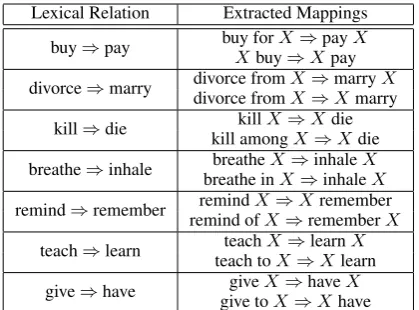
Lexical Relation Extracted Mappings buy⇒pay buy forXbuyX⇒⇒XpaypayX
divorce⇒marry divorce fromdivorce fromXX⇒⇒marryXmarryX kill⇒die kill amongkillX⇒XX⇒dieXdie
breathe⇒inhale breathe inbreatheXX⇒⇒inhaleinhaleXX remind⇒remember remind ofremindXX⇒⇒XrememberrememberX
teach⇒learn teach toteachXX⇒⇒learnXlearnX give⇒have give togiveXX⇒⇒haveXhaveX
Table 2: Some argument mappings for WordNet verb-verb relations discovered by unary-DIRT.
‘divorce’ (related to the verb ‘divorce’) and ‘strik-ing’ are missing. WordNet has a much richer set of nominalizations that we would like to use. To do so, we inherit associated frames and argument realizations for each nominalization synset from its closest hypernym that does appear in Nomlex. Thus, ‘divorce’ inherits its information from ‘sep-aration’ and ‘striking’ inherits from ‘hit’. A by-product of this process is the automatic extension of Nomlex-plus with 5100 new nominalization en-tries, based on the inherited information4.
3.2.2 Verb-Verb Relations
There are two inferential relations between verbs in WordNet that do not preserve argument posi-tions: cause and entailment. Unlike for nomi-nalizations, there is no broad-coverage manual re-source of argument mapping for these relations. Hence, we turn to unsupervised approaches that learn entailment rules from corpus statistics.
Many algorithms were proposed for learning entailment rules between templates from corpora (Lin and Pantel, 2001; Szpektor et al., 2004; Sekine, 2005), but typically with mediocre accu-racy. However, we only search for rules between verbs for which WordNet already indicates the ex-istence of an entailment relation and are thus not affected by rules that wrongly relate non-entailing verbs. We acquired a rule-set containing the top 300 rules for every unary template in the Reuters RCV1 corpus5 by implementing the unary-DIRT
algorithm (Szpektor and Dagan, 2008), which was shown to have relatively high recall compared to other algorithms.
To extract argument mappings, we identify all AmWN node pairs whose synsets are related in WordNet by a cause or an entailment relation. For each pair, we look for unary-DIRT rules be-tween any pair of members in the entailing and entailed synsets. For example, the synset {buy, purchase}entails{pay}, so we look for rules map-ping either ‘buy⇒pay’ or ‘purchase⇒pay’. Ta-ble 2 presents examples for discovered mappings. While unary-DIRT rules are not annotated with functional roles, they can be derived straightfor-wardly from the verbal dependency relations avail-able in the rule’s templates. The obtained rules are then added to AmWN as mapping edges.
We only search for rules that map a functional role in the frame of one verb to any role for the other verb. Focusing on frame elements avoids ex-tracting mapping rules learned for adjuncts, which tend to be of low precision.
3.3 Rule Filtering
In preliminary analysis we found two phenomena,
sense driftingandrare senses, which may reduce the effectiveness of AmWN-based inference even if each graph edge by itself, taken out of context, is correct. To address these phenomena within prac-tical inference we propose the following optional methods for rule filtering.
Sense Drifting WordNet verbs typically have a more fine-grained set of synsets than their re-lated nominalizations. There are cases where sev-eral verb synsets are related to the same nomi-nal synset. Since entailment between a verb and its nominalization is bidirectional, all such verb synsets would end up entailing each other via the nominal node.
Alas, some of these connected verb synsets rep-resent quite different meanings, which results in incorrect inferences. This problem, which we call
sense drifting, is demonstrated in Figure 3. To ad-dress it, we constrain each rule generation chain to include at most one verb-noun edge, which still connects the noun and verb hierarchies.
Rare Senses Some word senses in WordNet are rare. Thus, applying rules that correspond to such senses yields many incorrect inferences, since they are typically matched against other frequent senses of the word. Such a rule is ‘haveX⇒ X is born’, corresponding to a rare sense of ‘have’. WSD is a possible solution for this problem. How-ever, most state-of-the-art IE, QA and RTE
sys-tems do not rely on WSD methods, which are cur-rently not sufficiently robust.
To circumvent the rare sense problem, we in-stead filter out such rules. Each AmWN rule is validated against our unary-DIRT rule-set, which, being corpus-based, contains mostly rules for fre-quent senses. A rule is directly-validated if it is in the corpus-based rule-set, or if it is a nominal-verb rule which describes a reliable morpholog-ical change for a predicate. The AmWN graph-path that generated each rule is automatically ex-amined. A rule is considered valid if there is a sequence of directly-validated intermediate rules along the path whose transitive chaining generates the rule. Invalid rules are filtered out.
To illustrate, suppose the rule ‘a⇒d’ was gen-erated by the chain ‘a⇒ b⇒c⇒ d’. It is valid if there is a rule chain along the path that yields ‘a ⇒d’, e.g.{‘a⇒b’,‘b⇒c’,‘c⇒d’}or{‘a⇒b’, ‘b⇒d’}, whose rules are all directly-validated.
4 Experimental Setup
We follow here the experimental setup presented in (Szpektor and Dagan, 2008), testing the gener-ated rules on the ACE 2005 event dataset6. This
standard IE benchmark includes 33 types of event predicates such asInjure, SueandDivorce7. The
ACE guidelines specify for each event its possi-ble arguments. For example, some of the Injure
event arguments are Agent andVictim. All event mentions, including their instantiated arguments, are annotated in a corpus collected from various sources (newswire articles, blogs, etc.).
To utilize the ACE dataset for evaluating rule applications, each ACE event predicate was rep-resented by a set of unaryseed templates, one for each event argument. Example seed templates for
Injureare ‘Ainjure’ and ‘injureV’. Each event ar-gument is mapped to the corresponding seed tem-plate variable, e.g. ‘Agent’ toAand ‘Victim’ toV in the above example.
We manually annotated each seed template with a subcategorization frame and an argument func-tional role, e.g. ‘injure{trans} Vobj’. We also in-cluded relevant WordNet synset-ids, so only rules fitting the target meaning of the event will be ex-tracted. In this experiment, we focused only on the core semantic arguments. Adjuncts (time and
6http://projects.ldc.upenn.edu/ace/
Synset Members WordNet Gloss (verb) collar, nail, apprehend,arrest, pick up, nab, cop take into custody
m
(noun) apprehension, arrest, catch, collar, pinch, the act of apprehending (especially apprehending
taking into custody a criminal)
m
(verb) get, catch, capture succeed in catching or seizing, especially after a chase m
(noun) capture, seizure the act of taking of a person by force m
(verb) seize take or capture by force
⇑(hypernym)
(verb) kidnap, nobble, abduct, snatch take away to an undisclosed location against their will and usually in order to extract a ransom
Figure 3: A WordNet sense-drifting traversal, generating the incorrect inference ‘kidnap⇒arrest’.
place) were ignored since they typically don’t re-quire argument mapping, the main target for our assessment.
The ACE corpus was dependency-parsed with Minipar (Lin, 1998) and annotated with functional roles and frames for each predicate mention. The functional roles for a verb mention were taken di-rectly from the corresponding dependency tree re-lations. Its frame was chosen to be the largest WordNet frame of that verb that matched the men-tion’s roles.
Nominalization frames and functional roles in the text were annotated using our extended Nomlex-plus database. For each nominal mention, we found the largest Nomlex frame whose syntac-tic argument positions matched those of the men-tion’s arguments. The arguments were then anno-tated with the specified roles of the chosen frame. Ambiguous cases, where the same argument posi-tion could match multiple roles, were left unanno-tated, as discussed in Section 2.
Argument mentions for events were found in the annotated corpus by matching either the seed templates or the templates entailing them in some rules. The matching procedure follows the one de-scribed in Section 2. Templates are matched us-ing a syntactic matcher that handles simple syn-tactic variations such as passive-form and con-junctions. For example, ‘wound{trans} Vobj ⇒ injure{trans} Vobj’ was matched in the text “Hagelobjwaswoundedtransin Vietnam”. A rule application is considered correct if the matched ar-gument is annotated in the corpus with the corre-sponding ACE role.
We note that our system performance on the ACE task as such is limited. First, WordNet does not provide all types of needed rules. Second, the system of our experimental setting is rather basic,
with limited matching capabilities and without a WSD module. However, this test-set is still very useful for relative comparison of WordNet and our proposed AmWN.
5 Results and Analysis
We tested four different rule-set configurations: a) only the seed templates, without any rules; b) rules generated based on WordNet 3.0 without ar-gument mapping, using only synonym and hyper-nym relations; c) WordNet rules from (b), filtered using our corpus-based validation method for rare senses; d) rules generated from our AmWN.
Out of the 8953 non-substitutable inferential re-lations that we identified in WordNet, our AmWN implementation created mapping edges for 75% of 8325 Noun-Verb relations and 70% of 628 Verb-Verb relations. Altogether 41549 mapping edges between synset nodes were added. A manual er-ror analysis of these mappings is provided in Sec-tion 5.2.
Each configuration was evaluated for each ACE event. We measured the percentage of correct ar-gument mentions extracted out of all correct argu-ment argu-mentions annotated for the event (recall) and out of all argument mentions extracted (precision), and F1, their harmonic average. We report macro averages over the 26 event types.
5.1 Results
Configuration R (%) P (%) F1
No Rules 13.5 63.0 20.7
WordNet 17.5 35.3 18.5
WordNet with rule validation 16.5 46.9 20.4
AmWN 20.8 43.9 24.2
Table 3: Recall (R), Precision (P) and F1 results for the different tested configurations.
relative drop in precision (by 56%). The main rea-son for this decline is the application of rules in-volving infrequent word senses, as elaborated in Section 3.3.
When our rule validation approach is applied to standard WordNet expansions, a much higher precision is achieved with only a small decline in recall. This shows that our corpus-based filtering method manages to avoid many of the noisy rules for rare senses, while maintaining those that are frequently involved in inference.
Finally, our main result shows that adding ar-gument mapping improves performance substan-tially. AmWN achieves a much higher recall than WordNet. Recall increases relatively by 26% over validated WordNet, and by 54% over the no-rules baseline. Furthermore, precision drops only slightly, by 6%, compared to validated Word-Net. This shows that argument mapping increases WordNet’s graph connectivity, while our rule-validation method maintains almost the same pre-cision for many more generated rules. The im-provement in overall F1 performance is statisti-cally significant compared to all other configura-tions, according to the two-sided Wilcoxon signed rank test at the level of 0.01 (Wilcoxon, 1945).
5.2 Error Analysis
We manually analyzed the reasons for false pos-itives (incorrect extractions) and false negatives (missed extractions) of AmWN by sampling 300 extractions of each type.
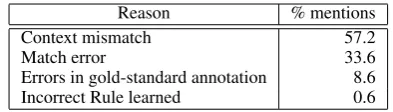
From the false positives analysis (Table 4) we see that practically all generated rules are correct (99.4%), that is, they would be valid in some con-texts. Almost all errors come from matching errors (including parse errors) and context mismatches, due to our limited IE implementation. The only two incorrect rules sampled were due to an in-correct Nomlex entry and a WordNet synset that should have been split into two separate senses. Considering that correct extractions resulted, per our analysis, from correct rules, the analysis of this
Reason % mentions
Context mismatch 57.2
Match error 33.6
Errors in gold-standard annotation 8.6
Incorrect Rule learned 0.6
Table 4: Distribution of reasons for false positives (incorrect argument extractions).
Reason % mentions
Rule not learned 67.7
Match error 18.0
Discourse analysis needed 12.0 Argument is predicative 1.3 Errors in gold-standard annotation 1.0
Table 5: Distribution of reasons for false negatives (missed argument mentions).
sample indicates that virtually all AmWN edges that get utilized in practice are correct.
Context mismatches, which constitute the ma-jority of errors (57.2%), occur when the entail-ing template of a rule is matched in inappropriate contexts. This occurs typically when the match is against another sense of the predicate, or when an argument is not of the requested type (e.g. “The Enron sentence” vs. “A one month sentence”). In future work, we plan to address this problem by utilizing context-sensitive application of rules in the spirit of (Szpektor et al., 2008).
Table 5 presents the false negatives analysis. Most missed extractions are due to rules that were not learned (67.7%). These mainly involve com-plex templates (‘file a lawsuit⇔sue’) and infer-ence rules that are not synonyms/hypernyms (‘ex-ecute⇒ sentence’), which are not widely anno-tated in WordNet. From further analysis, we found that 10% of these misses are due to rules that are generated from AmWN but filtered out by one of our filtering methods (Section 3.3).
12% of the arguments cannot be extracted by rules alone, due to required discourse analysis, while 18% of the mentions were missed due to in-correct syntactic matching. By assuming in-correct matches in these cases and avoiding rule filtering, we can estimate the upper bound recall of the rule-set for the ACE datarule-set to be 40%.
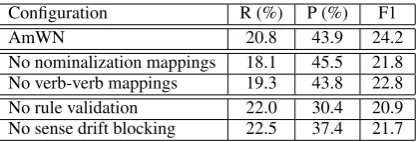
Configuration R (%) P (%) F1
AmWN 20.8 43.9 24.2
No nominalization mappings 18.1 45.5 21.8 No verb-verb mappings 19.3 43.8 22.8 No rule validation 22.0 30.4 20.9 No sense drift blocking 22.5 37.4 21.7
Table 6: The Recall (R), Precision (P) and F1 re-sults for ablation tests.
5.3 Component Analysis
Table 6 presents ablations tests that assess the marginal contribution of each AmWN component. Nominal-verb and verb-verb mappings contribute to the graph connectivity, hence the recall reduc-tion when they are removed.
Complementary to recall components, rule fil-tering improves precision. When removing the corpus-based rule-validation, recall increases rel-atively by 6% but precision drops relrel-atively by 30%, showing the benefit of noisy-rule filtering. Allowing sense drifting hurts precision, a rela-tive drop of 22%. Yet, recall increases relarela-tively by 8%, indicating that some verb synsets, con-nected via a shared nominal, entail each other even though they are not connected directly. For exam-ple, ‘foundX⇔createX’ was generated only via the shared nominal ‘founding’. In future work, we plan to apply AmWN to a coarse-grained set of WordNet synsets (Palmer et al., 2007) as a possi-ble solution to sense drifting.
6 Related Work
Several works attempt to extend WordNet with ad-ditional lexical semantic information (Moldovan and Rus, 2001; Snow et al., 2006; Suchanek et al., 2007; Clark et al., 2008). However, the only pre-vious work we are aware of that enriches Word-Net with argument mappings is (Novischi and Moldovan, 2006). This work utilizes VerbNet’s subcategorization frames to identify possible verb arguments. Argument mapping is provided only between verbs, ignoring relations between verbs and nouns. Arguments are mapped based on the-matic role names shared between frames of dif-ferent verbs. However, the semantic interpretation of thematic roles is generally inconsistent across verbs (Lowe et al., 1997; Kaisser and Webber, 2007). Instead, we discover these mappings from corpus statistics, offering an accurate approach (as analyzed in Section 5.2).
A frame semantics approach for argument
mapping between predicates is proposed by the FrameNet project (Baker et al., 1998). Currently, FrameNet is the only resource for frame-semantic argument mappings. However, it is manually con-structed and currently covers much less predi-cates and relations than WordNet. Furthermore, frame-semantic parsers are less robust than syntac-tic parsers, presently hindering the utilization of this approach in applications (Burchardt and Pen-nacchiotti, 2008).
Nomlex argument mapping patterns similar to ours were derived for IE in (Meyers et al., 1998), but they were not integrated with any additional information, such as WordNet.
7 Conclusions
We presented Argument-mapped WordNet (AmWN), a novel framework for augment-ing WordNet with argument mappaugment-ings at the syntactic representation level. With AmWN, non-substitutable WordNet relations can also be utilized correctly, increasing the coverage of WordNet-based inference. The standard entail-ment rule representation is augentail-mented in our work with functional roles and subcategorization frames, shown to be a feasible extension needed for correct rule application in general.
Our implementation of AmWN populates WordNet with mappings based on combining manual and corpus-based resources. It covers a broader range of relations compared to prior work and yields more accurate mappings. We also in-troduced a novel corpus-based validation mecha-nism, avoiding rules for infrequent senses. Our experiments show that AmWN substantially im-proves standard WordNet-based inference.
In future work we plan to add mappings be-tween verbs and adjectives and bebe-tween different frames of a verb. We also want to incorporate resources for additional subcategorization frames, such as VerbNet. Finally, we plan to enhance our text annotation based on noun-compound disam-biguation (Lapata and Lascarides, 2003).
Acknowledgements
References
Collin F. Baker, Charles J. Fillmore, and John B. Lowe. 1998. The berkeley framenet project. In Proceed-ings of ACL.
Roy Bar-Haim, Ido Dagan, Bill Dolan, Lisa Ferro, Danilo Giampiccolo, Bernardo Magnini, and Idan Szpektor. 2006. The second pascal recognising tex-tual entailment challenge. InSecond PASCAL Chal-lenge Workshop for Recognizing Textual Entailment. Regina Barzilay and Michael Elhadad. 1997. Using lexical chains for text summarization. In Proceed-ings of ACL.
Aljoscha Burchardt and Marco Pennacchiotti. 2008. Fate: a framenet-annotated corpus for textual entail-ment. InProceedings of LREC.
Peter Clark, Christiane Fellbaum, Jerry R. Hobbs, Phil Harrison, William R. Murray, and John Thompson. 2008. Augmenting WordNet for Deep Understand-ing of Text. InProceedings of STEP 2008.
Danilo Giampiccolo, Bernardo Magnini, Ido Dagan, and Bill Dolan. 2007. The third pascal recogniz-ing textual entailment challenge. InProceedings of the ACL-PASCAL Workshop on Textual Entailment and Paraphrasing.
Michael Kaisser and Bonnie Webber. 2007. Question answering based on semantic roles. In ACL 2007 Workshop on Deep Linguistic Processing.
Karin Kipper, Hoa Trang Dang, and Martha Palmer. 2000. Class-based construction of a verb lexicon. InProceedings of AAAI.
Mirella Lapata and Alex Lascarides. 2003. Detect-ing novel compounds: The role of distributional ev-idence. InProceedings of EACL.
Dekang Lin and Patrick Pantel. 2001. Discovery of in-ference rules for question answering. Natural Lan-guage Engineering, 7(4):343–360.
Dekang Lin. 1998. Dependency-based evaluation of minipar. InProceedings of the Workshop on Eval-uation of Parsing Systems at LREC 1998, Granada, Spain.
John B. Lowe, Collin F. Baker, and Charles J. Fillmore. 1997. A frame-semantic approach to semantic an-notation. InProceedings of the SIGLEX Workshop on Tagging Text with Lexical Semantics: Why, What, and How?
Catherine Macleod, Ralph Grishman, Adam Meyers, Leslie Barrett, and Ruth Reeves. 1998. NOMLEX: A Lexicon of Nominalizations. In Proceedings of EURALEX.
Adams Meyers, Catherine Macleod, Roman Yangarber, Ralph Grishman, Leslie Barrett, and Ruth Reeves. 1998. Using nomlex to produce nominalization pat-terns for information extraction. InProceedings of COLING.
Adam Meyers, Ruth Reeves, Catherine Macleod, Rachel Szekeley, Veronkia Zielinska, and Brian Young. 2004. The Cross-Breeding of Dictionaries. InProceedings of LREC.
George A. Miller. 1995. Wordnet: A lexical database for english. InCommunications of the ACM. Dan Moldovan and Rada Mihalcea. 2000. Using
wordnet and lexical operators to improve internet searches. IEEE Internet Computing, 4(1):34–43. Dan Moldovan and Adrian Novischi. 2002. Lexical
chains for question answering. In Proceedings of COLING.
Dan Moldovan and Vasile Rus. 2001. Logic form transformation of wordnet and its applicability to question answering. InProceedings of ACL. Adrian Novischi and Dan Moldovan. 2006. Question
answering with lexical chains propagating verb ar-guments. InProceedings of ACL.
Martha Palmer, Hoa Trang Dang, and Christiane Fellbaum. 2007. Making fine-grained and coarse-grained sense distinctions, both manually and automatically. Natural Language Engineering, 13(2):137–163.
Marius Pasca and Sanda Harabagiu. 2001. The in-formative role of wordnet in open-domain question answering. InProceedings of Workshop on WordNet and Other Lexical Resources: Applications, Exten-sions and Customizations.
Satoshi Sekine. 2005. Automatic paraphrase discovery based on context and keywords between ne pairs. In
Proceedings of IWP.
Rion Snow, Daniel Jurafsky, and Andrew Y. Ng. 2006. Semantic taxonomy induction from heterogenous evidence. InProceedings of ACL.
Fabian M. Suchanek, Gjergji Kasneci, and Gerhard Weikum. 2007. Yago: A core of semantic knowl-edge - unifying wordnet and wikipedia. In Proceed-ings of WWW2007.
Idan Szpektor and Ido Dagan. 2008. Learning entail-ment rules for unary templates. InProceedings of COLING.
Idan Szpektor, Hristo Tanev, Ido Dagan, and Bonaven-ture Coppola. 2004. Scaling web based acquisition of entailment patterns. In Proceedings of EMNLP 2004.
Idan Szpektor, Ido Dagan, Roy Bar-Haim, and Jacob Goldberger. 2008. Contextual preferences. In Pro-ceedings of ACL.