Issues on Quality Assessment of SNOMED CT
®
Subsets –
Term Validation and Term Extraction
Dimitrios Kokkinakis
Department of Swedish Language, Språkdata University of Gothenburg
SE-405 30, Gothenburg, Sweden
Ulla Gerdin Centre for Epidemiology
The National Board of Health and Welfare SE-106 30, Stockholm, Sweden
Abstract
The aim of this paper is to apply and develop methods based on Natural Language Processing for automatically testing the validity, reliability and coverage of various Swedish SNOMED-CT subsets, the Systematized NOmenclature of MEDicine - Clinical Terms a multiaxial, hierarchical classification system which is currently being translated from English to Swedish. Our work has been developed across two dimensions. Initially a Swedish electronic text collection of scientific medical documents has been collected and processed to a uniform format. Secondly, a term processing activity has been taken place. In the first phase of this activity, various SNOMED CT subsets have been mapped to the text collection for evaluating the validity and reliability of the translated terms. In parallel, a large number of term candidates have been extracted from the corpus in order to examine the coverage of SNOMED CT. Term candidates that are currently not included in the Swedish SNOMED CT can be either parts of compounds, parts of potential multiword terms, terms that are not yet been translated or potentially new candidates. In order to achieve these goals a number of automatic term recognition algorithms have been applied to the corpus. The results of the later process is to be reviewed by domain experts (relevant to the subsets extracted) through a relevant interface who can decide whether a new set of terms can be incorporated in the Swedish translation of SNOMED CT or not.
Keywords
Quality Assessment; Term Validation; Automatic Term Recognition; SNOMED CT; Scientific Medical Corpora.
1. Introduction
The purpose of the current paper is to provide an introduction and description of the methodology for the validation and quality assessment of the ongoing Swedish
translation of theSystematized NOmenclature of MEDicine
– Clinical Terms (SNOMED CT). The translation of SNOMED CT is part of the Swedish strategy for e-health and is expected to facilitate both interoperability between health- and social care systems and communication between health- and social care professionals in clear and unambiguous concepts and terms. SNOMED CT is a very large and systematically organized computer processable collection of health and social care terminology. The main aim of our work is to develop and apply Natural Language
Processing (NLP) techniques for automatically mapping structured SNOMED CT concepts to unrestricted texts in order to evaluate the validity and reliability of the translated terms. Also, algorithms for suggesting new candidate terms are currently being explored and may benefit the translation work.
The material used in this work is based on large samples of scientific medical data that cover a broad spectrum of medical subfields. Currently, the medical corpus consists of two main parts. The first part consists of the electronic editions from the latest 14 year publications of the Journal of the Swedish Medical Association,
Läkartidningen, (<http://www.lakartidningen.se/>). The second part of the corpus consists of electronic editions of
a Swedish diabetes journal, DiabetologNytt,
(<http://diabetolognytt.se/>). The corpus is used as a testbed for exploring and measuring the coverage and quality related to the translated concept instances as well as for applying various term extraction techniques, before new services based on SNOMED CT are launched.
By applying an empirical approach to the validation of the Swedish translation of various SNOMED CT subsets, we aim to explore issues related to the:
provision of concrete actions for evaluation
of the quality of the translated recommended terms;
identification of potential problems or
shortcomings related to the choice of
recommended terms;
design of activities to overcome such
potential deficiencies by e.g. suggesting sets
of potential term candidates for future
inclusion in the resource;
follow-up monitoring to ensure
effectiveness of corrective steps;
(possibility to) measuring the quality of
translations and comparing over time; as SNOMED CT and the corpus evolve.
This paper will put emphasis on the first three of these issues. The rest of this document provides a short, general
overview of SNOMED CT (Section 2) and its
characteristics, the textual resources developed for the task (Section 3), as well as methodological issues related to the validation process of subsets of the Swedish translation of SNOMED CT. Moreover, a number of automatic term recognition (or term extraction/mining) techniques have been tested for the purpose of suggesting candidate terms to be included in SNOMED CT after inspection by domain experts.
2. SNOMED CT®
SNOMED CT, theSystematized Nomenclature of Medicine
Clinical Terms, is a common computerized language, a so called “compositional concept system” which means that concepts can be specialized by combinations with other concepts, e.g. by post-coordination which describes the representation of a clinical meaning using a combination of two or more concept identifiers; [1]. This way a single expression consisting of several concepts related by attributes, such asfinding siteandseveritycan be created; e.g. [patient] [currently] has [severe] [fracture] of [left] [shaft of femur]; [2]
During the coming years SNOMED CT will be used by all clinical and information systems in the Swedish healthcare sector in order to facilitate both interoperability between healthcare systems and communications between healthcare professionals in clear and unambiguous terms. Its primary purpose is to be used as the standard reference terminology with Electronic Health Record systems (EHR). According to AHIMA [3], SNOMED CT provides a common language that enables consistency in capturing, storing, retrieving, sharing and aggregating health data across specialties and sites of care.
Table 1. The 19 top-level SNOMED CT-hierarchies.
Body structure
SNOMED CT is a clinically derived terminology, the content of which has been developed by clinical groups, mainly by the College of American Pathologists (CAP, <http://www.cap.org/>). SNOMED CT combines the content and structure of the SNOMED Reference Terminology/RT with the United Kingdom’s National Health Service – NHS
– Clinical Terms version 3. SNOMED CT covers most areas of clinical information and according to the international release of July 2008, it includes more than 315,000 active concepts, where each concept is claimed to have a semantic, logic-based definition stated in description
logic1. SNOMED CT concepts are organized into 19
top-level hierarchies (Table 1), each subdivided into several sub-hierarchies. Moreover, SNOMED CT contains over 806,000 English language descriptions (human-readable phrases or names associated with concepts) and more than 945,000 logically-defining relationships. Each concept may have more than one descriptor, and may appear in more
than one hierarchy e.g.pneumoniais aninfectious disease
and a lung disease. SNOMED CT provides a rich set of
inter-relationships between concepts. Hierarchical
relationships define specific concepts as children of more
general concepts. For instance, kidney disease is defined
as-a-kind-of disorder of the urinary system. In this way,
hierarchical relationships provide links to related
information about the concept. This last example shows that kidney disease has a relationship to the concept that represents the part of the body affected by the disorder (i.e.,
the urinary system).
2.1 IHTSDO and SNOMED CT
In April 2007 the International Health Terminology
Standards Development Organization (IHTSDO,
<http://www.ihtsdo.org>) acquired the intellectual property rights of SNOMED CT and its antecedents from the College of American Pathologists. IHTSDO is a non-profit association under Danish Law and it is established by a group of nine founding nations (Australia, Canada, Denmark, Lithuania, The Netherlands, New Zealand, Sweden, the United States and the United Kingdom). By acquiring the SNOMED CT, the IHTSDO and its member countries, will help to ensure the continued maintenance and evolution of SNOMED CT as well as its availability on an international scale. The IHTSDO assumed responsibility
for the ongoing maintenance, development, quality
assessment, and distribution of SNOMED CT. In Sweden the Swedish National Board of Health and Welfare (Socialstyrelsen, <http://www.socialstyrelsen.se>) runs the projects that in a few years time will provide a Swedish translation and a release centre with methods, routines, support and organization for national maintenance of SNOMED CT.
3. Materials and Methods
3.1 Corpus
This section provides a description of the material developed and used for this work which comprises two
1
major components: a new, large, Swedish electronic scientific medical textual corpus and two subsets of
SNOMED CT, namely one related to diabetes and one to
heart problems.
For the first phase of the validation process of the Swedish translations it was a prerequisite to have the appropriate textual collection to use as a testbed for indexing with SNOMED CT and then make it available to domain experts for further analysis. The archives of the
Journal of the Swedish Medical Associationare one of the most reliable sources for such exploration. Since 1996, volume 93, the archive’s content exists in the form of pdf-files, while the last four years, volumes 103-106, electronic editions are also produced using other, easier to process
formats such as .xml and .html. Table 2 shows some
characteristics of this corpus which currently comprises 26 945 different articles and 25.5 million tokens (roughly 21.8 million words, tokenised excluding punctuation).
Table 2. Characteristics of the Swedish Medical Association Journal corpus.
As a complement to this material we have also integrated yet another subdomain specific corpus from a Swedish
Diabetes Journal, DiabetologNytt. This corpus, which is
much smaller than the previous one, also covers published issues from 1996 up to the beginning of 2009 and consists of 861 different articles and 950,000 tokens (820,000 words).
3.2 Corpus Processing
Although the non-pdf editions of the Swedish Medical Association’s Journal are rather unproblematic for the subsequent NLP processing, the pdf-files pose certain difficulties due to the complexity of the layout of the
journal’s pages and the different pdf-versions that the material is encoded in. However, all material has been transformed to a unified UTF-8 text-format. The extraction was made in an automatic fashion with manual verification, since our aim was to preserve as much as possible of the logical text flow and eliminate the risk for losing valuable information such as each article’s title and publication details of each issue. By identifying and annotating the title of each article we can also benefit from the already MEDLINE-like MeSH-indexed version of the material which can be found at: <http://ltarkiv.lakartidningen.se/>. This way we can take advantage of the manually assigned indexes and ease the creation of various specialized
subcorpora, e.g. diabetes. Sentence identification,
tokenization and lemmatization were also part of this step. In order to reduce the quantity of generated n-grams from the statistical analysis of the corpus (section 5) we have also applied named entity recognition on the corpus in order to filter out named entities as well as numerical and time expressions.
Figure 1: Snapshot of the Swedish Medical Association Journal’s layout.
3.3 SNOMED CT Subsets
Because SNOMED CT is a large terminology it is sometimes necessary to definesubsetsfor various use cases and specific audiences;cf.[5]. Subsets are sets of concepts, descriptions and/or relations that share a specified common characteristic or common type of characteristic and are thus
appropriate to a particular user group, specialty,
organization, dialect (UK vs. American English) and
context (for constraining choices, e.g. diabetes or
mechanism that is of particular interest at the translation
stage, its implementation and actual use;cf.the SNOMED
CT - User Guide, page 6-4. Thus, the creation and
maintenance of appropriate subsets, navigational
hierarchies, and application filtering techniques reduce the problem of "noise" results and eliminates inconsistencies, making the data easier to analyse; [6]
Previous evaluation of the terminology to various subsets has resulted into high figures in terms of coverage.
Elkinet al.[7] found that 92.3% of terms used in medical
problem lists could be exactly represented by SNOMED
CT. Ruch et al. [8] reports a precision of over 80% on
assigning SNOMED concepts to MEDLINE abstracts, while comparable results are also reported by [9] and [10].
4. Term Validation
Even within the same text, a term can take many different forms. Tsujii & Ananiadou [11] discuss that “a term may
be expressed via various mechanisms including
orthographic variation, usage of hyphens and slashes […], lower and upper cases […], spelling variations […], various Latin/Greek transcriptions […] and abbreviations […].” This rich variety for a large number of term-forms is
a stumbling block especially for natural language
processing, as these forms have to be recognized, linked and mapped to terminological and ontological resources; for a review on normalization strategies see [12].
Another related issue is the fact that a number of necessary adaptations of the resource content itself have to take place in order to produce a format suitable for text processing, for instance indexing. Necessary, since it has been claimed by a number of researchers that many term occurrences cannot be identified in text if straightforward dictionary/database lookup is applied (cf.[13]). Therefore a number of conversion and normalization steps have to be applied to the original data. These steps are necessary before the actual implementation of a SNOMED CT-validator due to the nature of the original data. Therefore, a great effort has been put into defining ways to deal with the variety of term realization in the data, both in the textual and lexical (taxonomic) one. Some of the many possible variation types are further described in [14: 161-219]. In
short this variation, which should be in all cases meaning
preserving, includes:
1. morphologicalvariation, such as the use of inflection and derivational patterns, e.g. plural forms.
2. permutations of various types, such as
certain forms of syntactic (structural)
variations which capture the link between a
term, e.g. a compound noun, such as skin
neoplasm, and a noun phrase containing a right-hand prepositional phrase, such as
neoplasm of/in/on the skin. Naturally, both
the compound and the noun phrase should then convey the same meaning, unless these variants are lexicalized. Note that compounds
in Swedish are written as a single
orthographic unit, i.e. hudtumör (‘skin
neoplasm’).
3. compounding, which is the inverse of the above, in which a noun phrase containing a right-hand prepositional phrase is re-written to a single-word compound or in the case of a two word term written as a single compound, e.g. glomerulär filtration (‘glomerular filtration’) andglomerulusfiltration.
4. modifications and substitutions of various types, that is transformations that associate a term with a variant in which the head word or one of its argument has an additional modifier, hyphenation, e.g. b cell vs. b-cell; the substitution of Arabic to Roman numbers, e.g. NYHA type 2 vs. NYHA type II or the deletion of a part of a lengthy multiword term (usually function words, punctuation or other modifiers), e.g. diabetes mellitus type 1 vs.
diabetes type 1.
5. coordination, an unambiguous
transformation that associates two or more terms with a composite variant. Sometimes two or more entities are coordinated by their
heads, e.g. interleukin-1 och -6 actually
interleukin-1 ochinterleukin-6 (‘interleukin-1 and 6’) and sometimes by their arguments, e.g. hjärt- och njursvikt actually hjärtsvikt och njursvikt (‘heart and kidney failure’). Note that in Swedish such coordinations contain an obligatory hyphen at the end of each shortened form.
6. partial matching of a term, by applying
automatic compound segmentation, e.g.
insulinnivå (‘insulin level’); here the
compoundinsulinnivåhas been segmented as
insulin+nivå.
7. acronyms; e.g. ventricular tachycardia (VT).
8. ellipsis and coreference of various types, e.g. “…chromosome 17. This chromosome is…”.
9. lexico-semantic patterns, e.g.oftalmologisk
undersökning vs. ögonundersökning
(‘ophthalmologic examination’).
4.1 Term Validation Results in Subcorpora
CT subsets. The first belonging to the area ofdiabetes(92
terms) and the second to the area ofheart problems(2756
terms). Thus for instance, according to the previous
discussion on term variation, SNOMED CT single word
compound termshave been automatically segmented and a new set ofnoun plus prepositional phrasealternatives have been created and tested against the corpus. In the case of
two word terms we both changed the order of the constituents and also created a compound of the two
constituents. In the case of three word terms with a
preposition between we automatically created single word
compounds. In the case ofpermutationswe tested lengthy terms by re-ordering or even deleting individual “content empty” items, usually punctuation, conjunctions, function words and a few cases adjectival modifiers.
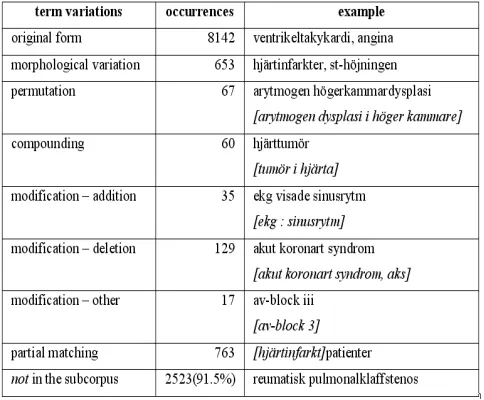
Table 3. Term variation in thediabetessubcorpus.
Table 4. Term variation in theheart problemssubcorpus.
Tables 3 and 4 provide information on the distribution of the variation for the two subsets in two different
subcorpora. The one consisting of articles on diabetes,
including the Swedish Diabetes Journal’s texts, while the other consists of articles in the domain ofheart problems. Acronym matching has been also been performed but due to frequent ambiguities between acronyms we decided not to suggest acronyms as variant forms. For instance, ‘VT’ in
the corpus can stand for: ventricular tachycardia; tidal
volume orofficial in charge ‘vakthavande tjänsteman’. Of course, a possible solution could be to only suggest unambiguous candidates occurring over a certain threshold.
5. Automatic Term Recognition
Automatic term recognition (or term extraction/mining) techniques can be divided into two broad categories, the
unithood-based and the termhood-based ones; [15]. Unithood refers to the attachment strength or stability of syntagmatic combinations or collocations. Some well studied, common measures of this approach are Pointwise Mutual Information (the co-occurrence frequencies of the constituents of complex terms are utilised to measure their dependency), the Log-Likelihood (which attempts to quantify how much more likely one pair of words is to
occur compared to others) and the chi-square (2) test.
Termhood refers to the degree that a linguistic unit actually represent (or is related to) a domain-specific concept. A common measure for termhood is the C-value/NC-value ([15]). For instance, in the eye-pathology domain "soft contact lens" is a valid term which has both high termhood and unithood, while its substring "soft contact" has high unithood and low termhood; example from [16].
Thus, the application of term extraction consists of two fundamental steps in which unithood as an important pre-requisite for termhood [17]; to identify term candidates from text (unithood), and to filter through the candidates, to separate terms from non-terms (termhood).
5.1 Term Recognition Methods
We have tested a number of methods that have been suggested in the literature. The methods we tested included a method for unigrams (the weirdness measure [18]), various methods for bigrams and trigrams [19]) and one method for multiword terms (C-value [15]).
5.1.1 Unigram Term Recognition
Gillam et al. [18] describe a method called weirdness,
In the above formula w stands for a word type, fSL for
word the frequency in a domain corpus,fGL for the word
frequency in a general corpus, NSLis the total number of
words in the domain corpus andNGLis the total number of
words in the general corpus, which in our case was a 45 million token newspaper corpus. Table 5 shows the top-10
results for unigram candidates for the diabetes and heart
subdomain.
Table 5. Top-ranked unigram candidates.
A manual review of the top-100 extracted candidates revealed a couple of major drawbacks with this approach. For the first the number of acronyms (e.g. UKPDS) proposed was high while the percentage of adjectival
modifiers (e.g. diabetisk ‘diabetical’) suggested as
candidates was also very frequent. Naturally, also a long number of the proposed nouns were part of multiword terms, (e.g.mellitus) particularly English.
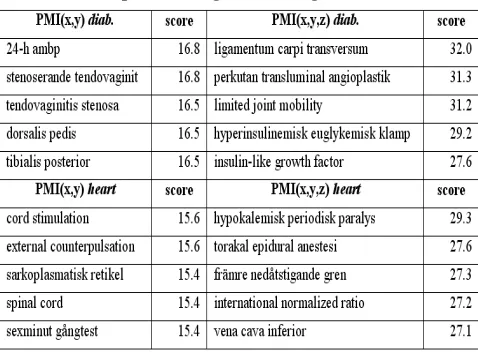
5.1.2 Bigram and Trigram Term Recognition Table 6. Top-ranked bigram and trigram candidates.
We have tested a number of bigram and trigram
recognition measures implemented in the Text-NSP
package [19].
The method that seems to achieve the most reliable results compared to other measures was Pointwise Mutual Information (PMI), which measures the strength of association between two or three words. Intuitively, PMI tells us how informative the occurrence of one word is about the occurrence of another word and co-occurrence frequencies of the constituents of complex terms are utilised to measure their dependency.
Table 6 shows the top-5 results for bigram and trigram
candidates for thediabetesandheartsubdomain.
5.1.3 Multiword Terms
The majority of the studies examined in the literature concerns two-word terms since they are considered the most important and typical in a core terminology [20]. However hybrid approaches such as the C-value/NC-value try to combine linguistics (term candidates and term formation patterns), statistics (ranking based on term length, frequency of occurrence and frequency of nested
terms) and contextual information (re-ranking term
candidates based on co-occurrence with significant context words) in order to suggestmultiword terms.
We have applied the C-value method [15] on our corpus to extract multi-word terms. For the linguistic analysis we used the TnT part of speech tagger [21] trained on general Swedish corpora and enhanced with a few hundred new words which were problematic for the tagger.
For instance, new words ending in -ns were annotated by
default as genitives but in the corpus such words are rather
nominatives, insufficiens (insufficiency) and prevalens
(prevalence). Other words were exclusively found as adjectival modifiers in general corpora rather than nouns in
the medical corpora. Alternative morphosyntactic
descriptions were added for these forms in the lexicon, e.g.
the homographterminal(as noun – predominant in general
In the above,ais the candidate string,f(a)is its frequency
of occurrence in the corpus, Ta is the set of extracted
candidate terms that containaandP(Ta)is the number of
these candidate terms. The C-value is a
domain-independent method used to automatically extract multi-word terms from a corpus. It aims to get more accurate terms than those obtained by the pure frequency of occurrence methods.
Table 7 shows the results of this method for which the
majority of the Swedish candidates extracted were 2-3
tokens long with a very few exceptions for candidates with 4 tokens. The majority of candidates longer than 4 tokens wereEnglishterms, e.g. “intrinsic cardiac nervous system” and “latent autoimmune diabetes in adults”.
Table 7. Top 5-ranked multi-word term candidates (diabetes on the top,heart problemson the bottom of the table).
6. Discussion and Conclusions
In this paper, we investigated two major issues related to the quality assessment of a large terminological medical resource that is currently translated to Swedish. The two
issues were term validation and term recognition. We
started by developing a large scientific medical corpora to be able to apply various methods and algorithms for both purposes. Priority was given to the term validation purpose and thus it was important to develop different methods to cope with term variation. The results showed that simple means can enhance the recognition of term variants that otherwise would have been neglected during the automatic processing.
Particularly helpful have been the partial matching and various forms of structural variation. Table 8 illustrates an example for which the recommended SNOMED-CT
diabetes mellitus typ 2 has 59 (40+19) occurrences while
the dominated variant typ 2-diabetes has 1004 (966+38)
occurrences. Still, subdomain specific corpora showed that only a fraction of the recommended terms in the two subsets actually appear in the subcorpora For the diabetes subcorpora we could only find 65,2% of the terms, while for the heart problems subcorpora the corresponding figure was much lower, namely 8,5%.
Table 8. Variation for the termdiabetes mellitus typ 2; frequencies in parenthesis are based on the entire corpus.
In order to assess the validity of this finding it is imperative to continue testing in much larger scale, starting by using thewholecollected corpus we have at our disposal so far. The ability to tackle different term variation phenomena is a crucial step for enhancing the performance of automatic term recognition and term management systems [22].
With respect to the second leg of our study, that is the evaluation of term recognition approaches and determining the relevance of extracted terms is an issue we let domain experts to decide how valid the candidate terms are and we intend to engage such experts for the task. Gold standards do not exist although term recognition has been a research enterprise with a long tradition. Moreover evaluation of term recognition is a highly subjective problem domain. However, suitable inspection interfaces (Figure 2) can enhance the work of the experts and relevant feedback can provide us with enough data in order to assess the validity and correctness of the various term extraction algorithms.
Figure 2: Term inspection interface.
Swedish basically because the noun noun pattern is not common in a compounding languages as Swedish,
compared to English, in which single word compound is
the norm. Perhaps other methods are more suitable and will be explored in the future, both with respect to multiword terms [23] and further term variation features [24].
7. Acknowledgements
We would like to thank the editors of the Journal of the Swedish Medical Association and DiabetologNytt for making the electronic versions available to this study.
8. References
[1] K. Spackman and J. Gutai. Compositional Grammar for SNOMED CT Expressions in HL7 Version 3. 2008.
[2] B. Luff and M. Bainbridge. Common User Interface Clinical Applications and Patient Safety. SNOMED CT and Interoperable Healthcare. Birmingham, UK. 2008.
[3] AHIMA. American Health Information Management Association). Statement on Implementation of SNOMED-CT. 2007. Accessed 2009-01-18, from: <http://www.ahima.org/dc/ positions/documents/MicrosoftWord-StatementonImplementationofSNOMEDRevand Appro12-1-2007.pdf>
[4] S. Schulz, B. Suntisrivaraporn and F. Baader. SNOMED CT's Problem List: Ontologists' and Logicians' Therapy Suggestions. Medinfo 2007, Studies in Health Technology & Informatics. IOS Press. 2007.
[5] J. Patrick et al. Developing SNOMED CT Subsets from Clinical Notes for Intensive Care Service. Health Care & Informatics Review Online. Open Access. 2008.
[6] D. Walker. GP Vocabulary Project – stage-2; SNOMED CT®; Report-2. 2004. Accessed 2009-01-20, from
<http://www.adelaide.edu.au/health/gp/rsearch/ current/vocab/2_02_2.pdf>
[7] P.L. Elkin et al. Evaluation of the Content Coverage of SNOMED CT: Ability of SNOMED Clinical Terms to Represent Clinical Problem Lists. Mayo Clin Proc. 81(6):741-748. 2006.
[8] P. Ruch, J. Gobeill, C. Lovis and A. Geissbühler. Automatic medical encoding with SNOMED categories. BMC Medical Informatics and Decision Making 2008, 8 (Suppl 1). 2008. [9] Y.A. Lussier, L. Shagina and C. Friedman C. Automating
SNOMED coding using medical language understanding: a feasibility study. Proc AMIA Symp. 2001; 418–422. 2001. [10] C. Friedman, L. Shagina, Y. Lussier and G. Hripcsak.
Automated encoding of clinical documents based on natural language processing. J Am Med Inform Assoc 2004, 11(5):392-402. 2004.
[11] J. Tsujii and S. Ananiadou. Thesaurus or Logical Ontology, Which One Do We Need for Text Mining? J. of Language Resources and Evaluation. Pp 77-90. Vol. 39:1. 2005. [12] M. Krauthammer and G. Nenadic. Term identification in the
biomedical literature. J Biomed Inform. 37(6):512-26. 2004. [13] L. Hirschman, A.A. Morgan and A.S. Yeh. Rutabaga By
Any Other Name: Extracting Biological Names. Journal of Biomed. Informatics. Vol. 35. Pp. 247-259. Elsevier. 2003.
[14]C. Jacquemin. Spotting and Discovering Terms through
Natural Language Processing. MIT Press. 2001.
[15]K. Frantzi, S. Ananiadou and H. Mima. Automatic recognition of multi-word terms: the C-value/NC-value method. J. on Digital Libraries, Vol. 3:2. Pp. 115-130. 2000. [16] I. Korkontzelos, Klapaftis I. and S. Manandhar. Reviewing
& Evaluating Automatic Term Recognition Techniques. 6th International Conference on Natural Language Processing, GoTAL 2008, Gothenburg, Sweden. 248-259. 2008
[17] W. Wong, and M. Bennamoun. Determining the Unithood of Word Sequences using MI and Independence Measure. 10th PACLING. Australia. 2007.
[18] L. Gillam, M. Tariq and K. Ahmad. Terminology and the construction of ontology. Terminology, 11:55–81. 2005. [19] S. Banerjee and T. Pedersen. The Design, Implementation
and Use of the Ngram Statistics Package. Fourth International Conference on Intelligent Text Processing and Computational Linguistics. Mexico, 2003.
[20] M.T. Pazienza, M. Pennacchiotti and F.M. Zanzotto. Terminology extraction: an analysis of linguistic and statistical approaches. In Knowledge Mining, Studies in Fuzziness & Soft Computing, Vol.185, Springer. 2005. [21] T. Brants. TnT - A Statistical Part-of-Speech Tagger. Sixth
Applied Natural Language Processing Conference – ANLP. Seattle, WA. 2000.
[22] G. Nenadié, S. Ananiadou and J. Mcnaught. Enhancing automatic term recognition through recognition of variation. 20th Conf. on Computational Linguistics. Switzerland. 2004. [23] F. Sclano and P. Velardi. TermExtractor: a Web Application to Learn the Common Terminology of Interest Groups and Research Communities. Ninth Conf. on Terminology & AI. Sophia Antinopolis. 2007.