GENERAL EQUATION FOR BINDING ENERGY
Aman M. Chogle
1
Department of Chemical Engineering, University of Mumbai, (India)
ABSTRACT
The purpose of this technical paper is to put forth a general equation for binding energy; an equation which is applicable to every object in the universe which performs simultaneous rotating and revolving motion. We apply the equation to the massive moon, satellites and even the tiniest of particles like electrons and will discuss ionization energy which is basically binding energy for electrons and calculate the values for some common elements. The paper is focused towards deriving the equation of binding energy applicable to objects performing an elliptical motion, such as comets/meteors/asteroids. The paper also mentions the significance of binding energy with a reference to the Chelyabinsk meteor. By deriving a general equation we understand how different objects placed in different parts of the universe, be it as huge as planets or as tiny as electrons, all (rotating and revolving) objects behave in a similar manner and are bound by binding energy which can be obtained by a single formula; hence, shedding light on the laws of physics and the grand design of the universe.
Keywords
: Binding Energy, Elliptical Motion, General Equation, Halley’s Comet, Chelyabinsk
Meteor, Ionization Energy.
I INTRODUCTION
Binding energy in simple terms is the energy required to keep and maintain an object within the orbit of an
entity to which it is bound. In other words, it can also be considered as the amount of energy required to
permanently remove the orbiting object from the influence of attraction. There are various forms of attraction
such as Gravitational forces or Coulombic forces of attraction in case of charged objects.
The general equation for binding energy is proposed so as to facilitate the calculation of binding energy. The
usefulness and practicality of the equation is demonstrated by applying it to some well-known entities such as
the International Space Station, Moon, and Halley’s Comet etc. most of which are objects that revolve in an
elliptical orbit. In short, we discuss an easy to remember equation which has innumerable applications and may
prove to be highly useful to students, engineers and other academicians.
II PRE-REQUISITES
Where,
III DERIVATION OF FORMULA
Before deriving the formula we need to understand the different kinds of orbital motion:
3.1
Types of orbital motion
There are broadly 3 different kinds of orbital motion:
3.1.1 Uniform Closed Orbit
These kinds of orbits are closed. They may not necessarily be circular. They may also be elliptical in nature.
These curves occur when the centripetal acceleration is equal to the linear acceleration.
Fig.1. Uniform Closed Orbit.
3.1.2 Helically Inward Orbit
These kinds of orbits are not closed. The orbiting body tends to move inward. That is, the body gradually gets
closer and closer to the centre of attraction. This results in a helically inward curve. These curves occur when
Fig.2. Helically Inward Orbit
3.1.3 Helically Outward Orbit
These kinds of orbits are also open. The orbiting body tends to move outward. That is, the body gradually gets
farther away from the center of attraction. This results in a helically outward curve. These curves occur when
the linear acceleration is greater than the centripetal acceleration.
Fig.3. Helically outward orbit
3.2
Assumption
In order to obtain the formula, we make the following assumption:
For a stable and continuous revolution, the centripetal acceleration must be equal to the linear acceleration.
This is the general formula for Binding Energy.
Application
3.3
The Moon
The Moon is our natural satellite and it continuously revolves around the Earth in a nearly circular orbit.
Fig.4. Moon’s orbit around the Earth
N·m
Where,
[1]
[2]
Thus, the Moon requires 𝟑.𝟖𝟏𝟎𝟗𝟕𝟑 × 𝟏𝟎^ 𝟐𝟖 N·mof energy to remain in orbit.
Apart from the Moon, the Earth has various other artificial satellites. These satellites revolve around the Earth in
a nearly circular orbit and are used for several purposes like Atmospheric study, Communications, Navigation,
Weather forecasting etc.
Fig.5. Satellite orbiting the earth
N·m
d = Distance of geostationary orbit above Earth's surface =35,786 km
Using this value we can know the amount of energy a satellite requires to remain in orbit. Hence, we can
calculate the energy which will be required to permanently remove a satellite from its orbit.
3.4.1 Binding Energy of International Space Station (ISS)
N·m
Where,
d=Distance between Earth and ISS ≈370 km
M
iss= Mass of the ISS ≈ 419,573 kg [3]
3.5 Ionization Energy
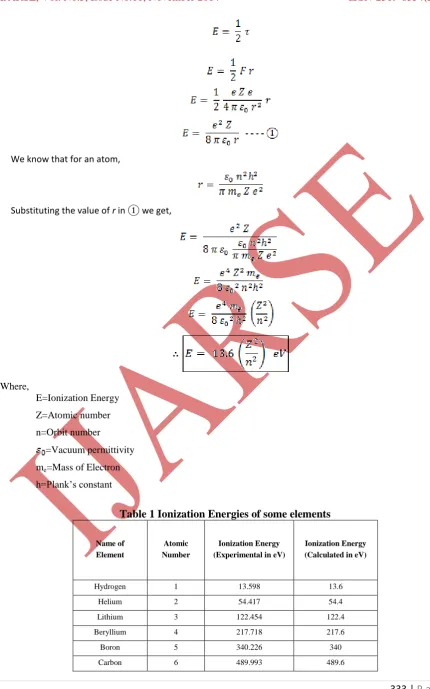
Ionization energy is the amount of energy required to remove an electron from an atom or a molecule which is
in gaseous state. If we analyze, ionization energy is also basically binding energy and so obeys the same laws
We know that for an atom,
Substituting the value of r in ① we get,
Where,
E=Ionization Energy
Z=Atomic number
n=Orbit number
=Vacuum permittivity
me=Mass of Electron
h=Plank’s constant
Table 1 Ionization Energies of some elements
Name of Element
Atomic Number
Ionization Energy (Experimental in eV)
Ionization Energy (Calculated in eV)
Hydrogen 1 13.598 13.6
Helium 2 54.417 54.4
Lithium 3 122.454 122.4
Beryllium 4 217.718 217.6
Boron 5 340.226 340
Nitrogen 7 667.046 666.4
Oxygen 8 871.409 870.4
Fluorine 9 1103.117 1101.6
Neon 10 1362.199 1360
Thus, we observe that the values of Ionization energy can be accurately calculated using this formula.
Note: The slight variation in the calculated and experimental values is due to effects like electronic repulsion
and shielding effect.
IV ELLIPTICAL PATH OBJECTS
4.1 Derivation of Equation for Distance between focus and point on curve
We must understand that all bodies do not perform circular motion. Sometimes a body may perform elliptical
motion also. This kind of motion is seen in cases of revolution around the Sun. Planets as well as asteroids,
comets etc. have an elliptical orbit around the Sun. This hence gives us the need to study binding energy in case
of elliptical motion.
Fig.6. An ellipse with its parameters and Sun at focus
We know,
Substituting the values in ①, we get,
For an ellipse,
4.2 Equation for elliptical path objects
Now that we know the equation for distance in case of an elliptical orbit, we can obtain the formula for Binding
Energy for elliptically revolving objects.
V BINDING ENERGY FOR EARTH
The Earth revolves around the Sun in an elliptical orbit. This is done in such a way that the Sun is at one of its two foci.
Fig.7. Elliptical motion around the Sun
5.1 Binding Energy when Earth is closest to Sun
At this instant the value of θ=0°. On substituting the value of θ in ①, we get,
5.2 Binding Energy when Earth is farthest from Sun
At this instant the value of θ =180°. On substituting the value of θ in ①, we get,
Similarly, the binding energy of Earth can be easily calculated at any particular instant of its orbital position.
VI BINDING ENERGY FOR COMETS/ASTEROIDS
Similar to planets, most comets revolve around the sun in elliptical orbits. Hence, they also obey the above
derived equation
6.1 Halley’s Comet
Halley’s Comet is one of the most commonly known comets that orbit the Sun. It is visible from the Earth with the naked eye and appears once every 76 years. It appeared most recently in 1986.
Where,
[4]
Fig.8. Orbit of Halley’s Comet around the Sun
VII CONCLUSION
Now that we have understood how to calculate Binding Energy and discussed some of its applications, we need
to understand how significant the knowledge of Binding Energy is. There have been numerous occasions of air
bursts and impact events. Many of them had devastating effects. Some notable ones include the Chelyabinsk
meteor and the Tunguska event [5]. Even though these events were disastrous, human kind should still consider
itself lucky, as any impact by an extraterrestrial body can potentially be extremely catastrophic. NASA has
suggested certain courses of action which can be implemented to prevent such incidents [6]. The important thing
to be noted is, irrespective of the method we adopt – Pulsed Laser, Mass Driver, Gravity Tractor or Asteroid
Tug; it will always be beneficial if we know the binding energy of the Potentially Hazardous Object (PHO).
For instance, if we choose to use nuclear explosives, knowing the binding energy of the PHO would give us a
much better idea about the required intensity of the blast. If the PHO is detected early, shifting it even by 5-10
degrees from its trajectory would be enough. In such cases, if the blast provides energy equivalent to 20-30% of
the binding energy or even lesser, the PHO could be deviated from its path; successfully preventing a collision
with the Earth. Hence, the knowledge of binding energy is crucial.
The Earth has been hit various times by meteors which have the potential of causing enormous loss to both lives
and property. It is therefore essential for us to scheme different methods through which we can prevent the Earth
from disastrous effects. The equation has been put forth with the intention to help solve this problem.
VIII ACKNOWLEDGEMENTS
I would like to sincerely thank Shaheen H. Kazi for providing me with all the support and motivation required to
put forth this paper. I would also like to genuinely thank Prof. V.B.Pawar for his creative suggestions for the
improvement of this paper.
REFERENCES
[1] http://nssdc.gsfc.nasa.gov/planetary/factsheet/earthfact.html NASA Goddard Space Flight Center
[2] http://nssdc.gsfc.nasa.gov/planetary/factsheet/moonfact.html NASA Goddard Space Flight Center
."JPL Small-Body Database Browser: 1P/Halley". Jet Propulsion Laboratory. 11 January 1994 last obs.
[4] Trayner, Chris. "The Tunguska event." Journal of the British Astronomical Association 107 (1997):
117-130.
[5] Near-earth Object Survey and Deflection Analysis of Alternatives: Report to Congress. [Washington,
D.C.]: National Aeronautics and Space Administration, 2007n, Science & Training, 2000, Annual Report