Spy Based Analysis of Selfish Mining
Attack on Multi-Stage Blockchain
Donghoon Chang , Munawar Hasan , and Pranav Jain
Dept. of Computer Science and Engineering, Indraprastha
Institute of Information Technology Delhi, India
{
donghoon, munawar1440, pranav16255
}
@iiitd.ac.in
Abstract
In this paper, we present selfish mining attack on the multi-stage blockchain proposed by Palash Sarkar. We provide detailed analysis of computational wastage of honest miners and biased rewards achieved by the selfish pool. In our analysis, we introduce a spy inside an honest pool which is a trivial task. Our spy is responsible for leaking the informa-tion of the stage mining from the honest pool to the selfish pool. In our analysis, we consider all the possible configurations of mining namely se-quential, parallel and pipelining. In all of these configurations, we show through our mathematical equations as to how a selfish miner can succeed in wasting the computation power of the honest miner and how he can in-fluence the reward of mining. For completeness, we provide an algorithm for performing a selfish mining attack on all the scenarios on multi-stage blockchain.
To thwart selfish mining on multi-stage blockchain we redesign the original verification algorithm by introducing a new parameter called the crypto-stamp. We present a new algorithm that uses crypto-stamp during the verification process of the mined stages or blocks and is able to detect with high probability whether the stages or blocks were kept private or not.
1
Introduction
Bitcoin [1] is a cryptocurrency which has gained a lot of popularity over the last few years. The driving force behind the bitcoin is the blockchain which provides immutability over the stored data. Bitcoin network is based on trustless, per-missionless anddecentralized environment. Mining is the process of approving any transaction in the bitcoin network. Miners are required to solve a crypto puzzle which is considered computationally hard to solve. Further, if the major-ity of the miners are honest, it is practically impossible for the dishonest miners
to solve the crypto puzzle before the honest miners can mine; often referred to as 51% rule. Such mining approaches are commonly called proof of work. The miners gets reward upon successfully solving the crypto puzzle. To solve a crypto puzzle, it requires a lot of computational power and hence is not feasible for any individual to mine in solitary, instead joining a mining pool is useful to increase the chances of the reward.
Eyal et. al[2] showed that majority rule is not enough to reward only honest miners. He showed that collusion is possible in Bitcoin’s decentralized network leading to loss of reward and wastage of computational power for honest min-ers. The idea is to keep mined block in the private pool rather than releasing it to the public network. This way the honest miners will continue to mine for the block that are public while the miners on the private pool will keep min-ing on their private block as the head. When this private chain is strategically released to public network, it will lead to forks in the public chain and power wastage for the honest miner. Further, depending on the strategy of the release of the private chain, its miners can also have unfair advantage in rewards. This phenomenon is referred asselfish mining. There by different researchers have shown results related to selfish mining in several scenarios and several platforms [4, 5, 6, 7].
RecentlyPalash Sarkar in [3] presented a completely new blockchain archi-tecture by splitting a single blockchain into several stages. This provided several degree of parallelism inside a single block of the blockchain. Palash Sarkar also claim that this strategy also removes the possibility of the selfish mining. In this paper, we will show thatselfish mining is still possible using a malicious user called spy.
Mining pools use a system that is based on shares which are blocks with proof of works for a different difficulty than the network difficulty. Mining pools will set the difficulty for a given miner to be something that is reasonable for it to achieve. So when that miner mines, it is looking for a block hash that meets the pool difficulty. Once it does, it submits the block. That submitted block, although likely not valid to the Bitcoin network, meets the pool difficulty and is known as a share.
So mining pools will count the shares and give weight to each share based upon the difficulty that it was mined at. In this way, the mining pool can determine how much work each miner has done on average and pay them accordingly once a block is actually found.
Blocks are found when a share meets both the pool difficulty and network dif-ficulty.
pool. We then introduce a new parameter called thecrypto-stamp, using which we design the multi-stage blockchain in a way that will preventselfish mining.
2
Preliminaries
In this section, we provide the notions and definitions needed to describe and analyze the multi-stage blockchain in light of spy.
The honest miners are the miners that work in a fixed pattern and follow the blockchain’s protocol. The selfish miners work in a way which leads to wastage of computational power of honest miners. Let the pool of honest miners be called as the honest pool, and the pool of selfish miners be called as the self-ish pool. A spy is a malicious user inside the honest pool which is responsible for leaking information of stage mining to the selfish pool. In this paper, we consider only one honest and one selfish pool to be working in the blockchain network.
We say that a block/stage is known to the network if the proof of work of the block/stage is known and can be verified by anyone in the network. A block/stage is said to be mined if its proof of work is verified and valid. A block/stage is said to be kept private if it is mined but not known to the network. Revealing a stage/block means making known a previously private stage/block. We will explain the meaning of blocks, stage and proof of work in detail in section 3.
3
Multi-Stage Blockchain
A blockchain is a distributed ledger which stores immutable records [1] in form of blocks. Each block consists of data over which immutability is required. Palash Sarkar introduced a new design rationale for blockchain called the multi-stage blockchain [3] where he introduced the concept of stages inside the block such that a block is divided intokstages wherek≥1. Ifk= 1, there is no distinc-tion between a stage and a block. Bitcoin [1], a decentralized crypto-currency is based on a blockchain with k = 1. From here on we will concentrate on multi-stage blockchain. Moreover single-stage blockchain is a special case of multi-stage blockchain and would inherit the idea provided in this paper.
3.1
Architecture
In this section, we describe the overall architecture of the multi-stage blockchain. We will be using similar notation as described in [3].
3.1.1 Blockchain
Denoting the ith block of the multi-stage blockchain by B
i, the multi-stage blockchain is of the form:
B0←B1←...←Bk−1←Bk←Bk+1←...
where Bi ← Bi+1 means that Bi+1 is dependent on Bi and Bi+1 cannot be
mined ifBiis not already mined.
BlocksB0, B1,...,Bk−1 are the genesis blocks while the blocksBk, Bk+1,... are
general blocks. The blockchain starts growing only after the genesis blocks are present.
3.1.2 Block
We will denoteBn as the nth block of the blockchain. Thus Bn is a general block ifn≥kand a genesis block ifn < k.
In the subsequent subsections, we will explain the general and genesis blocks in detail.
3.1.2.1 General Block
A general blockBn(n≥k) consists of the following information:
Bn
tn,k−1,ηn,k−1, τn,k−1,an,k−1,cn,k−1
. . .
tn,1, ηn,1,τn,1,an,1,cn,1 tn,0, ηn,0,τn,0,an,0,cn,0
Ln
bdigestn n
where,
• nis the block number.
• bdigestn is thenthblock’s digest.
• Ln is the list of transactions in thenth block.
– tn,j is the target for stage j.
– ηn,j is the nonce corresponding to the proof-of-work for stage j. – τn,j is the timestamp for the completion (when the block is revealed
to the network) of stage j.
– an,j is the address to which the reward for completing stage j is to be assigned.
– cn,j is the reward given toan,j for completing stage j.
Thejth stage of a general blockB
n is defined as the tuple (tn,j,ηn,j,τn,j,an,j,cn,j).
Letsn
j be thejth stage (0≤j < k) of nth block Bn (n≥k). Then, a general blockBn can be interpreted as a block consisting ofsn0, sn1, ..., snk−1.
3.1.2.2 Genesis Block
For the blockchain network to start, the initialkblocks need to be defined. A genesis blockBn(n < k) consists of the following information:
Bn
tn,ηn,τn,an,cn
bdigestn n
The block digests are defined as follows
bdigest0=H0(0, t0, a0, c0, τ0, η0)
bdigesti=Hi(bdigestn−1, n, tn, an, cn, τn, ηn)
∀ 0< n < k
The verification condition is
bdigestn< tn
3.1.3 Proof of Work
Let{H0, H1, ..., Hk−1} denote a set of predefined hash functions for each of
thek stages.
LetRH(Ln) be a root hash tree of the list of transactions.
The proof of work of various stages are defined as follows,
gn,0=H0(bdigestn−k, n, RH(Ln), tn,0, an,0, cn,0, τn,0, ηn,0
gn,j=Hj(bdigestn−k+j, gn,j−1, tn,j, an,j, cn,j, τn,j, ηn,j
∀ 0< j < k
Verification conditions for the proof of work of the different stages of general blockBn(n≥k) are:
gn,j< tn,j
∀ 0≤j≤k−1
4
Block Mining in Multi-Stage Blockchain
We assume that the first k blocks (genesis blocks) B0,B1,...,Bk−1 have been
mined and added to the network. The general blocksBn(n≥k) are mined and added after thek genesis blocks.
Every block has k stages. In order to mine a block, the miners need to com-plete proof of work of all thekstages. As everyjth stage depends on (j−1)th stage (0< j < k), the block is mined as soon as proof of work of last stage is completed.
A stagesis said to be dependent on another stage/block if the proof of work ofs cannot be completed without knowing the hash output/digest of the stage/block on whichs is dependent.
Letsn
j be the jth stage (0< j < k) ofnth block Bn (n≥k). Then, according to the structure of the general blocks,sn
j (0< j < k) depends on:
• j−1thstage of blockBn (snj−1)
• n−kth blockBn−k whilesn
0 (first stage ofnthblock) depends only on:
• n−kth blockB n−k
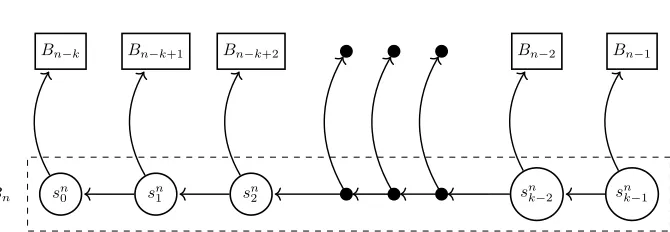
Bn−k Bn−k+1 Bn−k+2 4 5 6 Bn−2 Bn−1
sn
0 sn1 sn2 4 5 6 snk−2 snk−1
Bn
Figure 1: The figure shows the dependency of every stage of blockBn.
M ←N depicts that N is dependent on M.
4.1
Ways of Mining
Multi-stage blockchain supports multi-block mining which means that a miner can start working on the stages of a block even if the previous block is not com-pletely mined (proof of work of all stages of previous block are not completed) as the first stage of a blockBn depends on the digest of the block Bn−k and not the previous block.
The following are the different ways of mining that the honest pool can fol-low.
4.1.1 Honest Pool Withholding Stages
An honest minerM can try to mine on the stages privately and reveal the block only when it has mined all the stages.
As mentioned in [3], if an honest miner keeps the mined stages privately, it runs the risk that the other miners can together mine the block earlier. Then, the entire work done by M in obtaining proofs of works of various stages will be wasted and will result in no return.
Therefore, no miner would try to mine the stages privately. It will immediately reveal the stage of which it has completed the proof of work.
4.1.2 Sequential Mining
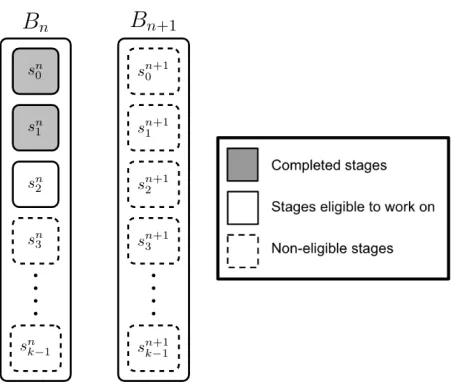
In this way of mining, all the miners of the honest pool work on a single stage of a single block at a time and do not move to the next block without completing the previous block. Suppose that the miners start working on blockBn. Then, all the miners will mine on a single stage and move to the next stage only when the previous stage is mined. The miners will move to blockBn+1 once the last
stage of blockBn is mined. Therefore, the honest pool needs to complete proof of work of all stages of the blockBn in order to move to the next blockBn+1.
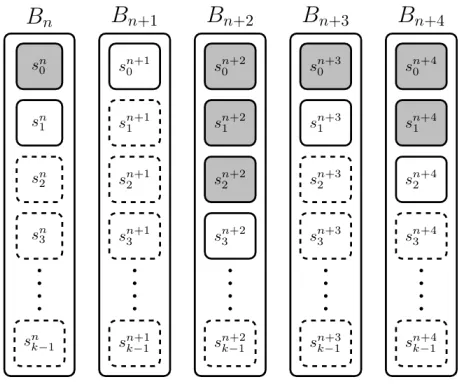
Figure 2: An example to show the eligible stages for the miners to work on in case of sequential mining.
As every block haskstages, the average time required to mine a block is equal to kTseq, where Tseq is the average time to mine a stage in case of sequential mining.
4.1.3 Parallel Mining
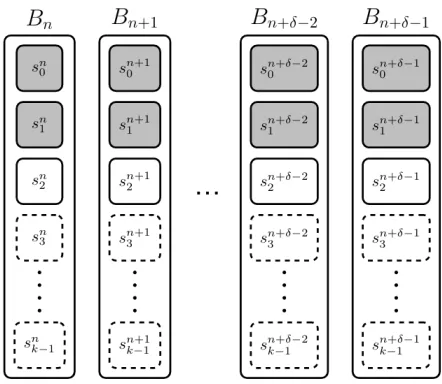
In parallel mining, the honest pool divides itself into groups to work on different blocks simultaneously. Every different group starts working on a different block and follows sequential mining in their own respective block.
Figure 3: The figure shows the blocks on which miners mine simultaneously by dividing them into groups.
Suppose that the honest pool divides themselves intoδ groups. Then, in time
kTpar, δblocks are mined whereTpar is the average time taken by each group of honest pool to mine a stage.
4.1.4 Pipelined Mining
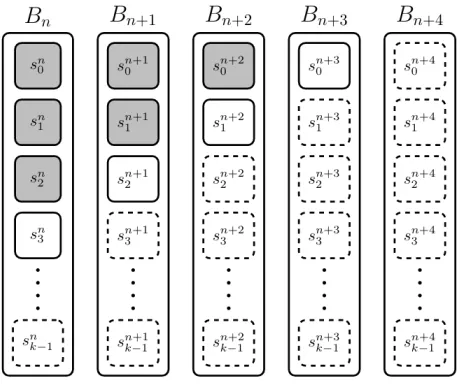
In case of pipelined mining, the miners work on multiple stages simultaneously. Suppose that the miners complete the proof of work of jth stage of general blockBn (0≤j ≤k−2). Then, the miners divides themselves to mine on the following:
• (j+ 1)th stage of blockB n
• jthstage of blockB n+1
That is, some miners start working on the next stage (sn
j+1) of the same block
(Bn) while some miners start working on the same stage (snj+1) of the next block (Bn+1).
Figure 4: An example to show the eligible stages for the miners to work on in case of pipelined mining.
Suppose proof of work of each stage in pipelined mining requires aboutTpipe seconds to be completed. Therefore, the time required to completely mine the first general block (Bk) is kTpipe. But once a stage is completed, the honest pool divides into two groups and one group of miners work on the next stage, while the other group of miners shift to the same stage of the next block. Thus, if block Bn (n ≥ k) is mined in kTpipe seconds, block Bi+1 will be mined in
(k+ 1)Tpipe seconds. Consequently, every subsequent block is mined in Tpipe seconds which makes the network very efficient.
4.1.5 Random Mining
The parameters of a stage are defined as the inputs that are required to compute the hash of the stage to complete the proof of work. For example the parameters of stagesnj is the tuple (tn,j, ηn,j,τn,j,an,j, cn,j)
In case of random mining, the honest pool can start working on any stage whose parameters are known. There is no fixed way of mining.
Figure 5: An example to show the eligible stages for the miners to work on in case of random mining.
The time required to mine a block is not constant in this case. It depends on the stages the honest pool chooses to work on.
5
Analysis of Multi-Stage Blockchain
In this section, we provide an in depth analysis of multi-stage blockchain in light of selfish strategy. We explain the attack scenario that can be applied on each and every way of mining discussed in section 3. We also do a mathematical analysis to prove that the selfish strategy will in fact result in a profit for the selfish pool.
5.1
Notations
Letαbe the percentage of total hash power controlled by the selfish pool and
β be the percentage of total hash power controlled by the honest pool. Considering only one honest and one selfish pool,
β = 1−α
Let λ be defined such that β = λ·α. Hence, λ is the ratio of hash power controlled by honest pool and selfish pool.
In our analysis, we assume that the reward for mining a stage is 1.
the total revenue obtained by the selfish pool be denoted byrself ish.
The relative revenue of the selfish pool is defined as the ratio of the revenue that selfish pool obtains and the total revenue obtained by all the pools working on the blockchain network. Considering only one selfish and one honest pool, the relative revenue of selfish pool is
Rself ish=
rself ish
rself ish+rhonest
5.2
Possible Selfish Mining Attacks
In the Bitcoin protocol, the honest pool mines on the longest branch in the blockchain system and publishes a single block at a time. The selfish miners in a pool emphasize on generating more revenue than its ratio of mining power through creation of fork in the blockchain. The main focus of the selfish pool is to force the honest pool to waste its computational power on the rotten blocks in the public branch, where the rotten blocks are the blocks that are known to the network but are not a part of the longest branch.
In the selfish mining strategy adopted by Eyal & Sirer [2], the selfish pool generates the blocks and keeps them private, thus creating a private branch. The selfish pool publishes its blocks parallel to the publishing of blocks by the honest pool, so that it can result in the creation of a fork leading to the switching of honest pool onto the selfish mined block. At the point of creation a fork, there can be two possibilities; the first possibility being the addition of new block in front of honest pool’s block invalidating the selfish pools lead and the second being mining of the second block in front of selfish pool’s block which makes the selfish pool’s block part of the longer branch.
5.2.1 Infiltration of Honest Pool
The first step of our proposed selfish mining attack is to place a selfish miner in the honest pool. As in general, there is no restriction on joining a public pool, this is feasible. We call the selfish miner present in the honest pool as a spy. As all mining pools always reveal the whole block and not the intermediate stages, the spy’s job is to leak out information regarding the mining of the individual stages. It lets the selfish pool know which stage of which block is the honest pool currently working on.
5.2.2 Attack on Sequential Mining
Let the time taken by the honest pool to mine a stage beT. Then, the selfish pool mines a stage in timeλT. Therefore, for everyk stages mined by honest
pool, the selfish pool mines k
λ
stages.
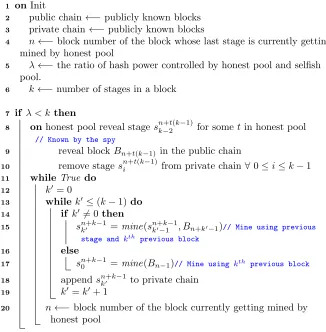
Algorithm 1:Selfish Strategy for Sequential Mining (Cases 1 and 2)
1 onInit
2 public chain ←−publicly known blocks 3 private chain←−publicly known blocks
4 n←− block number of the block whose stage 0 is currently getting mined by honest pool
5 λ←−the ratio of hash power controlled by honest pool and selfish pool.
6 k←−number of stages in a block
7 if λ < k then// Case 1
8 λ0=λ
9 onhonest pool reveals stagesnk−+2tλfor somet inside the honest pool
// Known by the spy
10 reveal blockBn+tλin the public chain
11 remove stagesni+tλfrom private chain∀0≤i≤k−1 12 whileTrue do
13 k0 = 0
14 whilek0≤(k−1)do 15 if k06= 0 then
16 sn+λ
0
k0 =mine(sn+λ 0
k0−1, Bn+λ0−k+k0)// Mine using previous stage and kth previous block
17 else
18 sn+λ
0
0 =mine(Bn+λ0−k)// Mine using kth previous block
19 appendsn+λ
0
k0 to private chain 20 k0 =k0+ 1
21 λ0=λ0+λ
22 else// Case 2
23 ξ=bk(k−1)/λc
24 onhonest pool reveals stagesξn−+2t(k−1)for some tin honest pool
// Known by the spy
25 revealξstages of blockBn+t(k−1)// with the help of spy
26 removesin+t(k−1) from private chain∀0≤i≤ξ−1 27 whileTrue do
28 k0 = 0
29 whilek0≤(ξ−1)do 30 if k06= 0 then
31 snk0+k−1=mine(snk+0−k1−1, Bn+k0−1)// Mine using previous stage and kth previous block
32 else
33 sn0+k−1=mine(Bn−1)// Mine usingkth previous block
34 appendsnk0+k−1 to private chain 35 k0 =k0+ 1
Public chain consists of stages that are mined and known to the blockchain network while private chain consists of stages that are mined but are kept pri-vate by the selfish pool. In Algorithm 1, initially, the pripri-vate and the public chain are the same.
We will divide our analysis into two cases, where the selfish pool’s strategy will be different in both the cases.
Case 1: λ < k
Whenever, the honest pool works on block Bn(n ≥ k), the selfish pool will work on block Bn+dλe. As λ < k, the selfish pool can work on block Bn+dλe
because the digest of blockBn+dλe−k is available.
When honest pool completely mines λ blocks, the selfish pool will be able to mine the wholeBn+dλeblock and the selfish pool keeps the block private. When
the honest pool starts mining on block Bn+dλe, the selfish pool starts mining
on blockBn+2dλe.
When honest pool completesk−1th stage (second last stage) of blockB n+dλe,
the spy reveals all the stages of blockBn+dλe, thus wasting honest pool’s
com-putation on blockBn+dλe.
Case 2: λ≥k
In this strategy, the selfish pool knows that it cannot outrun honest pool since
λ > k. Therefore, selfish pool plans to mine a fixed number of stages of a block rather than mining whole block.
When honest pool start working on blockBn, the selfish pool will start mining the first stage of block Bn+k−1. The selfish pool will keep a threshold ξ on
number of stages of blockBn+k−1 it plans to mine. Onceξ stages are mined,
the selfish pool will move to blockBn+2k−2and again start miningξstages. On
an average selfish pool can waste computations as well as consume reward ofξ
stages of the honest pool on the chosen block.
For every one stage mined by the selfish pool, the honest pool would have minedλstages. Therefore, for everyξstages mined by the selfish pool, honest pool would have mined ξ·λstages. The selfish pool needs to make sure that the honest pool do not outrun the selfish pool. Therefore,
ξλ
k < k−1
=⇒ ξ < k(k−1) λ
In order to maximize the profit,ξis chosen to be,
ξ=
k(k−1) λ
5.2.2.1 Revenue
Theorem 1. Letαbe the hash power of the selfish pool and let kbe the number of stages in a block.
If λ < k, then algorithm 1 is profitable for selfish pool in case of sequential mining if
1 2 > α >
1
k+ 1
If λ ≥ k, then algorithm 1 is profitable for selfish pool in case of sequential mining if
1 2 > α >
1
k(k−1) + 1 Proof.
Case 1: λ < k
For every λ blocks mined by the honest pool, the selfish pool mines a single block and keeps it private. Once the honest pool mines k−1 stages of the block held private by the selfish pool, the spy reveals all the stages of the block wasting the honest pool’s computation on thek−1 stages.
Let the reward of mining every stage is equal to 1. As the honest pool minesλ
blocks, each consisting ofkstages,
rhonest=kλ·tfor somet∈N
The selfish pool reveals a single block in the meantime. By the time the honest pool works onk−1 stages of the block held private by the selfish pool, selfish pool would have mined k−1
λ stages of other block. Thus,
rself ish= (k+
k−1
λ )·t for somet∈N
The relative revenue of selfish pool is:
Rself ish=
rself ish
rself ish+rhonest =
k+k−1
λ
k+k−1
λ +kλ
= k(λ+ 1)−1
kλ2+k(λ+ 1)−1
When the selfish pool’s relative revenue is greater than its size;α, then the attack is successful. Therefore,
k(λ+ 1)−1
Puttingλ=1−α
α and solving, we get,
k >1
Asλ < k,
1−α α < k
=⇒ α > 1 k+ 1
As the selfish pool’s size cannot be greater than 50% of the network’s size,
1 2 > α >
1
k+ 1
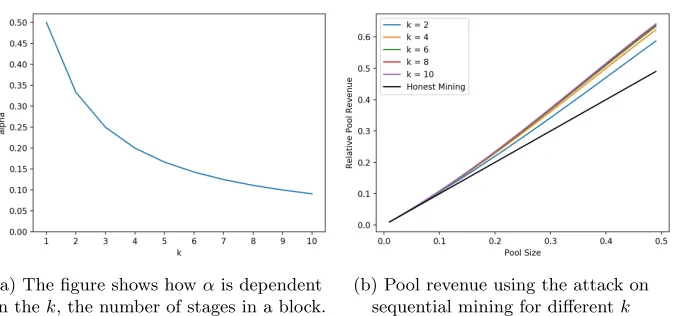
(a) The figure shows howαis dependent on thek, the number of stages in a block.
(b) Pool revenue using the attack on sequential mining for differentk
Figure 6: Plots showing the results of analysis on attack on sequential mining (Case 1)
Figure 6(a) shows the region in which α should lie so that Algorithm 1 (λ < k) is profitable. Ifαis above the curve, then the attack is profitable. Figure 6(b) shows that algorithm 1 for case whereλ < k is profitable for selfish pool and the profit increases with an increase in the value ofk.
Case 2: λ≥k
If honest pool is mining on blockBn, the selfish pool mines on block Bn+k−1.
When the honest pool completely mines blockBn+k−2, the selfish pool would
have minedξ(ξ < k) stages of blockBn+k−1 and kept them private. The spy
present in the honest pool reveals the stages as soon the honest pool mines (ξ−1)thstage of blockB
n+k−1.
As honest pool minesk−1 blocks each consisting ofkstages,
The selfish pool revealsξstages and by the time the honest pool works onξ−1 stages of the block, selfish pool would have mined ξ−1
λ stages of other block.
Thus,
rself ish= (ξ+
ξ−1
λ )·t for somet∈N
The relative revenue of selfish pool is:
Rself ish=
rself ish
rself ish+rhonest =
ξ+ξ−1
λ
k(k−1) +ξ+ξ−1
λ
= ξ(λ+ 1)−1
kλ(k−1) +ξ(λ+ 1)−1
When the selfish pool’s relative revenue is greater thanα, then the attack is successful. Therefore,
ξ(λ+ 1)−1
kλ(k−1) +ξ(λ+ 1)−1 > α
Puttingλ=1−α
α ,ξ=
k(k−1) λ
and solving, we get,
1 2 > α >
1
k(k−1) + 1
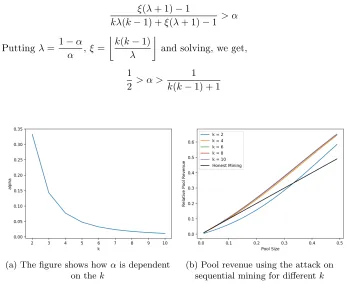
(a) The figure shows howαis dependent on thek
(b) Pool revenue using the attack on sequential mining for differentk
Figure 7: Plots showing the results of analysis on attack on sequential mining (Case 2)
Figure 7(b) shows that algorithm 1 for case whereλ > k is profitable for selfish pool of size greater than 0.33 for all values ofk.
5.2.3 Attack on Pipelined Mining
Let the time taken by the honest pool to mine a stage beT. Then, the selfish pool mines a stage in timeλT. Therefore, for everyk stages mined by honest
pool, the selfish pool mines
k λ
stages.
Case 1: λ < k
The selfish strategy for pipelined mining (λ < k) is described in algorithm 2.
Algorithm 2:Selfish Strategy for Pipelined Mining (λ < k)
1 onInit
2 public chain ←−publicly known blocks 3 private chain←−publicly known blocks
4 n←− block number of the block whose last stage is currently getting mined by honest pool
5 λ←−the ratio of hash power controlled by honest pool and selfish pool.
6 k←−number of stages in a block
7 if λ < k then
8 onhonest pool reveal stageskn−+2t(k−1)for some tin honest pool
// Known by the spy
9 reveal blockBn+t(k−1) in the public chain
10 remove stagesin+t(k−1)from private chain∀0≤i≤k−1 11 whileTrue do
12 k0 = 0
13 whilek0≤(k−1)do 14 if k06= 0 then 15 snk0+k−1=mine(s
n+k−1
k0−1 , Bn+k0−1)// Mine using previous stage and kth previous block
16 else
17 sn0+k−1=mine(Bn−1)// Mine usingkth previous block
18 appendsnk0+k−1 to private chain 19 k0 =k0+ 1
We consider an assumption in order to ease our analysis.
Assumption: The honest pool distributes equally on all possible stages where the miners could work at a particular point of time.
Consider blockBn (n ≥k). All the honest pool works on first stage of block
Bn (sn0). Once the first stage is completed, the honest pool divide themselves
equally into 2 groups to work on second stage of blockBn (sn1) and first stage
of blockBn+1 (sn0+1).
As, each group consists equal number of miners, both the stages will be mined in the same amount of time.
After (sn
1) and (s
n+1
0 ) are mined, the honest pool divides into 3 equal groups to
work on (sn
2), (s
n+1 1 ), (s
n+2 0 ).
Similarly, when honest pool finish its work on then+k−1thblock, the mining power of honest pool working onkth stage of blockBn+k is
β k.
Once the blockBnis mined, the honest pool has
β
k power unused and β k+ 1 of the honest pool are working on stagekof blockBn+1. Also, the miners are
divided to work onk+ 1 stages of different blocks. Therefore, the extra power of honest pool will be divided intok+ 1 stages.
The mining power of honest pool working on thekthstage of blockB n+1 is
β k+ 1+
β k(k+ 1) =
β k
Therefore, always β
k of the honest pool are working on the last stage of a block
at any point of time.
The selfish pool is able to mine a stage ahead of honest pool with high probability if
α > β k
=⇒ λ < k
Case 2: λ > k
Algorithm 3:Selfish Strategy for Pipelined Mining (λ > k)
1 onInit
2 public chain ←−publicly known blocks 3 private chain←−publicly known blocks
4 n←− block number of the block whose first stage is currently getting mined by honest pool
5 λ←−the ratio of hash power controlled by honest pool and selfish pool.
6 k←−number of stages in a block 7 privateBranchLen←−0
8 StageN umber←−0 9
10 onhonest pool mines a stage// Known by the spy
11 StageN umber←StageN umber+ 1
12 φ←length(private chain) - length(public chain) 13 append new stage to private chain
14 privateBranchLen←privateBranchLen+ 1 15 if φ= 0 andprivateBranchLen= 2then 16 publish all of private chain
17 privateBranchLen←0 18
19 onselfish pool mines a stage
20 StageN umber←StageN umber+ 1
21 φ←length(private chain) - length(public chain) 22 append new stage to private chain
23 if φ= 0then
24 private chain←public chain 25 privateBranchLen←0 26 else if φ= 1then
27 publish last block of the private chain 28 else if φ= 2then
29 publish all of the private chain 30 privateBranchLen←0 31 else
32 publish first unpublished block in private block 33 StageN umber←0
In this case (λ > k), the selfish pool cannot mine ahead of honest pool as by the time selfish pool could mine a stage of a block, the honest pool would have already mined it.
Therefore, in this case, the selfish pool tries to apply a strategy similar toEyal and Sirer’s Selfish-Minestrategy [2] but on stages of a single block.
private, thus creating a private branch. The spy present in the honest pool publishes its stages parallel to the stages mined by the honest pool, so that it can result in the creation of a fork leading to the switching of honest pool onto the selfish mined stage. At the point of creation a fork, there can be two possibilities; the first possibility being the creation of new stage by the honest pool invalidating the spys lead and the second being mining of the second stage by the spy and carry on with its lead against the honest pool.
5.2.3.1 Revenue
Theorem 2. Letαbe the hash power of the selfish pool and let kbe the number of stages in a block.
Ifλ < k,then Algorithm 2 is profitable for selfish pool in case of pipelined mining (λ < k) if
1 2 > α >
1
k+ 1
Proof. Once a block is completely mined in case of pipelined mining, every sub-sequent block is mined in timeT, whereT is the average time to mine a stage. In timeT, honest pool works onkstages simultaneously ofkdifferent blocks.
As β
k of the honest pool works on the last stage of a block at any point of time,
by the time the honest pool completes mining one stage, selfish pool will mine
k
λ stages. Therefore, if honest pool minesλstages, the selfish pool will minek
stages and completely mine a block. Also, as β
k of the honest pool work on the
last stage of a block, the honest pool miningλstages is equivalent to say that the honest pool minesλblocks.
If honest pool is mining on last stage of block Bn, then the selfish pool starts mining on block Bn+k−1. When the honest pool mines λ stages/blocks, the
selfish pool completely mines the blockBn−k+1 and keeps it private. Then, the
selfish pool will move to mine first stage of blockBn+bλc+k−1.
By the time the honest pool reaches blockBn+k−1 (mines k−λ blocks), the
selfish pool would have mined k(k−λ)
λ . Once honest pool reaches last stage of
blockBn+k−1, the spy reveals the block wasting the computation of honest pool.
As honest pool gets reward fork−1 blocks,
rhonest=k(k−1)·tfor some t∈N
As in the meantime, the selfish pool gets reward for the block Bn+k−1 and k(k−λ)
λ stages of blockBn+bλc+k−1
rself ish= (k+
k(k−λ)
The relative revenue of the selfish pool is:
Rself ish=
rself ish
rself ish+rhonest =
k+k(k−λ)
λ
k+k(k−λ)
λ +k(k−1)
= k
k+λ(k−1)
Puttingλ=1−α
α , we get
Rself ish=
αk k+α−1
When the selfish pools relative revenue is greater than, then the attack is suc-cessful. Therefore,
Rself ish=
αk
k+α−1 > α =⇒ α <1
which is always true. Therefore, the attack is profitable if
α > β k
=⇒ α > 1 k+ 1
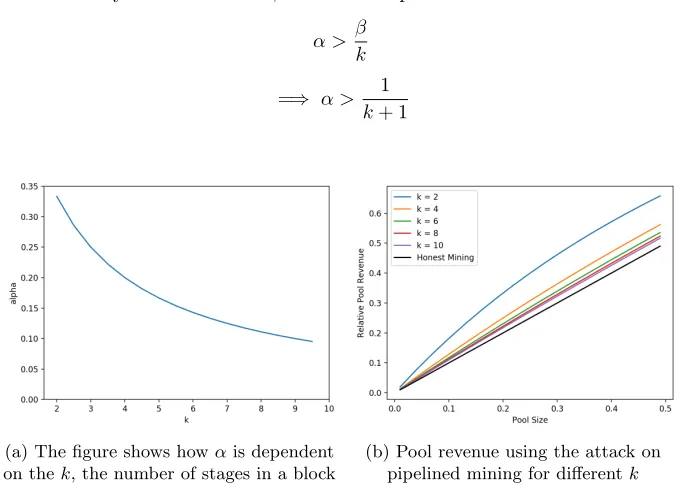
(a) The figure shows howαis dependent on thek, the number of stages in a block
(b) Pool revenue using the attack on pipelined mining for differentk
Figure 8: Plots showing the results of analysis on attack on pipelined mining (Case 1)
Figure 8(b) shows that algorithm 2 is profitable for the selfish pool and the profit decreases with an increase in the value ofk.
Theorem 3. Let α be the hash power of the selfish pool and let γ be the per-centage of number of miners of honest pool mining in front of the selfish pool’s block in case of a fork. Then, Algorithm 3 is profitable for selfish pool in case of pipelined mining (λ > k) if
1−γ
3−2γ < α <
1 2
Proof. Let us assume,H to be the honest pool and Sto be a selfish pool;γ be the percentage of number of miners ofH mining on selfish pool’s block in case of a fork. We assume that value of γ remains same for every fork that takes place in the Blockchain network.
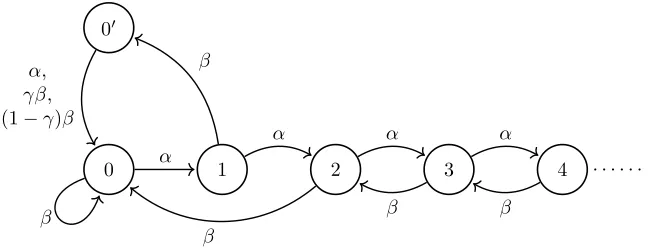
Figure 2 represents the progression of the system as a state machine, where the lead of the selfish pool is illustrated by the states of the system. Each number on the state diagrammatic representation shows the difference between the length of private and public branch.
In this state machine diagram, 0,00 represents no forked branch and two-forked branch respectively.
WhenS mines a stage with the frequency αand state s = 0, 1, 2,..., the lead gets increased to (s+1); when theH mines a stage with frequencyβ and state s = 3, 4,..., the lead gets decreased by one to (s-1). IfS has a lead of two and
H mines a stage,Spublishes its private branch and the system falls down from state 2 to state 0. The possible transitional frequencies have been shown in between the different states in the state machine diagram.
0 1 2 3 4
00
. . . . α
β
β
α α
β
α
β β
α,
γβ, (1−γ)β
Figure 2:The diagrammatic representation of a state machine as a progression system
We can find out the state probabilities from the state machine diagram using
P[state=x] =Px=
X
k
where transition from state k with frequencyω goes to state x. The following equations are obtained by calculating the probability distribution from the state machine.
P0= [α+βγ+ (1−γ)β]P00+βP0+βP2 P1=αP0
P00 =βP1
∀k≥j ≥2, Pj=αPj−1+βPj+1 Pk
j=0(Pj) +P00 = 1
(1)
After solving equation (1) , we obtain
P0=
(1−2α)
2α3−4α2+ 1 (2)
P1= α(1−2α)
2α3−4α2+ 1 (3)
P00 =
βα(1−2α)
2α3−4α2+ 1 (4)
Pj[j≥2] = (
α
1−α)
j−1
· α(1−2α)
2α3−4α2+ 1 (5)
We calculate the revenue of both selfish and honest pool using state probabilities and transitional frequencies,
rself ish= 2·αP00+ 1·γβP00+ 2·βP2+ 1·βP[i >2] (6) rhonest= 1·γβP00+ 1·βP0+ 2·(1−γ)βP00 (7)
In order to calculate the selfish pools revenue, we substitute the probabilities from equation (2) to (5) in the revenue equation of (6) and (7).
Rself ish=
rself ish
rself ish+rhonest
=α(1−α)(1−2α)(2α+γ(1−α)) + 2α
2(1−2α) +α3 α3−2α2−α+ 1
(8)
When the selfish pools relative revenue is greater than, then the attack is successful. Therefore,
Rself ish=
α(1−α)(1−2α)(2α+γ(1−α)) + 2α2(1−2α) +α3 α3−2α2−α+ 1 > α
=⇒ 1−γ
3−2γ < α <
(a) The figure shows howαis dependent on thek, the number of stages in a block
(b) Pool revenue using the attack on pipelined mining for differentγ
Figure 9: Plots showing the results of analysis on attack on pipelined mining (Case 2)
Figure 9(a) shows the region in which α should lie so that Algorithm 3 is profitable. Ifαis above the curve, then the attack is profitable.
We observe that Rself ish is independent of k. Figure 9 shows that algorithm 3 increases the profit of selfish pool with an increase in the value of γ. Also, higher value ofγ helps a small sized selfish pool to enjoy the profit.
The result we obtain for the selfish revenue is similar to the result obtained in [2] as the selfish attack proceeds similarly as [2] but on stages rather than blocks.
5.2.4 Attack on Parallel Mining
Algorithm 4:Parallel Approach
1 onInit
2 public chain ←−publicly known blocks 3 private chain←−publicly known blocks
4 n←− block number of the block whose stage 0 is currently getting mined by honest pool
5 δ←−Number of blocks that the honest pool work on simultaneously 6 k←−number of stages in a block
7 if δ < k−1 then 8 δ0=δ
9 onhonest pool reveals stagesnk−+2tδ for somet in honest pool// Known by the spy
10 reveal blockBn+tδ in the public chain
11 remove stagesni+tδ from private chain∀0≤i≤k−1 12 whileTrue do
13 k0 = 0
14 whilek0≤(k−1)do 15 if k06= 0 then
16 sn+δ
0
k0 =mine(sn+δ 0
k0−1, Bn+δ0−k+k0)// Mine using previous stage and kth previous block
17 else
18 sn+δ
0
0 =mine(Bn+δ0−k)// Mine using kth previous block
19 appendsn+δ 0
k0 to private chain
20 δ0 =δ0+δ
Suppose, that the honest pool divides itself intoδ groups to work onδ blocks at the same time.
Therefore, the amount of hash power of honest pool working on a stage of single
block is β
δ.
The selfish pool has an advantage in this case if
α > β δ
=⇒ λ < δ
=⇒ α > 1
δ+ 1 [β= 1−α]
If the honest pool works on blocks Bn, Bn+1, ..., Bn+δ−1, the selfish pool will
work on blockBn+δ.
block and keeps it private. When the honest pool completes second last stage of blockBn+δ, the selfish pool reveals the block wasting honest pool’s computation.
Ifλ > δ, then the selfish pool follows Algorithm 3 to generate a profit because it could never outrun the honest pool.
5.2.4.1 Revenue
Theorem 4. Letαbe the hash power of the selfish pool and let kbe the number of stages in a block.
If λ < δ, then Algorithm 4 is profitable for the selfish pool in case of parallel mining if
2k
(k+ 1) +δ(2k−1) > α > 1
δ+ 1
Proof. Suppose α > 1
δ+ 1. Then, the time in which honest pools mines k−1 stages of blockBn+δ+1, the selfish pool might have completed another block.
Therefore,
rhonest= (kδ+ (k−1)(δ−1))·tfor somet∈N
rself ish= (k+k)·t= (2k)·t for somet∈N
. The relative revenue of selfish pool is:
Rself ish=
rself ish
rself ish+rhonest
= 2k
2k+kδ+ (k−1)(δ−1)
= 2k
(k+ 1) +δ(2k−1)
When the selfish pool’s relative revenue is greater thanα, then the attack is profitable.
2k
(k+ 1) +δ(2k−1) > α > 1
Figure 10: The figures shows the region of possible values of αfor which the attack is profitable for different values ofk.
From figure 10, we can observe that the feasible region for αbecomes nar-rower as the value ofkincreases. Therefore, the selfish mining attack in case of parallel mining becomes less feasible as the number of stages of a block increases.
6
Crypto-Stamped Multi-Stage Blockchain
6.1
Architecture
value is currently being used; thereby forcing each miner to release the mined stages as soon as possible else face the risk of getting their mined stages rejected by the network.
We have also updated the validation constraints so as to incorporate our new approach. In the subsequent sections we present the updated architecture of [3], such that no selfish mining is possible.
6.1.1 Blockchain
The blockchain is of the form:
B0←B1←...←Bk−1←Bk←Bk+1←...
whereBi←Bi+1means thatBi+1is dependent onBii.eBi+1cannot be mined
ifBi is not already mined.
Blocks B0, B1,...,Bk−1 are genesis blocks while the blocks Bk, Bk+1,... are
general blocks.
6.1.2 General Block
We add an extra parameter to the general block data structure, called the crypto-stamp. The crypto-stamp is a tuple containing a hash value of block and the corresponding time stamp of the generation of that hash value. Hence, the updated block consists of the following information:
Bn
tn,k−1,ηn,k−1,τn,k−1,an,k−1,cn,k−1, (gn,k0 −1, τ
0
n,k−1)
. . .
tn,1,ηn,1, τn,1,an,1, cn,1, (g0n,1, τn,0 1) tn,0,ηn,0, τn,0,an,0, cn,0, (g0n,0, τn,0 0)
Ln
bdigestn n
where,
• n is the block number.
• bdigestn is the block digest.
• Ln is the list of transactions in the block.
• fornthblock and 0≤j≤k−1,
– tn,j is the target for stage j.
– τn,j is the timestamp for the completion (when the block is revealed to the network) of stage j.
– an,j is the address to which the reward for completing stage j is to be assigned.
– cn,j is the reward given toan,j for completing stage j.
– gn,j0 is the hash value (random value) of the most recent stage mined. It is needed to mine stage j of block bn.
– τn,j0 is the timestamp for the completion (when revealed to the net-work) of the most recent stage mined. It is needed to minejthstage ofnthblock.
6.1.3 Genesis Block
There is no change in the structure of the genesis block. Therefore, for 0≤n≤
k−1,
Bn
tn,ηn,τn,an,cn
bdigestn n
The block digests are defined as follows
bdigest0=H0(0, t0, a0, c0, τ0, η0)
bdigestn=Hi(bdigestn−1, n, tn, an, cn, τn, ηn)
∀ 0< n < k
The verification condition is
bdigestn< tn
6.1.4 Proof of Work
The proof of work of various stages are defined as follows,
gn,0=H0(bdigestn−k, n, RH(Ln), tn,0, an,0, cn,0, τn,0, ηn,0,(gn,0 0, τ
0
n,0))
gn,j =Hj(bdigestn−k+j, gn,j−1, tn,j, an,j, cn,j, τn,j, ηn,j,(gn,j0 , τn,j0 ))
∀ 0< j < k
Finally,bdigestn is set equal togn,k−1.
The verification conditions are:
gn,j< tn,j
|τn,j−τn,j0 |< T
where 0≤j < kandT is the average time of completion of a stage.
A pair (gi0+k,j, τi0+k,j) is called correct if gi0+k,j is computed usingτi0+k,j as the input.
6.1.5 Sub-Routine to Find Most Recent Stage
Before mining a stage, the miner needs to know the hash and the timestamp of the most recent stage mined. LetT be the time to find the most recent stage. As the most recent stage mined will be at the top of network,T is a very small value.
There are various block exploring services [22] which could be used to fetch the most recent stage.
Whenever a mining pool distributes work to the miners, it queries via the block exploring service and gives the information of the most recent stage along with the proof of work to the miners working in the pool. This way, the number of queries to the block exploring service will decrease drastically and therefore, there won’t be any delay in obtaining the output from the service.
7
Defence Mechanism
In this section, we show how our proposed structure of multi-stage blockchain doesn’t allow the selfish pool to proceed with selfish mining.
One of the verification condition of proof of work of a stage includes:
|τj−τj0|< T
where
• τj is the timestamp of the completion of proof of work of the stage.
• τj0 is the timestamp of the completion of proof of work of the stage that is most recently revealed.
• T is the average time of mining a stage.
Hence, the selfish pool cannot withhold mined blocks and reveal them later. Because if he does, then the verification condition wouldn’t hold true. Therefore, the proof of work will be discarded and the hash power of the selfish pool will be wasted.
8
Handling Forking
In the proposed Crpyto-Stamped Blockchain, to maintain the time of comple-tion of one block to be ten minutes just like in Bitcoin, the time to complete each stage will be less than ten minutes. This increases the chance of fork within stages due to network latency. The following strategy could be adopted to re-solve the forking and minimize network partitioning due to forking.
In case of a fork, we would have multiple digests (output of proof of work for each stage) which satisfy the verification conditions.
Supposeg1, g2, ..., gn be different hashes such that
gi< tn,j for alli= 1...n
wheretn,j is the target value of stage j of nthblock.
To resolve the fork, we choose min1≤i≤ngias the main branch and therefore the miners will choose min1≤i≤ngi to mine the next stage. The remaining hashes are discarded.
The above strategy doesn’t give an adversary any advantage as creating a fork wouldn’t generally be in the adversary’s favour. If the adversary tries to create a fork with a previously mined stage, then the proof of work is discarded due to failure of second verification condition. Therefore, an adversary cannot reveal an alternating long branch and expect it to be the main branch.
9
Conclusion
We have shown that how we can perform successful selfish mining attack on multi-stage blockchain by introducing a malicious user called the spy, inside an honest pool. The task of the spy is merely to leak the information regarding the stage completion in the honest pool. This leaked information is used by the selfish pool to waste computation power of honest pool and influence rewards. We proposed the selfish mining attack algorithms and analysed them on the three different types of mining strategies. Our results shows that selfish min-ing attack is still feasible on the Multi-Stage Blockchain [3] irrespective of the mining strategy the honest pool adopts. Hence, through our analysis we prove that multi-stage blockchain is not secure from selfish mining attack as claimed by the author.
References
[1] Satoshi Nakamoto. Bitcoin: A peer to peer electronic cash system
https://bitcoin.org/bitcoin.pdf, 2009
[2] Ittay Eyal, Emin G¨un Sirer. Majority is not Enough: Bitcoin Mining is Vulnerable, 2013
[3] Palash Sarkar. Multi-Stage Proof-of-work Blockchain, 2019
[4] Jianyu Niu, Chen Feng. Selfish Mining in Ethereum, 2019
[5] Fabian Ritz, Alf Zugenmaier. The Impact of Uncle Rewards on Selfish Min-ing in Etrhereum, 2018
[6] Qianlan Bai, Xinyan Zhou, Xing Wang, Yuedong Xu, Xin Wang, Qingsheng Kong. A Deep Dive into Blockchain Selfish Mining, 2018
[7] Muhammad Saad, Laurent Njilla, Charles Kamhoua, Aziz Mohaisen. Coun-tering Selfish Mining in Blockchains, 2018
[8] Daniel Fullmer, A. S. Morse. Analysis of Difficulty Control in Bitcoin and Proof-of-Work Blockchains, 2018
[9] Alejandro Baldominos, Yago Saez. Coin.AI: A Proof-of-Useful-Work Scheme for Blockchain-based Distributed Deep Learning, 2019
[10] Vivek Bagaria, Sreeram Kannan, David Tse, Giulia Fanti, Pramod Viswanath. Deconstructing the Blockchain to Approach Physical Limits, 2018
[11] R. Bowden, H.P. Keeler, A.E. Krzesinski, P.G. Taylor. Block arrivals in the Bitcoin blockchain, 2018
[12] Ben Kaiser, Mireya Jurado, Alex Ledger. The Looming Threat of China: An Analysis of Chinese Influence on Bitcoin, 2018
[13] Nick Arnosti, S. Matthew Weinberg. Bitcoin: A Natural Oligopoly, 2018
[14] Nikolai Zaitsev. Empirical forward price distribution from Bitcoin option prices, 2019
[15] Istvn Andrs Seres, Lszl Gulys, Dniel A. Nagy, Pter Burcsi, Topological Analysis of Bitcoin’s Lightning Network, 2019
[16] Andrew Chi-Chih Yao. An Incentive Analysis of some Bitcoin Fee Designs, 2018
[18] Alexandre Bovet, Carlo Campajola, Jorge F. Lazo, Francesco Mottes, Ia-copo Pozzana, Valerio Restocchi, Pietro Saggese, Nicol Vallarano, Tiziano Squartini, Claudio J. Tessone. Network-based indicators of Bitcoin bubbles, 2018
[19] Cuneyt Akcora, Matthew Dixon, Yulia Gel, Murat Kantarcioglu. Bitcoin Risk Modeling with Blockchain Graphs, 2018
[20] Dorit Ron, Adi Shamir. Quantitative Analysis of the Full Bitcoin Transac-tion Graph. 2013
[21] Simon Barber, Xavier Boyen, Elaine Shi, Ersin Uzun. Bitter to Better -How to Make Bitcoin a Better Currency, 2012
[22] Block Explorers
https://www.blockchain.com/explorer https://blockexplorer.com/
[23] RISC Pipeline