Available Online atwww.ijcsmc.com
International Journal of Computer Science and Mobile Computing
A Monthly Journal of Computer Science and Information Technology
ISSN 2320–088X
IJCSMC, Vol. 4, Issue. 5, May 2015, pg.1108 – 1116
RESEARCH ARTICLE
Foot Features Extraction
Based Shape Geometry
Prof. Dr. Kadhem M. Hashem
1, Fatima Ghali
2Computer Science Department, Education College, Thi-Qar University, Thi-Qar, Iraq
[email protected]; [email protected]
Abstract— In this paper we try to achieve that the foot geometry technology based on the fact that every person has a special foot shape. This present a new approach for extraction features from human foot based on shape geometry of its boundary frame by extracting 16 geometric features from a human foot .determine the foot center, and Then we calculated the distance between the center and outer point by different angles were measured .the angles are from 0˚ to 330˚ by increment with 30˚ gradual. The data base was created in our study containing 160 foots for 40 persons from images of students and employee in our college, which was more than 4 foot images per person, then discussing specific characteristics of foot biometrics compared to traditional hand and face based techniques. Euclidean distance used in the proposed system because in mathematics- the Euclidean distance or Euclidean metric is the "ordinary" distance between two measured points. MATLAB version 8.1(R2013a) has been used to implement the proposed method.
Keywords
-
Biometric recognition, Foot geometry, Euclidean distance.1
.
INTRODUCTIONThe reliability of the system based on the use of biometrics information (such as foot)that takes a spread significantly compared with the reliability of the traditional systems to recognize a query person. In fact using the biometric gives high accuracy and ability of easily recognition between the authorized and unauthorized users.
The biometrics contain a number of properties; these can be divided into behavioral biometrics which are the behavior characteristics and physical characteristics. The behavior characteristics such as signature, gait, and hand-writing print ….etc., while physical characteristics refer to structural pattern of human such as ear print, palm print, fingerprint …etc. [1].
The human foot is a complex arrangement of bones, ligaments and muscles that allow for the fine control of the human locomotion or posture. This bundle, represented in figure 1, has quite a good number of degrees-of-freedom that are not represented in the biomechanical model used in gait or posture analysis. Furthermore, if the foot is to be represented as a single rigid body then there is no point in defining the muscle actuators that are responsible for its „deformation‟ and „adaptation‟ to the contact surface. The geometric description of the foot surfaces that will be involved in the contact and their equivalent material properties have an extra importance[2].In this paper, some geometric features (16geometric features from foot) are extracted to any person.
2. Foot Geometry
The foot geometry technology based on the fact that every person has a special shape of foot belongs to him only, which is not affected by factors of time and aging. The foot size is relatively stable if the human has completed the growth phase and not properly use this type of measurements on children or those who are in the growth phase of their life. In other words, adult persons owning a distinctive unique foot among the rest of the people, foot geometry system always bases on the biometric features of the foot and some specifics measurements such as length and width of the foot [3].
3. The Proposed Foot Geometric Recognition System
The system‟s architecture as shows in Figure.1 relies on three different techniques adopted on fingerprint verification [4], face recognition [5] and hand geometry [6] and consists of the following modules.
Figure.1: The phases for any features extraction
Image acquisition
preprocessing
Features extraction3.1Image Acquisition
Images took by digital camera, while people should stand by a fixed distance from the camera to almost2 meters with fixed lighting and background. Camera‟s resolution is 20Mega pixel, and zoom50 degrees.(as shown in figure 2).
Figure.2:image foot of 10 person
3.2 Image Preprocessing
The next step is image preprocessing module. Image preprocessing relates to the preparation images for the next analysis and usage. Images captured by a camera or any similar techniques may need improvement to reduce noises in image; some images may need to simplified, enhanced segmented, filtered, etc. The role of the preprocessing module is to prepare the image for feature extraction. The first step in the preprocessing is to transform the color image into a gray scale image resulting to noisy gray scale image. Next step is the filtering which used in order to cancel the presented noise. Then, edge detection algorithm is applied for obtaining edge of the noiseless gray scale image. Image preprocessing module consists of the following operations:
(i) Gray scale image (ii) Noise removal (iii) Edge detection.
(i) Gray Scale Image
sample, that is, it carries only intensity information. Images of this sort, also known as black-and-white, are composed exclusively of shades of gray, varying from black at the weakest intensity to white at the strongest. Now color foot image is converted in to gray scale image with noise because there is some noise present in the input colored image due to dust and atmospheric conditions. This noise removal is essential for the system[7].
(ii) Noise Removal
By knowing the difference between the actual foot and captured image. This causes the variation in database feature and measured feature also affected the accuracy of the system. Another reason of noise removal is that edge detection which is difficult in noisy images, since both the noise and the edges contain high frequency content. Basically the noise produced in the image is due to device that used for capturing image for the foot, atmosphere condition or surrounding. There are many methods to remove the noise. In this proposed system the noise removed by using wiener2 filter, but before extracting features from the image, it is important to remove the noise from the image. Attempts to reduce the noise result in blurred and distorted edges. Operators used on noisy images are typically larger in scope, so they can average enough data to discount localized noisy pixels. This results in less accurate localization of the detected edges[8].
(iii) Edge Detection
In order to extract geometric features of the foot, it is required image contains only edges. Edge detection is the process of localizing pixel intensity transitions. The edge detection has been used by object recognition, target tracking, segmentation, and etc. Let„s consider the boundary detection under image enhancement because the goal is to emphasize features of interest i.e. boundaries and attenuate everything else.
An edge is a collection of connected high frequency points in an image. Visually, it is a region in an image where is a sharp change in intensity of the image. Edge detection refers to the operation performed on an image to detect the edges in an image. Edge detection plays a vital role in object detection and feature extraction and plays pivotal role in machine vision. There are different types of edges – step edges, roof edges, line edges, color edges, gray level edges, texture edges etc.
Not all edges are detected by all edge detection operators. Each operation has its specific specialty in edges and better the edge detection, usually; more complex and costly is the operation. Therefore, the edge detection is one of the most important parts of image preprocessing. There mainly edge detection method Canny[9].
With binary thresholding on the original image B to keep the most significant edges only, which reliably represent foot contours. Then, within the obtained image B1 we fill the interior of the foot using binary thresholding on B, i.e.
denotes the binarization of B using threshold b. This binarized image B2 is next subjected to morphological dilation using a square structuring element S to close the boundary:
Last, we employ morphological erosion on this image.
(as shown in figure 3)
a)gray image b) The Edge Detected Image
Figure.3: The gray image and The Edge Detected Input Image
4. Geometric Features
5. Features extraction
At the end of preprocessing phase, getting an image of gray level which describes all edges in the original one ,where the longest and most prominent edge in that image is the edge that represents the boundary of foot shape ,then used chain code algorithm for representation, which describes the point location edges of the image, this algorithm is one of the most efficient algorithm to describe the boundary of objects within the image, because their ability to never effect from rotation as it gave good results when used ,the most used features are following :
5.1.Foot Width
Observes that people differences with foot shape during data preparation, some people have a width foot and another have a normal or less width foot compared with the first one, also observe that some people have the foot area near the fingers having width more than the bottom of the foot area. foot width is defined as the distance between the left and right side point ,we can find three width from foot:
from the center point by founding the first width in the center of the foot.
second width is found near and above the center of the fingers.
third width is found below the center of the foot . (as shown in figure 4)
Figure.4: The three width
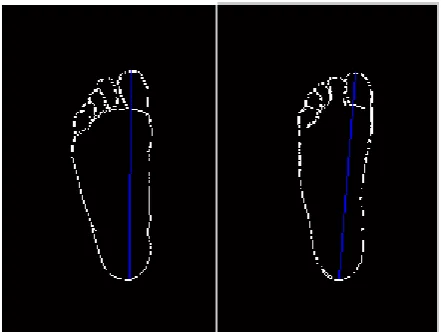
5.2 Foot length
Figure.5: The length
5.3 Center point
The center point is one of the best special characteristic for people recognition, it's calculating depend on the centroid of gravity as in the following equation.
The line segment Li, has the centroid Ci with coordinates xCi , yCi , i = 1; …….n.
After that measuringthe distances starting from the corner 0 to the corner 330(as shown in figure 6)
Figure.6: The length the measurements distances starting from the corner 0 tothe corner 330 A list of implemented features for the footprint-based identification task can be found in
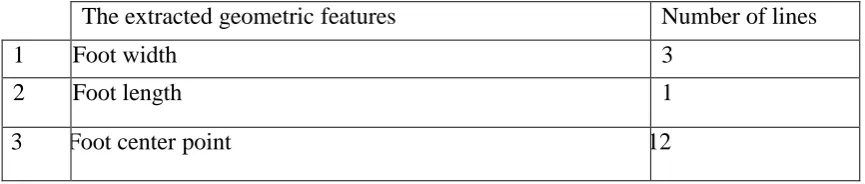
Table (1) summarize the extracted features and the number of each one
The extracted geometric features Number of lines
1 Foot width 3
2 Foot length 1
3 Foot center point 12
6. Conclusions
From the experiment results, Were extracted 3 geometric features to each from foot .the proposed method has been applied on the foot image was taken by digital camera and scanner for getting optimal results, one can use all the 16 geometric features , .determine the foot center, and then we calculated the distance between the center and outer point by different angles were measured .the angles are from 0ᵒ to 330ᵒ by increment with 30ᵒ gradual.
And we can find three width from foot: from the center point by founding the first width in the center of the foot, second width is found near and above the center of the fingers, and find third width below the center of the foot. Finally Foot length is defined as the distance between the top fingertip point and the bottom foot point.
References
[1] Yuksel, L. Akarun, and B. Sankur , "Hand vein biometry based on geometry and appearance method. "vol.5:IET, 2011, PP.398-406. aspects" Forensic Science International 179 (2008) 63–69
[2] Jorge Ambrósio and Inês Barbosa , Novel Foot Contact Model Identification , Technical University of Lisbon, SimKinPres,2008
[3] Y. ZHANG,D. ZHAO , G.SUN , Q.GUO and B. FU "palm print recognition based on sub –block energy features extracted by real 2D-Gabor transform" Department of electronic engineering, Beijing university of Technology , Beijing, 100124, chain ,2010
[4] NIST Fingerprint Image Software 2,” National Institute of Standards and Technology Software User‟s Guide, 2004
[5] M. Turk and A. Pent land, “Eigen faces for Recognition.” Journal of Cognitive Neuroscience, vol. 3, no. 1, pp. 71–86, 1991
[6] A. Kumar, D. C. M. Wong, H. C. Shen, and A. K. Jain, “Personal Verification using Palm print and Hand Geometry Biometric,” in Proc. of the 4th Int. Conf. on Audio-and Video-Based Biometric Person Authentication, 2003, pp. 668–678.
[7] Ms. Gagandeep Kaur "DESIGN OF A HAND GEOMETRY BASEDVERIFICATION SYSTEM" DEPARTMENT OF ELECTRICAL AND INSTRUMENTATION ENGINEERING THAPAR UNIVERSITY PATIALA –147004 JULY – 2010
[8] pranoti Das1,Sachin Meshrame2" An Efficient Hand-Geometry system for biometric identification " IOSR Journal of Electronics and communication Engineering (IOSR-JECE) ISSN:2278-2834,ISBN:2278-8735 .Volume 4, Issue 4 (Jan.-feb.2013),pp 17-19
[10] R. Sanchez-Reillo, C. Sanchez-Avila, and A. Gonzalez-Marcos. Biometric identification through hand geometrymeasurements. IEEE Transactions on Pattern Analysis and Machine Intelligence, 22(10):1168{1171, 2000.