Available Online atwww.ijcsmc.com
International Journal of Computer Science and Mobile Computing
A Monthly Journal of Computer Science and Information Technology
ISSN 2320–088X
IMPACT FACTOR: 6.017
IJCSMC, Vol. 5, Issue. 12, December 2016, pg.165 – 172
USING ENERGY CONSERVATION TO
IMPROVE THE LIFETIME OF
WIRELESS SENSOR
Arti Bahuguna
M.Tech CSE, Govind Ballabh Pant Engineering College, Pauri Garhwal (Uttarakhand)
Ajay Bahuguna
B.Tech Student of I.T Dept, H.N.B. Garhwal University, Srinagar (Uttarakhand)
Sunil Singh Bisht
M.Tech CSE, Govind Ballabh Pant Engineering College, Pauri Garhwal (Uttarakhand)
ABSTRACT: In the modern era, Wireless sensor network (WSN) has seen new horizons among the research community. It
has largest range of applications in most of the fields. Its beauty lies in its application area and it can be deployed anywhere.
WSN has low cost, low power sensor nodes, can be deployed in large numbers and can be even used in hazardous
environment. However, the sensor nodes in WSN do not have longer lifetime. Therefore to meet this challenge of increasing
the field lifetime of sensor nodes.A fundamental challenge in the design of Wireless Sensor Network is to enhance the
network lifetime. Wireless Sensor nodes carry limited irreplaceable power source. In single static sink node based wireless
sensor network, a sensor node spends most of its energy for relaying data packets especially which are located in the
surrounding area of the sink node. They dissipate their energy so fast due to many to one traffic pattern and finally they die.
Arti Bahuguna et al,International Journal of Computer Science and Mobile Computing, Vol.5 Issue.12, December- 2016, pg. 165-172
I.
INTRODUCTION
A network of wireless sensor nodes can be formed by densely deploying a large number of
sensor nodes in a given sensing area, from where the sensed data from the various nodes are
transported to a monitoring station (called as sink node or base station), often located far away
from the sensing area. The transport of data from a source node to the monitoring station can be
carried out by multi hop routing or flooding. By having more than one Base stations the average
number of hops between data source sink pairs can get reduced. This will reduce the energy
spent by a given sensor node for the purpose of relaying data from other nodes towards the base
station, which, in turn, can potentially result in increased network lifetime as well as in larger
amount of data delivered during the network lifetime. So the deployment of communication
nodes as well as the multiple sink nodes is most important factors that affect the lifetime in
wireless sensor network. Again, in this paper the focus is also on the issue related to reduce
power consumption and increase network life time.
So an energy efficient routing algorithm is coupled with multi sink placement scheme as the
solution. The power consumption of each node in wireless system can be divided into: (i) the
power utilized for the transmission of a packet; (ii) the power utilized for receiving a packet and
(iii) the power utilized while the system is idle. Here in each time interval the energy of each
node will be calculated. The rest of this paper is organized as following, Related works in the
section II, section III describes proposed system, simulation results are in section IV and section
V is for conclusion.
Wireless sensor networks (WSNs) lies on the top when we consider its popularity; it is possible
due to its innovative and interesting applications in almost all fields ranging from environment
monitoring to battlefield scenario. In computing and communication platforms, it sets a new
level for monitoring different environments. It concerned to remote geographical area where
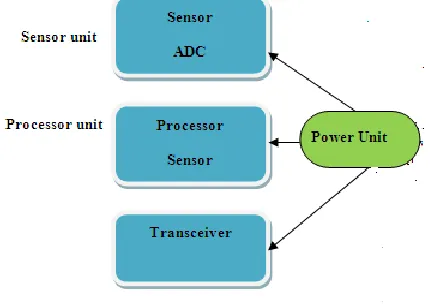
human intervention is not possible [1, 2, and 3]. Every sensor node in WSN consists of four basic
Fig 1 Different units of a typical sensor node
The processor unit includes a microcontroller and memory unit. It saves the sensed data. The
transceiver unit comprises of wireless radio transmitters and receiver stations. The power unit
consists of batteries that provide necessary power to other units [5, 6]. Many protocols proposed
to reduce the energy consumption and thereby increase the lifetime of the sensor network. These
protocols categorized into three types. The protocols coming under first class category focuses
on controlling of transmission power at node level and at the same time maintain the
connectivity of the network; it is possible by increasing the network capacity. However, here we
have to compromise with the cost of the network. Protocols referred to next category make
routing decisions based upon power optimization goals. Then protocols included in the last
category make very important and useful decisions about topology control, that means which
sensor nodes take part in the network activity (active mode) and which are not (sleep mode)
taking part in the network operations at the same time. [7,8,9,10]. Here the nodes have the good
knowledge about their respective positions through GPS or message passing.
Available Energy (Eav) ≥ Consumable Energy (Eout)
II.
RELATED WORKS
Arti Bahuguna et al,International Journal of Computer Science and Mobile Computing, Vol.5 Issue.12, December- 2016, pg. 165-172
rapid energy depletion due to long distance data transmission. Consequently, this problem limits
the use of WSN to gather data in certain regions. This becomes a cause that cannot be done to
gather data in certain regions. Thus, a more effective use of energy becomes the major challenge
in WSNs [2]. To improve energy efficiency, many researchers have suggested various routing
algorithms [3-11]. In most routing protocols, the paths are computed based on minimizing hop
count or delay. When the transmission power of nodes is adjustable, hop count may be replaced
by power consumption metric. Some nodes participate in routing packets for many source–
destination pairs, and the increased energy consumption may result in their failure. A longer path
passing through nodes that have plenty of energy may be a better solution. In [12] and [13] the
authors describe several localized routing algorithms that try to minimize the total energy per
packet and/or lifetime of each node. The proposed routing algorithms are all demand based.
These methods use control messages to update the positions of all nodes to maintain the
efficiency of the routing algorithms. Singh et al. [14] proposed power aware routing and
discussed different metrics in power aware routing. Some of the ideas in this paper are
extensions of what that paper proposed. Minimal energy consumption was used in [15]. Their
main idea, that is, to avoid using low power nodes and to choose the short path at the beginning,
has inspired the approach described in this paper.
III.
PROPOSED SYSTEM
A. Multi sink placement
Deploying multiple base stations has been shown to be relatively more energy efficient because
of reduced number of hops. On the other hand, it brings more system complexity; e.g. a node
should be transmitting to which base stations, from an energy efficiency consideration. In this
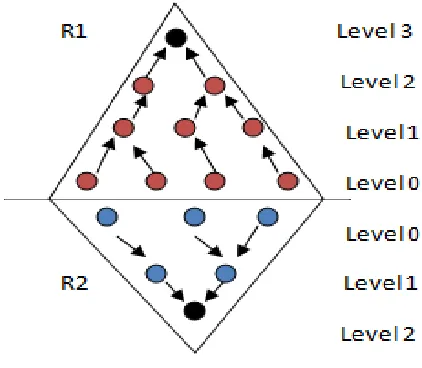
subsection, we introduce the network partitioning method. In the proposed system the whole
network is divided into two regions. Individual sink node will be there for each region. Nodes
can send data to their next hop neighbor nodes only but not to its previous hop nodes. Each node
will be able to send data only to its corresponding sink node i.e. from which region it belongs to.
Fig 2: Multi sink placement
In fig 2, partitioned networks are denoted as R1 and R2. Here level 0 nodes send data to level 1,
level 1 nodes to level 2 like this. But nodes of region R1 can‟t send data to region R2 nodes or its
sink node and vice versa.
B. Energy efficient routing algorithm
Route is selected based on residual energy of the neighbouring nodes. Node having the
maximum residual energy is selected to forward the information towards sink node. Say, S is the
set of all nodes in a network, n denotes node that transmits data towards sink node at any instant
of time, v is any neighbour node of n, En (v) is the energy of the node v at a particular time, w is
any neighbour node of n that is selected for further data transmission and time interval.
Algorithm 1: Energy efficient routing algorithm
1. Initialize S={n}
2. If „v‟ is next hop neighbour, calculate residual energy En(v) 3. Compare energy for all „v‟ nodes
Arti Bahuguna et al,International Journal of Computer Science and Mobile Computing, Vol.5 Issue.12, December- 2016, pg. 165-172
IV.
SIMULATION
The simulation work has been carried out using a NS2. Simulation parameters are,
Parameter Value
Area of simulation 1600*1600
Network density 36
Simulation time 50ms
Physical/ Maclayer protocal 802.11
Traffic type CBR
Table I : Simulation parameters
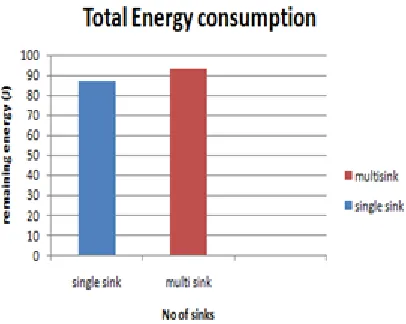
Fig 3: Energy consumption per round
After deploying multi sink nodes combined with the energy efficient routing protocol, the energy
consumption in each round is less (Fig 2) than in the case of single sink based network.
Remaining energy after the whole execution is also maximum for the proposed system (Fig 3).
V.
CONCLUSION
Due multi sink nodes hop distance between node-sink pair is reduced and energy efficient
routing avoids the low energy node while routing packets and prevents it from dying early. So
together they conserve energy which leads to prolonging the overall network lifetime as well as
the lifetime of a sensor node.
REFERENCES
[1] W.Su, Y.Sankarasubramaniam, I.F.Akyildiz and E. Cayirci, “A survey on sensor networks,”
IEEE Communications Magazine, vol. 40, no. 8, pp. 102–114, 2002.
[2] R. Rajagopalan and P. Varshney, “Data-aggregation technique in sensor networks: a survey,”
IEEE Communications Surveys & Tutorials, vol. 8, no. 4, pp. 48–63, 2006.
[3] W. R. Heinzelman, A. Chandrakasan, and H. Balakrishnan, “Energyefficient communication
protocol for wireless microsensor networks,” in Proceedings of the 33rd Annual Hawaii
International Conference on System Siences (HICSS '00), January 2000.
[4] C. Intanagonwiwat, R. Govindan, D. Estrin, J. Heidemann, and F. Silva, “Directed diffusion
for wireless sensor networking,” IEEE/ACM Transactions on Networking, vol. 11, no.1, pp. 2–
16, 2003.
[5] S. Lindsey, C. Raghavendra, and K. M. Sivalingam, “Data gathering algorithms in sensor networks using energy metrics,” IEEE Transactions on Parallel and Distributed Systems, vol. 13,
no. 9, pp. 924–935, 2002.
[6] W. B. Heinzelman, A. P. Chandrakasan, and H. Balakrishnan, “An application-specific
protocol architecture for wireless microsensor networks,” IEEE Transactions on Wireless
Arti Bahuguna et al,International Journal of Computer Science and Mobile Computing, Vol.5 Issue.12, December- 2016, pg. 165-172
[8] A. Manjhi, S. Nath, and P. B. Gibbons, “Tributaries and deltas: efficient and robust aggregation in sensor network streams,” in Proceedings of the ACM SIGMOD International
Conference on Management of Data (SIGMOD '05), Baltimore, Md, USA, June 2005.
[9] Y. Xue, Y. Cui, and K. Nahrstedt, “Maximizing lifetime for data aggregation in wireless sensor networks,” Mobile Networks and Applications, vol. 10, no. 6, pp. 853–864, 2005.
[10] Y. Lee, K. Lee, H. Lee, and A. Kusdaryono, “CBERP: cluster based energy efficient routing
protocol for wireless sensor network,” in Proceedings of the 12th International Conference on
Networking, VLSI and Signal Processing (ICNVS '10), vol. 3, pp. 24–28, 2010.
[11] S. Lindsey and C. S. Raghavendra, “PEGASIS: power-efficient gathering in sensor
information systems,” in Proceedings of the IEEE Aerospace Conference, vol. 3, pp. 1125–1130,
2002.
[12] I. Stojmenovic & S. Datta, “Power and cost aware localized routing with guaranteed delivery in wireless networks” Proc. 7th IEEE Symp. On Computers and Communications
(ISCC), Taormina/Giardini Naxos, Italy, July 2002, 31–36.
[13] Singh S, Woo M, Raghavendra CS. “Power-aware routing in mobile ad-hoc networks” In
Proc. of Fourth Annual ACM/IEEE International Conference on Mobile Computing and
Networking, Dallas, TX, October 1998; pp. 181–190.
[14] Rodoplu V, Meng TH.” Minimum energy mobile wireless networks”, In Proc. of the 1998
IEEE International Conference on Communications, ICC ‟98, Vol. 3, Atlanda, GA, June 1998;
pp. 1633–1639.
[15] Energy-Aware Fisheye Routing (EA-FSR) algorithm for wireless mobile sensor networks