Post-primary education in West Ham, 1918-39.
Kim Lorraine O'Flynn.
Abstract.
This thesis is concerned with post-primary education in West Ham 1918-39, with particular reference to secondary education. The realities of local educational experience are set against a background of educational acts an economies. The economic difficulties of the 1920s and the Depression of the 1930s were keenly felt in West Ham despite the efforts of the predominantly Labour council to mitigate poverty. A gap sometimes existed between the educational opportunities Labour councillors wished to provide and those they were able to provide. Generally a pragmatic approach was taken and certainly a secondary education was not seen as essential for all.
Chapter One outlines West Ham's pre-1918 history and growth with reference to local politics and immigrant and religious groupings. West Ham's interwar history is told in greater detail. Chapter Two relates the difficulties encountered by the West Ham Education Committee in its decision to establish compulsory continuation schools, not least from the parents of West Ham. West Ham was one of the few areas in the country which succeeded in implementing compulsory continuation education albeit for a limited period. A section on technical education is also included in this chapter, although detailed treatment is hampered by a scarcity of records.
Contents.
Abstract. P.3
Abbreviations. p.8
Acknowledgements. p.9
Illustrations. p.10
Chapter One: West Ham and its educational provision from the nineteenth century
to 1939. p.11
1.1 West Ham's early history; the roots of working-class culture. p.14 1.2 Politics in West Ham both local and national 1830-1939. p.28 1.3 Education in West Ham from the eighteenth century to 1939. p.38
Conclusion. p.58
Chapter Two: Continuation education in West Ham 1918-39;'...they are all
elementary school children'. p.66
2.1 The national debate concerning continuation education. p.66 2.2 Reactions to the continuation education clause of the 1918
Education Act in West Ham. p.68
2.3 West Ham's compulsory continuation institutes. p.76 2.4 West Ham's voluntary day continuation institutes. p.90 2.5 Other forms of post-primary education open to West Ham
children 1918-39. p.103
Chapter Three: Selection for secondary school education '...the examination should be so framed as to ensure that every child who has been through the ordinary curriculum of the junior school shall have a fair and equal chance,...'. p.116 3.1 Post-primary education during the 1920s and 1930s; the
national situation. p.116
3.2 The secondary school scholarship system in West Ham 1918-39. p.121 3.3 Scholarship papers and the provision for fee-paying places
in West Ham secondary schools. p.144
3.4 West Ham's higher elementary/central school examination 1918-39. p.147 3.5 West Ham's intending teacher and university entrants 1918-39. p.151
Conclusion. p.156
Chapter Four: The secondary and higher elementary/central schools of West Ham
1918-39. p.163
4.1 West Ham's secondary schools prior to 1918. p.164 4.2 The 1918 Education Act and the secondary and higher
elementary schools of West Ham. p.166
4.3 West Ham's secondary schools during the interwar period,
similarities and peculiarities. p.167
4.4 The problem of early leavers. p.209
4.5 The relationship of the Schools with each other and the
wider community. p.213
4.6 Girls and selective education in West Ham 1918-39. p.215 4.7 The higher elementary/central schools. p.217
Conclusion. p.220
5.5 East Ham's secondary and higher elementary schools
and scholarships. p.256
5.6 Finances, curriculum and staffing. p.258
Conclusion. p.260
Chapter Six: Conclusion. p.265
Abbreviations.
TUC Trade Union Congress.
LEA Local Education Authority.
WEA Workers' Educational Association.
NUWT National Union of Women Teachers.
GWR Great Western Railway.
NUT National Union of Teachers.
PRO Public Record Office.
WHHSG West Ham High School for Girls.
ST. A St. Angela's High School for Girls.
WHGSB West Ham Grammar School for Boys.
MSS The Municipal Secondary School.
Acknowledgements.
I would like to extend my grateful thanks to the following for the assistance they have given me in this study:
The staff of Newham's Local Studies Library; the archivists of Brentwood Cathedral; Mr Frank Sainsbury; the late Mrs V Reid and Mrs Phyllis Gardner; Mrs Grace Glegg, Mrs Molly Fossey and Miss Mary Steeds. Shawn O'Flynn for undertaking the printing, layout and all associated works connected with this thesis.
Illustrations.
Illustration 1 West Ham High School for Girls 1931. p.170
Illustration 2 St. Angela's High School 1937. p.177
Illustration 3 West Ham Municipal Secondary School 1930s. p.182
Illustration 4 The Grove Central School 1930s. p.219
Illustration 5 East Ham Grammar School for Boys 1960s. p.235
Chapter One: West Ham and its educational provision from the nineteenth century to 1939.
He's bought up a marsh and a gasworks at least 7 miles out of town. We'll either go down with swamp fever or the whole ruddy workforce will drown.
(Comment by Henry Tate's nephew on the acquisition of land in South West Ham to build a sugar refinery, 1874).
This thesis is concerned with the provision of post-elementary education in a London borough during the period 1918-39. It examines the effect of local cultural, social and financial conditions whilst setting them in a national context. It studies the complexities of West Ham life and the multitude of factors that influenced educational provision and practice, including kinship ties, traditional work values and the poverty of the area. National educational innovations are discussed in their pure form and as they were translated and transformed for West Ham life. East Ham, West Ham's neighbouring and sibling borough is used as a comparison over the same period of time. With the implementation of Hadow reorganisation during the 1930s post-elementary education could also be accurately described as post-primary education with the institution of a break at the age of 11; although this was not universal even within West Ham by the outbreak of the Second World War.
the country or even in adjacent areas. A study of West Ham in this context is particularly important because the Borough introduced compulsory continuation education in 1921 one of the few local authorities to succeed in doing so and was, in this manner, out of step with neighbouring boroughs. In addition, West Ham's secondary school provision did not conform to the norm in that it possessed three aided secondary schools, in contrast to only two municipal secondary schools and could provide far greater numbers of secondary school places for girls than for boys. Further local studies are therefore relevant in this context because they often provide the most accurate account of how secondary and other forms of post-primary education were actually provided during the period 1918-39.
In studies such as Brian Simon's The politics of educational reform 1920
-
1940 much emphasis is placed on the detrimental effects on education of the country's economic condition between the two world wars:Olive Banks in Parity and prestige in English secondary education places stress on the role of the 'scholarship ladder' and social class:
A grammar school education has been sought not only for the formal educational qualifications necessary for many professional and administrative callings, but for the more subtle qualities of speech, dress, manners etc., which are equally desirable for the socially mobile...The working class boy, as a general rule, 'considers school and progress at school of rather less importance than the middle class boy', probably because the middle classes tend to show a greater concern for the education of their children
precluded this. The fullest records, in the form of governors' minutes, remain for one of West Ham's girls' secondary schools and the least for the municipal secondary schools. Few records remain for West Ham's other post-elementary schools although a 1968 MA thesis on West Ham's continuation institutes incorporates some oral evidence which has since been lost. Oral evidence has been used with regard to pupils and their access to a selective schooling, but this has been subject to the small numbers of remaining witnesses with a first-hand knowledge of a pre-war secondary or higher elementary/central school education.
1.1
West Ham's early history; the roots of working-class culture.Figure 1.1 Population of West Ham 1801-1941.
Year Population (In Thousands) 1801 6,485
1811 8,136 1821 9,753 1831 11,580 1841 12,738 1851 18,817 1861 38,331 1871 62,919 1881 128,953 1891 204,903 1901 267,358 1911 289,000 1921 300,860 1931 294,278 1941 No Census
Source: Local Studies Notes No.2 L B of Newham.
1.1.1 West Ham's main immigrant populations in the early twentieth century.
By the end of the First World War, the dominant culture of West Ham was an
overwhelmingly working-class one. West Ham had lost most of its middle-class
inhabitants and had become an almost exclusively proletarian town. Politically, this
homogeneity attracted union organisers and Socialists who gave the area a radical
reputation although the successes of the non-Socialist Municipal Alliance before
the Great War and the support it could command, even in opposition during the
1920s, points to Socialism holding an ambiguous position amongst voters. The
various immigrant groups which had entered the area during the previous fifty
years had mainly been assimilated into the ways of their neighbours. Although
differences remained, as, for instance, between the religious practices of Catholics
or Jews, the desire of second or third generation immigrants, whether originating
women. The process and extent by which the various ethnic groups conformed owed much to how they were perceived by the indigenous population. In this respect, the predominantly Irish Catholics were the minority group most vocal in the defence of their rights and most disliked, both on the Council and by West Ham residents in general, for this trait.
therefore West Ham may have had an Irish population of between 25 and 30,000.7 Politically, although Irish immigrants were often to be found in the emerging trade union movements at the end of the nineteenth and beginning of the twentieth century, this did not always imply an adherence to Socialism. The influence of Catholic priests over their congregations tended to be strong and a distrust of radicalism with its overtones of Nonconformism was often preached, directly or indirectly. Indeed, it was in the south of West Ham with its heavy concentration of Catholics that the Labour Party sometimes found itself facing electoral difficulties, particularly if it offended religious sensibilities. Father Carless, Parish Priest of the dockside district of Custom House, wrote to the Bishop of Brentwood in 1930 suggesting that only mass meetings would ensure that Catholics received their full rights with regard to reorganisation.' These meetings did not occur and were, in the end, unnecessary due to reorganisation proceeding cautiously but Father Carless's words demonstrate the determination of individual priests and their parishioners to receive equal treatment from the predominantly Socialist West Ham Council, even if that meant acting against the party which was apparently most representative of their own class.
Figure 1.2 The Irish born population of England and Wales 1841-1921.
Year Number % Of Population 1841 289.404 1.8
1881 562,374 2.2 1911 375,325 1.0 1921 364,747 1.4
By the First World War West Ham had a fairly numerous Jewish community. It is not possible to state precisely how large this community was but the 1921 Census indicated that there were 358 Russian-born residents in the Borough, many of who would have been Jewish. There were also 362 German-born residents, some of who would have been Jewish.' If a rough figure of 500 Jewish heads of households, multiplied by five to include family members is taken, the Jewish population of West Ham from the First World War to the Second World War possibly numbered 2 to 3,000 although numbers may have been as large as 5,000. Many Jews had moved out of such areas as Whitechapel and Stepney as they became more affluent and settled into the Forest Gate area of West Ham. Synagogues were built but there seems to have been no pressure for the establishment of Jewish schools. This may have been because those who had relocated were the more anglicised members of the community who saw little necessity for an exclusively religious education. The Jewish community in West Ham, as opposed to the Irish Catholic community rarely entered into educational controversy with the local Education Committee. This may have been due to its small size but there may also have been a desire to appear self-effacing in order to avoid prejudice. The Education Committee, for its part, acceded to requests for scholarship candidates to take examinations on a day other than Saturday, for religious reasons although few other references to the Borough's Jewish minority appear in Education Committee records.
pre-war situation and is a consequence both of the internment and repatriation of West Ham's German community during the years 1914-1918 and the fact that the younger generation was inevitably British-born and thus excluded from the figures. Occasionally Lascars from ships calling at the docks or itinerant Sikhs would settle in West Ham but numbers were never very large and individuals generally settled into the host community without special provision being made for them.
Figure 1.3 The numbers of German and Russian residents in West Hams 1921.
German Russians
362 358
Source: Census of England and Wales 1921 (1923) HMSO.
Prior to the First World War, West Ham did have a middle-class element, families who lived in the large houses situated in the Grove in Stratford or thereabouts, in addition to the lower middle-class commuting office workers who tended to live in Forest Gate and Upton Park. The poet Gerald Manley Hopkins was born in one of the Grove houses in 1844, although the family soon moved to the Hampstead-Highgate area.10
1.1.2 Cultural norms in West Ham 1918-39.
In West Ham, during the 1920s and 1930s, the disruption of the Second World War and the putative break up of working-class families and communities had not yet occurred. Few families had lived in the area for more than 50 years but, despite the comparative newness of West Ham's expansion, the Borough inspired great loyalty in its inhabitants and a recognisable West Ham culture had grown up. Certain values were shared with working-class communities as distant as Yorkshire and South Wales. The extended family was accepted and valued. Black-legging in employment was despised. Education had to have some practical use. This statement is reinforced by an extract from R Hoggart's, The uses of literacy that refers to common working-class attitudes to education, on this occasion, from northern England:
...there is often a mistrust of 'book-learning'. What good does it do you? Are you any better off (i.e. happier) as a clerk? or as a teacher? Parents who refuse, ..., to allow their children to take up scholarships are not always thinking of the fact that they would have to be fed and clothed for much longer; at the back is this vaguely formulated but strong doubt of the value of education."
This statement demonstrates that West Ham was part of the mainstream working-class culture of the country, although the Borough possessed some special features which had various major and minor effects on the community.
expeditions to West Ham as if to undiscovered foreign territory. One such, Thomas Burke of the London Spy, reported on Canning Town in 1922, stating that it was 'a bit of old untamed London; a whiff of Tudor Bankside; and although like all East End parishes, it has its Missions and Settlements it hasn't yet surrendered to them'. Burke also described the men of Canning Town as slow and elephantine and the girls as lusty and comely'.12 Although rather over-written, Burke's article was probably a fair representation of the area with its docks, shops and many public houses. Silvertown, although no less working-class, was quieter, due perhaps to its lack of shopping facilities and to its almost total domination by industry. In another article, written in 1922, Burke described Cyprus-on-Thames, actually part of East Ham but, because of its isolation from the rest of the Borough, in many respects a very similar dockland community to that of Silvertown. Burke referred to the desolate atmosphere, the houses backing onto a 'wide but dismal prospect' (unused marsh land outside the dock walls) and the women 'faded by long toil with little appetite for life' and the 'heavy dejected men'.13 The more prosperous areas of West Ham, such as Stratford and Forest Gate, did not conform to this picture and throughout the worst years of slump and depression parents, although , admittedly, not always West Ham parents, managed to find the finances to allow their sons and daughters to take up fee-paying places at West Ham secondary schools.
sophistication beyond the limits of formal education. West Ham's proximity to London and the City was another factor in ensuring that the residents of the Borough had experience of other ways of life. Boys and girls gained employment as clerks in renowned City firms, and girls were employed as sales assistants in Harrods and Selfridges. From these vantage points other values could be observed and possibly mimicked, although some middle and upper-class traits, particularly those connected with child-care, may well have been deplored rather than imitated.
It is possible to gain further insight into the interwar, working-class way of life by reference to the 1955 enquiry by M Young and P Wilmott into the kinship network of families in Bethnal Green, East London. Although by the 1950s East London culture had suffered a number of changes, including the disruption of war and an accelerated movement to the suburbs and new towns, family relationships remained essentially similar to those which existed during the 1920s and 1930s. It is true to say that Bethnal Green and West Ham were not precisely the same, either at the time of the Young and Wilmott study or during the interwar years. Nevertheless, the disparities between the two Boroughs were outweighed by their similarities and the essential culture remained the same into the 1950s. The family played an emphatic role in the lives of working-class people.' Young and Wilmott remarked that in working-class culture, when a man and woman married they did not break away from their existing relatives. Thus a wife had to 'reconcile her new obligations to her husband with her old obligations to her parents, and the husband likewise' In simple terms, 'In the East End, ..., the relatives were not excluded; the wider family still flourished; the wife had a mother by her as well as her husband'.16 The implications of this for society in West Ham, as elsewhere in East
from grandfather to father to son, then the pressure would be for the child to conform to the family norm. This lack of choice was not generally resented by school-leavers. Children were often content to be relieved of a weary and worrying search for a job, and employment with relatives eased the transition from school to work. 'The need to work and the imperatives of working were a central part of the culture' 17 of West Ham, and in many families leaving school at 14 was a source of satisfaction rather than the reverse. In the typical family, children generally had some understanding of the state of parental finances and expected to contribute towards them sooner rather than later, in kind, if not with cash. The working-class family experienced its most extreme hardship just before the eldest child left school to go to work. It was at this stage that there were young children, the mother was tied to the home and expenses weighed most heavily against wages." Older girls who had not left school would 'mind' baby brothers and sisters and would help with dusting and possibly ironing. Boys would run errands and, in families without daughters or where girls were younger siblings, would also have childcare responsibilities. Although fathers were nominally the main wage-earners and the heads of the household, West Ham society was overwhelmingly matriarchal and in many cases major decisions were made by the maternal grandmother. In this culture, where young adolescents had a full role to play in the continued well-being of the family it is not surprising that seemingly arbitrary decisions by the Government or the local Council to deprive the family of the services or wages of these children were so bitterly resented and, indeed, contested.
with special distaste. 'All the children in the street would laugh at me. 'Rotten 'at' they shouted at me as I went by. I used to push the straw hat down to the bottom of my satchel. All the others went to an ordinary school and they didn't think much of us at all'. 19 It is a generalisation to claim that all scholarship winners were treated in this manner, but a distrust and a disregard for the supposed benefits of education tended to be the rule. Peer pressure of this kind was one factor in the common problem of early leaving from West Ham selective schools. Apart from parental decisions, voluntary or forced by family economics, to find work for a scholarship child, the discontent of the child itself at seeing contemporaries earning wages and taking an increasingly adult role, resulted in much wastage. In addition to the loss of wages inherent in keeping a child at secondary school, secondary school uniforms were a considerable expense in themselves, a large enough expense to cause some parents to consider refusing a secondary school place on that basis alone. In The family from One End Street published in 1937, Kate, aged 11 had won a scholarship place to the consternation of her mother.
Mothers sometimes attempted to circumvent this difficulty with home-made measures, particularly since even elementary schools could strongly suggest that uniforms be worn.
My mother couldn't face the expense of buying a new uniform, so she made mine. She bought material for a gym slip. Now, she was handy with a needle but this was difficult, because you had to have three box pleats in front, and she didn't have enough material for three so she made two. Imagine my agony in going to school with only two pleats. Well, I had to sweat it out.'
In West Ham, small, but traumatic difficulties with proper clothing could be the deciding factor as to whether or not a scholarship was taken up. The prevalence of early-leaving from West Ham's secondary schools, usually to take up employment, again points to a secondary school education not being seen as an absolute advantage in obtaining a good post. Certainly, a university education sometimes appeared no more highly prized than the gaining of the School Certificate since, unless a child was exceptionally clever or fortunate the majority of children going on to third level education became teachers; entering a profession hard-working and ill-rewarded.
the financial difference between accepting or refusing a scholarship. The extended family, whose general importance has already been discussed, often contributed in money or in kind towards the well-being of struggling family members. A network of friends and acquaintances might also help in a crisis or even on a more consistent basis. Indeed, it could be difficult to '...disentangle from one another the influences of family, home, and neighbourhood. It was not only that the neighbourhood rivalled family as a locus of sociability, but that the two overlapped and helped to constitute each other'.22
As has already been seen, West Ham had a concentration of very poor citizens. An extract from the autobiography of a West Ham worker emphasises this and the steps the West Ham Council took to alleviate it.
The West Ham Council, they inaugurated a scheme whereby they opened soup kitchens by the church. Poverty was very, very bad. You could go there and buy a penny bowl of soup and take a bit of bread with you, and that was your dinner. And the West Ham Borough Council inaugurated the scheme where they dug the Hollow Pond in Wanstead. For half a crown a day, a bloke could go and dig out this Hollow Pond, but you could only do a day's work. 23
1.2 Politics in West Ham, both local and national 1830-1939.
1.2.1 West Ham's early political background.
Prior to 1836 and the creation of the West Ham Union, West Ham comprised an individual parish under the authority of the vestry. The Union took over responsibility for poor relief and sanitary functions such as providing adequate sewers and drainage. In 1856, West Ham began to be administered by a local Board of Health with 12 elected members. Unfortunately, although not all were culpable, the Board became, for the next several years, associated with fraudulent behaviour and policies that were too often shown to be capricious and short sighted. The administration was always under strain, with a small staff by modern standards, which did not expand to keep pace with the huge growth of the town. The failure to employ staff in sufficient numbers and to pay them properly sprang from West Ham's chronic financial difficulties. Owing to the poverty of the area, the poor-rates and later also the school-rates were very high and the Board consequently had to beware of pressing ratepayers too hard. West Ham's sudden transformation from village to town had one important implication for the future. The vastness of the influx of newcomers meant that West Ham's earlier traditions were submerged. Existing landowners, such as the Henniker family, sold their lands off to the railways and for housing and left the district. The absence of gentry meant that councillors and other leaders of the community tended to be drawn from the lower middle classes and working classes and were popularly considered to be no better than those they governed. Local issues, due to this factor, were thus often more contentious than those with purely national implications.
were several Progressives, notably J H (later Lord) Bethell, who were later joined by others and by Socialists, led by W J (Will) Thorne. In 1897, the Socialists and a proportion of the Progressives on the Council formed a Labour group with a policy including trade union wages for Council employees and the provision of Council houses. After the 1898 municipal elections this group won control and proceeded enthusiastically with all schemes for Borough improvement which were then at the planning stage. The Socialist tendency of the Council was alarming to many in the Borough and in 1899 the Municipal Alliance was formed. The Alliance consisted of Conservatives, Liberals and other non-Socialists and received strong support from the churches, especially the middle-class free churches, in an attempt to counter the Socialists on the Council. The Alliance won the municipal elections in the same year and retained control until 1910. During the First World War there was an electoral truce with the Municipal Alliance controlling the Council.
manual labouring districts of Plaistow, Canning Town, Custom House and Silvertown; these last two comprising the dockside districts of West Ham. Upton Park and Forest Gate tended to house shop-keepers, skilled men, railway workers etc., while semi-skilled and unskilled labourers, and particularly dock workers, generally lived in the southern Plaistow, Canning Town, Custom House and Silvertown areas. Stratford was less easy to categorise and was a mixture of residential commercial and industrial interests although some of the largest and grandest of West Ham houses were situated in the Grove, Stratford. It was also the administrative centre for the Council.'
1.2.2 National and local politics 1918-39.
for mental growth. In this, and in line with his Socialist views, Hughes was advocating that all children should enjoy the advantages possessed by 'well-to-do folk'. Hughes castigated his own colleagues, 'Our own muddling and impotence are largely due to the fact that we are all partially and wrongly educated in one way or another. We discuss our own conditions and troubles at great length and give far too little time and thought to improving conditions for the children'. Most Labour candidates included some reference to education in their election material, two using an identical form of words to insist that education should be free from elementary school to university, in their phrase, giving 'our class equality of opportunity'. Labour's Alliance opponents placed less emphasis on education, although one candidate, F W Wybrew, welcomed the 1918 Education Act as a means of improving current and future generations morally and materially, rather than counting on any likelihood of it causing a social revolution. Possibly the most touching reference to education by the candidates in that year, came from H Threadkell, 'The Ex-Service Man's Candidate', who professed a keen interest in the new Act since education had the power to 'affect vitally the children of his comrades who had made the supreme sacrifice'.' Among those who gained seats were Socialists known for their opposition to the First World War but, equally successful were Labour Ex-Servicemen," this hinting at the delicate balance which existed between patriots and pacifists on West Ham's Council.
a density of more than two to a room is taken as the criterion of overcrowding, then in this respect the position in West Ham worsened between 1921 and 1931; except for a few small towns, only certain Metropolitan Boroughs and the large towns of Tyneside and Durham had a larger proportion of their population living in overcrowded conditions. By 1931, the proportions living at densities of more than two persons to a room were: West Ham 17.45 per cent Barking 6.37 per cent and East Ham 6.23 per cent compared with 1.69 per cent in the nearby district of Ilford.' The intense overcrowding in West Ham was, of course, connected with the poverty and the culture of the area. It was common practice for families to sub-let and sub-let again their living accommodation to other families and, in addition, grandparents and unmarried aunts and uncles often lived with a married son and daughter, making overcrowding worse. West Ham remained a very poor borough. This impoverishment was heightened by the fact that many men were either unemployed or employed only on a casual basis, as in the case of many dock workers. Returning ex-servicemen placed an added strain on both jobs and housing and it is not surprising that the Council's plans to implement the provisions of Fisher's Education Act were neither universally popular nor universally understood.
recommending savings of 175 million over the whole range of government activity, but selecting education as the subject of a particularly bitter attack." Specific Geddes proposals included reducing the salaries of teachers and excluding children under the age of six from schools. These measures, after some debate, were considered too harsh and the eventual savings of about six and a half million pounds were achieved mainly by requiring teachers to contribute five per cent of their salary towards superannuation' and by a reduction in special services and the provision of school meals.'
Labour victories in West Ham's municipal elections from 1919 to 1924 did not reflect the national state of affairs. The country was governed first by a Coalition then a Conservative government and although the most striking feature of the 1920s was the sustained surge in popular support for the Labour party, this should not obscure the Conservative preponderance that so characterised the period. Indeed, during the interwar period the Conservatives formed or predominated in five governments and were, consistently, the largest party except during the 1929-31 government." On the other hand, between the First World War and the 1930s the Labour party transformed itself from the rather loose federal structure it had originally been into a substantial parliamentary party, supported by a strong central organisation and a comprehensive framework of regional and local branches and members."
political allegiance. The main transition from one party to another occurred during the early 1920s when Labour was a staunch Home Rule party, free from association with the suppression of the Easter Rising or the 'Black and Tan' policy,' a transitional period for West Ham's Labour councillors culminating in them acquiring an absolute majority on the Borough Council.
further conflict. 42 The most striking feature of this incident is Alderman Crow's vehement reaction to Socialist taunts against the commitment of his party to education. Alliance councillors, no less than Labour, could not afford to have a political image opposed to educational progress, even if sections of West Ham's inhabitants sometimes came close to displaying such an attitude themselves.
1.2.3 West Ham's own brand of Socialism, 'Iabourism'.
J Marriott has stated that there has been a tendency to believe that the
achievements of the Labour party at national level were faithfully reproduced in local politics. In his opinion this not only misrepresents the situation locally, but nationally too." The advance of the Labour party after the First World War was very uneven. Overall the gains of the war and the immediate post-war period were not consolidated. Raised expectations of an inevitable triumph as the Party continued to expand were never fully realised even in areas such as West Ham that had a strong industrial base.' Even by 1931, although hardly a major city remained under Liberal control, the Liberals still occupied, often in alliance with the Conservatives, an important place on many borough councils.' This was demonstrated again and again in West Ham where the Municipal Alliance, although never again the majority party after 1919, still mounted strong opposition to the Socialist majority.
imply a complete acceptance of Socialist theory. Voters could support the Labour party whilst not agreeing with all of its policies. Something of this cultural identity may be seen in a speech made by the Labour mayor of West Ham, J J Jones, to a conference of class teachers held in West Ham in October 1924.
The Borough could not, of course, boast of the history of some of the great cities, but they could say that within the limits of the opportunities they had in the educational world, West Ham had done as well as most of them, if not better. West Ham was proud of their schools, proud of the teachers, proud of the scholars and proud of the parents...They in West Ham were Trade Unionists and made no apology on that account (cries of 'Hear,hear')...They would not allow blacklegging in their own professions if they could help it.'
The tone of this speech is not that of Labour party theory but of the solidarity of the working man. The threat to be feared was not necessarily Government or even the Conservative party but blackleg labour, which could undermine working-class unity. In West Ham and, indeed, in most working-class areas of the country, it was the gravest offence to undercut the wages of another, particularly since it could lead to wives and children going hungry. It was not commitment to Labour party ideals that were important but the neighbourly virtues of refraining from stealing another's livelihood. That West Ham teachers were included in this code of honour reflects the working-class background of the many masters and mistresses.
candidates and resurrected the old idea that Labour policies would be a burden on the rates. Labour's new education scheme appeared to many to prove this contention although it did not prevent Labour from gaining the majority of seats. Indeed, despite the Alliance advocating social reform and appealing to the common good, its narrow sectional base was reduced by controversy concerning unemployment. The Alliance's agreement with cuts in unemployment relief reduced its support so drastically that the ground it lost was never really recovered. By the end of the 1920s Labour 'dominated the formal political terrain'.'
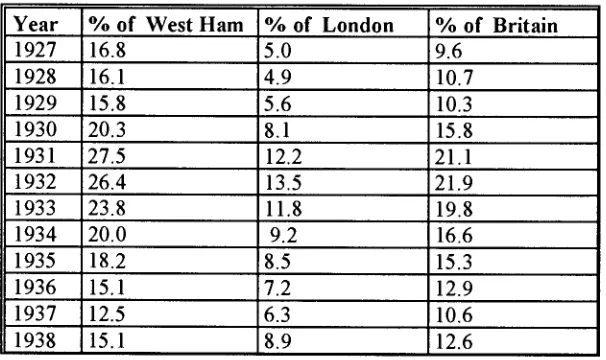
Figure 1.4 Unemployment in West Ham 1927-1938 compared to London and the rest of Great Britain as a percentage of the insured population.
Year % of West Ham % of London % of Britain
1927 16.8 5.0 9.6
1928 16.1 4.9 10.7
1929 15.8 5.6 10.3
1930 20.3 8.1 15.8
1931 27.5 12.2 21.1
1932 26.4 13.5 21.9
1933 23.8 11.8 19.8
1934 20.0 9.2 16.6
1935 18.2 8.5 15.3
1936 15.1 7.2 12.9
1937 12.5 6.3 10.6
1938 15.1 8.9 12.6
Source: John Marriott. The culture of labourism (1991) Edinburgh University Press p.124.
markedly higher than those for the metropolitan area and, indeed, for the whole south-east region, whose levels were very close to those of London. West Ham's poor record in this regard was attributable both to the underlying poverty of the area before the start of the Depression and to the high numbers of dock workers resident in the Borough dependent on work that was casual at the best of times. In spite of the success of labourism within formal political activity, support among the working-class electorate in West Ham was restricted. Labour activists repeatedly expressed concern at the persistent lack of interest in the party. To an extent this concern was well grounded. Polls at general elections, in West Ham, and the metropolitan constituencies, were significantly lower than might have been expected. They were lower than those of all neighbouring constituencies, including Poplar and Bethnal Green, which had electorates of similar social composition, and other Labour strongholds, such as Woolwich. In the 1924 General election, Poplar's poll was 72.1 per cent, Bethnal Green's was 68.4 per cent and that in Woolwich was 79.7 per cent, compared with an average of 65.3 per cent in West Ham.' The attitude of many West Ham voters towards politics during the interwar period can be summed up in Hoggart's words; 'in general most working-people are non-political in their outlook. The important things in life, so far as they can see, are other things'.' To be a Labour party voter or supporter was not necessarily to be a Socialist and accept Socialist theory.
1.3 Education in West Ham from the eighteenth century to 1939.
1.3.1 Early attempts at the education of the masses in West Ham.
Board's initial report gave details of educational provision in the area. There was a stock of 27 schools of which the Church of England was responsible for 15, the Nonconformists for seven, the Catholics for three and the Great Eastern Railway and Ragged School Union for one each. Among the church schools was Sarah Bonnell's, later to become West Ham High School for Girls, but then a well-endowed charity school. The West Ham Board found that the schools combined had accommodation for only 8,183 pupils out of 14,512 children between the ages of three and 13 and immediately set out to remedy this deficiency. By 1903, the Board had built 42 elementary schools, a school for the deaf, one for physically and mentally handicapped children and two pupil-teacher centres. By this time, many of the voluntary schools had closed, including all those belonging to the Nonconformists, in response to the increasing public preference for the generally well-equipped and staffed public elementary schools. One new elementary school had been built by the Church of England and two by the Catholics, a reflection of growing Catholic confidence and population. A start had also been made in providing secondary type education. The Sarah Bonnell charity school had been refounded under a scheme drawn up by the Endowed Schools Commissioners and became a high school for girls in 1873. This transformation met a demand from West Ham's middle-class residents for an advanced and socially exclusive education for their daughters. In addition, the Carpenters' Company Technical school for boys had opened in 1891, preparing pupils for white-collar employment, both locally and in the City. St. Angela's High School, founded in 1862 and West Ham Grammar School for Boys, founded in 1875 were Catholic schools and both were providing secondary education by the beginning of the twentieth century for Catholic and non-Catholic pupils.
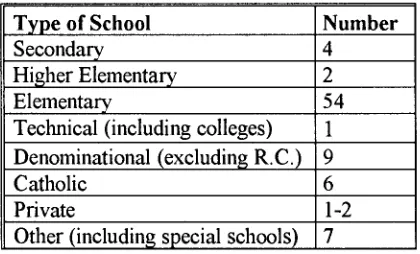
dockland town where such skills had immediate and practical application. For a short time West Ham sent its own junior secondary scholarship holders to the Carpenters' Company Technical school. The opening of the Municipal Secondary School in 1906 led to its redundancy and the school closed in 1905. After the closure, the Municipal Secondary School began to develop junior technical classes for those under 16, which overlapped those of the higher elementary schools. Also in 1906, the pupil-teacher centres in the Borough were re-opened as higher elementary schools.' The Education Act of 1902 had required West Ham, in company with the rest of the country, to 'take such steps as seem to them desirable to supply or aid the supply of education other than elementary and to promote the general co-ordination of all forms of education'. The opening of the Municipal Secondary School was a direct response to the Act, although the transformation of the Borough's pupil-teacher centres into higher elementary schools was somewhat against its spirit since its passing, according to E Eaglesham, 'helped to contain, to repel, and, in some respects to destroy the upward striving of the elementary school'.52 By 1918, West Ham possessed 54 elementary schools, 11 denominational schools other than Catholic, six Catholic schools, a technical college, two higher elementary schools, four secondary schools and 11 other schools, including private establishments that did not fall into any of these categories.
Figure 1.5 Educational Provision in West Ham in 1918.
Type of School Number
Secondary 4
Higher Elementary 2
Elementary 54
Technical (including colleges) 1 Denominational (excluding R.C.) 9
Catholic 6
Private 1-2
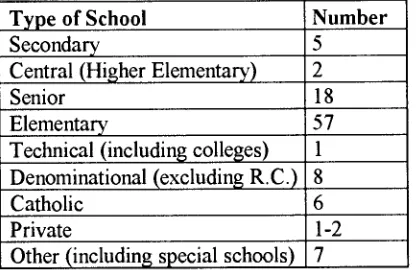
By 1939 a modest increase in educational provision can be seen. An additional
secondary school had been opened and three extra elementary schools provided. A
denominational school had closed and Hadow reorganisation had resulted in the
establishment of 18 senior schools.
Figure 1.6 Educational Provision in West Ham in 1939.
Type of School Number
Secondary 5
Central (Higher Elementary) 2
Senior 18
Elementary 57
Technical (including colleges) 1 Denominational (excluding R.C.) 8
Catholic 6
Private 1-2
Other (including special schools) 7
Source: Local Studies Notes No 72 L B of Newham.
1.3.2 West Ham and national educational innovations and economies; Hadow reorganisation and the May Committee on expenditure.
In 1922, West Ham Council published an ambitious booklet as a guide to the
facilities for education then available in the area. This publication, entitled
Forward, West Ham, was produced to coincide with a festival week during which
the work of the Borough's schools was on display to the public, providing an
'education in education'. One chapter described the divergence in the type of
education offered at the age of 11, when children entered secondary school, if they
passed the examination. A year later, pupils could enter the junior technical school
or take a place at secondary school, with the intention of training as teachers. Far
majority of children left school at 14 which was a blot on the English educational system since it led, 'when guidance and inspiration are perhaps most needed', to children being forced to face alone 'the difficulties and dangers of the factory and the street'. The anonymous compilers of Forward, West Ham were thus setting forward ideals close to those expressed by Tawney in Secondary education for all, the Labour Party's policy statement, also published in 1922. In Forward, West Ham, the hope was that the existing narrow educational ladder would be transformed into '...wide stairways, up which the boys and girls could march together in great companies, and none be left behind'."
as in the grammar schools because the children's interests were different and likely to be more practical, more concerned with earning a living.' The Hadow Report deplored the fact that 55 per cent of children at school between the ages of 11 and 16 were still in elementary schools and that only 7.5 per cent were in secondary or junior technical schools. "
The Hadow Report raised important issues, particularly as the desirability of some degree of post-primary reorganisation had been generally accepted across all gradations of political opinions. The Board of Education published a pamphlet in 1928 applauding the Hadow recommendations and urging local authorities to adopt the principles laid down in it and to prepare public opinion for the change. Some authorities tried to implement the scheme in full; others began to open new senior schools and to create senior departments.' Naturally, the prospect of a break at the age of 11 changed the educational balance for West Ham's elementary schools. In May 1928, the members of West Ham Education Committee discussed the subject of reorganisation, generally reaching favourable conclusions as to the necessity for change. The dissenting voice of Alderman Crow asked his colleagues to consider the likely effect that reorganisation would have on the Borough's finances. He reminded the Committee of the difficulties encountered by the Council seven years earlier, when parents had objected to their children transferring from their original elementary school in order to provide space for continuation classes (See Chapter Two). Alderman Crow's peers chose to see his objections as evidence of his parsimonious attitude towards education and decided to set up a committee on reorganisation; albeit, and despite the waning power of the Municipal Alliance, with Alderman Crow as one of its members.'
no more than 40 children and 50 children per class for seniors and juniors respectively. Infants were to be retained in their existing schools and there was to be 'no immediate disturbance of non-provided schools'. The Committee recognised that West Ham possessed a deficit in school accommodation. In addition, since the Borough was not a homogenous entity but consisted 'of a collection of districts where the conditions vary considerably, and while some of these lend themselves to experimental re-organisation, the majority must await the provision of additional accommodation before being dealt with'.59 The West Ham Education Committee was here referring to the social and geographical difference between different parts of the Borough. The Committee was sufficiently wise, in view of events eight years earlier during the continuation school controversy, not to attempt to reorganise schools which would result in younger children having to cross busy roads. There was also to be no attempt to reorganise schools that were in an isolated position and thus difficult to link to another, or to reorganise schools that lay close to schools to borough boundaries.
At the end of 1930 the Council's inspectors, E W Hodges and C M Bott reported on the progress of reorganised schools in Division C. They considered that each of the reorganised schools had made a good beginning and that new conditions for the teaching staff led to new opportunities for teachers, who now dealt with pupils as individuals rather than in groups. The inspectors recognised that with reorganisation in its early stages it was far too early to pass judgement on the actual curriculum. They accepted that each school should have its own strategy for what should be included, but remarked on the fact that the children, drawn from a number of different schools, had merged together in 'a fine spirit of oneness'. Of greater importance for the Education Committee, than the attitude of teachers and children, in view of events in East Ham, (see Chapter Five) was that of parents, the inspectors specifically commentating that there had been no complaints on the change of schools.' In July 1932, the Stratford Express carried an article concerned with the continuing reorganisation in West Ham that also emphasised the importance of parental attitudes. The article dealt with the removal of the Borough's central schools to new buildings and the subsequent use of the old central school buildings for elementary schooling. The piece went into some detail on the facilities now available in elementary, senior and central schools and finished by saying that:
The fullest publicity should be given to the schemes and consequently parents' meetings are being held so that explanations may be given and questions answered. The Education Committee is enthusiastic about the schemes, and is confident that the public will realise and appreciate the value and extent of the educational services provided and will co-operate heartily with all concerned.'
borrow money very cheaply, thus the Depression of the 1930s created circumstances favourable to reorganisation.' A letter to the West Ham Education Committee from the Board of Education in April 1932 displayed an acceptance of the slow pace of Hadow reorganisation 'the Board of Education have had under consideration the rearrangements at certain Schools proposed by the Authority as a provisional measure pending the carrying out of full reorganisation when possible at some future date...''
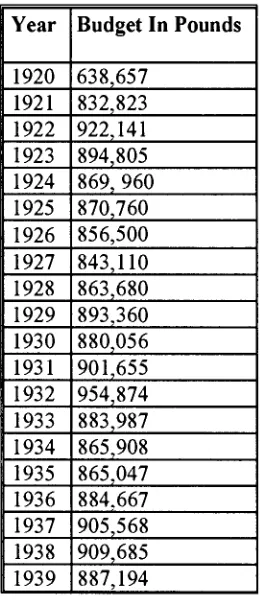
The tables below show West Ham's educational budget for the years 1920-39.
West Ham's expenditure on secondary and continuation schooling during the
interwar period is also shown.
Figure 1.7 The educational budget for West Ham 1920-39.
Year Budget In Pounds
1920 638,657 1921 832,823 1922 922,141 1923 894,805 1924 869, 960 1925 870,760 1926 856,500 1927 843,110 1928 863,680 1929 893,360 1930 880,056 1931 901,655 1932 954,874 1933 883,987 1934 865,908 1935 865,047 1936 884,667 1937 905,568 1938 909,685 1939 887,194
Figure 1.8 The percentage of West Ham educational budget 1920-39 spent on higher (including secondary) education.
Year % of West Ham
1920 8.8 1921 10.6 1922 12.0 1923 12.0 1924 12.2 1925 12.9 1926 12.7 1927 13.4 1928 14.0 1929 14.1 1930 13.9 1931 14.4 1932 13.9 1933 15.6 1934 15.2 1935 15.3 1936 15.6 1937 15.7 1938 15.5
Source: West Ham Education Committee minutes 1920-39.
Figure 1.9 The percentage of West Ham's educational budget spent on continuation education in selected years 1921-39.
Year Percentage
1921 1.0 1924 1.4 1928 1.6 1932 1.6 1936 1.1 1938 1.4
Although the 1939 budget was £887,194 compared with £638,657 in 1920, the peak years for expenditure were 1922 with a budget of £922,141 and 1932 with a budget of £954,874. The 1922 budget can be accounted for by large Labour party gains in the municipal elections of that year with Labour councillors redeeming promises made to increase funds for education. The 1932 figure demonstrates a less dramatic increase and is probably a result of the greater numbers of scholarship entrants and scholarship places available in West Ham in that year.
1.3.3 'The Catholic Question' in the country and Catholic education in West
Ham.
possible that the antagonism which existed owed something to the expansionist tendencies of the Catholic church. Evidence for this view may be found in Seebohm Rowntree's survey of church attendance in York in 1935 as compared with church attendance in the same city in 1901. York was a notably Nonconformist town but, during the period in question, the Free churches lost seven per cent of their members while the Catholics had increased their adherents by ten per cent, a pattern that was not unusual in the rest of the country.' Catholic numbers were not only swelled by conversion and by expansion of the settled population but also by new immigrants. In 1925 St. Joachim's Catholic elementary school in the poor district of Custom House was enlarged to provide accommodation for 200 additional pupils, a product of further Irish immigration.' Facts such as these would not have endeared Catholicism or Catholics to many West Ham citizens.
The West Ham Education Committee had faced religious difficulties in the middle 1920s over the demand by Catholic parents that a priest should be allowed access to their children boarding at Fyfield special school, an establishment in Essex run by the Borough. The subject was still under discussion in October 1928, and some idea of the feeling this had induced can be seen by a statement from one of the councillors who had agreed to permit the pastoral visits on the grounds that 'There was no fear of Protestant children being contaminated'.' This remark was later withdrawn under pressure from fellow councillors. Nationally, the growing tendency, at the time, to accept that the public elementary schools provided an adequate religious education was aided by the fact that they were '...shown to be reassuringly Protestant by the absence, generally speaking of Roman Catholic children'.' The issue that arose in January 1929 was less narrowly sectarian and grew out of West Ham's desire to make all secondary education in the Borough free. Due to the prohibitive cost of abolishing fees for all five West Ham secondary schools, the Education Committee had decided to apply for free places only at its two municipal secondary schools. This was an understandable decision, particularly since West Ham High School for Girls, a non-Catholic institution, was also excluded from these arrangements.
The reaction of Father Carless to the proposal had the effect of making the members of the Committee take sides. The lady member who had proposed the motion assured him that the Committee had no objections to Catholics or anyone else entering into the scheme, but informed him that if Catholic schools were to be included in the scheme the Church would have to hand them over to the Borough; an option that would not have been contemplated by the Catholic authorities. The influence of the Catholic church, continuing into 1929, can be attested to by the behaviour of Councillor G Doherty. Councillor Doherty was a Labour member and, although the records do not state it, was almost certainly a Catholic. The Councillor, plainly placing religion before politics, refuted the scheme and said that Catholics would fight every inch of the ground. He also went so far as to attack his own Party for what he saw as a wish to secularise the schools. He concluded his statement with the remark that many Socialists had fought the preceding election on the basis that they believed in 'fair play' for all, regardless of colour or creed, 'Now Catholics were asking them to put that into effect'.' A Protestant clergyman responded with the hope that the affair would not develop into a religious controversy, but hardly aided the cause of peace by adding that 'It is not true to say that Catholics helped to maintain the other schools of the Borough', a statement which was not accurate if West Ham possessed Catholic ratepayers, as, of course, it did. One councillor introduced a practical consideration. Since 50 per cent of pupils attending West Ham Grammar School were non-Catholic, in the event of secondary education in the Borough becoming free, the Education Committee would either have to find new schools for these children or reimburse the aided school.'
involved; indeed, in March 1929, St. Angela's was still sufficiently uncertain of the final outcome to write to the Committee urging that in the event of a free scheme being introduced, pupils attending or about to attend the Convent should be '...no less favourably treated'.82 National considerations caused the final abandonment of the scheme. In the same month, West Ham Council was in receipt of a communication from the Board of Education informing the Borough that the time was inopportune for the freeing of secondary education, referring to the forthcoming General Election in May. The Education Committee, recognising the difficulty of their position, followed governmental advice and wrote to the school governors concerned to announce that it would not press for secondary education to be made totally free in West Ham at the present time," a goal that was not finally achieved until after the 1944 Education Act.
matter. In her statement to the meeting the headmistress of St. Angela's said that although the school was organised into a two-form entry and provided grammar-school type education it had to be admitted that education with a more practical bias was probably more suitable for children in the second of the two forms."
The reason for the proposed change was linked by the headmistress to Section 76 of the 1944 Education Act '...the Minister and local education authorities shall have regard to the general principles that so far as it is compatible with the provision of efficient instruction and training..., pupils are to be educated in accordance with the wishes of their parents'." Since it was taken for granted that Catholic parents would wish to have their children educated in Catholic schools it was clear that St. Angela's and West Ham Grammar School for Boys (now called St. Bonaventure's) would have to be adapted to provide education for all Catholic children living in West Ham and East Ham. Some places were also to be reserved for children from Essex and surrounding districts.
There was a feeling on the part of the Catholic authorities that the West Ham Education Committee was not being fully co-operative in the matter of the new scheme. The Education Committees of East Ham and Essex, after their initial doubts, had raised less vehement objections. The cautious attitude of the West Ham Education Committee was understandable; the Borough had suffered heavy bomb damage to school buildings and with limited accommodation available was anxious that '...schools in West Ham should be filled with West Ham children'. 99 The scheme was approved both by the Catholic authorities and the Ministry of Education in April 1945. Wishing for unity of education, the Catholic Bishop of Brentwood said 'There was no question at present of a modern school for the Catholics of these areas...it was hoped that it would never arise...1.9'
Conclusion.
West Ham, by the end of the First World War, was no longer the rural village it had been 100 years before, but was an industrial borough, part of the industrial East End. Politics in the area had, by 1919, settled on the course by which Labour was to be the dominant party. The Municipal Alliance, Labour's main political opponent, was at its strongest in opposition during the 1920s. By the 1930s its influence was in decline, due less to increasing support for the Labour Party than to apathy. Opposed to a view of West Ham residents as lumpen proletariat, incapable of action, was the evidence of vigorous parental protests at the Council's attempts to introduce unpopular educational innovations. Family life and family commitments were of paramount importance for the people of the Borough and, since many families lived in extremely close proximity to neighbours, sometimes sharing a house, neighbourly and neighbourhood ties also influenced the future employment of a child, particularly in the rougher, dockside areas of West Ham. The different areas of West Ham were unequally affected by the financial difficulties of the interwar period, with the poorer wards naturally suffering more. The brunt of organising family life fell upon the woman of the family and, as J Cole has stated 'The cramped, dark and overcrowded conditions, the lack of the most elementary household facilities...aged and exhausted these women not only physically but mentally'.93
schools as voluntary institutions throughout the 1920s and 1930s and up to and beyond the outbreak of the Second World War.
Schooling for most West Ham children during the interwar period ended at 14; the norm for most of the country. This was not necessarily a cause for regret among parents and pupils since real life was popularly considered to begin with the taking up of employment. The Municipal Alliance, as typified by the forceful Councillor Crow, had an ambiguous attitude to increased expenditure on education. Generally, post-elementary school, non-secondary education found the least favour with the Alliance, as did educational experiments. There was, though, not always a clear divide between Municipal Alliance and Labour councillors. Labour councillors could sometimes be opposed, as much by personal inclination as political expediency, to any interference with the parents' right to put their offspring to work at the earliest possible opportunity. This widespread practice on the part of the mainly working-class parents of West Ham was not solely a product of neglect or ignorance. The culture of East London dictated that the best interests of a child could most usefully be served by placing him or her in as good an employment as could be secured. For boys as well as girls, a steady job and marriage were the ultimate aim, and prolonging the school-life of a child was not considered helpful in this respect.
Guardians found themselves deeply in debt due to their policy of relieving beyond their means. Neville Chamberlain, then Minister of Health, suspended them from office, replacing them with a nominated board which greatly reduced expenditure.94
Notes.
1. Simon, B. The politics of educational reform 1920-1940 (1978) Lawrence and Wishart p.307.
2. Banks, 0. Parity and prestige in English secondary education (1955) Routledge and Kegan Paul p.240.
3. Sainsbury, F. West Ham 1886-1986 (1986) Council of the London Borough of Newham. p.9.
4. Peschek, D. & Brand, J. Policies and politics in secondary education (case studies in West Ham and Reading) (1966) The London School of Economics and Political Science. p.13.
5. Rainbow, W. A view of commonman B C 80 to A D 1945 (1948) East Ham Labour Party and Trades Council p.24.
6. Peschek and Brand. op. cit. p.39.
7. Swift, R. The Irish in Britain 1815-1914 (1990) The Historical Association p.12.
8. Archives of the Diocese of Brentwood, correspondence of Father C Carless 15/1/30.
9. Census of England and Wales (1923) (County of Essex) HMSO p.82. 10. Sainsbury. op. cit. p.39.
11. Hoggart, R. The uses of literacy (1992) Penguin p.84. 12. Local Studies Notes. No 54. L B Newham.
13. Ibid No 43.
14. Benson, J. The working class in Britain 1850-1939 (1989) Longman. p.45. 15. Young, M. & Wilmott, P. Family and kinship in East London (1974) Pelican. p.31.
16. Young, M. & Wilmott, P. Family and class in a London suburb (1971). The New English Library p.34.
17. Cole, J. Women's role in the domestic and work spheres in West Ham 1920-1960 Polytechnic of East London. BA(Hons) p.16.
20. Garnett, E. The family from One End Street (1937) Heinemann. p.28.
21. The Jewish East End (1992) Education Pack Tower Hamlets Environment Trust p.21.
22. Cronin, J. E. Labour and society in Britain 1918-79 (1984) Batsford Academic and Educational Press p.78.
23. Perry, W. A West Ham life (1984) Parents' Centre Publications p.18. 24. Cronin. op. cit. p.78.
25. Mowat, C. Britain between the Wars 1918-1940 (1968) Methuen p.413. 26. Local Studies Notes. No 44 & No 47 L B Newham.
27. Sainsbury. op. cit. pp.78-99.
28. Lindsay, T. E. & Harrington, M. The Conservative Party 1918-79 (1979) Macmillan p.27.
29. Bush, J. Behind the lines. East London Labour 1914-19 (1984) Merlin p.236. 30. County Borough of West Ham, municipal election material. November 1919. W. R. Hughes, F. W. Wybrew, T. Scoulding, H. Rumsey & H. Threadkell.
31. Bush. op. cit. p.226.
32. The Victoria History of the County of Essex Vol. V (1966) Oxford University Press p.82.
33. McElwee, W. Britain's locust years 1918-40 (1979) Macmillan p.51 34. Lindsay & Harrington. op. cit. p.31.
35. Bernbaum, G. Social change and the schools 1918-1940 (1967). Routledge and Kegan p.29.
36. Simon, B. The politics of educational reform 1920-1940 (1978). Lawrence and Wishart p.49.
37. Ibid p.54.
38. Pugh, M. The making of modern British politics 1869-1939 (1982) Basil Blackwell p.241.
39. Ibid pp.241-251. 40. Ibid p.260.
43. Marriott, J. The culture of labourism. The East End between the Wars (1991) Edinburgh University Press p.9.
44. Ibid.
45. Peele, G & Cook, C. The politics of reappraisal 1918-1939 (1975) Macmillan p.166.
46. Stratford Express 1/10/24 p.2. 47. Bush. op. cit. p.223.
48. Marriott. op. cit. p.67. 49. Marriott. op. cit. pp.54-164. 50. Hoggart. op. cit. pp.102-103. 51. Sainsbury. op. cit. pp.146-158.
52. Lawson, J. & Silver, H. A social history of education in England (1976) Methuen p.371.
53. Forward, West Ham (1922) West Ham Council p.34. 54. Bernbaum. op. cit. p.29.
55. Sanderson, M. Educational opportunity and social change in England (1987) Faber and Faber p.26.
56. Lawson and Silver. op. cit. p.393. 57. Stratford Express 16/5/2 p.2.
58. West Ham Education Reports. No 25. April 1 1929-March 31 1930. pp.19-20.
59. Ibid. 60. Ibid.
61. Reports of the West Ham Education sub-Committee Vol. XXV& 1/12/30. p.25.
62. Stratford Express 9/7/32. p.2. 63. Sanderson. op. cit. p.29.
64. PRO ED 21/28650 26/4/32. To: West Ham Education Committee. From: Board of Education.
65. Stratford Express 20/9/33 p.4. 66. Ibid 24/4/37 p.2.
68. West Ham Education Committee Reports. No 27. March 1 1931-March 31 1932 pp.11-12.
69. Ibid. 3/11/34. p.7.
70. McElwee, W. Britain's locust years 1918-1940 (1979) Macmillan pp.152-153.
71. Raymond, J. The Baldwin age (1960) Eyre and Spottiswood p.145.
72. Cole, J. The health and education of children in West Ham 1870-1939. Polytechnic of East London BA p.45.
73. Sainsbury, F. West Ham 1886-1986 (1986) Council of the L B of Newham. p.114.
74. Stratford Express. 15/3/30 p.6. 75. Stratford Express 17/10/28 p.2 76. Stratford Express 10/10/28 p.2
77. Murphy, J. Church, state and schools in Britain, 1800-1970 (1971) Routledge and Kegan Paul p.104.
78. Ibid. 16/1/29. p.2.
79. Raymond. op. cit. p.145. 80. Stratford Express 16/1/29 p.2. 81. Ibid.
82. Reports of the West Ham Education sub-Committee Vol. XXVI 9/3/29. p.275. 83. Ibid.
84. Bernbaum. op. cit. p.62.
85. Report of the Consultative Committee of the Board of Education on the Education of the Adolescent (1926). Board of Education. p.37.
86. 84th Governors' Meeting St Angela's 16/1/45. 87. Ibid.
88. Parkinson, M. The Labour party and the organisation of secondary education 1918-65 (1970) Routledge and Kegan p.49.
89. Reports of the West Ham Education sub-Committee Vol. XIIII 21/11/45 p.34. 90. 84th Governors' Minutes St. Angela's 16/1/45.
93. Cole. op. cit. p.16.
Chapter Two: Continuation education in West Ham 1918-39; '...they are all elementary school children'.
One feature which distinguished West Ham from its neighbouring boroughs during the interwar period was the implementation of continuation education in its area. Much conflict stemmed from the Education Committee's attachment to this ideal and although the percentage of the Borough's annual education budget spent on the institutes was very small it was believed at the time that the resultant financial commitment was a factor in the West Ham's fiscal difficulties at least during the period of compulsion. The following chapter is a survey of the history of West Ham's continuation institutes and gives an account of the local controversy they caused.
2.1 The national debate concerning continuation education.
and school buildings for the proposed continuation schools. Commander J C Wedgewood, Liberal, but later to be a Labour minister, made the point that the imposition of compulsory continuation education on working-class children would have the effect of depriving their parents of their potential wages, wages that were of vital importance for economic survival in many poor homes.'
considered sufficient government intervention in family finances, the institution of continuation education was certain to face some difficulty.
2.2 Reactions to the continuation education clause of the 1918 Education Act in West Ham.
2.2.1 Professional and retail representations to West Ham Education Committee 1919-21.