PUPILS' APPROACHES TO DIFFERENT
CHARACTERIZATIONS
OFVARIABLE IN LOGO
SONIA URSINI LEGOVICH
THESIS SUBMITTED IN FULFILMENT OF THE REQUIREMENT FOR THE PH. D. DEGREE OF THE UNIVERSITY OF LONDON
ABSTRACT
This thesis is based on research investigating 12-13 years old pupils' potential to approach through Logo different characterizations of variable prior to formal algebra teaching. The characterizations of variable considered are variable as general number, variables in a functional relationship and variable as specific unknown. Pupils' potential is defined by their capability to solve a range of specific Logo-based tasks involving one characterization of variable. During the solution process peer collaboration was encouraged and support was available from the researcher.
The experimental work consisted of case studies of 6 pairs of pupils over a period of one year working in three specially designed Logo microworlds each one focussing on one characterization of variable. The observation of these pupils' work was carried out during their normal computer time with the researcher acting as the teacher of the whole group (34 pupils). Special attention was paid to the strategies pupils used to solve the posed tasks, researcher's interventions, peer collaboration and the influence of the Logo setting. Data included researcher's notes taken during the observation of pupils' work, pupils' written records, individual interviews and the responses to a paper and pencil questionnaire given at the beginning and at the end of the study.
Previous studies of pupils' learning of algebra show that they have difficulties with each one of the three characterizations of variable whether they are algebra beginners or more advanced students. Evidence from this study shows that pupils can develop a potential to work with these characterizations of variable prior to formal algebra teaching. Crucial elements provoking this development were: the design of the activities appealing to pupils' prior numeric knowledge; the Logo environment; social interaction between pupils and with the researcher; the use of communicative and egocentric speech.
TABLE OF CONTENTS
LIST OF TABLES 13
LIST OF FIGURES 17
ACKNOWLEDGEMENTS 21
CHAPTER 1 - INTRODUCTION 23
CHAPTER 2 - BACKGROUND TO THE STUDY 27
2.1 The multifaceted concept of variable 27
2.2 Pupils and the different uses of variable 30
2.2.1 Pupils and variable as general number 30
2.2.2 Pupils and variables in a functional relationship 32 2.2.3 Pupils and variable as specific unknown 34
2.2.4 Implications for teaching 37
2.3 The variable in Mexican school texts 41
2.3.1 Introduction 41
2.3.2 Variables in a functional relationship 41
2.3.3 Variable as general number 42
2.3.4 Variable as specific unknown 43
2.3.5 Other uses of literal symbols 44
2.3.6 Summary 45
2.4 A survey of the historical development of
the notions underlying different characterizations
of variable 46
2.4.1 Introduction 46
2.4.2 The early presence of specific unknonw 47
2.4.3 The early idea of functionality 48
2.4.4 The early search for general methods and the
appearance of general number 50
2.4.5 Vieta's work - A turning point 51
2.4.6 Summary 52
CHAPTER 3 - LOGO, PUPILS AND VARIABLE 55
3.1 Introduction 55
3.2.1 The idea of procedure in Logo 56 3.2.2 Distinguishing the variable aspects from the invariant ones 56
3.2.3 The naming of variables 57
3.2.4 Understanding that in a general Logo procedure
variables stand for any value 58
3.2.5 Operating on variables and accepting 'unclosed'
algebraic expressions 59
3.3 Logo and variable as specific unknown 61
3.4 Logo and variables in a functional relationship 62
3.5 Concluding remarks 62
CHAPTER 4 - RESEARCH METHODOLOGY 65
4.1 Introduction 65
4.2 The questionnaire 65
4.3 The Logo microworlds 66
4.4 The pilot study 67
4.5 What is meant by pupils' potential? 69
4.6 The main study 70
4.6.1 The classroom setting 70
4.6.2 The researcher's role 71
4.6.3 Data collection 72
CHAPTER 5 - THE QUESTIONNAIRE 73
5.1 Introduction 73
5.2 Results of the questionnaire 74
5.2.1 Analysis of pupils' responses to items involving
variable as specific unknown (VSU) 75
5.2.2 Analysis of pupils' responses to items involving
variable as general number (VGN) 81
5.2.3 Analysis of pupils' responses to items involving
variables in a functional relationship (VFR) 91
5.2.4 Summary 95
5.3 The case study pupils 95
5.3.1 Case study pupils' profile concerning variable as
specific unknown (VSU) 96
5.3.2 Case study pupils' profile concerning variable as
5.3.3 Case study pupils' profile concerning variables
in a functional relationship (VFR) 99
5.3.4 Summary 100
CHAPTER 6 - THE LOGO MICROWORLDS 103
6.1 Introduction 103
6.2 Introduction to Logo 103
6.3 The components of the Logo microworlds 105
6.3.1 The technical component 105
6.3.2 The pedagogical component 106
6.3.3 The contextual component 107
6.3.4 The pupil component 108
CHAPTER 7 - VARIABLE AS GENERAL NUMBER 109
7.1 Introduction 109
7.2 The activities 110
7.3 Researcher's intervention 112
7.4 Results 112
7.4.1 Pupils' potential to focus on the method 113 7.4.1.1 Focussing on the method in the Logo
numeric environment 113
7.4.1.2 Focussing on the method in the Logo
turtle graphics environment 116
The case of Etna
The case of Oscar and Jonathan
7.4.2 Pupils' potential to express in Logo a general method
to solve a problem 123
The case of Etna and Itzel - Constructing a meaning
for the symbol
The case of Valentin and Ernesto - Relaxing the link with particular numbers
7.4.3 Pupils' strategies to write general Logo procedures (GLPs) 130 7.4.3.1 Writing general Logo procedures (GLPs) in
the numeric environment 130
7.4.3.2 Writing general Logo procedures (GLPs)
in the turtle graphics environment 135 The case of Valentin and Ernesto - Evolution
of a strategy
7.5 Interview 145
7.5.1 The questions 145
7.5.2 Results 147
Martha's and Valentin's approach to question 4 Etna's approach to question 4
7.6 Discussion and conclusions 157
CHAPTER 8 - VARIABLES IN A FUNCTIONAL RELATIONSHIP 167
8.1 Introduction 167
8.2 The activities 168
8.3 Researcher's intervention 170
8.4 Results 170
8.4.1 Pupils' potential to approach the static aspect (SA)
and the dynamic aspect (DA) of variables in a functional
relationship (VFR) 170
8.4.1.1 Pupils' approach to the task 171
8.4.1.2 Intervention 172
8.4.1.3 Pupils' approach to the task after intervention 173
8.4.2 Pupils' potential to cope with the static aspect
(SA) and the dynamic aspect (DA) of variables in a functional relationship (VFR) and to shift
from one to the other - Pupils' analysis of six shapes 175 8.4.2.1 Pupils' perception of variables' movement 177
8.4.2.2 Providing scaffolds 178
8.4.2.3 Aspects influencing pupils' perception
of the movement of variables in a
functional relationship (VFR) 181 Suggested steps followed in order +
Input systematically increased +
Majority of the tested values recorded 181
The case of Nayeli and Soledad
Suggested steps not followed in order + Inputs non-systematically increased +
The case of Martha and Mariana
Suggested steps not followed in order + Inputs not systematically increased +
Few values recorded 187
The case of Etna and Itzel
The tabular notation as scaffold to shift
to the dynamic aspect (DA) of variables
in a functional relationship (VFR) 189
The case of Valentin and Ernesto
8.4.2.4 Variables linked by a constant functional
relationship 193
The case of Oscar and Jonathan
8.5 The interview 197
8.5.1 The questions 197
8.5.2 Results 199
8.6 Discussion and conclusions 205
CHAPTER 9 - VARIABLE AS A SPECIFIC UNKNOWN 211
9.1 Introduction 211
9.2 The activities 212
9.3 Researcher's intervention 215
9.4 Results 215
9.4.1 Conceptualizing a variable as specific
unknown (VSU) 216
The case of Oscar and Jonathan - Failure to conceptualize a variable as specific unknown (VSU)
9.4.2 Calculating the value of a variable as specific
unknown (VSU) 217
The case of Martha and Mariana - Shifting from an arithmetic to an algebraic approach to variable as specific unknown (VSU)
The case of Valentin and Ernesto - Ignoring the given equation
9.4.3 Using the calculated value of a variable as
specific unknown (VSU) 227
9.5 Discussion and conclusions 228
CHAPTER 10 - DISCUSSION OF PUPILS' POTENTIAL 237
10.1 Introduction 237
10.2 The final interview 237
10.2.1 Results 238
10.2.1.1 Pupils' potential to work in Logo with
variable as general number (VGN) 239 10.2.1.2 Pupils' potential to work in Logo with
variables in a functional relationship (VFR) 241 10.2.1.3 Pupils' potential to work in Logo with
variable as specific unknown (VSU) 242 10.2.2 Discussion of pupils' potential 243 10.3 Re-application of the questionnaire 244
10.3.1 Results 245
10.3.1.1 Pupils' solutions to items involving variable
as specific unknown (VSU) 245
10.3.1.2 Pupils' solutions to items involving variable
as general number (VGN) 248
10.3.1.3 Pupils' solution to items involving variables
in a functional relationship (VFR) 252
10.3.1.4 Concluding comment 256
CHAPTER 11 - CONCLUSION 257
11.1 Summary and interpretation of findings 257 11.1.1 Pupils' potential to work with variable as
general number 258
11.1.2 Pupils' potential to work with variables in
a functional relationship 261
11.1.3 Pupils' potential to work with variable as
specific unknown 263
11.2 Discussion of results from a Vygotskian
perspective 265
11.3 Implications of the study 268
REFERENCES 275
APPENDIX 1 - The questionnaire 285
LIST OF TABLES
Chapter 4:
Table 4.1 The Logo microworlds 67
Pupils' solution of simple equations 76 Pupils' symbolization of a simple equation involving
one appearance of variable as specific unknown (VSU) 79 Pupils' estimation of the values of variable as general
number (VGN) 81
Pupils' use of a given variable as general number (VGN) 85 Pupils' use of variable as general number (VGN) to
express a generalization 87
Pupils' answers to items involving variables in a functional
relationship (VFR) 92
Pupils' symbolization of variables in a functional
relationship (VFR) 94
The six selected pairs to be case studied 96 Pupils' profile concerning variable as specific
unknown (VSU) 97
Pupils' profile concerning variable as general
number(VGN) 98
Pupils' profile concerning variables in a functional
relationship (VFR) 100
Overview of the introductory activities 103 Case study pupils' use of Logo primitives and
fixed Logo procedures (FLPs) after four introductory
sessions 104
Chapter 5: Table 5.1 Table 5.2
Table 5.3
Table 5.4 Table 5.5
Table 5.6
Table 5.7
Table 5.8 Table 5.9
Table 5.10
Table 5.11
Chapter 6: Table 6.1 Table 6.2
Chapter 7:
Case study pupils' analysis of three fixed Logo procedures (FLPs) to double a number in order
to identify similarities and differences 114 Case study pupils' analysis of three fixed Logo
procedures (FLPs) to draw squares and the kind of intervention provided to help them write a general Logo
procedure (GLP) in the turtle graphics environment 117 Four strategies to write general Logo procedures
(GLPs) in the numeric Logo environment 130 Case study pupils' strategies to write general Logo
procedures (GLPs) in the numeric Logo environment 131 Five strategies to write general Logo procedures (GLPs)
in the Logo turtle graphics environment 135 Case study pupils' strategies to write general Logo
procedures (GLPs) in the turtle graphics environment 136 Type of intervention provided during the interview on
variable as general number (VGN) 147
Type of intervention received by each pupil during the
interview on variable as general number (VGN) 148 Table 7.2
Table 7.3
Table 7.4
Table 7.5
Table 7.6
Table 7.7
Table 7.8
Table 7.9
Chapter 8:
Table 8.1 Overview of the activities of microworld 2 168 Table 8.2 Case study pupils' descriptions of a functional relationship 177 Table 8.3 Case study pupils' analysis of six shapes 180 Table 8.4 Type of intervention provided during the interview on
variables in a functional relationship (VFR) 199 Table 8.5 Type of intervention received by each pupil during
the interveiw on variables in a functional
relationship (VFR) 200
Chapter 9: Table 9.1 Table 9.2
Overview of the activities of microworld 3
Pupils' strategies to determine the specific value of an input when it could be determined by solving an equation with multiple appearances of the VSU
212
222
Chapter 10:
Type of intervention received by each pupil during the final interview
Comparison between pupils' answers to items
involving variable as specific unknown (VSU), given at the beginning and at the end of the study
Comparison between pupils' answers to items involving variable as general number (VGN), given at the
beginning and at the end of the study
Comparison between pupils' answers to items involving variables in a functional relationship (VFR), given at the beginning and at the end of the study
Table 10.2
Table 10.3
Table 10.4
Table 10.5
239
246
249- 250
LIST OF FIGURES
Operating on variables and writing 'unclosed' algebraic expresssions in a general Logo
procedure (GLP) 59
Example of pupils' avoidance of operating on variables 60
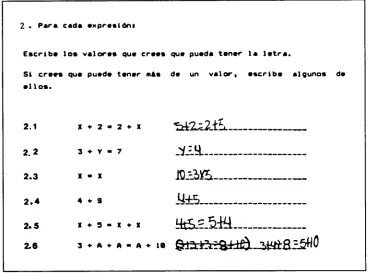
Items involving the calculation of the value of a variable
as specific unknown (VSU) 75
Etna - Answer to item 3 76
Mariana - Answers to items 2.5 and 2.6 77 Items requiring to symbolize a variable as specific
unknown (VSU) 78
Items requiring to interpret variable as general
number (VGN) 81
Items requiring to use a given variable as general
number (VGN) represented by a literal symbol 84 Items requiring to express a generalization 86
Valentin - Answer to item 12 88
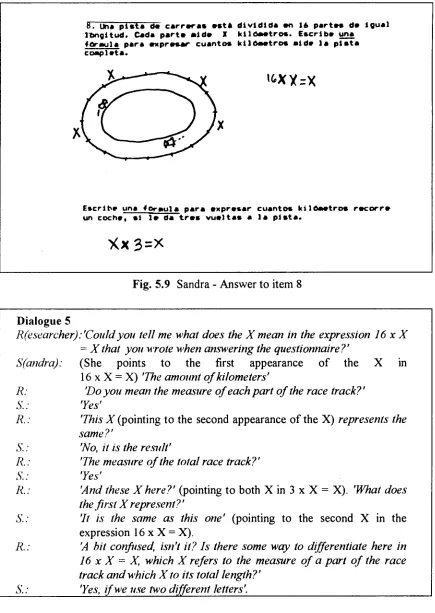
Sandra - Answer to item 8 90
Items requiring to interpret variables in a functional
relationship (VFR) 91
Item requiring to symbolize variables in a functional
relationship (VFR) 93
Chapter 3: Figure 3.1 Figure 3.2 Chapter 5: Figure 5.1 Figure 5.2 Figure 5.3 Figure 5.4 Figure 5.5 Figure 5.6 Figure 5.7 Figure 5.8 Figure 5.9 Figure 5.10 Figure 5.11 Chapter 7: Figure 7.1 Figure 7.2 Figure 7.3 Figure 7.4 Figure 7.5
Claudia and Sandra - Fixed Logo procedures to double a number
Nayeli and Soledad - General Logo procedures to draw squares
Etna - Analysis of three fixed Logo procedures to draw squares
Figure 7.6 Nayeli and Soledad - Use of simbolic variables to
write general Logo procedures 133
Figure 7.7 Valentin and Ernesto - General Logo procedures
written by using a 1-step strategy (N1) 133 Figure 7.8 Valentin and Ernesto - Evolution of the strategy
used to write general Logo procedures 138 Figure 7.9 Valentin and Ernesto - Use of a 2-step strategy
(T2b) to write a general Logo procedure 141 Figure 7.10 Valentin and Ernesto - Use of a 1-step strategy
(T1) to write a general Logo procedure 142 Figure 7.11 Valentin and Ernesto - Record of a general Logo
procedure written by using the hybrid spoken
language (Logo mixed with natural language) as support 143 Figure 7.12 Claudia and Sandra - Use of a 2-step strategy
(T2b) to write a general Logo procedure 145 Figure 7.13 Interview questions after microworld 1 146 Figure 7.14 Martha - Use of a 2-step strategy (T2b) to write
a general Logo procedure 151
Figure 7.15 Valentin - Use of a 1-step strategy (T1) to write
a general Logo procedure 152
Figure 7.16 Etna - Record of the commands applied to
a general number 154
Chapter 8:
Figure 8.1 Domain of definition of the six shapes 171 Figure 8.2 Oscar and Jonathan - Record of intervals and
predictions 174
Figure 8.3 Description of the functional relationship linking
the input and the size of the shape 176 Figure 8.4 Nayeli and Soledad - Analysis of the PYRAMID 182 Figure 8.5 Martha and Mariana - Analysis of the PALM 185 Figure 8.6 Etna and Itzel - Analysis of the PALM 188 Figure 8.7 Valentin and Ernesto - Analysis of the PALM 190 Figure 8.8 Valentin and Ernesto - Analysis of the PYRAMID 192 Figure 8.9 Oscar and Jonathan - Analysis of the BIRD 195
Figure 8.10 The drawings of the jungle' 196
Screen display corresponding to the first activity involving variable as specific unknown (VSU) Screen display corresponding to the second activity involving variable as specific unknown (VSU). Work sheet SU-2
Nayeli and Soledad - Calculations made to determine the values of two variables as specific unknown (VSUs)
Etna and Itzel - Approach to an equation with multiple appearances of variable as specific unknown (VSU)
Chapter 9: Figure 9.1
Figure 9.2
Figure 9.3 Figure 9.4
Figure 9.5
213
214 214
218
225
Chapter 10: Figure 10.1 Figure 10.2 Figure 10.3 Figure 10.4
The questions of the final interview Item 19
Mariana - Answer to item 2.5 Valentin - Answer to item 19
ACKNOWLEDGEMENTS
First of all I want to thank my supervisors, Prof. Celia Hoyles and Dr. Rosamund Sutherland, for their support, advise and encouragement during my stages at the Institute of Education as well as during their visits to the Department of Mathematical Education, CINVESTAV, in Mexico. I am very grateful to Dr. Teresa Rojano, my supervisor in Mexico, for her valuable comments and steady encouragement during these years. I also wish to thank Marta Gabriela Araujo who assisted me during the data collection.
I am indebted to the group of pupils from the school 'Centro Escolar Hermanos Revueltas' in Mexico City and in particular to the twelve case study pupils who were always ready to explain their way of working. I thank Dr. Eugenio Filloy, head of the school, who offered me all the facilities for developing the experimental work.
I would also like to thank the administrative team at the Department of Mathematical Education, CINVESTAV, in Mexico, in particular Guadalupe Guevara, Enrique Oaxaca and Marina Peral.
I am grateful to the British Council, to the Programa Nacional de Formacion y Actualizacion de Profesores de Maternaticas (PNFAPM) and to the Centro de Investigacion y de Estudios Avanzados del I.P.N. (CINVESTAV) for the economic support given to this research.
CHAPTER 1
INTRODUCTION
The concept of variable is central to algebra yet it is surprisingly difficult to define. The reason for this difficulty is that a variable has characterizations which vary according to the problem in which it is embedded. For instance, a variable may represent a specific unknown, that is a specific but unknown number that can be calculated considering the given constraints; a general number, that is an indeterminate number involved in a general method; or it might be used to represent a functional relationship between two changing values.
Research investigating pupils' learning of algebra reports that pupils have difficulties with each one of these characterizations of variable whether they are algebra beginners or more advanced students. However, there has not been investigation of pupils' potential to cope with the different characterizations of variable within environments specifically designed to facilitate this learning prior to formal algebra teaching. This research sets out to do this and additionally to investigate how these environments can help pupils construct a multifaceted notion of variable and lead them to the acceptance and use of its symbolization.
Variables are generally used in school texts without providing any introductory experience which might serve as a basis on which the idea of variable in its different meanings could be developed. In fact, pupils are faced with formal problems involving different characterizations of variable (e.g. equations, tautologies, functions) which they are taught to solve using a set of appropriate rules. This approach suggests, albeit implicitly, that with sufficient drill and practice, students will learn to cope with the different characterizations of variable in an appropriate way and moreover finally integrate their experience to form a multifaceted concept of variable. Research indicates that these expectations have few roots in reality.
Research using computer environments suggests new ways that pupils can be helped to approach the concept of variable. In particular, research investigating the development of pupils' algebraic thinking in Logo settings suggests that in these environments pupils have fewer difficulties. In particular they are more able to consider that a variable may represent a range of values as opposed to considering it representing only one arbitrary value, they are able to attach meaning to the symbols in the Logo procedures, they are able to operate on variables and finally they appear comfortable to use 'unclosed' algebraic expressions. Logo-based environments have thus been shown to facilitate pupils in seeing the power of general methods for solving similar problems and in constructing ways to express these methods.
These are promising results but leave considerable scope for further study. For example, no attention to date has been paid to the different characterizations of variable and the design of environments to facilitate their appropriation prior to any formal algebra teaching. This study sets out to fill this gap. It aims to investigate the feasibility to create pupils' potential to approach different characterizations of variable in specially designed Logo microworlds prior to the study of algebraic language. Pupils aged 12-13 years old without prior formal algebra instruction will be studied. The characterizations of variable considered are:
variable as specific unknown (VSU) - the variable represents a specific but unknown number that can be calculated under given constraints variable as general number (VGN) - the variable represents an
variables in a functional relationship (VFR) - variables represent numbers whose values move within a range of values linked one to each other by a relationship
It is considered that a pupil has developed a potential to cope in Logo with one of these characterizations of variable when (s)he is able to solve specially designed Logo-based tasks involving it. The tasks might be solved by the pupil alone or cooperating with a more capable peer or with researcher's guidance. The researcher helps pupils by providing hints, giving nudges, encouraging pupils to reflect on their own approaches, introducing new concepts or showing pupils the way of solving the given problem. Details on what is considered to indicate pupils potential in relation to each one of the different characterizations of variable will be specified in each section.
It is anticipated that this study will provide insight into pupils' ways of working with these notions and on the kind of support that might be facilitative. This information might suggest new ways to help pupils construct the idea of variable beyond the specificities of Logo environments.
This thesis is organized in 11 chapters. Chapter 2 presents the background to the study. It summarizes the outcomes of research investigating pupils' learning of elementary algebra. Pupils' approaches to variable as general number (VGN), variables in a functional relationship (VFR) and variable as specific unknown (VSU) are analyzed. Implications for teaching are discussed in reference to Vygotsky's idea of zone of
proximal development. This discussion is followed by an analysis of how the idea of
variable is presented in Mexican school texts for primary school and the first grade of secondary school. A brief survey of the historical development of the notions underlying different characterizations of variable is presented.
Chapter 3 surveys the results of research which has investigated pupils' way of working with variable in Logo. Chapter 4 presents the methodology to be adopted in the present study. Chapter 5 describes a paper and pencil questionnaire specifically designed for this investigation to provide a pre-algebraic profile of pupils concerning their interpretation and use of different characterizations of variable. It gives an overview of pupils' responses and the profiles of a sample of 12 pupils chosen for the case studies.
working in the microworlds involving the idea of variable as general number (Chapter 7);
variables in a functional relationship (Chapter 8); variable as specific unknown (Chapter
9).
Chapter 10 analyzes the case study pupils' responses in the final interview and their
answers to the extract of the questionnaire applied at the end of the study. It discusses
pupils' progress and their potential to approach different characterizations of variable.
The conclusion of the study and suggestions for further research are given in Chapter 11.
There are two appendices presenting respectively the questionnaire applied at the
beginning of the study (Appendix 1) and the Logo work sheets used during the study
CHAPTER 2
BACKGROUND TO THE STUDY
2.1 The multifaceted concept of variable.
'What are these things called variables?'. In this way Wagner (1983) titles one of her articles where she stresses the complexity of this concept and the difficulties beginning algebra students have with it. The concept of variable is not easy to define. Variable is used in different contexts with different meanings, and depending on this we treat it in different ways. Usiskin (1988), for example, highlights four different uses of variable and he links them to different conceptions of algebra.
Conception of algebra Generalized arithmetic
Means to solve certain problems Study of relationships
Structure
Uses of variable
Pattern generalizers (translate, generalize) Unknowns, constants (solve, simplify) Arguments, parameters (relate, graph) Arbitrary marks on paper (manipulate, justify)
(Usiskin, 1988, p. 17)
Although only one of these uses of variable may appear within a specific task, it is usual for students to have to cope with problems whose solution requires dealing with more than one of them. For example, to solve the following problem it is necessary to work with different uses of variable:
'Find an equation for the line through (6, 2) with slope 11 '
(Usiskin, 1988, p.14)
using the data. x and y are two variables linked by a functional relationship, x can be considered an argument that can assume any value, and the value of y changes depending on x. That is, to solve this problem students have to cope with general numbers, with constants, with unknowns, with variables in a functional relationship and they need to be able to shift from one interpretation of variable to another even when these different characterizations of variable are embedded in the same symbolic representation.
A competent user of algebra is able to give different interpretations to the variable depending on the problem faced. (S)he recognizes when (s)he is facing an equation (1) or a tautology (2) even if they look very similar:
X+ 5=X+X (1) X+ 5 =5 +X (2)
(S)he is able to simplify an algebraic expression and to cope with variability when dealing with functional relationships and to discriminate among the actions that have to be performed with variables in each specific case. To a competent user the differences between the variable uses can seem transparent and insignificant, because (s)he has already recognized them, but these are crucial for beginners and frequently they turn out to be the obstacles that block pupils' learning of algebra (Matz, 1982).
Variables in mathematics are usually represented by literal symbols. However, the same symbols are used to denote different characterizations of variable and different symbols are used to represent the same thing. This might blur distinctions that influence the way variable is manipulated in each case and hide the conditions that determine where and how the variable is varying (Matz, 1982). The symbolism used has been often considered conducive to obscuring the different uses of variable and to create confusion for beginning algebra students (Thorndike et al., 1923; Van Engen, 1953; Wagner, 1981; Matz, 1982). Proposals were made (Menger, 1956) to use symbols that would reflect the conceptual variety behind the different uses of variable. However, approaches like this would not free students from the necessity to be able to interpret the same symbolic variable in different ways. As it was already stressed, in order to solve a problem it is often necessary to shift between different interpretations of the same literal symbol.
interpret and to manipulate algebraic expressions, and to solve problems involving the use of variables represented by literal symbols.
Kuchemann (1980) identified six different pupils' interpretations and uses of literal symbols:
'Letter evaluated'.The letter is assigned a numerical value;
'Letter not used'. The letter is ignored or its existence is acknowledged without
giving it a meaning;
'Letter as object'. The letter is regarded as a shorthand for an object or as an object
in its own right;
'Letter as specific unknown'. The letter is regarded as a unique but unknown number
and pupils can operate upon it directly;
'Letter as generalized number'. The letter is seen as representing, or as being able to
take, several values;
'Letter as variable'. The letter is seen as representing a range of unspecified values,
and a systematic relationship is seen to exist between two such sets of values.
These findings highlight that pupils have different ways of interpreting letters representing variables. That is, algebra beginners consider that literal symbols used as variables can be interpreted in different ways and their meaning might vary with the problem. But the results reported by Kuchemann show also that pupils' interpretation is not always the appropriate one and often it is the source of erroneous answers.
From a Piagetian perspective, Kiichemann considered that his classification of pupils' interpretation of literal symbols was reflecting an increasing degree of difficulty. He regarded the first three categories indicative of a low level of response and argued that to consider that a child has an understanding of "beginning algebra", it is necessary for him (her) to be able to cope, at least, with simple items requiring the use of 'letter as specific unknown'. He claimed that pupils have fully understood the use of letter in algebra when they can cope with 'letter as variable'. The order introduced by Kiichemann suggests that for pupils is easier to work with 'letters as specific unknowns' than to handle 'letters as generalized numbers', and that they cope easier with 'letters as generalized numbers' than with 'letters as variables'.
easier with one interpretation of letters than with another implies that it is easier for pupils to work with one characterization of variable than with another. However, each one of the uses of variable can be taught at different levels of complexity, therefore a hierarchical organization of them does not seem appropriate for teaching purposes. Furthermore, researchers investigating pupils' work with different characterizations of variable, namely, variable as specific unknown, variable as general number and variables in a functional relationship, have found that beginning algebra pupils have difficulties with each one of them.
2.2 Pupils and the different uses of variable
2.2.1 Pupils and variable as general number.
The ability to generalize is one of the most important characteristic of intelligence (Krutetskii,1976). It is a general ability, that is, it is used in different domains and its use can be observed in very young children. However, the ability to generalize in mathematics is a specific ability, as Krutetskii and his team found; it is the specific ability to generalize numerical and spatial relations, that are expressed by numbers or literal symbols. He found a tight link between the degree of ability to generalize mathematical material and the development of ability to study mathematics. He argues that pupils who were able in mathematics easily grasped what was general in externally different situations, whereas less able pupils needed a lot of training and practice in order to be able to generalize.
Krutetskii states that mathematic generalization evolves and moves from the ability to see what is already known and general in the particular to what is unknown and general. It also moves from the necessity to go from many particular examples that are prerequisite for a generalization, to the ability to generalize from one single example. A point stressed by Krutetskii's study is that mathematical ability and in particular the ability to generalize in mathematics, are not innate but they are acquired. These arguments highlight crucial points that should be taken into account when designing teaching environments to help pupils develop the ability to generalize in mathematics.
Research investigating pupils' capability to work with variable as general number in traditional algebra tasks found that the great majority of the pupils tested have difficulties to cope with this characterization of variable. It was found (Kuchemann, 1980; Booth, 1984) that when faced with general numbers represented by a literal symbol a variety of interpretations of the literal symbol may occur and these may vary depending on the problem pupils are solving. Pupils might ignore the letter or interpret it as a specific unknown and assign it a specific value or they might interpret it as an object. Similar results were obtained in a study developed with secondary school pupils in Mexico (Avila et al., 1990).
These outcomes show that pupils are disoriented when they have to interpret literal symbols representing general numbers. Booth (1984), for example, hypothesized that pupils might have a "natural" tendency to interpret letters as standing for specific numbers. Both, Ktichemann (1980) and Booth (1984) suggested that the difficulty pupils have with letters as generalized number might depend on pupils' cognitive development.
However, the results of investigations developed in computational environments did not support this suggestion showing that in these environments pupils can be helped to develop an understanding of letter as general number. Thomas and Tall (1986), for example, extended Booth's teaching experiment to computational environments. They designed a software aiming to enable pupils 12 years old with no previous experience in algebra to improve their understanding of general algebraic concepts by structured exploration of particular examples. In particular, they focused on the use of letters as generalized number and letters as variable (Ktichemann's definition). The results of a post-test and a delayed post-test showed that the experimental group behaved significantly better than the control group on questions requiring an understanding of the use of letters as specific unknowns, letters as general numbers and letters as variables.
These findings suggest that approaches different from traditional ones might reduce pupils' difficulties and help them work with the idea of general numbers and its symbolic representation. Implicitly they also suggest that conventional instruction does not offer enough opportunities for pupils to construct the idea of general number and to develop a meaning for the symbol used to represent it. Therefore, the necessity to look for approaches that would help pupils work with general number and its symbolization.
Suggestions like these are not new. Mason (1985), for example, has investigated how to help pupils to deal with algebra as generalized arithmetic. He identified four steps in the generalization process: 'seeing' mentally grasping a pattern or a regularity; 'saying' -articulating the insight in words; 'recording' - using symbols to formulate the generalization; 'testing' - verifying the validity of the formulation. In consequence he stresses the relevance of offering pupils the opportunity to become aware of patterns or relationships and to stimulate the necessity to express them instead of rushing children into the use of literal symbols.
These arguments suggest the convenience of working with the idea of general number prior to the introduction of formal algebra language. They implicitly indicate that some of the difficulties pupils have to cope with literal symbols representing variables as general number might reflect a lack of understanding of the concept that the symbol is representing. To design appropriate environments might help pupils with arithmetic background shift from the realm of specific numbers to consider them as objects that can be subsumed under the more general concept of general number. In this way, pupils might be led to approach the idea of general number and its symbolization prior to the introduction of formal algebra.
2.2.2 Pupils and variables in a functional relationship
Variables may be used to express a relationship between two changing quantities. When used in this way their main characteristic is that they move within a range of values and the change in the value of one of them produces a change in the value of the other. This characteristic is emphasized when functional relationships are viewed as the expression of change. Dirichlet's definition of continuous function, for example, reflects this view:
the interval a to b, y=f(x) likewise varies gradually, then y is called a continuous function of x for this interval' (quoted in Hamley,1934, p. 14).
However, in present curricula functions are very often defined by two sets and a rule of correspondence which assigns to one element of one set exactly one element of the other set. In this 'modern' definition that was influenced by the development of the set theory, the idea of change and the relation between variables' movement is not stressed any more.
When this definition is used to introduce pupils to functions they may have difficulties to cope with the ideas of domain and range of variation either when the function is represented in graphic or in algebraic form (Markovits et al.,1986; Sfard,1989). They may also have difficulties with constant functions, with functions represented by a disconnected graph and with functions defined piecewise (Markovits et al.,1986).
Markovits and her colleagues (1986) suggest that these difficulties are a direct consequence of the 'modern' definition of function where the idea of variability is downgraded. Without claiming for a return to a more traditional approach these researchers suggest that pupils should be helped to narrow the gap between the old and the new definition of function. This implies that to support pupils' work with functions and the notions underlying them, namely, domain, range, monotonicity, maximum and minimum, they should be helped to perceive variables as entities whose value changes under given constraints, as well as to focus on the rule of correspondence linking them.
To develop these complementary views of variables in a functional relationship might be interpreted as a need for developing 'versatile thinking' (Tall and Thomas, 1991). 'Versatile thinking' refers to the capability to move freely and easily between the sequential/analytic and global/holistic modes of thinking (Tall and Thomas, 1991, p. 3). Concerning variables in a functional relationship this might be interpreted on the one hand as the capability to consider variables in a static, one-to-one correspondence and to be able to calculate the value of one of them in correspondence to the value assigned to the other. On the other hand, to be capable to look at variables as entities moving in a related way within ranges of values and to cope in this way with the idea of change.
ways of representing change situations (Bednarz and Dufour-Janvier, 1991). When dealing with the dynamic process pupils seem to look only for some essential characteristic that can be described pointwise. Pupils have also difficulties to perceive change when this is represented by means of graphics or other codes used in mathematics to illustrate dynamic concepts. They tend to interpret these representations in a static way. Difficulties to cope with change were observed for young pupils, 1st and 2nd grades (Bednarz and Dufour-Janvier, 1991) and it was also stressed as a characteristic that pupils studying elementary algebra may have (Heid and Kunkle, 1988).
It was found (Heid and Kunkle, 1988) that to use computer-generated tables of variable values over a given range of numbers might help pupils focus on how the values of algebraic expressions change. To analyze tables helped algebra beginners deduce domains where functions were increasing or decreasing and appreciate the effects of change in related variables.
However, tabular notation might not be helpful to work with non-linear functions. Kieran
(1992), for example, found that when working with tabular records 9-grade students (15
years old) who already have had some algebra instruction had difficulties to derive an overall view of the behaviour of non-linear functions from a tabular representation as well as to identify maximum and minimum values. In contrast, to work with a graphic representation provided these students with a global perspective. Nevertheless, other studies have found that younger pupils (Heid, 1989) or pupils classified as being of low-level ability (Dreyfus and Einsenberg, 1981) might have difficulties in working with graphics but not with tables. Dreyfus and Einsenberg (1981) suggest that notions underlying a functional relationship (e.g., domain, image) should be introduced in a graphical setting for high-level students and in a table setting for low-level students.
2.2.3 Pupils and variable as specific unknown
During primary school, prior to any algebra teaching, pupils often start dealing with simple problems where they are asked to find a specific unknown value. Usually the unknown value is not represented by a literal symbol, but by another signs (e.g. a box, a line, a void space). When pupils begin the study of algebra the sign is substituted by a literal symbol.
were able to solve number puzzle problems of the form 'I am thinking of a number. I add 12 to my number and then multiply by 6. I get 90. What is the number?' (Karplus et al., 1981, p. 148). He observed that the most frequent reasoning pattern used by pupils to solve this kind of word problems was to work backward from the given result, being trial-and-error the second most used strategy. Algebra beginners may also cope with variable as specific unknown when it appears in one-step equations, that is, equations of . the form ax = b , a + x = b and x + a = b (Kieran, 1984). To solve this kind of equations pupils use inverse operations or they substitute different numbers to the literal symbol in order to find the value that balance both sides of the equation. These findings show that faced with simple word problems or with one-step equations algebra beginners may conceptualize a specific unknown and determine its value working backward from the given result or using trial and error.
However, when a specific unknown is involved in equations with a more complicated structure (e.g., a + x = b + c, ax + b + cx = d, ax + b = cx + d) pupils have difficulties to cope with it. These equations cannot be solved in one step. To solve them it is necessary to perform first numeric operations and/or to operate with the unknown. This implies to be capable to perceive the equation globally in order to rearrange the terms before trying to calculate the value of the specific unknown (Herscovics and Linchevski, 1991b). When faced with these types of equations algebra beginners use different strategies in order to avoid operating with numbers and with unknowns. For example, it was found that faced with an equation with one appearance of the specific unknown but with more than one numeric term after the equal sign pupils tended to cut the equation after the first numeric term and to ignore the others (e.g. they solved the equation 4+ x-2+5 = 11+3-5 as it were the equation 4 + x - 2 +5 = 11) (Kieran, 1984).
To solve equations of the form ax + b + cx = d implies to be able to operate with specific unknown. That is, this type of equations cannot be solved using only arithmetic operations. To operate with the specific unknown presents difficulties to most algebra beginners. It was observed that to solve this type of equations pupils may try to invert the operations before grouping similar terms (Kieran, 1984). That is, they try to extend to these equations a rule they use successfully with one-step equations. They may also determine the specific unknown by systematic substitution (Herscovics and Linchevski, 1991a). These different approaches show that pupils tend not to operate with specific unknown.
Herscovics and Linchevski, 1991a). Filloy and Rojano (1984, 1989) found that the transition from solving equations of the form x + a = b to the solution of equations of the form ax + b = cx + d is neither immediate nor spontaneous. To solve this kind of equations algebra beginners often use trial and error assigning different values to the different appearances of the specific unknown in the same expression ('polysemia' error) (Filloy and Rojano, 1984). The 'polysemia' error can be avoided by telling pupils explicitly that all the appearances of the specific unknown represent the same value (Herscovics and Linchevski, 1991a). The difficulties pupils have with this type of equations led Filloy and Rojano to suggest that a didactical cut occurs when the specific unknown appears on both sides of the equation. To cope with this kind of equations it is necessary to be familiar with algebraic syntax. Although originated from arithmetic, to cope with algebraic syntax demands to break with certain arithmetical notions. Therefore the presence of the suggested didactical cut. Because of the difficulties pupils have to operate with the unknown also when multiple appearances of it occur on the same side of the equal sign Herscovics and Linchevski (1991a) considered the didactical cut in terms of a cognitive obstacle pupils may have to operate on or with the specific unknown.
These results highlight the difficulties pupils have in operating with or on the specific unknown. Traditional teaching that emphasizes manipulative skills seems not to be helpful for pupils to overcome these difficulties. Moreover, some of the approaches to specific unknown used in elementary school might originate incorrect equations solving strategies. For example, pupils are often taught that to solve an equations is equivalent to invert the operations. Kieran (1988) suggests that this approach may lead pupils to conceive the variable 'as the result of a set of inverse operations - with the letter having no existence of its own within the given equation' (Kieran, 1988, p. 95). This interpretation might be an obstacle for making sense of equations that cannot be solved by inverting the operations and for operating with or on specific unknown. It cannot be expected that pupils will spontaneously overcome these difficulties. As it was stressed by Filloy and Rojano (1989), to help pupils overcome the difficulties they have with operating on and with the specific unknown is an educational task.
construction of algebraic syntax. Teaching intervention was found crucial to help pupils progress from the model to the construction of algebraic notions.
It was also found (Herscovics and Linchevski, 1991b) that individualized teaching specially designed in order to help pupils overcome the inability to operate on or with specific unknown, led pupils to acquire the capability to group similar terms in an equation. However, it was observed that difficulties persisted when pupils had to cope with the unknown in the form of a singleton.
To look in pupils' background for a cognitive basis on which to build the new knowledge might be also crucial as was suggested by Chalouh and Herscovics (1988). A teaching experiment was designed (Chalouh and Herscovics, 1988) to help pupils without any formal algebra instruction create meaning for expressions involving one unknown and one operation, and for expressions with several unknown and multiple operations. The results obtained showed that pupils could pass from using signs representing place holders to letters, to letters representing a hidden quantity, and to letters representing an unknown quantity. They were also able to cope with algebraic expressions with multiple terms. To indicate explicitly the frame of reference and to ask pupils to answer 'in algebra' was found to be essential in order to help them shift from the arithmetic context to the algebraic one. These findings show that for algebra beginners it might be crucial to let them know clearly the mathematical context in which they are expected to work. This suggests that some erroneous behaviour might be influenced by not having clear the context in which they are expected to solve the problem.
These results show that great efforts have been made in order to look for approaches that would help pupils overcome the difficulties they have with specific unknown. However, more work is needed in order to help pupils grasp the idea of variable as specific unknown and be able to cope with it when dealing with problems and solving equations.
2.2.4 Implications for teaching
All these suggestions arise from research investigating algebra beginners or pupils that have had no formal algebra instruction at all. They claim for the necessity to approach each one of the different characterizations of variable in a way different from the traditional one. They manifest the necessity to devise appropriate environments where pupils might use their prior mathematic knowledge in order to approach these concepts in a meaningful way. Implicitly these arguments suggest that work should be done prior to approaching variables in a formal way. This leads to consider the feasibility to design environments in which pupils might be led to approach different characterizations of variable prior to formal algebra teaching. To work in these environments might help pupils create a potential to cope with different characterizations of variable and awaken in this way developmental processes that might help pupils cope later with a more formal treatment of variable. The idea of helping pupils create a potential to work with new concepts is linked to Vygotsky's idea of zone of proximal development.
In recent years the theory of the Soviet psychologist L.S. Vygotsky (1896-1934) has become a focus of interest for many psychologists studying children cognitive development and the formation of concepts. In particular, Vygotsky's notion of zone of
proximal development is awakening a growing interest among educational researchers.
This notion derived from both, a critique of the psychological tendencies that were developing in the first half of this century, and the search for a Marxist theory of cognitive development. Vygotsky (1978) criticized the relation established between development and learning by the most outstanding contemporary theories. He stressed, for example, that theories as the one developed by Piaget viewed development as a prerequisite for learning. He considered that a second major tendency was elaborated by James (1958) and that it identified development with learning. He discussed also Kofflca's approach stressing that in this view development and learning mutually influence each other but development is always a larger set than learning. He considered that the most frequent error of these different theories was to consider only one developmental stage, the one referring to child's actual development, that is, 'the level of development of a child's mental functions that has been established as a result of certain already completed developmental cycles' (Vygotsky, 1978, p. 85).
is determined by the child's capability to solve problems in collaboration with a more capable peer or with adult guidance. Vygotsky defined the zone of proximal
development as ' the distance between the actual developmental level as determined by
independent problem solving and the level of potential development as determined through problem solving under adult guidance or in collaboration with more capable peers' (Vygotsky, 1978, p. 86) and he considered that 'an essential feature of learning is that it creates the zone of proximal development; that is, learning awakens a variety of internal developmental processes that are able to operate only when the child is interacting with people in his environment and in cooperation with his peers' (Vygotsky, 1978, p. 90).
These ideas reflect Vygotsky's theory of the social origins of individual higher mental functions such as thinking, voluntary attention, logical memory, the formation of concepts. He considered that any function in the child's cultural development appears twice. First, it appears on the social plane, that is, between people as an interpsychological category, and then within the child as an intrapsychological category (Vygotsky, 1981). As pointed out by Wertsch (1984) this does not simply mean that individual's mental processes develop in a social environment but, that the organization of mental processes is the direct reflect of the social life in which they are formed. Therefore, the social environment in which the new concepts are approached acquires in this theory a crucial role. The mastery of a new concept is considered a consequence of interaction with more competent persons and this interaction creates the zone of
proximal development. That is, the zone of proximal development is not in the child
waiting to be awakened by a more competent person but, for a particular subject it is created as a consequence of negotiation established between the child and the expert (McLane, 1987).
teacher changes from being a transmitter of a body of knowledge to being an expert who by interacting with pupils helps them develop a potential for solving new problems and constructing new concepts. Peers collaborations acquires as well an outstanding role in contrast with individual and often competitive work. The organization of the social environment in which teaching activities take place also becomes crucial.
Because social interaction is considered by Vygotsky to be the fundamental vehicle of education and the creation of the zone of proximal development, speech is necessarily involved. In Vygotsky's theory speech and the evolution of its use have a crucial role in the formation of higher mental functions. He considers that even for young children the primary function of speech is social communication. Child's communicative speech evolves later to egocentric speech, that is, speech-for-oneself. Vygotsky states that this appears 'when the child transfers social, collaborative forms of behaviour to the sphere of inner-personal psychic functions' (Vygotsky, 1989, p. 35). Egocentric speech is then used by the child to direct himself during an activity he develops without the expert help. In this way, speech changes from having an interpersonal to having also an intrapersonal function (Vygotsky, 1978) and it is used as a problem solving tool. In Vygotskyitheory egocentric speech leads to inner speech, that is, to individualized verbal thought. In this context, egocentric speech is considered to be the transition step between social interchange characterized by communication and individualized inner mental functions (Kozulin, 1989).
2.3 The variable in Mexican school texts
2.3.1 Introduction
Because this study will be conducted in Mexico with Mexican pupils, the way different characterizations of variable are introduced in Mexican school texts will be briefly discussed. These texts reflect the official mathematic program used during the last twenty years. This has been analyzed and criticized from its appearance. Some methodological inconsistences and the incoherence between the declared psychological background and its practical realization have been highlighted (Rojano, 1977).
In Mexico the study of algebra starts officially during the second year of secondary school (pupils aged 13-14 years old). However, pupils are usually presented with symbolic variable earlier: during the primary school and during the first grade of secondary school. Therefore, the official texts used in the fourth, fifth and sixth grades of primary school, and some of the widely used mathematical texts for the first grade of the secondary school were analyzed.
2.3.2 Variables in a functional relationship
In the mathematical texts for primary school variables in a functional relationship appear principally in geometry. They are represented by literal symbols and they are used mainly to provide pupils with formulae for areas and volumes. Although the geometric formulae represent functional relationships between the variables involved, this aspect is not stressed. Pupils are expected to memorize formulae and to use them in order to obtain a result by substituting given values to the literal symbols involved. In this way literal symbols are emphasized as representing 'place holders', that is, symbols to which specific but arbitrary numbers might be substituted. A similar approach is used in the first year of secondary school where pupils are introduced to formulae for calculating the volume of geometric objects.
approach to functions emphasizes the idea of correspondence between variables but not that of change.
2.3.3 Variable as general number
The analyzed texts showed that in primary school the only contact pupils have with variable used as general number is in the fifth grade where pupils are introduced very briefly to the symbolic expression of some general arithmetic rules. The following example illustrates how the general commutative rule is deduced from few particular examples and how it is symbolized by means of letters used as general numbers:
'Observe that:
2 +3 =3 +2 7 + 2=2 + 7 9 + 6=6 + 9 3 +4=4 +3 7+ 8=8+ 7 5 + 3 = 3 + 5 0 + 2=2 + 0 1 + 3 = 3 + 1 etc..
we can conclude that if a and b represent two whole positive numbers, itwillbe a+b=b+a'.
(Matematicas 5, p. 94)
No additional explanation concerning the meaning of the literal symbols used is given. After this introduction pupils are invited to solve some exercises in order to foster the just given general commutative rule:
'If 4+ 3 = 3 + m then m= If 7 + 23 = x + 7 then x = '
(Maternaticas 5, p. 94)
exercises might contribute to strengthen the interpretation of literal symbols as place holders even when they represent specific unknowns. In a similar way the general associative and the distributive rules are introduced. There is no additional work with general numbers during the primary school.
The main aim of the mathematics course for the first year of secondary school in Mexico is to introduce pupils to generalized arithmetic. Pupils are usually presented with generalized arithmetic rules involving the use of variables as general numbers represented by a literal symbol. Throughout the books algebraic expressions representing generalized arithmetic rules are used. However, no construction of general methods is promoted and no explanation about the meaning of the literal symbols used is given. Moreover, on occasion the initials of meaning words are used to represent general numbers. This is illustrated by the following example that presents in a formal way what is meant by 'division':
'D=dc+r with r<d'
(Habacuc,1980,p. 74)
Here D stays for 'dividendo' (the number that is divided), d for 'divisor' (the number that divides), c for 'cociente' (quotient) and r for 'remanente' (remainder). This notation far from helping pupils to interpret the literal symbols as general numbers is leading to an interpretation of them as labels.
These approaches suggest that it is taken for granted that pupils will be able to conclude, by themselves, that in general rules literal symbols represent general numbers.
2.3.4 Variable as specific unknown
In primary school pupils deal with simple equations involving the idea of specific unknown. The specific unknown is always represented by a sign other than a letter (e.g. a box, a line) or a void space. Pupils are asked to find the 'missed number' in problems like
6 + =0 or 7 + =3
or to complete expressions, for example, in
No introduction to the use of literal symbols to represent specific unknowns is given. During the first grade of secondary school pupils are on occasion introduced to equation solving. For example, in Serralde (1982) some numeric examples concerning the subtraction of natural numbers lead to the following general conclusion:
' If a + b = c then c - a = or c - b =
(Serralde et al.,1982, p. 37)
After this and some numeric exercises dealing with subtraction, pupils are introduced to equations solving in order to apply the previously deduced general rule:
'5 + a = 12
a = 12 - 5 ... converting it to a subtraction a = 7 .... because 5 + 7 = 12'.
(Serralde et al., 1982, p. 39)
No explanation about the use of literal symbols is given although they are used to represent both, variable as specific unknown and variable as general number. This suggests an implicit assumption that pupils will be able to interpret the literal symbols in a correct way, that is, as general numbers when facing general statements, and as specific unknown when coping with equations.
2.3.5 Other uses of literal symbols
The analysis of the selected texts shows that literal symbols are widely used also as labels and as objects. For example, literal symbols are used as labels to name true and false propositions:
'a = the cat is an insect
f = 3 x 9 = 8 x 3
I= x is an odd number
They are used to name sets, objects of a set and to represent the general element of a set as it is illustrated by the following example:
'A = (x is a letter of the word 'mathematics') Which of these sets is a subset of A ?:
B = (a,e,i)
C = (m,a,t,e,o)
D = (x is a letter of the word 'house')
E= (a,m,o) '
(Escareno et al., 1979)
These different uses of literal symbols appear very often in the same text. This might contribute substantially to create confusion about the meaning literal symbols may have in mathematics.
2.3.6 Summary
This review of Mexican school mathematic texts shows that during the primary school pupils are presented with variables in a functional relationship. These are represented by literal symbols. But these are usually emphasized as 'place holders' and not as representing variables in a functional relationship. During the first year of secondary school the concept of function is on occasion briefly introduced in a formal way and the correspondence between the variables involved is stressed. However, the idea of change is not stressed and there are no activities leading to the construction of the idea of variables in a functional relationship as entities moving in a linked way.
In the first year of secondary school pupils are faced with generalized arithmetic expressions involving the use of literal symbols to represent variables as general numbers. However, there is an absence of activities leading to the construction of the idea of variable as general number.
In the analyzed texts there is no activity leading to the construction of different uses of variable. Pupils are rushed to the symbolic representation of variables. This suggests that they are expected to be able to make sense of the literal symbols and to work with different uses of variable. This approach may reflect an implicit belief that by drill and practice pupils will acquire the capability to cope with each one of the different uses of variable as well as to shift from one to another when required by a specific task. Although it is not expected that pupils will work alone and it is expected that the teacher will play a fundamental role in helping pupils cope with different uses of variable, the teachers usually reinforces the approach reflected by the school texts.
Due to the complexity of the concept of variable it is perhaps too optimistic to expect that an approach like the one reflected by the analyzed texts will help pupils to cope successfully with it. Moreover, the outcomes of research investigating pupils' difficulties with different characterizations of variable suggest the necessity to work with them prior to the introduction of algebraic symbolism. This suggestion is further supported by the historical development of the notions underlying some of the different characterizations of variable, namely, variable as specific unknown, variables in a functional relationship, variable as general number. These notions developed during centuries before the appearance of a symbolic system that subsumed them under a common symbolism and started the development of symbolic algebra.
2.4 A survey of the historical development of the notions underlying
different characterizations of variable
2.4.1 Introduction
2.4.2 The early presence of specific unknown
The study of Babylonian and Egyptian documents (about 2000 B.C.) as well as the analysis of early Hindu and Chinese (I. to VII. century A.D.) mathematics show that in these civilizations problems were solved where the determination of a specific unknown quantity was required (Neugebauer, 1969; Gillings, 1972). Problems involving what today we would call second and third degree equations and systems of linear equations with two or more unknowns were solved by Babylonians, Hindu and Chines (Neugebauer, 1969; Franci and Rigatelli, 1979; Bunt & al., 1976; Cajori, 1980). Although Egyptian algebra was far less advanced, they were solving numerical equation of first and second degree (Neugebauer, 1969; Gillings, 1972).
These cultures did not have anything approximating modern notation. Babylonian and Egyptian algebra was rhetoric (Neugebauer, 1969), that is, totally expressed in natural language. Chinese algebra was manipulative and linked to direct calculation. However, an attempt of representing the specific unknown can be observed in Chinese algebra. They used a computing board and carried out calculations by means of rods. To represent the specific unknown whose value they were looking for they used a rod that was easily distinguished from the others (Cajori, 1980).
An interesting approach to the symbolization of specific unknown quantities is observed in Hindu mathematics. They identified it by a color name (Rouse Ball, 1960) and when several unknowns occurred they gave them distinct names. They used the initials of the names as a symbol to represent the unknown quantity. Sometimes the word 'color' was used as synonymous for 'unknown quantity' (Rouse Ball, 1960). Although Hindu algebra cannot be considered symbolic, it might be classified as syncopated (Rouse Ball, 1960), that is, a combination of natural language and symbols, due to the use of words' abbreviations.
The most important approach to the use of a symbol to represent a specific unknown occurred in Greek algebra whose development reflected the Mesopotamian tradition (Neugebauer, 1969). Diophantus (about 250 A.D.) in 'Arithmetic', his main work, used a symbol to represent the 'unknown quantity' and its powers in problems that led to equations of first and second degree. However, as remarked by Klein, J. (1968) in his comment on Diophantus: