Compact Multi-Signatures for Smaller
Blockchains
Dan Boneh1, Manu Drijvers2,3, and Gregory Neven2 1
Stanford University
2 IBM Research – Zurich
{mdr,nev}@zurich.ibm.com
3 ETH Zurich
Abstract. We construct new multi-signature schemes that provide new functionality. Our schemes are designed to reduce the size of the Bitcoin blockchain, but are useful in many other settings where multi-signatures are needed. All our constructions support both signature compression and public-key aggregation. Hence, to verify that a number of parties signed a common message m, the verifier only needs a short multi-signature, a short aggregation of their public keys, and the messagem. We give new constructions that are derived from Schnorr signatures and from BLS signatures. Our constructions are in the plain public key model, meaning that users do not need to prove knowledge or possession of their secret key.
In addition, we construct the first short accountable-subgroup multi-signature (ASM) scheme. An ASM scheme enables any subsetS of a set ofnparties to sign a messagemso that a valid signature discloses which subset generated the signature (hence the subset S is accountable for signingm). We construct the first ASM scheme where signature size is onlyO(κ) bits over the description ofS, whereκis the security param-eter. Similarly, the aggregate public key is onlyO(κ) bits, independent of n. The signing process is non-interactive. Our ASM scheme is very practical and well suited for compressing the data needed to spend funds from at-of-nMultisig Bitcoin address, for any (polynomial size) tand
n.
1
Introduction
Consider n parties where each party independently generates a key pair for a signature scheme. Some time later allnparties want to sign the same message
m. A multi-signature scheme[28, 38] is a protocol that enables thensigners to jointly generate a short signatureσonmso thatσconvinces a verifier that alln
parties signedm. Specifically, the verification algorithm is given as input then
schemes [38]. Secure multi-signatures have been constructed from Schnorr sig-natures (e.g. [9]), from BLS sigsig-natures (e.g. [10]), and from many other schemes as discussed in Section 1.5.
A more general concept called anaggregate signature scheme[12] lets each of thenparties sign adifferentmessage, but all these signatures can be aggregated into a single short signatureσ. As before, this short signature should convince the verifier that all signers signed their designated message.
Applications to Bitcoin. Multi-signatures and aggregate signatures can be
used to shrink the size of the Bitcoin blockchain [40]. In recent work, Maxwell, Poelstra, Seurin, and Wuille [35] suggest using multi-signatures to shrink the transaction data associated with Bitcoin Multisig addresses. Conceptually, a Multisig address is the hash ofnpublic keyspk1, . . . ,pkn along with some num-ber t ∈ {1, . . . , n} called a threshold (see [2, 35] for details). To spend funds associated with this address, one creates a transaction containing all n public keyspk1, . . . ,pkn followed bytvalid signatures fromtof thenpublic keys, and writes this transaction to the blockchain. The message being signed is the same in allt signatures, namely the transaction data.
In practice, Multisig addresses often uset=n, so that signatures from alln
public keys are needed to spend funds from this address. In this case, alln sig-natures can be compressed using a multi-signature scheme into a single short signature. This shrinks the overall transaction size and reduces the amount of data written to the blockchain. This approach can also be made to work for
t < n, when nt
is small, by enumerating all t-size subsets [35, Sec. 5.2]. Multi-signatures can also be used to compress multi-input transactions, but for sim-plicity we will focus on Multisig addresses.
Notice that we still need to write allnpublic keys to the blockchain, so com-pressing the signatures does not save too much. Fortunately, there is a solution to this as well. Maxwell et al. [35], building on the work on Bellare and Neven [9], construct a Schnorr-based multi-signature scheme that also supports public key aggregation; the verifier only needs a short aggregate public key instead of an explicit list of allnpublic keys. With this approach, ann-of-nMultisig address is simply the hash of the short aggregate public key, and the data written to the blockchain in a spending transaction is this single short aggregated public key, a single short compressed signature, and the message. This data is sufficient to convince the verifier that all nsigners signed the transaction. It shrinks the amount of data written to the blockchain by a factor ofn.
In Section 5, we present a modification of the scheme by Maxwell et al. that we prove secure under the standard discrete-log assumption. Our
MSDL
scheme retains all the benefits of the original scheme, and in particular uses the same key aggregation technique, but we add one round to the signing protocol.1.1 Better constructions using pairings
Our main results show that we can do much better by replacing the Schnorr signature scheme in [35] by BLS signatures [13]. The resulting schemes are an extremely good fit for Bitcoin, but are also very useful wherever multi-signatures are needed.
To describe our new constructions, we first briefly review the BLS signa-ture scheme and its aggregation mechanism. Recall that the scheme needs: (1) An efficiently computable non-degenerate pairing e: G1×G2 → Gt in groups G1,G2,Gt of prime order q. We let g1 and g2 be generators of G1 and G2 re-spectively. (2) A hash function H0 :M →G1. Now the BLS signature scheme works as follows:
– Key generation: choose a randomsk ←$
Zq and output (pk,sk) where pk←
gsk
2 ∈G2.
– Sign(sk, m): outputσ←H0(m)sk ∈G1.
– Verify(pk, m, σ): ife(σ, g2)
?
=e H0(m),pkoutput “accept”, otherwise out-put “reject”.
This signature scheme supports a simple signature aggregation procedure. Given triples (pki, mi, σi) for i = 1, . . . , n, anyone can aggregate the signatures
σ1, . . . , σn∈G1 into a short convincing aggregate signatureσby computing
σ←σ1· · ·σn ∈G1. (1)
To verify this aggregate signatureσ∈G1 one checks that:
e(σ, g2) =e H0(m1),pk1
· · ·e H0(mn),pkn
. (2)
Note that verification requires all (pki, mi) fori= 1, . . . , n. When all the mes-sages being signed are the same (m1 =. . . =mn) the verification relation (2) reduces to a simpler test that requires only two pairings:
e(σ, g2)
?
=eH0(m1),pk1· · ·pkn
. (3)
Moreover, the verifier only needs to be given a short aggregate public-keyapk := pk1· · ·pkn∈G2.
The rogue public-key attack.The simple signature aggregation method in (1)
is insecure on its own, and needs to be enhanced. To see why, consider the following rogue public-key attack: an attacker registers a rogue public keypk2:=
gα
2·(pk1)−1∈G2, wherepk1∈G2is a public key of some unsuspecting user Bob, and α←$
it and Bob signed some messagem∈ Mby presenting the aggregate signature
σ:=H0(m)α.This signature verifies as an aggregate of two signatures, one from pk1 and one frompk2, because
e(σ, g2) =e H0(m)α, g2=e H0(m), gα2
=e H0(m),pk1·pk2
.
Hence, thisσsatisfies (3). In effect, the attacker committed Bob to the message
m, without Bob ever signing m.
Defenses.There are two standard defenses against the rogue public-key attack:
– Require every user to prove knowledge or possession of the corresponding secret key [10, 32, 47]. However, this is difficult to enforce in practice, as argued in [7, 47], and does not fit well with applications to crypto currencies, as explained in [35].
– Require that the messages being aggregated are distinct [12, 7], namely the verifier rejects an aggregate signature on non-distinct messages. This is suf-ficient to prevent the rogue key attack. Moreover, message distinctness can be enforced by always prepending the public key to every message prior to signing. However, because now all messages are distinct, we cannot take ad-vantage of public-key aggregation as in (3) when aggregating signatures on a common message m.
1.2 Our pairing-based results
In Section 3 we propose a different defense against the rogue public-key attack that retains all the benefits of both defenses above without the drawbacks. In particular, our multi-signature scheme supports public key aggregation and fast verification as in (3). Moreover, the scheme is secure in the plain public-key model, which means that users do not need to prove knowledge or possession of their secret key. The scheme has two additional useful properties:
– The scheme supports batch verification where a set of multi-signatures can be verified as a batch faster than verifying them one by one.
– We show in Section 3.3 that given several multi-signatures on different mes-sages, it is possible to aggregate all them using (1) into a single short sig-nature. This can be used to aggregate signatures across many transactions and further shrink the data on the blockchain.
Our construction is based on the approach developed in [9] and [35] for securing Schnorr multi-signatures against the rogue public key attack.
who aggregates all of them into a single signature. No interaction is needed, and the parties do not all need to be online at the same time. Moreover, we de-scribe an aggregate multi-signature scheme
AMSP
that further compresses the multi-signatures on the different transactions into a single aggregate signature, yielding even more space savings.Accountable-Subgroup Multi-signatures. Consider again n parties where
each party generates an independent signing key pair. An ASM enables any subsetS of thenparties to jointly sign a message m, so that a valid signature implicates the subset S that generated the signature; hence S is accountable for signing m. The verifier in an ASM is given as input the (aggregate) ASM public key representing allnparties, the setS ⊆ {1, . . . , n}, the multi-signature generated by the setS, and the message m. It accepts or rejects the signature. Security should ensure that a set of signersS06⊇S cannot issue a signature that will be accepted as if it were generated byS. We define ASMs and their security properties precisely in Section 4. This concept was previously studied by Micali et al. [38].
Any secure signature scheme gives a trivial ASM: every party generates an independent signing key pair. A signature by a setS on messagemis simply the concatenation of all the signatures by the members ofS. For a security parameter
κ, the public key size in this trivial ASM isO(n×κ) bits. The signature size is
O(|S| ×κ) bits.
Our
ASM
scheme is the first ASM where signature size is only O(κ) bits beyond the description of the setS, and the public key is only O(κ) bits, inde-pendent ofn. Concretely, the multi-signature is only two group elements, along with the description of S, and the public key is a single group element. The signing process is non-interactive, but initial key generation requires a simple one-round protocol between the all nsigners.To see how this can be used, consider again a Bitcoinn-of-nMultisig address. We already saw that multi-signatures with public key aggregation reduce the amount of data written to the blockchain to onlyO(κ) bits when spending funds from this address (as opposed toO(κ×n) bits as currently done in Bitcoin). The challenge is to do the same for at-of-nMultisig address wheret < n. Our ASM gives a complete solution; the only information that is written to the blockchain is a description ofS plus three additional group elements: one for the public key and two for the signature, even when nt
is exponential. This is much better than the trivial linear size ASM scheme currently employed by Bitcoin.
1.3 Proofs of possession
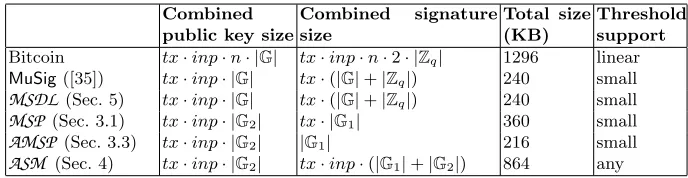
Combined public key size
Combined signature size
Total size (KB)
Threshold support Bitcoin tx·inp·n· |G| tx·inp·n·2· |Zq| 1296 linear MuSig([35]) tx·inp· |G| tx·(|G|+|Zq|) 240 small
MSDL (Sec. 5) tx·inp· |G| tx·(|G|+|Zq|) 240 small
MSP (Sec. 3.1) tx·inp· |G2| tx· |G1| 360 small
AMSP (Sec. 3.3) tx·inp· |G2| |G1| 216 small
ASM (Sec. 4) tx·inp· |G2| tx·inp·(|G1|+|G2|) 864 any Table 1. Comparison of the space required to authorize a block in the Bitcoin blockchain containingtxtransactions, each containinginpinputs, all fromn-out-of-n
multisig wallets. Here, |G| denotes the space required to represent an element of a
group. The fourth column shows the concrete number of bytes taken in a bitcoin block by choosing some sample parameters (tx= 1500,inp= 3,n= 3), using secp256k1 [18] for Bitcoin,MuSig, andMSDLschemes (|G|= 32B,|Zq|= 32B), and BLS381 [6] for the pairing-basedMSP,AMSP, andASM schemes (|G1|= 96B,|G2|= 48B,|Zq|= 32B). In the right-most column, “linear” denotes thatt-of-n thresholds are supported with key and signature sizes linear in nand t, “small” denotes that support is limited to
n t
being small, and “any” denotes support for arbitrary (polynomial size)tandn.
verified once and then discarded. Other applications may involve a more or less static set of signing nodes whose keys can be verified once and used in arbitrary combinations thereafter.
The PoP variants offer some advantages over our main schemes, such as simply using the product or hash of the public keys as the aggregate public key (as opposed to a multi-exponentiation), and having tighter security proofs to the underlying security assumption.
1.4 Efficiency comparison
Table 1 shows to what extent our constructions reduce the size of the Bitcoin blockchain. Our pairing-based scheme and
AMSP
and our discrete logarithm-based schemeMSDL
both require less than 20% of the space to authenticate all transactions in a Bitcoin block compared to the currently deployed solution, assuming realistic parameters. While not immediately visible from the table, accountable-subgroup multi-signature schemesASM
is most useful for t-of-nsignatures when nt is very large. For instance, for a 50-out-of-100 multisig wallets, the currently deployed bitcoin solution would require 30 times more space than our
ASM
scheme. The other schemes support threshold signatures using Merkle trees [37] as outlined in [35, Sec. 5.2], but only when ntis small enough to generate the tree. This method would for example be infeasible for a 50-of-100 threshold scheme.
1.5 Related Work
pair-ings [10, 32, 47, 11, 30], and lattices [5]. Defending against rogue public-key at-tacks has always been a primary concern in the context of multisignature schemes based on discrete-log and pairings [27, 39, 38, 12, 9, 7, 47], and is the main reason for the added complexity in discrete-log-based multi-signature systems. Aggre-gate signatures [12, 24, 1] are a closely related concept where signatures by different signers on different messages can be compressed together. Sequential aggregate signatures [33, 32, 41, 14, 23] are a variant where signers take turns adding their own signature onto the aggregate. The concept of public-key aggre-gation in addition to signature compression has not been explicitly discussed in the plain public key model until [35] and this work. This concept greatly reduces the combined length of the data needed to verify a multi-signature.
2
Preliminaries
2.1 Bilinear Groups
LetGbe a bilinear group generator that takes as an input a security parameter
κ and outputs the descriptions of multiplicative groups (q,G1,G2,Gt, e, g1, g2) where G1, G2, and Gt are groups of prime order q, e is an efficient, non-degenerating bilinear map e : G1×G2 → Gt, and g1 and g2 are generators of the groupsG1and G2, respectively.
2.2 Computational Problems
Definition 1 (Discrete Log Problem). For a group G=hgiof prime order
q, we define AdvdlG of an adversaryAas
Prhy=gx:y←$
G, x←$ A(y) i
,
where the probability is taken over the random choices of A and the random selection of y.A (τ, )-breaks the discrete log problem if it runs in time at most
τ and hasAdvdlG ≥. Discrete log is (τ, )-hard if no such adversary exists.
Definition 2 (Computational co-Diffie-Hellman Problem).For a groups
G1=hg1i,G2=hg2i of prime orderq, defineAdvcoG1-,CDHG2 of an adversaryAas
Prhy=g1αβ: (α, β)←$
Z2q, y← A(g α 1, g
β 1, g
β 2)
i
,
where the probability is taken over the random choices of A and the random selection of(α, β).A(τ, )-breaks theco-CDHproblem if it runs in time at most
τ and hasAdvcoG1-,CDHG2 ≥.co-CDHis (τ, )-hard if no such adversary exists.
Definition 3 (Computationalψ-co-Diffie-Hellman Problem).For a groups
G1 = hg1i,G2 = hg2i of prime order q, let Oψ(·) be an oracle that on input
g2α∈G2 returns gα1 ∈G1. DefineAdvψG-1co,G-2CDH of an adversaryAas
Prhy=gαβ1 : (α, β)←$
Z2q, y← A
Oψ(·)
where the probability is taken over the random choices of A and the random selection of (α, β). A (τ, )-breaks the ψ-co-CDH problem if it runs in time at most τ and has Advψ-co-CDH
G1,G2 ≥. ψ-co-CDH is(τ, )-hard if no such adversary
exists.
2.3 Generalized Forking Lemma
The forking lemma of Pointcheval and Stern [46] is commonly used to prove the security of schemes based on Schnorr signatures [48] in the random-oracle model. Their lemma was later generalized to apply to a wider class of schemes [9, 3]. We recall the version due to Bagherzandi, Cheon, and Jarecki [3] here.
Let A be an algorithm that on input in interacts with a random oracle H : {0,1}∗ →
Zq. Let f = (ρ, h1, . . . , hqH) be the randomness involved in an
execution of A, where ρ is A’s random tape, hi is the response to A’s i-th query to H, andqH is its maximal number of random-oracle queries. Let Ω be the space of all such vectors f and let f|i = (ρ, h1, . . . , hi−1). We consider an execution of A on inputin and randomnessf, denoted A(in, f), as successful if it outputs a pair (J,{outj}j∈J), where J is a multi-set that is a non-empty subset of {1, . . . , qH} and{outj}j∈J is a multi-set of side outputs. We say that
Afailed if it outputs J =∅. Let be the probability thatA(in, f) is successful for fresh randomness f ←$ Ω and for an input in ←$ IG generated by an input generatorIG.
For a given input in, the generalized forking algorithm GFA is defined as
follows:
GFA(in):
f = (ρ, h1, . . . , hqH)←
$ Ω
(J,{outj}j∈J)← A(in, f) IfJ =∅then outputfail
LetJ ={j1, . . . , jn} such thatj1≤. . .≤jn Fori= 1, . . . , n do
succi←0 ; ki←0 ; kmax←8nqH/·ln(8n/) Repeat untilsucci = 1 orki> kmax
f00←$ Ω such thatf0|
ji=f|ji Letf00= (ρ, h1, . . . , hji−1, h
00
ji, . . . , h
00
qH)
(J00,{out00j}j∈J00)← A(in, f00)
Ifh00j
i 6=hji andJ
006=∅ andj
i∈J00then out0ji←out00ji ; succi←1
Ifsucci= 1 for alli= 1, . . . , n
Then output (J,{outj}j∈J,{out0j}j∈J) else outputfail
We say thatGFAsucceeds if it doesn’t output fail. Bagherzandi et al. proved
the following lemma for this forking algorithm.
Lemma 1 (Generalized Forking Lemma [3]). Let IG be a randomized
qH random-oracle queries that succeeds with probability . If q > 8nqH/, then
GFA(in)runs in time at mostτ·8n2qH/·ln(8n/)and succeeds with probability at least /8, where the probability is over the choice of in ←$ IG and over the
coins of GFA.
2.4 Multi-Signatures and Aggregate Multi-Signatures
We follow the definition of Bellare and Neven [9] and define a multisigna-ture scheme as algorithms Pg, Kg, Sign, KAg, and Vf. A trusted party gen-erates the system parameters par ← Pg. Every signer generates a key pair
(pk,sk)←$ Kg(par), and signers can collectively sign a messagemby each calling
the interactive algorithmSign(par,PK,sk, m), wherePKis the set of the public keys of the signers, andsk is the signer’s individual secret key. At the end of the protocol, every signer outputs a signature σ. Algorithm KAg on input a set of public keysPK outputs a single aggregate public keyapk. A verifier can check the validity of a signatureσon messagemunder an aggregate public keyapk by running Vf(par,apk, m, σ) which outputs 0 or 1 indicating that the signatures is invalid or valid, respectively.
A multisignature scheme should satisfy completeness, meaning that for any
n, if we have (pki,ski)←Kg(par) fori= 1, . . . , n, and for any messagem, if all signers inputSign(par,ski, m), then every signer will output a signatureσsuch that Vf(par,KAg(par,{pki}n
i=1), m, σ) = 1. Second, a multisignature scheme should satisfy unforgeability. Unforgeability of a multisignature scheme
AMS
=(Pg,Kg,Sign,KAg,Vf) is defined by a three-stage game.
Setup. The challenger generates the parameterspar ←Pg and a challenge key pair (pk∗,sk∗)←$ Kg(par). It runs the adversary on the public keyA(par,pk∗).
Signature queries. Ais allowed to make signature queries on any messagem for any set of signer public keys PK with pk∗ ∈ PK, meaning that it has access to oracle OSign(par,·,sk∗,·) that will simulate the honest signer interacting in a signing protocol with the other signers of PK to sign message m. Note thatA
may make any number of such queries concurrently.
Output. Finally, the adversary outputs a multisignature forgery σ, a message m, and a set of public keysPK. The adversary wins if pk∗ ∈ PK, A made no signing queries onm∗, andVf(par,KAg(par,PK),m)}, σ) = 1.
Definition 4. We sayAis a(τ, qS, qH, )-forger for multisignature scheme
AMS
= (Pg,Kg,Sign,Vf,SAg,AVf)if it runs in timeτ, makesqSsigning queries, makesqH random oracle queries, and wins the above game with probability at least .
AMS
is(τ, qS, qH, )-unforgeable if no(τ, qS, qH, )-forger exists.2.5 Aggregate Multi-Signatures
aggregated into one. More precisely, we extend the definition of multisignatures with two algorithms.SAg takes input a set of tuples, each tuple containing an aggregate public key apk, a message m, and a multisignature σ, and outputs a single aggregate multisignature Σ. AVf takes input a set of tuples, each tu-ple containing an aggregate public keyapk and a messagem, and an aggregate multisignature Σ, and outputs 0 or 1 indicating that the aggregate multisigna-tures is invalid or valid, respectively. Observe that any multisignature scheme can be transformed into an aggregate multisignature scheme in a trivial man-ner, by implementingSAg(par,{apki,mi, σi}) to outputΣ←(σ1, . . . , σn), and AVf par,{apki,mi},(σ1, . . . , σn)
to output 1 if all individual multisignatures are valid. The goal however is to haveΣ much smaller than the concatenation of the individual multisignatures, and ideally of constant size.
The security of aggregate multisignatures is very similar to the security of multisignatures. First, an aggregate multisignature scheme should satisfy com-pleteness, meaning that 1) for any n, if we have (pki,ski) ← Kg(par) for i = 1, . . . , n, and for any messagem, if all signers inputSign(par,ski, m), then every signer will output a signatureσsuch thatVf(par,KAg(par,{pki}ni=1), m, σ) = 1, and 2) for any set of multisignatures{(apki, mi, σi)}where every element is valid (Vf(par,apki, mi, σi) = 1 for every element), the aggregated multisignature is also valid: AVf(par,{apki, mi},SAg(par,{(apki,mi, σi)})) = 1. Second, an ag-gregate multisignature scheme should satisfy unforgeability. Unforgeability of an aggregate multisignature scheme
AMS
= (Pg,Kg,Sign,KAg,Vf,SAg,AVf) is defined by a three-stage game, where the setup stage and the signature queries stage are the same as in the multisignature unforgeability game. The output stage is changed as follows:Output. Finally, the adversary halts by outputting an aggregate multisignature forgeryΣ, set of aggregate public keys a message pairs{apki,mi}, a set of public keysPK, and a messagem∗. The adversary wins ifpk∗∈ PK,Amade no signing queries onm∗, and AVf(par,{(apki,mi)} ∪ {(KAg(par,PK),m∗)}, Σ) = 1.
Definition 5. We say A is a (τ, qS, qH, )-forger for aggregate multisignature scheme
AMS
= (Pg,Kg,Sign,Vf,SAg,AVf) if it runs in time τ, makes qS sign-ing queries, makes qH random oracle queries, and wins the above game with probability at least .AMS
is (τ, qS, qH, )-unforgeable if no (τ, qS, qH, )-forger exists.3
Multi-Signatures with Key Aggregation from Pairings
schemes below enable aggregation of both signatures and public keys, however, this may no longer be true, and the best choice of groups may depend strongly on the concrete application. We describe our schemes below placing signatures inG1and public keys inG2, but leave it open which of those two groups has the more compact representation. Note that efficient hash functions exist mapping into either of the groups [49, 22, 15].
3.1 Description of our Pairing-Based Scheme
Our pairing-based multi-signature with public-key aggregation
MSP
is built from the BLS signature scheme [13]. The scheme is secure in the plain public key model, and assumes hash functionsH0:{0,1}∗→G2andH1:{0,1}∗→Zq.Parameters Generation. Pg(κ) sets up bilinear group (q,G1,G2,Gt, e, g1, g2)←
G(κ) and outputspar ←(q,G1,G2,Gt, e, g1, g2).
Key Generation. The key generation algorithm Kg(par) chooses sk ←$
Zq, computespk←gsk
2 , and outputs (pk,sk).
Key Aggregation. KAg({pk1, . . . ,pkn}) outputs
apk ←
n Y
i=1
pkH1(pki,{pk1,...,pkn})
i .
Signing. Signing is a single round protocol. Sign(par,{pk1, . . . ,pkn},ski,m) computes si ← H0(m)ai·ski, where ai ← H1(pki,{pk1, . . . ,pkn}). Sendsi to a designated combiner who computes the final signature as σ ← Qnj=1sj. This designated combiner can be one of the signers or it can be an external party.
Multi-Signature Verification. Vf(par,apk, m, σ) outputs 1 iff
e(σ, g−21)·e(H0(m),apk)
?
= 1Gt .
Batch verification.We note that a set ofbmulti-signatures can be verified as
a batch faster than verifying them one by one. To see how, suppose we are given triples (mi, σi,apki) for i = 1, . . . , b, where apki is the aggregated public-key used to verify the multi-signature σi onmi. If all the messagesm1, . . . , mb are distinct then we can use signature aggregation as in (1) to verify all these triples as a batch:
– Compute an aggregate signature ˜σ=σ1· · ·σb ∈G1,
– Accept allbmulti-signature tuples as valid iff
e(˜σ, g2)
?
=e H0(m1),apk1
· · ·e H0(mb),apkb
This way, verifying the b multi-signatures requires only b+ 1 pairings instead of 2b pairings to verify them one by one. This simple batching procedure can only be used when all the messages m1, . . . , mb are distinct. If some messages are repeated then batch verification can be done by first choosing random ex-ponents ρ1, . . . , ρb ←$ {1, . . . ,2κ}, where κ is a security parameter, computing ˜
σ=σρ1
1 · · ·σ ρb
b ∈G2, and checking that
e(˜σ, g2)
?
=e H0(m1),apk ρ1
1
· · ·e H0(mb),apk ρb b
.
Of course the pairings on the right hand side can be coalesced for repeated messages.
3.2 Security Proof
Theorem 1.
MSP
is an unforgeable multisignature scheme (as defined in Def 4)under the computational co-Diffie-Hellman problem in the random-oracle model. More precisely,
MSP
is (τ, qS, qH, )-unforgeable in the random-oracle model ifq > 8qH/and if co-CDH is ((τ+qHτexp1+qS(τexpl
2 +τexp1) +τexpl2)·8q
2 H/· ln(8qH/), /(8qH))-hard, where l is the maximum number of signers involved in a single multisignature, τexp1 andτexp2 denote the time required to compute
exponentiations in G1 andG2 respectively, andτexpi
1 andτexpi2 denote the time
required to compute i-multiexponentiations inG1 andG2 respectively.
Proof. Suppose we have a (τ, qS, qH, ) forger F against the
MSP
multisigna-ture scheme. Then consider an input generatorIGthat generates random tuples (A, B1, B2) = (g1α, gβ 1, g
β
2) whereα, β ←$ Zq, and an algorithmA that on input (A, B1, B2) and randomnessf = (ρ, h1, . . . , hqS) proceeds as follows.
AlgorithmApicks an indexk←$ {1, . . . , q
H}and runs the forgerF on input pk∗ ← B2 with random tapeρ. It responds to F’s i-th H0 query by choosing
ri←$ Zq and returningg1ri ifi6=k. Thek-thH0query is answered by returning
A. We assume w.l.o.g. thatF makes no repeatedH0 queries.Aresponds toF’s H1queries as follows.We distinguish three types of H1 queries:
1. A query on (pk,PK) withpk∈ PKandpk∗∈ PK, and this is the first such query withPK.
2. A query on (pk,PK) with pk ∈ PK andpk∗∈ PK, and and a prior query of this form withPKhas been made.
3. Queries of any other form.
Ahandles thei-th query of type (1) by choosing a random value forH1(pki,PK) for everypki6=pk∗∈ PK. It fixesH1(pk∗,PK) tohi, and returns theH1(pk,PK).
Ahandles a type (2) query by returning the values chosen earlier when the type (1) query for PKwas made. Ahandles a type (3) query by simply returning a random value inZq.
WhenF makes a signing query on messagem, with signersPK,Acomputes
apk ← KAg(par,PK) and looks up H0(m). If this is A, then A aborts with
output (0,⊥). Else, it must be of formgr
by computing si ← B1r. When F fails to output a successful forgery, then A outputs (0,⊥). If F successfully outputs a forgery for a message m so that H0(m) 6= A), then A also outputs (0,⊥). Otherwise, F has output a forgery (σ,PK,m) such that
e(σ, g2) =e(A,KAg(par,PK)).
Let jf be the index such that H1(pk∗,PK) = hjf, let apk ← KAg(par,PK),
and let aj ← H1(pkj,PK) for PK = {pk1, . . . ,pkn}. Then A outputs (J =
{jf},{(σ,PK,apk, a1, . . . , an)}).
The running time ofAis that ofFplus the additional computationAmakes. Let qH denote the total hash queries F makes, i.e., the queries to H0 and H1 combined.Aneeds one exponentiation inG1 to answerH0 queries, so it spends at mostqH·τexp1 to answer the hash queries. For signing queries with aPK of
size at mostl,Acomputes one multi-exponentiation costing timeτexpl
2, and one
exponentiation inG1costingτexp1, giving a total ofqS·(τexpl2+τexp1). Finally,A
computes the output values, which costs an additionalτexpl
2to computeapk.A’s
runtime is thereforeτ+qHτexp1+qS(τexpl
2+τexp1)+τexpl2. The success probability
of A is the probability that F succeeds and that it guessed the hash index of
F’s forgery correctly, which happens with probability at least 1/qH, makingA’s overall success probabilityA=/qH.
We prove the theorem by constructing an algorithm B that, on input a
co-CDHinstance (A, B1, B2)∈G1×G1×G2 and a forgerF, solves theco-CDH
problem in (G1,G2). Namely, B runs the generalized forking algorithm GFA
from Lemma 1 on input (A, B1, B2) with the algorithmAdescribed above. Ob-serve that theco-CDH-instance is distributed indentically to the output ofIG. If
GFAoutputs (0,⊥), thenBoutputsfail. IfGFAoutputs ({jf},{out},{out0}), thenB proceeds as follows.Bparses out as (σ,PK,apk, a1, . . . , an) andout0 as (σ0,PK0,apk0, a0
1, . . . , a0n0). From the construction ofGFA, we know thatoutand
out0 were obtained from two executions of A with randomness f and f0 such thatf|jf =f
0|
jf, meaning that these executions are identical up to thejf-thH1
query of type (1). In particular, this means that the arguments of this query are identical, i.e.,PK=PK0andn=n0. Ifiis the index ofpk∗inPK, then again by construction ofGFA, we haveai=hjf anda
0
i=h0jf, and by the forking lemma
it holds that ai 6= ai. By construction of A, we know that apk = Qnj=1pk aj j
and apk0 = Qnj=1pka
0
j
j . Since A assigned H1(pkj,PK) ← aj for all j 6= i be-fore the forking point, we have that aj = a0j for j 6= i, and therefore that apk/apk0 = pk∗ai−a0i. We know thatA’s output satisfies e(σ, g
2) = e(A,apk) and e(σ0, g2) = e(A,apk0), so that e(σ/σ0, g2) = e(A, B2ai−a
0
i), showing that (σ/σ0)1/(ai−a0i) is a solution to theco-CDHinstance.
Using Lemma 1, we know that if q > 8qH/, then B runs in time at most (τ+qHτexp1 +qS(τexpl
2+τexp1) +τexpl2)·8q
2
3.3 Aggregating Multi-Signatures
It is possible to further aggregate the multi-signatures of the
MSP
scheme by multiplying them together, as long as the messages of the aggregated multi-signatures are different. The easiest way to guarantee that messages are different is by including the aggregate public key in the message to be signed, which is how we define the aggregate multisignature schemeAMSP
here. That is,AMSP
andMSP
share thePg, Kg, andKAg, algorithms, butAMSP
has slightly modified SignandVfalgorithms that includeapkin the signed message, and has additional algorithmsSAgandAVfto aggregate signatures and verify aggregate signatures, respectively.Signing. Sign(par,PK,ski,m) computes si ←H0(apk,m)ai·ski, where apk ← KAg(par,PK) and ai←H1(pki,{pk1, . . . ,pkn}). The designated combiner col-lect all signaturessi and computes the final signatureσ←
Qn j=1sj.
Multi-Signature Verification. Vf(par,apk, m, σ) outputs 1 if and only if
e(σ, g−21)·e(H0(apk,m),apk)
?
= 1Gt.
Signature Aggregation.SAg(par,{(apki,mi, σi)}ni=1) outputsΣ← Qn
i=1σi.
Aggregate Signature Verification.AVf({(apki,mi)}ni=1, Σ) outputs 1 if and only ife(Σ, g−21)·Qni=1e(H0(apki,mi),apki)
?
= 1Gt.
The security proof is almost identical to that of
MSP
, but now requires an isomorphism ψ between G1 and G2. We therefore prove security under the stronger ψ-co-CDH assumption, which is equivalent to co-CDH but offers this isomorphism as an oracle to the adversary.Theorem 2.
AMSP
is a secure aggregate multisignature scheme under thecom-putational ψ-co-Diffie-Hellman problem in the random-oracle model. More pre-cisely,
AMSP
is(τ, qS, qH, )-unforgeable in the random-oracle model ifq >8qH/ and if the computationalψ-co-Diffie-Hellman problem is((τ+qHτexp1+qS(τexpl2+ τexp1) +τexpl
2+τexp n 1)·8q
2
H/·ln(8qH/), /(8qH))-hard, wherel is the maximum number of signers involved in a single multisignature, nis the amount of mul-tisignatures aggregated into the forgery,τexp1 andτexp2 denote the time required
to compute exponentiations inG1andG2respectively, andτexpi
1andτexpi2denote
the time required to computei-multiexponentiations inG1 andG2 respectively. Proof. Suppose we have a (τ, qS, qH, ) forgerFagainst the
AMSP
multisignature scheme. We construct A exactly as in the proof of Theorem 1, except that Fnow outputs an aggregate multisignature signature forgery instead of a plain multisignature forgery. That is,F outputs an aggregate multisignatureΣ, a set of aggregate public keys and message pairs {(apk1,m1), . . . ,(apkn,mn)}, a set of public keysPK, and a messagem∗. Letapk∗←KAg(par,PK). IfAcorrectly guessed that thek-thH0 query isH0(apk∗, m∗), then we have that
e(Σ, g−21)·e(A,apk∗)·
n Y
i=1
A looks up ri for every (apki,mi) such that H0(apki,mi) = gr1i. It computes
σ←Σ·Qni=1Oψ(apk−ri
i ), so that
e(σ, g2) =e(y,apk∗).
Note that A has now extracted a
MSP
forgery, meaning that the rest of the reduction is exactly as in the proof of Theorem 1. The success probability of the reduction is therefore the same, and the runtime is only increased by the extra steps required to computeσ, which costsτexpn1.
4
Accountable-Subgroup Multisignatures
Micali, Ohta, and Reyzin [38] defined an accountable-subgroup multisignature scheme as a multisignature scheme where any subsetS of a group of signersPK
can create a valid multisignature that can be verified against the public keys of signers in the subset. An ASM scheme can be combined with an arbitrary access structure over PKto determine whether the subset S is authorized to sign on behalf ofPK. For example, requiring that|S| ≥tturns the ASM scheme into a type of threshold signature scheme whereby the signature also authenticates the set of signers that participated.
Verification of an ASM scheme obviously requires a description of the set S of signers which can be described by their indices in the group PK using min(|PK|, |S| × dlog2|PK|e) bits. We describe the first ASM scheme that, apart from the description of S, requires no data items with sizes depending on |S|
or|PK|. Verification is performed based on a compact aggregate public key and signature. The aggregate public key is publicly computable from the individual signers’ public keys, but we do require all members of PK to engage in a one-time group setup after which each signer obtains a group-specific membership key that it needs to sign messages for the group PK.
4.1 Definition of ASM Schemes
We adapt the original syntax and security definition of ASM schemes [38] to support public-key aggregation and an interactive group setup procedure.
An ASM scheme consists of algorithms Pg, Kg, GSetup, Sign, KAg, and
Vf. The common system parameters are generated as par ←$ Pg. Each signer
generates a key pair (pk,sk) ←$ Kg(par). To paricipate in a group of sign-ers PK = {pk1, . . . ,pkn}, each signer in PK runs the interactive algorithm
GSetup(sk,PK) to obtain a membership keymk. We assume that each signer in
PK is assigned a publicly computable index i ∈ {1, . . . ,|PK|}, e.g., the index of pk in a sorted list ofPK. Any subgroup of signersS ⊆ {1, . . . ,|PK|}of PK
can then collectively sign a messagemby each calling the interactive algorithm
Sign(par,PK,S,sk,mk, m), where mk is the signer’s membership key for this
apk. A signatureσ is verified by runningVf(par,apk,S, m, σ) which outputs 0 or 1.
Correctness requires that for all n > 0, for all S ⊆ {1, . . . , n}, and for all
m ∈ {0,1}∗ it holds thatVf(par,apk,S, m, σ) = 1 with probability one when
par ←$ Pg, (pk
i,ski)←$ Kg(par),mki ←$ GSetup(ski,{pk1, . . . ,pkn}), and σ←$ Sign(par,{pk1, . . . ,pkn},S,ski,mki, m), whereGSetupis executed by all signers 1, . . . , nwhileSignis only executed by the members ofS.
Security.Unforgeability is described by the following game.
Setup. The challenger generates par ←Pgand (pk∗,sk∗)←$ Kg(par), and runs the adversaryA(par,pk∗).
Group Setup. The adversary can perform the group setup protocolGSetup(sk∗,PK) for any set of public keysPKso thatpk∗∈ PK, where the challenger plays the role of the target signerpk∗. The challenger stores the resulting membership key mk∗PK, but doesn’t hand it toA.
Signature queries. The adversary can also engage in arbitrarily many concurrent signing protocols for any messagem, for any group of signersPKfor whichpk∗∈ PKand mk∗PK is defined, and for anyS ⊆ {1, . . . ,|PK|}so thati∈S, where i
is the index ofpk∗in PK. The challenger runsSign(par,PK,S,sk∗,mk∗, m) to play the role of thei-th signer and hands the resulting signatureσtoA.
Output. The adversary outputs a set of public keysPK, a setS ⊆ {1, . . . ,|PK|}, a messagemand an ASM signatureσ. It wins the game ifVf(par,apk,S, m, σ) = 1, where apk ←KAg(PK), pk∗ ∈ PK andi is the index of pk∗ in PK, i∈ S, andAnever submittedmas part of a signature query.
Definition 6. We say thatAis a(τ, qG, qS, qH, )-forger for accountable-subgroup multisignature scheme
ASM
if it runs in timeτ, makesqG group setup queries,qSsigning queries,qHrandom-oracle queries, and wins the above game with prob-ability at least.
ASM
is(τ, qG, qS, qH, )-unforgeable if no(τ, qG, qS, qH, )-forger exists.4.2 Our ASM Scheme
where the aggregate public key of the subgroup signed the message and the membership keys corresponding toS.
The scheme uses hash functionsH0 : {0,1}∗ → G1, H1 : {0,1}∗ →Zq, and H2 :{0,1}∗ →G1. Parameter generation, key generation, and key aggregation are the same as for the aggregate multi-signature scheme in Section 3.
Group Setup. GSetup(ski,PK ={pk1, . . . ,pkn}) checks thatpki ∈ PK and that i is the index of pki in PK. Signer i computes the aggregate public key apk ←KAg(PK) as well asai←H1(pki,PK). It then sendsµj,i=H2(apk, j)ai·ski to signerj forj6=i, or simply publishes these values. After having receivedµi,j from all other signersj 6=i, it computesµi,i ←H2(apk, i)ai·ski and returns the membership keymki ←
Qn
j=1µi,j. Note that if all signers behave honestly, we have that
e(g1,mki) =e(apk,H2(apk, i)).
In other words, thismkiis a valid multi-signature on the messageH2(apk, i)) by allnparties, as defined in the scheme in Section 3.1.
Signing.Sign(par,PK,S,ski,mki, m) computesapk ←KAg(PK) and
si←H0(apk, m)ski·mki ,
and sends (pki, si) to a designated combiner (either one of the members of S or an external party). The combiner computes
pk ←Y
j∈S
pkj, s←Y
j∈S sj,
and outputs the multisignatureσ:= (pk, s). Note that the setS does not have to be fixed at the beginning of the protocol, but can be determined as partial signatures are collected.
Verification.Vf(par,apk,S, m, σ) parsesσas (pk, s) and outputs 1 iff
e(H0(apk, m),pk)·e( Y
j∈S
H2(apk, j),apk)
?
= e(s, g2)
andS is a set authorized to sign.
The presented ASM scheme satisfies correctness. If parties honestly execute
the group setup and and signing protocols, we have pk = g P
i∈Sski
2 , apk =
g P
i=1,...,nai·pki
2 , ands=H0(apk, m)
P
i∈Sski·Q
i∈SH2(apk, i) P
j∈1,...,naj·skj, which passes verification:
e(s, g2) =e H0(apk, m)
P
i∈Sski·Y
i∈S
H2(apk, i)
P
j∈1,...,naj·skj, g 2
=e H0(apk, m),pk
·e Y
i∈S
H2(apk, i), g
P
j∈1,...,naj·skj 2
=e H0(apk, m),pk
·e Y
i∈S
4.3 Security of our ASM Scheme
Theorem 3. Our ASM scheme is unforgeable under the hardness of the
com-putational ψ-co-Diffie-Hellman problem in the random-oracle model. More pre-cisely, it is (τ, qS, qH, )-unforgeable in the random-oracle model if q > 8qH/ and if ψ-co-CDH is(τ+qH·max (τexpl
2, τexp21) +qG·(l−1)τexp1+qS·(τexpl2+ τexp1) + 2τpair+τexp3
1)·8q
2
H/((1−(qS+qH)/q)·)·ln(8qH/((1−(qS+qH)/q)·
)),(1−(qS+qH)/q)·/(8qH))-hard, wherel is the maximum number of signers involved in any group setup,τexp1 andτexp2 denote the time required to compute
exponentiations in G1 andG2 respectively, andτexpi
1 andτexpi2 denote the time
required to compute i-multiexponentiations in G1 andG2 respectively, andτpair denotes the time required to compute a pairing operation.
Proof. Given a forgerF against the ASM scheme, we construct a wrapper algo-rithmA that can be used by the generalized forking algorithm GFA. We then
give an adversary B that can solve the ψ-co-CDH problem by running GFA.
The proof essentially combines techniques related to the non-extractability of BGLS aggregate signatures [12, 20] with Maxwell et al. ’s key aggregation tech-nique [35].
Given a forgerF, consider the following algorithmA. On inputin= (q,G1, G2,Gt, e, g1, g2, A=gα1, B1=g1β, B2=gβ2) and randomnessf = (ρ, h1, . . . , hqH),
and given access to a homomorphism oracle Oψ(·), A proceeds as follows. It guesses a random indexk←$ {1, . . . , q
H}and runsFon inputpar←(q,G1,G2,Gt, e,
g1, g2) and pk∗ ← B2, answering its oracle queries using initially empty lists
L0, L2 as follows:
– H1(x): If xcan be parsed as (pk,PK) and pk∗ ∈ PK and F did not make any previous queryH1(pk0,PK), then it setsH1(pk∗,PK) to the next unused value hi and, for all pk ∈ PK \ {pk∗}, assigns a random value in Zq to H1(pk,PK). Let apk ← Qpk∈PKpk
H1(pk,PK) and let i be the index of pk∗
in PK. IfF previously made any random-oracle or signing queries involving apk, then we say that event bad happened and A gives up by outputting (0,⊥). If H1(x) did not yet get assigned a value, then A assigns a random valueH1(x)←$ Zq.
– H2(x): Ifxcan be parsed as (apk, i) such that there exist defined entries for H1 such that apk =Qpk∈PKpk
H1(pk,PK), pk∗ ∈ PK, and i is the index of
pk∗ in PK, then A chooses r ←$
Zq, adds ((apk, i), r,1) to L2 and assigns H2(x)←g1rA−1/ai where ai=H1(pk∗,PK). If not, thenA choosesr←$ Zq, adds (x, r,0) toL2 and assignsH2(x)←gr1.
– H0(x): If this isF’sk-th random-oracle query, thenAsets m∗←x, hoping that F will forge on messagem∗. It then chooses r←$
Zq, adds (m∗, r,1) to
L0 and assigns H0(m∗) ← gr1. If this is not F’s k-th random-oracle query, thenAchooses r←$
Zq, adds (x, r,0) toL0 and assignsH0(x)←gr1A.
– GSetup(PK): Ifpk∗6∈ PK, thenAignores this query. Otherwise, it computes
apk ←Q
pk∈PKpk
H1(pk,PK), internally simulating the random-oracle queries
1, . . . ,|PK|, j 6= i, to create entries ((apk, j), rj,0) ∈ L2, as well as ai ← H1(pk∗,PK), where i is the index of pk∗ in PK. Since H2(apk, j) = g
rj 1 , A can simulate the values µj,i =H2(apk, j)ai·sk
∗
=H2(apk, j)ai·β for j 6=i as
µj,i←B ai·rj 1 .
After having received µi,j from all other signers j 6= i, A internally stores
µapk ←Qj6=iµi,j.
– Sign(PK,S, m): If F did not perform group setup for PK, then A ignores
this query. If m = m∗, then A gives up by outputting (0,⊥). Otherwise, it recomputes apk ← KAg(PK) and looks up ((apk, m), r0,0) ∈ L0 and ((apk, i), r2,1)∈L2, internally simulating queriesH0(apk, m) andH2(apk, i) to create them if needed, whereiis the index ofpk∗inPK. NowAmust sim-ulate the partial signaturesi =H0(apk, m)sk
∗
·µapk ·H2(apk, i)ai·sk
∗
, where
ai = H1(pk∗,PK). From the way A responded to random-oracle queries, we know that H0(apk, m) = g1r0A = g
r0+α
1 and H2(apk, i) = g1r2A− 1/ai =
gr2−α/ai
1 , so that A has to simulate si = g β(r0+α)
1 ·µapk ·g
β(air2−α)
1 =
µapk ·gβ(r0+air2)
1 , which it can easily compute assi←µapk ·Br10+air2. WhenFeventually outputs its forgery (PK,S, m, σ),Arecomputesapk∗←
KAg(PK) = Q|PK|
j=1 pk aj
j , where pkj is the j-th public key in PK and aj = H1(apk, j), and checks that the forgery is valid, i.e., Vf(par,apk,S, m, σ) = 1, pk∗∈ PK,i∈S whereiis the index ofpk∗∈ PK, andF never made a signing query for m. If any of these checks fails,A outputs (0,⊥). If m6=m∗, thenA
also outputs (0,⊥). Else, observe thatσ= (pk, s) such that
s = H0(apk, m∗)logpk · Y
j∈S
H2(apk, j)logapk
∗ .
Because of howAsimulatedF’s random-oracle queries, it can look up ((apk∗, m∗), r
0,1)∈
L0, ((apk∗, j), r2,j,0)∈L2forj∈S\ {i}, and ((apk∗, i), r2,i,1)∈L2, whereiis the index ofpk∗ in PK, such that
H0(apk, m∗) =g1r0 H2(apk, j) =g
r2,j
1 forj∈S\ {i} H2(apk, i) =g
r2,i 1 A
−1/ai
so that we have that
s=glogpk·r0
1 ·g
logapk∗·P
j∈Sr2,j
1 ·A
−logapk∗/a
i
If we let
t← s−1· Oψ(pk)r0· Oψ(apk∗)Pj∈Sr2,jai then we have that
t = Alogapk∗ = A P|PK|
j=1 ajlogpkj .
IfIis the index such thatH(pk∗,PK) =hI, then algorithmAoutputs (I,(t,PK,
A’s runtime isF’s runtime plus the additional computationAperforms. Let
qH denote the total hash queries F makes, i.e., the queries to H0, H1, and H2 combined. To answer aH1query,Acomputesapk which costs at mostτexpl
2 for
groups consisting of up to l signers. To answer H0 andH2 queries,Aperforms at mostτexp2
1.Atherefore spends at mostqH·max (τexpl2, τexp21) answering hash
queries. For every group-setup query with l signers, A computes apk costing
τexpl
2, andAcomputesµj,icosting (l−1)τexp1, meaningAspendsqG·(l−1)τexp1
answering group setup queries. For signing queries with aPK of size at mostl,
Acomputesapk costing time τexpl
2, and one exponentiation inG1costingτexp1,
giving a total ofqS·(τexpl
2+τexp1). Finally,Acomputes the output values, which
involves verifying the forgery (costing 2τpair) and computing t (costing τexp3 1),
giving A a total runtime of τ+qH·max (τexpl
2, τexp21) +qG·(l−1)τexp1+qS·
(τexpl
2 +τexp1) + 2τpair+τexp 3
1. A successfully outputs if the bad event does
not happen, it guesses the index of the forgery correctly, and F successfully forges. Eventbad happens with probability at most (qS+qH)/q for every hash query, so it happens with probabilityqH(qS+qH)/q.Aguesses the forgery index correctly with prbability 1/qH, andFforges with probability, givingAsuccess probability (1−(qS+qH)/q)·/qH.
Using the generalized forking lemma from Lemma 1, we can build an algo-rithmBthat solves theψ-co-CDHproblem by, on input (A=gα
1, B1=gβ1, B2=
g2β), runningGFA(q,G1,G2,Gt, e, g1, g2, A, B1, B2) to obtain two outputs (I,(t,
PK, a1, . . . , an)) and (I,(t0,PK0, a01, . . . , a0n)), giving GFA access to the
homo-morphism oracleOψ(·) offered byψ-co-CDH. Since the two executions ofAare identical up to the first queryH1(pk,PK) involving the forged set of signersPK, we have thatPK=PK0. Also, from the wayAassigns values to outputs ofH1, one can see that aj =a0j forj 6=iand ai 6=a0i, where i is the index of pk
∗
in
PK. We therefore have that
t/t0=A(ai−a0i) logpk
∗
=gαβ(ai−a0i)
1 ,
so thatBcan output its solutiong1α·β= (t/t0)1/(ai−a0i).
Using Lemma 1, we know that if q > 8qH/, then B runs in time at most (τ+qH·max (τexpl
2, τexp21) +qG·(l−1)τexp1+qS·(τexpl2+τexp1) + 2τpair+τexp31)·
8q2
H/((1−(qS+qH)/q)·)·ln(8qH/((1−(qS+qH)/q)·)) and succeeds with probability (1−(qS+qH)/q)·/(8qH).
5
A Scheme from Discrete Logarithms
by combining it with Bellare-Neven’s preliminary round of hashes. The result-ing scheme achieves the same space savresult-ings as Maxwell et al.’s original scheme, but is provably secure under the hardness of the discrete-logarithm assumption. Independently from our work, Maxwell et al. [36] revised their work to use the same protocol we present here.
5.1 Description of our Discrete-Logarithm Scheme
Our discrete-logarithm based multi-signature scheme
MSDL
uses hash functions H0,H1,H2:{0,1}∗→Zq, which can be instantiated from a single hash function using domain separation.Parameters generation.Pg(κ) sets up a groupGof orderqwith generatorg,
whereq is aκ-bit prime, and outputpar ←(G, g, q).
Key generation.The key generation algorithm Kg(par) choosessk ←$
Zq and computespk←gsk. Output (pk,sk).
Key Aggregation.KAg({pk1, . . . ,pkn}) outputs
apk ←
n Y
i=1
pkH1(pki,{pk1,...,pkn})
i .
Signing.Signing is an interactive three-round protocol. On inputSign(par,{pk1, . . . ,pkn},sk, m), signer ibehaves as follows:
Round 1. Chooseri←$ Zq and computeRi←gri. Let ti ←H2(Ri). Sendti to all other signers corresponding topk1, . . . ,pknand wait to receivetj from all other signersj 6=i.
Round 2. Send Ri to all other signers corresponding to pk1, . . . ,pkn and wait to receive Rj from all other signers j 6=i. Check thattj =H2(Rj) for all
j= 1, . . . , n.
Round 3. Compute apk ←KAg({pk1, . . . ,pkn}) and letai ← H1(pki,{pk1,
. . . ,pkn}). Note that when multiple messages are signed with the same set of signers,apk andai can be stored rather than recomputed.
Compute ¯R←Qnj=1Rj andc←H0( ¯R,apk, m). Computesi ←ri+c·ski·
aimodq. Sendsito all other signers and wait to receivesj from all other signers
j6=i. Computes←Pnj=1sj and outputσ←( ¯R, s) as the final signature.
Verification. Vf(par,apk, m, σ) parses σ as ( ¯R, s) ∈ G×Zq, computes c ← H0( ¯R,apk, m) and outputs 1 iffgs·apk−c
?
= ¯R.
The scheme allows for more efficient batch verification, which allows a verifier to check the validity ofnsignatures with one 3n-multi-exponentiation instead of
n2-multi-exponentiations. To verify that every signature in a list ofnsignatures
{(apki, mi,( ¯Ri, si))}ni=1 is valid, compute ci ← H1( ¯R,apki, mi), pick αi ←$ Zq fori= 1, . . . , n, and accept iff
n Y
i=1
gαisiapk−αici i R¯
−αi i
?
5.2 Security Proof
The security proof follows that of [35] by applying the forking lemma twice: once by forking on a random-oracle queryH0( ¯R,apk, m) to obtain two forgeries from which the discrete logarithm w of apk can be extracted, and then once again by forking on a query H1(pki,{pk1, . . . ,pkn} to obtain two such pairs (apk, w) and (apk0, w0) from which the discrete logarithm of the target public key can be
extracted.
Theorem 4.
MSDL
is an unforgeable multisignature scheme (as defined inDef 4) in the random-oracle model if the discrete log problem is hard. More pre-cisely,
MSDL
is(τ, qS, qH, )-unforgeable in the random-oracle model ifq >8qH/ and if discrete log is((τ+ 4lqT·τexp+O(lqT))·512qT2/(−δ)·ln2
(64/(−δ)),(−
δ)/64)-hard, wherelis the maximum number of signers involved in a single mul-tisignature,qT=qH+qS+1,δ= 4lqT2/q, andτexpis the time required to compute an exponentiation in G.
Proof. We first wrap the forgerF into an algorithmAthat can be used in the forking lemma. We then describe an algorithm B that runs GFA to obtain an
aggregated public key apk and its discrete logarithm w. We finally describe a discrete-logarithm algorithm D that applies the forking lemma again to B by runningGFB and using its output to compute the wanted discrete logarithm.
Algorithm A, on input in = (y, h1,1, . . . , h1,qH) and randomness f = (ρ, h0,1, . . . , h0,qH) runsF on inputpk
∗=y and random tape ρ, responding to its
queries as follows:
– H0( ¯R,apk,m): AlgorithmAreturns the next unused valueh0,ifrom its ran-domnessf.
– H1(pki,PK): Ifpk
∗∈ PKandFdid not make any previous queryH
1(pk0,PK), thenAsetsH1(pk∗,PK) to the next unused valueh1,ifrom its input and as-signsH1(pk,PK)←$ Zqfor allpk ∈ PK\{pk∗}. Letapk ←Qpk∈PKpk
H1(pk,PK).
IfF already made any random-oracle or signing queries involvingapk, then we say that eventbad1 happened andAgives up by outputting (0,⊥).
– H2(R):A simply chooses a random valuet←$ Zq and assignsH2(R)←t. If there exists another R0 6=R such that H2(R0) =t, or if t has already been used (either byF or inA’s simulation) in the first round of a signing query, then we say that eventbad2happened andAgives up by outputting (0,⊥).
– Sign(PK, m): Algorithm A first computes apk ← KAg(PK), simulating
in-ternal queries to H1 as needed. In the first round of the protocol,Areturns a random valueti←$ Zq.
After receiving valuestj from all other signers, it looks up the corresponding valuesRj such thatH2(Rj) =tj. If not all such values can be found, thenA sends Ri ←$ Gto all signers; unlessbad2 happens, the signing protocol fin-ishes in the next round. If all valuesRjare found, thenAchoosessi, c←$ Zq, simulates an internal query ai ←H1(pk∗,PK), computes Ri ←gsipk∗−
ai·c and ¯R ←Qnj=1Rj, assigns H2(Ri)← ti andH0( ¯R,apk, m)← c, and sends
we say that eventbad3happened andAgives up by outputting (0,⊥). (Note that the first assignment always succeeds, unlessbad2 occurs.)
After it received the valuesRj from all other signers,Asendssi.
WhenF outputs a valid forgery ( ¯R, s) on messagem for a set of signers PK=
{pk1, . . . ,pkn}, A computes apk ← KAg(PK), c ← H0( ¯R,apk,m), and ai ← H1(pki,PK) fori= 1, . . . , n. Ifj is the index such thatc=h0,j, thenAreturns (j,( ¯R, c, s,apk,PK, a1, . . . , an)).
Note thatapk =Qni=1pkai
i and, because the forgery is valid, g
s= ¯R·apkc . IfF is a (τ, qS, qH, )-forger, thenAsucceeds with probability
A = Pr[F succeeds∧bad1∧bad2∧bad3]
≥ Pr[F succeeds]−Pr[bad1]−Pr[bad2]−Pr[bad3]
≥ −qH(qH+qS+ 1)
q −
(q
H+qS)2
2q +
lqHqS
q
−qH(qH+qS+ 1)
q
≥ −4lq
2 T
q = −δ
where qT=qH+qS+ 1 and δ = 4l(qH+qS+ 1)2/q. The running time ofA is
τA=τ+ 4lqT·τexp+O(lqT).
We now construct algorithm B that runs the forking algorithm GFA on
algorithm A, but that itself is a wrapper algorithm around GFA that can be
used in the forking lemma. Algorithm B, on input in = y and randomness
f = (ρ, h1,1, . . . , h1,qH), runs GFA on input in
0 = (y, h
1,1, . . . , h1,qH) to obtain
output
j, ( ¯R, c, s,apk,PK, a1, . . . , an), ( ¯R0, c0, s0,apk0,PK0, a01, . . . , a
0
n)
.
In its two executions by GFA, F’s view is identical up to the j-th H0 query H0( ¯R,apk, m), meaning that also the arguments of that query are identical in both executions, and hence ¯R = ¯R0 and apk =apk. From the way Aanswers
F’s H1 queries by aborting whenbad1 happens, the fact thatapk =apk0 also means thatPK=PK0 and thatai=a0i fori= 1, . . . , n. The forking algorithm moreover guarantees thatc6=c0.
By dividing the two verification equations gs = ¯R·apkc
and gs0 = ¯R0 ·
apk0c
0
= ¯R·apkc0, one can see that w←(s−s0)/(c−c0) modqis the discrete logarithm ofapk. Ifiis the index such thatH1(pk∗,PK) =h1,i, thenBoutputs (i,(w,PK, a1, . . . , an)). It does so wheneverGFAis successful, which according
to Lemma 1 occurs with probabilityB and running timeτB:
B ≥
A
8 ≥
−δ
8
τB = τA·8qH/A·ln(8/A)
≤ (τ+ 4lqT·τexp+O(lqT))· 8qT
−δ·ln
8
Now consider the discrete-logarithm algorithmDthat, on inputy, runsGFB
on input y to obtain output (i,(w,PK, a1, . . . , an),(w,PK0, a01, . . . , a0n)). Both executions of B in GFB are identical up to the i-th H1 query H1(pk,PK), so we have that PK=PK0. BecauseA immediately assigns outputs ofH1 for all public keys in PK as soon as the first query for PK is made, and because it uses h1,i to answerH1(pk∗,PK), we also have that ai =a0i forpki 6=pk
∗ and
ai 6= a0i for pki =pk
∗. By dividing the equations apk = Qn i=1pk
ai
i =gw and apk0=Qni=1pka
0
i i =g
w0
, one can see thatDcan compute the discrete logarithm of pk∗ = y as x ← (w−w0)/(ai−a0i) modq , where i is the index such that pki =pk
∗
. By Lemma 1, it can do so with the following success probabilityD
and running timeτD:
D ≥
B
8 ≥
−δ
64
τD = τB·8qH/B·ln(8/B)
≤ (τ+ 4lqT·τexp+O(lqT))· 512q2
T
−δ ·ln
2 64
−δ .
6
Schemes with Proofs of Possession
As first observed by Ristenpart and Yilek [47], rogue-key attacks in multi-signatures can for some schemes be prevented by letting signers add a so-called proof of possession (PoP) to their public keys, which is simply a signature on their own public key. In particular, they showed this to be the case for Boldyreva’s [10, 13] and Lu et al.’s [32] multisignatures. We show that all of our schemes can also be strengthened with PoPs instead of with Maxwell et al.’s key aggregation [35], yielding an even simpler key aggregation where, after hav-ing verified the PoPs, the aggregate key is simply the product of all individual keys.
The main disadvantage of schemes using PoPs is of course the growth in public key size due to the PoPs. There are situations, however, where the size of individual public keys is not crucial. For example, Multisig addresses in principle do not need to reveal the individual public keys of all signers, as long as the aggregate public key is known and agreed upon by all signers. Signers can build trust in the aggregate key by exchanging and verifying each others’ PoPs when the Multisig wallet is created, but only advertise the aggregate key to the outside world. In distributed ledgers (e.g., Blockchain), the signers may be a relatively small and static set of nodes whose public keys can be verified once and then aggregated in arbitrary combinations.
Below, we only summarize the differences of the PoP variants to the original schemes and their security. The security proofs can be found in the supplemen-tary material.
6.1 Pairing-Based Schemes with PoPs
The
MSP
-pop
andAMSP
-pop
schemes are PoP variants of theMSP
andAMSP
schemes, respectively. In fact,MSP
-pop
is known [47, 10], but we recall it here for completeness. The schemes use an additional hash function H1 :{0,1}∗ → G1 that could be constructed from H0 using domain separation. Key generation differs in that it computes y←gsk2 as well as a proof of possessionπ←H1(y)x, and setspk←(y, π). To aggregate keys{(y1, π1), . . . ,(yn, πn)}), one first checks that e(H1(yi), yi)?
=e(πi, g2) for i = 1, . . . , n. If so, then KAg outputs apk ← Qn
i=1yi, otherwise it outputs⊥.
The signing protocol of
MSP
-pop
lets a signers with secret keyski compute its partial signature as si ← H0(m)ski, while that ofAMSP
-pop
computes it assi←H0(apk, m)ski. Signature combination, aggregation, and verification are otherwise identical toMSP
andAMSP
.Theorem 5.
MSP
-pop
andAMSP
-pop
are unforgeable multi-signature andag-gregate multi-signature schemes under the hardness of theco-CDHandψ-co-CDH problems, respectively, in the random-oracle model. More precisely,
MSP
-pop
is (τ, qS, qH, )-unforgeable in the random-oracle model ifco-CDHis(τ+(qH+2qS+l+ 3)τexp1 +l·τpair+O(l(qH+qS+ 1)), /(qH+qS+ 1))-hard, where l is the
maximum number of signers involved in a single multisignature,τexp1 is the time
required to compute an exponentiation in G1, and τpair is the time required to compute a pairing.
AMSP
-pop
is (τ, qS, qH, )-unforgeable in the random-oracle model if ψ-co-CDH is(τ+ (qH+ 2qS+l+ 3)τexp1+τexpn1 +l·τpair+O(l(qH+ qS+ 1)), /(qH+qS+ 1))-hard, where τexpn1 is the time required to compute an n-multiexponentiation in G1.
6.2 Accountable-Subgroup Scheme with PoPs
Key generation in
ASM
-pop
, our ASM scheme with PoPs, is the same as forMSP
-pop
andAMSP
-pop
above. Key aggregation is slightly different in that the aggregate of a set of keys PK={(y1, π1), . . . ,(yn, πn)}) not only contains the productY ←Qni=1yi, but also the hash of all public keysh←H3(PK), where H3:{0,1}∗→Zq is another hash function. The aggregate public key is given by the pairapk ←(Y, h). The reason to include this hash is that when simulating a response toH2(apk, i), the simulator must be able to tell whetheriis the index of the target signer in the setPKfor whichapk is the aggregate public key.Group setup GSetup(ski,PK = {pk1, . . . ,pkn}) computes apk = (Y, h) ← KAg(par,PK) and sendsµj,i=H2(apk, j)ski to signerj. After having received
Signature and verification are the same as for
ASM
, except that the product of public keyspk←Qj∈Spkj is replaced withy← Q
j∈Syj.
Theorem 6. Our
ASM
-pop
scheme is unforgeable under the hardness of thecomputational ψ-co-Diffie-Hellman problem in the random-oracle model. More precisely, it is (τ, qS, qH, )-unforgeable in the random-oracle model if ψ-co-CDH is(τ+(qH+qG(l−1)+qS+1)·τexp1+(2l+2)·τpair+τexpl+21 , /qH−qH(qS+qH)/q )-hard, where l is the maximum number of signers involved in any group setup,
τexp1 and τexpi
1 denote the time required to compute an exponentiation and i
-multiexponentiation in G1, respectively, and τpair denotes the time required to compute a pairing operation.
6.3 Schemes from Discrete Logarithms with PoPs
Drijvers et al. [21] presented the
DG
-CoSi
scheme, which combines double-generator Okamoto signatures [44] over non-pairing curves with proofs of posses-sion to protect against rogue-key attacks. The use of Okamoto signatures avoids the extra round of hashes in the signing protocol of Bellare-Neven [9], but in-creases the signature size with an additional element in Zq. Alternatively, one could consider theMSDL
-pop
scheme, a PoP variant of ourMSDL
that uses the extra round of hashes.To generate a key pair for
MSDL
-pop
, the signer choosessk←$Zq, computes
y ← gsk, and adds proof of possession that is a Schnorr signature [48] on y
usingH1 as a hash function. Meaning, it choosesr←$ Zq and computest←gr,
c←H1(t, y), ands←r+c·sk modq. The public key ispk ←(y, c, s). To aggregate keys {(y1, c1, s1), . . . ,(yn, cn, sn)}, one first checks that ci
?
= H1(gsyi−ci, yi) for alli= 1, . . . , n. If so, then the aggregate public key isapk ← Qn
i=1yi, otherwise it is returned as⊥. The signing protocol is mostly the same as
MSDL
, except that the signer in the third round computessi←ri+c·skimodq. TheMSDL
-pop
is secure under the discrete-logarithm assumption in the random-oracle model. The proof is similar to that ofDG
-CoSi
[21] and hence omitted.References
1. Ahn, J.H., Green, M., Hohenberger, S.: Synchronized aggregate signatures: new definitions, constructions and applications. In: Al-Shaer, E., Keromytis, A.D., Shmatikov, V. (eds.) ACM CCS 10: 17th Conference on Computer and Communi-cations Security. pp. 473–484. ACM Press, Chicago, Illinois, USA (Oct 4–8, 2010) 2. Andresen, G.:m-of-nstandard transactions. Bitcoin improvement proposal (BIP)
0011 (2011)
4. Bagherzandi, A., Jarecki, S.: Multisignatures using proofs of secret key posses-sion, as secure as the Diffie-Hellman problem. In: Ostrovsky, R., Prisco, R.D., Visconti, I. (eds.) SCN 08: 6th International Conference on Security in Commu-nication Networks. Lecture Notes in Computer Science, vol. 5229, pp. 218–235. Springer, Heidelberg, Germany, Amalfi, Italy (Sep 10–12, 2008)
5. Bansarkhani, R.E., Sturm, J.: An efficient lattice-based multisignature scheme with applications to bitcoins. In: Foresti, S., Persiano, G. (eds.) CANS 16: 15th Inter-national Conference on Cryptology and Network Security. Lecture Notes in Com-puter Science, vol. 10052, pp. 140–155. Springer, Heidelberg, Germany, Milan, Italy (Nov 14–16, 2016)
6. Barreto, P.S.L.M., Lynn, B., Scott, M.: On the selection of pairing-friendly groups. In: Matsui, M., Zuccherato, R.J. (eds.) SAC 2003: 10th Annual International Work-shop on Selected Areas in Cryptography. Lecture Notes in Computer Science, vol. 3006, pp. 17–25. Springer, Heidelberg, Germany, Ottawa, Ontario, Canada (Aug 14–15, 2004)
7. Bellare, M., Namprempre, C., Neven, G.: Unrestricted aggregate signatures. In: Arge, L., Cachin, C., Jurdzinski, T., Tarlecki, A. (eds.) ICALP 2007: 34th Interna-tional Colloquium on Automata, Languages and Programming. Lecture Notes in Computer Science, vol. 4596, pp. 411–422. Springer, Heidelberg, Germany, Wro-claw, Poland (Jul 9–13, 2007)
8. Bellare, M., Namprempre, C., Pointcheval, D., Semanko, M.: The one-more-RSA-inversion problems and the security of Chaum’s blind signature scheme. Journal of Cryptology 16(3), 185–215 (Jun 2003)
9. Bellare, M., Neven, G.: Multi-signatures in the plain public-key model and a general forking lemma. In: Juels, A., Wright, R.N., Vimercati, S. (eds.) ACM CCS 06: 13th Conference on Computer and Communications Security. pp. 390–399. ACM Press, Alexandria, Virginia, USA (Oct 30 – Nov 3, 2006)
10. Boldyreva, A.: Threshold signatures, multisignatures and blind signatures based on the gap-Diffie-Hellman-group signature scheme. In: Desmedt, Y. (ed.) PKC 2003: 6th International Workshop on Theory and Practice in Public Key Cryptography. Lecture Notes in Computer Science, vol. 2567, pp. 31–46. Springer, Heidelberg, Germany, Miami, FL, USA (Jan 6–8, 2003)
11. Boldyreva, A., Gentry, C., O’Neill, A., Yum, D.H.: Ordered multisignatures and identity-based sequential aggregate signatures, with applications to secure rout-ing. In: Ning, P., di Vimercati, S.D.C., Syverson, P.F. (eds.) ACM CCS 07: 14th Conference on Computer and Communications Security. pp. 276–285. ACM Press, Alexandria, Virginia, USA (Oct 28–31, 2007)
12. Boneh, D., Gentry, C., Lynn, B., Shacham, H.: Aggregate and verifiably encrypted signatures from bilinear maps. In: Biham, E. (ed.) Advances in Cryptology – EU-ROCRYPT 2003. Lecture Notes in Computer Science, vol. 2656, pp. 416–432. Springer, Heidelberg, Germany, Warsaw, Poland (May 4–8, 2003)
13. Boneh, D., Lynn, B., Shacham, H.: Short signatures from the Weil pairing. In: Boyd, C. (ed.) Advances in Cryptology – ASIACRYPT 2001. Lecture Notes in Computer Science, vol. 2248, pp. 514–532. Springer, Heidelberg, Germany, Gold Coast, Australia (Dec 9–13, 2001)