International Journal in Physical & Applied Sciences
http://www.ijmr.net.in email id- [email protected] Page 31 Nanofluids: Introduction, Preparation, Stability Analysis and Stability Enhancement
Techniques
Abdul Quddoos#1, Aditya Anand#2, Gaurav Kumar Mishra#3 and, Purnima Nag#4 #Department of Chemical Engineering, Jaipur National University, Jaipur
Abstract
Nanofluid was developed by suspending nanoparticles (such as metallic-Al, Cu & Ni or non-metallic-metal oxides, grapheme etc.) in the range of 1-100 nm in the base fluid such as water, oil, and acetone. Nanofluids have wide scope in the field of heat transfer, nuclear science, solar energy and biomedical science. Nanofluids show unique and amazing properties because of high surface area to volume ratio (1000 times larger than of microparticles) of nanoparticles. The suspension of microparticles in fluid was initiated by Maxwell but it has many drawbacks like agglomeration and sedimentation. Two techniques of preparation of nanofluid have been discussed in this paper. Nanoparticles have slight tendency to agglomerate and sediment, so analysis of stability of nanofluid is a necessity. This paper describes various techniques for analysis of nanofluid stability along with techniques for enhancement of stability.
Keywords: Nanofluids, agglomeration, sedimentation, stability of nanofluids, preparation of nanofluids.
1. Introduction
Nanofluids is the result of dispersion of nanosized materials such as nanoparticles, nanofibers, nanotubes, nanowires, nanorods, nanobubbles or nanosheets in the base fluid like water, oil, acetone, heat transfer fluids, polymer solutions, bio-fluids and etc. Scientist Choi of Argonne Laboratory (USA) successfully prepared nanofluid in 1995[1]. Nanoparticles are in dimension range of 1-100 nm. Nanoparticles show much different properties than parent material due to increase in surface area to volume ratio (1000 times larger than microparticles). So, nanofluids enhances many thermophysical properties such as thermal conductivity, thermal diffusivity, viscosity, and convective heat transfer coefficients of base fluids [2].
Nanofluids are categorized as metallic or nonmetallic on the basis of behaviour of colloidal particles. Nanofluid formed two phase system one is liquid and another is solid
[3]. The life time of nanofluid depends on its stability which is a major topic of concern because of agglomeration between the nanoparticles and sedimentation of nanoparticles after a period of time. This paper focus on preparation of nanofluids and stability mechanisms, analysis techniques and enhancement techniques ([1], [2], [4]).
2. Properties & applications of nanofluids
2.1 Properties
Ultrafast heat transfer ability. Increased lubrication.
Reduce friction coefficient. Very high thermal conductivity.
Very high rise in viscosity of base fluid.
Reduced chances of erosion.
2.2 Applications
International Journal in Physical & Applied Sciences
http://www.ijmr.net.in email id- [email protected] Page 32 Mass transfer enhancement.
Have potential in the field of energy storage and solar absorption.
Mechanical applications such as magnetic sealing and decreased pump power due to reduced friction.
In biomedical applications such as nanodrug delivery & anti-bacterial activity.
To intensify micro reactors.
Nanofluids based microbial fuel cell [3].
3. Preparation of nanofluids
There are two methods which are widely used for preparation of nanofluids described below.
3.1 Two-Step Preparation Process
In this method, nanoparticles have been made by many physical and chemical techniques such as physical vapour deposition, chemical vapour deposition, pulse laser deposition, ion implantation, sputtering etc. Then, the nanosized powder is dispersed in basefluid by using intensive magnetic force agitation, ultrasonic agitation, high-shear mixing, homogenizing, sol-gel vapour phase or ball milling [5]. In second step because of high surface area and surface activity, nanoparticles have the tendency to aggregate. So, this aggregation property adversely affect the stability of nanofluid.
3.2 Single-step preparation process
To get a more stable nanofluid single step preparation process is preferred, as name indicates it is synthesisized in only one step. This one-step process consists of simultaneously making and dispersing the nanoparticles in the basefluid [1]. In this method more stable nanofluid is prepared but has limitations of high cost of process, small scale production and has residual reactant in the basefluid.
3.3 Mathematical Expressions
Mass of nano-particle used = V C nf np
Where,
V = Volume of base fluid. nf
C = Concentration of nanofluid to prepared.
np
= Density of nanoparticle.
Percentage volume fraction of nanoparticles %V = Vnp
VnpVbf
*100Where,
np
V = Volume of nanoparticles.
bf
V = Volume of base fluid.
4. The stability of nanofluids
In developing or more precisely commercialising nanofluids, stability is one of the greatest challenge. Nanofluid has tendency to agglomerate because of vaan der Waals forces of attraction and has tendency to sediment because of density differential between colloidal particles and basefluid. Stability of a nanofluid also depend on the characteristics of the suspended particles and base fluid. According to Stokes law the sedimentation velocity (V) in a colloid can be expressed as follows:
2
9
np bf
V R g
The sedimentation velocity
V decreases with decreasing no. of nanoparticles
R , density difference between the nanoparticle and the basefluid
npbf
, and increasing base fluid viscosity
[6]. By reducing the density difference between the nanoparticles and the base fluid, increasing the viscosity of the fluid and reducing the particle size to prevent agglomeration a stable suspension can be prepared.International Journal in Physical & Applied Sciences
http://www.ijmr.net.in email id- [email protected] Page 33 It is the simplest method to evaluate the
stability of a nanofluid. In this method, an external force is applied to initiate sedimentation of particles. The volume or mass of sediment is measured and constant concentration of supernatant particles with respect to time indicates stable nanofluid.
4.1.2 Centrifugation method
Sedimentation method takes large time of observation. Hence, it has been found that the obtained nanofluids are stable for more than 1 month in the stationary state and more than 10 h under centrifugation at 3,000 rpm without sedimentation.
4.1.3 Zeta potential analysis
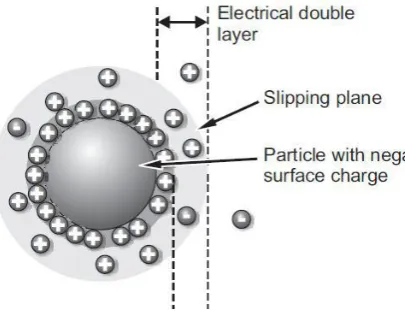
Zeta potential analysis is a technique for determining the surface charge of nanoparticles in a solution. It indicates potential difference between the dispersion medium and the stationary layer of fluid attached to the particle. It gives the degree of repulsion between nanoparticles. Colloidal particles with high zeta potential (negative or positive) are electrically stabilized while colloids with low zeta potentials tend to agglomerate ([7], [8], [9]).
Figure 1. Zeta Potential
4.1.4 Spectral Absorbency Analysis
It is based on fact that, there is a linear relationship between the absorbency intensity and the concentration of nanoparticles in base fluid. Spectrophotometer is used to determine the dispersion characteristics of suspended particles. The dispersion characteristics of particles directly affect the stability of nanofluid ([1], [3]).
4.1.5 3𝝎Method
This method is based on the relationship between thermal conductivity and sedimentation of nanoparticles [1]. It uses narrow band detection technique.
4.1.6 Electron microscopy
An electron microscope is a type of microscope that uses an electron beam to illuminate a specimen and produce a magnified image. Transmission electron microscope (TEM), Scanning electron microscope (SEM), Reflection electron microscope (REM), Scanning transmission electron microscope (STEM) are devices which use to take digital images of nanoparticles to give information about agglomeration[10].
4.2 Stability Mechanisms of Nanofluid
To maintain the nanofluid stability, agglomeration of nanoparticles must be prevented. So, there will be more need of repulsive forces than attractive forces between the nanoparticles. It is done by three mechanisms described below.
4.2.1 Steric stabilization
International Journal in Physical & Applied Sciences
http://www.ijmr.net.in email id- [email protected] Page 34 Figure 2. Steric stabilization [3]
4.2.2Depletion stabilization
Depletion stabilization of colloidal particles is achieved by adding macromolecules that are free in solution [11].
Figure 3. Depletion stabilization [11]
4.2.3 Electrostatic stabilization
In liquid dispersion medium, charge can adsorb to the surface of a colloidal particle through different mechanisms to form a charged layer. To maintain electro neutrality, an equal number of opposite charge will also surrounded the colloidal particles and it give rise to overall charge-neutral double layers. In charge stabilization, it is the mutual repulsion of these double layers surrounding particles that provides stability ([4], [11]). In
electrostatic stabilization, charge on surface is developed through one or more of the following mechanisms:
Preferential adsorption of ions
Dissociation of surface charged species Isomorphic substitution of ions
Accumulation or depletion of electrons at the surface
Physical adsorption of charged species onto the surface [3].
Figure 4. Electrostatic stabilization [3]
4.3 Stability Enhancement Techniques of Nanofluids
4.3.1 By Using Surfactants
Dispersants such as surfactants are used in nanofluids. Dispersants have a hydrophobic tail usually a long-chain hydrocarbon, and a hydrophilic polar head group. If the basefluid is polar solvent, we should select water-soluble surfactants. Surfactants can
contaminate the heat transfer media, form a resistance film between the particle and basefluid and may also produce foams when heating. Further Research is going on choice and challenges of surfactants used ([1], [3]).
4.3.2 pH Control of Nanofluids
International Journal in Physical & Applied Sciences
http://www.ijmr.net.in email id- [email protected] Page 35 So, by changing pH, we can alter the stability
of nanofluid.
4.3.3 Surface Modification Techniques
This technique do not requires need for addition of any surfactant. In it, functionalized nanoparticles are used to make nanofluids which overcome the drawbacks of surfactant using model. Hence nanofluid with good fluidity, low viscosity, high stability and high thermal conductivity is formed.
4.3.4 Ultrasonic agitation
To break the clusters formed due to agglomeration, ultra speed agitation is used. Ultrasonic bath processor, and homogenizer are powerful tools for breaking down the agglomerates ([5], [9]).
5. Conclusion
This paper widely review the nanofluids with a basic introduction of nanofluids and the techniques used to prepare nanofluids with their advantages and disadvantages. Main light of this paper focuses on stability of nanofluid. In this way, introduction, evaluation and enhancement techniques are described briefly. We have just started exploring the potential of nanofluid. So, there are a lot of challenges to overcome in nanofluid such as counter-result of many researchers, bad characterization of colloids, lack of knowledge about working mechanism, health issues and high cost of nanoparticles.
References
[1] Sayantan Mukherjee, Somjit Paria1, Preparation and Stability of Nanofluids-A Review, IOSR Journal of Mechanical and Civil Engineering, Volume 9, Issue 2 (Sep. - Oct. 2013), PP 63-69.
[2] R. Taylor, S. Coulombe, T. Otanicar, P. Phelan, A. Gunawan, W. Lv, G.
Rosengarten, R.Prasher, H.Tyagi,”Small particles, big impacts: A
review of thediverse applications of nanofluids”‖, J. Appl. Phys. 113, 011301 (2013).
[3] Wei Yu and Huaqing Xie A Review on Nanofluids: Preparation, StabilityMechanisms,and Applications, Journal of Nanomaterials Volume 2012, Article ID 435873, 17 pages
[4] Rahul A. Bhogare, B. S. Kothawale A Review on applications and challenges of Nano-fluids as coolant in Automobile Radiator, International Journal of Scientific and Research Publications, Volume 3, Issue 8, August 2013.
[5] Eugenio Turco Neto, Enio Pedone Bandarra Filho , Preparation Methods of Nanofluids to Obtain Stable Dispersions, 13th Brazilian Congress of Thermal Sciences and Engineering, December 05-10, 2010.
[6] Ibrahim Palabiyik, Sanjeeva Witharana, Zenfira Musina, Yulong Ding, Stability of glycol nanofluids – the consensus between theory and Measurement, arXiv:1208.4207 [physics.flu-dyn]
[7] Laura Fedele, Laura Colla, Sergio Bobbo, Simona Barison and Filippo Agresti, “Experimental stability analysis of different waterbased Nanofluids”, Nanoscale Research Letters 2011
[8] Changwei Pang, Yong Tae Kang, Stability and Thermal Conductivity Characteristics of Nanofluids (H2O/CH3OH + NaCl + Al2O3 Nanoparticles) for CO2 Absorption Application, International Refrigeration and Air Conditioning Conference at Purdue, July 16-19, 2012.
International Journal in Physical & Applied Sciences
http://www.ijmr.net.in email id- [email protected] Page 36 [10] Mohammadreza Behi, Seyed Aliakbar
Mirmohammadi Investigation on “Thermal Conductivity,Viscosity and Stability of Nanofluids”,Master of Science Thesis EGI-2012.
[11] Jingyu Shi, Steric Stabilization, The Ohio State University,August 29, 2002. [12] Y. Hwang, J. K. Lee, C. H. Lee et
al., ―”Stability and thermal conductivity characteristics of nanofluids”,‖ ThermochimicaActa, vol. 455, no. 1-2, pp. 70–74, 2007.