A Survey On Energy-Aware Load Balancing In
Cloud Computing Environment
Vivek Gehlot, Dr. S. P. Singh, Dr. Akash Saxena
Abstract— Cloud Computing (CC) technology outsourcing information, providing new opportunities for individuals, startup businesses and health care corporations through outsourcing calculation. Although the CC model offers users interesting and cost-effective opportunities, it is not mature and presents new problems for Cloud users. In the primary stages of system improvement, the performance pointer of data centers were simply the norms through cloud providers; However, cloud footprint and associated costs & carbon footprint, which contributes to the total cost of tenure of cloud organization systems, have become a major concerns in modern days. Energy conservation is one of the main apprehensions in the cloud environment, which reduces operating costs to a cloud data center. Now, the energy-conscious load balancing optimization method is a promising way to achieve the goal, to ensure faster processing time and to maximize the use of cloud resources.
Index Terms— Cloud Computing (CC), Energy Management, Load Balancing (LB), Load Balancing Algorithms.
—————————— ——————————
1
I
NTRODUCTIONCC offers different administrations on interest with ostensible charges. With CC, end clients are free from establishment, support & authorizing obstacles. Thus CC has turned into a significant technique for spreading data & giving computational administrations over the system. Step by step, the volume of data put away & recovered on mists is expanding quickly. With an enormous number of solicitations, both capacity and recovery, streaming to cloud, it is critical to adjust heap among existing servers. Burden adjusting gives client fulfillment and permits the best usage of assets. CC is a prevailing innovation embraced by It’s industry. There are dissimilar issues in CC, weight adjusting is a significant problem that should be tended to. Burden adjusting means to fulfill the client and powerful use of assets. It is basic in appropriating additional unique nearby outstanding task at hand reliably to the whole system to achieve consistency [1]. Today we use CC in our daily lives. CC is used when transferring images (information) to a personal communication site in person. The first point in the basic concept of CC is that CC is the most straightforward type of web application. For example, the use of Google Docs is the use of CC, as opposed to the introduction of Microsoft Office Home PC. This will eliminate information when the home PC is also damaged. Grouping CC can be built by interfacing different hubs. It uses the concept of virtualization. Another innovation in CC is terminal administrations. It illustrates the ancient innovation of software engineering, where the mainframe PC used to be associated with an unbalanced terminal, where the CC mainframe replaces the terminal administration servers and the memory terminals are replaced by smaller users [2].
————————————————
Vivek Gehlot, Research Scholar, Dept. of Computer Science & Engg., Nims Institute of Engg. & Tech., Nims University Rajasthan, Jaipur, India. Email: [email protected]
Dr. S. P. Singh, Prof. & Head, Dept. of Computer Science & Engg., Nims Institute of Engg. & Tech., Nims University Rajasthan, Jaipur, India
Dr. Akash Saxena, Professor, Department of Computer Science, Compucom Institute of Information Technology and Management, Jaipur, India
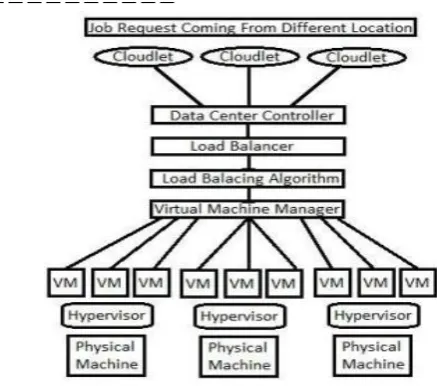
Fig. 1. Structure of cloud computing environment
2
L
OADB
ALANCINGThere are no difficulties in CC that require to be understood, which includes the basics, weight settings, and safety and security of the CC, and so on. Load adjustment is one of the most important tools for maintaining the administration level understanding (SLA) and for enhanced utilized assets. Weight balanced is a system that distributed the dues of a hub's assets to other assets in the other hub of the system without eliminating any running errors. So aligning heaps between different hubs of the cloud framework has become a principal challenge in the CC state. System load, memory load, CPU weight, load shifting can all be heaps. Therefore it is critical to share outstanding burden over various hubs of a framework for better execution and expanding assets usage [3].
1) Classification of Load Balancing Algorithm
a) Based on procedure orientation [4], they are categorized as:
1) Sender Initiated: In this, sender starts procedure; customer sends demand until a beneficiary is alloted to him to get his remaining burden.
3) Symmetric: This is a combination of the initial load balancing algo of the sender and receiver.
b) Based on the present state of the system [4], they are categorized as:
1) Static LB: The calculation of static weight adjustment, the alternative of the affecting heap does not depend on the current state of the construction. This requires learning about framework appliances and material goods. Exhibition of virtual machines will be solved during the labor landing season. The Ace processor performs the remarkable task of other slave processors as indicated in their presentation. Slave processors perform this type of duct work, which results in a return to the Ace processor. Static weight adjustment calculations are not prerequisite, and in this way, each machine has an automated acquisition in any case. Points in limiting execution time of acquisition and breaking point correspondence overhead and displacement. There is a drawback to putting this calculation into a processor or machine that cannot be mistakenly transferred to another machine after it is built. The four specific types of static weight adjustment systems are Round Robin computation, Central Manager algo, Threshold computation & Random computation.
2) Dynamic LB: The kind of weight adjustment calculations, the current state of the framework is used to solve any choice of adjusting the weight, so the removal of the heap depends on the present state of the construction. Consider procedures for switching from an overused mechanism to an unusable mechanism for faster execution. This implies it takes into consideration process acquisition which isn't bolstered in static burden adjusting approach. An important advantage of this methodology is that it depends on the present state of the heap selection framework, which greatly improves the general execution of the framework by replacing the heap.
3
C
HALLENGES IN CLOUD-
BASED LOAD BALANCING In this segment, we evaluate the confront of LB with the purpose of planning typical LB approaches in hope. Certain studied have declared tasks via cloud-based load balancing comprising [5]:1) Virtual Machine Migration (Time and Security)
Administration lying on request environment of CC infers that when there is an administration demand, assets ought to be given. Once in while assets (frequently VMs) should be relocated starting with one physical server then onto the next, potentially on a far area. Planners of weight adjustment calculations need to think of 2 problems in those cases: The transfer point, impact of exhibition and possibility of attack (safety concern).
2) Spatially Distributed Nodes in a Cloud
Hubs in CC circulated geologically. Test for this situation is that heap adjusting calculations ought to be structured with the goal that they consider parameters, for example, system data transfer capacity, correspondence speeds, separations among hubs, & separation between customer & assets.
3) Single Point of Failure
A portion of heap adjusting calculations is unified. In such cases, if the hub executing calculation (controller) comes up short, the entire framework will crash due to that solitary purpose of disappointment. Test here is to configuration appropriated or decentralized calculations.
4) Algorithm Complexity
Heap adjusting calculations ought to be straightforward regarding execution & task. Complex calculations have a negative effect on the entire execution.
5) The Emergence of Small Data Centers in CC
Tiny server farms are less expensive and devour less vitality as for huge server farms. Along these lines, processing assets are circulated all around the world. Test here is to configuration load-adjusting calculations for satisfactory reaction time.
6) Energy Management
Burden adjusting calculations ought to be intended to limit the measure of vitality utilization. In this way, they ought to pursue vitality mindful undertaking planning approach. Because of the propensity of associations and clients to utilize cloud administrations, later on, establishments of cloud suppliers will extend & along with these lines vitality utilization in this industry will increment quickly. This expansion in vitality use expands the expense of vitality along with builds carbon-discharge. The on-off chance that quantity of servers in server farms arrives at a limit, their capacity utilization can be as much as that of a city. Elevated vitality utilization has turned into a noteworthy worry for manufacturing and culture.
Table 1 Advantages & Disadvantages of Load Balancing Algorithms [6]
Scheduling
Algorithms Merits Demerits Static LB The decision around
weight balanced is completed at assemble time. Distributes traffic
equally between servers.
Fewer complexes.
Restricted to an environment where load differences are limited.
Don’t have capability towards control load variations throughout lope time.
Round Robin
set time quantum.;
Simple to
comprehend; Fairness Executes well-aimed
at short CPU burst. Similarly utilized
priority (arrival time & running time).
Higher challenges proceed for a long time.
May happen further context switches because of diminutive quantum time. Job must be similar to
accomplish an elevated presentation. Min- Min The lowest finishing
point of instant value. In the occurrence of
further tiny challenges, it displays the superlative outcome.
Starvation
Machine & confronts deviation cannot be forecast.
Max-Min Necessities are earlier identified. Hence
efforts well. comprehensive work. Dynamic LB Allow work during
operation; False tolerance.
the recent state of the system is essential.
Constant checking of nodes.
Deliberated further complex.
Honey Bee Escalations
throughput; Reduce reply moment in time.
High significance challenges cannot job deprived of VM machine.
Ant – Colony Earlier data may be composed through ants; Reduces create span; Independent jobs; Computationally exhaustive.
The network is out, so the search continues for a long time. No simplicity around
no. of ants.
Carton Better performance; Fairness; Equal dissemination of reactions.
Low communication is essential.
It is contingent upon lower costs.
Throttled Load Balancing
Good presentation; List is utilized towards handle challenges.
Challenges want to be delayed.
4
E
NERGYM
ANAGEMENT FORC
LOUDS
ERVICEP
ROVIDERS1) Macro-level Energy Management Solutions for Cloud
Service Providers
Cloud service providers, for example, Amazon, Google, & Microsoft possess & work topographically scattered server farms that guarantee satisfactory nature of administration for end-clients over the globe. The capacity is to redirect applications across several server farms is one of the most important variables for delivering safe, speedy, and gradually accessible administrations to end clients [7]. A geo-appropriated cloud condition that keeps running over-dispersed server farms empowers cloud suppliers to cultivate control board procedures with heterogeneous goals. While center thought for CC executives depends on topographically adjusting remaining task at hand by diverting got solicitations from end clients to server farms, choices made on a volume of the outstanding task at hand being handled are reliant on vitality board targets, comprising vitality costs, manageability, & carbon footprint. Utilizing as record frameworks would restrain the dynamic move capacity of remaining burdens. Vulnerability in got outstanding tasks at hand further confuses cloud remaining burden board for server farms & requires increasingly muddled ways to deal with figure outstanding tasks at hand. The cost-situated remaining task at hand booking & vitality executives may lessen nature of administration by expanding inertness in outstanding burden dealing with & by decreasing adaptation to internal failure. So as to keep up a satisfactory nature of administration & unwavering quality, such criteria are considered as imperatives in vitality executives rehearses. So as to execute vitality executives systems, cloud suppliers build up strategies for remaining burden appropriation among server farms. Vitality executive’s abilities of cloud suppliers advance interest reaction investment. The goal of interest reaction projects is towards progressively deal with power request of buyers to keep velocity with the contributing side of the influence framework. Utilizing as record frameworks would restrict
dynamic move capacity of remaining tasks at hand. Vulnerability in got remaining burdens further confounds cloud outstanding task at hand administration for server farms and requires increasingly entangled ways to deal with conjecture remaining tasks at hand. Cost-arranged outstanding burden planning & vitality board may diminish the nature of administration by expanding inactivity in the remaining task at hand taking care of & by lessening adaptation to internal failure. So as to keep up a worthy nature of administration & unwavering quality, such criteria are considered as imperatives in vitality executives rehearses. So as to execute vitality board systems, cloud suppliers set up approaches for a remaining task at hand dissemination among server farms. Vitality board abilities of cloud suppliers advance interest reaction support. The target of interest reaction projects is to powerfully deal with power request of customers to keep velocity with the contributing side of the influence framework. Cloud suppliers partake effectively sought after reaction programs through offering in various power markets (for example vitality and auxiliary administration showcase), just as proposing willful burden decrease administrations to local lattice administrators. In spite of open doors for cloud suppliers to effectively take an interest sought after reaction programs, there are a few difficulties including adolescence of the business sectors & absence of proper guidelines that breaking points their support in power markets. Taking an interest in dynamic interest reaction projects requires direct control heap of framework administrators over server farms, which may corrupt the exhibition of administrations given by cloud suppliers & result in money related misfortunes. Therefore, convoluted offering & hazard board systems are required to spur cloud suppliers to partake in vitality advertises & relieve their investment threats.
2) Micro-level Energy Management Strategies at Data
Centers
volume of vitality devoured by each sub-framework differs with the plan of the server farms & vitality proficiency of subcomponents. Around, 60% of complete power utilization in an ordinary server farm is related to IT equipment, including servers, stockpiling gadgets, & system switches; 30% of absolute power utilization is identified with the cooling framework, & 8% of intensity utilization relates to control misfortune in server farm influence molding resources, for example, UPSs & PDUs [9].
5
L
ITERATURES
URVEYYogesh Sharma et al (2019)., on the off chance that
unwavering quality factor of the assets is neglected then the VMs operating at that time will be fixed to the problematic physical assets. This will cause more disappointments and entertainments of VMs, in this way expanding vitality utilization. To tackle this issue, this paper proposes a disappointment mindful VM combination system, which takes an event of disappointments & peril pace of physical assets before consolidating the VM. We planned a disappointment prediction method based on exponential smoothing to initiate two adaptations to non-critical failure components (VM check pointing & VM movement). A reproduction based assessment of proposed VM union instrument was led by utilizing genuine disappointment follows. Outcomes show that by utilizing a blend of check pointing & VM movement with proposed disappointment mindful VM combination instrument, vitality utilization of CC framework is diminished by 34% & unwavering quality is improved by 12% while the diminishing event of disappointments by 14% [10].
Sekhar et al (2019)., it focuses on the meticulous planning
crisis of flexible non-straight parallel assignments in a climate cloud. A climate cloud is primarily looking for assets to implement climate models, for example, the Weather Research and Forecasting Model (WRF). In a climate cloud, the comparable of errors (i.e., climate models) must be modeled before everyone else, and the total amount of allocated assets subtasks. For booking of those undertakings, one key test is means by which to diminish normal vitality utilization while ensuring others prerequisites of such errands. We address this test by considering at same time due dates of undertakings, vitality utilization, framework load, & non-direct speedup of parallel errands when we settle on planning choice. In particular, we propose a versatile vitality mindful planning technique known as ASSD, which depends on Dynamic Voltage & Frequency Scaling (DVFS) model of registering assets & speedup of assignments under various parallelisms. We assess our technique by means of reproductions on a meteorological cloud. Our outcomes demonstrate that the proposed strategy expands the number of finished errands as well as altogether lessens normal vitality utilization [11].
Georgios L. Stavrinides and Helen D. Karatza (2019)., presents a vitality productive, QOS-mindful & practical booking procedure for ongoing work process applications in CC frameworks. The proposed methodology uses per-center Dynamic Voltage and Frequency Scaling (DVFS) on hidden diverse multi-center processors, just as inexact calculations, in order to fill in calendar holes. Simultaneously, it considers the impacts of data blunder on preparing the time of the part errands. We will probably give practicality and vitality
productivity by exchanging off outcome exactness while maintaining the level of quality of the outcome of the finished work to an adequate level and the financial cost necessary to execute the positions. The proposed planning heuristic is in contrast to the other two standard strategies as a result of different QoS requirements. The reenactment trials uncover that our methodology beats the other analyzed approaches, giving promising outcomes [12].
Madhya Mohammadi Golchi et al (2019)., introduces half
and half of Firefly & Improved Particle Swamp Optimization (IPSO) calculations so as to arrive at better normal burden via making & improving significant measurements, such as successful asset utilize & reaction time of assignments distinctly. This exploration has been specified some markers to assessing exhibition of suggested crossbreed strategy as well. Outcomes exhibited preferred presentation other over comparable techniques just as adaptable conduct in normal burden minimization through multi-targets enhancement [13].
Sara Tabaghchi Milan et al (2019)., introduces
comprehensive coverage of nature-inspired meta-heuristic techniques applied to cloud load-balancing. The main purpose of this paper is to highlight the importance of optimization algorithms and their benefits for overcoming cloud load balancing challenges. In addition, to solve the load-balancing problem in cloud environments, we analyze the advantages and disadvantages of nature-inspired meta-heuristic algorithms and consider their key challenges for proposing more effective technologies in the future [14].
Mainak Adhikari and Tarachand Amgoth (2018)., suggest a
new load balancing algorithm as a service (IaaS) cloud for infrastructure. Based on the number and size of incoming tasks, we devise a well-organized plan for configuring servers, finding VMs suitable for the assignment, and maximizing the use of computing resources. Through the simulation runs, we examine the proposed algorithm and compare the simulation results with the existing algorithms using different performance metrics. By comparison, we show that the proposed algorithm performs better than the current one [15].
Mohit Kumar et al (2018)., cloud architecture proposes an
ability to handle maximum user requests before the deadline and provides an elasticity mechanism with the help of a range-based trigger strategy. Calculation outcome (Table 1, Figs. 2-5) explained that the development of the algorithm reduces makespan time enhance mission approval proportion further 10% compare to Min-Min algorithm with the 30% First Come First Serve (FCFS) and Short Work First (SJF) in all conditions [16].
M. Lawanyashri et al (2017)., the use of virtual machines, to
algorithm is more efficient surpasses which compare to the accessible load balancing algorithms [17].
Mohit Kumar and S. C. Sharma (2017)., a load balancing
algorithm has been developed, which diminish the long run time and recover the computational ratio of the cloud resources. The results show that the algorithm is built to decrease the makespan and that the use of resources improves the amount of Min-Min algorithms, FCFS, and instantaneous work done every minute [18].
Ramesh Kumar Naha and Mohamed Othman (2016)., it
recommends 3 dissimilar cloud negotiator algorithm, & LB algorithm. In our planned algorithms reduces cost at the same time and observe to increase in overhaul performance & verify that simulation-based deployment [19].
6
C
OMPARATIVEA
NALYSIS OFL
OADB
ALANCINGA
LGORITHMFig. 2, the assessment outcome explained that consumption of energy based on EFOA, PSO, FOA-SA and HBB. The outcomes obtain explain that FOA-SA moves toward which compares consumption of energy to better other than load balancing algorithms.
Fig. 2. Graphical representation of energy consumption for various load balancing optimization algorithms
In comparison in Fig. 3, there are apply for the cloud which has 10 compute nodes & 5 diminutive virtual machines, DT- PALB consumes 58.60% of its energy consumption with components equivalent to PALB. As you can see in Fig. 4, this lessens the number of power machines on substantial equipment by 39.40%.
Fig. 3. Power consume by PALB and DTPALB with 10 hosts
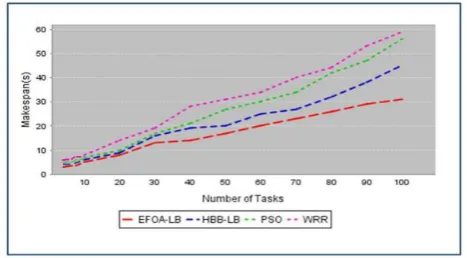
Fig. 4 comparing the span with EFOA-LB, HBB-LB, PSO and WRR shows that EFOA-LB helps achieve better results compared to HBB-LB, PSO, and WRR. Y-axis indicates the finishing point in this graph indicates that there is no time (create span) in seconds and X-axis indicates number of tasks.
Fig. 4. Makespan comparison of EFOA-LB, HBB-LB, PSO and WRR
7
C
ONCLUSIONThrough the internet we provide services of cloud computing is a contemporary prototype. Load balancing is an important step in CC, some nodes avoid busy situations, others are unused or have fewer jobs. Load balance can restore service quality (QoS) with response time, cost, throughput, performance, and use of resources. The goal of balancing the load of virtual machines is to diminish the consumption of energy and endow with utmost use of resources thereby lessens the no. of job rejections. When the number of users get bigger in the cloud, weight balanced becomes the face of a cloud provider. How’s it recover and sustain the performance of cloud systems & the intend of this paper is to talk about the model of load balancing in CC.
R
EFERENCES[1] S. Sankara Narayanan and M. Ramakrishnan, (2016). ―A
Comprehensive Study on Load Balancing Algorithms in CC Environments‖, Research Journal of Applied Sciences, Engineering and Technology, 13(10), pp. 794-799.
[2] Shikha Gupta and Suman Sanghwan, (2015). ―Load
Balancing in CC: A Review‖, International Journal of Science, Engineering and Technology Research (IJSETR), Volume 4, Issue 6, pp. 1912-1916.
[3] Grades Fixer, (2018). ―A Survey Paper on Load Balancing
Techniques in CC‖, Available at
https://gradesfixer.com/free-essay-examples/a-survey-paper-on-load-balancing-techniques-in-cloud-computing/.
[4] Foram F. Kherani and Prof. Jignesh Vania, (2014). ―Load
Balancing in CC‖, International Journal of Engineering Development and Research (IJEDR), Volume 2, Issue 1, pp. 907-912.
[5] Jafarnejad Ghomi, E., Masoud Rahmani, A. and Nasih
Qader, N., (2017). ―Load-Balancing Algorithms in CC: A
Survey‖, Journal of Network and Computer Applications, 88, pp. 50–71.
[6] Aslam, S. and Shah, M. A., (2015). ―Load Balancing
Algorithms in CC: A Survey of Modern Techniques‖, 2015 National Software Engineering Conference (NSEC), pp. 30-35.
[7] Mac Vittie, D., (2012). ―Maximizing the Strategic Point of
Control in the Application Delivery Network‖, F5 White
http://be.security.westcon.com/documents/42226/f5-strategic-control-application-delivery.pdf.
[8] Kaplan, J., Forrest, W. and Kindler, N., (2008).
―Revolutionizing Data Center Energy Efficiency‖, Available: https://www.sallan.org/pdfdocs/McKinsey_Data_Center_Effi ciency.pdf. (Report by McKinsey & Company)
[9] Vafamehr, A. and Khodayar, M. E., (2018). ―Energy-Aware
CC‖, The Electricity Journal, 31(2), pp. 40–49.
[10] Sharma, Y., Si, W., Sun, D. and Javadi, B., (2019).
―Failure-Aware Energy-Efficient VM Consolidation in CC Systems‖, Future Generation Computer Systems, 94, pp. 620–633.
[11] Hao, Y., Cao, J., Ma, T. and Ji, S., (2019). ―Adaptive
Energy-Aware Scheduling Method in a Meteorological Cloud‖, Future Generation Computer Systems, pp. 1-30.
[12] Stavrinides, G. L. and Karatza, H. D., (2019). ―An
Energy-Efficient, QoS-Aware and Cost-Effective Scheduling
Approach for Real-time Workflow Applications in CC Systems Utilizing DVFS and Approximate Computations‖, Future Generation Computer Systems, 96, pp. 216–226.
[13] Golchi, M. M., Saraeian, S. and Heydari, M., (2019). ―A
Hybrid of Firefly and Improved Particle Swarm Optimization Algorithms for Load Balancing in Cloud Environments: Performance Evaluation‖, Computer Networks, 106860, pp. 1-15.
[14] Milan, S. T., Rajabion, L., Ranjbar, H. and Navimipoir, N. J.,
(2019). ―Nature-Inspired Meta-Heuristic Algorithms for
Solving the Load Balancing Problem in Cloud
Environments‖, Computers and Operations Research, pp. 159-187.
[15] Adhikari, M. and Amgoth, T., (2018). ―Heuristic-Based
Load-Balancing Algorithm for IaaS Cloud‖, Future Generation Computer Systems, 81, pp. 156–165.
[16] Kumar, M., Dubey, K. and Sharma, S. C., (2018). ―Elastic
and Flexible Deadline Constraint Load Balancing Algorithm for CC‖, Procedia Computer Science, 125, pp. 717–724.
[17] Lawanyashri, M., Balusamy, B. and Subha, S., (2017).
―Energy-Aware Hybrid Fruitfly Optimization for Load Balancing in Cloud Environments for EHR Applications‖, Informatics in Medicine Unlocked, 8, pp, 42–50.
[18] Kumar, M. and Sharma, S. C., (2017). ―Dynamic Load
Balancing Algorithm for Balancing the Workload Among Virtual Machine in CC‖, Procedia Computer Science, 115, pp. 322–329.
[19] Naha, R. K. and Othman, M., (2016). ―Cost-Aware Service
![Table 1 Advantages & Disadvantages of Load Balancing Algorithms [6]](https://thumb-us.123doks.com/thumbv2/123dok_us/8620901.1410609/2.612.315.573.445.742/table-advantages-disadvantages-load-balancing-algorithms.webp)