204
International Journal in Management and Social Sciencehttp://ijmr.net.in, Email: [email protected] JOB SATISFACTION AND SUPERVISORY SUPPORT
Mohamed Ali Ben Matug Kastamonu University
Faculty of Economics and Administrative Sciences Department of Management, Turkey
Abstract
The concept of job satisfaction has acquired its significance through the proven impacts and relationships with other important business and human resource management indicators, such as performance, organizational relationships, organizational commitment, turnover and efficiency. Through literature research, it can be noticed that the interrelationships within the organization on the personal and professional levels are influential in determining the level of job satisfaction. Therefore, this research reviews several sources in the literature on the effects of supervisory support on job satisfaction. Different results from the literature are summarized to understand the relationship and its extents. The findings of the literature indicate a positive relationship between the two variables with moderate to strong impacts.
Keywords: human resource management, job satisfaction, supervisory support
INTRODUCTION
205
International Journal in Management and Social Sciencehttp://ijmr.net.in, Email: [email protected] their satisfaction, other models compiled a wider range of factors that extended to personal, professional and managerial factors.
The current research highlights the relationship and impact of supervisory support on job satisfaction, especially that the majority of studied considered different range of factors in studying the concept. The majority of research has proven the positive effects of a high satisfaction level on employees and organizational performance indicators, as well as loyalty, commitment and turnover rates. This study aims to understand the extent of impact of supervisory support on job satisfaction and relationship between the two factors through reviews and empirical studies in the literature.
JOB SATISFACTION
There is no specific solid definition of job satisfaction; however, there are a few definitions that were provided in the literature in order to approximate the most suitable meaning of the concept. Hoppock (1935) have put the term as the overall factors; environmental, physiological and psychological that leads to the vocal and behavioral expression of job satisfaction. In this definition, job satisfaction is a result of the combination of the several external factors in order to produce the final satisfaction feeling by the employee. Davis and Nestrom (1985) defined job satisfaction as the total of negative and positive emotions that the employee has towards his job, taking into consideration the experiences, needs and desires that accompany the business operations, and subsequently reflect onto behaviors in the workplace. Kaliski (2007) correlates job satisfaction to the sense of achievement of the worker in his role within the company and the level of success that is reached so far in it. The author presented the personal well-being of the employee, as well as productivity, as the most important indicators of job satisfaction.
206
International Journal in Management and Social Sciencehttp://ijmr.net.in, Email: [email protected] issues that cannot be easily evaluated. Additionally, there is evidence that job satisfaction is correlated to employee’s performance and efficiency, which are important indicators in operational and organizational performance. Therefore, job satisfaction can serve as an important indicator of measures and changes that are required in the organization to enhance performance or the workplace environment (Spector, 1997).
Several models provided an attempt to understand the factors that affect job satisfaction. Christen et al. (2006) presented a model based on correlations between the environmental and professional job factors, which affect the employee’s performance, and subsequently job satisfaction. Nonetheless, the model states that issues in understanding the role responsibilities and value affect negatively the level of job satisfaction. Lawler and Porter (1967) correlated job satisfaction with the different types of rewards given to the employees. The authors divided rewards into intrinsic and extrinsic types, which emerge from the performance of the individual and the team within the organization.
207
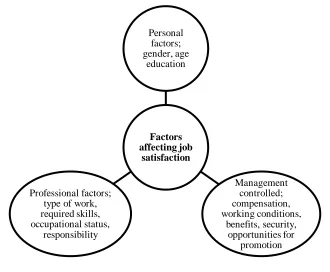
International Journal in Management and Social Sciencehttp://ijmr.net.in, Email: [email protected] Mishra (2013) divided the factors affecting job satisfaction into three categories according to its source of control or impact, as shown in FIGURE 1. The first group of factors are personal factors, such as gender, age, education and time of job. The second category is professional job factors, such as type of work, required skills, occupational status, and responsibility. The third category of factors is controlled by management, including compensation, working conditions, benefits, security and opportunity for promotion.
FIGURE 1: factors affecting job satisfaction (Mishra, 2013)
The assessment of job satisfaction combines many of the models that were reviewed previously with statements evaluated on a Likert satisfaction scale. The indicators used in the evaluation include working conditions, variety of tasks, supervision technical support, supervision human relationships, responsibility, recognition and reward, social status, social service, job security, independence, creativity, moral values, compensation, company policies, authority, advancement, activity, achievement and co-worker relationships (Aziri, 2011).
Factors affecting job
satisfaction
Personal factors; gender, age
education
Management controlled; compensation, working conditions,
benefits, security, opportunities for
promotion Professional factors;
type of work, required skills, occupational status,
208
International Journal in Management and Social Sciencehttp://ijmr.net.in, Email: [email protected] Javed, et al. (2014) assessed the determinants of job satisfaction and their impacts on employees’ turnover and performance. The research established hypotheses that study the relationship between job satisfaction and each of employee’s loyalty, employee’s intention to leave the organization, and job performance. The hypotheses also included studying the impact of perception towards the workplace environment and employee empowerment on job satisfaction. The regression model analysis that was performed on a sample of 200 employees in India showed that workplace environment and employee empowerment have positive effects on job satisfaction, while job satisfaction had positive impacts on job loyalty, job performance and turnover. The findings also show that job performance and employee empowerment had no significant impact on the turnover of the employees.
Lee, et al. (2017) implemented a study of job satisfaction measurement and its impact on turnover of early career employees on thirty companies in China. The research included more than 400 employees of different demographical categories. The correlational analysis found moderate to strong correlations between the different factors impacting job satisfaction, which are salary and welfare, work conditions, supervisory behavior, personal growth, interpersonal relationships and job competency. The results were all found significant using a factor analysis. Job satisfaction was found influential on the turnover rate of the employees.
Inuwa (2016) studied the relationship and impact between employee performance and job satisfaction on two hundred and fifty non-academic employees in a University. A moderate correlation was found between the two main factors, while the regression analysis yielded an R-square value of 0.444 at a 0.001 significance level. The results were presented as an evidence on the relationship between the two factors and the impact of change in one on the other.
209
International Journal in Management and Social Sciencehttp://ijmr.net.in, Email: [email protected] between those factors and employee’s performance. The findings are another evidence on the significance of job satisfaction on impacting performance within the organization.
SUPERVISORY SUPPORT AND ITS RELATIONSHIP WITH JOB SATISFACTION
The support of the supervisor is measured through the care given towards his or her employees; in terms of supporting their career goals, assisting them in their challenges, helping them to develop skills that are beneficial in their work, and showing them sympathy for their professional and personal concerns. Supervisory support is considered part of the organizational support, which are both measured through the perceptions of the employees. The role of the individual supervisor within the department and the organization has main streams; processes and systems, policies, culture and values, and performance standards. In order to support a high-performance management system, the supervisor has to be able to set goals and expectations from his or her employees, work for their learning and development process and establish efficient communication in order to be able to support, coach and monitor them (Cornelius, 2012).
The social exchange theory is one of the most important concepts that attempted to explain the relationship between the employee and the organization. The theory created a framework that clarifies the nature of the relationship, as well as the development of relationship between the employee and management, as explained by Blau (1964) and Gouldner (1960). The theory explains the balance established in professional and social relationships based on benefits and costs as perceived by people. Several factors interfere in the relationship, such as trust and satisfaction. Jeong and Oh (2017) proposed a framework for the social exchange theory, which is based on the communication quality between the social individuals, the extent of their opportunistic behavior, and the social and financial dependencies between them.
210
International Journal in Management and Social Sciencehttp://ijmr.net.in, Email: [email protected] The wellbeing of the employees included job, family and life satisfactions, while supervisory support included emotional support, instrumental support, flexible arrangements and leave policies. The research was applied on female members of the academic community in Malaysia. The analysis showed moderate correlations between supervisory support and wellbeing of the employees. In studying the effects of supervisory support statistically, an R square value of 0.232 was found as an impact on wellbeing. The result definitely suggests a positive relationship between the two concepts.
Latif and Gulzar (2011) investigated the effect of organizational support on supervisory support, and their impact on organizational commitment through a questionnaire instrument with hundred telecommunication employees in Pakistan. The correlational analysis showed weak to moderate positive relationships between the three variables, with significance at the 0.01 level. Moreover, the regression analysis showed that there are positive effects of organizational support and supervisory support on organizational commitment.
211
International Journal in Management and Social Sciencehttp://ijmr.net.in, Email: [email protected]
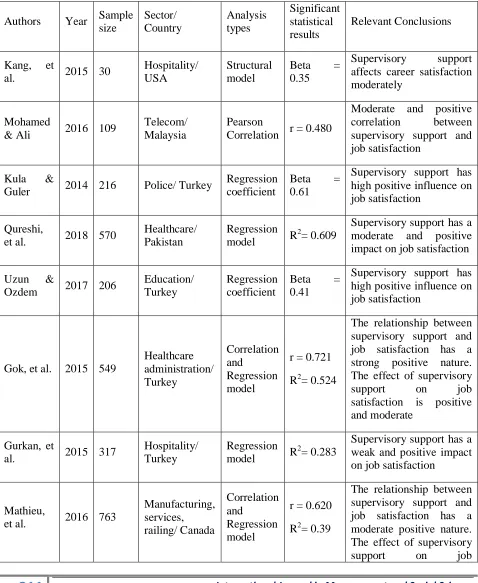
TABLE 1:Studies from the literature researched the relationship between supervisory support and job satisfaction
Authors Year Sample
size Sector/ Country Analysis types Significant statistical results Relevant Conclusions
Kang, et
al. 2015 30
Hospitality/ USA
Structural model
Beta =
0.35
Supervisory support
affects career satisfaction moderately
Mohamed
& Ali 2016 109
Telecom/ Malaysia
Pearson
Correlation r = 0.480
Moderate and positive
correlation between
supervisory support and job satisfaction
Kula &
Guler 2014 216 Police/ Turkey
Regression coefficient
Beta =
0.61
Supervisory support has high positive influence on job satisfaction
Qureshi,
et al. 2018 570
Healthcare/ Pakistan
Regression
model R
2
= 0.609
Supervisory support has a moderate and positive impact on job satisfaction
Uzun &
Ozdem 2017 206
Education/ Turkey
Regression coefficient
Beta =
0.41
Supervisory support has high positive influence on job satisfaction
Gok, et al. 2015 549
Healthcare administration/ Turkey Correlation and Regression model
r = 0.721
R2= 0.524
The relationship between supervisory support and job satisfaction has a strong positive nature. The effect of supervisory
support on job
satisfaction is positive and moderate
Gurkan, et
al. 2015 317
Hospitality/ Turkey
Regression
model R
2
= 0.283
Supervisory support has a weak and positive impact on job satisfaction
Mathieu,
et al. 2016 763
Manufacturing, services, railing/ Canada Correlation and Regression model
r = 0.620
R2= 0.39
The relationship between supervisory support and job satisfaction has a moderate positive nature. The effect of supervisory
212
International Journal in Management and Social Sciencehttp://ijmr.net.in, Email: [email protected]
satisfaction is positive and moderate
Chen et al. 2012 S1: 206 S2: 111 Hospitality/ China Pearson Correlation
S1: r = 0.220
S2: r = 0.670
Weak to Moderate and
positive correlation
between supervisory
support and job
satisfaction
McGilton,
et al. 2007 222
Healthcare (LTC)/ Canada
Pearson
Correlation r = 0.401
Moderate and positive
correlation between
supervisory support and job satisfaction
Bishwajit,
et al 2016 126
Healthcare/ Bangladesh
Pearson
Correlation r = 0.320
Moderate and positive
correlation between
supervisory support and job satisfaction
Griffin, et
al. 2001 4708
Manufacturing/ UK
Structural model
Beta =
0.36
Supervisory support
affects career satisfaction moderately
Babin &
Boles 1996 261
Service (Restaurants)/ USA
Pearson
Correlation r = 0.410
Moderate and positive
correlation between
supervisory support and job satisfaction
Steinhardt,
et al. 2003 178
Manufacturing/ USA
Pearson
Correlation r = 0.540
Moderate and positive
correlation between
supervisory support and job satisfaction
Mintz-Binder 2014 242
Academic/ USA
Spearman
Correlation r = 0.450
Moderate and positive
correlation between
supervisory support and job satisfaction
CONCLUSIONS
213
International Journal in Management and Social Sciencehttp://ijmr.net.in, Email: [email protected] performance, turnover and organizational commitment. Organizational and supervisory support are key human resource management practices that measure the involvement of the management in the professional and personal aspects of the employees. The impact of healthy supervisory support shows care and sympathy with the employees’ challenges and issues; therefore, increasing their psychological and emotional empowerment. The current research reviewed the literature for the most important factors that affect job satisfaction with emphasis on supervisory support. A review of studies from 1996 to 2018 show that the correlational, regression and structural analyses performed on different samples sizes and in different countries have yielded similar results. The relationship between supervisory support and job satisfaction has positive correlation factors ranging from moderate to strong, while the impact of the supervisory support on job satisfaction has similar indications. Further research is recommended to investigate the specific factors and practices that are part of supervisory support that can have the highest impact for a positive job satisfaction level in the organization.
REFERENCES
Achour, M., Abdul Khalil, S. B., Ahmad, B. B., Nor, M. R., & Yusoff, M. Y. (2017). Management and supervisory support as a moderator of work–family demands and women’s well-being - A case study of Muslim female academicians in Malaysia.
Humanomics, 33(3), 335-356.
Aziri, B. (2011). Job satisfaction: A literature review. Management Research and
Practice, 3(4), 77-86.
Babin, B. J., & Boles, J. S. (1996). The Effects of Perceived Co-Worker Involvement and Supervisor Support on Service Provider Role Stress, Performance and job
Satisfaction . Journal of Retailing, 72(1), 57-75.
Bishwajit, M., Khumyu, A., & Boonyanurak, P. (2016). Relationships between organizational commitments, supervisory support and job satisfaction of nurses.
214
International Journal in Management and Social Sciencehttp://ijmr.net.in, Email: [email protected]
Blau, P. M. (1964). Exchange and Power in Social Life. New York: Wiley.
Chen, Z., Sun, H., Lam, W., Hu, Q., Huo, Y., & Zhong, J. A. (2012). Chinese hotel employees in the smiling masks: roles of job satisfaction, burnout, and supervisory
support in relationships between emotional labor and performance. The
International Journal of Human Resource Management, 23(4), 826-845.
Christen, M., Iyer, G., & Soberman, D. (2006). Job Satisfaction, Job Performance, and
Effort: A Reexamination Using Agency Theory. Journal of Marketing, 70,
137-150.
Cornelius, M. (2012). Supervisor Roles and Responsibilities: Helping People Succeed.
Oakland: CompassPoint Nonprofit Services.
Davis, K., & Nestrom, J. W. (1985). Human Behavior at work: Organizational Behavior.
New York: McGraw Hill.
Gok, S., Karatuna, I., & Karaca, P. O. (2015). The Role of Perceived Supervisor Support
and Organizational Identification in Job Satisfaction. Procedia - Social and
Behavioral Sciences, 177, 38-42.
Gouldner, A. W. (1960). The norm of reciprocity: a preliminary statement. American
Sociological Review, 25(2), 161-178.
Griffin, M. A., Patterson, M. G., & West, M. A. (2001). Job satisfaction and teamwork:
the role of supervisor support. Journal of Organizational Behavior, 22, 537-550.
Gurkan, G., Tukelturk, S. A., & Kucukaltan, D. (2015). The Mediating Role of Supervisor Support in the Effect of Person-Organization Fit on Job Satisfaction in
Hospitality Enterprises. Journal of Tourism and Hospitality Management, 3(2),
15-37.
Herzberg, F. (1966). Work and the nature of man. Cleveland: World Publishing
Company.
Hoppock, R. (1935). Job Satisfaction. New York: Harper and Brothers.
Inuwa, M. (2016). Job Satisfaction and Employee Performance: An Empirical Approach.
215
International Journal in Management and Social Sciencehttp://ijmr.net.in, Email: [email protected]
Javed, M., Balouch, R., & hassan, F. (2014). Determinants of Job Satisfaction and its
Impact on Employee Performance and Turnover Intentions. International Journal
of Learning & Development, 4(2), 120-140.
Jeong, M., & Oh, H. (2017). Business-to-business social exchange relationship beyond
trust and commitment. International Journal of Hospitality Management, 65,
115-124.
Kaliski, B. S. (2007). Encyclopedia of Business and Finance,. Detroit: Thompson Gale.
Kang, H. J., Gatling, A., & Kim, J. (2015). The Impact of Supervisory Support on Organizational Commitment, Career Satisfaction, and Turnover Intention for
Hospitality Frontline Employees. Journal of Human Resources in Hospitality &
Tourism, 14, 68-89.
Kula, S., & Guler, A. (2014). Influence of Supervisor Support on Job Satisfaction Levels: An Evaluation of Turkish National Police (TNP) Officers in the Istanbul Police
Department. International Journal of Criminal Justice Sciences, 9(2), 209-224.
Latif, S., & Gulzar, A. (2011). The impact of organizational and supervisory support on survivors' organizational commitment after downsizing in telecom sector of
Pakistan. International Journal of Economics and Management Sciences, 1(5),
55-61.
Lawler, E. E., & Porter, L. W. (1967). The Effect of Performance on Job Satisfaction.
Industrial Relations, 20-28.
Lee, X., Yang, B., & Li, W. (2017). The influence factors of job satisfaction and its relationship with turnover intention: Taking early-career employees as an
example. anales de psicologia, 33(3), 697-707.
Locke, E. A., & Latham, G. P. (1990). A theory of goal setting and task performance.
Prentice Hall.
Mathieu, C., Fabi, B., Lacoursiere, R., & Raymond, L. (2016). The role of supervisory behavior, job satisfaction and organizational commitment on employee turnover.
216
International Journal in Management and Social Sciencehttp://ijmr.net.in, Email: [email protected]
McGilton, K. S., Hall, L. M., Wodchis, W. P., & Petroz, U. (2007). Supervisory Support,
Job Stress, and Job Satisfaction Among Long-term Care Nursing Staff. The
Journal of Nursing Administration, 37(7/8), 366-372.
Mintz-Binder, R. D. (2014). Exploring Job Satisfaction, Role Issues, and Supervisor
Support of Associate Degree Nursing Program Directors. Nursing Education
Perspectives, 35(1), 43-48.
Mishra, P. K. (2013). Job satisfaction. Journal of Humanities and Social Sciences, 14(5),
45-54.
Mohamed, S. A., & Ali, M. (2016). The importance of Supervisor Support for
Employees’ Affective Commitment: An analysis of Job Satisfaction. International
Journal of Scientific and Research Publications, 6(2), 435-439.
Qureshi, m. A., Hamid, K. B., Jeihoony, P., Ali, R., Brohi, N. A., Magsi, R., & Shah, S. M. (2018). Is supervisor support matter in job satisfaction? A moderating role of
fairness perception among nurses in Pakistan. Academy of Strategic Management
Journal, 17(6).
Rue, L. W., & Byars, L. (2003). Management, Skills and Application. New York:
McGraw-Hill/Irwin.
Shaju, M., & Subhashini, D. (2017). A study on the impact of Job Satisfaction on Job Performance of Employees working in Automobile Industry, Punjab, India .
Journal of Management Research, 9(1), 117-130.
Spector, P. E. (1997). Job satisfaction: Application, assessment, causes and
consequences. Thousand Oaks: Sage Publications.
Steinhardt, M. A., Dolbier, C. L., Gottlieb, N. H., & McCalister, K. T. (2003). The Relationship Between Hardiness, Supervisor Support, Group Cohesion, and Job
Stress as Predictors of Job Satisfaction. Stress Management, 17(6), 382-389.
Uzun, T., & Ozdem, G. (2017). The mediating role of job satisfaction on the relationship between teachers' perceptions of supervisor support and job performances.