University of South Carolina
Scholar Commons
Theses and Dissertations
2015
Neutrino and Antineutrino Induced Meson
Production
Libo Jiang
University of South Carolina
Follow this and additional works at:https://scholarcommons.sc.edu/etd Part of thePhysics Commons
This Open Access Dissertation is brought to you by Scholar Commons. It has been accepted for inclusion in Theses and Dissertations by an authorized administrator of Scholar Commons. For more information, please [email protected].
Recommended Citation
Neutrino and Antineutrino Induced Meson Production
by
Libo Jiang
Bachelor of Science
Northeast Forest University 2006 Master of Science
Harbin Institute of Technology 2008
Submitted in Partial Fulfillment of the Requirements for the Degree of Doctor of Philosophy in
Physics
College of Arts and Sciences University of South Carolina
2015 Accepted by:
Roberto Petti, Major Professor Vitaly Rassolov, Committee Member
Steffen Strauch, Committee Member Jeffery Wilson, Committee Member
c
Dedication
Acknowledgments
First of all, great gratitude to Professor Roberto Petti and Professor Sanjib Mishra. They gave me indispensable guidance and assistance to my work during the past few years and let me know how beautiful the physics is. 5 years ago, they warmly brought me into neutrino physics area, and are very thoughtful and helpful in supervision of my research and schedule. They continued answering my queries endlessly.
Many thanks to my committee members, Dr. Vitaly Rassolov, Dr. Steffen Strauch, and Dr. Jeff Wilson. Their guidance and help are very important to my research.
Many thanks to my colleagues and friends at University of South Carolina: Xinch--un Tian, Chris Kullenberg, Brian Mecurio, Jae Jun Kim, Kevin Wilson, Hongyue Duyang, Andrew Svenson, Kevin Wood, Tyler Alion, and Bing Guo. During the past few years, they gave me a lot of help and I had the pleasure of working with them.
I would also like to say a few works to thank Dr. Huifeng Fu, and Dr. Tian-hong Wang. They helped a lot in my theoretical calculations and understanding the electroweak theory.
Thank to the excellent work of the collaborators from ELBNF/DUNE, NOMAD collaborations.
Abstract
Coherent meson production measurement is very important in physics research. First, the coherent pion production is a potential background to ν oscillation in next gen-eration of Long Base Line Experiment(ELBNF/DUNE); second, coherent pion and coherentρproduction provide a detailed test of CVC and PCAC hypothesis; third, co-herent meson production can be used to monitor the neutrino and anti-neutrino fluxes in the experiment. This dissertation focuses on two parts: coherentπ− production in
NOMAD, and coherentρsimulation using LBNF fluxes. With the NOMAD data, the ratio between cross-sections of coherent π− and ¯ν
µ charged current interactions was
measured and compared with the measurements of coherent π+. The experience of coherentπanalysis may be used to evaluate the sensitivity of ELBNF/DUNE project to coherent processes. With the ELBNF process, I wrote a new C++ simulation pack-age and generated 100k coherentρ+ events. It is known that for the neutrino-induced process, the incoming neutrino fluxes could not be measured directly, and theQ2 and other variables related to it are unknown in the neutrino-induced neutral current interactions. The photon-induced coherent ρ0 provides a way to get additional in-formation to constrain the incoming neutrino fluxes. I calculated the ratios between the cross-sections of neutrino-induced coherent ρ±, ρ0 and photon-induced coherent
ρ0. With these ratios, some kinematic variable distributions are reweighted with this
Table of Contents
Dedication . . . iii
Acknowledgments . . . iv
Abstract . . . v
List of Tables . . . ix
List of Figures . . . xv
Chapter 1 Electroweak Theory and Neutrino Interaction . . . 1
1.1 Weak Interaction and Electroweak Theory . . . 1
Chapter 2 Challenges of Precision Oscillation Experiments . . 15
Chapter 3 Coherent Meson Production by Neutrino (Theory) 26 3.1 Kinematics of (Anti)Neutrino Scattering . . . 26
3.2 Neutrino Induced Coherent Pion . . . 27
3.3 Neutrino Induced Coherent ρ . . . 36
3.4 Cross-section of Coherent ρ0 . . . 46
Chapter 4 The Neutrino Oscillation Magnetic Detector (NO-MAD) experiment . . . 49
4.2 The NOMAD Detector . . . 50
4.3 Reconstruction and Simulation . . . 52
4.4 Neutrino Interaction Candidate in NOMAD Target . . . 53
4.5 Coherent Signature in NOMAD Target . . . 54
Chapter 5 A High Resolution Fine Grained Tracker (FGT) as the Near Detector for ELBNF/DUNE . . . 58
5.1 Introduction & Salient Physics Goals . . . 58
5.2 Sub Detectors . . . 60
5.3 How the FGT Helps Accomplish the Above Goals . . . 73
Chapter 6 Coherent π− Measurement in NOMAD . . . 75
6.1 Signal Signature . . . 75
6.2 Background . . . 76
6.3 Neutrino and Anti-neutrino Beams . . . 76
6.4 Neutrino Beam Mode . . . 78
6.5 Anti-neutrino Beam Mode . . . 131
6.6 Comparison of Neutrino Mode and Anti-neutrino Mode . . . 166
6.7 Comparison of Coherent π− and Coherent π+ . . . 172
6.8 Systematic Uncertainties . . . 175
6.9 Comparison with Previous Measurements . . . 207
Chapter 7 Coherent Rho and Absolute Flux Measurement . . . 208
7.1 Neutrino Induced Coherent ρ0 &ρ+ . . . 208
7.3 Connection Between the Neutrino & Photoproduction of Coh
-Rho: Absolute Flux . . . 211
7.4 Simulation of Coherent ρ+ Production . . . 212
Chapter 8 Summary and Future Work . . . 220
Bibliography . . . 222
List of Tables
Table 3.1 Table of vector and axial vector couplings. . . 47
Table 5.1 Summary of performance for the fine grained tracker configuration [1]. 59 Table 5.2 Parameters for the fine-grained tracker [1]. . . 63
Table 5.3 Parameters of the UA1/NOMAD dipole magnet [18]. . . 69
Table 6.1 Normalization of Neutrino Beam Mode events [52, 8]. . . 80
Table 6.2 Ratios between interaction mode. . . 80
Table 6.3 Minimum value for the fiducial volume in NOMAD. . . 81
Table 6.4 Cut table of Monte Carlo events in generated level. . . 83
Table 6.5 Reconstructed variable cut table after normalization and reweighted. 84 Table 6.6 The efficiency (ratio between Reconstructed ¯νµ CC and Simu-lated ¯νµ CC events) in 7 Eν bins. . . 90
Table 6.7 Reconstructed ¯νµCC events without normalization with the fac-tor from fit. . . 91
Table 6.8 Raw signal and fully corrected data after normalization. . . 91
Table 6.9 Fully corrected signal got from efficiency vector (shown in Table 6.6). 92 Table 6.10 ¯νµ CC events as a function of Eν (Evis) before normalization with the factor got from fit. . . 93
Table 6.11 ¯νµ CC efficiency matrix. . . 93
Table 6.13 Fully corrected signal got from efficiency matrix. . . 95
Table 6.14 Normalization of the MC events. . . 101
Table 6.15 Summary of event reduction in different data and MC samples
for the preselection cuts. . . 102
Table 6.16 The NN cut table (the beam(flux) reweight is applied to all the ¯
νµ-CC events). . . 116
Table 6.17 Kinematic information of a coherent π− event corresponding to
Figure 6.36 survived from preselection and Neural Network. . . 118
Table 6.18 BN and SN table in 7 visible energy (Evis) bins, calculated from variable BN depends on the Evis(R=σ(Cohπ−)
σ(¯νµCC)). . . 119 Table 6.19 BN and SN table in 7 visible energy (Evis) bins, using a fixed
BN(R=σ(Cohπ−)
σ(¯νµCC)). . . 120 Table 6.20 Signal in signal region, and Generated signal information
calcu-lated from variable BN. . . 121
Table 6.21 Norm-bkg, Corr-sig as a function of Evis in 7 bins calculated
from variable BN. . . 122
Table 6.22 Corrected signal (Corr-Sig) as a function of Evis in 7 bins cal-culated from variable BN(R=σ(Cohπ−)
σ(¯νµCC)). . . 123 Table 6.23 Corrected signal (Corr-Sig-Enus) as a function of Eν in 7 bins
calculated from variable BN(R=σ(Cohπ−)
σ(¯νµCC)). . . 126 Table 6.24 Norm-bkg, Corr-sig as a function of Evis in 7 bins, calculated
from a fixed BN. . . 127
Table 6.25 Corrected signal (Corr-sig) as a function of Evis in 7 bins, cal-culated from a fixed BN(R=σ(Cohπ−)
σ(¯νµCC)). . . 128 Table 6.26 Corrected signal (Corr-sig) as a function of Eν in 7 bins
calcu-lated from a fixed BN(R=σ(Cohπ−)
σ(¯νµCC) ). . . 128 Table 6.27 Normalization of (Anti-)Neutrino Beam Mode events [8]. . . 131
Table 6.29 Cut table of Monte Carlo events in generated level. . . 132
Table 6.30 Reconstructed variable cut table after normalization and reweighted. 133
Table 6.31 Reconstructed ¯νµ charged current events without normalization. . 136
Table 6.32 Raw signal and fully corrected data after normalization. . . 136
Table 6.33 The efficiency (ratio between Rec-¯νµ CC and Gen-¯νµCC events)
in 7 Eν bins. . . 137
Table 6.34 Fully corrected signal get from efficiency vector (shown in Table 6.33).137
Table 6.35 ¯νµ charged current events as a function of Eν (Evis) before
nor-malization. . . 138
Table 6.36 Background as a function of Eν and Evis before normalization. . . 138
Table 6.37 Raw signal and fully corrected data after normalization. . . 139
Table 6.38 Fully corrected signal get from efficiency matrix. . . 140
Table 6.39 Normalization of the MC events. . . 140
Table 6.40 Summary of event reduction in different data and MC samples
for the preselection cuts. . . 141
Table 6.41 The NN cut table (the beam(flux) reweight is applied to all the ¯
νµ-CC and νµ-CC events). . . 156
Table 6.42 Kinematic information of a coherent π− event corresponding to
Figure 6.68 survived from preselection and Neural Network. . . 158
Table 6.43 BN and SN table in 7 Bins, calculated from variable BN depends on the Evis(R=σ(Cohπ−)
σ(¯νµCC)). . . 159
Table 6.44 BN, and δBN table, using a fixed BN(R=σ(Cohπ −)
σ(¯νµCC)). . . 159 Table 6.45 Signal in signal region, and Generated signal information
calcu-lated from variable BN. . . 159
Table 6.46 Norm-bkg, Corr-sig as a function of Evis in 7 bins calculated
Table 6.47 Corrected signal (Corr-Sig) as a function of Evis in 7 bins cal-culated from variable BN(R=σ(Cohπ−)
σ(¯νµCC)). . . 162
Table 6.48 Corrected signal (Corr-Sig-Enus) as a function of Eν in 7 bins calculated from variable BN(R=σ(Cohπ−) σ(¯νµCC)). . . 162
Table 6.49 Norm-bkg, Corr-sig as a function of Evis in 7 bins, calculated from a fixed BN. . . 165
Table 6.50 Corrected signal (Corr-sig) as a function of Evis in 7 bins, cal-culated from a fixed BN(R=σ(Cohπ−) σ(¯νµCC)). . . 166
Table 6.51 Corrected signal (Corr-Sig-Enus) as a function of Eν in 7 bins, calculated from a fixed BN(R=σ(Cohπ−) σ(¯νµCC) ). . . 166
Table 6.52 Comparison of R=σ(Cohπ−) σ(¯νµCC) :FocP and R= σ(Cohπ−) σ(¯νµCC) :FocN as a func-tion of Evis using variable BN.) . . . 169
Table 6.53 Comparison of R=σ(Cohπ−) σ(¯νµCC) :FocP and R= σ(Cohπ−) σ(¯νµCC) :FocN as a func-tion of Eν using variable BN. . . 169
Table 6.54 Comparison of R=σ(Cohπ−) σ(¯νµCC) and R= σ(Cohπ+) σ(νµCC) as a function of Evis using variable BN. . . 172
Table 6.55 Comparison of R=σ(Cohπ−) σ(¯νµCC) and = σ(Cohπ+) σ(νµCC) as a function of Eν using variable BN. . . 175
Table 6.56 Comparison of R=σ(Cohπ−) σ(¯νµCC):FocP and R= σ(Cohπ−) σ(¯νµCC):FocN calcu-lated from a fixed BN. . . 180
Table 6.57 Comparison of R=σ(Cohπ−) σ(¯νµCC) and R= σ(Cohπ+) σ(νµCC) calculated from a fixed BN. . . 180
Table 6.58 Comparison between different background subtractions. . . 182
Table 6.59 Smearing matrix of Cohπ−:FocP . . . 183
Table 6.60 Smearing matrix of Cohπ−:FocN . . . 183
Table 6.62 Final state interaction (FSI) error as a function of energy in 14
bins . . . 185
Table 6.63 BN and SN table in 7 Bins using variable BN depends on the
Evis in 7 bins. . . 186
Table 6.64 BN and SN table in 7 Bins using a fixed BN. . . 186
Table 6.65 Norm-bkg, Corr-sig as a function of Evis in 7 bins using variable BN.187
Table 6.66 Corrected signal (Corr-Sig) as a function of Evis in 7 bins using
variable BN. . . 188
Table 6.67 Corrected signal (Corr-Sig-Enus) as a function of Eν in 7 bins
using variable BN. . . 188
Table 6.68 Norm-bkg, Corr-sig as a function of Evis in 7 bins using a fixed BN(the the beam(flux) reweight is applied to both of the ¯νµ-CC
events andνµ-CC events). . . 189
Table 6.69 Corrected signal (Corr-Sig) as a function of Evis in 7 bins using
a fixed BN. . . 190
Table 6.70 Corrected signal (Corr-Sig-Enus) as a function of Eν in 7 bins
using a fixed BN. . . 190
Table 6.71 BN and SN table in 7 Bins using variable BN depends on the
Evis in 7 bins. . . 191
Table 6.72 BN and SN table in 7 Bins using a fixed BN. . . 191
Table 6.73 Norm-bkg, Corr-sig as a function of Evis in 7 bins using variable BN.192
Table 6.74 Corrected signal (Corr-sig) as a function of Evis in 7 bins using
variable BN. . . 193
Table 6.75 Corrected signal (Corr-Sig-Enus) as a function of Eν in 7 bins
using variable BN. . . 193
Table 6.76 Norm-bkg, Corr-sig as a function of Evis in 7 bins using a fixed BN. 194
Table 6.77 Corrected signal (Corr-sig) as a function of Evis in 7 bins using
Table 6.78 Corrected signal (Corr-Sig-Enus) as a function of Eν in 7 bins
using a fixed BN. . . 195
Table 6.79 Comparison between RS and BS signal model simulation. . . 196
Table 6.80 Systematic on signal modeling. . . 197
Table 6.81 Comparison of R=σ(Cohπ−)
σ(¯νµCC) :FocP and R=
σ(Cohπ−)
σ(¯νµCC) :FocN as a
func-tion of Evis using variable BN. . . 198
Table 6.82 Comparison of R=σ(Cohπ−)
σ(¯νµCC) :FocP and R=
σ(Cohπ−)
σ(¯νµCC) :FocN as a
func-tion of Eν using variable BN. . . 198
Table 6.83 Comparison of R=σ(Cohπ−)
σ(¯νµCC) :FocP and R=
σ(Cohπ−)
σ(¯νµCC) :FocN as a
func-tion of Evis calculated from a fixed BN. . . 198
Table 6.84 Comparison of R=σ(Cohπ−)
σ(¯νµCC) :FocP and R=
σ(Cohπ−)
σ(¯νµCC) :FocN as a
func-tion of Eν calculated from a fixed BN. . . 203
Table 6.85 Ratio between R=σ(Cohπ−)
σ(¯νµCC) and R=
σ(Cohπ+)
σ(νµCC) as a function of Eν
using variable BN. . . 203
Table 6.86 Ratio between R=σ(Cohπ−)
σ(¯νµCC) and R=
σ(Cohπ+)
σ(νµCC) as a function of Eν
calculated from a fixed BN. . . 203
Table 6.87 Variation of Selection Cuts. . . 204
Table 6.88 The error of cross-section of charged current resonance and
co-herent ρ events in 14 bins. . . 206
Table 6.89 Summary of experimental measurements of coherentπ−
List of Figures
Figure 1.1 The (Q2,ν) plane in neutrino interactions [36]. . . 2
Figure 1.2 Diagrams of Weak Charged and Neutral Current . . . 9
Figure 1.3 Total cross-section as a function of energy for interactions of
photons and hadrons [50]. . . 14
Figure 2.1 The significance with which the mass hierarchy (top) and CP violation (δCP 6= 0 or π, bottom) can be determined by the
LBNE experiment with 34-kt far detector as a function of the value ofδCP. The plots on the left are for normal hierarchy and
the plots on the right are for inverted hierarchy. The width of the red band shows the range of the sensitivity that is achieved by LBNE when varying the beam design and the signal and
background uncertainties [1] . . . 16
Figure 2.2 Normal and inverted mass hierarchy [35]. . . 18
Figure 2.3 The expected reconstructed neutrino energy spectrum of νµ or
¯
νµ events in a 34-kt LArTPC for three years of neutrino(left)
and anti-neutrino(right) running with a 1.2-MW beam [1]. . . 19
Figure 2.4 The expected reconstructed neutrino energy spectrum of νe or
¯
νe oscillation events in a 34-kt LArTPC for three years of
neu-trino (left) and anti-neuneu-trino (right) running with a 1.2-MW, 80-GeV beam assuming sin2(2(2θ
13) = 0.09. The plots on the top are for normal hierarchy and the plots on the bottom are
for inverted hierarchy [1]. . . 20
Figure 2.5 The mass hierarchy (left) and CP violation (right) sensitivities as a function of exposure in kt· year, for true normal hierar-chy. The band represents the range of signal and background
normalization errors [1]. . . 21
Figure 2.7 νe and ¯νeflux distribution in ELBNF/DUNE project. . . 24
Figure 3.1 Kinematics of neutrino scattering. . . 27
Figure 4.1 Predicted neutrino(νµ) and anti-neutrino (¯νµ)flux in NOMAD. . . 50
Figure 4.2 Schematic layout of the West Area Neutrino Facility(WANF) beam line [8]. . . 50
Figure 4.3 Diagram of the NOMAD detector (top view) [5] . . . 52
Figure 4.4 νµ-CC candidates in NOMAD. . . 54
Figure 4.5 ¯νe-CC candidates in NOMAD. . . 54
Figure 4.6 QE candidates in NOMAD. . . 55
Figure 4.7 Resonance candidates in NOMAD. . . 55
Figure 4.8 Coherent ρ0 candidate event picture. . . 56
Figure 4.9 Coherent π+ candidate event picture. . . 56
Figure 4.10 Coherent π− candidate event picture. . . 57
Figure 5.1 Sketch of the proposed HIRESMNU detector showing the inner STT and the 4π ECAL in the dipole magnet with the muon-ID detector(MRD). The internal magnetic volume is approxi-mately 4.5m×4.5m×8m. Also shown is one module of the pro-posed STT [18] . . . 61
Figure 5.2 Layout of the straw layers and cross-section of an STT Module [18]. 63 Figure 5.3 Sketch of a basis STT module for the measurement of nuclear effects. Several modules can be placed in the upstream magnetic volume with different target materials(Pb,Fe etc.) of the same thickness in radiation length [18]. . . 64
Figure 5.4 Schematic of the ATLAS STT Endplug [18]. . . 65
Figure 5.6 DownStream(DS) or Forward ECAL [18]. . . 67
Figure 5.7 Specifications of the Barrel ECAL [18]. . . 68
Figure 5.8 UpStream(UP) ECAL [18]. . . 68
Figure 5.9 Specs of the UA1/NOMAD dipole magnetic [18]. . . 70
Figure 5.10 Conceptual sketch of one of the C-sections that constitute the magnet return yoke (dimensions are in mm). The vertical di-mension is longer that the horizontal one in order to accommo-date the magnet coil [18]. . . 71
Figure 5.11 Cross-section of a Resistive Plate Chamber with its associated strips for the read out of the induced signal [18]. . . 72
Figure 5.12 Layout of the HIRESMNU with downstream, external muon-ID detector(EMI) and shielding. The EMI specifications are pre-liminary; detailed simulation studies of EMI will yield a more robust design [18]. . . 73
Figure 5.13 Momentum and Energy resolution of HIRESMNU [18]. . . 73
Figure 6.1 Feynman Diagram of Coherent Pion Production. . . 75
Figure 6.2 Principle of the focusing. The lines are representative trajecto-ries of particles of three different momenta [8]. . . 77
Figure 6.3 Distribution of the angle between theπ+momentum vector and the beam line direction,PT/P, just upstream of the horn (top left),right after it(top right) and the ratio of the latter to the former(bottom) [8]. . . 78
Figure 6.4 Distribution of the angle between theπ−momentum vector and the beam line direction,PT/P, just upstream of the horn (top left),right after it(top right) and the ratio of the latter to the former(bottom) [8]. . . 79
Figure 6.5 Reconstruction of the event kinematics for individual events. . . . 82
Figure 6.7 χ2distribution with respect tokN C
norm, fixknormν¯µCC = 0.961,knormνµCC =
1.445 using 125 points. . . 88
Figure 6.8 χ2distribution with respect tokνµCC
norm, fixknormν¯µCC = 0.961,knormN C =
2.052 using 125 points. . . 89
Figure 6.9 An example of the structure of an artificial neutral network [21]. . 96
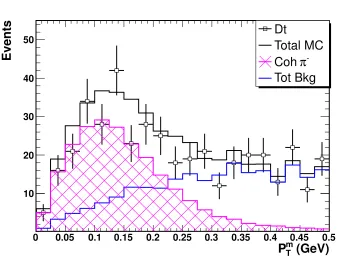
Figure 6.10 Pm
T distribution of the neutrino beam mode data (positive
fo-cusing data: FocP). . . 97
Figure 6.11 Xbj distribution of the neutrino beam mode data (positive
fo-cusing data: FocP). . . 98
Figure 6.12 ζ distribution of the neutrino beam mode data (positive
focus-ing data: FocP). . . 98
Figure 6.13 The NN distribution comparison of background and signal. . . 99
Figure 6.14 The NN distribution comparison of Data and MC. . . 99
Figure 6.15 The distribution of sensitivity of the neural network in coherent
π− analysis of neutrino beam mode. . . 103
Figure 6.16 The Ybj distribution from different contributions, ν-CC, ¯ν-CC,
NC, ¯ν-Cohρ− and Cohπ− in background (control) region and
the Comparison between Data (points with error bars) and
MC(histogram). . . 106
Figure 6.17 The Ybj distribution from different contributions, ν-CC, ¯ν-CC,
NC, ¯ν-Cohρ− and Cohπ− insignal (>0.7) region and the
Com-parison between Data (points with error bars) and MC(histogram). 106
Figure 6.18 TheXbj distribution from different contributions, ν-CC, ¯ν-CC,
NC, ¯ν-Cohρ− and Cohπ− in background (control) region and
the Comparison between Data (points with error bars) and
MC(histogram). . . 107
Figure 6.19 TheXbj distribution from different contributions, ν-CC, ¯ν-CC,
NC, ¯ν-Cohρ− and Cohπ− insignal (>0.7) region and the
Figure 6.20 The ζπ distribution from different contributions, ν-CC, ¯ν-CC,
NC, ¯ν-Cohρ− and Cohπ− in background (control) region and
the Comparison between Data (points with error bars) and
MC(histogram). . . 108
Figure 6.21 The ζπ distribution from different contributions, ν-CC, ¯ν-CC,
NC, ¯ν-Cohρ− and Cohπ− in
signal (>0.7) region and the
Com-parison between Data (points with error bars) and MC(histogram). 108
Figure 6.22 The Q2 distribution from different contributions, ν-CC, ¯ν-CC, NC, ¯ν-Cohρ− and Cohπ− in background (control) region and
the Comparison between Data (points with error bars) and
MC(histogram). . . 109
Figure 6.23 The Q2 distribution from different contributions, ν-CC, ¯ν-CC, NC, ¯ν-Cohρ− and Cohπ− insignal (>0.7) region and the
Com-parison between Data (points with error bars) and MC(histogram). 109
Figure 6.24 ThePTm distribution from different contributions,ν-CC, ¯ν-CC,
NC, ¯ν-Cohρ− and Cohπ− in background (control) region and
the Comparison between Data (points with error bars) and
MC(histogram). . . 110
Figure 6.25 ThePm
T distribution from different contributions,ν-CC, ¯ν-CC,
NC, ¯ν-Cohρ− and Cohπ− insignal (>0.7) region and the
Com-parison between Data (points with error bars) and MC(histogram). 110
Figure 6.26 The t distribution from different contributions, ν-CC, ¯ν-CC, NC, ¯ν-Cohρ− and Cohπ− in background (control) region and
the Comparison between Data (points with error bars) and
MC(histogram). . . 111
Figure 6.27 The t distribution from different contributions, ν-CC, ¯ν-CC, NC, ¯ν-Cohρ− and Cohπ− insignal (>0.7) region and the
Com-parison between Data (points with error bars) and MC(histogram). 111
Figure 6.28 The t0 distribution from different contributions, ν-CC, ¯ν-CC,
NC, ¯ν-Cohρ− and Cohπ− in background (control) region and
the Comparison between Data (points with error bars) and
MC(histogram). . . 112
Figure 6.29 The t0 distribution from different contributions, ν-CC, ¯ν-CC,
NC, ¯ν-Cohρ− and Cohπ− insignal (>0.7) region and the
Figure 6.30 The Eπ distribution from different contributions, ν-CC, ¯ν-CC,
NC, ¯ν-Cohρ− and Cohπ− in background (control) region and
the Comparison between Data (points with error bars) and
MC(histogram). . . 113
Figure 6.31 The Eπ distribution from different contributions, ν-CC, ¯ν-CC,
NC, ¯ν-Cohρ− and Cohπ− in
signal (>0.7) region and the
Com-parison between Data (points with error bars) and MC(histogram). 113
Figure 6.32 The ΦP T
had distribution from different contributions, ν-CC, ¯ν
-CC, NC, ¯ν-Cohρ− and Cohπ− in background (control) region
and the Comparison between Data (points with error bars) and
MC(histogram). . . 114
Figure 6.33 The ΦP T
haddistribution from different contributions,ν-CC, ¯ν-CC,
NC, ¯ν-Cohρ− and Cohπ− insignal (>0.7) region and the
Com-parison between Data (points with error bars) and MC(histogram). 114
Figure 6.34 The angleθ between Muon and Pion distribution from differ-ent contributions, ν-CC, ¯ν-CC, NC, ¯ν-Cohρ− and Cohπ− in
background (control) region and the Comparison between Data
(points with error bars) and MC(histogram). . . 115
Figure 6.35 The angle θ distribution from different contributions, ν-CC, ¯
ν-CC, NC, ¯ν-Cohρ− and Cohπ− in signal (>0.7) region and
the Comparison between Data (points with error bars) and
MC(histogram). . . 115
Figure 6.36 Coherent π− event picture originated by ¯ν
µ contamination in
the neutrino mode. . . 117
Figure 6.37 The distribution of BN as a function of visible energy (Evis) in
7 bins(the beam(flux) reweight is applied to all the ¯νµ-CC events). 120
Figure 6.38 R=σ(Cohπ−)
σ(¯νµCC) distribution in both linear scale (top) and log scale (bottom), calculated using a variable BN which depends on the
Evis(the beam(flux) reweight is applied to all the ¯νµ-CC events). . 124
Figure 6.39 R×<E> distribution in both linear scale (top) and log scale (bottom), calculated using a variable BN which depends on the
Figure 6.40 R=σ(Cohπ−)
σ(¯νµCC) distribution in both linear scale (top) and log scale (bottom), calculated from a fixed BN (the beam(flux) reweight
is applied to all the ¯νµ-CC events). . . 129
Figure 6.41 R×<E> distribution in both linear scale (top) and log scale (bottom), calculated from a fixed BN (the beam(flux) reweight
is applied to all the ¯νµ-CC events). . . 130
Figure 6.42 Pm
T distribution of the anti-neutrino beam mode data (negative
focusing data: FocN). . . 142
Figure 6.43 Xbj distribution of the anti-neutrino beam mode data (negative
focusing data: FocN). . . 143
Figure 6.44 ζ distribution of the anti-neutrino beam mode data (negative
focusing data: FocN). . . 143
Figure 6.45 The NN distribution comparison of background and signal. . . 144
Figure 6.46 The NN distribution comparison of Data and MC. . . 144
Figure 6.47 The distribution of sensitivity of the neural network in coherent
π− analysis of anti-neutrino beam mode. . . 145
Figure 6.48 The Ybj distribution from different contributions, ν-CC, ¯ν-CC,
NC, ¯ν-Cohρ− and Cohπ− in background (control) region and
the Comparison between Data (points with error bars) and MC
(histogram). . . 146
Figure 6.49 The Ybj distribution from different contributions, ν-CC, ¯ν-CC,
NC, ¯ν-Cohρ− and Cohπ− insignal (>0.7) region and the
Com-parison between Data (points with error bars) and MC (histogram).146
Figure 6.50 TheXbj distribution from different contributions, ν-CC, ¯ν-CC,
NC, ¯ν-Cohρ− and Cohπ− in background (control) region and
the Comparison between Data (points with error bars) and MC
(histogram). . . 147
Figure 6.51 TheXbj distribution from different contributions, ν-CC, ¯ν-CC,
NC, ¯ν-Cohρ−and Cohπ−insignal (>0.70) regionand the
Figure 6.52 The ζπ distribution from different contributions, ν-CC, ¯ν-CC,
NC, ¯ν-Cohρ− and Cohπ− in background (control) region and
the Comparison between Data (points with error bars) and MC
(histogram). . . 148
Figure 6.53 The ζπ distribution from different contributions, ν-CC, ¯ν-CC,
NC, ¯ν-Cohρ− and Cohπ− in
signal (>0.7) region and the
Com-parison between Data points with error bars) and MC (histogram). 148
Figure 6.54 The Q2 distribution from different contributions, ν-CC, ¯ν-CC, NC, ¯ν-Cohρ− and Cohπ− in background (control) region and
the Comparison between Data (points with error bars) and MC
(histogram). . . 149
Figure 6.55 The Q2 distribution from different contributions, ν-CC, ¯ν-CC, NC, ¯ν-Cohρ− and Cohπ− insignal (>0.7) region and the
Com-parison between Data (points with error bars) and MC (histogram).149
Figure 6.56 ThePTm distribution from different contributions,ν-CC, ¯ν-CC,
NC, ¯ν-Cohρ− and Cohπ− in background (control) region and
the Comparison between Data (points with error bars) and MC
(histogram). . . 150
Figure 6.57 ThePm
T distribution from different contributions,ν-CC, ¯ν-CC,
NC, ¯ν-Cohρ− and Cohπ− insignal (>0.7) region and the
Com-parison between Data (points with error bars) and MC (histogram).150
Figure 6.58 The t distribution from different contributions, ν-CC, ¯ν-CC, NC, ¯ν-Cohρ− and Cohπ− in background (control) region and
the Comparison between Data (points with error bars) and MC
(histogram). . . 151
Figure 6.59 The t distribution from different contributions, ν-CC, ¯ν-CC, NC, ¯ν-Cohρ− and Cohπ− insignal (>0.7) region and the
Com-parison between Data (points with error bars) and MC (histogram).151
Figure 6.60 The t0 distribution from different contributions, ν-CC, ¯ν-CC,
NC, ¯ν-Cohρ− and Cohπ− in background (control) region and
the Comparison between Data (points with error bars) and MC
(histogram). . . 152
Figure 6.61 The t0 distribution from different contributions, ν-CC, ¯ν-CC,
NC, ¯ν-Cohρ− and Cohπ− insignal (>0.7) region and the
Figure 6.62 The Eπ distribution from different contributions, ν-CC, ¯ν-CC,
NC, ¯ν-Cohρ− and Cohπ− in background (control) region and
the Comparison between Data (points with error bars) and MC
(histogram). . . 153
Figure 6.63 The Eπ distribution from different contributions, ν-CC, ¯ν-CC,
NC, ¯ν-Cohρ− and Cohπ− in
signal (>0.7) region and the
Com-parison between Data (points with error bars) and MC (histogram).153
Figure 6.64 The ΦP T
had distribution from different contributions, ν-CC, ¯ν
-CC, NC, ¯ν-Cohρ− and Cohπ− in background (control) region
and the Comparison between Data (points with error bars) and
MC (histogram). . . 154
Figure 6.65 The ΦP T
had distribution from different contributions, ν-CC, ¯ν
-CC, NC, ¯ν-Cohρ− and Cohπ− in signal (>0.7) region and the Comparison between Data (points with error bars) and MC
(histogram). . . 154
Figure 6.66 The angleθ between muon and pion distribution from differ-ent contributions, ν-CC, ¯ν-CC, NC, ¯ν-Cohρ− and Cohπ− in
background (control) region and the Comparison between Data
(points with error bars) and MC (histogram). . . 155
Figure 6.67 The angle θ distribution from different contributions, ν-CC, ¯
ν-CC, NC, ¯ν-Cohρ− and Cohπ− in signal (>0.7) region and
he Comparison between Data points with error bars and MC
(histogram). . . 155
Figure 6.68 Coherent π− event picture originated by ¯ν
µ contamination in
the anti-neutrino mode. . . 157
Figure 6.69 The distribution of BN as a function of visible energy(Evis) in
7 bins (the beam(flux) reweight is applied to all the ¯νµ-CC events). 160
Figure 6.70 R=σ(Cohπ−)
σ(¯νµCC) distribution in both linear scale (top) and log scale (bottom), calculated from variable BN which depends on the
Evis (the beam(flux) reweight is applied to all the ¯νµ-CC events). 163
Figure 6.71 R×<E> distribution in both linear scale (top) and log scale (bottom), calculated from variable BN which depends on the
Figure 6.72 R=σ(Cohπ−)
σ(¯νµCC) distribution in both linear scale (top) and log scale (bottom), calculated from a fixed BN (the beam(flux) reweight
is applied to all the ¯νµ-CC events). . . 167
Figure 6.73 R×<E> distribution in both linear scale (top) and log scale (bottom), calculated from a fixed BN (the beam(flux) reweight
is applied to all the ¯νµ-CC events). . . 168
Figure 6.74 Comparison of R=σ(Cohπ−)
σ(¯νµCC):FocP and R=
σ(Cohπ−)
σ(¯νµCC):FocN as a
function ofEν using variable BN. . . 170
Figure 6.75 Distribution of the sum of R=σ(Cohπ−)
σ(¯νµCC):FocP and R=
σ(Cohπ−) σ(¯νµCC):FocN
as a function of Eν using variable BN. . . 171
Figure 6.76 Comparison of R=σ(Cohπ−)
σ(¯νµCC) and R=
σ(Cohπ+)
σ(νµCC) using variable BN. . . 173
Figure 6.77 Comparison of R=σ(Cohπ−)
σ(¯νµCC) and R=
σ(Cohπ+)
σ(νµCC) using variable BN. . . 174
Figure 6.78 Comparison of R=σ(Cohπ−)
σ(¯νµCC):FocP and R=
σ(Cohπ−)
σ(¯νµCC):FocN
calcu-lated from a fixed BN. . . 176
Figure 6.79 Distribution of the sum of R=σ(Cohπ−)
σ(¯νµCC):FocP and R=
σ(Cohπ−) σ(¯νµCC):FocN
calculated from a fixed BN. . . 177
Figure 6.80 Comparison of R=σ(Cohπ−)
σ(¯νµCC) and R=
σ(Cohπ+)
σ(νµCC) calculated from a
fixed BN. . . 178
Figure 6.81 Comparison of R=σ(Cohπ−)
σ(¯νµCC) and R=
σ(Cohπ+)
σ(νµCC) calculated from a
fixed BN. . . 179
Figure 6.82 Comparison of R=σ(Cohπ−)
σ(¯νµCC) calculated from a fixed BN to R=
σ(Cohπ−) σ(¯νµCC) calculated from variable BN. . . 181
Figure 6.83 Comparison of R=σ(Cohπ−)
σ(¯νµCC) between BS and RS Model
calcu-lated from a fixed BN. . . 197
Figure 6.84 Comparison of R=σ(Cohπ−)
σ(¯νµCC) and R=
σ(Cohπ+)
σ(νµCC) as a function ofEν
using variable BN. . . 199
Figure 6.85 Comparison of R=σ(Cohπ−)
σ(¯νµCC) and R=
σ(Cohπ+)
σ(νµCC) as a function ofEν
Figure 6.86 Ratio between R=σ(Cohπ−)
σ(¯νµCC) and R=
σ(Cohπ+)
σ(νµCC) as a function of Eν
using variable BN. . . 201
Figure 6.87 Ratio between of R=σ(Cohπ−)
σ(¯νµCC) and R=
σ(Cohπ+)
σ(νµCC) as a function of
Eν calculated from a fixed BN. . . 202
Figure 6.88 Total energy-dependent uncertainties on the yields of each of
the neutrino species(νµ and ¯νµ). . . 205
Figure 7.1 Feynman diagram of photon induced coherentρ process. . . 209
Figure 7.2 Q2 distribution of neutrino induced coherent ρ+ events gener-ated from LBNE flux and photon induced coherent events ob-tained fromν-induced coherent ρ+ events reweighted by factor
π2α2
G2
FQ4. . . 214 Figure 7.3 Xbj distribution of neutrino induced coherentρ+ events
gener-ated from LBNE flux and photon induced coherent events ob-tained fromν-induced coherent ρ+ events reweighted by factor
π2α2
G2
FQ4. . . 215 Figure 7.4 Ybj distribution of neutrino induced coherentρ+ events
gener-ated from LBNE flux and photon induced coherent events ob-tained fromν-induced coherent ρ+ events reweighted by factor
π2α2
G2
FQ4. . . 216 Figure 7.5 Pm
T distribution of neutrino induced coherent ρ+ events
gener-ated from LBNE flux and photon induced coherent events ob-tained fromν-induced coherent ρ+ events reweighted by factor
π2α2
G2
FQ4. . . 217 Figure 7.6 ζρdistribution of neutrino induced coherentρ+events generated
from LBNE flux and photon induced coherent events obtained fromν-induced coherent ρ+ events reweighted by factor π2α2
G2
FQ4. . . 218 Figure 7.7 t distribution of neutrino induced coherentρ+ events generated
from LBNE flux and photon induced coherent events obtained fromν-induced coherent ρ+ events reweighted by factor π2α2
G2
Chapter 1
Electroweak Theory and Neutrino Interaction
1.1 Weak Interaction and Electroweak Theory
Theoretically, all the interactions between particles can be classified into four funda-mental interactions and listed in order of decreasing strength as: the strong inter-action, electromagnetism, the weak interinter-action, and gravity. The weak interaction operates between all particles except photons and gravitons. It causes reactions which make particles ultimately decay into the stable leptons and hadrons, such as electrons, neutrinos, protons, and so on. These decays are the natural sources for us to study the weak interaction, however, only in a limited energy region. The advent of neu-trino experiments in humans’ laboratories ameliorated the situation by enabling us to explore weak interactions in a much wider energy region. The neutrino-hadron scattering is one such experiment.
The neutrino-hadron scattering can be classified with the help of a plane composed of Q2 and ν [16], where Q2 and ν are the square of the momentum transfer and the energy transfer between the initial and final leptons respectively (Q2 and ν are defined in chapter 2). Figure 1.1 shows the weak interactions with respect toQ2 and
ν. In this figure, Region I with very smallQ2 and ν represents weak decays; Region II (diagonal line) represents (quasi-)elastic scattering; Region III is the resonance region, starting with the line W =M+mπ(W is the hadronic mass, M is the proton
mass, mπ is the pion mass); Region IV with high values of Q2 and ν is the domain
scattering, which is the focus of this thesis. In this Region, the interactions with very lowQ2 allow study two basic properties of the weak current: One is the conservation of the vector current (It is also called CVC hypothesis), which was introduced to explain the equality of the vector muon and nuclear beta decay. The other one is the partial conservation of the axial current (It is also called PCAC hypothesis) which can be used to explain the small (∼20%) renormalization of the nuclear axial decay constant by the strong interactions [36]. When the Q2 is very low, the nuclear stays intact in coherent process, then the nucleons inside can not be considered as free. In this case, the perturbative theory of strong interactions can not be used. To study the processes with very low Q2, the Hadron Dominance Model has been brought up to describe the hadronic behavior in coherent process, which is going to be introduced in this chapter. Therefore, the study of coherent meson production can also provide a detailed test of Hadron Dominance Model.
Q
2(
GeV
2)
2M ν(GeV2)
I
II
III
IV
V
x= 1 W=M+mπ
x=C
Space-Time Structure of the Weak Charged and Neutral
Current
This subsection gives basics of electroweak theory (which can be found in many textbooks, such as [33] and [30]). For convenience, we give the convention for the Dirac matrices in this thesis as follows.
Let{γµ, µ= 0,1,2,3}be an orthonormal set of vectors in space-time. The
signa-ture of space-time is expressed by the equations:
γ02 = 1, γ12 =γ22 =γ32 =−1, (1.1)
γµ = gµνγν, (1.2)
and the matrices follow an anti-commutation relation:
{γµ, γν}+ =
1
2(γµγν +γνγµ) = gµν. (1.3)
As usual, a special multivector
iγ0γ1γ2γ3 = γ5 (1.4)
is introduced which can be used to construct peudoscalars. A multivetor is said to be even (odd) if it commutes (anti-commutes) with γ5. A slashed 4-momentum (or other 4-vector) represents the product of the 4-momentum (or other 4-vector) with
γµ.
In the Standard Model the electroweak interaction is described by a gauge field theory. The gauge group is the SU(2)L×U(1)Y group, where L indicates that this
SU(2) group only acts on the left-handed components of fermion fields. The subscript
Y for U(1) group is called hypercharge and specifies this U(1) group.
The local SU(2)L × U(1)Y gauge invariance of the electroweak Lagrangian is
guaranteed by introducing the covariant derivativeDµ,
Dµ=∂µ+igAiµτi+ig0Bµ
Y
where τi = σi/2 (i = 1,2,3) with σi being the Pauli matrix. Ai
µ and Bµ are gauge
boson fields. For each generator of the group, there is a gauge field. The covariant derivative transforms as
Dµ →Dµ0 =U(θi(x), η(x))DµU−1(θi(x), η(x)), (1.6)
where
U(θi(x), η(x)) =eiθi(x)τi+iη(x)Y /2, (1.7)
with θi(x) and η(x) being the parameters of the transformation. Then the gauge
boson fields transform as
Aiµτi →A0iµτi =U(θj(x))[Aiµτi− i g∂µ]U
−1(
θi(x)), (1.8)
Bµ →Bµ0 =Bµ−
1
g0∂µη(x). (1.9)
The interaction part of the Lagrangian can be written as
LI = −
1
2L¯L(g /A i
σi−g0B/)LL−
1
2Q¯L(g /A i
σi+ 1
3g0B/)QL
+g0e¯RBe/ R− 23g0u¯RBu/ R+13g0d¯RBd/ R, (1.10)
whereLLand QL represent the left-handed lepton doublet and the left-handed quark
doublet in the fundamental representation ofSU(2)Lgroup respectively. Specifically,
for the first generation of the Standard Model,
LL =
νeL
eL
!
, QL=
uL
dL
!
. (1.11)
In order to see the interaction term for neutrinos explicitly, we take the explicit form of the Pauli matrices and obtain
LI,L = −
1 2
¯ νeL eL
g /A3 −g0B/ g(A/1−i /A2) g(A/1+i /A2) −g /A3−g0B/
νeL eL
+g0e¯
where we have omitted the quark part of the Lagrangian. This equation shows that the interactions are inter-mediated by the mixtures of the gauge fields. The off-diagonal terms of Equation (1.12) are conjugations of each other, so we can introduce a complex fieldWµ by
Wµ≡ A
µ
1√−iAµ2
2 . (1.13)
Replacing Aµ1 and Aµ2 with Wµ, we have, for interactions between neutrinos and
electrons,
L(CC) = −√g
2{ν¯eLW e/ L+ ¯eLW/ †
νeL}
= −2√g
2ν¯eγµ(1−γ5)eWµ+H.c.
= −2√g
2jW,Lµ Wµ+H.c., (1.14)
where
jW,Lµ = ¯νeγµ(1−γ5)e = 2 ¯νeγµeL. (1.15)
The complex gauge field Wµ carries a charge which should be the electrical charge
to guarantee the conservation of electrical charge. So the current jW,Lµ is called the (leptonic) charged current and the corresponding part of Lagrangian is indicated by CC (which represents charged current) as a superscript (see Equation (1.14)).
The diagonal terms of Equation (1.12) are mixtures of Aµ3 and Bµ, so we can
introduce two fields Zµ and Aµ as the linear combinations of A
3 and Bµ by
Aµ = sinθWAµ3 + cosθWBµ, (1.16)
Zµ = cosθWAµ3 −sinθWBµ, (1.17)
whereθW is a parameter to be determined and is usually called the weak mixing angle
or Weinberg angle. Recalling that the electromagnetic interaction should come out of the electroweak theory, we require thatAµis just the photon field. This requirement
determines the Weinberg angle and the relation among the couplings g, g0 and the
To see how this happens, let us pick up the neutral current (NC) Lagrangian from Equation (1.12):
L(N C)=−1
2{ν¯eL(g /A3−g0B/)νeL−e¯L(g /A3+g0B/)eL−2g0e¯RBe/ R}. (1.18)
Substituting Aµ3 and Bµ with Aµ and Zµ by using Equations (1.16) and (1.17), we
obtain
L(N C) = −1
2{ν¯eL[gcosθW +g0sinθW)Z/ + (gsinθW −g0cosθW)A/]νeL
−e¯L[gcosθW −g0sinθW)Z/ + (gsinθW +g0cosθW)A/]eL
−2g0e¯R[−sinθWZ/ + cosθWA/]eR}. (1.19)
As neutral particles, neutrinos should not interact with the electromagnetic field, so we have
gsinθW =g0cosθW. (1.20)
Now taking this relation back into Equation (1.19), we obtain
L(I,LN C) = −
g
2 cosθW{ ¯
νeLZν/ eL−(1−2 sin2θW) ¯eLZe/ L+ 2 sin2θWe¯RZe/ R}
+gsinθWe /¯Ae. (1.21)
The last term describes electrons interacting with photons, which is just what we need for electromagnetic interactions, so the couplinggsinθW should be equal to the
electrical couplinge:
gsinθW =e. (1.22)
We have 4 parameters g, g0, e and θW with 2 equations (1.20) and (1.22), so in
principle, we can choose any two of them to describe the theory. From Equations (1.20) and (1.22), we can also deduce
tanθW =
g0
g, (1.23)
and
Experimentally, the value of sin2θ
W can be extracted from neutral current
pro-cesses, and is different according to different renormalization prescriptions. In the on-shell scheme, it is
sin2θ
W = 1−
MW2
MZ2 , (1.25)
where MW and MZ are the masses of W and Z respectively.
To sum up, the neutral current Lagrangian can be written as
L(N C) =LZ+Lγ, (1.26)
whereLγ is the electrodynamic (QED) Lagrangian (interaction part) and is given by
Lγ =−ejµ
γ,LAµ (1.27)
where the leptonic electromagnetic current jγ,Lµ is
jγ,Lµ =−eγ¯ µe. (1.28)
The weak neutral current Lagrangian LZ is given by
LZ =−2 cosgθ
W
jZ,Lµ Zµ, (1.29)
where the leptonic weak neutral current is
jZ,Lµ = 2gνLν¯eLγµνeL+ 2gLe¯LγµeL+ 2gRe¯RγµeR. (1.30)
The coefficients gν
L, gL, and gR can be read off from Equation (1.21). Finally, the
leptonic weak neutral current can be written as
jZ,Lµ = ¯νeγµ(gνV −gAνγ5)νe+ ¯eγµ(gVl −gAl γ5)e, (1.31)
where
gVν,l =gν,lL +gν,lR, (1.32)
Following the same procedure, one can deduce the Lagrangian for quarks. The corresponding interaction Lagrangian is
LI,Q = L(QN C)+L
(CC) Q
= −ejν
γ,QAν −
g 2 cosθW
jν
Z,QZν−
g
2√2jW,Qν Wν −
g
2√2(jW,Qν )†Wν†. (1.34)
The first two terms after the second equality sign constitute the neutral current Lagrangian while the last two terms constitute the charged current Lagrangian. The quark weak charged currentjν
W,Q, the quark weak neutral currentjZ,Qν and the quark
electromagnetic current jν
γ,Q read, respectively,
jW,Qν = ¯uγν(1−γ5)d, (1.35)
jν
Z,Q = ¯uγν(guV −guA)u+ ¯dγν(gdV −gAdγ5)d, (1.36)
jγ,Qν = 2
3uγ¯ νu− 13dγ¯ νd. (1.37)
For coefficients gu,dV and gu,dA , we have, in general,
gLf =I3f −qf sin2θW, (1.38)
gfR=−qfsin2θW, (1.39)
gVf =gLf +gfR=I3f −2qfsin2θW, (1.40)
gfA=gfL−gfR=I3f. (1.41)
where the superscript f denotes a specific fermion (lepton or quark) field. I3 is the third component of the weak isospin andqf is the electrical charge of the
correspond-ing fermion.
We have shown that the electroweak interaction includes the weak interaction which is inter-mediated by charged gauge fieldsW±and neutral gauge fieldsZ
d, ν(¯ν) u, l−(l+)
W+(W−)
f=ν, l, q f=ν, l, q Z0
Figure 1.2: Diagrams of Weak Charged and Neutral Current
The weak interaction is a short range interaction, because the gauge bosons are massive. Roughly, we have Rweak (Range of Weak Interaction)
Rweak = ~
c
MWc2 ≈2×10 −18
m = 0.002f m0.1f m. (1.42)
Weak Current of Hadrons and the CVC and PCAC
hypothesis
The previous subsection gives the weak currents for leptons and quarks. In the real world, quarks never show up as isolated particles, instead only hadrons which are composed with quarks (as well as gluons) appear in experiments. For the coherent pion and rho processes, we encounter weak current for nucleons.
In the quark model proton and neutron are the states of |uudi and |uddi re-spectively. The weak interaction of these nucleons has more complicated structures compared to that of leptons or bare quarks, because it suffers from other interactions (mainly the strong interaction). However, the weak current of nucleons still consists of a vector currentVα and an axial-vector current Aα according to Lorentz invariance
of the theory. So we may write
[Jhadronweak ]α=Vα−Aα. (1.43)
Vα and Aα can be expressed as suitable Dirac matrices sandwiched between spinors
for nucleons. To specify, the vector current may consist of aγαterm (corresponding to
qβ is the four-momentum transferred and σ
αβ = 12[γαγβ − γβγα]), and a qα term
(corresponding to an induced scalar form factor). The axial current may consist of a
γαγ5 term (corresponding to an axial-vector form factor or point-like interaction), a
σαβqβγ5term (pseudotensor form factor), and aqαγ5term (induced pseudoscalar form
factor). Form factors for each term are dependent on the type of hadrons involved and this is expressed as h1 and h2 indices.
Vα = ¯ψh1[γαf
h1h2
1 (Q2, ν)−iσαβqβf2h1h2(Q2, ν) +qαf3h1h2(Q2, ν)]ψh2,
Aα = ¯ψh1[γαg
h1h2
1 (Q2, ν)−iσαβqβg2h1h2(Q2, ν) +qαg3h1h2(Q2, ν)]γ5ψh2,
(1.44)
where ψh1(h2) represents the spinor of nucleonh1(h2) [51].
All the form factorsfi andgi are real according to the time reversal invariance of
the strong interaction [27]. Furthermore, in the exact isospin invariance, one finds
f3(Q2) = 0, g2(Q2) = 0. (1.45)
As a consequence, the contraction of vector currentVα withqα vanishes, i.e., qαVα =
0. The f1 term vanishes due to the free Dirac equation for the nucleon spinors (remember that in the isospin symmetric-case, the proton and neutron have the same mass). The f2 term vanishes due to the anti-symmetric property of σαβ. On the
other hand, qαV
α = 0 implies ∂αVα = 0 in the configuration space, i.e., the vector
current is conserved in the case that the strong interaction is isospin invariant. This property was proposed in Ref. [25, 28] and is called the conserved vector current (CVC) hypothesis.
weak current takes a form similar to that at the leptonic vertex
[Jhadronweak ]α(Q2 = 0) = Vα−Aα
= ¯ψpγα(f1pn(Q2 = 0)−gpn1 (Q2 = 0)γ5)ψn, (1.46)
and by definition
f1(0) =gV, g1(0) = gA. (1.47)
Experiments tell us that gV ' 1, which implies that the coupling of this hadronic
current is consistent with that of the corresponding leptonic current. Analogously to the conservation of electrical current leading to the universality of electron/proton charge, this universality of weak vector charge implies a conservation of the weak vector current. It should be mentioned that the isospin is not an exact symmetry, but is violated by the electromagnetic interactions, responsible for the mass difference of u and d quarks (thus proton and neutron), so the vector current is not exactly conserved. However, the violation of isospin symmetry is very small, so the CVC hypothesis is a good approximation.
Now, we consider the axial current. Experiments tell us that gA '1.25, which is
different from unity. This implies that the axial-vector current is affected by strong in-teractions and is not conserved. (In fact, if the axial current were conserved, the com-monly observed pion decay π± →µ±ν would be forbidden.) For this non-conserved
axial current, there is another hypothesis, called partially conserved axial current (PCAC) hypothesis, that relates the derivative of the axial current to the pion field, which was first proposed in Ref. [26]. We will give more details about PCAC in the next chapter.
The Goldberger-Treiman Relation
symmetry arises, that is the chiral SU(2) symmetry. This chiral symmetry would result in the conservation of the axial current, so that qαA
α = 0. Now consider the
axial current of neutron-proton transition. From Equation (1.44), we have, for theg1 term:
qµAg1
µ = g1(q2)¯p(/p−p/ 0)
γ5n
= −g1(q2)¯p /p0γ5n−g1(q2)¯pγ5/pn
= −(mp+mn)g1(q2)¯pγ5n, (1.48)
and for the g3 term:
qµAg3
µ = ¯pq2g3γ5n. (1.49)
The g2 term vanishes automatically. Then we have
(mp+mn)g1(q2) = q2g3(q2). (1.50)
From this equation, we see that, eitherg1 goes to zero asq2 →0 org3(q2) has a pole. From experiments, we have known that g1(0) = gA ' 1.25, so g3(q2) should have a
pole at q2 →0. This pole is due to the interaction of pions with the weak current of hadrons, which gives a contribution
qµ
q2fπ √
2gπN Npγ¯ 5n (1.51)
to the matrix element of the axial vector current.
Comparing Equation (1.50) and Equation (1.51), we obtain
mNgA=
gπgπN N
√
2 , (1.52)
where the proton mass and neutron mass are taken as the same andmN =mp =mn.
Vector Meson Dominance Model(VMD) and Hadron
Dominance Model(HDM)
The discussion of the previous subsection tells us that the axial vector current of hadrons receives contributions from interactions with pions, and sheds light on how to treat the hadron currents. For example, the electrical current of hadrons may be treated with the so called the Vector Meson Dominance Model (VMD) (details of this model can be found in Refs. [13, 32]) where the amplitude of a photon scattering off a hadron is obtained by summing over the amplitudes of dominant vector meson-hadron scatterings (multiplied by corresponding meson propagators). Specifically one has
M(γ+α→β) = X
V=ρ0,ω,φ e gV
m2V
Q2+m2V M(V +α→β), (1.53)
where mV is the mass of corresponding meson and em
2 V
gV is the coupling constant of the vector meson to the photon. The foundation of this model is the observation that the photon-induced processes exhibit hadronic properties as shown in Figure 1.3. The total cross-sections of photon-induced processes and pion-nucleon scatterings have similar resonance structures at low energy, but become structureless at higher energy.
On the theoretical side, the VMD model assumes the photon state |γ > is the superposition of a "bare" photon state(|γB >) and a sum of hadronic states with the
same quantum numbers as the photon (JP C = 1−−, Q=B =S = 0). Then the state
vector could be written as
|γ >'qZ3|γB >+√αem|h >, (1.54)
where Z3 is the renormalization constant of photon factor, and αem = 1371 is the fine
![Fig ur e 1 .1 : T he ( Q2 , ν ) pla ne in ne ut r inoint e r a c t io ns [3 6 ].](https://thumb-us.123doks.com/thumbv2/123dok_us/8434136.1388072/28.612.141.481.383.676/fig-ur-pla-in-ne-inoint-io-ns.webp)
![Fig. 8. Distribution of the angle between the π− momentum vector and the beamline direction, pT /p, just upstream of the horn (top left), right after it (top right)and the ratio of the latter to the former (bottom).Fig ur e 6 .4 : D is t r ibut io n o f t he a ng le be t w e e n t he π−mo me nt um v e c t o r a nd t he be a mline dir e c t io n, PT/ P , j us t ups t r e a m o f t he ho r n ( t o p le f t ) ,r ig ht a f t e r it ( t o p r ig ht ) a ndt he r a t ioo f t he la t t e r t ot he f o r me r ( bo t t o m) [8 ].](https://thumb-us.123doks.com/thumbv2/123dok_us/8434136.1388072/105.612.94.455.71.425/distribution-momentum-vector-beamline-direction-upstream-right-mline.webp)


![Figure 1: An example of the structure of an artificial neutral network.Fig ur e 6 .9 : An e x a mple o f t he s t r uc t ur e o f a n a r t ific ia l ne ut r a l ne t w o r k[2 1 ].](https://thumb-us.123doks.com/thumbv2/123dok_us/8434136.1388072/122.612.183.419.227.467/figure-example-structure-articial-neutral-network-fig-ic.webp)