Available Online atwww.ijcsmc.com
International Journal of Computer Science and Mobile Computing
A Monthly Journal of Computer Science and Information Technology
ISSN 2320–088X
IJCSMC, Vol. 4, Issue. 6, June 2015, pg.783 – 788
RESEARCH ARTICLE
A Tree Based Decomposition
Model for Eye Blink Detection
Anupama
1, Kavita
2Student, CSE Deptt, Shri Baba Mastnath College of Engineering [email protected]
Asstt. Prof, CSE Deptt, Shri Baba Mastnath College of Engineering
Abstract: In this paper, a tree decomposition model for eye blink detection is presented. The work is defined as a layered model for identification of human object over the video and identifying the moment based analysis over the video frames. At first the object region is identified and then the decomposition model is applied for eye blink identification based on featured map. The results show that the work has identified the eye blink effectively for the work.
Keywords – Tree, Decomposition, Eye Blink
1. Introduction
Image Processing is having its significance in almost all the application area because of its visual involvement. It can be used as the real time online information processing as well as can be work on offline captured image set. In each application area, the significance of image processing is in various applications. Such as in case of medical image processing it can be used for organ classification, disease identification etc. These application areas also change the significance of application based on the application data. It means, each application area as well as application data having its own constraints specification and restriction under which the information processing is performed. One of the common image processing area is object classification. Object is one of the broader term and specific to the application area[1][2][3][4][5].
An object can be represented as an individual identity described under the shape and size features with some quantitative measures. The object can be an organ in medical image processing, an apple or flower in agricultural image processing or some real time object can found around. The identification of these objects and divided them in various classes is having different challenges. Some of the objects forms that can be identified in real time processing are described here[6][7][8][9].
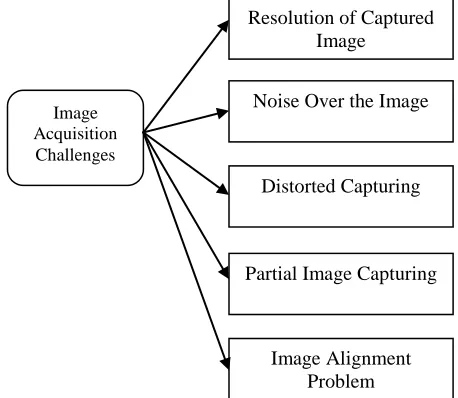
scanner. The challenge is not only limited to the device itself but also the device quality and the expertise to handle the device[10][11][12][13][14]. If the acquisition is not proper, it can results number of impurities in the capturing. Some of these impurities are shown in figure 1.
Figure 1 : Image Acquisition Problems
These problems can occur because of device problem, expertise problem or the environmental problems. To perform the effective image operations, it is required to either get a perfect image without any impurity or remove these impurities before performing the actual operation. The stage of removing these impurities over the image is called preprocessing the image. The preprocessing stage is defined before the actual process to remove the noise, blur, adjustment of brightness-contrast, angular alignment, shape normalization etc. Once the filtered image is obtained, the next work is to apply the actual algorithmic process for object segmentation or classification[13][14][15].
A) Classification
Image classification is one of the most requirement approach used in most of the application area to identify the object and the object category. This is also used to identify the outlier over the object image. There are different context respective to which the object categorization and pattern recognition can be performed. This object categorization includes the object search based on the visual characteristics. The basic model of object information extraction and classification is shown in figure 2.
Figure 2 : Image Information Processing
Image Acquisition
Challenges
Resolution of Captured Image
Noise Over the Image
Distorted Capturing
Partial Image Capturing
As shown in the figure, the user perform the request on image dataset by specification of its need in terms of statistical features or the visual object input. The classification algorithm will use the object dataset as the training set and the input characteristics as the testing set and perform the classification. The classification model will match the appropriate image based on the similarity analysis and identify the most effective object from the dataset.
In this paper, an exploration to the classification model and the various algorithmic approaches adapted by different researchers are discussed. In this section, the requirement of image processing and classification approaches in different application areas is discussed. The section also discussed the challenges in the classification process. In section II, the work defined by earlier researchers is discussed. In section III, the study on the existing approaches is presented. In section IV, the conclusion obtained from the work is presented.
II. RESEARCH METHODOLOGY
As discussed in earlier section, image processing in real time images is one of most required image processing activity with integrated challenges and significances. The basic model of the classification is shown in figure 3. This model is described in a generic form without the specification of any application area or application data. No specification of any integrated approach for any stage is also defined in this model.
To perform the recognition, the input set is defined in the form of imageset related to the domain and with acquired results in the form of class. This imageset can be a dataset of raw images or it can be featured component imageset. Each image of the dataset is described with the relative class. If the imageset is raw imageset, then to convert it to normalize images, it is required to perform the filteration over it. This filteration stage will reduce the image noise and convert it to normalize images adjusting the size and color contrast of images. Now this normalize imageset will be considered for the classification. Instead of performing the analysis on complete image, some of the image features are extracted. These features can be statistical features such as mean, standard deviation, entropy value etc. or it can be visual features of image. Later on these features will be defined as the dataset called featureset. Now this featureset will be consider as the training set for the classification algorithm. After generating the featured training set, the next work is to accept the input image and performed the classification process on it. To perform this classification, the input image will be converted to the normalize image. This normalize image is then processed under different measures to obtain the image features. This feature will work as the testing set for classification model. At the final stage of this model, the classification is been performed under specific algorithmic approach. There are number of available algorithmic approaches.
III. RESULTS
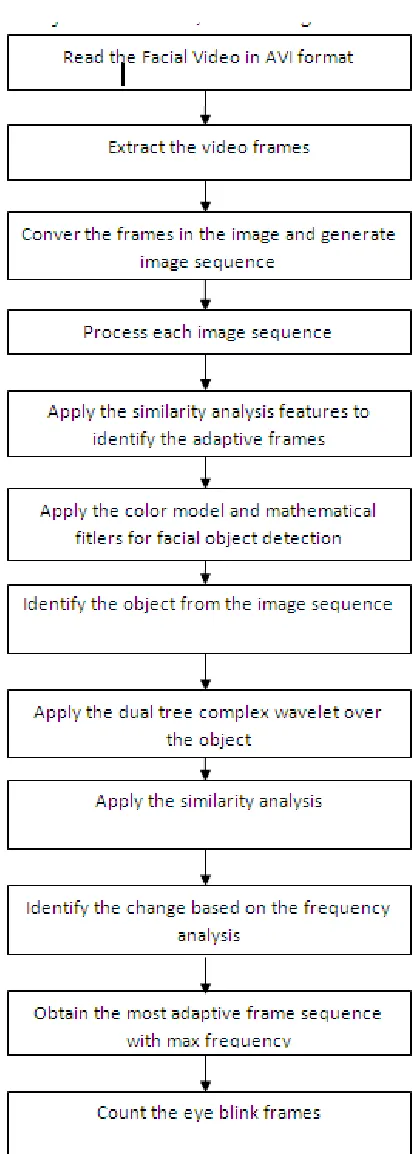
The presented work is implemented in matlab environment for different videos. The analysis of the work is here done in terms of object detection over the video and to perform the identification of the eye blink based on the moment analysis between the frames. The result graphs obtained from the work are given here under
Figure 3 : Detection Results
Here figure 3 is showing the detetion reults obtained from the work. The figure shows that the work has significantly identified the objects over the video so that the accurate identificaiton can be done.
IV. CONCLUSION
In this paper, an improved model for eye blink detection is presented based on moment analysis. The presented work model is defined to obtain the maximum mapped image so that the adaptive object identification over the videos can be done.
References
[1] Ioana Sporea," Supervised Learning in Multilayer Spiking Neural Networks". [2] Riano Lorenzo," A New Unsupervised Neural Network for Pattern Recognition with
Spiking Neurons", 2006 International Joint Conference on Neural Networks Sheraton Vancouver Wall Centre Hotel, Vancouver, BC, Canada July 16-21, 2006 0-7803-9490-9/06©2006 IEEE
[3] Matthias Oster," A Spike-Based Saccadic Recognition System", 1-4244-0921-7/07 © 2007 IEEE
[4] QingXiang Wu," Knowledge Representation and Learning Mechanism Based on Networks of Spiking Neurons", 2006 IEEE International Conference on Systems, Man, and Cybernetics October 8-11, 2006, Taipei, Taiwan 1-4244-0100-3/06@2006 IEEE
[5] Susumu Nagatoishi," Effect of Refractoriness on Learning Performance of a Pattern Sequence", Proceedings of International Joint Conference on Neural Networks, Atlanta, Georgia, USA, June 14-19, 2009 978-1-4244-3553-1/09©2009 IEEE
[6] Yan Meng," Human Activity Detection using Spiking Neural Networks Regulated by A Gene Regulatory Network", 978-1-4244-8126-2/10 ©2010 IEEE
[7] Jae-sun Seo," A 45nm CMOS Neuromorphic Chip with a Scalable Architecture for Learning in Networks of Spiking Neurons", 978-1-4577-0223-5/11©2011 IEEE
Address Event Representation, Rank Order, and Temporal Spike Learning", WCCI 2012 IEEE World Congress on Computational Intelligence June, 10-15, 2012 - Brisbane, Australia IJCNN
[10] Nimish Kale," Impact of Sensor Misplacement on Dynamic Time Warping Based Human Activity Recognition using Wearable Computers", Wireless Health ’12, October 23–25, 2012, San Diego, USA ACM 978-1-4503-1760-3
[11] Soumitra Samanta," FaSTIP: A New Method for Detection and Description of Space-Time Interest Points for Human Activity Classification", ICVGIP ’12, December 16-19, 2012, Mumbai, India ACM 978-1-4503-1660-6/12/12
[12] Kyungseo Park," Abnormal Human Behavioral Pattern Detection in Assisted Living Environments", PETRA’10 , June 23-25, 2010, Samos, Greece ACM ISBN 978-1-4503-0071-1/10/06
[13] Georgios Goudelis," Using Mutual Information to Indicate Facial Poses in VideoSequences", CIVR ’09, July 8-10, 2009 Santorini, GR ACM 978-1-60558-480-5/09/07
[14] Sawsan M. Mahmoud," Abnormal Behaviours Identification for An Elder’s Life Activities using Dissimilarity Measurements", PETRA ’11, May 25 - 27, 2011, Crete, Greece. ACM ISBN 978-1-4503-0772-7/11/05