The Implementation And Automation Of Software Reliability
Assessment Model Using Neuro Fuzzy System
Bonthu Kotaiah
1 Assistant Professor, Maulana Azad National Urdu University, Hyderabad, India
ABSTRACT
Dependency on computer aided systems is increasing heavily now a days in the modern era with the evolution of latest concepts, technologies and tools in the field of computer science. At the same time the quality of service is being affected by some software failures or faults or bugs in order to meet the required level of performance and accuracy levels which ultimately leads so many people to go for alternatives of the old softwares. To address the issues so many software engineers, developers and system analysts recognized that some software functions are critical and their consequences of the problems are significant enough and they tried to find out/suggest the solutions for them. Let us examine the different definitions given by different scientists for the software quality and software reliability. In this project we proposed an approach for the
implementation of Software Reliability
Assessment Model based on Neuro-Fuzzy based Systems using MTBF values as a parameter.
1.INTRODUCTION 1.1 Neuro Fuzzy Models
usually not differentiable. There are two solutions to this problem:
a) Replace the functions used in the fuzzy system (like min and max) by differentiable functions, or
b) Do not use a gradient-based neural learning algorithm but a better-suited procedure.
The Neuro Fuzzy technique, then, is used to derive a fuzzy system from data, or to
enhance it by learning from examples. The exact implementation of the Neuro Fuzzy model does not matter. It is possible to use a neural network to learn certain parameters of a fuzzy system, like using a self-organizing feature map to find fuzzy rules, or to view a fuzzy system as a special neural network and to apply a learning algorithm directly.
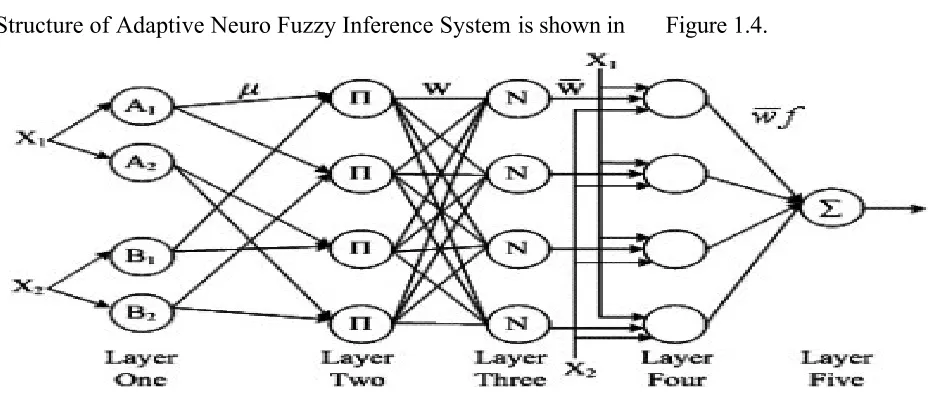
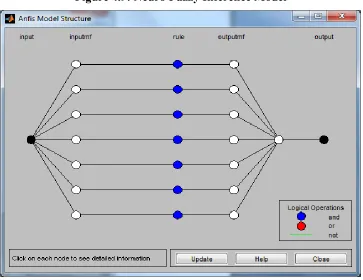
The Structure of Adaptive Neuro Fuzzy Inference System is shown in Figure 1.4.
Figure 1.4: Structure of Adaptive Neuro Fuzzy Inference System.
The rule structure is made up of Neuro Fuzzy commands of “IF”, “AND, “Continues” and “THEN” carefully connected together to arrive at the specified desired parameter (output).
1.2 Objectives
The objectives set for the study in the project are as follows:
To identify the factors that affect the Software Reliability at different phases of SDLC(Software Development Life Cycle)
To find out, analyze the effect of errors, bugs and failures in the software under the development.
To collect the datasets of software programs from running software with the appropriate runtime errors that is useful for the assessment.
To formulate a theoretical analysis for the evaluation of the metrics used for assessment and development of model.
To identify how MTBF relates with the Software Reliability.
To calculate the metrics with the given
datasets both analytically and
programmatically.
To develop a model for the assessment of Software Reliability based on Neuro Fuzzy Systems approach and to implement it.
To train the neural network with some collected Software Reliability parameters (at different phases of SDLC) mapped to numerical data and are loaded into neural network at input layer.
To assess and evaluate the performance of the trained network for Software Reliability at the design level with some numerically
approximated values by using fuzzy membership function (sigmoid).
To compare the approximated Software Reliability against the expected reliability approximation.
To compare the performance of
proposed model against conventional FIS (Fuzzy Inference System) models based on evaluation and validation metrics to prove that the proposed model is the promising one than the others.
To validate the proposed model both theoretically and statistically.
2. Background
the same year, Pooja Rani et.al. proposed a risk predicting tool based on Neuro Fuzzy approach for software Risk Prediction. Firstly Fuzzy Inference System is created and then Neural Network based three different training algorithms: BR (Bayesian Regulation), BP (Back propagation) and LM (Levenberg-Marquardt) are used to train the neural network. In [2013] Lance Fiondella et.al presents an efficient methodology based on the multivariate Bernoulli (MVB) distribution to analyze the reliability of a software application considering COCOF.Unlike the earlier techniques, the proposed methodology introduces only a quadratic number of parameters [11].
In 2012 Singh et al [15] explain that the transfer function is a function used to transform the activation level of a neuron into an output signal. The behavior of the ANN depends on both the weights and the activation function that is specified for the neuron. Neurons are structured depending on the learning algorithm used. Learning consists of adjusting the weight and threshold values until certain criteria are encountered for example the training error falls below some user-defined level, the number of training cycles or epochs exceeds a certain value or all the validation tests have been performed.
In 2011, we propose an adaptive framework of incorporating path testing techniques into the reliability estimation for modular software systems. Three estimated methods based on common program structures are presented to calculate the path reliability. The derived path reliabilities then are used as an approximation of software reliability. When more testing paths are available as testing proceeds, our proposed methods can then recalibrate the estimated accuracy [12]. In 2011 Bragina, T. & Tabunshchyk, G. Analysed the project risk, that depends on basic software risk level of projects with iterative lifecycle and software development project model [17]. Fuzzy model for the project risk are proposed by the authors. In 2011, Marko Palviainen et.al defines an approach for reliability evaluation that assists software developers in producing predicted reliability values for not-yet-implemented components, to measure reliability values for components and to evaluate how different component selections affect the reliability of a software system.[14].
3. Implementation: Software Reliability Assessment Model Using Neuro-Fuzzy System
also different levels of severity faced by organizations in the case of reliability issues [4], An attempt has been made to implement a model based on the Neuro Fuzzy System. Here, the complex problem of Software Reliability modeling can be split to number of sub-problems:
Selection of the Software Reliability model structure.
Estimation of the Software Reliability model parameters like MTTF [2] (Mean- Time-To-Failure) and Mean- Time- To-Repair (MTTR) , MTBF and availability etc.,
Evaluation of the model prediction capabilities.
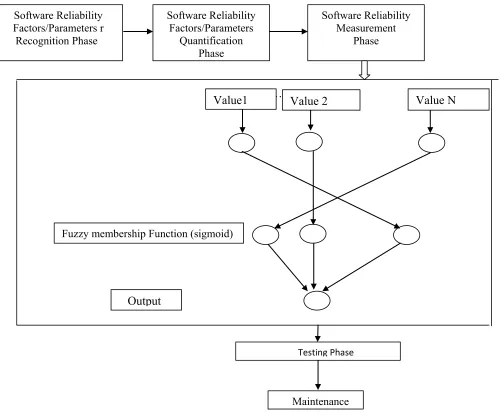
The preliminary prediction of Software Reliability prediction using Neural Network Based Systems and the comparison of Software Reliability Assessment Methods [20] with Neuro Fuzzy Based Systems [6][7][9] was observed by the researcher to arrive at the conclusion for the development of the proposed approach [5][8]. Figure 3.3 shows the proposed model of the research analysis, where the parameters concerned with the reliability assessment are given as the inputs for network. Weights are been added at the consequent layer ad using the predefined rules a decision is obtained at the validation. Based upon the
outcome of validation the assessment will be finalized. A generalized block diagram of the proposed approach is shown in the Figure 3.3. In this research work a Neuro Fuzzy interference model is designed for the assessment of reliability of a software growth model, the algorithm mainly focuses on MTBF which is analyzed and calculated theoretically and practically. Fuzzy rules employed for the proposed model are:
If MTBF (Mean time Between Failure)
>0.8 then reliability is very high
If 0.7<MTBF <0.8 then reliability is high If 0.6<MTBF <0.7 then reliability is
moderate
If 0.5<MTBF <0.6 then reliability is low If 0.4<MTBF <0.3 then reliability is very
low
In order to assess the reliability of software during design phase using Neuro Fuzzy Logic, the model is divided into five phases. These phases are as follows:
3.1.1 Recognition Phase
The objectives of identification phase are: 1. To identify the reliability factors. 2. To evaluate a mathematical analysis for the approximation constraints.
The objectives of the quantification phase are:
1. To identify the how the reliability factors are linked with assessment of reliability and quantify them.
2. To evaluate a mathematical analysis for the relationship.
3.1.3 Assessment Phase
The objectives of the measurement phase are
1. To assess the metrics for the estimation of reliability.
2. To conduct the experiments for the generation of results.
3.1.4 Testing Phase
The objectives of verification and validation phase are
1. To verify the model‟s effectiveness in the assessment of software reliability. 2. To compare and validate the reliability model with conventional models.
3.1.5 Maintenance Phase
The objectives of finalization phase are 1. To incorporate the changes and suggestions.
2. To finalize the metrics and model for assessment.
3.1.6 Revision Phase
There is a review and revision of output of every phase for the refinement of the study. The aim of this phase is to check whether the objectives of each phase are fulfilled or not. The review and review process is depicted in Figure 3.2.
Figure 3.2: Process Flow of the Proposed Approach 3.2 Implementation of the Proposed Approach
The Figure 3.3 shows the steps to be followed for implementation of the approach [3]. The values of Parameter Normalized MTBF are given as input at the input layer of Neural Network. Sigmoid fuzzy membership function at the hidden layer of neural network is applied and the Software Reliability approximated
value is found out. During validation, the values assessed using conventional FIS system and the value obtained from the proposed Neuro Fuzzy systems based model will be compared against two evaluation criteria like MSE (Mean Squared Error) and Average Error (AE).
……..
………..
Software Reliability Factors/Parameters r Recognition Phase
Software Reliability Factors/Parameters
Quantification Phase
Software Reliability Measurement
Phase
Value1 Value 2 Value N
Fuzzy membership Function (sigmoid)
Output
Testing Phase
Figure 3.2: Proposed Neuro Fuzzy based Model of Software Reliability Assessment
Mathematical approximation of proposal model metrics
For approximating the values of the proposed model metrics, a quantitative approach is adopted for calculating the appropriate results. The formula that has been used to calculate approximated values is defined as:
Formula: Ca ( xi ) = C (a) - h X f(a), based on Euler‟s theorem
Where, C (a) = Set of Measured values. „h‟ can be derived by,
x1 + x0 n h
Where, n= no. of values in the dataset. x0 = 0 and x1 = 1 (since the probability ranges from 0 to 1). Here „x‟ is MTBF. f(a) can be function, denoted as,
f(a)=MTBF/(1+MTBF)
Ca (xi ) is the set of values to be approximated.
Procedure for „h‟ Calculation
Let us take, x0 = 0 and x1 = 1 then, 1= 0 + 17 * h
h= 1/17 = 0.058
According to [18], Iterations are Performed at least 5 to 10 iterations to arrive at good approximated Software Reliability value.
At every iteration, to calculate % of Reliability, use the following formula
% of Reliability = (Average of Approximated values)/ (Average of Measured values) * 100
At final iteration, if the approximated value falls above 99.00%, then the study can say that it is good approximation.
3.3 Data Collection
It was found that the proposed model is the promising one. The amount an element is in a set is measured with a membership function. Membership functions range from 0 to 1. Membership functions are used to describe linguistic terms such as low, medium and high. There are various types of fuzzy membership functions such as triangular, trapezoidal, and Gaussian [16].
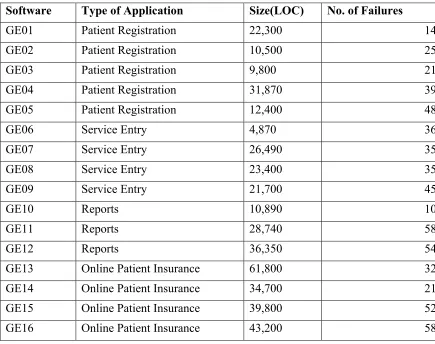
The dataset contains failure observations of 17 programs in Glace EMR Billing Software, in time series (i, Xi) and is used to predict the
performance of the proposed model. Where, i = serial number of the program. The models are applicable to the area of Software Reliability engineering. Table 4.1 shows all the 17 projects and the information recorded. The application types are Patient Registration, Service Entry, Reports, Online Patient Insurance Verification applications. The attributes recorded for each software are Software Code, Type of Application, Size of Software (in Lines of Code (LOC)), Number of Failures.
Table 4.1: Software Reliability Data Project Information
Software Code
Type of Application Size(LOC) No. of Failures
GE01 Patient Registration 22,300 14
GE02 Patient Registration 10,500 25
GE03 Patient Registration 9,800 21
GE04 Patient Registration 31,870 39
GE05 Patient Registration 12,400 48
GE06 Service Entry 4,870 36
GE07 Service Entry 26,490 35
GE08 Service Entry 23,400 35
GE09 Service Entry 21,700 45
GE10 Reports 10,890 10
GE11 Reports 28,740 58
GE12 Reports 36,350 54
GE13 Online Patient Insurance
Verification
61,800 32
GE14 Online Patient Insurance
Verification
34,700 21
GE15 Online Patient Insurance
Verification
39,800 52
GE16 Online Patient Insurance
Verification
GE17 Online Patient Insurance Verification
44,600 56
3.4 Parameters used for Measurement and Validation
MTBF consists of Mean Time To Failure (MTTF) and Mean Time To Repair (MTTR). MTTF is the difference of time between two consecutive failures and MTTR is the time required to fix the failure.
MTTF = Average time between 2 observed failures. i.e., average time it takes for a system to fail
MTBF = Average time between consecutive software system failures =MTTF+MTTR
MTTR = Average time taken to repair the system after the occurrence of failure.
Methods to Assess Software Reliability
There are two methods to assess the software reliability. The methods are as follows:
Counting failures at periodic intervals of time(µ()) : Observe the way of cumulative failure count = Total Number of failures observed until execution.
- Time from start of system execution.
Based on Failure Density(()):
Observe the trend of number of failures per unit time. i.e., no. of failures observed per unit time after „‟ time units from the staring stage of the system execution, which can be called as failure intensity at time, „‟.
The value of different parameters is calculated as:
Software Reliability = MTBF / (1+MTBF).
Normalized MTBF = (sum of MTBF values observed)/ number of readings.
In the study, the parameter is normalized MTBF to arrive at the effective assessment of Software Reliability using the proposed approach.
3.5 Parameters Estimation and Experimental Results
has been used as a base for conducting the experiments.
3.5.1 Parameters Estimation
The calculation of normalized Mean Time
Between Failures (MTBF) is done
mathematically and the results are shown in Table 4.3 and table 4.4 respectively. Then, the assessed values are given as input to Neuro Fuzzy Systems based approach for the better
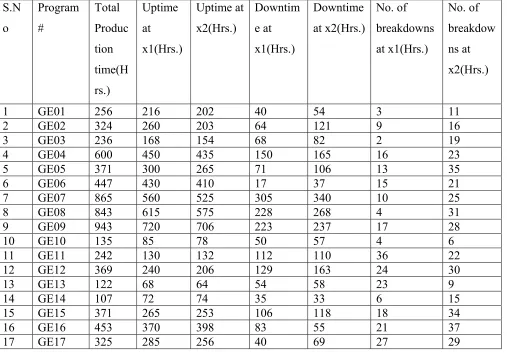
assessment of Software Reliability. Based on the experiments conducted and the results observed, the researcher concludes that the proposed approach perform well. To conduct the experiments the dataset is recorded based on the factors like total production time, uptime, downtime, No. of breakdowns at two intervals of time „x1‟ and „x2‟ and the recorded values are shown in Table 4.2.
Table 4.2: Production Time Analysis for the Program Dataset
S.N o
Program #
Total Produc tion time(H rs.)
Uptime at x1(Hrs.)
Uptime at x2(Hrs.)
Downtim e at x1(Hrs.)
Downtime at x2(Hrs.)
No. of breakdowns at x1(Hrs.)
No. of breakdow ns at x2(Hrs.)
1 GE01 256 216 202 40 54 3 11
2 GE02 324 260 203 64 121 9 16
3 GE03 236 168 154 68 82 2 19
4 GE04 600 450 435 150 165 16 23
5 GE05 371 300 265 71 106 13 35
6 GE06 447 430 410 17 37 15 21
7 GE07 865 560 525 305 340 10 25
8 GE08 843 615 575 228 268 4 31
9 GE09 943 720 706 223 237 17 28
10 GE10 135 85 78 50 57 4 6
11 GE11 242 130 132 112 110 36 22
12 GE12 369 240 206 129 163 24 30
13 GE13 122 68 64 54 58 23 9
14 GE14 107 72 74 35 33 6 15
15 GE15 371 265 253 106 118 18 34
16 GE16 453 370 398 83 55 21 37
Calculations
For all observations, the following parameters can be calculated as follows: Total Production time= Uptime+ down time
MTBF= Total uptime (total time- total downtime) for all observations Number of Breakdowns
Where,
MTTF= Mean Time To Failure (in hours/minutes/seconds). MTTR= Mean Time To Repair (in hours/minutes/seconds).
MTBF= Mean Time Between Failures (in hours/minutes/seconds).
MTTR= Total downtime for all observations
Number of breakdowns
MTTF= (Failure at obs.1+ Failure at obs.2+…+ Failure at obs.N) Number of software programs under test
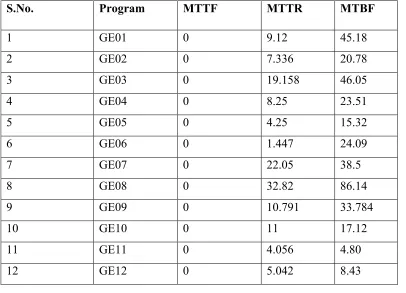
Table 4.3: Calculation of MTBF & MTTR
S.No. Program MTTF MTTR MTBF
1 GE01 0 9.12 45.18
2 GE02 0 7.336 20.78
3 GE03 0 19.158 46.05
4 GE04 0 8.25 23.51
5 GE05 0 4.25 15.32
6 GE06 0 1.447 24.09
7 GE07 0 22.05 38.5
8 GE08 0 32.82 86.14
9 GE09 0 10.791 33.784
10 GE10 0 11 17.12
11 GE11 0 4.056 4.80
13 GE13 0 4.396 5.03
14 GE14 0 4.016 8.46
15 GE15 0 4.679 11.08
16 GE16 0 2.719 14.18
17 GE17 0 1.93 9.69
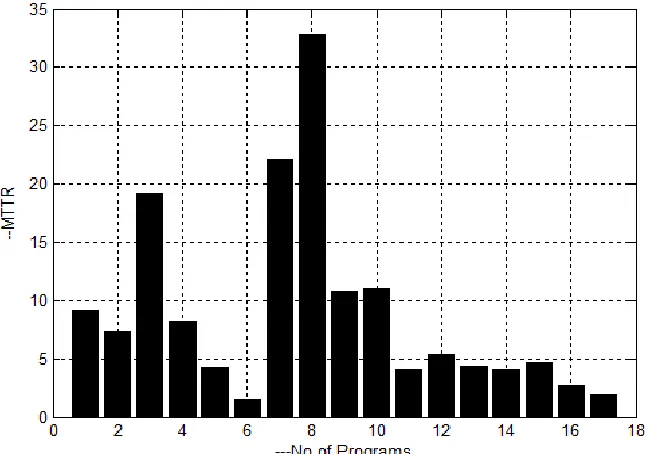
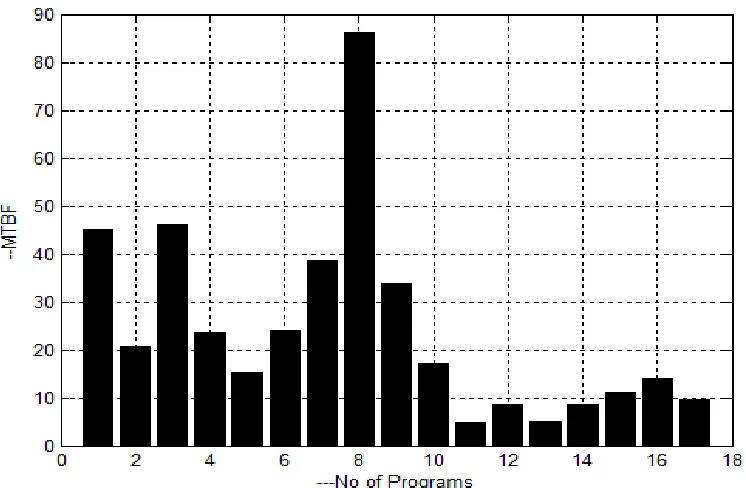
The ratio of MTTR and MTBF w.r.t. number of programs in the dataset is represented in Figure 4.5, Figure 4.6 respectively.
Figure 4.6: Analysis of MTBF Ratio w.r.t. Number of Programs
3.5.2 Implementation of the Proposed Approach through MATLAB
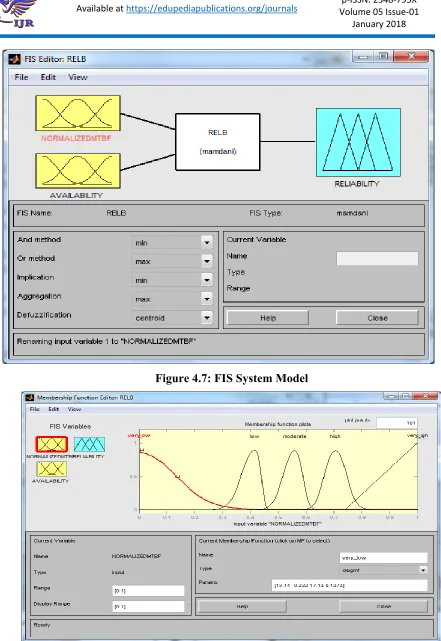
The experiment is conducted with the 17 programs of Glace EMR Medical Billing. The analysis is done using FIS (fuzzy interference system) and the proposed Neuro Fuzzy model in MATLAB environment. The Fuzzy Inference Systems based model is presented with the parameter Normalized MTBF in Figure 4.7. The generated membership function based on employed fuzzy IF-THEN rules ranging from “very low” to “very high” are shown in Figure 4.8. The dataset will be given as training data to ANFIS systems and the
Figure 4.7: FIS System Model
Figure 4.9: Neuro Fuzzy Inference Model
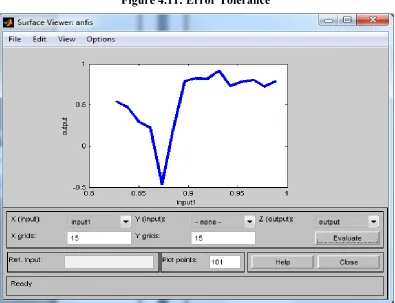
Figure 4.12: Performance Analysis 4. Conclusion and Future Work
The conclusions made by our project study are as follows:
Normalized MTBF is taken into
consideration for the effective assessment of Software Reliability using Neuro Fuzzy based Systems.
Fuzzy Rules are implemented properly to guide the Assessment process.
Fuzzy Membership function like
sigmoid function is taken into consideration for the assessment using ANFIS.
The observations conclude that
proposed network model performs better in terms of less error in prediction as compared to existing analytical models and hence it is a better alternative to do Software Reliability test using neural network. However it can be seen from the Software Reliability estimates that the ANFIS method proposed in this research provides a good fit than analytical models.
The researcher plans to predict Software Reliability using hybrid intelligent system. In addition to neural network
model genetic programming can be applied further.
The researcher plans to develop a novel recurrent architecture for Genetic Programming (GP) and Group Method of Data Handling (GMDH) and also GMR(Group Maturity Rating) in combination of Fuzzy logic for predicting Software Reliability.
5. Limitations and Delimitations
As every coin has two faces. The proposed work too suffers from the following limitations:
This approach is tested on a smaller dataset using one software only.
It would be more accurate if it has been tested on multiple datasets on different software outcomes.
No research study completes in all aspects, there is always a scope for further improvement.
High values of MTBF increases the Software Reliability, means there exists a linear relation between the parameters considered.
On the other hand the approach has the following merits:
The Neuro Fuzzy approach is most accurate mode of measurement.
The approach is very easy to implement.
References
[1] Bonthu Kotaiah, R. A. Khan (2013), “Different Issues in Predicting the Software Reliability”, International Journal of Science and Engineering Investigations (IJSEI), Vol. 2, Issue 12, Pp.65-68, ISSN: 2251-8843. [2] Bonthu Kotaiah, R. A. Khan, D.S.R.
Krishna (2013), “A Neural Network
methodology for Software Reliability prediction of long-term MTTF”, Mathematical Sciences International Research Journal, Volume 2, Issue No.1, ISSN 2278-8697 Pp. No.101-103.
[3] Bonthu Kotaiah, R.A. Khan (2015), “Effective Assessment of Software Reliability by Using Neuro-Fuzzy System”, International Journal of Research (IJR) e-ISSN: 2348-6848, p-ISSN: 2348-795X Volume 2, Issue 08, Pp. No. 250-270.
[4] Bonthu Kotaiah, R.A. Khan (2013), “Assessing the level of Software Reliability using Neuro Fuzzy System”, International
Conference on Information & Engineering Sciences (ICIES -2013) (Print Journal).
[5] Bonthu Kotaiah, R.A. Khan (2013), “The Prelimilinary Prediction of Software Reliability Prediction using Neural Network Based Systems”, International Conference on Mathematical Modelling And Numerical Simulation(ICMMANS), BBAU, Conference Proceedings, Pp. No.62.
[6] Bonthu Kotaiah, R.A. Khan(2013), “Comparison of Software Reliability Assessment Methods with Neuro Fuzzy Based Systems”, International Conference on Nanoscience And NanoTechnology (ICNN), BBAU, Conference Proceedings. Pp. No.256.
[7] Bonthu Kotaiah, R.A. Khan(2013), “Software Reliability Assessment by using Neural Networks with Fuzzy Logic based systems”, International Conference on
Advances in Computer
Science(AET-ACS),Elsevier,onlinelink:http:searchdl.org/pu blic/book_serieselsevierst/6/ 540.pdf.
[9] Bonthu Kotaiah , R.A. Khan(2013),
“Software Reliability Assessment by using Neural Networks with Fuzzy Logic Based Systems”, Advances In Engineering And
Technology Conference(AET), Delhi, NCR,
Elsevier, Conference Proceedings.
[10] Bonthu Kotaiah , R.A. Khan(2014), “Issue in the Assessment of Software Reliability with Mathematical Modelling Based Safety-Critical System”, National
Conference on Information Security
Challenges(NCISC- 2014), Organized by
Department of Information Technology,
Babasaheb Bhimrao Ambedkar
University(BBAU), Lucknow, Conference Proceedings.
[11] Fiondella, Lance, Rajasekaran, Sanguthever, Gokhale, Swapana, (2013), Efficient Software Reliability analysis with correlated component failures, IEEE Trans. Reliab. 62 (1), 244–255.
[12] Hsu, C., Huang, C., (2011), “An adaptive reliability analysis using path testing for complex component based software systems”,
IEEE Trans. Reliab. 60 (1), 158–170.
[13] Hai Hu, Chang-Hai Jiang, Kai-Yuan Cai, W. Eric Wong, Aditya P. Mathur, (2013), “Enhancing Software Reliability estimates using modified adaptive testing”, Information
and Software Technology Journal Elsevier, pp. 288–300.
[14] Palviainen, Markov, Evesti, Antti, Ovaska, Eila, (2011), The reliability estimation, prediction and measuring of component – based software. J. Syst. Softw.,
1054–1070.
[15] Singh, R.P., Rawat, V., Pawar, M. & Mishra, R.K.(2012), “Design of an optimal multi-layer neural network for eigenfaces based face recognition”, Recent Research in Science and Technology, 4(1), 24–32.
[16] Wong, J., Ho, D., & Capretz, L. F. (2008), “Calibrating function point backfiring conversion ratios using neuro-fuzzy technique”, International Journal of Uncertainty, Fuzziness and Knowledge- Based Systems, 16(06), 847-862.
[17] Bragina, T. & Tabunshchyk, G. (2011), “Fuzzy model for the software projects design risk analysis”, in the Experience of Designing and Application of CAD Systems in
Microelectronics (CADSM), in 11th
International Conference (pp. 335-341). IEEE. [18] Hosmer, D., Lemeshow, S. (1989),
Applied Logistic regression, John Wiley and Sons.
systems”, Applied Computing and Informatics 10, Elsevier B.V. , P. No. 38–51,
[20] Bonthu Kotaiah, T.Arundathi, P.M. Jahan (2014), “Comparative analysis of machine learning techniques for Software Reliability prediction”, Mathematical Sciences International Research Journal: Vol. 3 Spl Issue (2014) ISSN 2349-1353.
Appendix- A
MATLAB Program for Practical Validation
clear
% MTBF input
aa= VECTOR OF MTBF VALUES; af=aa./mean(aa);
% Read the FIS structure named as RELB F=readfis('RELB.fis');
% Evalate the input with the given fuzzy structure
ff=evalfis([aa./max(aa)+.7,aa+.7]',F) % this section is regarding ANFIS % train the data for it give MTBF and Availability as inputs
trnData = [af , aa]; numMFs = 7; mfType = 'dsigmf'; epoch_n = 100;
% generate a new anfis with this training data in_fis = genfis1(trnData,numMFs,mfType); out_fis = anfis(trnData,in_fis,60);
ff' mean(ff)
% evaluate the data with input anfis structure oo=evalfis([aa]',out_fis)'
mean(oo)
Mr. Bonthu Kotaiah