Available online: https://edupediapublications.org/journals/index.php/IJR/ P a g e | 4727
A bs tract :
A self-compacting concrete (SCC) is the one that can be placed in the form and can go through obstructions by its own weight and without the need of vibration. Since its first development in Japan in 1988, SCC has gained wider acceptance in Japan, Europe and USA due to its inherent distinct advantages. The major advantage of this method is that SCC technology offers the opportunity to minimize or eliminate concrete placement problems in difficult conditions. It avoids having to repeat the same kind of quality control test on concrete, which consumes both time and labor. Construction and placing becomes faster & easier. It eliminates the need for vibration & reducing the noise pollution. It improves the filling capacity of highly congested structural members. SCC provides better quality especially in the members having reinforcement congestion or decreasing the permeability and
improving durability of concrete. The primary aim of this study is to explore the feasibility of using SCC by examining its basic properties and durability characteristics i.e. water absorption, shrinkage, and sulfate resistance. An extensive literature survey was conducted to explore the present state of knowledge on the durability performance of self-consolidating
concrete. However, because it usually requires a larger content of binder and chemical admixtures compared to ordinary concrete, its material cost is generally 20- 50% higher, which has been a major hindrance to a wider implementation of its use. There is growing evidence that incorporating high volumes of mineral admixtures and micro fillers as partial replacement for Portland cement in SCC can make it cost effective. However, the durability of such SCC needs to be proven. This research work consists of: (i) development of a suitable mix for SCC that would satisfy the requirements of the plastic state; (ii) casting of concrete samples and testing them for compressive strength, shrinkage, water absorption, sulfate resistance. Local aggregates, cement, admixtures and additives produced by the local suppliers were used by in this work. The significance of this work lies in its attempt
Engineering properties of concrete by partial replacement of
cement with fly ash and fine aggregate with foundary sand
Kalluri Kishore Babu
1,
Dr. Dumpa Venkateswarlu
2D.S.V.S.Ram Sagar
31
M.Tech (student) in structural Engineering, department of civil engineering, Godavari Institute of Engineering
and Technology (Autonomous), Rajahmundry, Velugubanda Village, Rajanagaram (mandal) East Godavari,
A.P, India, pin code: 533296.
2
Professor and Head of the Department, department of civil engineering, Godavari Institute of Engineering and
Technology (Autonomous), Rajahmundry, Velugubanda Village, Rajanagaram(mandal) East Godavari, A.P,
India, pin code:533296.
3
Assistant Professor
,structural Engineering, department of civil engineering, Godavari Institute of Engineering
Available online: https://edupediapublications.org/journals/index.php/IJR/ P a g e | 4728
to provide some performance data of SCC so as to draw attention to the possible use of SCC.
Keywords : s elf compacting concrete , M40, compressive strength, flexural strength, split tens ile s trength.
1.
Introduction
Self-compacting concrete, also referred to as self-consolidating concrete, is able to flow and consolidate under its own weight and is de aerated almost completely while flowing in the formwork. It is cohesive enough to fill the spaces of almost any size and shape without segregation or bleeding. This makes SCC particularly useful wherever placing is difficult, such as in heavily-reinforced concrete members or in complicated work forms.
The objectives of this research were to compare the Splitting Tensile Strength and Compressive Strength values of self-compacting and normal concrete specimens and to examine the bonding between the coarse aggregate and the cement paste using the tension testing machine.
Self-Compacting Concrete(SCC) is a highly flow able concrete that can spread into place under its own weight and achieve good compaction in the absence of vibration without exhibiting defects due to segregation and bleeding. Self-Compacting Concrete (SCC) is a product of the technological advancements in the area of underwater concrete technology where the mix is proportioned to insure high fluidity as well as high resistance to water dilution and segregation. The use of SCC has gained wide acceptance in Japan since the late 1980s for casting congested members, as well as placement of concrete in restricted areas where compaction may not be practical. For example repair of bottom sides the beam, girder and slabs often necessitates the filling
narrow and difficult to access areas. Other areas where SCC can be employed to facilitate concrete placement and assure durability can involve filling the complex formwork and the casting of tunnel lining sections with restricted access to consolidation. Self-Compacting concrete can also be used in casting non congested structures when limitation of concrete consolidation or the required duration of intervention can reduce the construction costs as well as noise, which can be important in some urban areas, this can contribute to an improvement in working condition and overall productivity of the construction site. Because of the highly stable nature of SCC, its use can enable the casting of deep sections in fewer lifts without settlements, segregation or bleeding. This can reduce the number of lifts in deep sections, hence decreasing construction time, cold joints and labour requirements.
2.
REQUIREMENT FOR SCC
Available online: https://edupediapublications.org/journals/index.php/IJR/ P a g e | 4729 Throughout regular concrete, it's tough to make
certain homogeneous product top quality and also beneficial density in greatly strengthened places .
3.
PRODUCTION OF SCC
Production of SCC obliges more experience and consideration than the customary vibrated cement. The plant work force would need preparing and experience to effectively deliver and handle SCC. At the outset, it might be important to complete a larger number of tests than common to figure out how to handle SCC and addition the experience. Before any SCC is delivered at the plant and utilized at the occupation site, the blend must be appropriately planned and tried to guarantee agreeability with the venture particulars. The fixings and the hardware utilized as a part of building up the blend and testing ought to be the same fixings and gear to be utilized as a part of the last blend for the venture.
4.
BENEFITS AND ADVANTAGES OF
SCC
Modern, presently day self-compacting concrete (SCC) can be classified as an advanced construction material. The SCC as the name suggests, does not require to be vibrated to achieve full compaction. This offers many benefits and advantages over conventional concrete.
Improved quality of concrete and reduction of onsite repairs. Faster construction times.
Lower overall costs. Facilitation of introduction of automation into concrete construction. Improvement of health and safety is also achieved through elimination of handling of vibrators.
Substantial reduction of environmental noise loading in and around a site.
Possibilities for utilization of “dusts”, which are currently waste products demanding with no practical application and which are costly to dispose off.
Better surface finishes. Easier placing.
Thinner concrete sections. Greater freedom in Design
Improved durability, reliability of Concrete structures.
Ease of placement, results in cost savings through reduced equipment and labor requirement. SCC makes the level of durability and reliability of the structures independent from the existing on-site conditions related to the quality of labor, casting and compacting systems available.
The high resistance to external segregation and the mixtures of self-compacting ability allow the elimination of macro-defects, air bubbles, and honeycombs responsible for penalizing mechanical performance and structure durability.
5.
LITERATURE REVIEW
Hajime Okamu ra an d M as ah iro Ou ch i (2003), addressed the two major issues faced by the international community in using SCC, namely the absence of a proper mix design method and jovial testing method. They proposed a mix design method for SCC based on paste and mortar studies for super plasticizer compatibility followed by trail mixes. However, it was emphasized that the need to test the final product for passing ability, filling ability, flow ability and segregation resistance was more relevant.
Available online: https://edupediapublications.org/journals/index.php/IJR/ P a g e | 4730 mixes. They reported about the development of self
compacting concrete with reduced segregation potential. The systematic experimental approach showed that partial replacement of coarse and fine aggregate with finer materials could produce self compacting concrete with low segregation potential as assessed by the V-Funnel test. The results of bleeding test and strength development with age were highlighted by them. The results showed that fly ash could be used successfully in producing self compacting high strength concrete with reduced Segregation potential. It was also reported that fly ash in self compacting concrete helps in improving the strength beyond 28 days.
6.
MATERIALS USED
CEM ENT:
Ordinary Portland Cement (53 Grade) confirming to IS: 269-1976 was used throughout the investigation. The physical properties of the cement were determined as per IS: 4031-1968.
Fig 1.OPC 53 grade cement FINE A GGREGA TES:
It is the aggregate most of which passes 4.75 mm IS sieve and contains only so much coarser as is permitted by specification.
Fig 2.fine aggregates
COA RSE A GGREGA TES:
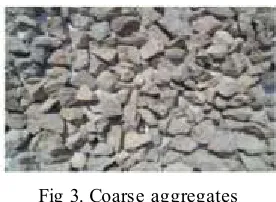
It is the aggregate most of which is retained on 4.75 mm IS sieve and contains only so much finer material as is permitted by specification.
Fig 3. Coarse aggregates Fo u n d ary San d :
Foundary Sand is also called as manufactured sand obtained by crushing natural granite stone. Foundary Sand is defined as a crushed granite aggregate produced by crushing natural granite stone.
Fig 4.foundry sand Fly A s h
Fly ash is one of the residues generated in burning, and comprises the fine particles that rise with the flue gases. Ash which does not rise is termed bottom ash. In an industrial context, fly ash usually refers to ash produced during ignition of coal.
W A TER:
Fresh and clean water is used for casting and curing of specimen. The water is relatively free from organic matters, silt, oil, sugar, chloride and acidic material as per requirements of Indian standard.
Available online: https://edupediapublications.org/journals/index.php/IJR/ P a g e | 4731 Admixtures are those ingredients in concrete other
than Portland cement, water, and aggregates that are added to the mixture immediately before or during mixing.
Super plasticizer agent conplast (SP423) of 2.8 lit/m3 for all concrete mixes was used to Achieve good workability.
Fig 5.Conplast SP423
7.
Mix design for M40 Grade concrete:
Per cubic meter requirement of ingredients 1. Cement – 319.33kgs
2. Sand - 825.45kgs 3. Metal - 1121.03kgs 4. Water -191.6 liters
Finally mix proportion becomes 1: 2.58 : [email protected] w/c
8.
Experimental investigations
a. Co mp res s iv e Stren g th
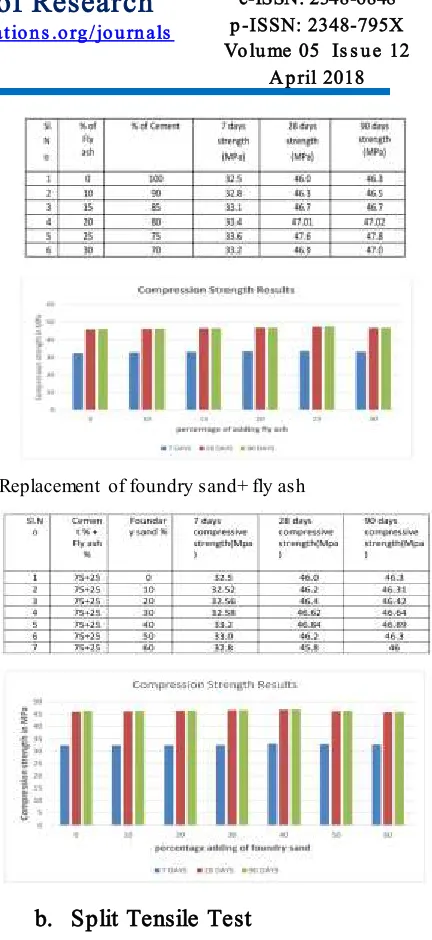
Cubes of size 150 mm x 150 mm x 150 mm were casted by partial replacement of cement with fly ash. The strength variation was monitored at the ages of 7, 28 and 90 days by conducting compressive strength test using compression testing machine.
Replacement of fly ash
Replacement of foundry sand+ fly ash
b.
Split Tensile Test
Available online: https://edupediapublications.org/journals/index.php/IJR/ P a g e | 4732 Replacement of foundry sand +fly ash
c.
Flexural Strength
Replacement of fly ash
Replacement of foundry sand +fly ash
9.
Conclusions
Self-compacting concrete can be obtained in such a way, by adding chemical and mineral admixtures, so that its split tensile and compressive strengths are higher than those of normal vibrated concrete.
By use of chemical and mineral admixtures, self compacting concrete has shown smaller interface micro cracks than normal concrete, in-fact which lead to a better bonding between aggregate and cement paste and to an increase in split tensile and compressive strengths.
Available online: https://edupediapublications.org/journals/index.php/IJR/ P a g e | 4733 time, which in most of the cases is shorter than
the time when normal concrete is used, due to the fact that no time is wasted with the compaction through vibration. The second advantage is related to the placing. As long as SCC does not require compaction, it can be considered environmentally friendly, because if no vibration is applied no noise is made.
The percentage increase in compressive strength at 7, 28 and 90 days of cement partially replaced with 25% fly ash were found to be 3%, 3.4% and 3.2%.
The percentage increase in split tensile strength at 7, 28 and 90 days of cement partially replaced with 25% fly ash were found to be 7%, 6% and 5%.
The percentage increase in flexural strength at 7, 28 and 90 days of cement partially replaced with 25% fly ash were found to be 5%, 3% and 3%. Further the strength parameters were slightly enhanced when the fine aggregate was replaced with different percentages of foundary sand.The optimum percentage of foundary sand to replace the fine aggregate was found to be 40%.
The percentage increase in compressive strength at 7, 28 and 90 days of fine aggregate partially replaced with 40% foundary sand were found to be 2%, 1.8% and 1.2%.
The percentage increase in split tensile strength at 7, 28 and 90 days of fine aggregate partially replaced with 40% foundary sand were found to be 6%, 3.5% and 3.4%.
The percentage increase in flexural strength at 7, 28 and 90 days of fine aggregate partially replaced with 40% foundary sandwere found to be 2.8%, 2.5% and 2.3%.
The values of compressive strength, split tensile strength and flexural strength of both cement and coarse aggregate treated concrete to its optimum values at 28 days were found to be 46.84Mpa, 4.14Mpa and 4.82Mpa respectively.
The % improvement of compressive strength, split tensile strength and flexural strength of both cement and coarse aggregate treated concrete to its optimum values at 28 days were found to be 2 %, 4% and 3% respectively.
References
1) Dietz, J. and J. Ma, “Preliminary Examinations for the Production of Self Compacting Concrete Using Lignite Fly Ash”, LACER No.5, pp.125-139 (2000). 2) Dodson, V., “Concrete Admixtures”, VNR Structural Engineering Series (1990).
3) Duval, R. and E. H. Kadri, “Influence of Silica Fume on the Workability and the Compressive Strength of High-Performance Concretes”, Cement and Concrete Research
Journal, Vol. 28,Issue 4, pp.533-547 (1998).
4) BUREAU OF INDIAN STANDARDS,” IS: 516-1970”,Methods of Tests for Splitting Tensile Strength of concrete Cylinder, New Delhi
5) Venu Malagavelli, ‘High Performance concrete with GGBS and Foundary Sand’, International Journal of Engineering Science and Technology, vol.2(10),5107-5113,2010
6) Priyanka A. Jadhav, Dilip K. Kulkarni ‘Effect of replacement of natural sand by manufactured sand on the properties of cement mortar’ International Journal Of Civil and Structural Engineering’, volume 3, No 3, 2013.
Available online: https://edupediapublications.org/journals/index.php/IJR/ P a g e | 4734 Computers and Applied Sciences, volume 2, no., Feb