© 2014, IJCSMC All Rights Reserved
24
Available Online atwww.ijcsmc.comInternational Journal of Computer Science and Mobile Computing
A Monthly Journal of Computer Science and Information Technology
ISSN 2320–088X
IJCSMC, Vol. 3, Issue. 8, August 2014, pg.24 – 33
RESEARCH ARTICLE
A Framework for Web Based Student
Record Management
System using PHP
Er. Saurabh Walia
1, Er. Satinderjit Kaur Gill
21
Student (M.Tech) CSE, Eternal University, Akal school of post graduate studies, Baru Sahib, Himachal Pradesh, 173101, India
2
Assistant Professor, Eternal University, Akal school of Post graduate studies, Baru Sahib, Himachal Pradesh, 173101, India
1
[email protected], 2 [email protected]
Abstract—Student Record Management System (SRMS) gives a straightforward interface to support of
student data. It might be utilized by instructive universities or colleges to keep up the records of students
effectively. The creation and administration of error less, exceptional data in regards to a student' scholarly
profession is discriminatingly paramount in the colleges and in universities. Student information system
manages all sorts of student details, academic related reports, college details, fee details, results, batch
details, attendance details and other resource related details too. It tracks all the details of a student from very
first moment to the end of the course which could be utilized for all reporting purpose, tracking of
attendance, progress in the study, completed semesters, years, coming semester year curriculum details, fee
details, project or any other assignment details, final exam result and all these will be available through a secure, online interface embedded in the college’s Student Record Management System.
© 2014, IJCSMC All Rights Reserved
25
I. INTRODUCTION
The data framework is essential in gathering all information also data of all staff or part in one association to be in one spot. The framework is typically given extremely accommodating errand that will supplant the human as to keep it in record as the stock or different purposes. To outline a supportive framework with a specific end goal to make simplicity to the client, the framework is created by utilizing Xampp Server interfacing with database that is using 'PHP' language as the dialect or guideline of the framework. The proposed framework is a standalone framework. This framework centered on recording and updating the information. It is additionally given report on the other hand printed record to the client in the framework which will make the status of the student simpler to be checked. This new framework utilized database idea to store all the data which related with area application forms. This framework focused around database idea which is more solid. All learner information will be kept in a devoted database. By utilizing this database idea, a few issues, for example, information misfortune and harm could be stayed away from. This framework additionally focused to make a simple checking students' status. By utilizing this framework, staffs can check the students' status quicker in time contrasted with the current framework. Hence, the staff can lessen holding up time in place to check all the documents like some time recently. The other target is the issue that identified with looking and upgrading the information. Staffs can pursuit and upgrade the information methodically. This framework will give a few capacities, for example, looking and overhauling so as to help the staffs to control the information applications [1].
© 2014, IJCSMC All Rights Reserved
26
II. OBJECTIVES
Objectives of this research
are:- Giving online interface for students.
Expanding the effectiveness of college record administration. Abatement time needed to access and convey students’ records.
To make the framework more secure.
III.METHODOLOGY
XAMP SERVER:-
XAMPP stands for Cross-Platform (X), Apache (A), MySQL (M), PHP (P) and Perl (P). It is a simple, lightweight Apache distribution that makes it extremely easy for developers to create a local web server for testing purposes. Everything you need to set up a web server – server application (Apache), database (MySQL), and scripting language (PHP) – is included in a simple extractable file. XAMPP is also cross-platform, which means it works equally well on Linux, Mac and Windows. Since most actual web server deployments use the same components as XAMPP, it makes transitioning from a local test server to a live server is extremely easy as well. Web development using XAMPP is especially beginner friendly XAMPP is a small and light Apache distribution containing the most common web development technologies in a single package. Its contents, small size, and portability make it the ideal tool for students developing and testing applications in PHP and MySQL. XAMPP is available as a free download in two specific packages: full and lite. While the full package download provides a wide array of development tools, this article will focus on using XAMPP Lite which contains the necessary technologies that meet the Ontario Skills Competition standards.
© 2014, IJCSMC All Rights Reserved
27
XAMPP has four primary components:-1. Apache: Apache is the actual web server application that processes and delivers web content to a computer. Apache is the most popular web server online, powering nearly 54% of all websites.
2. MySQL: Every web application, howsoever simple or complicated, requires a database for storing collected data. MySQL, which is open source, is the world’s most popular database management system. It powers everything from hobbyist websites to professional platforms like WordPress.
3. PHP: PHP stands for Hypertext Preprocessor. It is a server-side scripting language that powers some of the most popular websites in the world, including WordPress and Facebook. It is open source, relatively easy to learn, and works perfectly with MySQL, making it a popular choice for web developers.
4. Perl: Perl is a high-level, dynamic programming language used extensively in network programming, system admin, etc. Although less popular for web development purposes, Perl has a lot of niche applications.
PHP:-
PHP (Hypertext Preprocessor) Open-source, server-side scripting language used to generate dynamic web-pages PHP scripts reside between reserved PHP tags. This allows the programmer to embed PHP scripts within HTML pages. Various built-in functions allow for fast development Compatible with many popular databases. PHP scripts are executed on the server. PHP files have a file extension of ".php", ".php3", or ".phtml".
Features of PHP:-
Open source and free to download and use. Easy for newcomer and advance features Used to create dynamic web pages.
Freedom to choose any operating system and a web server.
Not constrained to output only HTML. PHP's abilities include outputting images, PDF files etc.
Support for a wide range of databases. Eg: dBase, MySQL, Oracle etc.
© 2014, IJCSMC All Rights Reserved
28
Creating a Database and Table, and Inserting Data:-
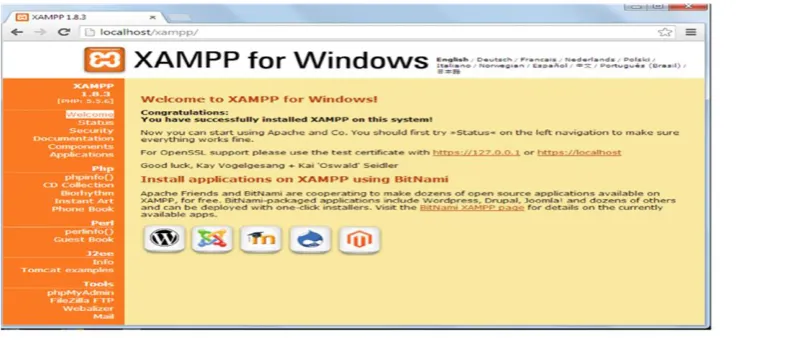
Firstly open the control panel of the XMAPP server and start MYSQL and Apache module. After that start the browser and open the local host the page will appear as given below in the figure. It requires the username and password of the PHP admin. The username is default ‘root’ and the password will be given by admin when he starts the software first time. Both Apache server and MYSQL server should run. Data types are also present there. User can also apply the various keys to the tables. Data will be fetched from the tables by using SQL. Insertion in the tables will also done by using SQL.
Fig 2:- home page for creating tables in database.
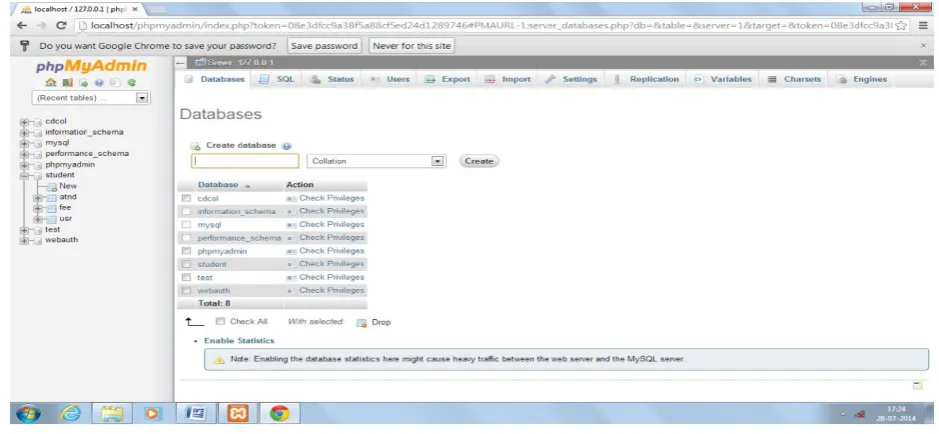
When we enter the username and password the PHP admin page will be opened as given in the figure. To create the database click on the database and it will ask for the database name then by giving the database name the database will be created.
© 2014, IJCSMC All Rights Reserved
29
MYSQL:-
MySQL is the most popular open source database server. With MySQL, we can query a database for specific information and have a recordset returned. A database defines a structure for storing information. MySQL is ideal for both small and large applications. It supports standard SQL. MySQL compiles on a number of platforms. It is free to download and use. PHP combined with MySQL are cross-platform (means that you can develop in Windows and serve on a Unix platform). MySQL is a relational database system. It can store bits of information in separate tables and link those tables together. Each table consists of separate fields, which represent each bit of information.
SQL:-
SQL (Structured Query Language):-Structured Query Language (SQL) is a standard computer language for relational database management and data manipulation. SQL is used to query, insert, update and modify data. Most relational databases support SQL, which is an added benefit for database administrators (DBAs), as they are often required to support databases across several different platforms. SQL code is divided into four main categories:
Queries are performed using the ubiquitous yet familiar SELECT statement, which is further divided into clauses, including SELECT, FROM, WHERE and ORDER BY.
Data Manipulation Language (DML) is used to add, update or delete data and is actually a SELECT statement subset and is comprised of the INSERT, DELETE and UPDATE statements, as well as control statements, e.g., BEGIN TRANSACTION, SAVEPOINT, COMMIT and ROLLBACK.
Data Definition Language (DDL) is used for managing tables and index structures. Examples of DDL statements include CREATE, ALTER, TRUNCATE and DROP.
Data Control Language (DCL) is used to assign and revoke database rights and permissions. Its main statements are GRANT and REVOKE.
IV.RESULTSANDDISCUSSION
Student Database:-
© 2014, IJCSMC All Rights Reserved
30
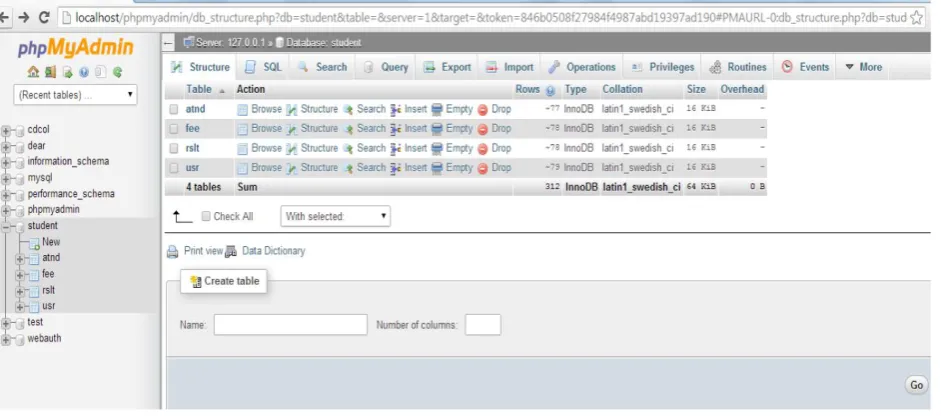
Fig 3:- Tables in student database.Login Form:-
When the system starts it firstly shows the login form. In that form only the registered user can sign in. The user who is registered he will enter his user name and password to access the system.
Fig 4:- Sign in form for user.
Home page:-
© 2014, IJCSMC All Rights Reserved
31
Fig 5:- home page for user ‘BS12BTCS012’.When the user ‘BS12BTCS007’ click on the fee button then the fee of that student will appear and it will also show the last date of submission of fee.
Fig:- Total fee of user ‘BS12BTCS007’.
© 2014, IJCSMC All Rights Reserved
32
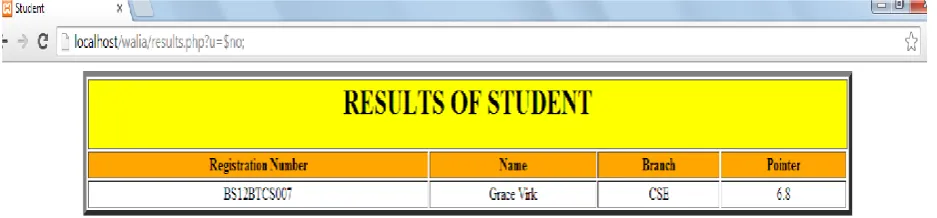
Fig 6:- Attendance of user ‘BS12BTCS007’.After that student want to see his result then he will click on the result button. Result will appear to him with his name, branch and registration number.
Fig 7:- Result of user ‘BS12BTCS007’.
When the user sign in then only his information will be shown to him to achieve this developer uses the sessions in php coding at the backend he will also use the SQL queries there. There are some specialised users who can update the data also in student database these permissions are given to the faculty members.
V. CONCLUSION
© 2014, IJCSMC All Rights Reserved
33
ACKNOWLEDGEMENT
I would like to thank my facilitator Er. Satinderjit Kaur gill for assisting and guiding me in this research and in writing this research paper. I would like to thank my professors who helped me in pursuing my degree. Finally I would like to thank my family for giving me the financial support for doing this degree without their supports it is impossible. At last I would like to thank my friends for giving me the good suggestions.
REFERENCES
[1] N. M. Z. Hashim and S. N. K. S. Mohamed, “Development of Student Information System”, Universitiy Teknikal Malaysia Melaka, vol. 2, pp. 256-260, August 2013.
[2] S.R.Bharamagoudar, Geeta R.B. and S.G.Totad, “Web Based Student Information Management