Copy Detect Image Falsification Using an Effective Set Partition
of Pixels and Conversion of Wavelets
Krishnaveni . V & Nilofer Lalani
M.Tech (DECE) RRS College of Engineering and Technology
Assistant Professor RRS College of Engineering and Technology
[email protected]
;[email protected]
ABSTRACT:
With the recent digital photography and easy availability of photo editing software it has become possible to make modifications in an image which cannot be distinguished by naked eye. Images and videos are tampered to create sensational news, spread rumors or to alter the facts and this is becoming widespread. Image forgery is being practiced since early days of photography, much before the invention of computers. The Proposed attempt along with conventional copy move forgery has been made to detect forgery in images using localization in novel image .This method can ample scope to develop new and efficient algorithms that can handle varieties of image forgeries. It has been seen that the proposed technique is robust and can detect forgeries in rotation and scaling of the copied segments effectively than traditional methods. Experimental results can justify that our proposed technique can give more desirable results than
traditional methods
.
.
KEYWORDS: Copy-Move Forgery Detection, Adaptive Over-Segmentation, Local Color Feature, Forgery Region Extraction
I. INTRODUCTION
The world is getting advanced day by day as the technology is growing rapidly. According to the type of wish he needed, human develops different software’s. Hence likewise now many image editing
software are available. Using these tools the images get edited. This editing may have a positive face as well as a negative face. The negative face may cause for a human life itself. Now different editing tools are available that can edit the image in any way as they wish. Many morphological operations can be occurred in an image. These manipulations in an image are a serious issue regarding the authenticity, integrity, and reliability of the image.
More and more researchers have begun to focus on the problem of digital image tampering. Of the existing types of image tampering, a common manipulation of a digital image is copy-move forgery, which is to paste one or several copied region(s) of an image into other part(s) of the same image. During the copy and move operations, some image processing methods such as rotation, scaling, blurring, compression, and noise addition are occasionally applied to make convincing forgeries. Because the copy and move parts are copied from the same image, the noise component, color character and other important properties are compatible with the remainder of the image; some of the forgery detection methods that are based on the related image properties are not applicable in this case.
DETECTION OF COPY-MOVE FORGERY
effective location of this kind of imitation. Since the fraud will probably be spared in the lossy JPEG arrangement and on account of a conceivable utilization of the modify device or other restricted image preparing instruments, the portions may not coordinate precisely but rather just roughly. Along these lines, we can plan the accompanying prerequisites for the discovery calculation:
1. The identification calculation must consider an inexact match of little image portions
2. It must work in a sensible time while presenting couple of false positives (i.e., recognizing wrong coordinating ranges).
3. Another regular supposition that ought to be acknowledged is that the manufactured section will probably be an associated segment as opposed to a gathering of little fixes or individual pixels. In this area, two calculations for recognition of the Copy-Move imitation are produced – one that uses a correct match for identification and one that depends on a surmised coordinate. Before portraying the best approach in light of rough square coordinating that delivered the best harmony amongst execution and intricacy, two different methodologies were explored – Exhaustive hunt and Autocorrelation.
This is the least complex (in priciple) and most clear approach. In this technique, the image and its circularly moved form (see Figure 5) are overlaid looking for carefully coordinating image fragments. Give us a chance to expect that xij is the pixel estimation of a grayscale image of size M×N at the position i, j. In the thorough inquiry, the accompanying contrasts are analyzed:
| xij – xi+k mod(M) j+l mod(N) |, k = 0, 1, …, M–1, l = 0, 1, …, N–1 for all i and j.
It is anything but difficult to see that contrasting xij and its patterned move [k,l] is the same as contrasting xij and its recurrent move [k',l'], where k'=M– k and
l'=N– l. Subsequently, it gets the job done to examine just those movements [k,l] with 1≤ k ≤ M/2, 1≤ l ≤ N/2, along these lines cutting the computational many-sided quality by a factor of 4.
Block diagram of copy- move forgery
III. PROPOSED SYSTEM
The proposed scheme integrates both the traditional block-based forgery detection methods and key point-based forgery detection methods. Similar to
a. Adaptive Over-Segmentation algorithm
The proposed image phony discovery utilizing versatile over-division in subtle elements. Figure demonstrates the system of the proposed conspire for image fraud recognition. Right off the bat, the versatile over-division strategy is proposed to portion the host image into non-covering and unpredictable squares. At that point SLIC is connected into each square to extricate highlight focuses as piece highlights which are coordinated with each other to find the focuses which can around demonstrate the speculated fabrication areas. At last the falsification areas are identified by the coordinated element focuses. So as to partition the host image into
decent technique to decide the underlying size in super pixel division calculations. Consequently, in this paper, we proposed the Adaptive Over-Segmentation technique which can decide the underlying size adaptively in view of the surface of the host image and along these lines can partition the host image into sporadic and non-covering pieces. In the proposed Adaptive Over-Segmentation strategy, right off the bat, the Discrete Wavelet Transform (DWT) is utilized into the host image to produce the low recurrence and high recurrence sub-groups. At that point the underlying size of the super-pixels is ascertained with the versatile square size calculation. At long last, with the ascertained beginning size, the SLIC division calculations utilized to section the host image into unpredictable and non-covering image pieces.
.
b. Block Feature Extraction
After the host image is fragmented into image pieces, square highlights are separated from the image squares (IB). The conventional piece based fabrication identification techniques removed highlights of an indistinguishable length from the square highlights or specifically utilized the pixels of the image obstruct as the square highlights. Nonetheless, these highlights reflect basically the substance of the image squares, forgetting the area data. Additionally, these highlights are not impervious to different image changes. Consequently, in this venture, the element focuses are separated from each image obstruct as square highlights and the component focuses ought to be vigorous to different bends, for example, image scaling, pivot, and JPEG pressure. The element point extraction strategies, SIFT and SURF have been broadly utilized. The component focuses created utilizing these techniques are strong against basic image handling operations, for example, turn, scale, obscuring, and pressure. Analyses have demonstrated that the outcomes got utilizing SIFT are more steady
and have better execution contrasted with other component extraction strategies. Consequently, in this task SIFT is utilized for include point extraction. Along these lines, each square component contains sporadic piece area data and the removed SIFT highlight focuses.
After the host image is fragmented into image squares, piece highlights are separated from the image squares (IB). The customary square based imitation identification techniques extricated highlights of an indistinguishable length from the piece highlights or specifically utilized the pixels of the image obstruct as the piece highlights. Be that as it may, these highlights reflect essentially the substance of the image pieces, forgetting the area data. Additionally, these highlights are not impervious to different image changes. In this manner, in this task, the component focuses are removed from each image obstruct as piece highlights and the element focuses ought to be hearty to different twists, for example, image scaling, pivot, and JPEG pressure. The component focuses produced utilizing these techniques are powerful againstcommon image handling operations, for example, turn, scale, obscuring, and pressure. Investigations have demonstrated that the outcomes acquired utilizing SIFT are moreconstant and havebetter execution contrasted with other component extraction techniques. Consequently, in this proposed conspire SIFT is utilized for highlight point extraction. Along these lines, each piece highlight contains unpredictable square data and the removed SIFT include focuses.
c. Block Feature Matching Algorithm
accepting that they have a similar move vector. At the point when the move vector surpasses a client indicated edge, the coordinated obstructs that added to that particular move vector are distinguished as districts that may have been replicated and moved. In our calculation, in light of the fact that the square component is made out of an arrangement of highlight focuses, we proposed an alternate technique to find the coordinated pieces. The point by point steps are clarified as takes after. Calculation: Block Feature coordinating calculation Input: Block Features (BF); Output: Labeled Feature Points (LFP).
STEP-1: Load the Block Features BF ={BF1,BF2,... where N implies the quantity of image pieces; and figure the connection coefficients CC of the image squares.
STEP-2: Calculate the piece coordinating limit BTR as indicated by the circulation of relationship coefficients.
STEP-3: Locate the coordinated pieces MB as per the square coordinating limit B TR.
STEP-4: Label the coordinated element focuses in the coordinated pieces MB to show the presumed falsification locales.
IV.
RESULTS
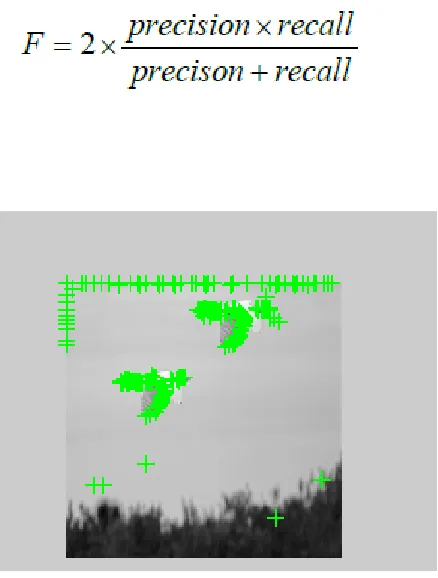
Fig : 3.7 Copying,Scaling,Rotating
In order to evaluate the performance of the proposed scheme, the precision and recallarecalculated.We also give the Fscore, which is defined as a measure which combines the precision and recall in a single value.
Where means the set of forgery regions detected by the proposed scheme for the dataset; and means the set of all forgery regions for the dataset R 'RD
Fig : 3.8 Keypoint Localization
We assess the proposed conspire under various conditions demonstrates the outcomes at both image
level and pixel level, under plain duplicate move, which implies the balanced duplicate move. Fig demonstrates the F scores when the replicated locales are assaulted by different assaults: (a) down-Sampling, the host images are downsized from 90% to 10% in venture of 20%;(b) scaling, the duplicated districts are scaled with the scale factor fluctuates from 91% to 109%, in venture of 2%;(c) pivot, the duplicated areas are turned with the revolution point changes from 2º to 10º, in venture of 2º; and (d) JPEG pressure, the fabrication images are JPEG compacted with the qualify factor shifts from 100 to 20, in venture of - 10. It can be effortlessly observed that in the greater part of the cases, the proposed conspire performs much superior to the current best in class fraud identification strategies.
Fig: 3.9 Localized Forgery Extraction using SPP
V. CONCLUSION
In this paper, we have proposed a novel duplicate move falsification discovery plot utilizing versatile over-division. Including further utilizing Set parcel of pixels (SPP) calculation can adaptively portion the host image and later element extraction done to unpredictable pieces effectively created by duplicate move discovery and square component. In each square, the component indicates are removed and coordinated show the speculated falsification locales. The Forgery Region Extraction calculation is proposed to process the presumed include focuses, in this way producing the identified fabrication areas and show yield with its key point neighborhood highlight and fashioned locales individually. Test comes about demonstrate that the proposed plan can accomplish great execution under different testing conditions such geometric changes, and JPEG pressure. Future work may concentrate on applying the proposed versatile over-division strategy into other sort of imitation, for example, grafting or other sort of media, for example, video and sound.
REFERENCES
[1] Amruta Jagtap, H. A. Hingoliwala, H. A. Hingoliwala, “Survey Paper on Advanced Techniques for Image Forgery Detection”, International
Journal of Science and Research (IJSR), Vol 4 Issue 12, 2015.
[2] A. J. Fridrich, B. D. Soukal, and A. J. Lukáš, "Detection of copy-move forgery in digital images," 2003.
[3] Sreelakshmi. M, Amrutha M, “Forgery and Forensic Detection Using Adaptive over segmentation and DCT of JPEG Images”.
[4] Chi-Man Pun, Chen Yuan, Xiu-Li Bi,” Image Forgery Detection Using Adaptive Over-Segmentation and Feature Point Matching”.
[5] M.Meenakshi, K.S.Mohan,” A Novel Image Forgery Detection Approach By Using Scale Invariant Feature Transform”, International Research
Journal of Engineering and Technology (IRJET), Vol 02, Issue 07, 2015.
[6] Shamna Parveen.S, Dr.D.Palanikkumar, “A Novel Approach For Inter Frame Copy Move Forgery Detection”, International Journal on
Applications in Information and Communication Engineering, Vol 1, Issue 12, pp 60 – 62, 2015.
[7] Musaed Alhussein, “Image Tampering Detection Based on Local Texture Descriptor and Extreme Learning Machine”.
[8] Mr. Raskar Rahul Bhausaheb , Prof. Sandeep Kumar, Mr. Kharade Sachin, “Centroidal Distance Based Offline Signature Recognition Using
Global and Local Features”, Vol 3, Issue 3, 2015. [9] K.Girija, S.Herman Jeeva, M.Soniya, P.Sabarinathan, “Detecting Video Sequence Matching Using Segmentation Method”, International