Industrial Data Acquisition System By Using Internet Of Things
Kodi Soujanya 1, Mushkam Shirisha2,Kemsaram Kiran31
KodiSoujanya, M.Tech Student, Dept Of ECE, Sindhura College Of Engg& Technology, Medipally(V),Ramagundam(Mn), Peddapalli(Dst),Telangana, India.
2
MushkamShirisha,Assistant professor, Dept of ECE, Sindhura College Of Engg& Technology, Medipally(V),Ramagundam(Mn),
Peddapalli(Dst),Telangana, India. 3
KemsaramKiran, Assistant professor, Dept of ECE, Sindhura College Of Engg& Technology, Medipally(V),Ramagundam(Mn), Peddapalli(Dst),Telangana, India.
Abstract The main objective of the project is to “Data
acquisition for industrial automation on ARM 7”. LPC2148
development board,GPRS Modem, Cell Phone which can
support JAVA Application, Intelligent appliances.
Wireless Packet Data Networks, such as GPRS, hold
great promise for applications that rely on machine to
machine (M2M) communication. The rapidly advancing
mobile communication technology and the decrease in costs
make it possible to incorporate mobile technology into home
automation systems. Based on an SMS/GPRS (Short Message
Service/General Packet Radio Service) mobile cell module
and a microcontroller, a home automation server can be
established, Powerful microcontrollers are used as parts of
most home and office appliances of today. Integrating web
servers to these intelligent devices will aid in controlling
them over the Internet and also in creating effective user
interfaces in the form of web pages. This paper presents the
development of AT modem driver, text based command
processing software, output for an Atmel micro-controller to
facilitate in sending and receiving data via the cell module.
The proposed design is implemented using SMS(commonly
known as text messages) and GPRS (Internet based protocol)
as the main communication protocol.
Keywords: IOT, Controller, Sensors.
INTRODUCTION
Remote control via the Internet is not a new featureand used in home automation systems.however,providing a mechanism
for interaction betweendevices in this environment is quite challenging. Theinternet has been mostly used to connect personalcomputers so far, but shortly all kinds of applianceswith embedded computers will exchange information
over the Internet. A massive number ofmicrocontrollers are available in today’s deviceswhich can be linked to the Internet. If theseintelligent appliances could be connected to theInternet at low cost, the way we control and managetheir functions would change entirely. An embeddedweb server should use the HTTP protocol to transmitWeb pages from the embedded system to the attachedto the appliance. The embedded system requires anetwork interface, such as Ethernet, a TCP/IPprotocol stack, embedded web server software andstatic and dynamic web pages that form the userinterface for that specific device.
LITERATURE SURVEY
This system has simple features designed with the objective of minimum power consumption using LED light, fans and other appliances which are controlled using a GPRS module via SMS.With embedded systems fast expanding its reach, subject matter related to this field is available in abundance. While working on this project we have studied matter from various sources such as books, online articles and reference manuals. The knowledge gained from this activity has been of great help to us in understanding the basic concepts related to our project and has ignited further interest in this topic.―Remotedata acquisition through gprs technology for industrial automation.We understood the preponderance of the ARM processors in the field of embedded systems and the features of ARM processors from the document ―The ARM Architecture‖ by Leonid Ryzhyk. The ARM architecture is a confluence of many useful features that makes it better than other peer processors. Being small in size and requiring less power, they prove useful in providing an efficient performance in embedded applications.
PROPOSED SYSTEM
Fig 1: Block diagram
METHODOLOGY
Micro controller:
This section forms the control unit of the whole project. This section basically consists of a Microcontroller with its associated circuitry like Crystal with capacitors, Reset circuitry, Pull up resistors (if needed) and so on. The Microcontroller forms the heart of the project because it controls the devices being interfaced and communicates with the devices according to the program being written.
ARM7TDMI:
ARM is the abbreviation of Advanced RISC Machines, it is the name of a class of processors, and is the name of a kind technology too. The RISC instruction set, and related decode mechanism are much simpler than those of Complex Instruction Set Computer (CISC) designs.
Liquid-crystal display (LCD)
It is a flat panel display, electronic visual display that uses the light modulation properties of liquid crystals. Liquid crystals do not emit light directly. LCDs are available to display
arbitrary images or fixed images which can be displayed or hidden, such as preset words, digits, and 7-segment displays as in a digital clock.
Temperature sensor:
Fig .2: Temperature sensor
LDR:
LDRs or Light Dependent Resistors are very useful especially in light/dark sensor circuits. Normally the resistance of an LDR is very high, sometimes as high as 1000 000 ohms, but when they are illuminated with light resistance drops dramatically. The animation opposite shows that when the torch is turned on, the resistance of the LDR falls, allowing current to pass through it. This is an example of a light sensor circuit: When the light level is low the resistance of the LDR is high. This prevents current from flowing to the base of the transistors. Consequently the LED does not light. However, when light shines onto the LDR its resistance falls and current flows into the base of the first transistor and then the second transistor. The LED lights on. The preset resistor can be turned up or down to increase or decrease resistance, in this way it can make the circuit more or less sensitive.
Fig .3: LDR
GPRS:
GPRS (general packet radio service) is a packet-based data bearer service for wireless communication
services that is delivered as a network overlay for GSM, CDMA and TDMA (ANSI-I36) networks. GPRS applies a packet radio principle to transfer user data packets in an efficient way between GSM mobile stations and external packet data networks. Packet switching is where data is split into packets that are transmitted separately and then reassembled at the receiving end. GPRS supports the world's leading packet-based Internet communication protocols, Internet protocol (IP) and X.25, a protocol that is used mainly in Europe. GPRS enables any existing IP or X.25 application to operate over a GSM cellular connection. Cellular networks with GPRS capabilities are wireless extensions of the Internet and X.25 networks.
Fig4: GPRS module
DC Motor:
Fig .5: DC Motor
Motor driver (L293D):
DC motors are typically controlled by using a transistor configuration called an "H-bridge". This consists of a minimum of four mechanical or solid-state switches, such as two NPN and two PNP transistors. One NPN and one PNP transistor are activated at a time. Both NPN and PNP transistors can be activated to cause a short across the motor terminals, which can be useful for slowing down the motor from the back EMF it creates. H-bridge. Sometimes called a "full bridge" the H-bridge is so named because it has four switching elements at the "corners" of the H and the motor forms the cross bar. The switches are turned on in pairs, either high left and lower right, or lower left and high right, but never both switches on the same "side" of the bridge. If both switches on one side of a bridge are turned on it creates a short circuit between the battery plus and battery minus terminals. If the bridge is sufficiently powerful it will absorb that load and your batteries will simply drain quickly. Usually however the switches in question melt.
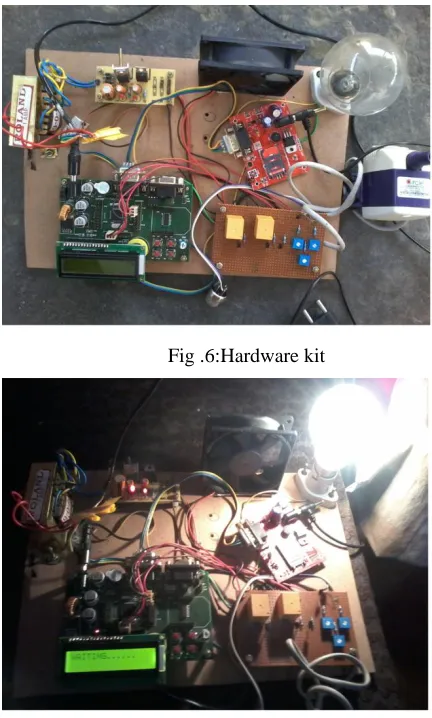
RESULT:
Fig .6:Hardware kit
Fig .7:Message sending
CONCLUSION
An intuitive control system with a set of user-friendly operations, called Point-n-Press, is proposed for controlling connected devices/appliances in IoT-based smart homes. The proposed scheme leverages the directionality characteristic of IR to enable easy and intuitive control of devices (i.e., controlling an appliance in smart homes by pointing to it). A user-friendly UI is designed by considering the state dependencies between each control operation.
[1] F. Wang, L. Hu, J. Zhou, and K. Zhao, ―A survey from the perspective of evolutionary process in the Internet of Things,‖ Int. J. Distrib.Sens.Netw., vol. 2015, no. 9, pp. 1–9, Jan. 2015.
[2] M. Javier et al., ―From the internet of things to the
internet of people,‖ IEEE Int. Comput., vol. 19, no. 2, pp. 40– 47, Mar. 2015.
[3] L. Zhang, L. Zheng, H. Yang, and T. J. Pan, ―Research of the key technologies of the smart home based on IOT,‖ Appl. Mech. Mater., vol.713–715, pp. 2304–2307, Jan. 2015. [4] M. R. Alam, M. B. I. Reaz, and M. A. M. Ali, ―A review of smart homes—past, present, and future,‖ IEEE Trans. Syst., Man, Cyber., vol.42, no. 6, pp. 1190–1203, Nov. 2012. [5] K. Ben, P. Sachin, A. Pieter, and G. Ken, ―A survey of research on cloud robotics and automation,‖ IEEE Trans. Autom. Sci. Eng., vol.12, no. 2, pp. 398–409, Apr. 2015. [6] C.-H. Lu et al., ―Energy-responsive aggregate context for
energy saving in a multi-resident environment,‖ IEEE Trans. Autom.Sci.Eng., vol. 11, no. 3, pp. 715–729, Jul. 2014. [7] H. C. Tadimeti and M. Pulipati, ―Overview of automation systems and home appliances control using PC and microcontroller,‖ Int. J. Sci.Res., vol. 2, no. 4, pp. 127–131, Apr. 2013.