ISSN 2286-4822
www.euacademic.org DRJI Value: 5.9 (B+)
Efficacy of Sensory Motor Training on Pain,
Disability and Function in Patients with Chronic
Non-Specific Low Back Pain
-An Experimental Study-
KAPIL GARG MPT (Muskuloskeltal) Dolphin P.G. Institute of Biomedical and Natural Sciences Dehradun, Uttarakhand India Dr. DEPTEE WARIKOO MPT (Muskuloskeletal) Asst. Professor Dolplhin (PG) Institute of Biomedical & Natural Sciences SHIVAM KARN MPT (Neurology) Dolphin (PG) Institute of Biomedical & Natural Sciences
Abstract:
Back Pain: -An Experimental Study-
statistically insignificant. The conclusion this study depicted that both Sensory motor training and Core Stability exercises are equally effective in reducing Pain, Disability and increasing Function in subject with Chronic Non-specific Low Back Pain. However, Sensory motor training was found to be better impact when means were considered.
Key words: Pain, Disability, Function, Sensory Motor Training, Core Stability Exercise, Chronic Non-Specific Low Back Pain.
Introduction
Low back pain (LBP) is a common and costly problem, often associated with high recurrence rate and equivocal management efficacy. Low back pain remains the primary cause of absenteeism and disability in every industrialized society. [Vesa Lehtola et.al.2012].About 80% of the population experiences low back pain more than once throughout their lives. Those experiencing acute low back pain, 90% recover within two months, but chronic low back pain triggers physical atrophy and psychological problems. Low back pain sustained for more than 12 weeks is called chronic low back pain (CLBP).[ Jin Ah Hwang 2013].CLBP patients experience trunk muscular atrophy, muscle response delays, and decreased postural adjustment ability and in particular undergo changes in APAs (Anticipatory Postural Adjustments). [Jin Ah Hwang 2013],[ Paul W. Hodges1999].
sensory motor deficits are present in LBP patients.[ Martin Descarreaux et.al.2005] These deficits can affect segmental spinal stability and eventually lead to articular damage and subsequent chronic pain. Sensorimotor dysfunction associated with LBP may include disturbances in a wide range of control mechanisms, the patho-physiological mechanisms.[Ehab E et.al 2001].
Patient with low back pain present with impaired spine reposition sense and altered motor control [ Apeksha O Yadav et.al.2013].
Poor reposition sense has been shown to be related to risk musculoskeletal injury in several joints, including ankle and knee. Low back disorders have also been associated with changes in trunk position sense.[Sara E. Wilson et.al.2003]. Reconditioning of proprioceptive senses and Sensorimotor training that increases one’s muscle adjustment ability maximizes the sensory input in different parts of the body and aids in improving one’s motor adjustment ability. [ Jin Ah Hwang 2013]
Sensorimotor training has recently been found to be quite helpful in increasing motor performance and coordination when compared with previous methods.[Jin Ah Hwang 2013],[ Heitkamp HC et.al.2001].
Back Pain: -An Experimental Study-
Methodology
An experimental study was conducted on total of 28 subjects who were enrolled from various hospitals and health centers in Dehradun on the basis of inclusion and exclusion criteria. This study was approuved by ethical commity of Dolphin (PG) Institute of Biomedical and Natural Sciences, Dehradun. Subjects were divided into 2 groups after informed consent was informed. Group A (Sensory Motor Training n=13), and Group B (Core Stability Exercises n=15).
Pre intervention readings of pain using Numeric Rating Scale, disability using Oswestry Disability Questionnaire and function using Back Pain Functional Scale were carried out for each patient. For both the group interventions was given five times in a week for 4 weeks. Post intervention reading was calculated in the same manner as pre intervention after the end of 4 weeks.
Data Analysis
Data analysis was done using SPSS 16.0 version. Descriptive analysis was done to calculate the mean for age, weight, and height of subjects. Paired t-test was applied to compare the pre and post intervention readings within the group. Independent t-test was done to compare the pre and post intervention readings between the groups. The statistical significance was set as 95% confidence interval with p value <0.05 considered to be significant.
Results
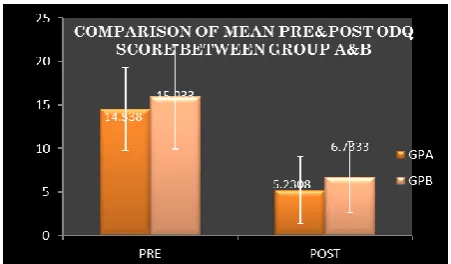
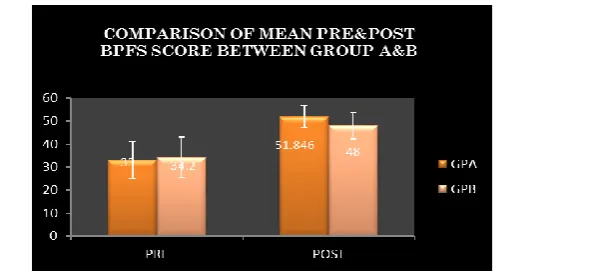
Data were analyzed for 28 participants: 13 in Group A and 15 in Group B. Analysis of Pain, Disability and Function showed that both the group proved to be effective in decreasing the pain, disability and increasing functional level independently. When results were compared between the groups, Group A showed better improvement than Group B. However the results were statistically insignificant.
Discussion
Back Pain: -An Experimental Study-
respectively. [Benedict M et.al.2011]In support to our results proving both the techniques statistically effective.
The result showed positive effect of both the treatment techniques, however within the group difference was not statistically significant for both the outcome measures. Both the techniques are presumable restoring the coordination between the trunk muscles which thereby is improving their function and decreasing disability. In support of our results,
Amal F Ahmed [Amal F Ahmad 2011] depicted that sensory motor training increases coordination between muscle groups and improves the response to sensorial information.
They added that progression is made through alteration indifferent postures, base of support and challenges to their center of gravity.[ Ferraz MB1990]So we can depict that these exercises elicit automatic and reflexive muscular stabilization demanding a patient to maintain postural control under a variety of situations, which may have a psychological impact on their performance. Kelly P. Westlake and Elsi G. Culham
concluded that sensory specific exercise had a training effect on proprioceptive re-integration. [Kelly P. Westlake et.al.2007].Thus we could add that these exercises have a positive impact on balance thereby increasing the functional performance. Jin AH Huang et al added that reconditioning of proprioceptive sensors and sensory motor training that increases ones muscle adjustment ability maximizes the sensory input in different parts of body and adds in improving ones motor adjustment ability [Jin Ah Hwang 2013].Generally speaking we could add that Sensory motor training increases inter-muscular control, improving ones response to sensory information which could be a major reason of improving function and decreasing disability. In support of our study
decreased disability and increased function in present study. [Amal F Ahmad 2011].
The purpose of this study was to adopt shorter treatment duration with sensory motor training (4 weeks) rather than traditional core stability exercises (6 weeks). Also, Sensory motor training supposed to improve the anticipatory postural control rather than only strengthening the superficial and deep muscle groups as in core stability exercises. [Jin Ah Hwang 2013]. One of our aims was also to add literature on Sensory motor training as there is abundant literature on the cores stability exercises but literature on sensory motor training is scarce. Our results were clinically significant but statistically insignificant.
The reason behind this may be that Sensory motor training is a fairly new technique and not most of the patients were familiar with the training and some of the patients also reported difficulty in performing exercise on the balance board. While on the other hand patients performing Core Stability were convinced to perform the exercises although sufficient precautions were taken to prevent fall and same was conveyed to the patients but some of the subjects could have been still apprehensive thus not able to perform exercises to their full potential. This may explain the statistical insignificant results. Our study proved that indeed SMT could be a choice of treatment for LBP patients as it is effective in decreasing Pain, Disability and increasing Function.
For future research EMG could be used to exactly evaluate the alteration in muscle activity of TrA after Sensory motor training. In addition effect of SMT on Repositioning Error could be checked in Low Back Pain patients.
Conclusion
Back Pain: -An Experimental Study-
Disability and increasing Function in subject with Chronic Non-specific Low Back Pain. However Sensory motor training was found to be better impact when means were considered. So we could conclude that SMT is indeed a choice of treatment for patients with CNSLBP.
Clinical Significance
Previous literatures says that Sensorimotor training if effective in reducing pain in osteoarthritis and Anticipatory Postural Adjustments in chronic back pain but our literature proves that Sensory Motor training is effective in reducing Pain, Disability and improving Function in patients with CNLBP.
Tables and Graphs
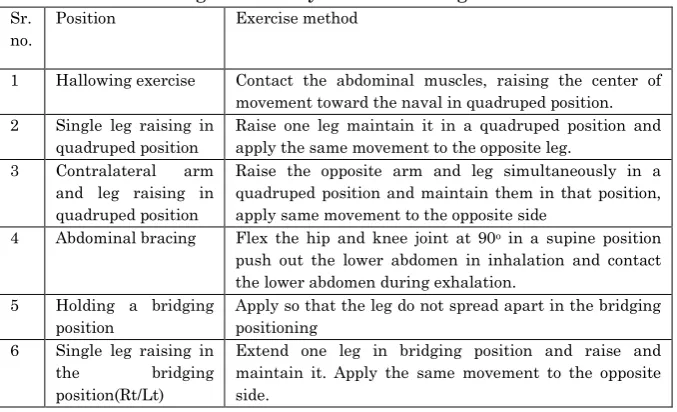
TABLE 1.1:- Training for Sensory Motor Training Sr.
no.
Position Exercise method
1 Hallowing exercise Contact the abdominal muscles, raising the center of movement toward the naval in quadruped position. 2 Single leg raising in
quadruped position
Raise one leg maintain it in a quadruped position and apply the same movement to the opposite leg.
3 Contralateral arm and leg raising in quadruped position
Raise the opposite arm and leg simultaneously in a quadruped position and maintain them in that position, apply same movement to the opposite side
4 Abdominal bracing Flex the hip and knee joint at 90o in a supine position
push out the lower abdomen in inhalation and contact the lower abdomen during exhalation.
5 Holding a bridging position
Apply so that the leg do not spread apart in the bridging positioning
6 Single leg raising in the bridging position(Rt/Lt)
Extend one leg in bridging position and raise and maintain it. Apply the same movement to the opposite side.
Back extension 3/15 3/15 3/15 3/15 3/15 Week 2
Curl-up Back extension
4/15 4/15
4/15 4/15
4/15 4/15
4/15 4/15
4/15 4/15 Week 3
Curl-up Back extension
4/20 4/20
4/20 4/20
4/20 4/20
4/20 4/20
4/20 4/20 Week 4
Curl-up Back extension
4/20 4/20
4/20 4/20
4/20 4/20
4/20 4/20
4/20 4/20
Fig 1.1: Between Group Analysis of Pain
Back Pain: -An Experimental Study-
Fig 1.3: Between Group Analysis of BPFS Score
Acknowledgement
It has been a privilege and a great experience working under an esteemed guide Dr. Deptee Warikoo, Assistant Prof. Department of Physiotherapy, Dolphin (PG) Institute of Bio-Medical and Natural Sciences, Dehradun. I thank him for her constant help, support, encouragement & guiding my work in every step.I thank to my HOD sir Dr. Prosenjit Patra & my friends Shivam, Tabassum and Sushree and my sister Deepti who directly or indirectly have helped me not only during this project but also during the time of my course in this institute.
REFERENCE
Apeksha O Yadav, Ketaki G Deshmukh. Effectiveness of Core Muscle Stabilization Training on Dynamic Balance in Mechanical Low Back Patients. Indian Journal of Physiotherapy and Occupational Therapy. 2013; vol 7(3): 34-39.
Amal F Ahmed. Effect of Sensorimotor training on Balance in Elderly Patients with Knee osteoarthritis. Journal of
Advance Research 2011; 2:305-311.
Multiple Baseline Study of 3 Participants. Physical Therapy. 2011; 91:535-546.
Ehab E. Georgy. Lumbar Repositioning Accuracy as a Measure of Proprioception in Patients with Back Dysfunction and Healthy Controls. Asian Spine Journal. 2011; Vol. 5(4):201-207
Ferraz MB. Reliability of pain scales in the assessment of literate and illiterate patients with rheumatoid arthritis. J Rheumatol.1990; 17(8):1022-4.
Gauri Shankar, Vinod Chaurasia. Comparative Study of Core Stability Exercises with Swiss Ball in Improving Endurance. International Journal of Health Sciences &Research. 2012; 2(5):56-63.
Gerold R. Ebenbichler, Lars I. E. Oddsson, Josef Kollmitzer, ZeynepErim. Sensory-motor control of the lower back: implications for rehabilitation. American College of Sports Medicine. 2001; 1889-1898.
Heitkamp HC, Horstmann T, Mayer F, Weller J, Dickhuth HH. Gain in Strength and Muscular Balance after Balance Training. International Journal of Sports Med 2001; 22:285-290.
Jin Ah Hwang, Sea Hyun Bae, Gi Do Kim, Kyung Yoon Kim. The Effects of Sensory motor Training on Anticipatory Postural Adjustment of the Trunk in Chronic Low Back Pain Patients. J Phys Ther Sci. 2013; 25(9): 1189–1192. Kelly P Westlake eta la. Sensory-Specific Balance Training in
Older Adults: Effect on Proprioceptive Reintegration and Cognitive Demands. Physical Therapy. 2007; 87(10): 1274-1283.
Martin Descarreaux, Jean-Se Bastien Blouin, Normand Teasdale. Repositioning accuracy and movement parameters in low back pain subjects and healthy control subjects. Eur Spine J. 2005; 14: 185–191.
Back Pain: -An Experimental Study-
Limb Movement at Different Speeds. Arch Phys Med Rehabil. 1999; vol 8:1005-1012.
Stratford PW Binkley JM et al. Development and initial validation of the Back Pain Functional Scale. Spine. 2000; 25: 2095-2102
Sara E. Wilson and Kevin P. Granata. Reposition Sense of Lumbar Curvature with Flexed and Asymmetric Lifting Postures. Spine. 2003 March 1; 28(5): 513–518.