© 2014, IJCSMC All Rights Reserved
178
Available Online at www.ijcsmc.comInternational Journal of Computer Science and Mobile Computing
A Monthly Journal of Computer Science and Information Technology
ISSN 2320–088X
IJCSMC, Vol. 3, Issue. 10, October 2014, pg.178 – 184
SURVEY ARTICLE
A Cloud Computing Survey with its
Applications and Challenges
Pooja Namdeo Vilayatkar
Student of Master of Engineering in CSE HVPM’s College of Engineering and Technology
Amravati, India
Abstract:
Cloud computing is an emerging technology in the computer industry where the computing is moved to a cloud of computers. This emerging technology opens new era of e-services in different disciplines. Cloud computing is the style of computing where massively scaled IT related capabilities are provided as a service across the internet to multiple external customers and are billed by consumption. Cloud computing also provides power referenced with Multimedia-IT as a service. Users can enjoy the service even he knows nothing about the technology of cloud computing and the professional knowledge in this field and the power to control it. In this paper, we give the characteristics of cloud computing and also data storage security issues in it. We explore cloud computing services and applications used mainly in India along with its design challenges.
Keywords: Cloud-computing, Scheduling, Data Security, e-applications, affordable
I. Introduction
© 2014, IJCSMC All Rights Reserved
179
cost of providing service with a shared infrastructure. One common denominator to all of these different constituencies is higher efficiencies and lower cost, which is one reason why cloud computing is gaining so much traction during a recessionary period.
With the development of Web 2.0, Internet multimedia is emerging as a service. To provide rich media services, multimedia computing has emerged as a noteworthy technology to generate, edit, process, and search media contents, such as images, video, audio, graphics, and so on. In this new cloud-based multimedia-computing paradigm, users store and process their multimedia application data in the cloud in a distributed manner, eliminating full installation of the media application software on the users’ computer or device and thus alleviating the burden of multimedia software maintenance and upgrade as well as sparing the computation of user devices and saving the battery of mobile phones. Multimedia processing in a cloud imposes great challenges. In this paper we will see further some of the challenges in India.
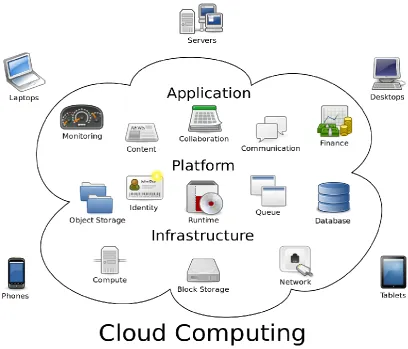
Figure below is showing simple cloud computing components. It has Central Processing Unit (CPU), Database (DB), Mobile phones, Server. In centre, it is having cloud for communication.
Fig. Cloud Computing environment for scheduling multiple applications
© 2014, IJCSMC All Rights Reserved
180
II. Characteristics Of Cloud ComputingA. On Demand Self Services:
Computer services such as email, applications, network or server service can be provided without requiring human interaction with each service provider. Cloud service providers providing on demand self-services include Amazon Web Services (AWS), Microsoft, Google, IBM and Salesforce.com. New York Times and NASDAQ are examples of companies using AWS (NIST).
B. Broad Network Access:
Cloud Capabilities are available over the network and accessed through standard mechanisms that promote use by heterogeneous thin or thick client platforms such as mobile phones, laptops and PDAs. Cloud Computing works as the Platform independent for any devices.
C. Resource Pooling:
The provider’s computing resources are pooled together to serve multiple consumers using multiple-tenant model, with different physical and virtual resources dynamically assigned and reassigned according to consumer demand. This on-demand services gives a view like dynamic allocation of process in any computing environments.
C. Rapid Elasticity:
Cloud services can be rapidly and elastically provisioned, in some cases automatically, to quickly scale out and rapidly released to quickly scale in. To the consumer, the capabilities available for provisioning often appear to be unlimited and can be purchased in any quantity at any time.
D. Measured Service:
Cloud computing resource usage can be measured, controlled, and reported providing transparency for both the provider and consumer of the utilized service. Cloud computing services use a metering capability which enables to control and optimize resource use.[3] This implies that just like air time, electricity or municipality water IT services are charged per usage metrics pay per use. Users only pay for services they use, by subscription or transaction-based models. Measuring services is much useful for any organization.
E. Pay Per Use:
Consumers are charged fees based on their usage of a combination of computing power, bandwidth use and/or storage. By this if any one who is not able to pay large amount of money at the same time can also use the service and pay only for how much he is consuming.
F. It Service-Oriented Approach:
Cloud Computing is IT/business service-oriented as opposed to traditional system- or server-oriented models. Rather than getting bogged down by the network administration of an environment, an IT service-oriented approach provides business agility, as users can perform administrative tasks faster [4].
G. Reliability And Fault-Tolerance:
Cloud environments have built-in redundancy because of the large number of servers that constitute them. If you take advantage of geo-redundancy, servers are more strategically placed at different geographical locations in order to alleviate downtime related issues.
H. SLA-driven:
cost-© 2014, IJCSMC All Rights Reserved
181
effectively in response to changes in the business environment. Cloud Computing enables business leaders to realize a higher level of IT and business agility owing to the ability to re-provision technological infrastructure.
I. APIs:
Clouds virtualizes resources as a service, which implies the need for an application programming interface (API), from which resources can be controlled and managed.
J. Flexible:
Clouds are flexible. They can be used to serve a large variety of workload types-varying from small loads of a small consumer application to very heavy loads of a commercial application.
III. Data Security Issues In The Cloud
A. Privacy and Confidentiality:
Once the client host data to the cloud there should be some guarantee that access to that Data must be limited to the authorized access. Inappropriate access to customer sensitive data by cloud personnel is another risk that is posing potential threat to cloud data. Assurances should be provided to the clients and proper practices and privacy policies and procedures should be in place to assure the cloud users for the safety of data. The cloud seeker should be assured that data hosted on the cloud will be confidential.[4]
B. Data integrity:
With providing the security of data, cloud service providers should implement mechanisms to ensure data integrity which is the necessary thing and be able to tell what happened to a certain dataset and at what point. The cloud provider should make the client aware of what particular data is hosted on the cloud, the origin and the integrity mechanisms put in place.
C. Data Location and Relocation:
Cloud Computing offers a high degree of data mobility. Consumers of the data do not always know the location of their data. However, when an enterprise has some sensitive data that is kept on a storage device in the Cloud, they may be want to know the location of it. They may also wish to specify a preferred location for that data to be kept where. This, then, requires a contractual agreement, between the Cloud provider and the consumer that data should Stay at a particular location or reside on a given known server.
D. Data Availability:
Customer data is normally stored in chunk on different servers often residing in different locations or in different Clouds. In such case, data availability becomes a major legitimate issue as the availability of uninterruptible and seamless provision becomes relatively difficult. Storage, Backup and Recovery: If you decide to move your data to the cloud the cloud provider should ensure adequate data resilience storage systems. At a minimum they should be able to provide RAID (Redundant Array of Independent Disks) storage systems. Security in data storage is the important metrics in performance comparison of these systems. If the provided cloud storage can be accessed or destroyed by malicious attackers, the service provider will lose trust from its users, and the leakage of personal data could cause great damage to each individual. So they required which consists of:
© 2014, IJCSMC All Rights Reserved
182
IV. Cloud Computing Applications In India With Its Design Challenges
Cloud providers in India have developed products, services, and applications to meet diverse customer needs. Some have developed specialized e- applications to meet the demands of specific industries and sectors.
A. E-Commerce and Customer Relationship Management
India’s largest retailer, Future Group (www.futuregroup.in), uses the cloud to support data warehousing and analytics for its retail chains. The retailer uses clouds to manage its customer loyalty program, which involves storing and analyzing millions of gigabytes of data.[5] In February 2011, Dr. Reddy’s Laboratories deployed Salesforce customer relationship management to improve its deals pipeline, track sales cycle, and analyze sales funnel. Dr. Reddy’s expects cloud-led streamlining to increase revenue by over 30 percent.[6]
With the demands of the todays needs Mobile commerce called as ―m-commerce‖ is a business model for commerce using mobile devices. The m-commerce applications generally fulfill some tasks with mobility (e.g., mobile transactions and payments, mobile messaging, and mobile ticketing). The m-commerce applications includes a few classes including finance, advertising and shopping. The m-commerce applications have to face various challenges also. For example, low network bandwidth, high complexity of mobile device configurations, and security, etc. Therefore, m-commerce applications are integrated into cloud computing environment to address these challenges [12]. This paradigm combines the advantages of both 3G network and cloud computing to increase data processing speed and security level based on PKI (public key infrastructure). The PKI mechanism uses an encryption-based access control and an over-encryption to ensure privacy of user’s access to the outsourced data. Cloud computing technology utilizes to enhance the security for users and improve the customer satisfaction, customer intimacy, and cost competitiveness.
B. Education
Indian universities, including the Indian Institute of Technology, Kanpur, are banking on the cloud to develop innovative research and education activities. In January 2012, the Indian government, in cooperation with E-Tutor and Oztern Technology, launched the country’s first cloud-based tablet, known as the E-tutor Tablet, targeting first- through 12th-grade students. [7] E-Tutor developed the content for the $150 tablet, and Oztern designed the technology. In April 2012, Microsoft announced its biggest global cloud deal, which would provide free services to All India Council for Technical Education (AICTE). As part of Microsoft’s corporate social responsibility initiatives, the project will make resources on the cloud available to 7.5 million students and 450,000 teachers in 11,000 AICTE-affiliated institutions. [8]
C. Healthcare
An innovative application in the early phases of development aims to identify counterfeit or substandard drugs. [9] While buying a drug at a pharmacy store, a customer can find a 12-digit code by scratching a sticker on the surface of the package and then send a text message to a given number. The code sent by the customer is matched with that registered by the pharmaceutical company in HP’s cloud database. The customer then receives a response back that tells whether the drug is counterfeit or genuine. Although this application provides obvious commercial benefits to drug manufacturers and patients, one of the most important benefits of this technique is that it helps save lives by enabling the customers to check the authenticity of life-saving drugs. This system was developed in Africa by the nonprofit organization, mPedigree, and HP Labs.
D. Social and Economic Changes
In October 2010, Intel announced an agreement with an alliance of 70 companies, including Bombay Stock Exchange (BSE) and CtrlS, to develop hardware and software for an open and interoperable cloud. The Open Data Center Alliance works to address security, energy efficiency, and interoperability. The BSE expects that the new trading platforms supported by mobile telephony and clouds would broaden participation by allowing real-time and seamless access to data across phones, laptops, and other devices. This approach would also deepen and widen asset classes traded. The new platforms will increase participation of younger Indians in pensions, insurance, and mutual funds. The popularity of mobile-based cloud applications is particularly promising. As of early 2012, only 121 million Indians were online, but there were 898 million mobile subscribers—292 million of which reside in rural areas.[10]
© 2014, IJCSMC All Rights Reserved
183
India had 0.9 fixed broadband subscriptions per 100 inhabitants. So although India is a heterogeneous cloud market with divergent demands, low cost rather than advanced performance is likely to be a driving force in the short run.
For global cloud providers, affordability will be a key consideration to compete in India. A related point is that cloud-related products and services offered in India must recognize the local technological reality, such as low bandwidth and mobile-driven digitization. Foreign companies could benefit by collaborating with local cloud providers, characterized by lean cost structures and experience in developing low-cost products. For Indian cloud providers, on the other hand, their ability to deliver value for money in the domestic market could give them a competitive advantage in foreign markets, especially if they’re in a position to reconfigure their resources to operate effectively in emerging markets.
V. Conclusion
The cloud represents a drastic shift, not only in terms of the new economics it brings to bear, but also in terms of the new possibilities it enables. Realizing the full benefits of this new paradigm requires rethinking the way we build applications. As we have seen there are lots of characteristics of cloud computing, so its necessary to use that facilities to improve IT infrastructures. We also saw that we have to take care of the Data Security challenges also. As the Cloud Computing is the bigger, cheaper, and advanced platform we have to develop large application securely and efficiently in Our Country.
References
[1] R. Buyya, C. S. Yeo, and S. Venugopal, ―Market-oriented cloud computing: Vision, hype, and
reality for delivering it services as computing utilities,‖ in
Proc.10th IEEE
[2] Wenwu Zhu, Chong Luo, Jianfeng Wang, and Shipeng Li , IEEE SIGNAL PROCESSING
MAGAZINE MAY 2011&
MAY 2011
[3] Y. Chen, X. Li and F. Chen, ―Overview and Analysis of Cloud Computing Research and
Application‖, International Conference on E-Business and E -Government (ICEE), May 2011.
[4] H. Takabi, J.B.D. Joshi, and G-J. Ahn, ―Security and Privacy Challenges in Cloud Computing
Environments,‖ IEEE Security & Privacy, vol. 8, no. 6, 2010.
[5] S. Biswas, ―Cloud Computing Startups Raise Big Money,‖
CloudTweaks
, 6 Feb. 2012,
www.cloudtweaks.com/2012/02/cloud-computingstartups-raise-big-money-update-6.
[6] ―Dr. Reddy’s Sales Process with Salesforce.com,‖ EFYTimes.com, 3 Feb. 2011;
www.efytimes.com/e1/58149/fullnews.htm.
[7] ―E-tutor Tablet: Cloud-Based Solution for Students Launched,‖
The Economic Times
, 25 Jan.
2012;
http://economictimes.indiatimes.com/tech/hardware/e-tutor-tablet-cloudbased-solution-for-students-launched/articleshow/11630507.cms.
[8] B. Menezes, ―Microsoft Bags Its Biggest Cloud Order—from AICTE,‖
Daily News and Analysis
,
14
Apr.
2012;
www.dnaindia.com/money/report_microsoft-bags-its-biggestcloud-order-from-aicte_1675575.
[9] C. Gopalakrishnan ―How Cloud Technology Can Help You Spot Fake Drugs,‖
The Times of India
,
29
Sept.
2011;
http://timesofindia.indiatimes.com/tech/personal-tech/computing/How-cloud-technologycan-help-you-spot-fake-drugs/articleshow/10168266.cms
© 2014, IJCSMC All Rights Reserved