Language Resources for Multi-Modal Dialogue Systems
Oliver Lemon and Alexander Gruenstein
Center for the Study of Langauge and Information Stanford University
210 Panama Street, Stanford CA 94305
lemon,[email protected]
Abstract
This paper reviews a resource base of software agents for hub-based architectures, which can be used generally for advanced dialogue systems research and deployment. The problem of domain-specificity of dialogue managers is discussed, and we describe an approach to it developed at CSLI, involving a domain-general dialogue manager with application specific “Activity Models”. We also describe relevant grammar development tools.
1. Introduction
The limited portability of dialogue-interfaces is cur-rently a barrier to their development and more widespread use. We present and demonstrate new resources developed at CSLI1and elsewhere which can be used (in tandem with
existing “off-the-shelf” components) to build multi-modal dialogue systems for a range of applications, each bringing their own activities and vocabulary to dialogues. We shall show that a rich resource base of software agents now ex-ists for hub-based architectures (e.g. Galaxy Communicator (Seneff et al., 1998), OAA (Martin et al., 1999)), which can be used generally for advanced dialogue systems research and deployment.
In Section 3. we survey the components which are now available, but we first discuss common approaches and problems.
A variety of researchers have built “toolkits” for the development of dialogue systems (e.g. the OGI Toolkit (McTear, 1998), TrinidiKit (Larsson et al., 2000; Larsson and Traum, 2000)), but these have been limited to simple dialogues which are essentially pre-scripted by a developer, either as Finite State Machines or Form-filling systems (e.g. a list of questions to resolve in order to buy airline tickets). However, some current research systems handle complex non-scriptable dialogues which enable a human user to in-teract with a device performing co-operative activities, such as searching for objects (e.g. (Lemon et al., 2001a; Lemon et al., 2001c)). The usual problem with such systems is that their central component, the “Dialogue Manager”, is application-specific, thus making them unsuitable candi-dates for developer toolkits for more flexible and useful dia-logue systems. For example, the Pegasus, Orion, Mercury, and Jupiter systems developed at MIT (Zue et al., 1994; Seneff, 2000; Seneff and Polifroni, 2000; Zue, 2000) each have domain-specific dialogue managers, with around 350 rules each. The time and expertise needed to develop such dialogue managers by hand prohibits more widespread de-velopment and deployment of the technology.
1This research was (partially) funded under the Wallenberg laboratory for research on Information Technology and Au-tonomous Systems (WITAS) Project, Link¨oping University, by the Wallenberg Foundation, Sweden.
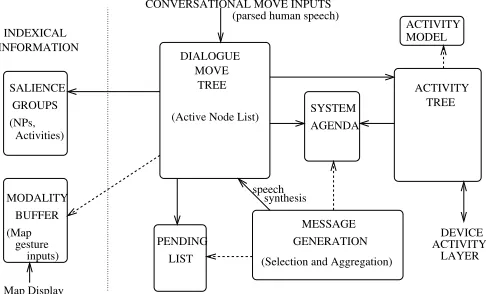
Conceptually, however, it is clear that there is a domain-independent level of conversational competence exhibited by humans. For instance, a question deserves in answer, re-gardless of what “domain” that question is about. Likewise, a command or instruction changes conversational context such that certain responses are responsestothat utterance, and others are not. Capturing this level of abstraction to “speech acts” or “dialogue moves” computationally allows us to build domain-general dialogue management tools (see (Lemon et al., 2002 submitted), and Figure 1).
DIALOGUE
ACTIVITY MOVE
TREE
AGENDA
SYSTEM TREE
BUFFER MODALITY
PENDING LIST GROUPS
Activities) (NPs,
(Selection and Aggregation) SALIENCE
(Map gesture
inputs) ACTIVITYLAYER
speech synthesis
Map Display INFORMATION
INDEXICAL
CONVERSATIONAL MOVE INPUTS (parsed human speech)
(Active Node List)
MESSAGE GENERATION
ACTIVITY MODEL
DEVICE
Figure 1: CSLI dialogue management system
2.) for specifying the “Activities” that an application can carry out (c.f. ‘recipes’ in COLLAGEN (Rich et al., 2001)), such that a developer need only specify activities, together with lexical cues for them, in order to “dialogue-enable” an application. Similar work is underway by (Rayner et al., 2002 in press). The next section outlines this idea.
2. Activity Models
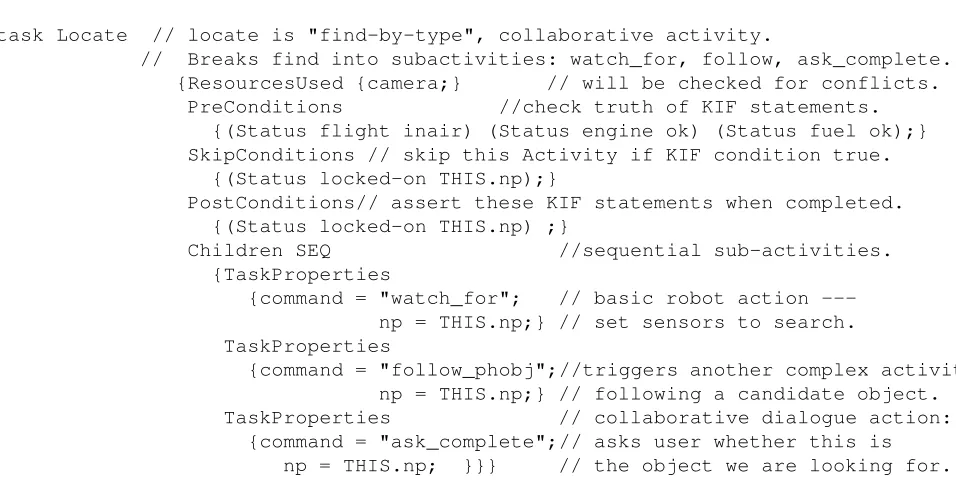
The applications which we wish to “dialogue-enable” using conversational interfaces are capable of performing some basic activities or actions (possibly simultaneously). Some applications know only how to carry out sequences of atomic activities, in which case it is the dialogue sys-tem’s job to decompose linguistically specified high-level activities (e.g. “record the film on channel 4 tonight”) into a sequence of appropriate basic actions for the device. In this case a declarative “Activity Model” (see Figure 2) for the application states how linguistically-specified activities can be decomposed into sequences of atomic actions. This model also states traditional planning and resource con-straints such as preconditions and postconditions of actions. In this way, a relatively “stupid” device (e.g. with little or no planning capabilities) can be made into a more intelli-gent device when it is dialogue-enabled.
We choose to focus on building this class of dialogue systems because we share with (Allen et al., 2001), a ver-sion of the thePractical Dialogue Hypothesis:
“The conversational competence required for practical dialogues, although still complex, is sig-nificantly simpler to achieve than general human conversational competence.”
Of course, applications may be able to plan and ini-tiate actions themselves. Dialogue is then also used to re-specify constraints, revise activities, and monitor the progress of tasks. We propose one representation and rea-soning scheme to cover the spectrum of cases from applica-tions with no planning capabilities to those exhibiting more impressive AI. Both dialogue manager and application have access to a single “Activity Tree” which is a shared (and thus co-ordinated) representation of current and planned ac-tivities and their execution status, involving temporal and hierarchical ordering (in fact, one can think of the Activ-ity Tree as a HTN for the application). Applications can then use the full resources of the dialogue system to report execution progress of activities, and engage the user in col-laborative dialogue about them.
We now turn to a slection of available software agents for building end-to-end dialogue systems.
3. Software Agents
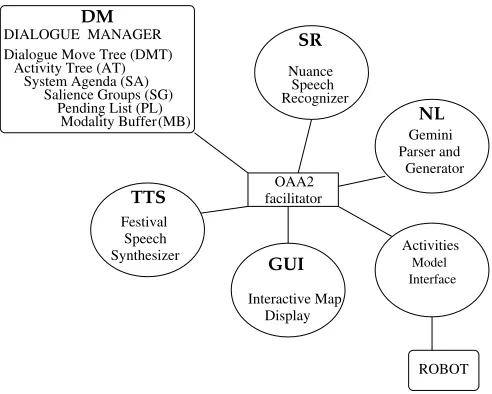
A collection of resources (Dialogue Manager, Ac-tivity Manager) and wrappers to “off-the-shelf” systems (Speech Recognizer, Speech Synthesizer, Parser, Genera-tor) has been developed at CSLI as a set of portable soft-ware agents in Java, under the Open Agent Architecture (OAA2).Agents are available at our website.
The core of the architecture is OAA’s “facilitator” which manages asynchronous message passing between a number
facilitatorOAA2
Synthesizer
Generator Gemini Parser and RecognizerSpeech
Nuance
Speech Festival
Display Interactive Map
NL SR
TTS DM
GUI ActivitiesModel
Interface
DIALOGUE MANAGER
Dialogue Move Tree (DMT) Activity Tree (AT)
System Agenda (SA) Salience Groups (SG)
Pending List (PL) Modality Buffer (MB)
ROBOT
Figure 3: The WITAS multi-modal dialogue system archi-tecture
of software agents which are specialists in certain tasks, for example speech recognition, database queries, or graphical display. In our current system there are six main agents2
each responsible for various subtasks in the dialogue sys-tem (see Figure 3):
1. NL (natural language): a Prolog wrapper to SRI’s “Gemini” unification-based parser and generator, us-ing a grammar for human-robot conversation devel-oped at CSLI.
2. SR (speech recognizer): a Java wrapper to a Nuance 8 speech recognition server using a language model compiled directly from the Gemini grammar (with the consequences that every recognized utterance has a logical form, and that every logical form can be mapped to a surface string).
3. TTS (text-to-speech): a Java wrapper to the Festival 1.4.3 speech synthesiser (Black et al., 1999), for sys-tem speech output.
4. GUI:an interactive map display of the current oper-ating environment which displays route plans, way-points, locations of vehicles including the robot, and allows deictic reference (i.e. mouse pointing) by the user.
5. DM (dialogue manager): co-ordinates multi-modal inputs from the user, interprets dialogue moves made by the user and application, updates and maintains the dialogue context, handles reports and questions, and sends speech and graphical outputs to the user (Java). 6. Activity Layer:translates commands and queries from
the dialogue interface into commands and queries to the back-end application, and vice-versa for reports and queries received from the application. Uses an Ac-tivity Model (see Section 2.) and a realtime CORBA communication layer (Java, JaCORB).
Figure 2: A “Locate” Activity Model for a robot, exhibiting collaborative dialogue
task Locate // locate is "find-by-type", collaborative activity.
// Breaks find into subactivities: watch_for, follow, ask_complete.
{ResourcesUsed {camera;} // will be checked for conflicts.
PreConditions //check truth of KIF statements.
{(Status flight inair) (Status engine ok) (Status fuel ok);} SkipConditions // skip this Activity if KIF condition true.
{(Status locked-on THIS.np);}
PostConditions// assert these KIF statements when completed. {(Status locked-on THIS.np) ;}
Children SEQ //sequential sub-activities.
{TaskProperties
{command = "watch_for"; // basic robot action
---np = THIS.---np;} // set sensors to search. TaskProperties
{command = "follow_phobj";//triggers another complex activity np = THIS.np;} // following a candidate object.
TaskProperties // collaborative dialogue action:
{command = "ask_complete";// asks user whether this is
np = THIS.np; }}} // the object we are looking for.
Although the GUI map and database is domain specific, the methods used in the system to determine the reference of GUI gestures (mouse clicks) are general, and can be re-used in a variety of contexts3. Variants of some of these
components have been used in other dialogue systems, no-tably SRI’s CommandTalk (Stent et al., 1999), the NASA Personal Satellite Assistant (Rayner et al., 2000), and the robot control system of (Guzzoni et al., 1996).
As well as the components mentioned above, the fol-lowing components also have wrappers developed for use in dialogue systems development under OAA (this is not a full listing, but is as comprehensive as I can be at the time of writing)4:
Java Theorem Prover (Java, CSLI)
SNARK theorem prover (Stickel et al., 2000) (Lisp, SRI)
IBM ViaVoice speech synthesizer (C, SRI)
Bliksem theorem prover for first-order logic, translates Discourse Representation Structures (DRS) to first-order formulae (Prolog, HCRC)
Spass theorem prover for first-order logic, translates DRS to first-order formulae (Prolog, HCRC)
Dipper Dialogue Move Engine (Prolog, HCRC)
Finder, model builder for first-order logic, inputs are DRS (Prolog, HCRC)
3e.g. any application where items are selected by point-and-click gestures. Dragging and dropping would be nice to add.
4Where possible I note in parentheses the language used and the institution at which the work is based.
MACE, model-builder for first-order logic, inputs are DRS (Prolog, HCRC)
Heyu, X-10 device control interface (HCRC)
Left corner parser (Prolog, HCRC)
Racer, decription logic theorem prover (Prolog, HCRC)
TrindiKit dialogue management toolkit (Larsson and Traum, 2000) (Prolog, Gothenburg University) The main sites for these efforts have been SRI, the NASA Rialist group, HCRC (Edinburgh), Gothenburg University (Department of Linguistics), and CSLI (Stanford Univer-sity).
Various components also exist for the Galaxy Com-municator hub architecture. See the Galaxy Communica-tor “Open Source Toolkit” athttp://communicator.
sourceforge.net/download/index.html. This
includes:
JSAPI wrapper for IBM ViaVoice or other JSAPI-compliant recognizers
wrapper for Sphinx speech recognizer
wrapper for Phoenix parser
wrappers for Festival, TrueTalk speech synthesizers
MITRE dialogue manager
3.1. Grammar Compilation
Regulus (Rayner et al., 2001)
Kiefer and Kreiger (Kiefer and Krieger, 2000)
Gemini (Dowding et al., 1993)
UNIANCE5
Papers investigating this issue are (Moore, 1998; Dowd-ing et al., 2001; Rayner et al., 2001). The virtue of this process is that developers need only write one unifica-tion grammar for the applicaunifica-tion, which can be used in three ways: interpretation, generation (if the system is bi-directional), and speech recognition.
Another challenge is that multiple application-specific grammars are often used for parsing, generation, and speech recognition. Recent developments in “plug-and-play” grammars (Rayner et al., 2002 in press) allow appli-cations and devices to bring their own specific vocabulary and grammar rules to a domain general “core” grammar, and use them on the fly.
4. Conclusion
We described a number of software resources available for advanced dialogue systems research and deployment. These include hub architectures, parsers, speech recogniz-ers, speech synthesizrecogniz-ers, dialogue managrecogniz-ers, and toolkits, as well as development tools such as software for compiling unification grammars to context-free grammars for speech recognition.
At CSLI, these tools have been used to rapidly proto-type dialogue systems for interaction with intelligent au-tonomous devices such as mobile robots (Lemon et al., 2001c) and intelligent tutoring systems (Clark et al., 2001). We also discussed the problem of domain-specificity of dialogue systems – a problem which is especially acute in the core area of dialogue management. We outlined the ap-proach taken to this at CSLI, based on the representation of domain-specific “activity models” for devices, applica-tions, or services. This allows dialogue management to be handled in a general fashion, in our case using abstract “di-alogue move” classes to build and update a “di“di-alogue move tree” representing dynamic dialogue context.
More information and demos see http: //www-csli.stanford.edu/semlab/witas/
Other applications include interaction with avatars and computer-generated characters in video games (Lemon, 2002).
Acknowledgements
With thanks to John Dowding (NASA Rialist), Beth-Ann Hockey (NASA Rialist), Stina Ericsson (Gothenburg), Johan Bos (HCRC), Staffan Larsson (Gothenburg), Stanley Peters (CSLI).
5See http://www.iccs.informatics.ed.ac.uk/
˜jbos/systems.html
5. References
James F. Allen, Bradford W. Miller, Eric K. Ringger, and Teresa Sikorski. 1996. A robust system for natural spo-ken dialogue. InProceedings of ACL.
James Allen, Donna Byron, Myroslva Dzikovska, George Ferguson, Lucian Galescu, and Amanda Stent. 2001. Toward conversational human-computer interaction. AI Magazine, 22(4):27–37.
Alan Black, Paul Taylor, and Richard Caley. 1999. The Festival Speech Synthesis system. http://www.
cstr.ed.ac.uk/projects/festival/.
Peter Bohlin, Robin Cooper, Elisabet Engdahl, and Staffan Larsson. 1999. Information states and dialog move en-gines. Electronic Transactions in AI. Website with com-mentaries:www.etaij.org.
Brady Clark, John Fry, Matt Ginzton, Stanley Peters, Heather Pon-Barry, and Zachary Thomsen-Gray. 2001. Automated tutoring dialogues for training in shipboard damage control. InProceedings of SIGDIAL 2001. Robin Cooper and Staffan Larsson. 1998. Dialog moves
and information states. Technical Report 98-6, Goteborg University. Gothenburg papers in Computational Lin-guistics.
John Dowding, Jean Mark Gawron, Doug Appelt, John Bear, Lynn Cherny, Robert Moore, and Douglas Moran. 1993. GEMINI: a natural language system for spoken-language understanding. InProc. 31st Annual Meeting of the ACL.
J. Dowding, B.A. Hockey, M. J. Gawron, and C. Culy. 2001. Practical issues in compiling typed unification grammars for speech recognition. InProceedings of the Thirty-Ninth Annual Meeting of the Association for Com-puational Linguistics.
Renee Elio and Afsaneh Haddadi. 1999. On abstract task models and conversation policies. InWorkshop on Specifying and Implementing Conversation Policies, Au-tonomous Agents’99, Seattle.
John Fry, Hideki Asoh, and Toshihiro Matsui. 1998. Nat-ural dialogue with the Jijo-2 office robot. InIEEE/RSJ International Conference on Intelligent Robots and Sys-tems IROS-98, pages 1278–1283, Victoria, B.C., Canada.
(Seewww-csli.stanford.edu/semlab/juno).
Dafydd Gibbon, Inge Mertins, and Roger Moore. 2000.
Handbook of Spoken and Multi-modal Dialogue Sys-tems. Kluwer.
Didier Guzzoni, Adam Cheyer, Luc Julia, and Kurt Kono-lige. 1996. Many robots make short work. In AAAI Robotics Contest, Menlo Park, CA. SRI International, AAAI Press.
B. Kiefer and H. Krieger. 2000. A context-free approxi-mation of head-driven phrase structure grammar. In Pro-ceedings of 6th International Workshop on Parsing Tech-nologies, pages 135–146.
Staffan Larsson and David Traum. 2000. Information state and dialogue management in the TRINDI Dialogue Move Engine Toolkit. Natural Language Engineering, 6(3-4):323–340.
TRINDIKIT 1.0 Manual. Technical report, University of Gothenburg.
Stanislao Lauria, Guido Bugmann, Theocharis Kyriacou, Johan Bos, and Ewan Klein. 2001. Training personal robots using natural language instruction. IEEE Intelli-gent Systems.
Oliver Lemon, Anne Bracy, Alexander Gruenstein, and Stanley Peters. 2001a. Information states in a multi-modal dialogue system for human-robot conversation. In Peter K¨uhnlein, Hans Reiser, and Henk Zeevat, editors,
5th Workshop on Formal Semantics and Pragmatics of Dialogue (Bi-Dialog 2001), pages 57 – 67.
Oliver Lemon, Anne Bracy, Alexander Gruenstein, and Stanley Peters. 2001b. A multi-modal dialogue sys-tem for human-robot conversation. In Proceedings of North American Association for Computational Linguis-tics (NAACL 2001).
Oliver Lemon, Anne Bracy, Alexander Gruenstein, and Stanley Peters. 2001c. The WITAS Multi-Modal Dia-logue System I. InProceedings of 7th European Con-ference on Speech Communication and Technology (Eu-rospeech’ 01), Aalborg.
Oliver Lemon, Alexander Gruenstein, and Stanley Peters. 2002 (submitted). Collaborative actvities and multi-tasking in dialogue systems. Traitement Automatique des Langues (TAL). Special Issue on Dialogue.
Oliver Lemon. 2002. Transferable multi-modal dialogue systems for interactive entertainment. In AAAI Spring Symposium on Artificial Intelligence in Interactive En-tertainment, Technical Report SS-02-01, pages 57 – 61, Menlo Park, CA. AAAI Press.
Diane Litman, Micheal Kearns, Satinder Singh, and Mar-ilyn Walker. 2000. Automatic optimization of dialogue management. InProceedings of COLING 2000. Susann LuperFoy, Dan Loehr, David Duff, Keith Miller,
Florence Reeder, and Lisa Harper. 1998. An archi-tecture for dialogue management, context tracking, and pragmatic adaptation in spoken dialogue systems. In
COLING-ACL, pages 794 – 801.
David Martin, Adam Cheyer, and Douglas Moran. 1999. The Open Agent Architecture: a framework for building distributed software systems. Applied Artificial Intelli-gence: An International Journal, 13(1-2).
M. McTear. 1998. Modelling spoken dialogues with state transition diagrams: Experiences with the CSLU toolkit. In Proc 5th International Conference on Spoken Lan-guage Processing.
R. Moore. 1998. Using natural language knowledge sources in speech recognition. In Proceedings of the NATO Advanced Studies Institute.
Douglas Moran, Adam Cheyer, Luc Julia, David Martin, and Sangkyu Park. 1997. Multimodal user interfaces in the Open Agent Architecture. InProc IUI 97, pages 61 – 68.
Nuance. 2000.http://www.nuance.com.
James Pittman, Ira Smith, Phil Cohen, Sharon Oviatt, and Tzu-Chieh Yang. 1996. Quickset: a multimodal inter-face for military simulation. InProceedings of the Sixth
Conference on Computer Generated Forces and Behav-ioral Representation, Orlando, pages 217–224.
Manny Rayner, Beth Ann Hockey, and Frankie James. 2000. A compact architecture for dialogue management based on scripts and meta-outputs. InProceedings of Ap-plied Natural Language Processing (ANLP).
M. Rayner, J. Dowding, and B.A. Hockey. 2001. A base-line method for compiling typed unification grammars into context free language models. InProceedings of Eu-roSpeech.
Manny Rayner, John Boye, Ian Lewin, and Genevieve Gor-rel. 2002 (in press). Plug and play spoken dialogue pro-cessing. InSIGdial 2001 book. Kluwer.
Charles Rich, Candace Sidner, and Neal Lesh. 2001. Col-lagen: applying collaborative discourse theory to human-computer interaction.AI Magazine, 22(4):15–25. Nicholas Roy, Joelle Pineau, and Sebastian Thrun. 2000.
Spoken dialog management for robots. InProceedings of ACL 2000.
S. Seneff and J. Polifroni. 2000. Formal and natural lan-guage generation in the mercury conversational system. S. Seneff, E. Hurley, R. Lau, C. Pao, P. Schmid, and V. Zue.
1998. Galaxy-ii: A reference architecture for conversa-tional system development. InProceedings of ICSLP. Stephanie Seneff. 2000. Orion: From on-line interaction
to off-line delegation. InProc. 6th International Confer-ence on Spoken Language Processing.
Amanda Stent, John Dowding, Jean Mark Gawron, Eliz-abeth Owen Bratt, and Robert Moore. 1999. The Com-mandTalk spoken dialogue system. InProceedings of the Thirty-Seventh Annual Meeting of the ACL, pages 183– 190, University of Maryland, College Park, MD. Associ-ation for ComputAssoci-ational Linguistics.
Mark E. Stickel, Richard J. Waldinger, and Vinay K. Chaudhri. 2000. A Guide to SNARK. Technical Note Unassigned, AI Center, SRI International, 333 Ravenswood Ave., Menlo Park, CA 94025, May. Wei Xu and Alexander Rudnicky. 2000. Task-based
di-alog management using an agenda. In Proceedings of ANLP/NAACL 2000 Workshop on Conversational Sys-tems, pages 42–47.
V. Zue, S. Seneff, J. Polifroni, M. Phillips, C. Pao, D. God-deau, J. Glass, E., and Brill. 1994. PEGASUS: A spo-ken language interface for on-line air travel planning. InProc. ARPA Human Language Technology Workshop ’94, Princeton, NJ.