Large-scale Dictionary Construction via Pivot-based Statistical Machine
Translation with Significance Pruning and Neural Network Features
Raj Dabre1, Chenhui Chu2, Fabien Cromieres2, Toshiaki Nakazawa2, Sadao Kurohashi1 1Graduate School of Informatics, Kyoto University
2Japan Science and Technology Agency
[email protected],(chu,fabien,nakazawa)@pa.jst.jp,[email protected]
Abstract
We present our ongoing work on large-scale Japanese-Chinese bilingual dictionary con-struction via pivot-based statistical machine translation. We utilize statistical significance pruning to control noisy translation pairs that are induced by pivoting. We construct a large dictionary which we manually verify to be of a high quality. We then use this dictionary and a parallel corpus to learn bilingual neural net-work language models to obtain features for reranking the n-best list, which leads to an ab-solute improvement of 5% in accuracy when compared to a setting that does not use signif-icance pruning and reranking.
1 Introduction
Pivot-based statistical machine translation (SMT) (Wu and Wang, 2007) has been shown to be a possi-ble way of constructing a dictionary for the language pairs that have scarce parallel data (Tsunakawa et al., 2009; Chu et al., 2015). The assumption of this method is that there is a pair of large-scale parallel data: one between the source language and an in-termediate resource rich language (henceforth called pivot), and one between that pivot and the target lan-guage. We can use the source-pivot and pivot-target
parallel data to develop a source-target term1
trans-lation model for dictionary construction.
Pivot-based SMT uses the log linear model as conventional phrase-based SMT (Koehn et al., 2007) does. This method can address the data sparseness problem of directly merging the source-pivot and pivot-target terms, because it can use the portion of terms to generate new terms. Small-scale experi-ments in (Tsunakawa et al., 2009) showed very low
1In this paper, we call the entries in the dictionary terms. A
term consists of one or multiple tokens.
accuracy of pivot-based SMT for dictionary
con-struction.2
This paper presents our study to construct a large-scale Japanese-Chinese (Ja-Zh) scientific dictionary,
using large-scale Japanese-English (Ja-En) (49.1M
sentences and 1.4M terms) and English-Chinese
(En-Zh) (8.7M sentences and4.5M terms) parallel
data via pivot-based SMT. We generate a large pivot translation model using the Ja-En and En-Zh paral-lel data. Moreover, a small direct Ja-Zh translation model is generated using small-scale Ja-Zh parallel
data. (680k sentences and 561k terms). Both the
direct and pivot translation models are used to trans-late the Ja terms in the Ja-En dictionaries to Zh and the Zh terms in the Zh-En dictionaries to Ja to
con-struct a large-scale Ja-Zh dictionary (about 3.6M
terms).
We address the noisy nature of pivoting large phrase tables by statistical significance pruning (Johnson et al., 2007). In addition, we exploit lin-guistic knowledge of common Chinese characters (Chu et al., 2013) shared in Ja-Zh to further improve the translation model. Large-scale experiments on scientific domain data indicate that our proposed method achieves high quality dictionaries which we manually verify to have a high quality.
Reranking the n-best list produced by the SMT decoder is known to help improve the translation quality given that good quality features are used (Och et al., 2004). In this paper, we use bilingual neural network language model features for rerank-ing the n-best list produced by the pivot-based sys-tem which uses significance pruning, and achieve a 2.5% (absolute) accuracy improvement. Compared to a setting which uses neither significance pruning nor n-best list reranking the improvement in
accu-2The highest accuracy evaluated based on the 1 best
transla-tion is21.7%in (Tsunakawa et al., 2009).
289
racy is about 5% (absolute). We also use character based neural MT to eliminate the out-of-vocabulary (OOV) terms, which further improves the quality.
The rest of this paper is structured as follows: Section 2 reviews related work. Section 3 presents our dictionary construction using pivot-based SMT with significance pruning. Section 4 describe the bilingual neural language model features using a parallel corpus and the constructed dictionary for reranking the n-best list. Experiments and results are described in Section 5, and we conclude this paper in Section 6.
2 Related Work
Many studies have been conducted for pivot-based SMT. Utiyama and Isahara (2007) developed a method (sentence translation strategy) for cascading a source-pivot and a pivot-target system to translate from source to target using a pivot language. Since this results in multiplicative error propagation, Wu and Wang (2009) developed a method (triangula-tion) in which they combined the source-pivot and pivot-target phrase tables to obtain a source-target phrase table. They then combine the pivoted and direct tables (using source-target parallel corpora) by linear interpolation whose weights were manu-ally specified. There is a method to automaticmanu-ally learn the interpolation weights (Sennrich, 2012) but it requires reference phrase pairs which are not
eas-ily available. Work on translation from
Indone-sian to English using Malay and Spanish to En-glish using Portuguese (Nakov and Ng, 2009) as pivot languages worked well since the pivots had substantial similarity to the source languages. They used the multiple decoding paths (MDP) feature of the phrase-based SMT toolkit Moses (Koehn et al., 2007) to combine multiple tables which avoids inter-polation. The issue of noise introduced by pivoting has not been seriously addressed and although statis-tical significance pruning (Johnson et al., 2007) has shown to be quite effective in a bilingual scenario, it has never been considered in a pivot language sce-nario.
(Tsunakawa et al., 2009) was the first work that constructs a dictionary for language pairs that are re-source poor using pivot-based SMT, however the ex-periments were performed on small-scale data. Chu
et al. (2015) conducted large-scale experiments and exploited the linguistic knowledge of common Chi-nese characters shared in JapaChi-nese-ChiChi-nese (Chu et al., 2013) to improve the translation model.
N-best list reranking (Och et al., 2004; Sutskever et al., 2014) is known to improve the translation quality if good quality features are used. Recently, (Cho et al., 2014) and (Bahdanau et al., 2014) have shown that recurrent neural networks can be used for phrase-based SMT whose quality rivals the state of the art. Since the neural translation models can also be viewed as bilingual language models, we use them to obtain features for reranking the n-best lists produced by the pivot-based system.
3 Dictionary Construction via Pivot-based SMT
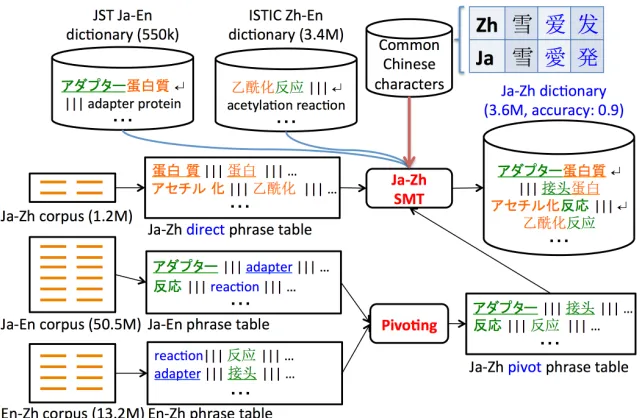
Figure 1 gives an overview of our construction method. Phrase-based SMT (Koehn et al., 2007) is the basis of our method. We first generate Ja-Zh (source-target), Ja-En (source-pivot) and En-Ja-Zh (pivot-target) phrase tables from parallel data re-spectively. The generated Ja-Zh phrase table is used
as the direct table. Using the Ja-En and En-Zh
phrase tables, we construct a Ja-Zh pivot phrase ta-ble via En. The direct and pivot tata-bles are then com-bined and used for phrase-based SMT to the Ja terms in the Ja-En dictionaries to Zh and the Zh terms in the Zh-En dictionaries to Ja to construct a large-scale Ja-Zh dictionary. In addition, we use common Chi-nese characters to generate ChiChi-nese character fea-tures for the phrase tables to improve the SMT per-formance.
3.1 Pivot Phrase Table Generation
We follow the phrase table triangulation method (Wu and Wang, 2007) to generate the pivot phrase table. This method generates a source-target phrase table via all their shared pivot phrases in the source-pivot and source-pivot-target tables. The formulae for gen-erating the inverse phrase translation probabilities
and direct lexical weightings, φ(f|e) andlex(f|e)
are given below. Inverting the positions of e and
f give the formulae for the direct probabilities and
weightings,φ(e|f)andlex(e|f).
φ(f|e) =X pi
pivot-these models to perform character based translation of untranslated words and avoid OOVs.
The procedure we followed to perform reranking
is given below. A decoder always gives n-best
lists when performing tuning and testing. To learn reranking weights, we use the n-best list, for the tun-ing/development set, corresponding to the run with the highest evaluation metric score (BLEU in our case).
1. For each input term in the tuning set:
(a) Obtain 4 neural translation scores for each translation candidate.
(b) Append the 4 scores to the list of features for the candidate.
2. Usekbmira4to learn feature weights using the
modified n-best list and the references for the tuning set.
3. Charater level BLEU as well as word level BLEU are used as reranking metric.
4. For each input term in the test set:
(a) Obtain 4 neural translation scores for each translation candidate and append them to the list of features for that candidate. (b) Perform the linear combination of the
learned weights and the features to get a model score.
5. Sort the n-best list for the test set using the cal-culated model scores (highest score is the best translation) to obtain the reranked list.
We also try another reranking method by treating it as a classification task using the support vector
machine (SVM) toolkit.5 When evaluating
dictio-naries, the translation is either correct or incorrect which is unlike sentence translation evaluation. We thus learn a SVM using the development set n-best list and the references to learn a classifier which is able to differentiate between a correct and an incor-rect translation. The method we used for reranking is:
4
We used the K-best batch MIRA in the Moses decoder to learn feature weights.
5
https://www.csie.ntu.edu.tw/cjlin/libsvm/
1. For each input term in the tuning set:
(a) Obtain 4 neural translation scores for each translation candidate.
(b) Append the 4 scores to the list of features for the candidate.
(c) Generate classification label for candidate by comparing it with the reference.
2. Learn SVM classifier using the constructed training set.
3. For each input term in the test set:
(a) Obtain 4 neural translation scores for each translation candidate and append them to the list of features for that candidate. (b) Use the SVM model to perform
classifica-tion but give the probability scores instead of labels.
4. Sort the n-best list for the test set using the cal-culated probability scores (highest score is the best translation) to obtain the reranked list.
If there are any OOVs in the reranked n-best list then we replace them with the translation obtained using the above mentioned character based neural models (in the Ja-Zh direction).
5 Experiments
We describe the data sets, experimental settings and evaluations of the results below.
5.1 Training data
We used following two types of training data:
• Bilingual dictionaries: we used general
do-main Ja-En, En-Zh and Ja-Zh dictionaries (i.e.
Wikipedia title pairs and EDR6), and the
scien-tific dictionaries provided by the Japan Science
and Technology Agency (JST)7 and the
Insti-tute of Science and Technology information of
China (ISTIC)8 (called the JST dictionary and
ISTIC dictionary hereafter), containing1.4M,
4.5Mand561kterm pairs respectively. Table 1
6
https://www2.nict.go.jp/out-promotion/techtransfer/EDR/J index.html
7
http://www.jst.go.jp
8
Language Name Domain Size
Ja-En
wiki title general 361,016 med dic medicine 54,740 EDR general 491,008 JST dic science 550,769
En-Zh
wiki title general 151,338 med dic medicine 48,250 EDR general 909,197 ISTIC dic science 3,390,792
Ja-Zh
wiki title general 175,785 med dic medicine 54,740 EDR general 330,796
Table 1: Statistics of the bilingual dictionaries used for training.
Language Name Size
Ja-En
LCAS 3,588,800 abst title 22,610,643 abst JICST 19,905,978 ASPEC 3,013,886
En-Zh
LCAS 6,090,535 LCAS title 1,070,719 ISTIC pc 1,562,119
Ja-Zh ASPEC 680,193
Table 2: Statistics of the parallel corpora used for training (All the corpora belong to the general scientific domain, except for ISTIC pc that is a computer domain corpus).
shows the statistics of the bilingual dictionaries used for training.
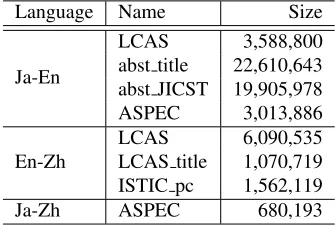
• Parallel corpora: the scientific Ja-En, En-Zh
and Ja-Zh corpora we used were also provided
by JST and ISTIC, containing 49.1M, 8.7M
and680k sentence pairs respectively. Table 2
shows the statistics of parallel corpora used for training. Among which ISTIC pc was provided by ISTIC, and the others were provided by JST.
5.2 Evaluation
5.2.1 Tuning and Testing data
We used the terms with two reference
trans-lations9 in the Ja-Zh Iwanami biology dictionary
(5,890 pairs) and the Ja-Zh life science dictionary (4,075 pairs) provided by JST. Half of the data in
9Different terms are annotated with different number of
ref-erence translations in these two dictionaries.
each dictionary was used for tuning (4,983 pairs), and the other half for testing (4,982 pairs). The eval-uation scores on the test set give an idea of the qual-ity of the constructed dictionary.
5.2.2 Settings
In our experiments, we segmented the Chinese and Japanese data using a tool proposed by Shen et al. (2014) and JUMAN (Kurohashi et al., 1994) re-spectively. For decoding, we used Moses (Koehn et al., 2007) with the default options. We trained a word 5-gram language model on the Zh side of
all the En-Zh and Ja-Zh training data (14.4M
sen-tences) using the SRILM toolkit10with interpolated
Keneser-Ney discounting. Tuning was performed by minimum error rate training which also provides us with the n-best lists used to learn reranking weights. As a baseline, we compared following three meth-ods for training the translation model:
• Direct: Only use the Ja-Zh data to train a direct
Ja-Zh model.
• Pivot: Use the Ja-En and En-Zh data for
train-ing Ja-En and En-Zh models, and construct a pivot Ja-Zh model using the phrase table trian-gulation method.
• Direct+Pivot: Combine the direct and pivot
Ja-Zh models using MDP.
We further conducted experiments using different significance pruning methods described in Section 3.3 and compared the following:
• Direct+Pivot (Pr:S-P): Pivoting after pruning
the source-pivot table.
• Direct+Pivot (Pr:P-T): Pivoting after pruning
the pivot-target table.
• Direct+Pivot (Pr:Both): Pivoting after pruning
both the source-pivot and pivot-target tables.
We also conducted additional experiments using the Chinese character features (labeled +CC) (described in 3.4), but we only report the scores on Direct+Pivot (Pr:P-T), which is the best setting (thus labeled BS) for constructing the dictionary. Finally, using the
10
BS, we translated the Ja terms in the JST (550k)
dic-tionary to Zh and the Zh terms in the ISTIC (3.4M)
dictionary to Ja, and constructed the Ja-Zh
dictio-nary. The size of the constructed dictionary is3.6M
after discarding the overlapped term pairs in the two translated dictionaries. We then used this dictio-nary along with the Ja-Zh ASPEC parellel corpus to rerank the n-best list of the BS using the methods mentioned in Section 4. The following scores are reported:
• BS+RRCBLEU: Using character BLEU to
rerank the n-best list.
• BS+RRWBLEU: Using word BLEU to rerank
the n-best list.
• BS+RRSVM: Using SVM to rerank the n-best
list.
This is followed by substituting the OOVs with the character level translations using the learned neural translation models (which we label as +OOVsub).
5.2.3 Evaluation Criteria
Following (Tsunakawa et al., 2009), we evalu-ated the accuracy on the test set using three met-rics: 1 best, 20 best and Mean Reciprocal Rank (MRR)(Voorhees, 1999). In addition, we report the BLEU-4 (Papineni et al., 2002) scores that were computed on the word level.
5.2.4 Results of Automatic Evaluation
Table 3 shows the evaluation results. We also
show the percentage of OOV terms,11 and the
ac-curacy with and without OOV terms respectively. In general, we can see that Pivot performs better than Direct, because the data of Ja-En and En-Zh is larger than that of Ja-Zh. Direct+Pivot shows better perfor-mance than either method.
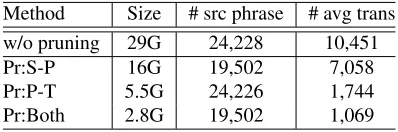
Different pruning methods show different perfor-mances, where Pr:P-T improves the accuracy, while the other two not. To understand the reason for this, we also investigated the statistics of the pivot tables produced by different methods. Table 4 shows the statistics. We can see that compared to the other two pruning methods, Pr:P-T keeps the number of source phrases, which leads a lower OOV rate. It
11
An OOV term contains at least one OOV word.
Method Size # src phrase # avg trans w/o pruning 29G 24,228 10,451
Pr:S-P 16G 19,502 7,058
Pr:P-T 5.5G 24,226 1,744
Pr:Both 2.8G 19,502 1,069
Table 4: Statistics of the pivot phrase tables (for tuning and test sets combined).
also prunes the number of average translations for each source phrase to a more reasonable number, which allows the decoder to make better decisions. Although the average number of translations for the Pr:Both setting is the smallest, it shows worse per-formance compared to Pr:P-T method. We suspect the reason for this is that many pivot phrases are pruned by Pr:Both, leading to fewer phrase pairs induced by pivoting. Augmenting with +CC leads to further improvements, and substituting the OOVs using their character level translation gives slightly better performance.
The most noteworthy results are obtained when reranking is performed using the bilingual neural language model features. BS+RRCBLEU, which uses character BLEU as a metric, performs almost as well as BS+RRWBLEU which uses word BLEU. There might be a difference in the BLEU scores of these 2 settings but the crucial aspect of dictionary evaluation is the accuracy regarding which there is no notable difference between them. We expected that since reranking using SVM, which focuses on accuracy and not BLEU, would yield better results but it might be the case that the training data ob-tained from the n-best lists is not very reliable. Fi-nally, substuting the OOVs from the reranked lists further boosts the accuracies and although the incre-ment is slight the OOV rate goes down to 0%. It is important to understand that the 20 best accuracy is 73% in the best case which means that if reranking is proper then it is possible to boost the accuracies by approximately 15%.
5.2.5 Results of Manual Evaluation
Accuracy w/ OOV Accuracy w/o OOV
Method BLEU-4 OOV term 1 best 20 best MRR 1 best 20 best MRR
Direct 40.64 26% 0.3697 0.5255 0.4258 0.4978 0.7082 0.5736
Pivot 52.32 8% 0.4938 0.7258 0.5730 0.5361 0.7880 0.6220
Direct+Pivot 53.69 8% 0.5088 0.7360 0.5902 0.5522 0.7987 0.6405
Direct+Pivot (Pr:S-P) 52.30 12% 0.4944 0.6881 0.5649 0.5589 0.7779 0.6386 Direct+Pivot (Pr:P-T) 55.44 8% 0.5267 0.7278 0.5990 0.5716 0.7898 0.6500 Direct+Pivot (Pr:Both) 49.71 12% 0.4591 0.6766 0.5391 0.5189 0.7649 0.6094 Direct+Pivot (Pr:P-T)+CC = [BS] 55.86 8% 0.5303 0.7260 0.6005 0.5755 0.7878 0.6517
BS+OOVsub 55.38 0% 0.5325 0.7300 0.6033 0.5325 0.7300 0.6033
BS+RRCBLEU 57.78 8% 0.5568 0.7260 0.6222 0.6042 0.7878 0.6752
BS+RRWBLEU 58.55 8% 0.5566 0.7260 0.6218 0.6040 0.7878 0.6748
BS+RRSVM 55.28 8% 0.5472 0.7260 0.6147 0.5938 0.7878 0.6670
BS+RRCBLEU+OOVsub 57.25 0% 0.5590 0.7300 0.6249 0.5590 0.7300 0.6249 BS+RRWBLEU+OOVsub 58.00 0% 0.5588 0.7300 0.6246 0.5588 0.7300 0.6246 BS+RRSVM+OOVsub 54.85 0% 0.5494 0.7300 0.6174 0.5494 0.7300 0.6174
Table 3: Evaluation results.
they were not covered by the reference translations in our test set. Taking this observation into
consider-ation, the actual 1 best accuracy is about90%.
Au-tomatic evaluation tends to greatly underestimate the results because of the incompleteness of the test set.
5.3 Evaluating the Large Scale Dictionary
As mentioned before the setting Direct+Pivot (Pr:P-T)+CC was used to translate the Ja terms in the JST
(550k) dictionary to Zh and the Zh terms in the
IS-TIC (3.4M) dictionary to Ja so as to construct the
Ja-Zh dictionary. The size of the constructed
dictio-nary is 3.6M after discarding the overlapped term
pairs in the two translated dictionaries. Since we had no references to automatically evaluate this massive dictionary, we evaluated its accuracy by humans.
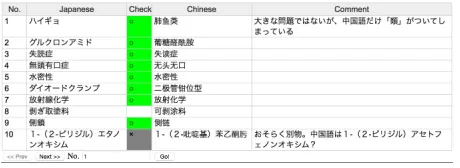
We asked 4 Ja-Zh bilingual speakers to evaluate100
term pairs, which were randomly selected the con-structed dictionary. Figure 3 shows the web inter-face used for human evaluation. It allows the eval-uators to correct errors and well as leave subjective comments, which can be used to refine our meth-ods. The evaluation results indicate that the 1 best
accuracy is about90%, which is consistent with the
manual evaluation results on the test set.
6 Conclusion and Future Work
In this paper, we presented a dictionary construc-tion method via pivot-based SMT with significance pruning, chinese character knowledge and
bilin-Figure 3: Human evaluation web interface.
gual neural network language model based features reranking. Large-scale Ja-Zh experiments show that our method is quite effective. Manual evaluations showed that 90% of the terms are correctly trans-lated, which indicates a high practical utility value of the dictionary. We plan to make the constructed dictionary available to the public in near future, and hope that crowdsourcing could be further used to im-prove it.