CSEIT183151 | Received : 03 Jan 2018 | Accepted : 16 Jan 2018 | January-February-2018 [(3) 1 : 153-159 ]
International Journal of Scientific Research in Computer Science, Engineering and Information Technology © 2018 IJSRCSEIT | Volume 3 | Issue 1 | ISSN : 2456-3307
153
Numerical Studies on Fluid Flow over a Cavity Involving Density
Fields with and without Use of Spoiler Expending LES Approach
Dr. Nirmal Kumar Kund
Associate Professor, Department of Production Engineering, Veer Surendra Sai University of Technology, Burla, Odisha, India
ABSTRACT
The present research implicates the development of an apposite numerical model concerning the supersonic flow past a three-dimensional open cavity with length-to-depth ratio of 2. The Mach number of the supersonic free-stream is 2 as well as the Reynolds number of the flow is 105. The numerical simulations have been carried
out by means of Large Eddy Simulation (LES) method. The Smagorinky model is considered for this investigation. The results have been demonstrated in the form of flow fields represented by the density contours. Very large recirculation is observed within the open cavity without the installation of the spoiler. However, the reduction of the recirculation inside the open cavity is attained by installing a spoiler at the leading edge of the cavity in the form of one-fourth of a cylinder. In addition, the changes in the flow structures within the open cavity by keeping the spoiler is fully examined. And, there exists the qualitative agreement between the two. The trends of results for both the stated cavities are as expected. In overall, the comparisons between the results of the open cavity flows with and without the installation of the spoiler at the leading edge of the cavity is also made.
Keywords: Numerical Simulation, Supersonic Flow, Open Cavity, Spoiler, LES, Density Contour
I.
INTRODUCTION
The aerodynamic forces induced on the surface of the moving bodies cause huge noise which is observed in our day-to-day life like exhaust pipes, vacuum cleaners, ventilation systems, fans etc. The flow induced noise is the most vital issue in various engineering practices relating to surface transport, aviation and marine applications. Airframe noise is a significant constituent of overall noise. One of the most important airframe noises is the cavity noise. It is generated from open wheel wells, weapon bays, door gaps, side mirrors, open sun roof, etc. The door gaps, wheel wells and weapon bays are modelled as rectangular cavities and the serene flow outer to the cavity is taken to be even. Although the rectangular cavity is simple in shape, it is very rich in different dynamic and acoustic phenomena, likely covered by
an aeroacoustic feedback loop depending on the shape/size of the cavity as well as the flow situations. Very severe tone noises is generated owing to the vortex shredding at the upstream edge of the cavity, while the flow takes place past a cavity.
Wendt [6]. The achievements and challenges of large-eddy simulation are described by Piomelli [7]. The numerical simulations of fluidic control for transonic cavity flows are carried out by Hamed et al. [8]. The LES studies on feedback-loop mechanism of supersonic open cavity flows are conducted by Li et al. [9]. A validation study on unsteady RANS computations of supersonic flow over 2D cavity is done by Vijayakrishnan [10]. The lid-driven cavity flows of viscoelastic liquids are very well illustrated by Sousa et al. [11]. The experimental investigations on double-cavity flows are studied by Tuerke et al. [12]. It is perceived that a general study on cavity flow has been done both experimentally and computationally for enhancing the aerodynamic efficiency. But, apart from its distinction, the complicated flow physics of flow past a cavity has captivated the investigators around the world for more investigations and still remains to be a thrust field of research.
Despite the fact that quite a number of experiments have been executed to study the flow characteristics within the cavity, however, some are not at all effective for all flow situations. The operation of the control devices are considerably affected by the Mach number. Control devices require to be designed so that they function over an extensive range of Mach numbers. The incoming boundary layer is also another important factor which controls the operation of the control devices. Keeping this outlook in focus, the drive for this investigation is to study the flow phenomenon in a 3D open cavity supersonic flow. Also, the suppression of cavity recirculation by passive technique has been studied by installing spoiler at the leading edge of the cavity. The comparison between the open cavity flows with and without the attachment of the spoiler has also been made. In overall, the current investigations concern with the development of a three-dimensional numerical model for comparative simulation predictions of the open cavity flows in terms of density flow fields with and without the installation of the spoilers.
II.
DESCRIPTION OF PHYSICAL PROBLEM
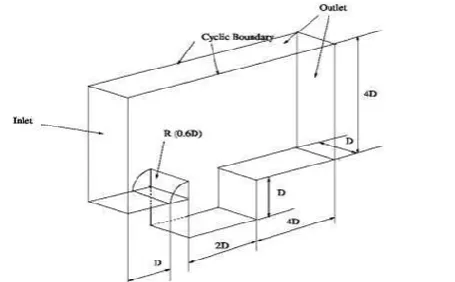
Supersonic flow past a three-dimensional cavity is studied numerically. The streamwise length, depth and spanwise length of the cavity are 20 mm, 10 mm, and 10 mm, respectively. The length-to-depth ratio (𝐿/𝐷) for the cavity is 2. The width-to-depth ratio (𝑊/𝐷) is 1. The cavity is three-dimensional with streamwise length-to-spanwise length ratio (𝐿/𝑊) > 1. In addition, the Mach number of the free-stream along with the Reynolds number based on the cavity depth are taken as 2 and 105, respectively, for setting
the inflow conditions. edge has a dimension of 0.6D. One-fourth part of a cylinder has been used for the shape of the spoiler. The domain is three-dimensional with 𝐿/𝑊 > 1. The upper boundary is at a distance of 4D above the cavity to ensure that no reflected shock affects the flow features inside the cavity.
No-slip adiabatic wall boundary conditions is applied at the wall boundaries. Zero-gradient condition is applied at all the outflow boundaries. Periodical boundary condition is applied in the spanwise direction of the cavity. No-slip adiabatic wall boundary condition is employed for the spoiler.
III.
MATHEMATICAL FORMAULATION
A. Generalized governing transport equations
The 3D compressible Navier-Stokes equations are the governing equations, which comprise the continuity equation (1), the momentum equation (2), and the energy equation (3) which are as mentioned below:
conservation form of the Navier-Stokes equations. The conservation form of these governing equations are reached from a flow model fixed in space [6]. The stated equations are relevant to viscous flow, except that the mass diffusion is not involved.
It is supposed, in aerodynamics, that the gas is a perfect gas. The equation of state for a perfect gas is,
= 𝑅𝑇 (4)
Where, R = specific gas constant = Cp - Cv (5) For a calorically perfect gas (constant specific heats), the caloric equation of state is,
e = internal energy per unit mass = CvT (6)
B. LES Turbulence Modelling
The turbulent flows may be simulated applying three different methods: Reynolds-Averaged Navier-Stokes equations (RANS), direct numerical simulation (DNS), and large eddy simulation (LES). Direct numerical simulation has high computational necessities. DNS resolves all the scales of motion and for this it desires a number of grid points proportional to (Re)9/4 and computational scales' cost
is proportional to (Re)3 [7].
In the current investigation, behaviours of the turbulent flow field have been simulated applying LES as it is suitable for unsteady complex flows and noise induced flows. LES computes the large resolved scales and also models the smallest scales. The turbulence model is incorporated by dividing the time and space varying flow parameters into two The top-hat filter smooth both the fluctuations of the large-scale as well as those of small scales. The filtering operation whenever introduced to the Navier-Stokes equation, it results in:
energy cascade. Most of these models are eddy viscosity models connecting the subgrid-scale stresses (𝜏𝑖𝑗) and the resolved-scale rate of strain-tensor (𝑆𝑖𝑗),
𝜏𝑖𝑗 – (𝛿𝑖𝑗/3) = −2𝜈𝑇𝑆𝑖𝑗 (11) Where, 𝑆𝑖𝑗 is the resolved-scale rate of strain tensor = (𝜕ū𝑖/𝜕𝑥𝑗+ 𝜕ū𝑗/𝜕𝑥𝑖)/2.
In most of the circumstances it is supposed that all the energy received by the unresolved-scales are dissipated instantly. This is the equilibrium assumption, i.e., the small-scales are in equilibrium [7]. This simplifies the problem to a great extent and an algebraic model is found for the eddy viscosity:
𝑠𝑔𝑠 = 𝐶∆2|𝑆|𝑆𝑖𝑗, |𝑆| = (2𝑆𝑖𝑗𝑆𝑖𝑗)1/2 (12)
Here, ∆ is the grid size and is generally considered to be the cube root of the cell volume [7]. This model is termed as the Smagorinsky model and 𝐶 is the Smagorinsky coefficient. In the current investigation, its value has been considered to be 0.2.
IV.
NUMERICAL PROCEDURES
A. Numerical scheme and solution algorithm
The 3D compressible Navier-Stokes governing transport equations are discretized over an outline concerning finite volume method (FVM) through the SIMPLER algorithm. Here, the turbulent model utilized for large eddy simulation is Smagorinsky model, on account of its minimalism. The spatial derivatives like Laplacian and convective terms are computed by second order scheme based on Gauss theorem. Furthermore, the viscous terms are calculated by second order scheme. Additionally, the implicit second order scheme is utilized for time integration. The numerical fluxes are calculated by using Sweby limiter in central differencing (CD) scheme, which is a total variation diminishing (TVD) scheme. The central differencing (CD) is an unbounded second order scheme, while, the total variation diminishing (TVD) is a limited linear scheme. The developed solver is utilized to predict
flow behaviours of the related flow variables pertaining to supersonic flow over an open cavity.
B. Choice of grid size, time step and convergence criteria
The computational domain is again decomposed into upper cavity and inside cavity region as illustrated in figure 2. The grid is refined at the regions near to the wall (where very high gradient is expected) to determine the behaviour of shear layer satisfactorily. A comprehensive grid-independence test is performed to establish a suitable spatial discretization, and the levels of iteration convergence criteria to be used. As an outcome of this test, the optimum
seconds. Even though, it is tested with smaller grids of 128000 in numbers, it is witnessed that a finer grid structure does not change the results considerably.
The convergence in inner iterations is confirmed only when the condition |
|
is fulfilled
Figure 2. Computational grid of cavity with spoiler in X-Y Plane
V.
RESULTS AND DISCUSSION
The recirculation necessitate to be suppressed within the cavity for the present circumstance of supersonic flow over an open cavity. This may be accomplished by keeping a spoiler at the leading edge of the open cavity. The spoiler placed in the current examination is one-fourth part of a cylinder.
Comparisons of density distributions with and without spoiler
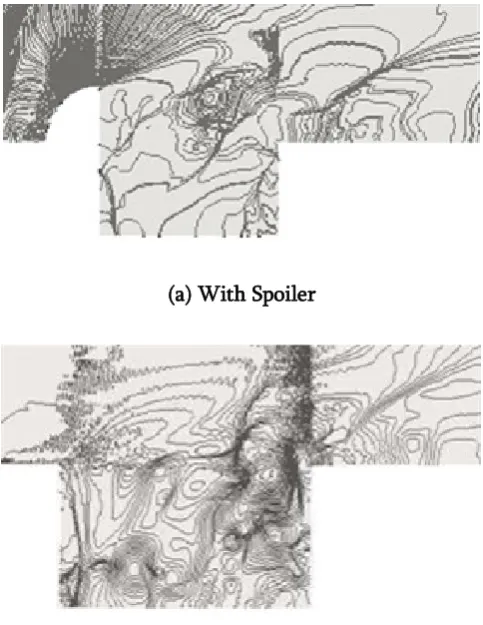
The density contours, at an instant of time t = 0.1 sec, for the supersonic flow past an open cavity with and without the installation of the spoiler at the leading edge of the open cavity are exemplified in the figure 3. The flow characteristics of the open cavity with the spoiler is entirely different from that of the open cavity without the spoiler. The dissimilarity in the flow behaviours may clearly be identified from the density contours. One shedding vortex is realized inside the open cavity with the spoiler in contradiction of two shedding vortices noticed inside the open cavity without the spoiler. The recirculation zones for both the open cavities are rather different from one another. A shock is observed to be reflected from the upper boundary, nonetheless, it does not have any adverse influence on the fluid flow characteristics within the open cavity. The density contours, at three different instants of times like t = 0.2 sec, t = 0.3 sec and t = 0.4 are also epitomized in the figure 4, figure 5 and figure 6, respectively. The comparisons among the
flow behaviours may also be envisaged from all the above-mentioned figures demonstrated at four different instants of times. It is observed from the comparisons of the stated open cavity flow fields showing the density contours that even though there are recirculation regions present inside the open cavity, however, these regions change from time to time with and without the installation of the spoiler at the leading edge of the open cavity.
(a) With Spoiler
(b) Without Spoiler
Figure 3. Density contour at time, t = 0.1 sec, with and without the use of spoiler
(b) Without Spoiler
Figure 4. Density contour at time, t = 0.2 sec, with and without the use of spoiler
(a) With Spoiler
(b) Without Spoiler
Figure 5. Density contour at time, t = 0.3 sec, with and without the use of spoiler
(a) With Spoiler
(b) Without Spoiler
Figure 6. Density contour at time, t = 0.4 sec, with and without the use of spoiler
VI.
CONCLUSION
In the current study, the numerical simulation has been conducted for the supersonic flow past an open cavity with and without the installation of the spoiler at the leading edge of the open cavity. The open cavity has length-to-depth ratio of 2 in addition Mach number of the free-stream is 2.0. The numerical simulation is performed by means of LES based on Smagorinsky model. The simulation outcomes are ascertained in the form of the cavity flow-fields represented by the density contours. The LES model has got the potential to establish all the key flow structures of the open cavity. The density contour of the open cavity with the installation spoiler is compared with that of without the installation spoiler. There exists the qualitative agreement between the two. The trends of results for both the stated cavities are as expected. In general, in the present research, a three-dimensional model is established for an open cavity and a spoiler is installed at its leading edge to investigate the flow structures and to reduce the recirculation within the open cavity.
VII.
REFERENCES
[1]. Heller, H. H., Holmes, D. G., & Covert, E. E. (1971). Flow-induced pressure oscillations in shallow cavities. Journal of sound and Vibration, 18(4), 545-553.
rectangular cavities. Journal of Fluid Mechanics, 89(02), 373-399.
[3]. Kaufman, I. I., Louis, G., Maciulaitis, A., & Clark, R. L. (1983). Mach 0.6 to 3.0 flows over rectangular cavities (No. AFWAL-TR-82-3112). Air force wright aeronautical labs wright-patterson AFB, OH.
[4]. Sweby, P. K. (1984). High resolution schemes using flux limiters for hyperbolic conservation laws. SIAM journal on numerical analysis, 21(5), 995-1011.
[5]. Rizzetta, D. P. (1988). Numerical simulation of supersonic flow over a three-dimensional cavity. AIAA journal, 26(7), 799-807.
[6]. Anderson, J. D., & Wendt, J. F. (1995). Computational fluid dynamics (Vol. 206). New York: McGraw-Hill.
[7]. Piomelli, U. (1999). Large-eddy simulation: achievements and challenges. Progress in Aerospace Sciences, 35(4), 335-362.
[8]. Hamed, A., Das, K., & Basu, D. (2004). Numerical simulations of fluidic control for transonic cavity flows. AIAA Paper, 429, 2004. [9]. Li, W., Nonomura, T., Oyama, A., & Fujii, K.
(2010). LES Study of Feedback-loop Mechanism of Supersonic Open Cavity Flows. AIAA paper, 5112, 2010.
[10]. Vijayakrishnan, K. (2014) Unsteady RANS computations of supersonic flow over two
dimensional cavity using OpenFOAM-A
validation study. AIAA 2014.