Bring vs. MTRoget: Evaluating Automatic Thesaurus Translation
Lars Borin,
∗Jens Allwood,
†Gerard de Melo
‡∗Spr˚akbanken, Dept. of Swedish †SSKKII, Dept. of Applied IT ‡IIIS, Tsinghua University
University of Gothenburg, Sweden University of Gothenburg, Sweden Beijing, P.R. China
[email protected] [email protected] [email protected]
Abstract
Evaluation of automatic language-independent methods for language technology resource creation is difficult, and confounded by a largely unknown quantity, viz. to what extent typological differences among languages are significant for results achieved for one language or language pair to be applicable across languages generally. In the work presented here, as a simplifying assumption, language-independence is taken as axiomatic within certain specified bounds. We evaluate the automatic translation of Roget’s Thesaurusfrom English into Swedish using an independently compiled Roget-style Swedish thesaurus, S.C. Bring’sSwedish vocabulary arranged into conceptual classes(1930). Our expectation is that this explicit evaluation of one of the thesaureses created in the MTRoget project will provide a good estimate of the quality of the other thesauruses created using similar methods.
Keywords:lexical resource, Roget, Swedish
1.
Introduction
Evaluation of automatic language-independent methods for language technology resource creation is difficult, since the situations where you will need to resort to automatic meth-ods almost by definition are such that there will be no gold-standard evaluation data available. The applicability of such methods is also confounded by a largely unknown quan-tity, viz. to what extent typological differences among lan-guages are significant for results achieved for one language or language pair to be applicable across languages gener-ally (Bender, 2011).
However, under certain additional assumptions, language-independence can be taken as axiomatic within specified bounds, and the case described here is arguably one where this holds.
Outside the NLP field, the most well-known lexical-semantic resource for English is without doubt Roget’s Thesaurus1 (Roget, 1852; H¨ullen, 2004). Although not as well-known in NLP as the Princeton WordNet (Fell-baum, 1998), the digital version of Roget offers a valuable complement to WordNet (Jarmasz and Szpakowicz, 2004), which has seen a fair amount of use in NLP (e.g., Morris and Hirst 1991; Jobbins and Evett 1995; Jobbins and Evett 1998; Wilks 1998; Kennedy and Szpakowicz 2008).
Similarly to WordNet, it would be desirable to have coun-terparts to Roget for other languages than English. While wordnets have been built for or translated into a number of other languages,2translations of Roget are rare. For this reason, de Melo and Weikum (2008b) proposed a method for translating Roget to French fully automatically. Their proposed method can be abstractly characterized as belong-ing to a class of methods involvbelong-ing transfer of annotations from one language to another via bilingual resources, using word and phrase translations as the bridging elements (see section 2).
1Also alternately referred to as “Roget” below.
2See the Global WordNet Association website:<http:// globalwordnet.org>.
The present paper is devoted to the problem of evaluating such automatically created resources, capitalizing on the existence of a human-authored Swedish Roget-style the-saurus (see section 3). Thus, we present an explicit evalua-tion of MTRoget-swe, an automatic translaevalua-tion of Roget to Swedish, by way of explicit comparison with this resource, following the advice of Sahlgren and Karlgren (2005), who argue that a lexicon is best evaluated by comparing it with an existing lexicon of the same type.
Our expectation is that the results of the explicit and very detailed quantitative and qualitative comparison described below will carry over to other languages – at least under specific additional assumptions to be discussed below – and more generally shed light on the merits and challenges of automatic translation approaches to building lexical re-sources.
2.
Automatic Thesaurus Translation
Roget’sThesaurus, first published by Peter Mark Roget in 1852, ranks among the most well-known reference works on the English lexicon and is based on a conceptual clas-sification of words into slightly over 1,000 hierarchically organized classes (Old, 2004).3In each class, there can be separate lists of relevant nouns, verbs, adjectives, adverbs, and phrases.
Semicolons, together with paragraph structure, are used to organize words into smaller groupings, which are thought to be more closely semantically related. The American 1911 edition (Roget, 1911) has been made available as a text file through Project Gutenberg by Cassidy (2000), with minor extensions, including more than 1,000 new terms and annotations that mark obsolete and archaic forms.
3In this paper, we use the term “class” in reference to
137. Infrequency -- N. infrequency, rareness, rarity; fewness &c 103; seldomnessˆ; uncommonness.
V. be rare &c adj..
Adj. unfrequentˆ, infrequent; rare, rare as a blue diamond; few &c 103; scarce; almost unheard of, unprecedented, which has not occurred within the memory of the oldest inhabitant, not within one’s previous
experience; not since Adamˆ.
scarce as hen’s teeth; one in a million; few and far between. Adv. seldom, rarely, scarcely, hardly; not often, not much,
infrequently, unfrequentlyˆ, unoftenˆ; scarcely, scarcely ever, hardly ever; once in a blue moon.
once; once in a blue moon; once in a million years; once for all, once in a way; pro hac vice [Lat.].
Phr. ein mal kein mal [G.].
Figure 1: Excerpt from the Roget’s Thesaurus text file: class/head(word) 137 (Infrequency)
137. ovanlighet; s¨allsynthet, s¨allspordhet, undantag,
undantagsf¨orh˚allande, undantagsfall, undantagsst¨allning, raritet, rarhet, v˚aplycka, vit korp, tunns˚addhet, f˚atalighet, knapphet, brist.
v. tryta, fattas, brista.
a. ovanlig, s¨allsynt, s¨allspord, undantagsm¨assig, rar, enast˚aende, enstaka, gles, tunns˚add, f˚atalig, sparsam, knapp;
oerh¨ord, oh¨ord, utomordentlig, exempell¨os, h¨apnadsv¨ackande, fenomenal; s¨allan, undantagsvis, knappt, knappast n˚agonsin, icke allom givet, icke i mannaminne, n˚agon enda g˚ang, en och annan g˚ang, ibland,
stundom, emellan˚at, alltemellan˚at, d˚a och d˚a, ¨omsom, sparsamt, h¨ar och d¨ar, h¨ar och var, ont om, knappast, n¨appeligen.
Figure 2: Excerpt from the Bring text file: class/head(word) 137 (Ovanlighet‘infrequency’)
been found to be applicable to termstin Swedish and other languages as well. Using this model, we obtain MTRoget-swe, an automatically produced Swedish thesaurus that closely follows the structure of Roget’s Thesaurus (see fig-ure 4, top).4.
3.
Bring’s Swedish Thesaurus
The author of what is probably the first Swedish thesaurus, Sven Casper Bring (1842–1931) worked as a lawyer, dis-trict judge and translator. Besides practicing law, he pub-lished several translations from French, Italian and English to Swedish. His final work was an adaptation of Roget’s Thesaurusto Swedish, which appeared in 1930 under the titleSvenskt Ordf¨orr˚ad ordnat i begreppsklasser‘Swedish vocabulary arranged in conceptual classes’. He writes in his preface to the book that he was inspired by similar adapta-tions that had taken place of Roget’sThesaurusto German.
Like in Roget’s Thesaurus, the vocabulary included in the book is divided into slightly over 1,000 “conceptual
4
MTRoget-swe is freely available from <http://www. demelo.org/gdm/mtroget/>
classes”. A “conceptual class” corresponds to a class, or “head(word)”, in Roget’s Thesaurus. Each conceptual class consists of a list of words, where, when there are enough relevant words, nouns are listed first, followed by verbs, ad-jectives and last phrases. In some cases, Bring has not found words in all four categories. For instance, the classlibertin ‘libertine’ contains only nouns, although this may not be Bring’s doing, since the same is true of the corresponding class in Roget, as well.
Following the structure introduced by Roget, semicolons, together with paragraph structure, group words together, which are thought to be more closely semantically related. In this way, the number of semicolon enclosed paragraphs to some extent indicate how richly structured a particular conceptual area is. Within each conceptual class and within each paragraph group, there is an attempt to list those words first, which are most similar to the word that identifies the “conceptual class” (see figure 2).
subsequently Gr¨onqvist (2005) constructed a computerized 21,145 41,240 126,660 62,385 147,805 14 34
Figure 3: MTRoget-swe coverage of Bring (M%andB%) for the 1,010 classes
M∩B M only B only M tot. B tot. B% M%
12 5 44 17 56 21 71
Table 3: Coverage figures for class 137
We further calculated the overall MTRoget-swe vocabulary coverage of Bring when disregarding the class structure (see table 4). In other words, the figures in table 4 com-pare the entire vocabulary of MTRoget-swe with the entire vocabulary of Bring, “vocabulary” being defined as ‘set of lemma/POS-combinations’. In this calculation all classes were used, not only the 1,010 common classes.
M∩B M only B only M tot. B tot. B% M% 13,753 8,271 44,215 22,024 57,968 23 62
Table 4: Coverage disregarding class structure
The low average coverage per class should be seen in light of the figures in table 4. We would have expected to find a larger share of the MTRoget-swe vocabulary in the much larger vocabulary of Bring. One reason for the discrepancy could be in the fact that Bring is an old dictionary, while the bilingual lexicons used for the translation of MTRoget-swe are modern. Since there is a manually prepared (partial) list of obsolete words in Bring, we performed a simple com-parison of the MTRoget-swe vocabulary with this list (see table 5).
M∩B M only B only M tot. B tot. B% M% 113 21,911 5,740 22,024 5,853 2 0
Table 5: Coverage of obsolete entries in Bring
There is a marked difference; in table 5, only 2% of the ob-solete Bring words are also in MTRoget-swe (against 23% for Bring as a whole). Compensating for these known ob-solete words and estimating the final number of obob-solete
words,9we arrive at an adjusted Bring vocabulary coverage of approximately 33%.10
4.2. Qualitative evaluation
In the qualitative evaluation, we have systematically inves-tigated a small random sample of the M only case. The sample comprised 200 items selected at random from the 41,240 M only entries. They could be classified into the four categories listed in table 6.
missing different class wrong POS wrong POS same class different class
63 122 6 9
Table 6: Qualitative evaluation results
Looking more closely at the 63 missing items in table 6, we can classify them as shown in table 7.
modern missing wrong phrases names translation
words words form errors
21 12 13 10 2 5
Table 7: Breakdown of missing items
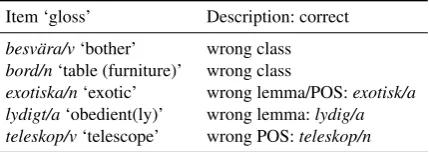
It is clear that a large share of the missing items are either modern words which entered the language after Bring was compiled, or words which are older (according to a standard historical dictionary of Swedish) but which for some reason do not appear in Bring. Some examples are given in table 8.
Somewhat surprisingly, we made the observation – encour-aging in this context – that clear translation errors account for only a small part of the missing items. Some cases of wrong POS appear to have resulted from translation errors,
9
About 14,000 Bring items which were not found in a large modern lexical resource remain to be investigated. reveals the ma-jority of them to be obsolete, too.
10
#137. N. RARHET, RARITET, S¨ALLSYNTHET; OVANLIGHET, S¨ALLSYNTHET; Adj. S¨ALLSYNT, RAR, OVANLIG; f˚a; KNAPP, S¨ALLSYNT, EXEMPELL¨OS, utan motstycke;
Adv. KNAPPT, KNAPPAST, ovanligen, S¨ALLAN, sv˚arligen; KNAPPT, KNAPPAST, sv˚arligen; KNAPPT, KNAPPAST, sv˚arligen; en g˚ang;
137. OVANLIGHET; S¨ALLSYNTHET, s¨allspordhet, undantag,
undantagsf¨orh˚allande, undantagsfall, undantagsst¨allning, RARITET, RARHET, v˚aplycka, vit korp, tunns˚addhet, f˚atalighet, knapphet, brist.
v. tryta, fattas, brista.
a. OVANLIG, S¨ALLSYNT, s¨allspord, undantagsm¨assig, RAR, enast˚aende, enstaka, gles, tunns˚add, f˚atalig, sparsam, KNAPP;
oerh¨ord, oh¨ord, utomordentlig, EXEMPELL¨OS, h¨apnadsv¨ackande, fenomenal; S¨ALLAN, undantagsvis, KNAPPT, knappast n˚agonsin, icke allom givet, icke i mannaminne, n˚agon enda g˚ang, en och annan g˚ang, ibland,
stundom, emellan˚at, alltemellan˚at, d˚a och d˚a, ¨omsom, sparsamt, h¨ar och d¨ar, h¨ar och var, ont om, KNAPPAST, n¨appeligen.
Figure 4: Class 137 in MTRoget-swe (top) and Bring (bottom) with common items in uppercase
Item ‘gloss’ Description
aura/n‘aura’ modern
haja/v‘get the drift’ modern (colloquial) senarel¨agga/v‘postpone’ modern
ta av/v‘take off’ modern orthography (Bring:avtaga/v) v¨ansterj¨avel/n‘left-wing bastard’ modern (colloquial)
Table 8: Missing items: modern words
Item ‘gloss’ Description: correct
besv¨ara/v‘bother’ wrong class bord/n‘table (furniture)’ wrong class
exotiska/n‘exotic’ wrong lemma/POS:exotisk/a lydigt/a‘obedient(ly)’ wrong lemma:lydig/a teleskop/v‘telescope’ wrong POS:teleskop/n
Table 9: Missing items: mistranslations/misclassifications
and a part of the items ending up in the wrong class as well may have done so due to wrong translations given by the bilingual sources. See table 9.
While our comparison focuses on Swedish, we expect that under certain conditions many of the results carry over to other languages. Specifically, these conditions are (1) that comparable bilingual resources (dictionaries, parallel cor-pora, etc. of similar quality and coverage levels) are used for those language pairs, and arguably also (2) that the other languages are typologically similar (cf. Bender 2011, mainly with respect to the morphological complexity of
words, which determines, directly or indirectly, the degree of accuracy we may expect, e.g., from automatic parallel corpus alignment.
Note, however, that the method evaluated here rests on the notion of translation equivalence, relying as it does on bilingual dictionaries, parallel corpora, etc., which actually presuppose that something of this sort exists. To the extent that we can find true translations of the terms in Roget, the construction of a corresponding lexical-semantic resource for a target language becomes an automatic affair, since the kind of lexical-semantic relations – (near-)synonymy and and (general) semantic closeness – which define the structure of Roget’s Thesaurus are assumed to be language-independent.
5.
Conclusions and Future Work
Our evaluation showed the MTRoget-swe coverage of Bring to be fairly low, especially in the stricter sense of av-erage covav-erage per class (34M%/14B%), but also in the looser sense of vocabulary coverage (62M%/23B%).
In particular, we intend to contrast the coverage of Bring with the coverage of the bilingual resources that serve as inputs for the MTRoget approach, as this would aid in dis-tinguishing genuine missed opportunities of the approach per se from more haphazard shortcomings of the input data, as indicated by terms present in Bring but missing from the bilingual resources.
Additionally, since a modernized Bring is in the works (see section 3), a natural follow-up study to that reported here is to evaluate MTRoget-swe against the modernized Bring.
Finally, using suitable bilingual dictionaries, the result of this evaluation can serve as new training data to bootstrap or filter additional lexicons for the MTRoget project.
6.
References
Bender, Emily M. (2011). On achieving and evaluat-ing language-independence in NLP. Linguistic Issues in Language Technology, 6(3).
Borin, Lars, Dan´ells, Dana, Forsberg, Markus, Kokkinakis, Dimitrios, and Toporowska Gronostaj, Maria. (2010). The past meets the present in Swedish FrameNet++. In 14th EURALEX International Congress, pages 269–281, Leeuwarden. EURALEX.
Borin, Lars, Forsberg, Markus, Olsson, Leif-J¨oran, and Up-pstr¨om, Jonatan. (2012). The open lexical infrastructure of Spr˚akbanken. In Proceedings of LREC 2012, pages 3598–3602, Istanbul. ELRA.
Borin, Lars, Forsberg, Markus, and L¨onngren, Lennart. (2013a). SALDO: a touch of yin to WordNet’s yang. Language Resources and Evaluation, 47(4):1191–1211. Borin, Lars, Forsberg, Markus, and Lyngfelt, Benjamin. (2013b). Close encounters of the fifth kind: Some linguistic and computational aspects of the Swedish FrameNet++ project.Veredas, 17(1):28–43.
Bring, Sven Casper. (1930).Svenskt ordf¨orr˚ad ordnat i be-greppsklasser. Hugo Gebers f¨orlag, Stockholm. Cassidy, Patrick. (2000). An investigation of the semantic
relations in the Roget’s Thesaurus: Preliminary results. InProceedings of CICLing 2000, pages 181–204. de Melo, Gerard and Weikum, Gerhard. (2008a). A
ma-chine learning approach to building aligned wordnets. InProceedings of the First International Conference on Global Interoperability for Language Resources. de Melo, Gerard and Weikum, Gerhard. (2008b). Mapping
Roget’s Thesaurus and WordNet to French. In Proceed-ings of LREC 2008, Marrakech. ELRA.
Fellbaum, Christiane, editor. (1998). WordNet: An elec-tronic lexical database. MIT Press, Cambridge, Mass. Gr¨onqvist, Leif. (2005). The Bring Browser – a
comput-erized version of the Swedish Bring Thesaurus. Depart-ment of Linguistics, University of Gothenburg.
H¨ullen, Werner. (2004). A history of Roget’s Thesaurus: Origins, development, and design. Oxford University Press, Oxford.
Jarmasz, Mario and Szpakowicz, Stan. (2001). The design and implementation of an electronic lexical knowledge base. In Proceedings the 14th Biennial Conference of the Canadian Society for Computational Studies of In-telligence (AI 2001, pages 325–333.
Jarmasz, Mario and Szpakowicz, Stan. (2004). Roget’s Thesaurus and semantic similarity. In Nicolov, Nicolas, Bontcheva, Kalina, Angelova, Galia, and Mitkov, Rus-lan, editors,Recent Advances in Natural Language Pro-cessing III. Selected papers from RANLP 2003, pages 111–120. John Benjamins, Amsterdam.
Jobbins, Amanda C. and Evett, Lindsay J. (1995). Auto-matic identification of cohesion in texts: Exploiting the lexical organization of Roget’s Thesaurus. In Proceed-ings of Rocling VIII, pages 111–125, Taipei.
Jobbins, Amanda C. and Evett, Lindsay J. (1998). Text segmentation using reiteration and collocation. In Pro-ceedings of the 36th ACL and 17th COLING, Volume 1, pages 614–618, Montreal. ACL.
Kennedy, Alistair and Szpakowicz, Stan. (2008). Evaluat-ing Roget’s thesauri. In Proceedings of ACL-08: HLT, pages 416–424, Columbus, Ohio. ACL.
Morris, Jane and Hirst, Graeme. (1991). Lexical cohesion computed by thesaural relations as an indicator of the structure of text. Computational Linguistics, 17(1):21– 48.
Old, L. John. (2004). Unlocking the semantics of Roget’s Thesaurus. In2nd International Conference on Formal Concept Analysis, pages 236–243, Berlin. Springer. Roget, Mark Peter. (1852). Thesaurus of English Words
and Phrases. Longman, London.
Roget, Mark Peter. (1911). Thesaurus of English Words and Phrases. Thomas Y. Crowell Company, New York. Sahlgren, Magnus and Karlgren, Jussi. (2005).
Auto-matic bilingual lexicon acquisition using random index-ing of parallel corpora. Natural Language Engineering, 11(3):327–341.