Clinical Data-Driven Probabilistic Graph Processing
Travis Goodwin and Sanda Harabagiu
Human Language Technology Research Institute University of Texas at Dallas
Richardson, TX 75083-0688, USA
{travis,sanda}@hlt.utdallas.edu
Abstract
Electronic Medical Records (EMRs) encode an extraordinary amount of medical knowledge. Collecting and interpreting this knowledge, however, belies a significant level of clinical understanding. Automatically capturing the clinical information is crucial for performing comparative effectiveness research. In this paper, we present a data-driven approach to model semantic dependencies between medical concepts, qualified by the beliefs of physicians. The dependencies, captured in a patient cohort graph of clinical pictures and therapies is further refined into a probabilistic graphical model which enables efficient inference of patient-centered treatment or test recommendations (based on probabilities). To perform inference on the graphical model, we describe a technique of smoothing the conditional likelihood of medical concepts by their semantically-similar belief values. The experimental results, as compared against clinical guidelines are very promising.
Keywords:Information Retrieval, Bioinformatics, Patient Cohort
1.
Introduction
An increasing abundance of clinical data is available through massive warehouses of Electronic Medical Records (EMRs). Both within the United States and across the world, hospitals generate millions of EMRs each year. These EMRs include rich clinical information, consisting of detailed notes on patients’ medical history, physical exam findings, lab re-ports, radiology rere-ports, operative rere-ports, and discharge summaries. Clinical information contains multiple men-tions ofmedical problems, including observations resulting from a physical exam (known assigns), features that the patient observed first-hand (known assymptoms), historical and present medical problems (known asco-morbidities), in addition todiagnosticinformation. We have used the onto-logical definitions of medical concepts related to diseases outlined in (Scheuermann et al., 2009) to capture the seman-tics of clinical information. Hence, we have considered the fact that EMRs also document the medical interventions per-formed during the patient’s hospital stay, includingmedical testsand their results, as well as all themedical treatments
performed as part of the patient’stherapy. These forms of clinical information are crucial for performing comparative effectiveness research. As shown in (Ratner et al., 2009), capturing the clinical information from EMRs enables the discovery of alternative methods to prevent, diagnose, treat, or monitor a medical problem.
It has been shown that clinical information – medical con-cepts (e.g. problems, tests and treatments) – can be automat-ically identified from clinical texts, as described in (Uzuner et al., 2011). However, because medical science centers around asking hypotheses, experimenting with new methods of care, and evaluating medical evidence, medical concepts are associated with different degrees of belief, orassertions. As such, clinical writing entails a large number of specula-tive statements indicating the physician’s belief at the time, rather than strictly quantifying a fact. In order to take into account the physicians’ beliefs when automatically process-ing the clinical information from EMRs, we also recognized
the assertions formulated by physicians when discussing any of the medical concepts.
The 2010 i2b2/VA challenge evaluated the task of automati-cally inferring six types ofassertions, or belief states, used to qualify medical problems in EMRs (Uzuner et al., 2011). However, those assertions correspond to clinical information found in only one type of EMR: discharge summaries. Be-cause we consider more types of EMRs, we have extended the problem of classifying medical assertions by consider-ing additional types of assertions. The new assertion values were selected based on discussions with practicing clini-cians, and by following the guidelines outlined in (Uzuner et al., 2011).
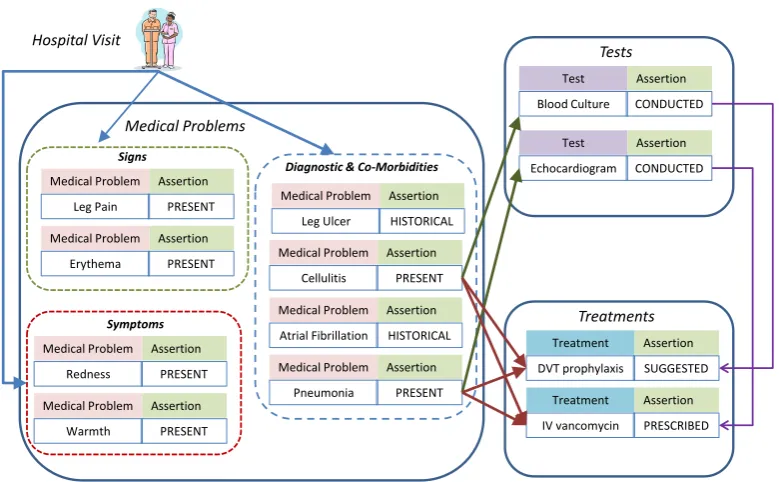
Medical concepts and their assertions were cast as nodes in a graph which encodes a patient’sclinical pictureand therapy along with the potential dependencies between them. We called this graph theclinical graph(CG). As in (Scheuermann et al., 2009), the clinical picture is defined as theclinical phenome1which contains the clinical findings (e.g. medical problems, signs, symptoms and tests). Like-wise, we use Scheuermann’s definition oftherapyas all the treatments, cures, and preventions included within the man-agement plan for an individual patient. Figure 1 illustrates our representation of the CG for a patient. Given the pa-tient’s hospital visit, we automatically discover the medical problems along with the tests and treatments documented during the patient’s hospital course. Medical problems, tests, and treatments are qualified by their assertions and con-nected by their dependencies (e.g. when cellulitiswas a present diagnostic, ablood culturetest was conducted). Moreover, as reported in (Scheuermann et al., 2009), the clinical picture may vary widely between patients with the same disease and even for the same patient during the course of his or her diseases. Therefore, in order to capture the vari-ation in the corresponding clinical graphs (CGs), we have
1
Hospital Visit
Test Assertion
Blood Culture CONDUCTED
Test Assertion
Echocardiogram CONDUCTED
Tests
Treatments
Treatment Assertion
DVT prophylaxis SUGGESTED
Treatment Assertion
IV vancomycin PRESCRIBED
Signs
Medical Problem Assertion
Leg Pain PRESENT
Medical Problem Assertion
Erythema PRESENT
Symptoms
Medical Problem Assertion
Redness PRESENT
Medical Problem Assertion
Warmth PRESENT
Medical Problems
Medical Problem Assertion
Leg Ulcer HISTORICAL
Medical Problem Assertion
Cellulitis PRESENT
Medical Problem Assertion
Atrial Fibrillation HISTORICAL
Medical Problem Assertion
Pneumonia PRESENT
Diagnostic & Co-Morbidities
Figure 1: The Clinical picture & therapy Graph (CG).
Hospital Visits
Visit 1
Visit 2
Visit 3
Visit 4
Visit 5
V M E R
P
at
ie
n
t
Coho
rt
R
et
rie
val
S
ys
tem
Tests Treatments
Medical Problems Clinical Picture
& Therapy
Tests Treatments
Medical Problems Clinical Picture
& Therapy
Tests Treatments
Medical Problems Clinical Picture
& Therapy
Tests Treatments
Medical Problems Clinical Picture
& Therapy
Tests Treatments
Medical Problems Clinical Picture
& Therapy
Figure 2: The combined Cohort Clinical Graph (CCG).
considered apatient cohortwhich we obtained by using the system reported in (Goodwin and Harabagiu, 2013). Patient cohort retrieval results in an ordered set of hospital visits which correspond to a cohort of patients sharing the same diagnosis (e.g.patients with abcess2). As illustrated in Fig-ure 2, this enabled us to access all the clinical pictFig-ures and therapies from all the clinical graphs (CGs) of all patients within a cohort. This clinical information regarding a patient cohort constitutes the set of all hospital visits (V), the set of all medical problems (M), the set of all medical tests (E), and the set of all treatments (R), across the CGs of all the patients belonging to the cohort. We refer to the graph that combines all CGs as the Cohort Clinical Graph (CCG). Given a patient cohort, the corresponding CGG was cast as a
2
Abscess is an infectious disease of the skin and soft tissue.
k-partite graph (wherek= 4) because there are four types of nodes (V,M,EandR), as illustrated in Figure 2. It is to be noted that the edges from the CCG originate from the CGs of patients from the cohort. We also noticed that, crucially, the CCG can also be viewed as a factorization of a Markov network. In this way, we were able to transform the CCPT into a probabilistic graphical model. Probabilistic graphical models (Koller and Friedman, 2009) are known to be a state-of-the-art representation for producing probabilistic inference, which we used for finding recommendations for the most adequate tests or treatments for a patient, given inference on the CCG.
prob-abilistic graphical model. Section 4 presents the inference mechanisms we considered and how they may be used for clinical test and treatment recommendation. Section 5 dis-cusses the experimental results, and Section 6 summarizes the conclusions.
2.
Medical Language Processing
Open-source software, such as MetaMap (Aronson, 2001) or, more recently, cTakes (Savova et al., 2010) can parse EMRs to determine concept unique identifiers (CUIs) which corre-spond to entries in the Unified Medical Language System (UMLS) (Bodenreider, 2004). However, UMLS includes many concepts that were authored according to ontological principles and, thus, it is too fine-grained for our purpose of data-driven probabilistic processing of EMRs. In select-ing a conceptual representation, we also evaluated the more general frameworks developed by the i2b2/VA challenge in 2010 (Uzuner et al., 2011). This framework was designed to detect medical concepts within clinical text and assign one of several distinct assertions indicating the state of the author’s belief for each concept. This i2b2 challenge helped popularize the notion that recognizing medical concepts alone is not sufficient for clinical reasoning, because, when medical concepts are used in clinical texts, physicians also express their belief state about such concepts, e.g. that a medical problem is present or absent, that a treatment is con-ditional on a test. The i2b2 challenge, however, considered assertions only for medical problems. In our aim to build the CCG, we have extended the problem of assertion classifica-tion in two ways: (1) we have produced asserclassifica-tions (or belief values) for all medical concepts (including treatments and tests) that we have automatically identified; and (2) we have introduced 6 additional values which are defined in Table 1.
2.1.
Medical Concept Recognition
To recognize the nodes of the CCG, we have partitioned medical concepts within three categories: (1) medical prob-lems (e.g.ATRIAL FIBRILLATION– an irregular heart beat); (2) medical treatments (e.g. ABLATION– the removal of undesired tissue); and (3) medical tests (e.g. ECG – an elec-trocardiogram). We detect these medical concepts using the methods reported in (Roberts and Harabagiu, 2011). Further, we distinguish three sub-classes of medical problems: (a) signs (observations from a physical exam), (b) symptoms (observations by the patient), (c) co-morbidities (diseases or disorders), and (d) the diagnostic. Our method recognizes medical concepts in three steps:
Step1: Identification of the boundaries within text that refers to a medical concept;
Step2: Classification of the medical concept into (1) medi-cal problems, (2) medimedi-cal treatments, or (3) medimedi-cal tests.
Step3: Classification of medical problems into (a) signs, (b) symptoms, (c) co-morbidities, or (d) diagnos-tics.
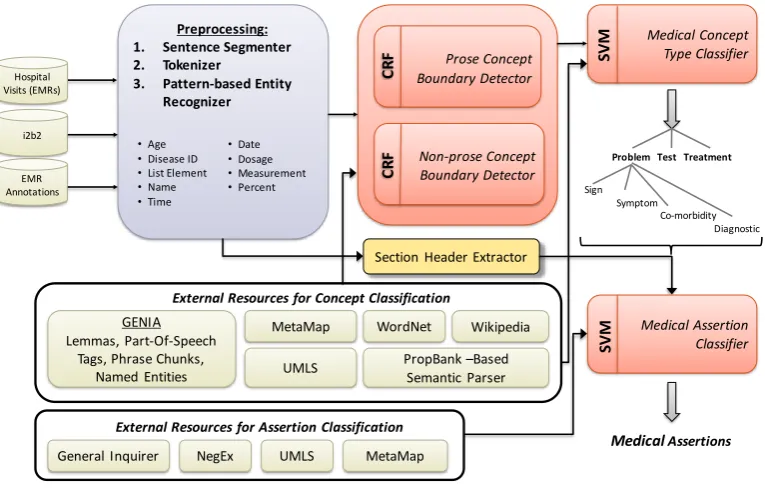
Medical concepts were recognized both within the narrative (i.e. report text) and structured sections (e.g.CHIEF COM -PLAINT) of EMRs. To do this, we used two conditional random fields (CRFs), trained on the i2b2 annotations as
well as our own set of 2,349 EMR annotations. As illus-trated in Figure 3, we incorporated knowledge from many lexico-semantic resources. In this research, we used the feature set reported in (Roberts and Harabagiu, 2011). Addi-tionally, we have normalized the detected medical concepts by (1) converting the surface string to lowercase, (2) filtering words belonging to closed-class3words, and (3) ignoring word order.
2.2.
Medical Assertion Classification
In order to encode the medical knowledge from EMRs with the clinical graph (CG) of each patient, we needed to au-tomatically qualify each medical concept with one of the assertions given in Table 1. We performed this automatic classification using an SVM classifier which considers in-formation from: (a) the medical concept to be classified, (b) the section header where the assertion is implied, (c) features available from UMLS (extracted by MetaMap), (d) features reflective of negated statements, disclosed through the NegEx negation detection package, and (e) belief values are available from the Harvard General Inquirer’s category information (Stone et al., 1966). Additional details of the automatic assertion identification techniques are provided in (Roberts and Harabagiu, 2011).
3.
Generating the Graphical Model
For clinical decision support, it is critical to analyse the relationships between medical problems, medical tests, and associated treatments across patients’ hospital visits. As such, we must move beyond merely identifying the textual mentions of medical concepts and their associated belief values. To this end, we present a framework for modelling the data-driven interactions between problems, treatments, and tests. We first create a CG in which connections between medical concepts are not only inferred, but their strength is also quantified by a weight. Because of the economy of language, relations between medical concepts are rarely explicitly stated, but they are rather implied. To capture these implications, we postulate that co-occurrence statistics can inform these relations, and further that they can also inform the strength of these relations.
After we create complete CGs, we can then transform the combined CGs for a cohort of patients (the CCG) into a probabilistic graphical model.
3.1.
Inferring Edges in the Cohort Clinical
Graph
The nodes of the CCG are automatically discovered by the language processing techniques described in Section 2. In addition, we needed to infer the edges of the CCG and the weights of the edges indicating semantics used in the clinical picture and therapy ontological definition. The observations from the clinical picture of a patient connected hospital visit (or nodes fromV) to the observed medical problem (or nodes fromM) generating edges of typeTVM. In the
clin-ical picture of patients, connections between the observed
3
Assertion Value Pr
oblem
T
reatment
T
est
Scenario EMR Excerpt
HISTORICAL* X X X occurred during a previous hospital visit the patient’s past medical history is signif-icant forCONGESTIVE HEART FAILURE
CONDITIONAL X X X occurs only during certain conditions readmit him forREHABonce theWOUND
hasHEALED
PRESCRIBED* X has been assigned and will occur she was given ROCEPHINand ZITHRO
-MAX
ABSENT X X X is not present the patient denies anyCHEST PAINat this
time
SUGGESTED* X has been advised, but cannot be assumed to occur was recommended that he be on ALLOP -URINOL
PRESENT X is currently happening there is a moderatePERICARDIAL EFFU
-SION
HYPOTHETICAL X may occur in the future she is to return for anyWORSENING PAIN
ORDERED* X has been scheduled and will occur in the future we will do aPULMONARY FUNCTION
TEST ASSOCIATED WITH
ANOTHER X not associated with the patient father died ofLUNG CANCER
POSSIBLE X may occur, but there is uncertainty I believe that this may represent
worsen-ing forPULMONARY HYPERTENSION
ONGOING* X X currently exists and can be assumed to persist
into the future continueDIALYSIS
CONDUCTED* X has been performed and completed UNASYN3GRAMSIV was given
Table 1: Assertion values for medical concepts (typeset inSMALLCAPS) in each excerpt; “moment” refers to the specific instant when the medical concept was mentioned. Newly defined assertions are marked with an ‘*’.
Preprocessing: 1. Sentence Segmenter 2. Tokenizer
3. Pattern-based Entity Recognizer
GENIA Lemmas, Part-Of-Speech
Tags, Phrase Chunks, Named Entities
MetaMap
UMLS
WordNet
PropBank –Based Semantic Parser
Wikipedia
External Resources for Concept Classification •Age
•Disease ID
•List Element
•Name
•Time
•Date
•Dosage
•Measurement
•Percent
Problem Test Treatment Medical Concept
Type Classifier
SVM
Non-prose Concept Boundary Detector
C
R
F
Prose Concept Boundary Detector
C
R
F
NegEx General Inquirer
External Resources for Assertion Classification
MetaMap UMLS
Section Header Extractor
MedicalAssertions
Medical Assertion Classifier
SVM
Sign Symptom
Co-morbidity Diagnostic EMR
Annotations i2b2 Hospital Visits (EMRs)
Figure 3: Language processing used for constructing the CGs and CCG.
medical problems (i.e. nodes fromM) and results of tests (i.e. nodes fromE) exist as well, giving rise to edges of typeTMEin the CCG. In addition, connection between both
types of nodes (medical problems and tests) in the clinical picture and therapies exist. Thus, we shall also have edges
in the CCG between medical problems (i.e. nodes fromM) and treatments (nodes fromR), generating edges of type TMR. Similarly, we have edges between tests (i.e. nodes
follows:
• The weight of an edge of typeTVM between a visit
v ∈ Vand a medical problemm ∈ Mis computed as the number of EMRs associated withvwhich also mentionm.
• The weight of an edge of typeTMEbetween a medical
problemm ∈ M and testeinE is computed by the number of EMRs in which both m and eco-occur (regardless of the patient).
• The weight of an edge of typeTMRbetween a medical
problemm∈Mand treatmentrinRis computed by the number of EMRs in which bothmandrco-occur (regardless of the patient).
• The weight of an edge of type TER between a test
e∈Eand treatmentrinRis computed by the number of EMRs in which botheandrco-occur (regardless of the patient).
3.2.
The Probabilistic Graphical Model
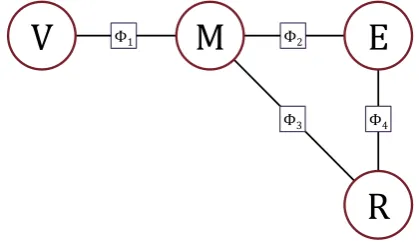
In Section 3.1 we presented a co-occurrence-based method of building a cohort clinical graph (CCG). The observation that this graph is in fact ak-partite graph (wherek = 4) enables us to build the factorized Markov network illustrated in Figure 4, which we call the Clinical Markov Network (CMN).
Φ1 Φ2
Φ3 Φ4
V
M
E
R
Figure 4: The factorized Clinical Markov Network (CMN).
In the CMN, we assume that each vertex class (V, M, E, or R) represents a distinct random variable in the in-duced Markov network. Similarly, each of the four types of weighted edges (TVM, TME, TMR, TER) have associated four
different factors to indicated the strength of the edge in the CCG:
• Φ1(v, m) =weight of edge{v, m} ∈TVM
• Φ2(m, e) =weight of edge{m, e} ∈TME
• Φ3(m, r) =weight of edge{m, r} ∈TMR
• Φ4(e, r) =weight of edge{e, r} ∈TER
This factorization allows us to perform efficient probabilis-tic inference by defining the joint probability as the Gibbs distribution given in Equation 1.
P(v, m, e, r) = 1
ZΦ1(v, m)Φ2(m, e) Φ3(m, r)Φ4(e, r)
(1)
Note thatZ is the typical normalization constant equal to
the partition function, as given in Equation 2.
Z = X
v,m,e,r
Φ1(v, m)Φ2(m, e)Φ3(m, r)Φ4(e, r) (2)
4.
Probabilistic Inference
By modelling the CCG as a probabilistic graphical model, we have gained access to an incredible breadth of proba-bilistic information through the power of probaproba-bilistic infer-ence. We can use this probabilistic information to construct a recommendation engine enumerating the most probable treatments for a given patient given their medical problems and/or their medical tests.
We can use this joint distribution to calculate posterior prob-ability of conducting a medical test during a particular pa-tient’s hospital visit (i.e. P(E =e|V =v)) as shown in Equation 3.
P(e|v) = 1 Z
X
m∈M
Φ2(e, m)Φ1(v, m) (3)
Likewise, we can infer the posterior distribution of med-ical treatments for a given set of N medical problems, m0, m1, . . . , mN ∈ M, as the conjunction of each prob-lem’s posterior distribution, as shown in Equation 4.
P(r|m0∧m1∧. . .∧mN) =
N Z
X
e∈E
Φ4(e, r) N Y
i=1
Φ3(mi, r)Φ2(mi, r) (4)
Although this straightforward approach yields precise re-sults, it suffers from significant sparsity problems induced by our decision to qualify all medical concepts by the physi-cian’s belief state. Rather than restricting ourselves to the interactions between concepts exactly matching the speci-fied belief states (e.g. the likelihood that a test is conducted given than a problem is present), we also consider the inter-action between the same concepts with semantically similar belief states (e.g. suggested, ordered, prescribed, condi-tional). For example, consider that assertions ONGOINGand CONDUCTEDboth imply a strong degree of certainty that the medical concept occurred and are likely to have simi-lar semantic relationships despite having different temporal groundings. Thus, they aresemantically coherent. Based on this observation, we introduce an assertion smoothing factor,S, that encodes the degree to which two assertions aresemantically coherent, as given in Equation 5.
S(a1,a2) =
|C|
X
i=0
X
v∈V
P (ci, a1), v
|C|
X
j=0
P v,(cj, a2) (5)
This smoothing factor, S(a1, a2), captures the degree by
which occurrences for a certain medical concept labeled with the assertiona2may be relevant to probabilistic queries
targeting the same medical concept with assertiona1. We
estimate this value as the number of two-step paths in the CMN from any concept with assertiona1to any concept
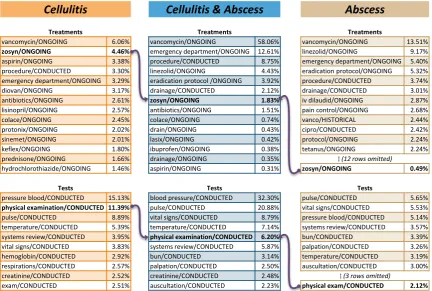
ure 6. We observed that the likelihood of conducting a physical examination has a distribution rank which varies across all cohorts. Although it is ranked second for cel-lulitis (at 11.39% likelihood), it is ranked much lower for abscess at position 12 (at 2.12% likelihood). This reflects the recommendation in the guidelines for cellulitis: because cellulitis leaves a patient vulnerable to secondary conditions, a thorough physical examination should be performed. As such, for patients suffering from bothcellulitis & abscess, the likelihood of conducting a physical examination moves up to rank 5 (6.20%), reflecting the interaction between the two conditions in EMRs.
We also observed that the first three most-commonly con-ducted tests (i.e. blood pressure, pulse, andvital signs) constitute the majority of the probability mass. This reflects a critical observation on the utility of medical test annota-tions: that the mere mention of a medical test is not sufficient for statistical reasoning. EMRs document a wide battery of tests and their results for each patient allowing physicians to ascess not only their primary medical problem, but also any secondary conditions or co-morbidities. In order to improve the capability of clinical reasoning enabled by the CMN, the value of tests should be considered and associated with the identification of the mention of each test.
6.
Conclusions
In this paper, we show how medical language processing enables the automatic derivation of clinical pictures and therapies for entire patient cohorts. We explain how this knowledge can inform a data-driven probabilistic graphical model on which inference can be performed in a rigorous way for determining the most probable treatments for a given set of medical conditions. Further, we observe that the utility offered by medical test mentions is limited for probabilistic reasoning. Despite this, we evaluated the most likely treatments against (1) the Infectious Diseases Society of American (IDSA)’sPractice Guidelines for the Diagnosis and Management of Skin and Soft-Tissue Infectious(Stevens et al., 2005), (2) Howe and Jones Guidelines for the Man-agement of Periorbital Cellulitis/Abscess (Howe and Jones, 2004), (3) Uzcategui et. al’sClinical Practice Guidelines for the Management of Orbital Cellulitis(Uzcategui et al., 1997), and (4) the National Library of Medicine’s MED-LINEplus Web Service (Miller et al., 2000) and confirmed the validity the probabilistic information encoded by our model.
7.
References
Aronson, A. R. (2001). Effective mapping of biomedical text to the umls metathesaurus: the metamap program. In
Proceedings of the AMIA Symposium, page 17. American Medical Informatics Association.
Bodenreider, O. (2004). The unified medical language sys-tem (umls): integrating biomedical terminology.Nucleic acids research, 32(suppl 1):D267.
Goodwin, T. and Harabagiu, S. M. (2013). The impact of belief values on the identification of patient cohorts. InInformation Access Evaluation. Multilinguality, Mul-timodality, and Visualization, pages 155–166. Springer Berlin Heidelberg.
Howe, L. and Jones, N. (2004). Guidelines for the manage-ment of periorbital cellulitis/abscess. Clinical Otolaryn-gology & Allied Sciences, 29(6):725–728.
Koller, D. and Friedman, N. (2009). Probabilistic graphical models: principles and techniques. MIT press.
Miller, N., Lacroix, E.-M., and Backus, J. E. (2000). Med-lineplus: building and maintaining the national library of medicine’s consumer health web service.Bulletin of the Medical Library Association, 88(1):11.
Ratner, R., Eden, J., Wolman, D., Greenfield, S., and Sox, H. (2009). Initial national priorities for comparative effectiveness research. National Academies Press. Roberts, K. and Harabagiu, S. (2011). A flexible framework
for deriving assertions from electronic medical records.
Journal of the American Medical Informatics Association, 18(5):568–573.
Savova, G. K., Masanz, J. J., Ogren, P. V., Zheng, J., Sohn, S., Kipper-Schuler, K. C., and Chute, C. G. (2010). Mayo clinical text analysis and knowledge extraction system (ctakes): architecture, component evaluation and appli-cations. Journal of the American Medical Informatics Association, 17(5):507–513.
Scheuermann, R. H., Ceusters, W., and Smith, B. (2009). Toward an ontological treatment of disease and diagnosis.
Proceedings of the 2009 AMIA Summit on Translational Bioinformatics, 2009:116–120.
Stevens, D. L., Bisno, A. L., Chambers, H. F., Everett, E. D., Dellinger, P., Goldstein, E. J., Gorbach, S. L., Hirschmann, J. V., Kaplan, E. L., Montoya, J. G., et al. (2005). Practice guidelines for the diagnosis and manage-ment of skin and soft-tissue infections. Clinical Infectious Diseases, 41(10):1373–1406.
Stone, P. J., Dunphy, D. C., and Smith, M. S. (1966). The general inquirer: A computer approach to content analy-sis.
Uzcategui, N., Warman, R., Smith, A., and Howard, C. (1997). Clinical practice guidelines for the management of orbital cellulitis. Journal of pediatric ophthalmology and strabismus, 35(2):73–9.
Uzuner, ¨O., South, B. R., Shen, S., and DuVall, S. L. (2011). 2010 i2b2/va challenge on concepts, assertions, and re-lations in clinical text. Journal of the American Medical Informatics Association, 18(5):552–556.