Towards an integrated scheme for semantic annotation of multimodal dialogue
data
Volha Petukhova and Harry Bunt
Tilburg Center for Creative Computing Tilburg University, Netherlands {v.petukhova,harry.bunt}@uvt.nl
Abstract
This paper investigates the applicability of existing dialogue act annotation schemes, designed for the analysis of spoken dialogue, to the semantic annotation of multimodal data, and the way a dialogue act annotation scheme can be extended to cover dialogue phenomena from multiple modalities.
1.
Introduction
In natural communication, the participants use all modali-ties that are available to them. Nonverbal behaviour is an essential part of human communication. This includes the use of gestures, facial expressions, gazes, posture shifts, etc; communicative resources which make the communi-cation richer in many ways.
Several corpora with multimodal data transcriptions have in recent years become available, such as the AMI meeting corpus1, the IFA Dialog Video corpus2and the ISL meeting corpus (Burger et al., 2002). They are largely used to study aspects of verbal and nonverbal behaviour in natural hu-man conversations in general, e.g. interactive styles, emo-tionally relevant behaviour, affected speech, etc., as well as numerous aspects of human natural dialogue such as turn-taking behaviour, grounding, social regulating mechanisms and so on. Recent years witness a growing interest in the use of multimodal data for modelling tasks such as auto-matic interpretation and generation of multimodal commu-nicative behaviour that dialogue participants naturally ex-hibit in interactive discourse.
For analysing the visual modality several coding schemes have been designed, in most cases based on the analy-sis of nonverbal actions in terms of behavioural low-level features. For example, the Facial Action Coding System (FACS)3 codes facial expressions describing muscular ac-tivities that produce changes in facial appearance. Ham-NoSys4 is a transcription system to code hand gestures
by describing shapes, direction, speed, length and form of movement, hands orientation and location.
Few annotation schemes attempt to code semantic and pragmatic information in visual expressions. For example, the SmartKom Coding scheme is based on intentional in-formation provided by a gesture (Steininger, 2001), such
1
A
¯ugmented M¯ulti-party I¯nteraction (http://www.
amiproject.org/).
2
http://www.fon.hum.uva.nl/
IFA-SpokenLanguageCorpora/IFADVcorpus/
3For more information visit: http://
face-and-emotion.com/dataface/general/ homepage.jsp
4
For more information visit: http://www. sign-lang.uni-hamburg.de/projekte/hamnosys/ hamnosyserklaerungen/englisch/contents.html
as command (interactional gesture), searching (supporting gesture), and emotions (residual gesture). DIME-DAMSL (Pineta et al., 2005) extends the DAMSL dialogue act anno-tation scheme (Allen and Core, 1997) with the annoanno-tation of the graphical modality that involves, for instance, point-ing to, movpoint-ing or addpoint-ing a piece of furniture, or showpoint-ing a catalogue. The MUMIN annotation scheme (Allwood et al., 2004) was developed for the study of gestures and facial displays in interpersonal communication and puts emphasis on the communicative function of such expressions, in par-ticular their feedback and turn-managing functions. Dybkjær and Bernsen in (2002), giving a comprehensive overview of coding schemes for multimodal data, point out that the majority of these schemes are designed for a par-ticular purpose and are used solely by their creators. Stan-dardisation has been achieved to some extent for coding behavioural features for certain nonverbal expressions, e.g. for facial expression, however, for the semantic annotation of such expressions combined with other modalities such as speech there is still a long way to go.
Existing dialogue act annotation schemes5, however, are
limited to analysis of spoken modality.
Over the last few years there has been increasing collabo-rative effort across research groups working on Embodied Conversational Agents, ECAs, to define a common frame-work for designing ECA systems, called SAIBA6. The
AA-MAS workshop ‘Towards a Standard Markup Language for Embodied Dialogue Acts’ in 2008 and 2009 gathered re-searchers for first broad discussions about the issues sur-rounding the definition of a standard Functional Markup Language (FML)7. A major concern is that of dialogue acts.
The relevance of the taxonomies that have been proposed in the literature and the way these can be used, adapted and extended for the ECA domain is discussed. It was
con-5We analyzed 18 well-known dialogue act annotation
schemes: DAMSL, SWBD-DAMSL, LIRICS, DIT++, MRDA, Coconut, Verbmobil, HCRC MapTask, Linlin, TRAINS, AMI, SLSA, Alparon, C-Star, Primula, Matis, Chiba and SPAAC.
6S
¯ituation, A¯gent, I¯ntention, B¯ehavior, A¯nimation framework specifies multimodal generation at a macro-scale. For more information please visit http://www.mindmakers.org/ projects/SAIBA
7Detailed information can be found at
cluded that existing dialogue act taxonomies, such as Con-versation acts (Allen et al., 1994), the Verbmobil coding scheme (Alexandersson et al., 1998), DAMSL (Allen and Core, 1997) and DIT (Bunt, 1999) can be used to further the development of FML. It was emphasised that the key difference between the coverage of most of these schemes and ECAs that ECAs communicate through a combination of verbal and nonverbal means, which means that for most of these schemes certain extensions are required.
In the context of the ISO project 24617-2 “Semantic an-notation framework, Part 2: Dialogue acts”, which aims to design a standard for annotating dialogues with dialogue act information, an approach has been developed for deal-ing with phenomena relatdeal-ing to multiple modalities used in dialogue, which are explored and motivated in this paper. In this paper we outline two exploratory studies investigat-ing the dialogue act annotation of multimodal data (Section 2). Sections 4 and 5 report the results and discuss their impact on dialogue act annotation scheme design. Finally, conclusions are drawn in Section 6.
2.
Exploratory annotation study
2.1. Dialogue act annotation scheme
We used the DIT++8 dialogue act annotation scheme for
the semantic annotation of multimodal dialogue data. This choice was motivated by several considerations. First of all, we wanted a taxonomy which has a well-defined near standard inventory of communicative functions with fine-grained distinctions, based on solid theoretical and empiri-cal grounds. DIT++ is a starting point for the ISO project
24617-2 ”Semantic Annotation Framework, Part 2: Dia-logue acts”, which aims at developing a standard for the markup of communicative functions in dialogue. DIT++
incorporates theoretical and empirical findings from other approaches (see Petukhova and Bunt, 2009c and Bunt and Schiffrin, 2007 for comparative analyses).
Second, we wanted a dialogue act taxonomy that allows to describe not only task-oriented communicative actions, but also actions related to other communicative dimensions such as feedback, turn taking, time management and deal-ing with social obligations, since many nonverbal acts are performed for purposes other than the underlying task. The DIT++ taxonomy distinguishes 10 dimensions,
address-ing information about: the domain or task (Task), process-ing status of the speaker (Auto-feedback) or partners
(Allo-feedback), managing difficulties in the speaker’s
contribu-tions (Own-Communication Management) or those of part-ners (Partner Communication Management), the speaker’s need for time to continue the dialogue (Time
Manage-ment), establishing and maintaining contact (Contact Man-agement), allocation of turns (Turn ManMan-agement), the way
the speaker is planning to structure the dialogue (Dialogue
Structuring), and social conventions (Social Obligations Management).
Third, a dialogue act annotation scheme should contain open classes, allowing suitable additions of those commu-nicative functions which are specific for a certain modality.
8For more information about the tagset, please visit:
http://dit.uvt.nl/
The DIT++tagset contains 3 open classes.
Finally, a dialogue act annotation scheme should offer seg-mentation strategies that are flexible enough to identify meaningful dialogue units from multiple modalities. In nat-ural conversation the use of speech is combined with non-verbal signs and vocal sounds, and all participants are most of the time performing some nonverbal communicative ac-tivity. DIT++ allows multiple segmentation.
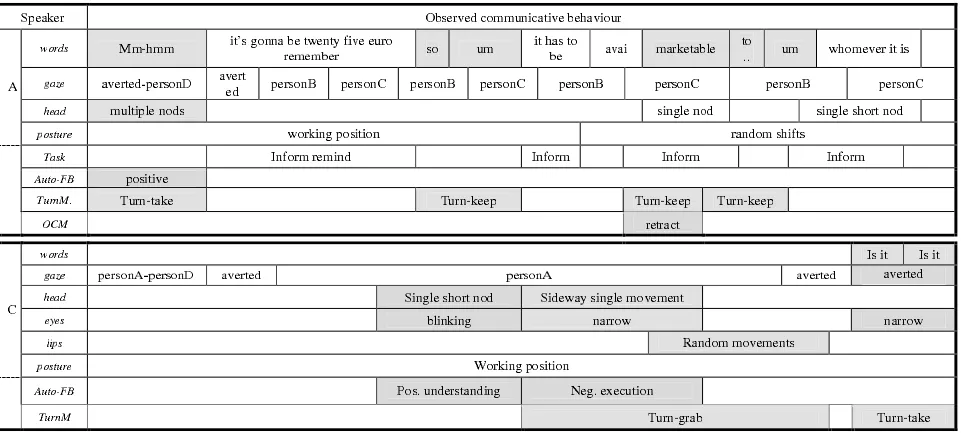
Communica-tive functions can be assigned in multiple dimensions to units called functional segments, which are defined as the functionally relevant minimal stretches of communicative behaviour (see Geertzen et al., 2007). Figure 1 illustrates the segmentation and annotation of multimodal units.
3.
Corpus material and annotations
We conducted two annotation studies where annotators were asked to annotate dialogues with the DIT++ tagset
using the ANVIL tool9: (1) using only speech transcription
and sound; (2) using speech transcription, sound and video provided with transcriptions of nonverbal signals (gaze, head, facial expression, posture orientation and hand move-ments).
In both studies we used two scenario-based dialogues with a total duration of 51 minutes from the AMI corpus10 . The transcriptions contain manually produced orthographic transcriptions, including word-level timings, and transcrip-tions of visible movements for each participant, including gaze direction; head movements; hand and arm gestures; eyebrow, eyes and lips movements; and posture shifts. Transcribers were asked to code low-level features such as form of movement (e.g. head: nod, shake, jerk); hands: pointing, shoulder-shrug, etc.11); direction (up, down, left,
right, backward, forward); trajectory (e.g. line, circle, arch); size (e.g. large, small, medium, extra large); speed (slow, medium, fast); and repetitions (up to 20 times). The floor transfer offset (time difference between the start of a turn and the end of the previous turn) and duration of a movement (in milliseconds) were computed automatically. We examined agreement between annotators in labelling communicative functions using Cohen’s kappa measure (Cohen, 1960). Two experienced annotators reached sub-stantial agreement (kappa = .76).
We compared the annotations with respect to the number and nature of (1) functional segments identified; (2) com-municative functions altered; (3) comcom-municative functions specified; and (4) communicative functions assigned to sin-gle functional segments.
4.
Study results
The analysis showed that nonverbal communicative be-haviour may serve four purposes:
9
For more information about the tool visit:
http://www.dfki.de/˜kipp/anvil
10
Seehttp://www.amiproject.org/
11Hand gesture transcription was performed
accord-ing to Gut,U., Looks, K., Thies, A., and Gibbon, D. (2003). CoGesT: Conversational Gesture Transcription System. Version 1.0. Technical report. Bielefeld
Univer-sity http://www.spectrum.uni-bielefeld.de/
Figure 1: Transcription, multidimensional segmentation and annotation.
1. emphasizing or articulating the semantic content of di-alogue acts;
2. emphasizing or supporting the communicative func-tions of synchronous verbal behaviour;
3. performing separate dialogue acts in parallel to what is contributed by the partner;
4. expressing a separate communicative function in par-allel to what the same speaker is expressing verbally.
4.1. Full-fledged dialogue acts
Our study shows that the number of identified functional segments is larger when taking the visual modality into account in addition to the speech. In the first study 1,917 functional segments were identified when annotating speech only. In the second study annotators identified 2,396 functional segments when using both speech and nonverbal signals, i.e. about 20% more.
The 479 new functional segments, which have only non-verbal components, form a single full-blown dialogue act or multiple dialogue acts. These acts mainly address auto-feedback (68.5%): positive (65.3%), negative (3.2%). Signs of feedback notably overlap the main speaker’s utter-ance (850ms on average). They are used frequently around the utterance boundaries: (1) in final boundary position in 39.4% of the cases; (2) near the start of a new segment after speaker identification or continuation signals like discourse markers (e.g. ‘so’, ‘and’, ‘because’, ‘such as’, ‘but’); edit-ing expressions; restarts; or retractions, in 22.3% of all cases; (3) during turn-internal hesitation phases (36% of all cases).
4.1.1. Feedback
In face-to-face communication, where the communicative partners have permanent visual feedback, they also use the modalities other than speech to indicate the flow of their understanding process. First of all, if the speaker addresses some particular person in the conversation, they usually
have direct eye contact. Gaze direction clearly shows oth-ers where the focus of attention lies. Also, listenoth-ers usually shift their posture slightly (e.g. leaning forward, backward or aside, shifting one’s weight in a chair) to communicate a potentially changing emotional state and an awareness of surrounding activity or tension. The interlocutor can indi-cate his attention by side-way turns of his head to the left or right. Positive feedback was realized by several types of head nods and jerks. The face can also display the state of cognitive processing, such as perception and interpre-tation, e.g. half lowered eyebrows, half opened mouth. Often head nods are combined with a smile or laugh and eye blinking. We also observed that intensification of the up-down head movements (repeated short nods) accompa-nied by some posture shifts (leaning forward) indicates that the interlocutor is positive about the previous message and wants to add something, and therefore also wants to take
the turn.
low-ering eyebrows (indicator of skepticism, disagreement or doubt).
4.1.2. Turn Management
Of all dialogue acts performed nonverbally 4.7% are used for the purpose of managing the allocation of turns. In other words, dialogue participants perform certain actions to take the turn over or to give the turn away. In Turn Man-agement, a distinction is made between turn-obtaining acts (turn-initial acts) and acts for keeping the turn or giving it away (turn-final acts). A turn-initial function indicates whether the speaker of this turn obtains the speaker role by grabbing it (turn grab), by taking it when it is available, (turn take) or by accepting the addressee’s assignment of the speaker role to him (turn accept). A turn ends either be-cause the current speaker assigns the speaker role to the ad-dressee (turn assign), or because he offers the speaker role without putting any pressure on any particular addressee to take the turn (turn release). A turn may also have smaller units with boundaries where a reallocation of the speaker role might have occurred, but does not occur because the speaker indicates that he wants to keep the turn. Such a segment has a turn keep function.
Dialogue participants do not just start speaking if they want to say something or stop speaking if they want to end their contribution. As (Petukhova and Bunt, 2009b) showed, par-ticipants in dialogue signal that they want to have the turn often by using gaze re-directions, gaze aversion, facial ex-pression and posture shifts. In multi-party conversations gaze plays a more significant role in managing fluent turn transitions than in two-person dialogues, because of the in-creased uncertainty about who will be the next speaker. As for gaze patterns that accompany turn-initial segments, in 29.4% of the cases the participant has direct eye contact with his addressee. In 11.8% of the cases the participant who wants to have the next turn gazes at more than one of the partners, most probably verifying their intention con-cerning the next turn. A dialogue participant who aims for the next turn first gazes at one or more partners, and averts his gaze shortly before starting to speak (44.1%).
Comparable patterns were observed in previous studies. A speaker usually breaks mutual gaze while speaking and re-turns gaze to the addressee upon turn completion (Kendon, 1967). Goodwin in (1981) claims that the speaker looks away at the beginning of turns and looks towards the lis-teners at the end of the turn. More recently, Novick (1996) found that 42% of the turn exchanges follows a pattern in which the speaker looks toward the listener while complet-ing the turn. After a short moment of mutual gaze the lis-tener averts his gaze and begins the next turn.
Independent from the possible meanings of specific types of head movements, and from their feedback functions, head movements are used for turn management purposes. It was noticed in (Hadar et al., 1984) that speakers use head move-ments to mark syntactic boundaries and to regulate the turn-taking process. In our data the intention to have the next turn was signalled by repetitive short head nods (positive feedback), by waggles (indicated negative feedback or un-certainty), or head shakes (signalling disagreement). Hand and arm gestures that may be related to the
partic-ipant’s intention to have the turn were not observed fre-quently. We identified some shoulder shrugs that signalled uncertainty accompanied by head waggles and hand move-ments when a participant listening to the speaking part-ner suddenly moves his hand/fist away from the mouth or makes an abrupt hand gesture for acquiring attention.
To signal the intention to have the next turn, participants frequently made random silent lip movements, compress-ing, bitcompress-ing, lickcompress-ing, or pouting their lips. They also often keep their mouth (half-) open, narrow (possible sign of neg-ative feedback) or widen (indicating surprise) their eyes ac-companied by lowering or raising eyebrows.
Various types of upper-body posture shifts were often used as turn-initial signals. Participants would change their body orientation from working position (both hands on the ta-ble, leaning slightly forward, head turned to the speaker) to leaning forward, backward or aside, producing random shifts (shifting one’s weight in a chair), shifting from bow-ing position (bendbow-ing, curlbow-ing, or curvbow-ing the upper body, usually while writing). Cassell et al. in (2001) looked at posture shifts at turn boundaries and discourse segment boundaries, and showed that both boundaries had an influ-ence on posture shifts. Posture shifts with the upper body were found more frequently at the start of a turn than in the middle or end (48%, 36%, and 18% respectively).
Several studies showed that participants is dialogue use semantic, syntactic, pragmatic, prosodic, but also visual features to signal turn endings (Ford & Thompson, 1996; Grosjean & Hirt,1996; De Ruiter et al., 2006; Barkhuysen et al., 2008, among others). We observed that the speaker giving the turn away (either releasing or assigning) has di-rect eye contact with the communicative partner(-s). Turn assigining events are often signaled by deictic head nods or deictic hand gestures. Releasing the turn the speaker usu-ally terminates any hand gesticulation. Orientation of the upper-body is mainly towards the potential next speaker. Turn keeping, by contrast, is signalled by a significant amount of gaze aversion, by holding/freezing the currently produced hand gesture or by a palm-down stopping gesture (meaing ‘wait’ or ‘hold on’) preventing others interrupt the speaker. Speakers used to stay in the working position (both hands on the table, leaning slightly forward, head turned to the addressee), lean forward or to the addressee, randomly shift their posture (shifting one’s weight in a chair) and bow (bending, curling, or curving the upper body, usually while writing or searching notes).
4.1.3. Discourse Structuring
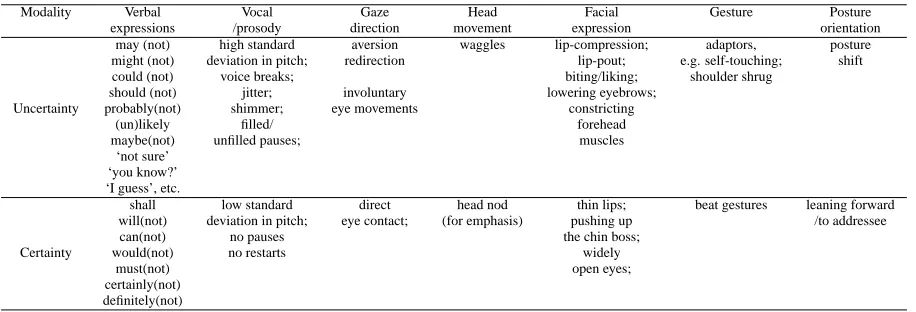
Modality Verbal Vocal Gaze Head Facial Gesture Posture expressions /prosody direction movement expression orientation
may (not) high standard aversion waggles lip-compression; adaptors, posture might (not) deviation in pitch; redirection lip-pout; e.g. self-touching; shift could (not) voice breaks; biting/liking; shoulder shrug
should (not) jitter; involuntary lowering eyebrows; Uncertainty probably(not) shimmer; eye movements constricting
(un)likely filled/ forehead
maybe(not) unfilled pauses; muscles ‘not sure’
‘you know?’ ‘I guess’, etc.
shall low standard direct head nod thin lips; beat gestures leaning forward will(not) deviation in pitch; eye contact; (for emphasis) pushing up /to addressee can(not) no pauses the chin boss;
Certainty would(not) no restarts widely
must(not) open eyes;
certainly(not) definitely(not)
Table 1: Expressions of modality
4.1.4. Time Mangement
24.8% of all nonverbal acts were assigned the communica-tive function of stalling (time management). Gaze aver-sion within an utterance was interpreted by annotators as indicating stalling. Head waggles are observed as stalling signals, as are various types of self-touching: touching, scratching, or holding the back of the neck or head with the open palm and rubbing the cheek or side of the neck. Our investigation shows that the nonverbal ‘speaker-’ and ‘listener-regulatory’ movements described above have functions for managing speaking turns and time, provid-ing feedback and structurprovid-ing the conversation, or a combi-nation of those. These movements can be interpreted in a particular context with or without the co-occurring spoken utterance, and can be analysed in terms of dialogue acts. In-deed, our comparative analysis of 18 existing dialogue an-notation schemes (see Introduction for the list) shows that these communicative aspects are reflected in a significant majourity of them: Feedback is not defined only in Lin-lin and Primula; Turn management acts are not defined in HCRC MapTask, Verbmobil, Linlin, Alparon and C-Star; Discourse Structuring is not defined in TRAINS and Al-paron; and Time Management is not defined in MRDA, HCRC MapTask, Linlin, Maltus, Primula and Chiba.
4.2. Communicative function alteration and specification
In a number of cases the communicative functions assigned to speech segments were corrected after annotators got ac-cess to visual signals. Mostly, this concerned an adjust-ment of the level of feedback, e.g. from understanding to evaluation or execution (6.8%). In (Petukhova and Bunt, 2009a) we noticed that participants in dialogue provide dif-ferent types of evidence to their partners if they merely un-derstand the partner’s intentions than if they also adopt the information provided (positive execution feedback). Sev-eral types of head movement were studied, and the features were investigated that were used to interpret these signals as indicating understanding or agreement. It was shown that dialogue participants use multiple signals and modali-ties to provide evidence of grounding at different levels, and that conversational partners perceive and understand this more accurately when they can rely on multiple informa-tion sources. While simple head nods were perceived as a
signal of successful understanding, more complex expres-sions, such as a combination of multiple slow head nods with lip movements and blinking, were perceived as sig-nals of belief transfer (adoption). Also words like ‘uh-uh’ in combination with head nods were interpreted by multi-ple judges as an understanding signal, whereas variations of ‘yes’ accompanying head nods were seen as signals of adoption.
Dialogue participants often express assessments of the va-lidity of their propositions. Kendon (2004) observed that nonverbal acts which are not part of the propositional or referential meaning of the utterance may have modal func-tions, e.g. indicating whether the speaker regards what he is saying as a hypothesis or as an assertion. About 47% of all functional segments in our data are modalized (34.5% uncertain, 12.6% certain). A degree of certainty can be expressed verbally, e.g. by auxiliary verbs like ‘may’, ‘might’, ‘could’; adverbs like ‘probably’, ‘likely’; and by expressions like ‘I guess’, ‘I’m not sure’, as well as nonver-bally, e.g. waggles, shoulder shrugs, puzzled look. Table 1 gives an overview of observed expressions.
It was further noticed that nonverbal expressions may reveal the speaker’s attitude towards the addressee(-s), towards the content of what he is saying, or towards the actions he is considering to perform. For instance, nonverbal expres-sions are used to mark new, important information, or mark out logical components of that. As such they reinforce ver-bal communication and allow to accentuate or emphasise words or ideas. To stress the importance of information that the speaker is providing he can use beat gestures, which are known to accompany important information, as well as eyebrow movements to indicate where the focus of the ad-dressee’s attention should be positioned. Along with hand and eyebrow movements speakers often use head nods for emphasis coinciding with the most prominent words in an utterance. For example:
(1) wording:I’m gonna do an opening
head:...nod
thinking or reflecting, surprised, confused, amused, scepti-cal, interested, disappointed, and guilty. Attitudes and emo-tions are often communicated by face.
We conclude here that nonverbal expressions are often used to support the communicative functions of the synchronous verbal behaviour and help to disambiguate it (e.g. under-standing vs adoption). Nonverbal signs also emphasize or qualify a communicative function expressed by a verbal ut-terance, expressing modality (certain vs uncertain) or attitu-dinal and emotional state. No existing dialogue act annota-tion scheme deals with this type of informaannota-tion. A proposal to this effect is formulated in Section 5.
4.3. Multifunctionality in multimodal utterances
A verbal functional segment has on average 1.3 commu-nicative functions (also confirmed in Bunt, 2009), whereas we observed that using information from all modalities gives 1.4 functions per segment on average. Table 2 presents the relative frequency of co-occurrences of mul-tiple functions in various dimensions.
In spite of the fact that the average number of functions per segment does not differ much, multimodality is sig-nificant for enabling the multifunctionality of utterances in some dimensions. For instance, our observations show that nonverbal communicative acts are very often concerned with feedback and other interaction management dimen-sions. Speech-focused movements, for example, accom-panying relatively unpredictable content words (e.g. iconic gestures during lexical search), body-focused movements (e.g. searching for an elusive word or expression in mem-ory) normally indicate that the speaker needs some time to gather his/her thoughts or to formulate the utterance, and is therefore stalling for time, but also keeping the turn. Some-times pauses increase the pressure on other participants to say something. The longer the pause, the more pressure builds on the other person(-s) to respond. Pauses near the beginning of an utterance can have the function of con-tact check, requesting attention. Speakers often make short pauses until the gaze of a recipient has been obtained and secured.
Repetitive head nods, lip movements, raising a finger, and beginning gesticulation may indicate that the previous con-tribution has been understood and the participant would like to grab the turn to add or correct something. Nonverbal expressions which are used to manage turns may also be used by the speaker to edit and structure his own speech. It was noticed by Butterworth (Butterworth, 1980), for ex-ample, that an excessive amount of gaze aversion when the speaker is having difficulty formulating a message may lead a listener to interfere. Here, also expressions of uncertainty (e.g. lip compression, curving the mouth downwards, low-ering eyebrows and eyelids, constricting the forehead mus-cles, head waggles) may invite the partner to take the turn and assist.
Nonverbal signals also add functionality to utterances ad-dressing the Task dimension, in particular for Turn Man-agement, Time ManMan-agement, Discourse Structuring, Own Communication Management and Allo-Feedback. The speaker who is ready with his dialogue contribution and wants the addressee to take the turn may signal this by
gaz-ing at the potential next speaker or by pointgaz-ing at the ad-dressee or performing a deictic head movement. When the speaker shifts his posture, e.g. leaning or turning to an ad-dressee, near the end of his turn, he signals that he expects the addressee to react to what the speaker just said. If the speaker gazed at more than one participant near the end of an utterance this often means that the speaker wants to re-lease the turn and somebody else to continue the dialogue. Gaze aversion, by contrast, often means that the speaker has not yet finished his contribution and wants to keep the turn. In this case, if the speaker experiences difficulties in formulating his utterance or needs some time to gather his thoughts, he may signal this by clems (involuntary eye movements), self-touching gestures like rubbing checks or neck, touching hair or biting lips, or by using some iconic gesture modelling an object in the air.
It was observed that feedback utterances like ’okay’ or ’yes’ in combination with repetitive head nods often have a com-municative function of turn take or grab, and also abrupt head movements signal an effort by the listener to take the speaking turn. Head nods as signs of positive feedback are used for structuring the discourse when the speaker indi-cates that what was happened in dialogue up to now is suc-cessfully processed and his is ready to move to the next topic, or close the discussion or entire conversation. Interesting nonverbal behaviour was observed with respect to speaker speech production and editing (own communi-cation management). The speaker interrupts himself by speech corrections or editing and indicates that he wants to delete part of an utterance and/or substitute this by some-thing else. Retractions frequently occur at the beginning of an utterance and within other hesitations and phrasal breaks. When the speaker’s gaze reached a non-gazing par-ticipant or the partner’s gaze arrived later with some delay, the speaker often restarted or retracted his utterance indi-cating by this that he wishes to gain the addressee’s atten-tion. Such behaviour is multifunctional in the sense that the speaker signals that he corrects or retracts his utterance and by doing this he indents to elicit feedback from his inter-locutors at the same time.
Dialogue act taxonomies that take the multifunctionality of utterances into account such as DIT++, LIRICS, DAMSL,
MRDA and Coconut, known as multidimensional dialogue act annotation schemes, allow assigning multiple functional labels to one stretch of communicative behaviour and there-fore provide a better account for the multifunctionality of verbal and nonverbal signals.
4.4. Articulating semantic content
Our studies show that about 39% of all transcribed nonver-bal signals neither contribute to the communicative func-tion of a verbal utterance nor form a full-fledged dialogue act on their own. Nonverbal signals are often used for ar-ticulating the semantic content of a dialogue act, relating to the propositional or referential meaning of an utterance. Hand gestures are often used deictically when the speaker points to entities which he is referring to. This accounts for about 48.6% of all hand movements. For example:
(2) wording:Press this little presentation
within Task Auto-F. Allo-F. Turn M. Time M. DS Contact M. OCM PCM SOM Task 1.1 (1.2) 0.1 (2.7) 5.6 (8.5) 2.6(3.4) 0.3(0.3) 0(0) 4.3(4.6) 0.3(0.3) 1.5(1.5) Auto-F. 0.5(0.7) 0(0) 12.7(15.5) 0.5(2.6) 0.3(3.1) 0(0) 0(0) 0(0) 0(0.5) Allo-F. 0(3.3) 0(0) 23.7(23.7) 1.2(1.5) 0(0) 0(0) 0(15.4) 0(5.1) 0(0) Turn M. 39.3(40.8) 6.2(12.2) 1.8(6.0) 49.6(60.6) 0.7(1.1) 0(0.3) 2.5(5.9) 0(0.7) 0.4(0.7) Time M. 34.6(41.7) 0.5(3.5) 0(11.2) 9.1(9.7) 0(0.5) 0(0) 0(4.2) 0(1.4) 0(0.6) DS 1.7(6.8) 0(6.8) 0(0) 6.7(20.9) 0(1.7) 0(0) 0(1.7) 0(0) 0(8.4) Contact M. 0(0) 0(0) 0(0) 18.2(18.2) 0(0) 0(0) 0(0) 0(0) 0(0) OCM 77.9(80.9) 0(0) 0(5.4) 6.5(6.5) 0(8.0) 0(0.9) 0(0) 0(0) 0(0) PCM 0(0) 0(0) 0(18.2) 27.3 (27.3) 0(0) 0(0) 0(0) 0(0) 0(0) SOM 0.9(0.9) 0(1.2) 0(0) 1.2(8.3) 0(1.2) 13.9(13.9) 0(0) 0(0) 0(0)
Table 2: Co-occurrences of communicative functions across dimensions in % excluding nonverbal expressions and includ-ing nonverbal expressions (in brackets).
Some iconic, metaphoric and pantomimic gestures were observed which form part of the semantic content or specify the semantic content of an utterance (51.4%). For example:
(3) wording:then we’ll move into acquaintance including a tool training exercise
hand:...semi-sphere..
(4) wording:then we’ve moved to age group twenty five to thirty five
hand:...away-motion...
(5) wording:The younger group of people would want smaller
hand:...size(both hands)
The speaker in example (3) performs a metaphoric ges-ture ‘a spherical shape’ accompanying the word ‘includ-ing’. The speaker in (4) performs a pantomimic gesture depicting the movement. The speaker in (5) performs an iconic gesture using both hands with open palms towards each other depicting size of the object in question.
These types of nonverbal acts normally co-occur with speech, i.e. are coverbal. Their meaning is inseparable from the meaning of verbal components and their inter-pretation arises directly from the overall speech utterance. Therefore, such nonverbal acts, which can be considered as pure semantic acts, as a rule do not have a communicative function on their own, but together with the speech deter-mine the meaning of the multimodal utterance as a whole.
5.
Extensions to DIT
++Our studies show that the DIT++inventory of
communica-tive functions was unable to cover all phenomena exhibited by participants’ nonverbal behaviour. People may be less straightforward in expressing their communicative inten-tions. They often indicate their attitude toward their com-municative partners and toward what they are saying. They emphasize, express doubts, criticize, show interest and so on. In this respect some fine-tuning is required.
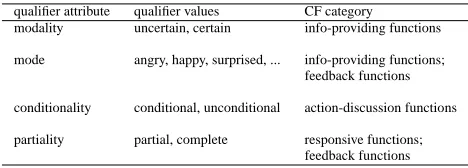
Adding communicative functions like ’Amused Sugges-tion’ and ’Uncertain Answer’ would lead to an explosive growth of the tagset and would probably not provide a com-plete solution anyway. Instead, we propose to add a set of qualifiers that can be attached to communicative func-tion in order to describe the speaker’s behaviour more ac-curately. For instance, modal qualifiers can be introduced to annotate the strength of the speaker’s beliefs about the validity of a proposition, having the values uncertain and
certain. For more fine gradation of uncertainty one might
introduce additional values like certain negative (”definitely
not”) - uncertain negative (”probably not”) - uncertain pos-itive (”probably”) - certain pospos-itive (”definitely”). Emo-tional and attitudinal phenomena in dialogue can be labeled with different levels of granularity: coarse (positive, nega-tive and neutral); medium (basic emotions comparable to Ekman’s 6 emotions), and fine (labels for specific emotions like misery, annoyed, worry; specific attitudes like critical, impatient, agreeable, serious, curious). We propose to leave this category open-ended, allowing specific qualifiers to be chosen according to the needs of particular applications and tasks.
qualifier attribute qualifier values CF category
modality uncertain, certain info-providing functions
mode angry, happy, surprised, ... info-providing functions; feedback functions
conditionality conditional, unconditional action-discussion functions
partiality partial, complete responsive functions; feedback functions
Table 3: Function qualifier attributes, values, and function categories
Other qualifications of communicative functions could be
conditionality, referring to the possibility (with respect to
ability and power), necessity or volition of performing an action, and can therefore only be attached to action-discussion functions; and partiality that limits the scope of a communicative function in addressing only part of the se-mantic content of the utterance to which the current utter-ance is related.
Table 3 summarizes the qualifier attributes and values that we propose, indicating in the rightmost column the cate-gories of communicative functions to which they may be attached.
6.
Conclusions
In this paper we explored the role of nonverbal modali-ties in the interpretation of dialogue behaviour and inves-tigated experimentally whether it is possible to apply a di-alogue act annotation scheme for the semantic annotation of multimodal data. The general conclusion of our exper-iments is that a well-worked out, fine-grained, open mul-tidimensional dialogue act taxonomy such as DIT++ (but
without changing its set of communicative functions, in the form of qualifiers that can be attached to communicative function tags.
7.
Acknowledgments
This research was conducted within the project Multidi-mensional Dialogue Modelling, sponsored by the Nether-lands Organisation for Scientific Research (NWO), under grant reference 017.003.090. We also very thankful to anonumous reviewers for their valuable comments.
8.
References
Alexandersson, J., et al. 1998. Dialogue acts in
Verbmobil-2. Second edition. Report 226. DFKI Saarbruecken,
Uni-versity of Stuttgart; TU Berlin; UniUni-versity of Saarland. Allen, J. et al. 1994. The TRAINS Project: a case study
in building a conversational planning agent. TRAINS
Technical Note 94-3. University of Rochester.
Allen, J., Core, M. 1997. Draft of DAMSL: Dialog Act
Markup in Several Layers.
Allwood, J., Cerrato, L., Dybkjær, L., Jokinen, K., Navar-retta, C., and Paggio, P. 2004. The MUMIN multimodal
coding scheme. Technical report.
Barkhuysen, P., Krahmer, E., and Swerts, M.. 2008. The interplay between auditory and visual cues for end-of-utterance detection. The Journal of the Acoustical Soci-ety of America, 123(1):354–365.
Bunt, H. 1999. Dynamic interpretation and dialogue
the-ory. In: M. Taylor, F. Neel, and D. Bouwhuis (eds.), The structure of multimodal dialogue II, Amsterdam:
Ben-jamins, pp. 139–166.
Bunt, H. and Schifrin, A. 2006. Methodological aspects of
semantic annotation. In: Proceedings LREC 2006,
Gen-ova.
Bunt, H., and Schiffrin, A. 2007. Documented compilation
of semantic data categories. LIRICS Deliverable D4.3
available athttp://lirics.loria.fr/
Bunt, H. 2009. Multifunctionality and multidimensional
dialogue semantics. Proceedings of the DiaHolmia
Workshop on the Semantics and Pragmatics of Dialogue, Stockholm, Sweden, pp. 3–15.
Burger, S., MacLaren, V., and Yu, H. 2002. The ISL
Meet-ing Corpus: the impact of meetMeet-ing type on speech style.
Proceedings ICSLP, Denver CO, USA.
Butterworth, B. 1980. Evidence from pauses in speech. In B.Butterworth(ed.), Language Production: Speech and Talk, vol.1. Academic Press, London, pp. 155–177. Cassell, J., Nakano, Y.I., Bickmore, T.W., Sidner, C.L.,
and Rich, R. 2001. Non-Verbal Cues for Discourse Structure. In: Proceedings of the 39th Annual Meeting
on Association for Computational Linguistics, Toulouse,
France.
Clark, H. and Krych, M.A. 2004. Speaking while
monitor-ing addressees for understandmonitor-ing. Journal of Memory
and Language, 50: 62-81.
Cohen, J. 1960. A coefficient of agreement for nominal
scales. Education and Psychological Measurement, 20:
37–46.
Dybkjær, L. and Bernsen, N.O. 2002. Data Resources and
Annotation Schemes for Natural Interactivity: Purposes and Needs. Proceedings of the LREC2002 Workshop on
Multimodal Resources and Multimodal Systems Evalua-tion.
Ford, C.E., and Thompson, S.A. 1996. Interactional units in conversation: syntactic, intonational, and pragmatic resources for the management of turns. In: Emanuel A. Schegloff and Sandra A. Thompson, editors, Interaction and grammar, Cambridge: Cambridge University Press, pp. 135– 184.
Geertzen, J., Petukhova, V., and Bunt, H. 2007. A
Mul-tidimensional Approach to Utterance Segmentation and Dialogue Act Classification. Proceedings of the 8th
SIG-dial Workshop on Discourse and Dialogue, Antwerp, pages 140–149.
Goodwin, C. 1981. Conversational Organization: Inter-action between hearers and speakers. New York: Aca-demic Press.
Grosjean, F. and Hirt, C. 1996. Using prosody to predict the end of sentences in English and French: Normal and brain-damaged subjects. Language and Cognitive Pro-cesses, 11:107–134.
Hadar, U., Steiner, T.J., Grant, E.C., and Rose, F.C. 1984. The timing of shifts of head postures during conversa-tions. Human Movement Science, 3:237–245.
Kendon, A. 1967. Some functions of gaze-direction in so-cial interaction. Acta Psychologia, 26: 22–63.
Kendon, A. 2004. Gesture: visible action as utterance. Cambridge University Press, Cambridge.
Novick, D.G., Hansen,B., and Ward, K. 1996. Coordinat-ing Turn-takCoordinat-ing with Gaze. In: ProceedCoordinat-ings of the
Inter-national Symposium on Spoken Dialogue, Philadelphia,
PA, pp.53–56.
Pavelin, B. 2002. Le Geste `a la parole. Toulouse: Presses Universitaires du Mirail.
Petukhova, V., and Bunt, H. 2009. Grounding by
nod-ding. Proceedings of the 1st Conference on Gesture and
Speech in Interaction, Poznan, Poland.
Petukhova, V., and Bunt, H. 2009. Who’s next?
Speaker-selection mechanisms in multiparty dialogue.
Proceed-ings of the DiaHolmia Workshop on the Semantics and Pragmatics of Dialogue, Stockholm, Sweden, pp. 19–26. Petukhova, V., and H. Bunt. 2009. Dimensions in
commu-nication. TiCC Technical Report TR 2009-002, Tilburg
University.
Pineda, L., Castellanos, H., Coria, S., Estrada, V., L´opez, F., L´opez, I., Meza, I., Moreno, I., P´erez, P.,and Rodr´ıguez, C. 2005. Balancing Transactions in
Prac-tical Dialogues. Technical report, Department of
Com-puter Science, Mexico.
de Ruiter, J.-P. Mitterer, H., and Enfield, N.J. 2006. Pro-jecting the end of a speaker’s turn: A cognitive corner-stone of conversation. Language, 82: 515–535.