NLP Resources for the Analysis of Patient/Therapist Interviews
Horacio Saggion
∗, Elena Stein-Sparvieri
∗∗, David Maldavsky
∗∗, Sandra Szasz
∗∗∗∗Department of Information and Communication Technologies (DTIC)
Universitat Pompeu Fabra Campus de la Comunicacio Poble Nou
C/Tanger, 122-140 Barcelona, Spain [email protected]
∗∗Instituto de Altos Estudios en Psicología y Ciencias Sociales
Universidad de Ciencias Sociales y Empresariales Paraguay 1401, PB, Bs. As. Argentina [email protected];[email protected]
∗∗∗Department of Computer Science
University of Sheffield
211 Portobello Street - Sheffield, England, UK [email protected]
Abstract
We present a set of tools and resources for the analysis of interviews during psychotherapy sessions. One of the main components of the work is a dictionary-based text interpretation tool for the Spanish language. The tool is designed to identify a subset of Freudian drives in patient and therapist discourse.
1.
Introduction
In recent years the field of Natural Language Processing (NLP) has seen a renewed interest on the analysis of non-factual, emotional discourse characterized by the presence of affective language and sentiments, and charged with subjectivity.
One area which has not been properly investigated, however, is that of NLP in the field of psychology and, more specifically, NLP in the analysis of interac-tions between patients and therapists during psychotherapy.
There has been substantial research in the development of methods to analyse linguistic input in the field of psy-chotherapy in order to measure a number of psychological variables such as emotion, abstraction, referential activity, etc. among them Bucci’s Referential Activity (RA) non-weighted (Bucci, 2002) and non-weighted dictionaries (Bucci and Maskit, 2006) for the English language, or Höltzer and others’ affective dictionary (Hölzer et al., 1997) for the German language.
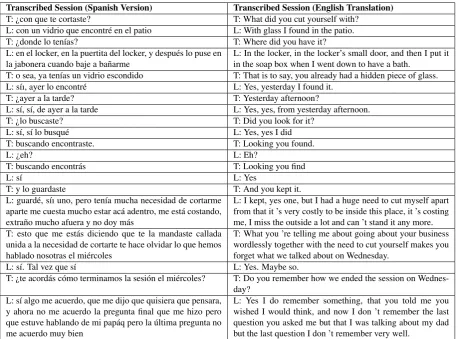
We are developing a set of NLP tools and resources for the analysis of interviews framed on a psychoanalytic theory, the work presented being, to the best of our knowledge, the first to investigate the application of NLP techniques, including dictionary-based interpretation, for the automatic analysis of spoken transcriptions in Spanish (Argentinian variety) of psychoanalysis sessions between therapists and patients. In Figure 3 we show a fragment of a manually transcribed interview in Spanish (and its translation to English) from our development corpus.
The automatic analysis of the sessions, which is used as a tool for assessment and interpretation of the transcribed psychotherapy sessions is based on a theory developed by Liberman and extended by Maldavsky (Liberman and
Maldavsky, 1975) and framed on Freudian theory (Freud, 1925). The automatic tools to be presented here aim at rec-ognizing a subset of Freudian drives manifested in both pa-tient’s and therapist’s discourse.
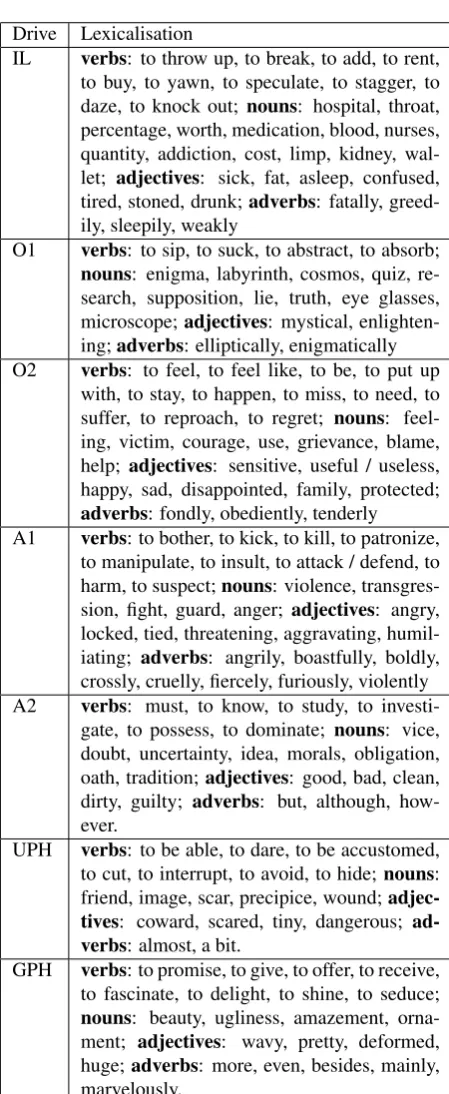
Abbreviation Drive Name IL Intra-somatic libido O1 Primary oral
O2 Secondary oral sadistic A1 Primary anal sadistic A2 Secondary anal sadistic UPH Urethrae phallic GPH Genital phallic
Table 1: Drives in Liberman and Maldavsky theory
The objective of the analysis is not to provide a full auto-mated solution to discourse interpretation in this area, but a set of tools and resources to assist therapists during dis-course analysis. Although work in text-based interpretation in psychology is not new, researchers in our project have identified limitations in current practices due to the fact that current text-based systems do not tackle ambiguity prob-lems at lexical, syntactic, or semantic levels: for example systems that consider out-of-context superficial forms are unable to distinguish between different uses of the same lexical item (“para” as a preposition vs. “para” as a form of the verb “parar” (to stop); “rio” as a common noun vs. “rio” as a contextual clue for the identification of a geographical name; etc.). The use of advanced natural language process-ing techniques could help produce better analysis of the in-put material and therefore be used for a better diagnosis and follow-up.
2.
Theoretical Framework Overview
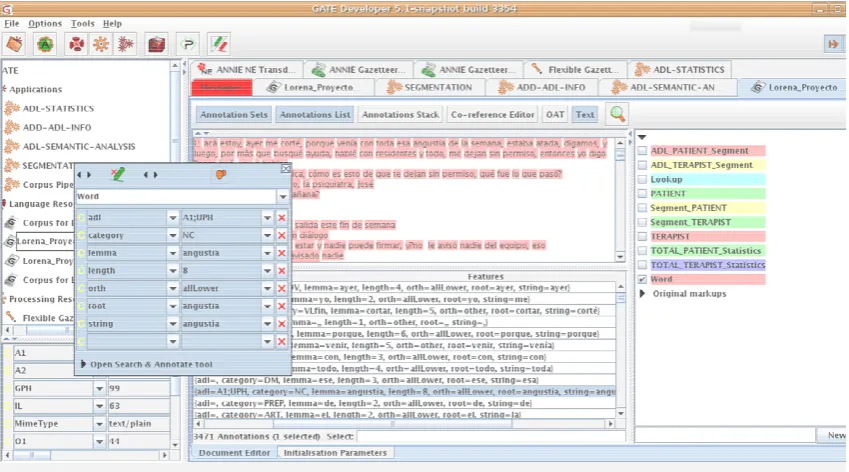
Figure 1: Word Analysis using the Dictionary
the analysis of different sections of news sources (econ-omy/business, sports, politics, etc.) in order to identify cross-source similarities and tendencies.
6.
Current Work
The paper has described a number of tools we are develop-ing for the analysis of transcribed psychotherapy interviews in the Spanish language including the implementation in GATE of a dictionary for the identification of drives in the context of a Freudian theory. We are currently develop-ing a module for speech act recognition and classification in order to identify a subset of speech acts categories as-sociated to the theory’s drives. In induction sessions with psychotherapist we have managed to capture ways in which speech acts in the adopted framework are expressed and we are using the information to start implementation of a rule-based speech act detection program (with regular ex-pressions and a dictionary) based on use use of syntactic and lexical information. We are also annotating the devel-opment corpus of interviews (a total of 30 will be anno-tated with a minimum of 2 annotators per interview) with speech acts categories and semantic information. The an-notated corpus will be used for the development of a train-able speech act recognition program based on lexical clues and syntactic information. The set of resources developed in the project will be made available to the computational linguistics community for research purposes.
Acknowledgements
We thank the reviewers of the paper for their comments. This work was partially supported by a grant from the
Royal Society (JP090069), UK. The first author is grateful to the Programa Ramón y Cajal 2009 from the Ministerio de Ciencia e Innovación, Spain.
7.
References
W. Bucci and B. Maskit. 2006. A Weighted Referential Activity Dictionary. InComputing Attitude and Affect in Text: Theory and Applications, volume 20 ofThe Infor-mation Retrieval Series, pages 49–60. Springer Verlag. W. Bucci. 2002. Referential Activity (RA): Scales and
computer procedures. InAn Open Door Review of Out-come Studies in Psychoanalysis. International Psychoan-alytical Association.
C.K. Chung and J.W. Pennebaker. 2008. Revealing dimen-sions of thinking in open-ended self-descriptions: An automated meaning extraction method for natural lan-guage. Journal of Research in Personality, 42:96–132. Hamish Cunningham, D. Maynard, K. Bontcheva, and
V. Tablan. 2002. GATE: A framework and graph-ical development environment for robust NLP tools and applications. In Proceedings of the 40th
An-niversary Meeting of the Association for Computa-tional Linguistics (ACL’02), Philadelphia, USA, Jul.
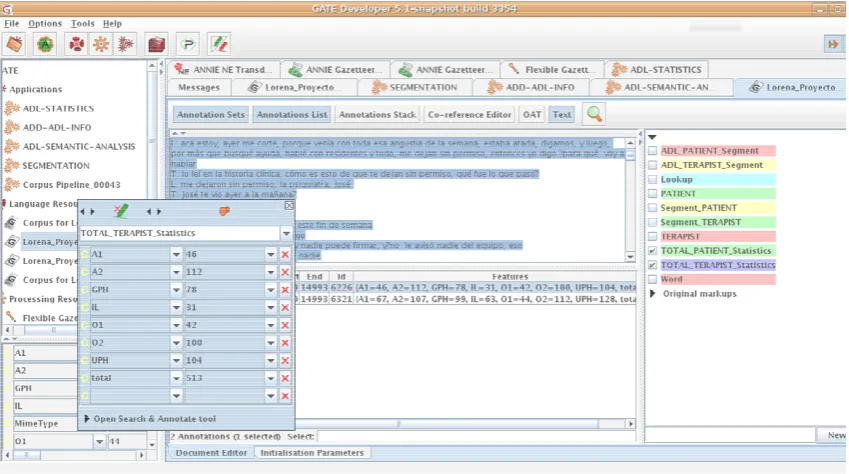
Figure 2: Drives’ Statistics over Patient and Therapist Segments
Andrea Esuli and Fabrizio Sebastiani. 2006. SENTI -WORDNET: A publicly available lexical resource for opinion mining. InProceedings of LREC-06, 5th Con-ference on Language Resources and Evaluation, pages 417–422, Genova, IT.
S. Freud. 1925. Obras Completas. Amorrortu (Eds.), Madrid, Spain.
Anindya Ghose, Panagiotis G. Ipeirotis, and Arun Sun-dararajan. 2007. Opinion mining using econometrics: A case study on reputation systems. InProceedings of the Association for Computational Linguistics. The Associ-ation for ComputAssoci-ational Linguistics.
M. Hölzer, D. Pokorny, H. Kächele, and L. Luborsky. 1997. The Verbalization of Emotions in the Therapeu-tic Dialogue-A Correlate of TherapeuTherapeu-tic Outcome? Psy-chotherapy Research, 7(3):261–273.
D. Liberman and D. Maldavsky. 1975. Psicoanálisis y semiótica. Paidos, Buenos Aires, Argentina.
D. Maldavsky. 2003. La investigación psicoanalítica del lenguaje: algoritmo David Liberman. Editorial Lugar, Buenos Aires, Argentina.
A. Roussos and M. O’Connell. 2005. Construcción de un diccionario ponderado en español para medir la Activi-dad Referencial. Revista del Instituto de Investigaciones de la Facultad de Psicología - UBA, 10(2):99–119. H. Saggion and A. Funk. 2009. Extracting Opinions and
Facts for Business Intelligence. RNTI. In Press.
H. Saggion and A. Funk. 2010. Interpreting sentiword-net for opinion classification. In Proceedings of Lan-guage Resources and Evaluation Conference, Malta,
May 2010.
H. Saggion, E. Stein-Sparvieri, D. Maldavsky, and S. Szasz. 2010. Human language technology for text-based analy-sis of psychotherapy sessions in the spanish language. In
NAACL 2010 Young Investigators Workshop. NAACL. H. Schmid. 1995. Improvements in part-of-speech tagging
with an application to german. InIn Proceedings of the ACL SIGDAT-Workshop, pages 47–50.
Transcribed Session (Spanish Version) Transcribed Session (English Translation)
T: ¿con que te cortaste? T: What did you cut yourself with? L: con un vidrio que encontré en el patio L: With glass I found in the patio. T: ¿donde lo tenías? T: Where did you have it? L: en el locker, en la puertita del locker, y después lo puse en
la jabonera cuando baje a bañarme
L: In the locker, in the locker’s small door, and then I put it in the soap box when I went down to have a bath.
T: o sea, ya tenías un vidrio escondido T: That is to say, you already had a hidden piece of glass. L: síı, ayer lo encontré L: Yes, yesterday I found it.
T: ¿ayer a la tarde? T: Yesterday afternoon?
L: sí, sí, de ayer a la tarde L: Yes, yes, from yesterday afternoon. T: ¿lo buscaste? T: Did you look for it?
L: sí, sí lo busqué L: Yes, yes I did T: buscando encontraste. T: Looking you found.
L: ¿eh? L: Eh?
T: buscando encontrás T: Looking you find
L: sí L: Yes
T: y lo guardaste T: And you kept it. L: guardé, síı uno, pero tenía mucha necesidad de cortarme
aparte me cuesta mucho estar acá adentro, me está costando, extraño mucho afuera y no doy más
L: I kept, yes one, but I had a huge need to cut myself apart from that it ’s very costly to be inside this place, it ’s costing me, I miss the outside a lot and can ’t stand it any more. T: esto que me estás diciendo que te la mandaste callada
unida a la necesidad de cortarte te hace olvidar lo que hemos hablado nosotras el miércoles
T: What you ’re telling me about going about your business wordlessly together with the need to cut yourself makes you forget what we talked about on Wednesday.
L: sí. Tal vez que sí L: Yes. Maybe so.
T: ¿te acordás cómo terminamos la sesión el miércoles? T: Do you remember how we ended the session on Wednes-day?
L: sí algo me acuerdo, que me dijo que quisiera que pensara, y ahora no me acuerdo la pregunta final que me hizo pero que estuve hablando de mi papáq pero la última pregunta no me acuerdo muy bien
L: Yes I do remember something, that you told me you wished I would think, and now I don ’t remember the last question you asked me but that I was talking about my dad but the last question I don ’t remember very well.