Using linear interpolation and weighted reordering hypotheses in the Moses
system
Marta R. Costa-juss`a∗, Jos´e R. Fonollosa†
∗Barcelona Media Research Center
Barcelona, Spain [email protected] †Universitat Polit`ecnica de Catalunya
Barcelona, Spain [email protected]
Abstract
This paper proposes to introduce a novel reordering model in the open-source Moses toolkit. The main idea is to provide weighted reordering hypotheses to the SMT decoder. These hypotheses are built using a first-step Ngram-based SMT translation from a source language into a third representation that is called reordered source language. Each hypothesis has its own weight provided by the Ngram-based decoder. This proposed reordering technique offers a better and more efficient translation when compared to both the distance-based and the lexicalized reordering. In addition to this reordering approach, this paper describes a domain adaptation technique which is based on a linear combination of an specific in-domain and an extra out-in-domain translation models. Results for both approaches are reported in the Arabic-to-English 2008 IWSLT task. When implementing the weighted reordering hypotheses and the domain adaptation technique in the final translation system, translation results reach improvements up to 2.5 BLEU compared to a standard state-of-the-art Moses baseline system.
1. Introduction
Statistical machine translation (SMT) constitutes a re-search sub-area of machine translation (MT) that has recently gained much popularity. In fact, this tech-nology has experienced real growth motivated by the development of computer resources needed to imple-ment translation algorithms based on statistical meth-ods (Brown et al., 1993).
Nowadays, one of the most popular SMT approaches is the phrase-based system (Zens et al., 2002) using a combination of feature functions. The Moses sys-tem (Koehn et al., 2007) is an implementation of this phrase-based machine translation approach. An in-put sentence is first split into text chunks (so-called phrases), which are then mapped one-to-one to target phrases using a large phrase translation table. Phrases may be reordered, but typically a reordering limit is used.
Our ongoing efforts are mainly dedicated to finding the best way to reorder the source side of the bilingual corpus aiming to decrease the divergences in word or-der of the source and target languages. This is es-pecially important when the translation is performed between pairs of languages with non-monotonic word order, like Arabic and English. Recent techniques pro-pose modular approaches where reordering is faced before translation. This makes it possible to easily change the reordering strategy and to speed up
trans-lation because a montonic search is used. Using a sta-tistical Ngram-based system, we propose to generate weighted reordering hypotheses and to introduce them as input graphs to the Moses system.
Another promising way to improve the quality of MT output is to involve additional out-of-domain paral-lel information into bilingual modeling. (Koehn and Schroeder, 2007) perform a log-linear combination of translation models. Inspired by the results presented in (Foster and Kuhn, 2007). we interpolate a prin-cipal translation model (TM) with a secondary one, adjusting the weight coefficients according to the cor-responding monolingual language models.
This paper is organized as follows. Section 2. briefly describes several reordering approaches related to the one that we are proposing. Section 3. introduces the phrase-based system used throughout this paper. Sec-tion 4. reports the proposed Ngram-based reordering technique. Section 5. reports the experiments us-ing the Arabic-to-English task and, finally, section 6. presents the conclusions.
2. Related reordering work
IWSLT VIOLIN
Arabic English Arabic English
Sentences 24.45 K 24.45 K 130.59 K 130.59 K
Words 170.24 K 188.54 K 4.12 M 4.44 M
Average sentence length 6.96 7.71 31.52 34.01
Vocabulary 10.89 K 6.92 K 72.9 K 65.9 K
Table 1: The main and additional basic corpora statistics.
Figure 1: Ngram-based reordering approach.
based statistical approach. The aim of the Ngram-based reordering approach (also called statistical ma-chine reordering, SMR) consists in using an SMT sys-tem to deal with reordering problems. Therefore, the reordering hypotheses are built with an SMT system which translates from an original source language (S) to a reordered source language (S’), given a target lan-guage (T).
Figure 1 shows an example of the Ngram-based ordering system which translates from English to a re-ordered English given the Spanish as target language.
4.1. Introduction to the Ngram-based translation
model
The Ngram-based model used for reordering is in-spired by the Ngram-based translation model (Mari˜no et al., 2006). This section is dedicated to make a brief summary of the Ngram-based translation model. Differently to the phrase-based translation model, the Ngram-based translation model is trained on bilingual n-grams. This model constitutes a language model of a particular “bi-language” composed of bilingual units (translation units) which are referred to as tuples. In this way, the translation model probabilities at the sentence level are approximated by usingn-grams of tuples, such as described by the following equation:
ˆ
tI1= arg max
tI 1
{p(sJ1, t
I
1)}=· · ·= (1)
arg max tI
1
{
N
Y
n=1
p((s, t)n|(s, t)n−x+1,· · ·,(s, t)n−1)}
(2) where the nth tuple of a sentence pair is referred as (s, t)n.
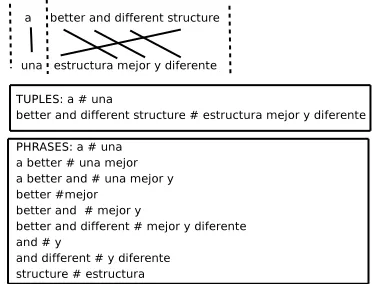
Figure 2: Regular tuple extraction compared to phrase
extraction.
As any standardn-gram language model, the bilingual translation model is estimated over a training corpus composed of sentences in the language being mod-eled. In this case, we consider sentences in the
“bi-language” previously introduced.
The Ngram-based approach is monotonic in that its model is based on the sequential order of tuples during training. Tuples are extracted from a word-to-word aligned corpus (see an example in Figure 2) in such a manner that a unique segmentation of the bilingual corpus is achieved.
• a monotonic segmentation of each bilingual sen-tence pair is produced,
• no word inside the tuple is aligned to words out-side the tuple, and
• no smaller tuples can be extracted without violat-ing the previous constraints.
4.2. Ngram-based reordering approach
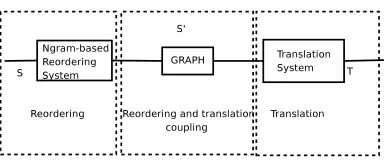
Figure 5: Reordering and translation coupling.
using the Ngram-based model which is used to com-pute reordering hypotheses.
The reordering information is extracted from the alignment as shown in Figure 3 (b). Finally, source words are replaced by source word classes as shown in Figure 3 (c). Therefore, the Ngram-based model is composed of bilingualn-grams and these are com-posed of the source word classes and the new reorder-ing positions (Costa-juss`a and Fonollosa, 2009). Translation from S to S’ is computed as follows:
1. Source words are replaced by their correspond-ing word classes. In this paper, statistical classes (Och, 1999) are used.
2. Decoding using an Ngram-based model from the source word classes into reordered source posi-tions that are the reordering hypotheses.
At work, the decoder builts a search graph. This graph offers several weighted reordering hypotheses of the source sentence. Note that each arch of the graph contains the weight given by the Ngram-based model. Figure 4 shows an example of reordering graph given the Spanish as a source language.
Finally, the weighted reordering graph is used as input of the monotonic SMT system. The final translation system coupled with the reordering system is shown in Figure 5.
5. Experiments
Experiments were run using the Basic Traveling Ex-pression Corpus (BTEC) Arabic to English translation task used in the 2008 IWSLT Evaluation Campaign. Model weights were tuned with the 2006 IWSLT de-velopment corpus, containing 489 sentences and 6 ref-erence translations. Experiments were tested on the 2008 official IWSLT evaluation test set both the CRR (Correct Recognition Results) and ASR (Automatic Speech Recognition) output 1, containing 507 sen-tences and 6 reference translations.
The phrase-based system used in this paper is based on the well-known Moses toolkit, which is nowadays
1http://www.slc.atr.jp/IWSLT2008/
considered as a state-of-the-art SMT system (Koehn et al., 2007). The training and weights tuning proce-dures are explained in details in the above-mentioned publication, as well as, on the Moses web page:
http://www.statmt.org/moses/.
5.1. Arabic data preprocessing
We used a similar approach to that shown in (Habash and Sadat, 2006), namely the MADA+TOKAN sys-tem for disambiguation and tokenization. For disam-biguation only diacritic unigram statistics were em-ployed. For tokenization we used the D3 scheme with -TAGBIES option. The scheme splits the following set of enclitics: w+, f+, b+, k+, l+, Al+ and pronom-inal enclitics. The -TAGBIES option produces Bies POS tags on all taggable tokens.
5.2. Reordering parameters
This section provides the details of the reordering pa-rameters used for each technique.
The maximum distance of the words to be reordered was set to 6 in the distance-based reordering.
The parameters of the lexicalized reordering were set-tled as follows:
• The lexicalized distortion model was defined as
msd-bidirectional-fe. Msd means the reordering
types can be monotone, swap and discontinu-ous (Tillmann, 2004). Bidirectional means that certain phrases may not only flag, if they them-selves are moved out of order, but also if subse-quent phrases are reordered. fe concerns out of sparse data and the probability distribution con-ditions on the foreign phrase f and on the English phrase e.
• The maximum number of words to be reordered (max-skip) was set to 6.
Finally, the Ngram-based reordering approach used 100 statistical classes (Och, 1999). The Ngram-based model used a context of 3 bilingual units. The decod-ing limited the beam search to 5.
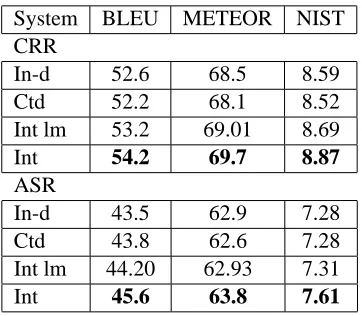
5.3. Baseline and interpolation performance
DISTANCE-BASED: Is there any place shopping?
LEXICALIZED: Is there any place shopping?
Ngram-based: Is there any place to go shopping?
DISTANCE-BASED: Could you tell me how to get to the market Central?
LEXICALIZED: Could you tell me how to get to the market Central?
NGRAM-BASED: Could you tell me how to get to the Central market?
DISTANCE-BASED: Are there any hospital emergency around?
LEXICALIZED: Are there any hospital emergency around?
NGRAM-BASED: Are there any emergency hospital around?
Figure 6: Translation examples using different reordering techniques.
F.J. Och. 1999. An efficient method for determining bilingual word classes. In Proc. of the 9th Conf. of
the European Chapter of the Association for Com-putational Linguistics, pages 71–76, June.
H. Schwenk and Y. Est`eve. 2008. Data selection and smoothing in an open-source system for the 2008 NIST machine translation evaluation. In
Proceed-ings of the Interspeech’08, Brisbane, Australia.
C. Tillmann. 2004. A unigram orientation model for statistical machine translation. In Proc. of the
Hu-man Language Technology Conf., HLT-NAACL’04,
pages 101–104, Boston, May.
R. Zens, F.J. Och, and H. Ney. 2002. Phrase-based statistical machine translation. In M. Jarke, J. Koehler, and G. Lakemeyer, editors, KI - 2002:
Advances in artificial intelligence, volume LNAI
2479, pages 18–32. Springer Verlag, September. Y. Zhang, R. Zens, and H. Ney. 2007. Chunk-level
reordering of source language sentences with auto-matically learned rules for statistical machine trans-lation. In Proc. of the Human Language