CSEIT1831477 | Received : 16 Feb 2018 | Accepted : 27 Feb 2018 | January-February-2018 [(3) 1 : 1895-1900 ]
International Journal of Scientific Research in Computer Science, Engineering and Information Technology © 2018 IJSRCSEIT | Volume 3 | Issue 1 | ISSN : 2456-3307
1895
Improving the Efficiency and Effectiveness of Sales Force with
Mobile SFA
Dassanayake D. M. G. T*1, Yamasinghe R. P2, Perera K. M. P2, De Silva K. H. P. I2 , Mallawarachchi Y1,
Wickramarathne J2
1Department of Information Technology, Sri Lanka Institute of Information Technology, Malabe, Sri Lanka
2Department of Software Engineering, Sri Lanka Institute of Information Technology, Malabe, Sri Lanka
ABSTRACT
This research involves discovering how to cater the Fast Moving Consumer Goods (FMCG) companies in Sri Lanka to be successful in their sales process through improving sales force efficiency. Strength of sales force of a particular company affect for the highest possible sales of that company. Therefore a mechanism which has the ability to increase the sales force productivity is a need as well as a challenge. An innovative approach to increase sales force engagement in company sales process is a vital. Mobile Sales Force Automation (SFA) is a convenient solution as the smartphones has a considerable amount of usage in the current industry. As well as sales force productivity, company management decisions also affect for the number of sales. The main focus of this research is to improve sales force engagement through mobile SFA and explore methods which can support for intelligent business decisions regarding sales.
Keywords : Sales Force Automation, mobile SFA, data analysis, ARIMA, Fast Moving Consumer Goods, sales forecasting
I.
INTRODUCTION
Sales Force Automation (SFA) is the technique of using software to automate the business tasks of sales. Today with the rapid globalization and technology
advancement organizations tend to identify
opportunities to expand their services and to take their conventional work approaches to a new era.
SFA systems have been studied for roughly thirty years. Many researches were carried out in the areas of SFA systems all over the world. The sales function is viewed as being a part of conceiving, producing and delivering customer value by understanding customer needs and meeting them by supplying goods and services appropriate to those needs [1]. The emerging use of technology by sales people is evident through the growing use of SFA products
and cutting-edge communication technology
deployed in the field [2]. Academic research on SFA started in the early 1980s and is categorized under four themes. They are adoption of SFA by organizations, the impact of SFA on an organization, success or failure of SFA projects and sales force adoption of SFA [3].
A. Background study
industry is particularly well suited to gain from the potential benefits of mobile SFA [6].
When considering SFA researches there are successes as well as failures. Early empirical work and anecdotal evidence also support the argument that the failure of SFA initiatives is, in part, being prompted by limited user acceptance of the implemented technology [7]. The results of a carried survey indicate that sales people perceived the system to be a tool used by the upper level management to more closely manage their sales activities [8].
According to the literature survey conducted some points are highlighted. They are,
Mobile SFA is beneficial for sales force of a company.
SFA system can be used as a management tool
by a company management.
SFA systems are time saving and increase efficiency of sales force.
Increase sales productivity of the company.
There are prevailing SFA systems in the world as information system that connects and integrates sales activities with the organization’s other operations. Most of the current SFA solutions are applications that mainly automate sales tasks including sales activities, order processing, customer management, sales forecasting and analysis, sales force management and information sharing. SFA software is not only a tool to the success of today’s sales force but is also vital to the entire organization [14].
A research has shown, however that 55-75% of SFA projects fail. The high failure rate of SFA can be
caused due to gaps that exist between the sales force and management [15]. One of the main problems is low user acceptance which can be attributed to such factors as the disruption of established sales routines,
sales force perception of the system as
micromanagement tool, differences in sales force and managerial expectations for the system and lack of managerial support for the system as perceived by the sales force.
There is no use if the SFA system does not perform the anticipated results and also if it does not affect for increasing sales force productivity. Main objective of a company is to adapt for such technologies to increase their sales. Therefore a SFA system which concerns these matters is a need.
Sales force productivity can be increased by allowing real time access to enterprise data like customer contact information, sales history, pricing and products on mobile devices for sales force. The major changes that affect sales functions are globalization, increased customer focus and increasing use of SFA systems.
II.
METHODS AND MATERIAL
This innovative SFA solution is a combination of two parts. One is an Android mobile application and
Analysis of salesperson performance, GPS navigation and best path analysis
Analysis and improve customer engagement and relationship in the sales process.
A. Analysis of sales person performance and Best path analysis
To analyze the salesperson performance, track all the activities done by the salesperson on the android device. In every 5 second intervals the Broadcast receiver checks what are the activities is being accessing by the salesperson. (Broadcast receiver is running as background running application.) All those activities are saved in SQLite Database. System will automatically synchronize with server once per day. Then all the data send to the server. Management can view those activities in their dashboard by daily or monthly basis. When the “DSI VLink Helper” application installed on the device it starts the Broadcast receiver which allows to register for system or application event. In here Application register for the ACTION_BOOT_COMPLETED system event which is fired once the Android System has competed the boot process.
AlarmManager class provides access to the system alarm services. These allow scheduling the broadcast receiver to be done at specific intervals, in this case it is five seconds. ActivityManager used to retrieve overall activities that currently “running” in the system. From those activities top most currently running activity’s class name is taken. Details of the activity, such as usage time and the application name is then saved to the Android Lite DB. These data will automatically synchronized to the server once per day.
Salesperson has to cover numerous showrooms in a particular area with a short specific time. As a best solution for that, “Travelling Salespersons Problem” (TSP) using Nearest Neighbor Algorithm is used in the “DSI VLink Helper” application. It is one of the most intensively studied problems in computational mathematics. In this case shortest possible route is selected of given list of showrooms and distance between each pair of showrooms, which visit exactly each showroom once and returns to the origin showroom.
B. Atomic data synchronization
Atomic data synchronization enables offline ordering mechanism for which the master data has to be cloned to the Android application. Some of the data gets updated daily. Since data synchronization involves lot of time, in order to increase the productivity of the sales force while minimizing the waste through 2 way authentication mechanism for data communication, product showcasing using the app itself and atomic data synchronization using intelligent mechanism. If there is a large collection of
products, images of all products consume
considerable memory space and time when downloading. A salesperson is assigned some specific number of products. Mobile application consists of product images synchronization with progressive downloading mechanism which will be more accurate with the offline system along with caching mechanism to avoid re-downloads upon request which saves productive time of the sales staff. At a point where the salesperson meets a reseller in a situation with no internet connectivity. As an efficient solution for such instances system has the capability for offline communication to avoid the hassle the salesperson has to face.
C. Sales forecasting
p = the order of the Autoregressive model d = the degree of differencing
q = the order of the Moving average model.
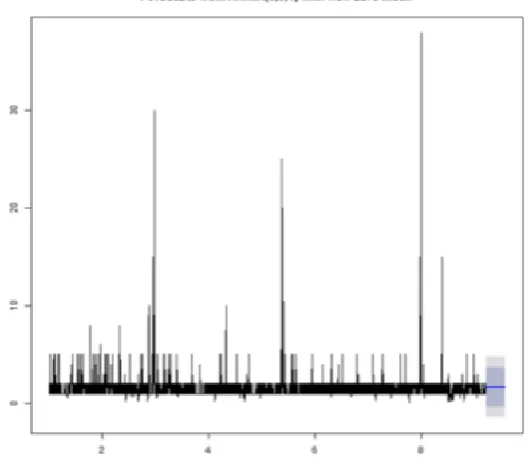
Here in this research we used a dataset with daily sales information. Therefore it is in a time series that consists of single observations recorded sequentially over equal time increments which is called as univariate time series. In time series analysis, the moving-average (MA) model is a common approach for modeling univariate time series. According to the dataset, ARIMA model for this research work has to be built as ARIMA (0, 0, 1) which indicates MA(1) .We focuses on a monthly forecasting, therefore a time series is created and applied to the ARIMA model as follows.
myTs <- ts(x$QTYsold, start = 1, frequency = 12) fit.arima <- arima(myTs, order = c(0, 0, 1))
Following represent the forecasting for the next month.
fore <- forecast(fit.arima, h = 1)
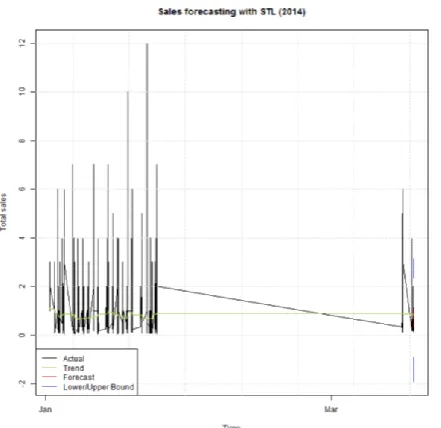
A general sales forecasting can be done using above ARIMA model. But when considering sales, it may differ according to several time periods within the year. For example in Sri Lanka New Year time period, Christmastime period are some seasons that increase product sales. During these seasons number of sales is more when considering with normal time periods. Therefore forecasting for such seasonal periods should be done separately. For that purpose this research focused on another model which is Seasonal and Trend decomposition using Loess (STL) model. This is a very versatile and robust method for decomposing time series. STL handles any type of seasonality not only monthly and quarterly data. The seasonal component is allowed to change over time and the rate of change can be controlled by the user. Considering all the facts we used STL model to decompose the time series and used it for sales forecasting with a confidence level of 95% as follows.
myTs <- ts(x$QTYsold, start = 1, frequency = 256) fit.stl <- stl(myTs, s.window = 256)
sts <- fit.stl$time.series trend <- sts[, "trend"]
fore <- forecast(fit.stl, h = 30, level = 95)
Within this research work we tried to perform sales forecasts using both ARIMA and STL models to improve the accuracy of the forecasts.
III.
RESULTS AND DISCUSSIONFollowing diagrams shows the output graphs of sales forecasting done within this research work. According to the dataset that considered for the forecasting, sales forecasts can be received as follows under distributor wise, outlet wise and category wise.
Figure 1. Forecasting from ARIMA(0,0,1) with non-zero
Figure 2. Sales forecasting with STL (2014)
In Figure 2 sales forecasting with STL decomposition is done. Here graph shows four kinds of deviations. They are Actual, Trend, Lower/Upper Bound and forecasting.
To measure accuracy of the forecast, we used forecast error. The forecast error is the difference between the actual value and the forecast value for the corresponding period.
Et = Yt – Ft where,
E = the forecast error art period t Y = the actual value at period t F = the forecast for period t
To calculate the accuracy we use the forecasted value for March 2014 wih its actual sales value. Then we can get E = 0.15. As a percentage we get forecast error as 8.8%. Therefore this sales forecast has an accuracy rate of 91.2%. Sales forecasting along with ARIMA and STL models has showed a high accuracy rate.
In salesperson performance analysis, usage of “DSI VLink Helper” application is obtained by both daily and weekly basis which is useful in overall determination of usage of “DSI VLink Helper” application.
Figure 3. Salesperson performance analysis
IV.
CONCLUSION
Within this research work, an innovative approach is made to improve efficiency and effectiveness of sales force in order to increase sales productivity. This approach will assist most of the FMCG companies to improve their sales productivity. There are different aspects to be focused. This research work addressed several aspects that can be used to increase sales productivity of a company with respect to improvement in sales force engagement.
V.
ACKNOWLEDGEMENT
The authors would like to acknowledge the Sri Lankan FMCG company which provided the necessary data for this study.
VI.
REFERENCES
[1]. Jones, E., Brown, S. P., Zoltners, A. A., & Weitz, B. A., The changing environment of selling and sales management, Journal of Personal Selling and Sales Management, 2005, pp.105-111.
[2]. Clark, P., Rocco, R.A., & Bush, A.J., "Sales force
automation systems and sales force
agenda" Journal of Relationship Marketing, 2007, pp.67-87.
[3]. Buttle, F., Ang, L., & Iriana, R., Sales force automation: review, critique, research agenda, International Journal of Management Reviews, 2006, pp. 213-231.
[4]. Aberdeen Group, "Mobile sales force effectiveness. Strategies beyond mobility utilization", Mobile SFA Benchmark Report,
2007, Available:
http://www.salesforce.com/assets/pdf/datasheet s/MobileSalesForce_effectiveness.pdf Accessed: March 8 2015]
[5]. Robert L. Engle and Michael L. Barnes, Journal of Business & Industrial Marketing: Sales force automation usage, effectiveness, and cost‐
benefit in Germany, England and the United States, Vol. 15 Issue: 4, MCB UP Ltd, 2000, pp.216-241.
[6]. E.Scornavacca, S.Huff, H.Hoehle and
A.Sutherland, Strategy, Adoption and
Competitive Advantage of Mobile Services in the Global Economy: Perceptions of the Impact of Mobile Sales Force Automation on Salespeople’s Performance, Western Illinois University USA: In Lee, 2012, pp.189-202. [7]. Murat Serdaroglu, Sales force automation use
and salesperson performance, University of Paderborn, 2010, pp.1-10.
[8]. David J. Faulds, Jian Guan, Robert M. Barker and Stephen F. Gohmann, Sale Force Automation Systems: The Correspondence Between The Perception Of Productivity Gains And The Perception Of Management Control Among Salespeople, Vol. 11, 2007.
[9]. Next Generation Technologies. Online].
Available: www.negete.com/msales Accessed: January 15 2015]
[10]. X-ONT Software. Online]. Available:
www.xontworld.com/fieldpro.html Accessed: January 15 2015]
[11]. Fizel Jabir, "Prima Management Services introduces Sales Force Automation", November
28 2013. Online]. Available:
http://www.dailynews.lk/?q=business/prima- management-servicesintroduces-sales-force-automation. Accessed: January 15 2015]
[12]. Winmate Newsletter, "Successful Case Coca-Cola Sales Force Automation", March 19 2014.
Online]. Available:
http://www.winmate.com.tw/newsletter/Newsl etter20140319.htm Accessed: January 15 2015] [13]. Capterra, "Top Sales Force Automation
Software products", Available:
http://www.capterra.com/sales-force-automation-software/ Accessed: January 15 2015]
[14]. Robert M. Barker, Stephan F.Gohmann, Jian Guan, David J. Faulds, Business Horizons: Why is my sales force automation system failing? , Vol. 52 Issue:3, Elsevier, 2009, pp.233-241. [15]. Earl D. Honeycutt Jr., Tanya Thelen, Shawn