Development and Alignment of a Domain-Specific Ontology for Question
Answering
Shiyan Ou
1, Viktor Pekar
1, Constantin Orasan
1, Christian Spurk
2, Matteo Negri
3Research Group in Computational Linguistics, University of Wolverhampton, UK1 German Research Centre for Artificial Intelligence GmbH (DFKI), Germany2
Fondazione Bruno Kessler – FBK, Italy3
E-mail: {Shiyan.Ou; V.Pekar; C.Orasan}@wlv.ac.uk, [email protected], [email protected]
Abstract
With the appearance of Semantic Web technologies, it becomes possible to develop novel, sophisticated question answering systems, where ontologies are usually used as the core knowledge component. In the EU-funded project, QALL-ME, a domain-specific ontology was developed and applied for question answering in the domain of tourism, along with the assistance of two upper ontologies for concept expansion and reasoning. This paper focuses on the development of the QALL-ME ontology in the tourism domain and its alignment with the upper ontologies – WordNet and SUMO. The design of the ontology is presented in the paper, and a semi-automatic alignment procedure is described with some alignment results given as well. Furthermore, the aligned ontology was used to semantically annotate original data obtained from the tourism web sites and natural language questions. The storage schema of the annotated data and the data access method for retrieving answers from the annotated data are also reported in the paper.
1.
Introduction
With the appearance of Semantic Web technologies, it becomes possible to develop novel, sophisticated question answering systems, where ontologies are usually used as the core knowledge component. An ontology is a specification of a conceptualization (Gruber, 1993). There are two types of ontology: domain ontology and upper ontology. A domain ontology (or domain-specific ontology) represents a set of concepts which are specific to a domain and the relationships among these concepts. An upper ontology describes common concepts that are generally applicable across a wide range of domains. Several standardized upper ontologies are available for public use, such as WordNet (Fellbaum, 1998), SUMO (Niles & Pease, 2001), and OpenCyc (Lenat, 1995). A domain ontology is used in restricted-domain question answering systems to formalize domain knowledge and represent natural language questions and underlying unstructured information sources. Meanwhile, one or more upper ontologies are usually used as complements of the domain ontology to augment the available domain resources through semantic connections and definitions. This paper focuses on the development of a domain ontology and its alignment to the upper ontologies, carried out in the QALL-ME1 project.
QALL-ME is an EU-funded project which aims to establish a shared infrastructure for multilingual and multimodal question answering in the tourism domain. The QALL-ME system allows users to pose natural language questions in several languages (both in textual and speech modality) using a variety of input devices (e.g. mobile phones), and returns a list of specific answers formatted in the most appropriate modality, ranging from small texts, maps, videos, and pictures. In order to achieve
1 http://qallme.fbk.eu/
the project’s objectives, a domain-specific ontology for the tourism domain was developed and shared among all the partners. The main purpose of the ontology is to provide a common vocabulary for the tourism domain as well as a computerized specification of the meaning of terms used in the vocabulary to enable knowledge sharing and reuse among the partners and succeeding researchers. The ontology will be made incrementally available for research purposes on the project’s website, once new versions will be developed. Since the ontology is domain specific, this means that it does not contain general concepts which are applicable to a wide range of domains. In order to address this problem, the QALL-ME ontology was aligned with two upper ontologies, WordNet and SUMO, which are widely used in the NLP field. Due to the changing nature of the QALL-ME ontology throughout the life of the project, automatic means for performing this mapping were investigated. After the ontology was designed, it was used to semantically annotate original data obtained from the tourism web sties and natural language questions created by users. The annotated data was stored in the database as instances of the ontology, and a data access method was provided to retrieve specific content from the database for answering the user’s questions.
The subsequent sections are organized as follows: Section 2 reviews the related ontologies developed in the previous projects. Section 3 presents the development of the QALL-ME ontology. Section 4 presents the alignment of the QALL-ME ontology to WordNet and SUMO. Section 5 describes the storage and retrieval of the ontology data, and Section 6 presents the summary and conclusion.
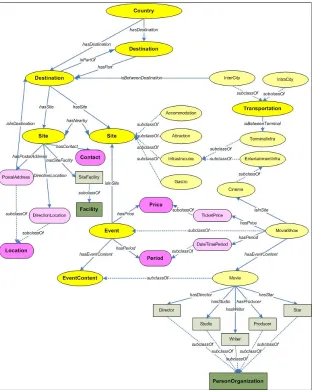
• Ellipse, rectangle, and rounded rectangle boxes respectively represent main classes, element classes, and attribute classes, and highlighted classes in bold are top-level classes.
• Solid lines represent properties, and dot lines represent subclasses.
Figure 1: The main classes and some of their important relationships in the QALL-ME ontology
From the point of application, the instances of attribute classes and element classes cannot exist independently, and must be attached to an instance of the main classes or other element classes. The main classes and their relationships with some element and attribute classes in the QALL-ME ontology are shown in Figure 1.
A country must contain at least one destination (i.e.
∃hasDestination some Destination), and a destination must belong to a country (i.e. ∃isInCountry some
Country). A destination may be a part of a bigger destination (i.e. isPartOf) or may contain several smaller destinations (i.e. hasPart). A destination must contain at least one site (i.e. ∃hasSite some Site). A site can be accommodation, gastro, attraction or infrastructure. It may have some nearby sites (i.e. hasNearby). A site may host one or more events (i.e. hasEvent). Transportation is used to connect two terminals which are a kind of infrastructure (i.e. isBetweenTerminal).
QALL-ME SUMO WN2.1 WN2.1 Gloss
Accommodation @inhabits =02647858 living quarters provided for public convenience; "overnight accommodations are available"
Chalet @Building =02973228 a Swiss house with a sloping roof and wide eaves or a house built in this style
GasStation @Corporation =03388513 a service station that sells gasoline Location =located =00026074 a point or extent in space
PostOffice @Organization =08034771 an independent agency of the federal government responsible for mail delivery
Ship @TransportationDevice = 04145707 a vessel that carries passengers or freight
Table 2: Sample alignments between QALL-ME, WordNet 2.1 and SUMO
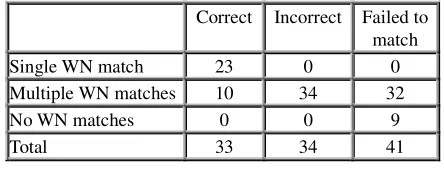
To evaluate the alignment quality of this algorithm, we compared the automatically generated alignments against the manually produced alignments between the two ontologies, which were considered as a gold standard. Table 1 summarises the results of the evaluation.
While the overall accuracy of the alignment is clearly suboptimal (precision of 49% and recall of 31%), we noticed that for concept names with unambiguous matches in WordNet the algorithm performs without any errors. Ambiguous concept names are the major source of errors. Concept names without any WordNet matches are relatively few, but they also cannot be reliably assigned to a WordNet synset. An evident reason for poor disambiguation quality seems to be the fact that at the moment the QALL-ME ontology is rather shallow (maximum depth is 4 edges), which, even after distance normalisation, does not provide reliable estimates of the semantic distance between concepts. Furthermore, only a few concepts have comments that are usable for definition similarity.
Based on that, we developed a semi-automatic alignment procedure, whereby unambiguous matches were aligned automatically, multiple WordNet matches were disambiguated by a human, and concept names without any matches were aligned completely manually. Table 2 gives some examples of the alignments we obtained (‘=’ indicates equivalence and ‘@’ subsumption). We expect that if the QALL-ME ontology acquires a deeper structure and more comments are added to its concepts, the disambiguation step might yield better accuracy and eventually the disambiguation step can be partially automated.
5.
Storage and Retrieval of Ontology Data
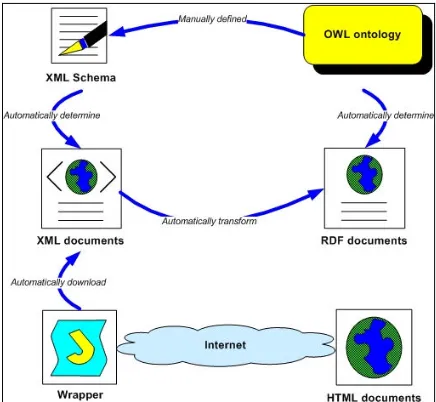
To make an ontology applicable in a real system, an underlying data model is needed to store records about the things defined in the ontology. There are different ways of storing and encoding sets of records. We used a graph model, RDF, which represents data as a collection of triples in the form of <subject, predicate, object>. Once the QALL-ME ontology was developed and aligned, the original tourism data, which are possible answers to user questions, were annotated using the ontology andrepresented as the RDF triples. For the structured data obtained in XML or database formats, a mapping between XML tags or table fields to the classes and relations in the ontology was created and used to convert the structured data in other formats into the RDF format directly. For the unstructured data which were obtained as HTML pages taken from tourism web sites, a set of wrappers were developed to locate snippets of useful information, and annotate them semantically using XML tags. For each kind of data (e.g. Hotel, Cinema and Movie) which corresponds to a class in the ontology, an XML schema was designed according to the OWL ontology. The XML files for storing this kind of data must conform to the corresponding XML schema. Finally, the data was transformed from the XML format to the RDF format using XSLT, and thus the RDF data became the instances of the QALL-ME ontology. The annotation procedure is shown in Figure 2.
Figure 2: The procedure for data annotation
For the application of question answering, response time is a crucial issue, especially for the enormous amount of data. Thus the storage system must have good scalability and efficiency. Furthermore, the system should provide sufficient reasoning capability to support the semantic requirements of the application. Considering the above requirements, we selected Jena2 as the storage system and the SPARQL query language as the data retrieval method. Jena2 has some unique features (e.g. denormalized database schema, arbitrary property tables, optimized storage for reification), which make it an efficient storage solution (Wilkinson et al., 2003). SPARQL is a RDF query language, which has become a WC3 recommendation (Prud’hommeaus & Seaborne, 2008).
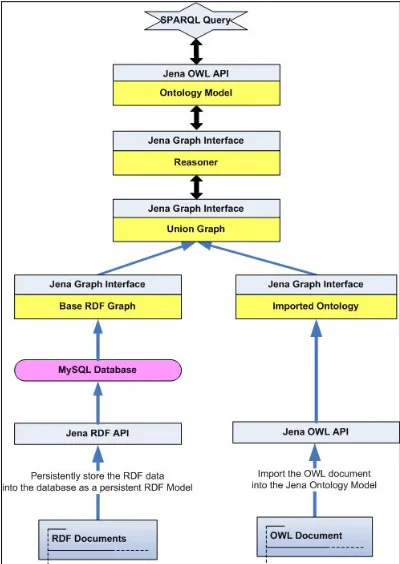
Jena2 supports in-memory storage and database storage. Storing data in a file system is the simplest but also the most inefficient technique for storing data because the whole file has to be scanned and all the data has to be loaded into the computer’s main memory for each-time running. It is quite efficient for a small amount of data but not able to handle large data. We therefore imported the RDF data into a MySQL-persistent database using Jena2. In contrast to the in-memory storage, the database-persistent storage saves the overhead of loading the data into the model each time, and the RDF models significantly larger than the computer’s memory can be stored too. The latter, however, comes at the expense of a higher overhead (a database interaction) to retrieve and update RDF data from the model. Figure 3 shows the architecture for data storage and data access using Jena2.
Figure 3: Data storage and data access using Jena2
The RDF documents were loaded into the RDF model, which was then persistently imported into the MySQL relational database, through the Jena RDF API. The RDF data stored in the database is called Base RDF Graph
which holds the asserted statements. The OWL ontology document which only defines the classes and properties in the domain is imported from the file system through the Jena OWL API. The OWL model, called Imported Ontology, was not persisted in the database because the meta-model will often be updated and the file size is very small and easy to load. The Base RDF Graph and the
Imported Ontology form the Union Graph. Jena’s
Reasoner can use the contents of the Base Graph and the semantic rules of the OWL language to derive additional statements that the model does not express explicitly. SPARQL queries were operated on the Ontology Model to retrieve specific pieces of data from it.
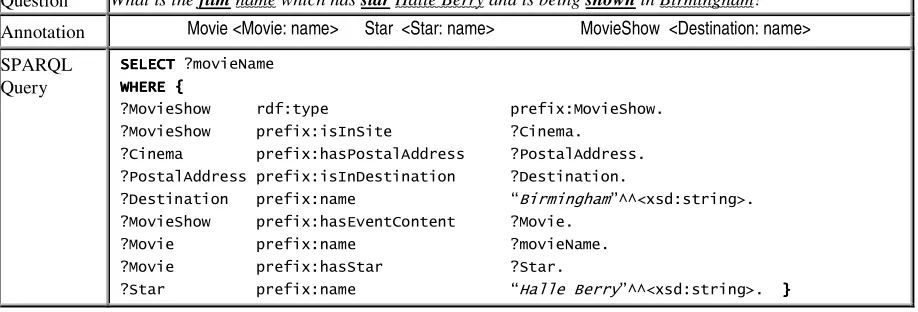
To extract answers from the RDF database, a natural language question needs to be transformed into a SPARQL query. It is a difficult task involving complex semantic annotation of the question with the use of the defined ontology. Various methods to automatically perform such annotation and transformation are being investigated in the QALL-ME project, e.g. Negri, Magnini & Kouylekov (2008) and Ou et al. (2008), which are out of the scope of this paper. A simple example is given in Table 3 to show how to annotate the words and phrases in the question using the concepts and properties defined in the ontology and create a SPARQL query.
6.
Summary and Conclusion
The paper presents the development of a tourism ontology which aims to support multilingual Question Answering. In contrast to other ontologies in the same domain, this ontology has a bigger scope in that it covers more aspects of the domain. The ontology was encoded in OWL DL, an ontology language having richer expressive and reasoning power than other ontology languages. Furthermore, the ontology was aligned with WordNet and SUMO, two upper ontologies, to expand concepts defined in the domain.
The tourism data was mainly obtained as HTML web pages, and semantically annotated based on the ontology and thus converted into the RDF format as the instances of the ontology. We stored the annotated data persistently in a MySQL database using Jena2. The SPARQL query language was used to access and manipulate the annotated data. In the future, we will explore other storage solutions (e.g. Jena2’s SDB10 and Sesame) and compare their efficiency. Natural language questions can be annotated using the aligned ontology and transformed into SPARQL queries to retrieve answers from the database. Various methods performing such annotation and transformation are being investigated in the QALL-ME project.
10
Question What is the film name which has star Halle Berry and is being shown in Birmingham?
Annotation Movie <Movie: name> Star <Star: name> MovieShow <Destination: name>
SPARQL Query
SELECT SELECT SELECT
SELECT ?movieName WHERE
WHERE WHERE WHERE {{{ {
?MovieShow rdf:type prefix:MovieShow. ?MovieShow prefix:isInSite ?Cinema.
?Cinema prefix:hasPostalAddress ?PostalAddress. ?PostalAddress prefix:isInDestination ?Destination.
?Destination prefix:name “Birmingham”^^<xsd:string>. ?MovieShow prefix:hasEventContent ?Movie.
?Movie prefix:name ?movieName. ?Movie prefix:hasStar ?Star.
?Star prefix:name “Halle Berry”^^<xsd:string>. }}}}
Table 3: Semantic annotation of a question based on the aligned QALL-ME ontology and its SPARQL query
7.
Acknowledgements
This work is supported by the EU-funded project QALL-ME (FP6 IST-033860).
8.
References
Antoniou, G. & van Harmelen, F. (2004). Web Ontology Language: OWL. In S. Stabb & R. Studer (Eds.), Handbook on Ontologies. Heidelberg, Germany: Springer, pp. 67-92.
Arroyo, S., Lara, R., Ding, Y., Stollberg, M. & Fensel, D. (2004). Semantic Web Languages: Strengths and Weakness. In Proceedings of the International Conference in Applied Computing.
Bozsak et al. (2002). KAON: Towards a Large Scale Semantic Web. In Proceedings of the 3rd International Conference on Electronic Commerce and Web Technologies. Heidelberg, Germany: Springer, pp. 304-313.
Broekstra, J., Kampman, A. & van Harmelen, F. (2002). Sesame: A Generic Architecture for Storing and Querying RDF and RDF Schema. In Proceedings of the 2nd International Semantic Web Conference. Heidelberg, Germany: Springer, pp. 54-68.
Clissmann, C. & Höpken,W. (2004). Harmonise Ontology User Manual, Retrieved 5 March, 2008, from http://www.harmo-ten.info/harmoten_docs/D2_2_Ont ology_User_Manual_V3.2.0.3.doc
Fellbaum, C. (ed.) (1998). WordNet, An Electronic Lexical Database. Cambridge, MA: The MIT Press. Gruber. T. R. (1993). A translation approach to portable
ontologies. Knowledge Acquisition, 5(2), pp. 199-220. Hahn, U. & Schattinger, K. (1998). Towards Text
Knowledge Engineering. In Proceedings of the 15th National Conference on Artificial Intelligence. Menlo Park, CA: AAAI Press, pp. 524-531.
Legrand, B. (2004). Semantic Web Methodologies and Tools for Intra-european Sustainable Tourism. White paper. Paris: Mondeca.
Lenat, D. B. (1995). Cyc: A large-scale investment in knowledge infrastructure. Communication of the ACM,
38(11), pp. 33-38.
Manning, C. & Schuetze, H. (1999). Foundations of Statistical Natural Language Processing. Cambridge, MA: The MIT Press, pp. 299.
Negri, M., Magnini, B. & Kouylekov, M. (2008).Detecting Expected Answer Relations through Textual Entailment. In Proceedings of the 9th International Conference on Intelligent Text Processing and Computational Linguistics. Heidelberg, Germany: Springer, pp. 532-543.
Niles, I. & Pease, A. (2001). Towards a Standard Upper Ontology. In Proceedings of the 2nd International Conference on Formal Ontology in Information Systems. New York, NY: ACM, pp. 2-9.
Ou, S., Orasan, C., Mekhaldi, D. & Haslser L. (2008). Automatic Question Pattern Generation for Ontology-based Question Answering. In Proceedings of the 21st International Florida Artificial Intelligence Research Society Conference. Menlo Park, CA: AAAI Press.
Prud’hommeaux, E. & Seaborne, A. (2008). SPARQL Query Language for RDF. WC3 Recommendation 15 January 2008. Retrieved 14, March, 2008, from http://www.w3.org/TR/rdf-sparql-query/.
Staab, S. et al. (1999). GETESS – Searching the Web Exploiting German Texts. In Proceedings of the 3rd International Workshop on Cooperative Information Agents III. Heidelberg, Germany: Springer, pp. 113-124. Wilkinson, K., Sayers, C., Kumo, H. & Reynolds, D.
(2003). Efficient RDF Storage and Retrieval in Jena2. In Proceedings of the 1st International Workshop on Semantic Web and Databases. Berlin, Germany: Humboldt-Universität, pp. 131-150.
Wood, D., Gearon, P. & Adams, T. (2005). Kowari: A Platform for Semantic Web Storage and Analysis. In Proceedings of XTech 2005 Conference.