Modelling Word Similarity.
An Evaluation of Automatic Synonymy Extraction Algorithms.
Kris Heylen
∗, Yves Peirsman
∗†, Dirk Geeraerts
∗, Dirk Speelman
∗∗QLVL - University of Leuven,†Research Foundation - Flanders
Blijde-Inkomststraat 21, PO Box 3038, 3000 Leuven (Belgium) {kris.heylen, yves.peirsman, dirk.geeraerts, dirk.speelman}@arts.kuleuven.be
Abstract
Vector-based models of lexical semantics retrieve semantically related words automatically from large corpora by exploiting the property that words with a similar meaning tend to occur in similar contexts. Despite their increasing popularity, it is unclear which kind of semantic similarity they actually capture and for which kind of words. In this paper, we use three vector-based models to retrieve semantically related words for a set of Dutch nouns and we analyse whether three linguistic properties of the nouns influence the results. In particular, we compare results from a dependency-based model with those from a 1st and 2nd order bag-of-words model and we examine the effect of the nouns’ frequency, semantic speficity and semantic class. We find that all three models find more synonyms for high-frequency nouns and those belonging to abstract semantic classses. Semantic specificty does not have a clear influence.
1.
Introduction
One of the major challenges in the development of com-putational language resources is the modelling of natural language semantics. The retrieval of semantically similar words is essential for the automatic extraction or extension of thesauri, but also for query expansion modules in infor-mation retrieval applications. Within statistical NLP, the task of finding meaning related words has been succesfully approached with so-called vector-based models of lexical semantics. They rely on the assumption that words with a similar meaning tend to occur in similar contexts and, con-sequently, that a word’s meaning can be modelled as a func-tion of the contexts it occurs in. In practice, these models cull statistics about the co-occurence of a word with a large number of context features from large corpora and put these into a vector. The semantic similarity between two words is then quantified as the similarity between their respective context vectors.
Although all vector space models are based on the same underlying assumption, they do come in many different flavours. The main difference between them lies in how they define the central notion ofcontext. The first models were so-called document-based models with Latent Seman-tic Analysis (Landauer and Dumais, 1997) as best known example. They used whole documents or paragraphs as contexts so that words that often co-occurred in documents appeared as semantically similar. For extracting tight se-mantic relations like synonyms, word-based models have become more popular in recent years and they will be the focus of this study. Word-based models restrict contexts to the words in near proximity to the target words for which they try to find related words. For these models, two words will be similar if they often co-occur with the same con-text words, but unlike document-based models, they do not expect target words to co-occur regularly with each other. Even within the broad class of word-based models, differ-ent definitions of context are used. One option is simply to look at the context words that appear in a pre-defined window around the target word. The context features are
in this case the so-called first order co-occurrences of the target (Levy and Bullinaria, 2001). Because these models do not differentiate between the context words within the context window, they are often called bag-of-words mod-els. A second order bag-of-words-model (Sch¨utze, 1998) makes use of the second order co-occurrences, i.e. the con-text words of the first order co-occurrences, and by doing so should allow to generalise over meaning related con-text words and avoid data sparseness. Finally, a third op-tion (Lin, 1998) (Pad´o and Lapata, 2007) only takes those context words into account that stand in a specific syntactic dependency relation to the target word. In this case, only context words like verbs governing a target noun in its sub-ject function, or adsub-jectives modifying the target are counted as context features.
It is clear that these different types of context features are likely to capture different kind of semantic information. However, so far, little is known about the influence of the context definition on the semantic information present in the vector spaces. While most researchers choose one spe-cific vector space model and apply it to their task, “compar-isons between the ... models have been few and far between in the literature” (Pad´o and Lapata, 2007). Yet, without any knowledge of the linguistic characteristics of the models, it is impossible to know which approach is best suited for a particular task, and why. In previous studies (Peirsman et al., 2007) and (Peirsman et al., 2008), we evaluated the overall performance of the three types of word-based mod-els mentioned above and we analysed the semantic relations that they retrieved. However, in these studies we did not take into account that models might behave differently for different classes of target words. Yet, both for thesaurus ex-traction and query expansion it is vital to know whether the algorithms work equally well for all types of target words. In this study we therefore take a closer look at three proper-ties of the target words, viz. frequency, semantic specificity and semantic class, and we analyse whether they influence the performance of the three models.
three vector-space models. Section 3. first presents the eval-uation measures we used and than dicusses, consecutively, the influence of frequency, semantic specificity and seman-tic class on the peformance of the three models. In sec-tion 4. we wrap up with conclusions and some suggessec-tions for future research.
2.
Set-up
Our experiments compare three types of word-based vector space models: a first-order and second-order bag-of-words model and a dependency-based model. The data for these models consists of the 300 million word Twente Nieuws Corpus of Dutch lemmatised and parsed newspaper text1.
We extracted from the lemmatised corpus the 10,000 most frequent nouns and their context vectors and then calculated for each target noun the single most similar noun among the remaining 9,999 possibilities, which we will designate as the target’snearest neighbour. The parameters of the three models were set as follows:
Dimensionality Only the 4,000 most frequent features were used.
Context Window For the first and second order co-occurrence approaches, a context window of three words on either side of the target word was used.
Weighting scheme Context vectors contained the point-wise mutual information between the feature and the target, rather than raw frequency.
Frequency cut-off With second-order and first-order co-occurrences, only those features that occurred at least five times together with the target word were counted. For the syntactic model no such a cut-off was used to avoid data sparseness.
Similarity metric The cosine of the angle described by two context vectors was used to measure the similarity between these vectors.
Stop list For the 1st and 2nd order co-occurrence models, semantically empty words were not feauture candi-dates. For the syntactic model, no such stop list had to be used because of the imposed dependency rela-tion.
Syntactic relations For the syntactic model, 8 syntactic relations were taken into account2:
1. subject of verbv
2. direct object of verbv
3. prepositional complement of verb v introduced by prepositionp
4. head of an adverbial PP of verbvintroduced by prepositionp
5. modified by adjectivea
1
Parsing was done at the University of Groningen with the Alpino dependency parser for Dutch (van Noord, 2006)
2Each specific instantiation of the variablesv,p,a, ornled to
a new context feature
6. postmodified by a PP with headn, introduced by prepositionp
7. modified by an apposition with headn
8. coordinated with headn
dependency 1° b.o.w. 2° b.o.w. cohyponym hypernym hyponym synonym
models
semantic relations (percentage)
0.0
0.2
0.4
0.6
0.8
1.0
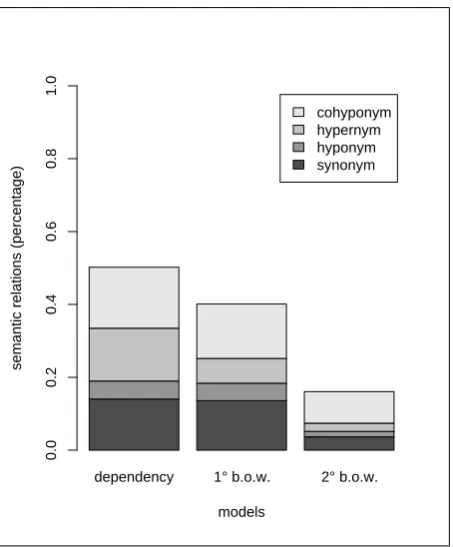
Figure 1: General performance of the three models
3.
Results and discussion
For all three models, we performed two types of evalua-tion: overall performance and specific semantic relations retrieved. As a gold standard, the Dutch part of EuroWord-Net (Vossen, 1998) was used. Like its English counterpart, EuroWordNet is a lexical database structured as a hierarchi-cal network of concepts. The Dutch section of EuroWord-Net contains 44K synsets, which is a fair bit sparser than English WordNet (117K synsets) and which, as we will see, will influence the results. Our evaluations are based on the target-neighbour pairs retrieved by the three models and of course only pairs with both the target and nearest neighbour present in EuroWordNet can be assessed. For the dependency-based model, 7479 pairs out of the poten-tial 10,000 were present in the database and could be re-tained for further analysis. For the first and second order bag-of-words models this figure was 6776 and 6727 pairs respectively.
cohyponym hypernym hyponym synonym
log frequency
semantic relations (percentage)
0.0
0.2
0.4
0.6
0.8
1.0
6−7 7−8 8−9 9−10 10−12 6−7 7−8 8−9 9−10 10−12 6−7 7−8 8−9 9−10 10−12
dependency 1° bag−of−words 2° bag−of−words
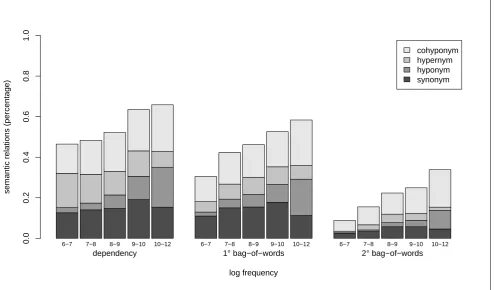
Figure 2: Effect of Frequency
systems. All three regression models are highly significant (LRdep = 321,LR1bow = 297,LR2bow = 282, all three
withp < .01) and show significant (p < .01) higher odds in favour of synonyms (+22%dep,+26%1bow,+40%2bow),
hyponyms (+90%dep,+91%1bow,+135%2bow) and
cohy-ponyms (+26%dep, +33%1bow, +45%2bow) with each 1
unit increase in log frequency. For hypernyms, the effect was not significant for the dependency-based model, but the odds did increase significanly for the first (+31%) and second (+47%) order bag-of-words model. Comparison of the95%confidence intervals learns that the impact of fre-quency on finding synonyms was significantly stronger for the second order bag-of-words model than for the depen-dency based model. As we already saw for overall perfor-mance, the best performing model, viz. the dependency-based model, seems less sensitive to the frequency of the target words.
3.2. Influence of semantic specificity
Words can differ in terms of their semantic specificity: A word likecraftis a much more general term than say hy-droplane or space shuttle. To assess whether semantic specificity influences the overal performance of our three models, we calculated the correlation between the Wu & Palmer score for target-neighbour pairs and the target’s depth in the conceptual hierarchy of EuroWordNet. Since this hierarchy goes down from general concepts to more specific ones, the depth in the hierarchy is an indicator of semantic specificity6. In EuroWordNet this depth
var-6If a target word occurred at different depths due to polysemy,
we took the minimal depth as a conservative estimate for semantic
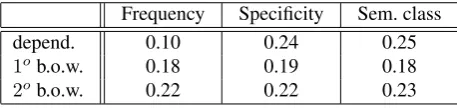
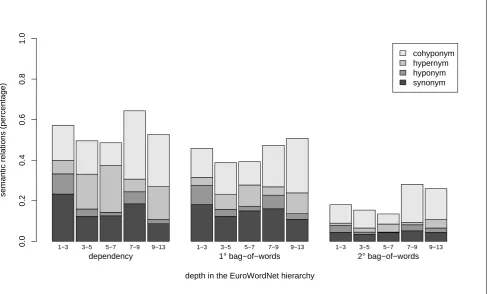
ries from 1 to 13. The second column in Table 1 shows a moderate positive, but significant correlation between the Wu & Palmer score and the depth of a target word for all three models (tdep = 21.4,t1bow = 16.3,t2bow = 18.2; p < .05). At first sight, it is easier to find semanti-cally related words for more specific target words than for more general ones. However, when we look at the spe-cific semantic relations retreived, a more complicated pic-ture emerges. Figure 3 shows the percentage of relations found at different depths for the three models and this time, there is no clear tendency to discerned. The total percentage of nearest neighbours displaying one of the four relations does not show a linear trend. Rather, the percentage de-creases at first, then goes up again for depths 7 to 9 and ends with a small drop for the most specific nouns deep down in the hierarchy. The same holds for the percentage of syn-onyms and hypsyn-onyms found: the most general nouns seem to have relatively more synonyms and hyponyms among their nearest neighbours and so do the more specific tar-get words, especially at depths 7 to 9. Looking at the data, nouns at depth 7 to 9 seem to refer mainly to persons like teacher, villainor opponent. However, it is not immedi-ately clear why it should be easier to find synonyms for person designations. The respective multinomial logistic regression models show effects that are only border signif-icant and very small. In other words, the odds of finding a specific semantic relation do not seem to be influenced by semantic specificity, at least not in a linear fashion and measured through hierarchy depth. Possibly, the presence of base level concepts in the structure of the lexicon might
cohyponym hypernym hyponym synonym
depth in the EuroWordNet hierarchy
semantic relations (percentage)
0.0
0.2
0.4
0.6
0.8
1.0
1−3 3−5 5−7 7−9 9−13 1−3 3−5 5−7 7−9 9−13 1−3 3−5 5−7 7−9 9−13
dependency 1° bag−of−words 2° bag−of−words
Figure 3: Effect of Semantic Specificity
explain this non-linearity. These will probably occur at in-termediate levels of specifity, could have a higher number of synonyms and hyponyms due to their special status and migth explain the peaks at depths 7 to 9. However, this hypothesis certainly needs further investigation.
Given the obvious lack of a linear relation it is actually rather remarkable that we still find a fairly strong correla-tion between the Wu & Palmer score and hierarchy depth, a correlation which is even slightly stronger than the one for log frequency, which did show a clear linear effect. This might be an artefact of the normalization for hierar-chy depth in the the Wu & Palmer score as can be seen in the denominater of formula 1. Wu & Palmer’s reason for this normalization was the intuition that words close to each other deep down in the hierarchy are more related than those higher up. For example,hydroplaneandjetplaneare more related thancraftandmachinealthough their relative distance in the hierarchy is similar. As a consequence, the Wu & Palmer score partially reflects how deep a target-neighbour pair is situated in the hierarchy and this might explain the fairly high correlation. Indeed, if we use inverse path length as a similarity measure, which does not nor-malise for hierarchy depth, the correlation completely dis-appears: it is then a non-significant -0.03, -0.01 and -0.01 for the dependency-based, 1st order and 2nd order bag-of-word model respectively. We can therefore conclude that semantic specificity does not have a clear influence on the performance of the three models.
3.3. Influence of semantic class
Nouns can refer to different types of concepts: objects, events, properties, locations etc. To assess whether our
models behave differently for target words from distinct se-mantic classes, we annotated each target word in our sam-ple automatically with its highest but one ancestor in the EuroWordnet hierarchy7. This resulted in 69 different
se-mantic classes, of which we only took the 10 most fre-quent into account . These were: object, event,property, situation,group, part, utterance, substance,location and thought. For target words belonging to more than one se-mantic class due to polysemy, only the most frequently oc-curring class was taken into account. To test whether the overall performance of the three models was different for different semantic classes, we performed a one-way Anal-ysis of Variance (anova) of the average Wu & Palmer score over the 10 classes. The third column in Table 1 shows the R-measure of explained variance for these three anova models8. For all three models, the anova’s were highly
sig-nificant (Fdep = 51.3, F1bow = 24.8, F2bow = 41.7, all
threep < .01) so that semantic class membership can be said to account for a substantial share of the variation in Wu & Palmer score. The anova models also showed that the average Wu & Palmer score was significantly higher forobjectsthan for all other categories (p < .01). For ex-ample, the average Wu & Palmer score forobjectsis25%
higher than forthoughts.
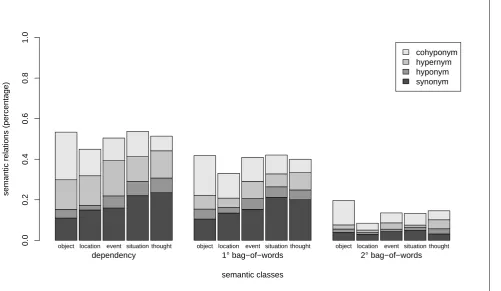
Let us then look at the specific semantic relations. Fig-ure 4 shows the semantic relations retrieved for five of the
7
The highest ancester is alwaysthing.
8For simple linear regression, this R-measure corresponds to
cohyponym hypernym hyponym synonym
semantic classes
semantic relations (percentage)
0.0
0.2
0.4
0.6
0.8
1.0
object location event situation thought object location event situation thought object location event situation thought
dependency 1° bag−of−words 2° bag−of−words
Figure 4: Effect of Semantic Class.
semantic classes. Whereas the total percentage of related neighbours does not differ markedly between the semantic classes, the relative frequency of synonyms, cohyponyms and, to a lesser extent, hyponyms does. If we zoom in on the dependency-based model and go from left to right in the figure, we see the percentage of synonyms increase steadily from 11% to 23% and the share of hyponyms from 4%
to7%, whereas the percentage of cohyponyms drops from
23%to7%. A multinomial logistic regression (model sig-nificance:LLR= 178,p < .01) confirms the significance of these differences between the semantic classes. For ex-ample, the odds of finding synonyms forthoughtsis104%
higher than those for objectswhereas the odds of finding cohyponyms forthoughtsis70%lower than those for ob-jects. The odds of finding hypernyms did not significantly differ from one semantic class to another. Am ultinomial logistic regression for the first-order bag-of-words model shows effects of semantic class that are similar, but some-what weaker, although the difference with the dependency-model is not significant. Finally, the multinomial logistic regression model for the second-order bag-of-word model shows only a significant decrease in the odds of finding co-hyponyms going fromobjectstothoughtsand no effect for the other semantic relations. Comparison of the95% con-fidence intervals shows that the effect differences between the three models are not significant. In other words, seman-tic class membership has a comparable effect on all three models.
Looking more closely at the share of synonyms and hy-ponyms when going from objects over locations, events and situations to thoughts, there seems to be an upward
trend that follows a cline from concrete to abstract se-mantic classes. In other words, relatively more synonyms are found for abstract semantic classes likesituationsand thoughtsthan for concrete ones likeobjectsandlocations.
As with the analysis of semantic specificity in the previ-ous section, we see a remarkabe discrepancy between the evaluation of overall performance and the evaluation of the specific semantic relations retrieved. The anova mod-els showed that the average Wu & Palmer scores for ob-jects is higher than for the 9 other semantic classes, e.g.