Evaluation of the PIT Corpus Or What a Difference a Face Makes?
Petra-Maria Strauß
?, Stefan Scherer
†, Georg Layher
†, Holger Hoffmann
‡?Institute of Information Technology
†Institute of Neural Information Processing
‡Medical Psychology Section, University Clinic for Psychosomatic Medicine and Psychotherapy
University of Ulm, 89069 Ulm, Germany [email protected]
Abstract
This paper presents the evaluation of the PIT Corpus of multi-party dialogues recorded in a Wizard-of-Oz environment. An evaluation has been performed with two different foci: First, a usability evaluation was used to take a look at the overall ratings of the system. A shortened version of the SASSI questionnaire, namely the SASSISV, and the well established AttrakDiff questionnaire assessing the hedonistic and pragmatic dimension of computer systems have been analysed. In a second evaluation, the user’s gaze direction was analysed in order to assess the difference in the user’s (gazing) behaviour if interacting with the computer versus the other dialogue partner. Recordings have been performed in different setups of the system, e.g. with and without avatar. Thus, the presented evaluation further focuses on the difference in the interaction caused by deploying an avatar. The quantitative analysis of the gazing behaviour has resulted in several encouraging significant differences. As a possible interpretation it could be argued that users are more attentive towards systems with an avatar - the difference a face makes.
1.
Introduction
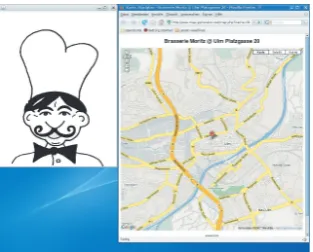
Spoken language dialogue systems are increasingly being deployed in more and more different domains and applica-tions. They are thus confronted with the challenge to meet new demands such as being aware of their users and the context in which they are interacting. The present work focuses on such a novel sort of dialogue system that acts as an independent dialogue partner in the interaction with two users. The users are having a conversation about any topic. As soon as they come to speak of the system’s spec-ified domain, the system starts listening closely and takes the initiative to interact as soon as it can contribute to the interaction. The system has been simulated as part of an extensive Wizard-of-Oz environment (Strauss et al., 2006) that has been used to record the PIT Corpus of multi-party dialogues (Strauss et al., 2008) which builds the basis of the evaluation presented in this paper. Figure 1 shows a screenshot of the system in use as it appears to the users.
Figure 1: Screenshot of the system showing the avatar and a city map.
2.
Experimental Setup
2.1. Data Recordings
The dialogues used for the evaluation have been collected in a Wizard-of-Oz environment that simulated a proactive spoken dialogue system interacting with two users in the example domain of restaurant selection. 76 dialogues were recorded over three recording sessions. The participants who took part in the recordings were not aware of the fact that the system was only a simulation. For a thorough de-scription of the setup refer to (Strauss et al., 2006). The simulated system, i.e. the wizard interaction tool (Scherer and Strauss, 2008), has been enhanced between the differ-ent recording sessions in terms of interaction speed and fea-tures. The participants filled out a questionnaire prior and subsequent to the recordings to submit their subjective es-timation of the interaction. Technical self assessment was performed which shows that all participants have a similar attitude towards technology (Strauss et al., 2008). In each interaction, one of the users was the system’s main interac-tion partner leading the interacinterac-tion with the system. Only these users’ ratings were used for the evaluation. In Figure 2 a scene recorded with three different cameras is shown. The user displayed in the left most picture is the main user.
Figure 2: Typical scene taken from recording Session III with three different camera angles.
Session I II III Total
IIIa IIIb IIIc IIId
Number of dialogues 19 20 37 76
14 11 5 7
Duration of session 3:47 h 4:18 h 5:40 h 13:45 h
Min dialogue duration 3:15 m 4:18 m 2:43 m 2:43 m
Max dialogue duration 26:11 m 33:39 m 18:24 m 33:39 m
Mean dialogue duration 12 m 13 m 9:44 m 11 m
Avatar - + + - + - 51.3%
Emotion-eliciting strategy - - - - + + 15.8%
Table 1: Statistical information of the PIT corpus.
3.2. Gaze Direction Analysis
The gaze direction of the main user has been analysed in order to assess user acceptance of the dialogue system. The difference in the behaviour of the user towards the com-puter versus towards the other human are investigated. It is further differentiated between addressing behaviour, i.e. gaze of the user while addressing the other dialogue part-ner, and listening behaviour, i.e. behaviour while listening to the other dialogue partner speak. Results of recording sessions I and II are given in the following. Between Ses-sion I and II the system has been enhanced and usability has been improved. Thus, the results have to be treated with caution as comparability of these sessions is limited. Evalu-ation of Session III (which includes both dialogues with and without avatar for direct comparison) is still ongoing, first results are presented further below. The dialogues are di-vided into three phases for this evaluation. Phase 1 denotes the part of the dialogue before the system’s first interaction. Phase 2 describes the interaction between all three dialogue partners. Phase 3 denotes the phase in the dialogue when an object other than the avatar is displayed on the screen (e.g. restaurant menu or city map).
Table 2 presents the general gazing behaviour of the main user throughout the entire dialogue and according to the different phases. It lists the mean values of the percentages of the main user’s gaze pointing to either dialogue partner, i.e. the other dialogue (U2) or the system (S), regardless of who is speaking or who is addressed. The values differ only slightly between the two setups. During Phase 1, the gaze towards U2 is predominant, as expected, as the system is not yet interacting. During Phase 2, the gaze goes more towards the system than to U2, however consistent for both setups. During Phase 3 a further object is displayed on the screen which attracts most of the U1’s gaze.
The fact that during Phase 2 the gazing behaviour towards both dialogue partners yields very similar values for both setups does not necessarily denote that the system is treated equally by the user. There is also no obvious explanation why the system is looked at more than the other user. Thus, further investigation has been performed analysing Phase 2 in terms of the current speaker. First, a look is taken at the addressing behaviour. For this, only the points are
con-no avatar (I) avatar (II)
U1 looking at S U2 S U2
Phase 1 10.0% 70.4% 9.2% 58.1%
Phase 2 51.1% 39.1% 50.8% 37.7%
Phase 3 67.4% 27.5% 77.8% 18.8%
Dialogue 44.0% 43.9% 45.0% 40.5%
Table 2: Gazing behaviour of main user (U1) towards the second user (U2) and the system (S) according to different phases of dialogue.
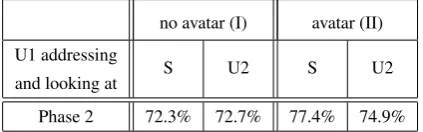
sidered when the main user U1 is addressing the respective dialogue partner. The results are shown in Table 3. It can be observed that the system is looked at slightly more when speaking to it when an avatar is deployed. The difference is however not very large and not statistically significant (p=0.23).
no avatar (I) avatar (II)
U1 addressing
S U2 S U2
and looking at
Phase 2 72.3% 72.7% 77.4% 74.9%
Table 3: Addressing behaviour of main user (U1).
Table 4 presents the results of the listening behaviour, i.e. the other dialogue partner is speaking and user U1 is looking at the speaker. The system attracts the user’s gaze significantly more when represented by the avatar (p=0.023) than if represented only by voice. The difference towards the values regarding the other user U2 is very prominent: The other dialogue partner (U2) attracts the main user’s gaze to a large extent more than the system. However, deploying an avatar shows improvement in this aspect.
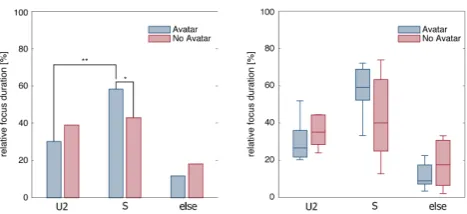
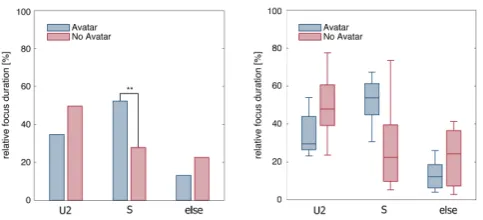
Figure 6: Gazing behaviour of main user towards either the second user (U2), the system (S) or elsewhere (else) over Phase 2 (interaction without visual information) of Session III dialogues. Significantly different results between the ob-servations with or without an avatar are marked with brack-ets on the left side figure (** ... p<.01). The mean values are displayed. On the right side figure box plots of the ob-served relative focus durations are shown.
Acknowledgment
The presented work was supported by the Transregional Collaborative Research Centre SFB/TRR 62 “Companion-Technology for Cognitive Technical Systems” funded by the German Research Foundation (DFG).
5.
References
M. Hassenzahl, M. Burmester, and F. Koller. 2003. AttrakDiff: Ein Fragebogen zur Messung wahrgenommener hedonischer und pragmatischer Qualit¨at. Mensch & Computer 2003. Interaktion in Bewegung, pages 187–196.
K. S. Hone and R. Graham. 2000. Towards a tool for the Subjective Assessment of Speech System Interfaces (SASSI). Natural Language Engineering, 6(3-4):287– 303.
H. B. Mann and D. R. Whitney. 1947. On a test of whether one of two random variables is stochastically larger than the other.Annals of Mathematical Statistics, 18:50–60. S. Scherer and P.-M. Strauss. 2008. A flexible wizard of
oz environment for rapid prototyping. In Proceedings of International Conference on Language Resources and Evaluation (LREC).
P.-M. Strauss, H. Hoffmann, H. Neumann, W. Minker, G. Palm, S. Scherer, F. Schwenker, H. Traue, and U. Wei-denbacher. 2006. Wizard-of-oz data collection for per-ception and interaction in multi-user environments. In
Proceedings of International Conference on Language Resources and Evaluation (LREC).
P.-M. Strauss, H. Hoffmann, W. Minker, H. Neumann, G. Palm, S. Scherer, H. Traue, and U. Weidenbacher. 2008. The pit corpus of german multi-party dialogues. InProceedings of LREC 2008.