A solar lantern for the rural population of Cambodia
A
NGKOR
L
IGHT
Martijn Kranen
Industrial Design Engineering
University of Twente
October 2007
Mrs. dr. Angèle Reinders – University of Twente Ir. Henry de Gooijer – Kamworks
B
ACHELOR THESIS
P
ROTOTYPING
,
REDESIGN AND PRODUCTION PLAN FOR THE
A
NGKOR
L
IGHT
A SOLAR LANTERN FOR THE RURAL POPULATION OF CAMBODIA
Martijn Kranen
Industrial Design Engineering
University of Twente
October 2007
Mrs. dr. Angèle Reinders – University of Twente
Ir. Henry de Gooijer – Kamworks
Arjen Luxwolda – Kamworks
In
regardless of the amount of extra hours per product added.Personally I experienced that living in a poor country marks the relativity of the wealth of our Western world. Our hunt for more and better things sometimes intends to overshoot in the materialistic direction. People living in the most sober circumstances with great pleasure and joy point out that ability to contribute to a sustainable product was a big consideration. During the project my view on the best way to help third world countries changed a little. We can and should provide the knowledge to help these people but should not judge the culture of a country from a strictly Western point of view. Trying to understand why people act the way the do really helps in this process and providing education can help them to develop themselves and their country.
Working with local people and attending a class at the University of Leap was a nice way to get acquainted with the Cambodian culture. At the start I was overwhelmed with the attention given to all western people, everyone was looking at us and in the more rural areas people are even waving and shouting (especially the children). After a while I got used to this phenomenon, but it was nice to see that I was not the only one seeing new things.
I had real fun with the Cambodian employees of Kamworks, with the other students and the kids at the orphanage, who were always smiling. Exploring the country by motorbike revealed a lot of things tourists
FIGURE 2: THE STU DENTS AT KAMWORKS (EXCEPT BAS)
In
tr
o
d
u
ct
io
n
normally don’t see and meeting people who normally don’t see tourists. It was a beautiful way to explore Cambodia and its natural and cultural treasures.
I want to thank the following people who helped me to complete this project: Arjen for his help and endless patience while answering a lot of questions. I also want to thank him for the constructive discussions we had about the production process. Henry for his support and critical eye while watching at a distance from the Netherland. Leap for his endless smiles and stories about Cambodia and its people and for showing us around. Sarin and Sita for their help in the workshop and a wonderful insight in the Cambodian way of living. Last but not least I want to thank Angèle Reinders for her support from the Netherland, especially helping to achieve things difficult to arrange at the University.
A special thanks goes to Loes and my family for their support and motivation while being far away from home.
Martijn Kranen
FIGURE 4:LEAP,CAMBO DIAN STUDENT, TRANSLATO R AND FRIEND
In
tr
o
d
u
ct
io
n
S
UMMARY
I
NTRODUCTIO NThis report is the result of a bachelor graduation project at the University of Twente commissioned by Kamworks, a small Cambodian company founded by the Dutch charity foundation Pico Sol. The company itself aims at the production and sale of affordable PV products for the rural consumer market in Cambodia. The project covers the prototyping, the redesign and the design of the production plan for a solar lantern.
T
HE PROBL EMCambodia is a country with limited power resources. About 90% of the Cambodian households have no access to electricity infrastructure for reliable lighting. These people are also very poor and live below the poverty line of less than 1$ per day. Needs like lightning are not obviously catered for, because of this limited power availability. The alternative, using a fuel lamp, is very expensive because of the high fuel price.
Another problem Cambodia faces is the unemployment rate. General wages are low and because of the turbulent history about 60% of the population is 20 years or younger. Job opportunities for this group are very low.
A
NALYSIS OF THE EXIS TING LANTERNThe project started at Kamworks aims to solve a part of both problems described. In association with the Delft University the first version of a solar lantern has been developed, delivering both an affordable lightning solution to the rural population and work opportunities to young Cambodians. This version of the lantern was designed by Stephen Boom in 2005 as a result of a master graduation project. The complete design process was done in the Netherland, exact for a field study of about 6 weeks. The lantern had not been produced and tested locally and exact knowledge of the Cambodian situation was not always available during the design process.
This project started with a global analysis of the situation and the problem. Next the existing prototype of the lantern was reproduced in Cambodia, followed by a general analysis of the result and the production process. Several tests were done with this prototype, including a drop test, a water test and a user test to determine deficiencies of the product.
R
EDESIGN OF THE LAN TERNUsing the requirements formulated by the company and the deficiencies found a redesign was carried out. Every aspect was looked after, but special attention was given to a low price for the product and the possibility to produce it locally. Inquiries were done to obtain the lowest price for components used.
In
tr
o
d
u
ct
io
n
D
ESIG N OF TH E PRODUCTI ON PLANThe production of a product in Cambodia differs a lot from a situation in the Netherland. Production aspects like availability of machines and labour were examined and potential problems were investigated. Based on the findings the design of the product was altered and a production plan was made. Several tools including moulds and bending aids were designed and tested. An scheme was made to describe the assembly of the total product.
R
ESULTSIn
3.2 Recommendations and results out of previous research ... 19
3.3 Reproducing the prototype ... 20
3.4 Prototype testing ... 25
3.5 Competitors ... 27
3.6 Standards ... 28
3.7 Changed boundary conditions ... 29
3.8 List of requirements of the Angkor Light ... 30
In
tr
o
d
u
ct
io
n
4.14 Materials ... 44
4.15 Colours ... 45
4.16 Cost price... 45
4.17 Packaging ... 47
4.18 The final product... 48
5
P
RODUCTION... 51
5.1 Introduction... 51
5.2 Production situation ... 51
5.3 Employees ... 51
5.4 Production equipment ... 51
5.5 Mould design ... 53
5.6 Production process ... 55
5.7 Metal parts ... 56
5.8 Production guide ... 57
5.9 Assembly ... 59
6
C
ONCLUSIONS AND RECOMMENDATIONS... 60
6.1 Meeting the requirements ... 60
6.2 Recommendations ... 62
7
L
IST OF DEFINITIONS... 64
In
tr
o
d
u
ct
io
n
1
I
NTRODUCTION
1.1
B
ACKGROUNDThis report is the result of a bachelor project at the department of Industrial Design Engineering of the University of Twente. It covers the redesign of a solar lantern for the rural population of Cambodia. The project was commissioned by Kamworks, a small solar company in Cambodia.
1.1.1
K
A M W OR KSKamworks is a young Cambodian PV company with Dutch founders. This initiative arises out of Pico Sol, an also Dutch independent charity organization which makes an effort to help the small-scale application of solar energy in third world countries. The company itself aims at affordable PV products for the rural consumer market in Cambodia. About 90 percent of the population of this country has no access to electricity.
The goal of Kamworks is being expressed in their mission statement: “Affordable energy for sustainable development”. At the moment the main focus lies on installing so called Solar Home Systems at orphanages, churches, schools etc. These activities will be extended with the production of commercial consumer PV products.
Kamworks is located in a village named Sré Ampil, 40 km south-east from Phnom Penh, on the grounds of an orphanage (see Appendix O ). One of the problems these orphans come across is finding a job when they are leaving the orphanage. Cambodia is mainly a traditional agricultural society and children usually continue with the business of their parents. Kamworks tries to establish some jobs by employing them to produce sustainable energy products. In this way both the environment and the orphans gain profit.
The University of Twente is an entrepreneurial research university. It offers education and research in areas ranging from public policy studies and applied physics to biomedical technology. The discipline Industrial Design Engineering focuses on the design of mass produced (consumer) products. The bachelor project is the final assignment of three years of the bachelor program.
In
tr
o
d
u
ct
io
n
1.2
A
SSIGNMEN T1.2.1
B
A C KGR OU ND OF T HE P R OBLE MAt this moment the rural population of Cambodia does not have a solution for affordable permanent indoor lighting. Indoors and in improvised stores under their house people make use of kerosene lamps and lighting powered by generators and batteries. Outdoor lightning solutions only consist of small torches powered by expensive batteries. Although there is a demand for both permanent indoor and movable outdoor lightning no affordable products are available.
With five full hours of sun per day and a balanced distribution over the year, Cambodia is one of the sunniest countries in the world. Because of this fact, the potential for successful solar powered products is very high. To utilise this potential in 2005 Stephen Boom of Delft University of Technology carried out a Master thesis with the goal to design a solar lantern. In October of that year he finished this project resulting in the SOLantern. At the moment a prototype of this lantern is made, but it is not ready yet for mass production.
1.2.2
A
S S I GNM E NT DE S C R IP T I ONThe goals of this assignment are to redesign the SOLantern to make it useable and affordable for the target group and make it producible in Cambodia. The assignment consists of the analysis of the current design, the redesign of the lantern and the production plan.
At the completion of the assignment a pre-production series of about 20 pieces must be able to be produced using the designed production plan. Next extensive user tests can be performed with these products by the company.
1.2.3
SI T U A T I ON
To get a good idea of the local situation, the end users and the production capabilities the assignment will be carried out in Cambodia. A team of 6 students will be working on different parts of the lantern and its distribution system (see Appendix A for more information).
1.2.4
FR A M E W OR K
The approach that will be followed consists of several parts (Figure 6).
The general analysis consists of reading lecture and papers concerning the lantern, e.g. the reports of Stephen Boom (Boom, 2005) and Mando Rotman (Rotman, 2006). Also the local situation in Cambodia will be explored and the rural population will be questioned about the prototype.
The technical analysis will be done by the local reproduction of the prototype, by performing several tests with this prototype and by the analysis of the competitors. Also an examination about the availability of materials and a cost price analysis will be performed.
After gathering this data a redesign of the lantern will be performed to fulfil the demands. FIGURE 6: PROCESS OF THE PROJECT
In
tr
o
d
u
ct
io
n
To produce a pre-production series and a subsequent production of about 400 products the implementation of the production is carried out. This will result in the production of this pre-production series which will be used to perform some final tests.
The timeframe of this assignment will be three months.
1.3
N
AMING CONV ENTIO NG
Because the project is carried out in a country with huge differences compared to the Netherlands a general analysis about the local situation is carried out. This analysis consists of an exploration of the geographic situation, the language, the market, the energy and lightning situation. At the end of the chapter the SOLantern is introduced and placed into the local situation.
2.2
C
AMBODIACambodia is a country in South East Asia, bordered by Thailand on the west and north, Laos at the north and Vietnam at the east. It has a population of almost 15 million people (Population Reference Bureau, 2007) covering an area of 181.035 square km (World Bank, Environment Department, 2004), this is about 4.5 times the size of the Netherlands. The country is located in the tropics. Cambodia has an average minimum temperature of 23° and an average maximum temperature of 32° with almost no variation during the year (The Weather Channel, 2007).
The country is mainly known to the outside world because of the cruelties of the Khmer Rouge regime in the ’70, led by “Brother Number One” Pol Pot. Nowadays the country has still not completely overcome its history, the leaders of the regime have never been
prosecuted (Pol Pot died in freedom in 1999) and the soldiers of the regime are still walking around and could be anyone’s neighbours without them knowing.
In two weeks after the Khmer Rouge was defeated by the Vietnamese in 1978, next the Khmer Rouge started a guerrilla war which finally ended after the peace settlement in 1991. In 1993 the first democratic elections were held, but even today the country is not really a democracy because corruption and intimidation are every day’s business.
Due to the economically and technical recession during and after this period and the lack of financial support of Western countries like neighbouring country Vietnam received, Cambodia is still a low developed country.
2.3
L
ANGUAGEThe Khmer language is part of the Austro-Asiatic language group, together with e.g. Vietnamese and Mon found in Thailand, Cambodia, Burma, Vietnam and Lao (Gordon, 2005). These languages differ a lot from Western languages in sound and writing. It has a completely different kind of alphabet and several other sounds are used (see Figure 8 for an example of Khmer writing). The English education is
developing but at the time almost no one speaks it at a high level making communication with local people very difficult.
FIGURE 8:THE WO RD "CAMBODIA" IN KHMER
G
e
n
er
al
a
n
al
ys
is
2.4
M
ARKET SITUATIO N2.4.1
C
OR R U P T I ONAccording to the Corruption Perceptions Index Cambodia was ranked 151 out of 163, meaning that it belongs to the 15 most corrupt countries in the world (Transparency International, 2006). Compared to the 9th place of the Netherlands it is obvious that trade is not as straightforward as in western countries. A lot of regulations exists and officers in function don’t hesitate to ask more money purely for personal gain to get things aranged. Going higher up in the command chain will get around this problem but is time consuming.
This fact has certain implications for product development and production in Cambodia. A longer period to get the necessary paperwork has to be taken into account and even unpredictable incidental higher costs for licensing and the import of products will be possible. The gouvernment is aware of the corruption problem and is trying to organize things better for foreign companies, especially because this in the interrest of the country. But the same corruption is causing these things to change very slow.
2.4.2
SE LLI NG P R ODU C T S
Large electronic concerns do not exist in Cambodia, instead little market shops are located in a lot of villages. These shops sell a lot of different products varying from ventilators to gas stoves which make finding a certain product sometimes difficult. Prices for products are always established by bargaining.
A big problem for buyers in general is the unknown quality of a product. A brand name is no guarantee because the Cambodian market is flooded with fake Chinese products copying quality brands. A big challenge is to develop a quality product and convince the people of this fact.
G
2.5
E
LECTRICIT Y IN RURALC
AMBODIAIn the rural areas of Cambodia electricity is not an obvious presence. Over 85% of the total population of Cambodia lives in rural areas (Institut de Technologie du Cambodge, 2002) and over 85% of the total population suffers of the lack of access to the electricity grid. Together with electricity prices of 16 c/kWh in Phnom Penh and an average of 51 c/kWh in the rural areas Cambodia has one of the lowest electrification rates in Asia and among the highest electricity costs in the world (Economic Consulting Associates, World Bank,
2002).
The electricity distribution differs from the distance to a city. At the moment only 7 of the biggest cities have access to the national power grid supplying power generated by the national power company Electricité du Cambodge (EDC). It is very unlikely that this company will extend the grid to cover more than 80% of the population because of the high costs and low gain.
The second type of power suppliers are Rural Electricity Enterprises (REEs). Relatively small generators supply power to one or two villages only, making a large grid not necessary. This type of power supply is suitable for rural areas but with the average price of 51 c/kWh very expensive.
The third method consists of car batteries charged by local generator shops, but this is also an expensive solution, up to $3.5 per kWh (Economic Consulting Associates, World Bank, 2002). The batteries are not charged with the right current and with very inefficient diesel generators causing very short battery life, loss of energy and a lot of pollution.
2.6
S
OLARE
NERGYAt the moment solar energy in Cambodia is a rare phenomenon. Some small NGOs are installing Solar Home
Systems in small villages, supplying power to one to several small households to let them use some electrical
lights and perhaps a small television if affordable. These systems are often paid by foreign countries as a part of an aid project.
Solar Home Systems are an effective way to supply rural villages with electricity. The costs are generally about $1.2/kWh (Kamworks, 2007), mainly because of the high material and installation costs.
Another option is to extend the electricity grid to reach these people. This is even more expensive and the costs also depend on the distance
between the existing grid and the area that needs to be covered. Solar energy has no need for a large grid, resulting in the same cost per kW independent at every location with the same amount of radiation (Figure 10).
OUTSIDE THE PROVINCIAL TOWNS, POWER SUPPLY IS RARE AND MEAGER, WITH ONLY ABOUT 6 POPULATION, SOME 55 PERCENT USE AUTOMOBILE BATTERIES (COSTING US$ 2.0-3.5 /KWH) FOR OCCASIONAL AND LIMITED USE, OR DO WITHOUT ELECTRICITY COMPLETELY (36 PERCENT)
. WORLD BANK
(http://go.worldbank.org/C1KN2PJ7M0)
“
”
G
e
n
er
al
a
n
al
ys
is
2.7
L
IGHTNIN G IN RURALC
AMBODIALighting in the rural areas is a matter of improvisation and creative use of available resources. At the moment several kinds of lightning solutions exist.
2.7.1
TR A DI T I ONA L C
A M BODI A N LA M PThe first one is the Traditional Cambodian lamp, a simple tin fuel lamp (Figure 12). Kerosene is available throughout the country and is therefore an easy way to get some light. Besides a bad smell this solution has some other disadvantages:
Little light is produced
These kinds of lamps are unsafe because the top part becomes too hot and can fall off easily. At that moment a fire can arise. The lamp is useless in rainy conditions
Burning fuel is polluting to the environment
Due to the high fuel price the use of this kind of lighting is expensive. Families using this kind of lighting spend $20-24 per year on fuel (MIT Sloan - GLab team, 2007).
2.7.2
FLU OR ES C ENT T U BE
Some kind of electric lighting is available. Light bulbs are very energy consuming and are therefore not used. Fluorescent tubes are used instead, but little is known about electricity and its safety aspects and very bad wiring and fixation of these lights is used often. Besides this increase of the risk of short-circuit and fire several other problems with this kind of lightning exist:
Batteries are used carelessly, with the result of damaged batteries and less capacity
Batteries are being charged with the inefficient generators. The characteristics of these batteries are not taken into account while charging resulting in overload and heavy wear.
FIGURE 11:MONTHLY AVERAGES INSOLATION IN PHNOM PENH
FIGURE 13:A HANGI NG FLUORES CENT TUBE
G
e
n
er
al
a
n
al
ys
is
The charging process is very polluting because of the very inefficient generators used
2.7.3
FI S HER M A N’
S LI GHTA lighting product commonly used is the headlight for assistance by fishing or finding frogs and is powered by a small battery. A different purpose is the use as lighting inside a house. In this situation a car battery is used as power supply.
The biggest problem with this headlight is the weak light bulb. User interviews performed by Stephen Boom indicate that the bulb needs to be replaced up to 3 times a day. The fishermen spend about $10 dollar a month on charging of the battery and replacement of the light bulbs.
This product is a multifunctional; by removing the reflector the headlight is transformed into an ambient light usable for indoor lightning. This principle is used in the development of the SOLantern.
2.8
T
HESOL
ANT ERNThe lantern developed by Stephen is a sustainable solar product aimed at the needs of the rural population.
Because a rechargeable battery and a solar panel are used no extra costs are needed to keep it working. The lantern should replace the two current polluting and inefficient lighting solutions: the traditional Cambodian lamp and the fluorescent tube.
The chosen materials and production methods are supposed to make it possible to produce the lantern in Cambodia. This is not tested yet and no local manufactures are located at this moment.
At this moment only a basic prototype of the design is produced in the Netherlands. Several requirements formulated by Stephen are not evaluated yet.
G
e
n
er
al
a
n
al
ys
is
2.8.1
P
U R P OS E OF U S EThe product can be used inside the house for reading, cooking and talking and outside the house for walking and tasks like finding animals. Several general lightning categories can be determined when these tasks are analysed (Plas, 1998). To fulfil all demanded purposes the product should be able to comply with all these lighting categories (Table 1).
2.8.2
TA R GET GR OU P
The target group defined by Kamworks are:
“Poor people living in rural and developing areas without a reliable access to an electricity grid”.
Poor people are those with an income of about $1 per day. The first target market will be Cambodia because of the lack of electricity grid and the huge potential for PV products. About 5 million rural people in Cambodia (1.1 million families) belong to the target group. Monthly expenditures of these families for lighting vary from $1-3 per month (Boom, 2005). The product positioning is illustrated in Figure 16.
Symbol Light distribution Light fixation
General lighting
Evenly distributed light around the lamp in horizontal plane
Fixated on the ground
General lighting
Evenly distributed light around the lamp in horizontal plane
Fixated at the ceiling
General lighting
Big bundle of light from above
Fixated at the ceiling
Task light
Bright spot to see more details
Fixated at the ceiling
General lighting Big bundle of light
Mobile possible to carry in one hand.
Spot light very bright spot Mobile possible to carry in one hand
G
At the moment a Master thesis is written by Miriam Reitenbach about the marketing of Kamworks’ solar products. Several directions are being explored varying from fixed a market stall to altered tuk-tuks driving between villages to sell the products.
The entrepreneurs selling will also be able to repair products and give information about PV to customers. An educational program made by Jony Heerink providing general knowledge about solar energy and Kamworks’ vision is used to train these people (Heerink, 2007).
2.8.4
SE LLI NG P R I C E
The target price of the solar lantern made by Stephen Boom was estimated at $50. Several market researches confirmed this price as the maximum amount of money people are able to spend on this kind of product (MIT Sloan - GLab team, 2007) (Rotman, 2006).
The current price estimated by Stephen is almost $63 (see Table 2), this is higher than the indication of the amount of money the target group can spend on a lantern. Attention should be given to obtain an accurate prediction of the real cost price and the selling price and lowering it. This can be done by enquiring a lot of companies to get the lowest price and comparing alternatives based on price during the redesign process.
G
e
n
er
al
a
n
al
ys
is
TABLE 2: THE COST BREAKDO WN OF THE SOLANTERN
Components Price ($) Reference
Plastic components $2,77 Westward.com
Electronics $7,56 Conrad electronics
Metal components $0,09 PMB
Screws, Nuts, bolds etc $1,29 Assumption
CFL $2,10 Kamworks Chinese supplier
Battery $2,80 Kamworks Chinese supplier
Subtotal $16,61
Capital costs (machinery) $0,53 Assumption
Labor $0,25 Assumption
Transport, packaging, breakage (15%) $2,49 Business plan Kamworks
Subtotal $3,27
Distribution and marketing (14%) $6,05 Business plan Kamworks
Profit(20%) $8,64 Business plan Kamworks
Margin retailer(10%) $4,32 Business plan Kamworks
VAT(10%) $4,32 Business plan Kamworks
Subtotal $23,33
Total excl, solar panel $43,21
Solar panel: $19,50 Kamworks Chinese supplier
Te
3
T
ECHNICAL ANALYSIS OF THE
SOL
ANTERN
3.1
I
NTRODUCTIO NAfter a general analysis of situation presented in the previous chapter a technical analysis of the existing lantern will be carried out. This will be done in the following steps:
Recommendations from previous reports about the lantern are analyzed, questions are formed based on these recommendations
The prototype is reproduced locally to:
o do a user test, a drop test and a water test o analyze deficiencies of the product
o analyze problems in the production process Technical analysis of the SOLantern and its functions
A new competitor analysis is made to determine the strengths and weaknesses of the product Answers to these questions, results from these tests and conclusions from the previous chapter are
used to determine a list of requirements and wishes for the final product
This list of requirements will be a starting-point of the concept development phase and is used to check if the final product fulfils its needs.
3.2
R
ECOMMENDATI ONS AN D RESULTS OUT O F PREVIOUS RESEARCHThree reports have been written (partially) about the solar lantern. The first one is the initial master-thesis of Steven Boom about the SOLantern, the second is the internship report of Mando Rotman about Product Market Combinations (PMCs) in Cambodian rural areas and the last one is a market research project of the MIT about solar product and the marketing of them. In all of these report recommendations and points of attention are written down for further investigation. A complete list (with answers) can be found in Appendix B .The ones useful for the redesign of the lantern are extracted, put together and sorted by way to acquire the answers.
3.2.1
R
EP OR TS
T EP HE NB
OOMThe graduation assignment of Boom (Boom, 2005) was to design the SOLantern. His report is a reflection of the design process, including a general analysis of the problem, the technical aspects of the lantern and a small user evaluation at the end. Most of his considerations regarding the design are written down making it a very useful document as a start of the redesign.
A lot of research is done in the Netherland, so very few local available materials are listed. Because this is necessary to know when starting mass production in Cambodia it will be an important part to investigate.
3.2.2
R
EP OR T MA NDOR
OTM A NExtensive field research was carried out by Rotman (Rotman, 2006) to determine possible PMCs for Kamworks in the rural areas. Useful data about people’s earnings and willingness to pay where collected.
3.2.3
R
EP OR T MITTe
One prototype of the lantern is made in the Netherlands by Stephen Boom. No tests with this prototype have been done in Cambodia, only earlier prototypes have been shown to the target group. Bringing the prototype to Cambodia is very difficult and therefore no option. By producing the prototype with local machines advantages and problems will be known and can be taken into account while redesigning the product. For these reasons the prototype is reproduced using local machines and locally available materials.
Because the first prototype was not fully functional and some boundary conditions have been changed, some additions are made:
a bigger battery is used causing the bottom part to be larger
a connection to attach the solar panel is made (not implemented in the first prototype)
3.3.1
A
VA I LA BLE MA C HI NER YCambodia is a development country and therefore it is not possible to easily get every imaginable machine to produce the product. It is helpful to know which kinds of machines are available at the moment at Kamworks; this can be taken into account in the design process to make the product producible. Kamworks is able to buy some second handed machines when needed. The available machinery at Kamworks is listed in Appendix C .
The power needed is produced by the existing solar panels and an additional generator. The batteries of the solar system have a capacity of 19.2 kWh (1800 Wp), the generator is capable of producing an extra 15 kWh. The vacuum form machine needed about 4.73 kW for heating and another 0.75 kW for all other operations. All other machines used only a fraction of this amount. Because of the high start-up power needed by the vacuum forming machine and high energy use the generator must always be used during production with this machine.
3.3.2
MA T ER I A LS
3. 3. 2. 1 PL A S T I C S
During the reproduction period non-transparent polystyrene and acrylic with a thickness of 1.5 mm where available at the company. Transparent acrylic (2 mm) and an acrylic-like material with a thickness of 1 mm were found in Phnom Penh, almost the only place in Cambodia to find these kinds of materials. No other plastics for vacuum forming were available, especially at the short-term.
Some printed overhead sheets were used to make the front panel (the button overlay). This part was put onto the casing using two components glue.
3. 3. 2. 2 ME T A L
Metal is widely available at local stores, including large sheets and strips. While producing the prototype not all strips with the right width were in stock, so a metal sheet was cut into smaller pieces.
Instead of RVS as material for the handle aluminium was used, because of its availability and nice appeal.
3. 3. 2. 3 BU Y P A R T S
Some identical 4.5 Ah batteries were available at the company with the desired voltage and size. The connections were also positioned at the same place as the one used in Booms design so one of these batteries was used.
Te
The CFL used was a standard 5W light with a E14 connection submitting a bluish light. The lamp holder used was a E14 fitting mounted onto the internal frame with two metal strips and some screws. The original design consisted of a different connection not available in Cambodia.
KN O B S
The knobs to attach the handle with the internal frame were taken from the Netherlands, because it was known that they were not available in Cambodia.
3.3.3
THE P R ODU C T I ON P R OC E S S
The local production of the prototype is very useful to analyze the difficulties in this process. Not only problems regarding the product itself are discovered, also the complete production environment is tested. The problems experienced are described in the next paragraphs, with a direction in which the solution can probably be found.
3. 3. 3. 1 VA C U U M F O R M I N G
At Kamworks the 3 plastic parts are made using the vacuum form machine. Vacuum forming is a process in which thermoplastic materials are formed on top of a mould through which the air is sucked out of the space between those two. The complete process is explained in Appendix L together with applications for the Angkor Light.
DI F F E R E N T M A T E R I A L S
Several materials with varying thicknesses are used because PC (the material selected by Boom) was not available. Using these materials revealed some (potential) problems.
In general thinner sheets are formed better than the thicker ones and higher or vertically varying shapes (Figure 17). Using sheets with higher thicknesses enlarged this effect.
A solution would probably be a bigger vacuum pump resulting in more suction but this is not feasible given the high costs. Also a bigger sheet and bigger frame could solve this problem but the company will end up with a lot of waste material. Therefore this solution is also not preferable.
PR E-S T R E T C H F O R M D I S A P P E A R S
The pressure beneath the material is blow up the plastic into a bubble shape. This is necessary to produce an equal wall thickness in the final product. At the moment only one action at a time can be performed, e.g. blowing and ascending the mould is not possible. When the pressure pomp stops working, the plastic shrinks back and the bubble shape is partially lost.
Blowing more air into the mould than desirable to compensate the shrinkage is one solution, but the undesirable side effect is that the plastic will be stretched too much and wall thickness may vary in the final
Te
product. A better solution is an adjustment to the machine to make it possible to perform multiple actions at one time. mould to stay at the same place whilst the other part is stretched because the mould keeps ascending. After the vacuum forming step chill marks between the two parts are visible.
The effect described is almost impossible to making cracks in the reflective layer. This is caused by the much higher stiffness of this layer compared to the plastic sheet. More and longer heating and adjusting the pre-stretch height offer no solution to this problem. Once in a while a useful product was made, but this is definitely no workable situation in a production environment.
Only adding a layer after vacuum forming of the part will be an option, e.g. gluing a thin plastic layer on the reflector or by using paint can be a solution.
3. 3. 3. 2 ME T A L C U T T I N G, B E N D I N G A N D F I X I N G
Forming the handle was a matter of alternately bending and measuring the aluminium strip. The same process was performed while producing the inner metal frame. Moulds are necessary to produce these parts in large quantities to ensure the right shape.
Rounding the endings of the strip was done with a grindstone; in mass production cutting would be preferred. Drilling and cutting should be done before bending because this requires less complicated alignment tools.
Because no spot welding machine was available the internal frame was put together with bolts. The advantage of this method is the possibility to separate the parts when necessary, a disadvantage is the amount of extra space required and the extra costs.
3. 3. 3. 3 CFL H O L D E R
A standard CFL holder was used to attach the lamp, the connection with the frame was made of the same metal. By the use of a standard holder the construction was very solid and reliable and should be seriously considered as a possibility in the final product. Another kind of fitting will be used because the ballast of the lamp will be manufactured in-house, but these holders are available in all possible variations and mountings.
3. 3. 3. 4 FI N I S H I N G PL A S T I C P A R T S
Te
Polystyrene is easy to cut and to plane away, so is ABS. Acrylic is very difficult to cut and to sand, because it cracks really easy. A solution is to use a high speed grinder making which melts the material. Drilling reveals the same problem, PS and ABS are easy to work with and only a high speed drill can be used in case of acrylic.PA I N T I N G T H E T O P C A S I N G
The top casing needs to be transparent because the lamp needs to shine trough it but the bottom part of it should be coloured, otherwise the battery and internal frame are visible. This is done by painting the plastic on the inside, temporary covering the part that should pass trough the light. Because of the difficult form of this part taping off is very difficult and paint easily flows to places where it should not be.
An easy to use temporary seal should be made or a replacement of the paint should be found.
SC R E W C O N N E C T I O N T O A T T A C H T H E H A N D L E
The bolts used to connect the handle with the internal frame were attached to it using an electrode welding machine. The intense heat and the thick electrode caused the metal inside the bolt to melt and to make the screw thread disappear. A tap was needed to reconstruct the thread again which of course is not preferable when producing in large quantities.
FR O N T C O V E R
A silicon foil was intended to be cover the power switch, a thin printed plastic sheet was used instead. Double components glue was used to attach the cover onto the casing, but the power switch could not be used anymore because of the stiffness of the sheet. Attaching only the upper and lower part of the cover solved this problem.
Te
ch
n
ic
al
a
n
al
ys
is
o
f
th
e
SO
La
n
te
rn
3.3.4
THE FI NA L R EP R ODU C ED P R OT OT YP E
The result of the reproduction is a completely functional prototype representing the last design made by Boom, with a few minor adjustments to the local production situation.
Te
In order to see if the product fulfils its requirements certain tests need to be performed. Each test is preceded by a description of the purpose and an evaluation at the and with any problems discovered.
3.4.1
US E R T ES T
the lantern in general, about how they are able to use it and if they are capable and willing to pay the estimated selling price.The most important conclusions of the user test are that the lamp is used by people as intended. The function of the lantern with and without the
reflector is understood well and things people want to do with it are exactly the intended ones.
Disadvantages mentioned are the bad fixation of the reflector and the weight. Three out of ten people are capable of and willing to pay the price of $50, but only if the quality of the product is very high and it will last long. The other people want to buy the product for a price between $20 and $25, otherwise they cannot it.
The complete questionnaire including literal answers can be found in Appendix G .
3.4.2
WA T ER T EST
During this test an amount of water with a pressure between 1 and 2 bar is being sprayed over the product at a downwards angle. Also water from the side and from below is sprinkled, simulating rain splashing on the floor. To determine if and where water is coming into the lantern, paper tissues are placed against the casing and on top of the inner parts. A complete test set-up can be found in Appendix I .
Unfortunately water is leaking into the casing at the following points:
The holes used by the connection bolts between the top and the bottom casing
The holes used by the connection bolts between the bottom casing and the handle
The little gap between the to ends of the rubber on top of the bottom part
This means that water is coming through every possible hole in the product. The first two problems are very similar; a solution can probably be found in the same direction.
Te
ch
n
ic
al
a
n
al
ys
is
o
f
th
e
SO
La
n
te
rn
3.4.3
DR OP T ES T
The requirement made by Boom concerning the height where the lantern could be dropped from was 50 cm. This value was taken because almost every rural family has some combined tables/couches in their home, which have an average height of the assumed criteria. Because a rural house always has a tamped down earthen floor and this will also be the hardest kind of foundation during outside use of the lantern this kind of surface was add to the criteria.
Results of the test are listed below, a complete report can be found in Appendix H .
A casing made of acrylic was very brittle and was damaged easily
PS and ABS have much better impact resistance; partly because they are more flexible
The damage mostly occurred at the point were the battery touched the casing. This was possible because the upper casing and the frame did not fixate the bottom casing into its original shape during the collision.
The frame including its connections did not suffer from multiple drops
PC, although not actually tested, will probably not be strong enough to withstand the same drop test
Te
Several competing products are on the market, but most of them are not available in Cambodia. An extensive examination of these products was performed by Stephen Boom including a comparison of the strengths and weaknesses. One of the outputs of this research was a collage of the most important ones (Figure 25).
Most of these products have a cheap appearance, feel cheap and are cheap. Some are of a much better quality, are much more expensive and are made for the western (camping) market. The cheap ones cost as less as $10, the expensive ones have typical prices of $10 and more. The characteristics of a stereotypical lantern are (Boom 2005):
A big plastic handle to carry the product
Top part with the on/off switch. This part can be opened to replace the light bulb.
A cap to give the impression that the light reflects downwards.
(Semi) transparent cap to cover the light bulb inside. Mostly it makes use of fluorescent tubes of 5-7W
A solid base for lead acid battery or dry cells and electronics. The base can be opened to replace battery.
An separate solar panel (if included)
Chinese products are famous in Cambodia because of their lack of quality. In accordance with this finding an important conclusion was made about these competitors; to excel above their level a quality product with according look and feel should be made. The new lantern should be able to distinguish itself on appearance and functionality from these stereotypical models with a bad reputation. The risk of (illegal) copies by Chinese manufacturers should be taken in account during the design of the lantern.
Because this investigation took place in 2005 the products currently available could be changed. Also a comparison between these products and the existing Angkor Light is possible to reveal the current advantages and disadvantages.
3.5.1
C
OM P A R I S ONThe biggest advantage of the Angkor Light is its light beam shining more than the full lower (or upper) hemisphere (Figure 26). All other products have a cap blocking light at the top side, some of them also have bars to support this cap prevent light to pass in some horizontal directions. The other advantages not seen at any other product are the ability to use a optional reflector to converge the light if necessary and the possibility to turn and fixate the lantern to aim downwards or forwards.
FIGURE 25: COLLA GE OF CO MPETITION (BOOM 2005)
FIGURE 26:THE LI GHT DISTRIBU TION AROUND THE PRODU CT IN AN ANGLE OF 110 DEGREES MEASURED
FROM THE VERTICAL AXIS (LOWER HEMISPHERE)
1m
Te
The most important advantages of competing lanterns are:
One product featured an extra connection to charge mobile phones or other small devices Some lanterns are very light weighted
The size of some lanterns is very small
If possible these features should be incorporated into the new design.
3.6
S
TANDARDSSeveral standards were used to check and to show the quality of the product. Guaranteed quality is very important in the Cambodian market situation, due to the existence of a lot of (Chinese) products of inferior quality. Together with the existence of known selling points the trust of the consumer can be acquired.
3.6.1
INGR ES S
PR OT E C T I ON RA T E
To satisfy the need of checking the level of being water proof the Ingress Protection rate is used. The IP rating defined in international standard IEC 60529 and classifies the level of protection that electrical appliances provide against the intrusion of solid objects or dust, accidental contact, and water. The one used is IP23, standing for the protection against:
Objects of 12.5 mm and bigger (fingers or similar objects) Water falling as a spray at any angle up to 60° from the vertical
(rainwater)
To determine if the product complies with this standard, tests need to be done.
3.6.2
PVGA P A ND
IEC
Te
ch
n
ic
al
a
n
al
ys
is
o
f
th
e
SO
La
n
te
rn
PV GAP co-operates closely with the International Electrotechnical Commission (IEC) in respect of standardization (principally with IEC Technical Committee N° 82, Solar Photovoltaic Energy Systems) and certification (with the IEC Quality Assessment System for Electronic Components, IECQ).
By obtaining a PV GAP mark the product can be distinguished from the bad Chinese product available on the market. The standard consists of several documents called PV Gap Standard Specifications, covering product specifications for the both the electronics and the general design (PV GAP, 2004).
3.7
C
HANGED BOU NDARY CON DITIO NSSeveral additions to the lantern have been requested by Kamworks due to problems encountered during the design of the electronics. Implications will be described during the design phase. The alternations are new boundary conditions for the redesigned lantern and consist of:
A bigger battery with more capacity, 4.5Ah instead of 3Ah A CFL with separate ballast
Te
During the previous design stage performed by Stephen Boom a list of requirements was formulated (Boom, 2005). A lot of these requirements are in line with the findings presented in this chapter. The list is extended with the changed boundary conditions and requirements from the company. A direct reference is added if available.
3.8.1
P
R ODU C T I ON Vacuum forming should be used as production technology for the plastic parts Final assembly should be in Cambodia
3.8.2
A
ES T HET I C S The product should have a modern western look and feel (Boom 2005, 2.3.3.1)
The product style should fit with the mood board made by Stephen Boom (Boom 2005, 3.6.3), the colours should be bright and powerful the Cambodian way (Appendix P )
The product should express stability (Boom 2005, 2.2.3.1)
Make people feel proud to own a product like this; Refer to the Cambodian look and feel The product should have a quality appeal and consist of plastic parts
The product should look and feel robust
3.8.3
THE P R ODU C T S HOU LD M EE T T HE DEM A NDS OF T HE
PV-GAP
The on/off switch should withstand cycle of 100000 times
Charge controller protect from damage from voltage under open circuit conditions Protected against damage from reversal polarity conditions of battery and solar panel The battery should be protected by a fuse. This may be on the circuit board
Solar panel connection should withstand minimum of 1000 connection cycles
The battery capacity (C2) shall not decrease over the testing period more than 10% of the initial battery capacity. C0-C2/ C0 <10%
The measured days of autonomy shall match or exceed the defined minimum days of autonomy as indicated by the manufacturer
The lamp shall operate undamaged according to the manufacturer specs. At maximum battery volt and max radiation
The manufacturer shall specify the daily number of hours the system can service the load under test conditions
The product should be able to operate during rainy conditions a according to IP23 The product should be able to withstand the shipping vibration test
3.8.4
E
LE C T R IC A L C OM P ONE NT SLI G H T
The light bulb should be visible
The light bulb should be able to be replaced The CFL should meet the PV-GAP standard
BA T T E R Y
The battery should not make contact with the electric system when stored The battery should have a minimum capacity of 2,5 Ah (at 12V)
Te
The battery should be protected from direct sunlight
The user should be able to obtain information when the battery is almost empty The user should be able to obtain information about the charging status of the product The battery should be able to be replaced
The battery should meet the PV-GAP standard
SO L A R P A N E L
The panel should be able to take inside the house (Boom 2005, 2.2.3.3) The panel should be able to be fixated and aimed at the sun
The product should operate on 12 Volts (Boom 2005, 3.4.1) The panel should meet the PV-GAP standard
3.8.5
OT HE R
The selling price should not exceed the maximum of $50
The product should be sold as one integrated package containing the solar panel determined in (Boom 2005, 3.4.4), mobile lighting unit and instruction guides
3.8.6
US E
The product should be able to be carried by the user (Boom 2005, 3.3.2)
The lighting product should be able to stand on a rough underground like stones and sand and mud (Boom 2005, 3.3.2)
The lighting product should be able to be hanged (Boom 2005, 2.2.3.1 and 3.3.2)
The light should shine evenly distributed in an angle of 110 degrees measured from the vertical axis, around the product
The minimum illumination level should be at least 20 lux at a distance of 1m
Components that are irreplaceable, like casing and frame, should be able to operate after a fall of 50 cm (walking height and table height) on earth ground (Boom 2005, 3.3.2)
3.8.7
LI S T OF P R EFER ENC ES
The product should made be out of local materials which are easy provided
The production of the product should fit with the main objective to contribute to the development of Cambodia by offering local labour
Users can easily take the lantern and solar panel to their work (rice field or marketplace) The product should be easy to repair
The product should fit all lighting categories
The product should have a connection to supply power to other products (e.g. a mobile phone)
3.9
D
EFICI ENCIES OF THE PRODUCTAfter analyzing the recommendations, reproducing the prototype and performing a user, a drop and a water test and comparing the results with the requirements several deficiencies of the product can be summarized. Solutions to the problems to meet the requirements will result in the final product presented in chapter 4. The following problems were found:
3.9.1
C
A S I NG The handle touches the top casing causing scratches
Te
The casing is damaged due to the pressure performed by the internal frame during use
The casing is not watertight, especially at the separation between the two ends of the rubber and the opening for the bolts connecting the top casing with the internal frame
The casing is not large enough to contain the bigger battery
3.9.2
E
LE C T R ONI C C OM P ONE NT S Users can easily open the product and access the electronics producing approximately 300V during start-up of the CFL (Hil, 2007)
Users can easily access the electrodes of the battery and/or detach the battery itself to use it in other ways, causing battery exhaustion and illegitimate warranty claims
Because the power connector is placed on the circuit board and because it has no supporting frame behind it a lot of torque is applied every time a connector is plugged in. The circuit board might be damaged after time
The lantern is designed for a CFL including a ballast instead of a CFL with separate ballast No interface for the new electronics is available
3.9.3
P
R ODU C T I ON The edge of the painted and the transparent area of the top casing is frayed
The paint comes off at the contact points between the top casing and the base casing
3.9.4
A
ES T HET I C S The picture of the on/off button is not exactly placed above the button itself
When the on/off switch is pushed it sometimes does not work because of the stiffness of the plastic in front
The on/off switch works unnaturally: in an outward position the lantern is turned on, in an inwards position it is turned off
The light of the lamp shines through the lower casing, revealing the threads and other inner parts giving the product an shabby look
The colours chosen in the prototype do not reflect the taste of the Cambodian population
3.9.5
C
OS T S The price of $62.71 (see Table 2) is much higher than the target price of $50
3.9.6
OT HE R P R OBLEM S
When the lantern is placed at an downward angle the lantern is not balanced
The handle is cutting into the users hand, especially when the lantern is placed at an downward angle Because there are 4 stability pins at the base casing it is overdetermined and not stable at a bumpy
surface
The reflector does not stay in position when aimed to the front neither turned when aimed backwards
3.10
C
ONCLUSIONSDuring the tests and the analysis done with the prototype several deficiencies were found. To fulfil the requirements described in §0 several adjustments to the design, the production process need to be carried out.
D
e
si
gn
o
f
th
e
A
n
gk
o
r
Li
gh
t
FIGURE 33:OVERVIEW OF THE ANGKOR LIGHT
4
D
ESIGN OF THE
A
NGKOR
L
IGHT
4.1
I
NTRODUCTIO NThe previous chapter dealt with several shortcomings of the current product. In the following chapter the solutions to these problems will be presented. Changes to several parts are summarized first followed by solutions to general problems. At last a total cost price calculation is given.
4.2
G
ENERAL PRODUCT LAYOUTThe products consists of a internal frame wrapping around the battery and serving as a support for the casing and other components. The following order will be used
in this chapter (see also Figure 33): Casing
o Reflector o Top casing o Inner top casing o Base casing Handle
Front plate
Internal components o Internal frame o Light source o Electronics
D
The material chosen by Boom consists of a plastic PS sheet with a very thin reflective layer glued on top of it. As seen in the previous chapter cracks develop very easy and make this material not really applicable. Gluing a thin reflective layer on top of a plastic sheet will also cause problems; tests revealed that vacuum forming is not possible because the layer is to stiff and will not form when it is glued onto the product afterwards seams will always be visible because it does not shape very well into double curved surfaces.
Some different brands of reflective paint are available in the neighbourhood of Phnom Penh; two types of spraying paint and one type of paint in a can were found. The chrome spray has much better reflective properties than the other ones; even better than the original reflective layer (see Table 3 for the test results). To prevent the layer from scratches an extra layer of clear paint was added, unfortunately decreasing the extend of reflection with about 40 lux.
Because of the much longer lifetime of the reflector the choice was made to add the clear paint nevertheless.
4.3.2
F
I X A T I ONThe reflector does not stay in position when placed forwards or backwards. It even falls off when the lantern is turned downwards. This problem is caused by the shape of the reflector and the base casing which are modelled to be able to be released by the mould. The current solution with two rubber strips does not provide enough friction to fixate the reflector.
The reflector must also be able to be placed at the base casing upwards and downwards causing more problems because the connection point of the reflector has a draft and is therefore not symmetrical in de vertical direction. Several options were drafted and tested on usability and makability. The solution chosen consists of a click mechanism with a rim making use of the flexibility of the plastic (Figure 34).
4.3.3
R
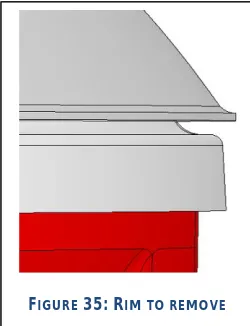
EM OVI NG OF T HE R E FLE C T ORBy adding a click mechanism to fixate the reflector the force needed to detach it will be higher. Removing the reflector without adjustments is difficult; therefore an extra rim was created (Figure 35). The rim is easy to release from the mould and formed in a regular shape, making the mould not more difficult to produce.
FIGURE 34:REFLECTO R FIXATION PROBLEM AND SOLUTION
TABLE 3:REFLECTOR COATING ILLU MINATION
D
The addition of the rim to the reflector also implies changes to the top casing (Figure 34). The solution chosen for this part has four separate horizontal rims instead of one big horizontal ring, because this fits better into the design of the existing vertical grooves. Tests with the prototype showed both a complete ring and separate rims provide a good solution to the fixating problem.
Another design consideration was the possibility to use a cavity to lower the screws attaching the upper parts onto the frame (Figure 36). Lowering the screws is optically better, but two big problems were encountered. The first problem was the connection to the internal frame. The cavity is rounded at the bottom side due to problems occurring during vacuum forming while using sharp
corners. The rubber ring between the internal frame and the casing had to be shaped according to the cavity; this was not possible using the available material and tools.
The second problem was the precision required to position the top casing into the inner top casing. In theory the depth of a cavity can be at most 75% of the width of the opening on the surface, excess thinning will occur beyond this depth (Formech International Ltd., 2001). Even shallow cavities will result into a thinner casing, especially at these two points where the top casing connects to the frame this is very unwanted.
The shape of the top casing was altered to make it visually more consistent with the lower part. Making the top casing rounder also has several advantages:
The chill marks encountered during the production of the prototype will be minimized because the plastic is stretched less at the top (see §3.3.3.1)
The total shape resembles Angkor Wat better, making it more recognisable as a Cambodian product The top of the part will be stronger because there will be less stretching of the plastic making it less
thin
4.5
I
NN ER TOP CASINGOne problem discovered after the production of the prototype was that the light of the CFL shines trough the base casing revealing a lot of the inner parts. This effect is unwanted because it looks very cheap.
Two more problems encountered were the frayed painting of the top casing and the paint coming off at the contact points with the base casing. Several test where done to obtain a straight paint line, like using paper tape, a removable plug and even some fluids preventing the paint to stick to the plastic. No solution was found making it both possible to produce the product locally and being also a solution usable in a production process.
FIGURE 36:CAVITY
D
All problems can be solved by using a separate part. This extra layer blocks the light normally shining partially by the lack of a layer of paint and the added quality appeal to the lantern.
4.6
B
ASE CASINGThe total shape is adjusted to the bigger battery which is about 1.5 times higher than the old one and has therefore been rotated 90° to lower the point of gravity and make the lantern more stable. Still it has effect on the height and the required strength of the base casing because of the increased overall weight and volume. The drop tests described in §3.4.3 revealed that PS with a thickness of 1.5 mm was needed, instead of 1 mm in the original design. Vacuum forming test with this material showed that sharp corners and deep cavities could cause problems.
The new design was adjusted to fit the Cambodian style together with the top casing. More curves are used compared to the SOLantern, this was possible because the frame was used to position the battery instead of the casing itself. Rounded corners also facilitate the vacuum forming process and these curves make it less obvious that it is a casing for the rectangular battery. The indentations were kept because they strengthen the casing, identify the front panel and reflect the shape of the top casing.
The number of stability pins has been decreased from four to three, making the connection with the ground not overdetermined anymore. These pins are placed as far as possible to the outside of the product to provide as much stability as possible. Drafts to ease the release of the part from the mould were missing in the original design and were added.
The battery support nodes were kept to absorb the energy of the battery in case the lantern will be dropped onto the ground.
FIGURE 40:BASE CASING WITH HOLES FOR CONNECTIONS
FIGURE 41: BOTTOM LAYOU T WITH STABILITY PINS AND BATTERY SU PPO RT NODES
D
able to be fixated in that position. Heavy clamping of the casing has to be prevented when the handle is turned (see §3.9.1).Several concepts have been developed to eliminate this problem, all with several advantages and disadvantages. The main considerations are to ability to produce it locally and the expected lifespan. By limiting the rotation to a certain degrees the problem arises that not all lightning function can be fulfilled. After testing of several possibilities the most basic one turned out to be the best: a rubber ring made of an old car tire will fixate the handle in every desirable position without damaging the casing (Figure 42). This material is also very cheap and easy available in rings.
A nut is welded onto the internal frame to provide screw thread for the bolt attached to the knob. A rubber ring is also placed at the inner side of the casing to prevent harmful contact between the internal frame and the plastic casing (and also to make the lantern waterproof).
4.8
I
NTERNAL FRAMEThe internal frame is made of steel and is more capable of resisting shocks than plastic. Therefore the support function of the casing for the heavy battery was decreased by transferring it to the frame. To achieve this, the frame was almost completely released from
the base casing and rubber rings were placed in between to absorb the energy transferred from the frame to the casing. Only the bottom part of the frame is still slightly connected due to height restrictions.
By adding a frame at the back the casing is stronger in general and the back of the product is also supported. Only little weight is added by this alteration.
The frame can be separated into two parts by unscrewing four bolts making it possible to
FIGURE 42: FIXATION KNOB
D
added to the top part to support the CFL holder.4.9
E
LECTRONICSSimultaneously with the development of the Angkor Light new electronics were designed by two students of the “Haagse Hogeschool”. The goal of this project was (among others) to design an external ballast having several advantages over a commonly used internal ballast:
The external ballast developed is able to dim the CFL
The ballast will be separate of the CFL giving more design opportunities The ballast designed will be more power efficient
Beside the development of this ballast a new controller for the CFL and a charge controller for the battery type used were designed making the lightning and loading much more efficient.
4.9.1
CFL
By quantifying the lighting categories in which the lantern need to be used the sufficiency of the light output of the final product can be checked. These values stated in Table 4 are based on the recommendation of Duco Schreuder (Schreuder, 2005) on lighting for very poor people.
FIGURE 45:COMPLETE INTERNAL FRA ME
FIGURE 44:BALLAS T OF A NORMAL CFL
D
e
si
gn
o
f