CSEIT184663 | Published – 08 May 2018 | May-June 2018 [ (4 ) 6 : 332-337 ]
National Conference on Engineering Innovations and Solutions (NCEIS – 2018)
International Journal of Scientific Research in Computer Science, Engineering and Information Technology
© 2018 IJSRCSEIT | Volume 4 | Issue 6 | ISSN : 2456-3307
332
User Assistance in Android Platform Using Tensorflow
Dr. Yuvaraju B. N ¹, Veena M*²¹Professor, Computer Science & Engineering, The National Institute of Engineering (NIE), Mysuru, Karnataka, India
²Computer Science & Engineering, The National Institute of Engineering (NIE), Mysuru, Karnataka, India
ABSTRACT
Technology is making life easier. While the requirement currently is how the technology will be smarter in reducing the involvement of humans for decision making, recognizing or classifying. With the advent of mobile phones not only communication but user assistance which means the smart applications that can ease out day to day activities also witnessed an evolution. Android being one of the most preferred operating systems for mobiles has revolutionized this aspect. Machine learning which the most trending technique of Artificial intelligence is is essential in making this true. Machine learning platforms compatible with android have realized several possibilities of user convenient applications and also have paved a way for infinite innovations. In this paper we explain how TensorFlow one of the machine learning platform combined with android can be employed for error code detection in thermostats. We mostly focus on the deep learning mechanisms being implemented in TensorFlow.
Keywords: Machine learning, Tensor flow.
I.
INTRODUCTION
Artificial Intelligence seems to be a modern concept but its thoughts dates back to Greek mythologies where mechanical men simulated more powerful work than humans. In 1950’s Alan Turing ‘s "Computing Machinery and Intelligence” was published in Mind which invoked an idea of thinking machine. Artificial Intelligence in simpler words means to simulate human intelligence in machines. The attempt of bringing about activities such as learning, planning, problem solving which involve thought process, in machines by simulation of human brain functionality is known as Artificial Intelligence. Machine learning is the integral part of Artificial Intelligence. It is redundant to bring about the complex mechanism of decision making or intelligence in machines using conventional programming techniques. Machine learning is the
way of teaching the computers to learn by them instead of teaching them everything what they need to do and when. This involves giving the machines access to the information and make them learn to see a pattern, classify or analyze how input mathematically deduces to output through examples. Machine learning can be defined as the mechanism that teaches systems how to learn by themselves without being explicitly programmed.
mathematical operations, while the graph edges represent the multidimensional data arrays (tensors) communicated between them. The flexible architecture allows deploying computation to one or more CPUs or GPUs in a desktop, server, or mobile device with a single API.
Android is one of the most widely used mobile operating system. Smarter applications can provide highest assistance to end users for several use case scenarios. Artificial intelligence embedded to android through TensorFlow opens up several possibilities. In this paper we have come up with one such solution of detecting error codes in thermostats and displaying the respective error message. Thermostatically controlled devices constitute at least 50% of the devices used in our day to day lives. The aim is to provide a solution that can help in troubleshooting the thermostat as an android application using TensorFlow. The rest of the paper is organized as follows: Section 2 explains about neural networks, Section 3 presents related work, Section 4 presents methods of developing proposed error code detection system, Section 5 presents achieved results and discussion related to them, and Section 6 holds our conclusion.
II.
NEURAL NETWORKS
Neural Networks is the part of machine learning technique that is inspired by biological brain which empowers computer to learn from set of data. Basic unit of computation in neural network is an artificial neuron which is referred as "node" or "unit". This is a mathematical model of biological neuron. The signals are represented as numerical values. Each input value is multiplied with value called as weight which brings about modulation as in biological neuron. A step function is applied on the weighted sum of the input which is the strength of the input to based on which the output is determined. Stack of neural networks is called as Deep learning, which means network composed of several layers. It basically has three types of layers. Input layers,
hidden layer and output layer. Input layer links with external environment that presents a pattern to the Major types of deep learning neural networks are as listed below:
Feed forward Neural Network.
Radial basis function Neural Network.
Kohonen Self Organizing Neural Network.
Recurrent Neural Network.
Convolutional Neural Network
Modular Neural Network
Feed forward Neural network is unidirectional in nature. The data passes from input node to output node and there is no back propagation. It may or may not have hidden layers making it the simplest of the Artificial Neural networks. Such networks have implications in voice recognition and in computer vision as the target output classes are complicated. Radial basis function neural networks depend on the distance of input point with respect to center. The first layer performs the radial basis function out of which is given to the next layer. Next layers perform functions based on this output. This network finds it application mostly in power restoration systems.
neuron which differentiates it from feed forward neural network. After a cycle of output the neurons acts like memory cells from further. These Neural networks are the backbone of Text to Speech conversion applications.
Convolutional Neural Networks are advanced feed forward neural networks that has learnable weights and biases. Input is divided into batches of filters where extraction of features through process of convolution from which it derives its name. The input goes through series of operations like convolution and pooling which helps the network to extract features and be able to learn the values of weights or biases by itself and then correct those values through back propagation of errors. It mainly finds its application in image processing, feature extraction and classification. Modular Neural Networks as the name suggests has several modules of neural networks that works independently towards the output. Here the network modules get unique input and performs subtask. Networks do not communicate with each other as they work independently reduce the communication overhead and increases the processing speed as the work gets distributed. It is employed in task decomposition, multi modular strategies.
III.
RELATED WORKS
In [1] this example deep learning neural networks are implemented in TensorFlow to perform optical character recognition. Various methods to perform OCR are available like fuzzy logic, matrix matching, structural analysis of sub features and so on. It is an area where there is always scope for improved accuracy. Here deep learning neural networks are employed mainly because of their accuracy and generalization power. The Deep Learning Convolutional Neural Network is implemented using TensorFlow. This was tested with android application enclosing the TensorFlow trained model to perform number plate recognition. A varied and large data set is used to train the CNN model to make it learn the value of weights that will be further used
for recognition of real time example. The Android application provides interface through device camera and output the predicted values after recognition. This aims at providing solution in terms of performing number plate recognition as an Android application. The promising results final overall accuracy for the plate detector CNN was 98.5% and 96.8% for character recognition CNN makes it an efficient user assisting application with scope for improving and modifying as specific to use case scenario criteria such as font of recognition and number of digits to be recognised
In [2] these example TensorFlow applications are used in user assistance through recognition of heritage centers of a city and providing them information about it through Android application. This solution implementation can be differentiated into two parts. The artificial Intelligence part of recognizing the heritage centre when encountered with an image of it is brought about by deep learning neural networks TensorFlow. Camera device input and interface for output and providing user assistance through information regarding the recognized heritage center is implemented as an android application that has TensorFlow model. The object recognition is brought about in TensorFlow by Inception V3 model. Inception V3 is a CNN model of Google trained for ImageNet Large Visual Recognition Model capable of recognizing 1000 classes, each classes associated with a label. Its final layer has been retrained with the artworks, historical buildings, painting, statues of the city. Using TensorFlow API for android, a mobile application is developed that takes a still from the camera of the device and recognize the heritage site. This provides a user assistance by recognizing the site of significance. As smart phones are easily available it serves to be of a great user assistance.
Thermostats play a major role in maintaining device temperature there by providing control over temperature and saving electricity. As complicated advancement thermostat goes through even the problems grow with it. Error codes is a way in which the modern digital thermostat expresses the problem associated with it. Developing a component for detection of error codes in thermostat includes several steps. Collection of data set, retraining of the model and defining an Error code detection model to be implemented in android.
A. Data set and Pre-processing.
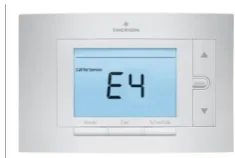
Quality of dataset and amount of dataset that is used plays a major role in developing an efficient model for detection. Images of thermostat are wide in range as they vary with the manufacturing companies. For the purpose of this research one specific kind of thermostat were used. Considering the few images available images were artificially synthesized for this purpose. As the error codes are complex in number a specific number of error codes were used for dataset. Dataset synthesis was varied based on the focus angle, lighting conditions. Amount and quality of dataset directly affects the prediction accuracy. There is always a margin to improve the accuracy through well defined and refined dataset. Samples of the generated dataset are displayed in Figure 1.
Figure 1. Samples of the dataset
B. Retraining of model.
"Inception" is the convolutional neural network model implemented for image classification by Google capable of recognizing 1000 classes. This model is retrained with the specific data set of error codes to create the model graph that is customized for the recognition of Error codes in Thermostat. Retraining involves supervised learning of the model. The initial layers extract the general features such as picking out edges and basic shapes. It is the final layer that comes up with the relevant high level categorisation. So we can obtain the model for specific recognition by retraining the final layer. Retraining needs a very profound dataset. A large number of labelled images of thermostats error codes considering the factors and circumstances of recognition scenario needs to be created and collected. This well-formed huge data set is to be provided to model for retraining. figure 2 depicts the results of retraining in a graph and a label file that has learnt values of "biases" or "weights" that will be used to recognise image.
Figure 2. Retraining process
C. Implementation in android
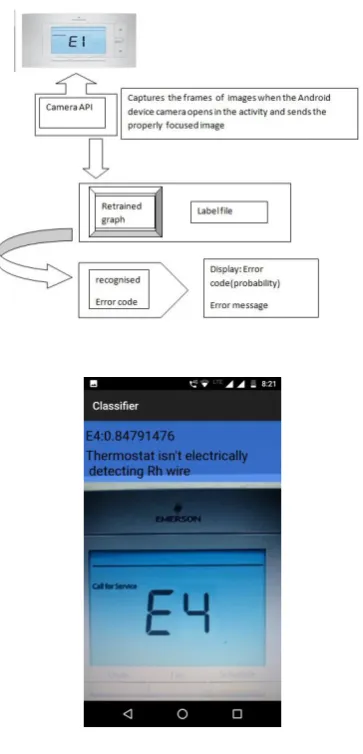
camera API implemented to continuously capture frames of image of thermostat and send the image of proper focus to the model for recognition. The graph file used in android is a static. pb extension file. The graph obtained after retraining has to be optimized to be used in the android application. This optimization includes freezing of the graph values. When the image is sent as bitmap pixel values to the graph it performs recognition and returns the error code name along with probability matching from the label file. Once the error code is recognised further the matching error message associated with the error code along with its probability is displayed.
Figure 3. Implementation process
V.
RESULTS AND DISCUSSION
Proposed system of error code recognition was tested in the real-time environment using the android implementation. Fifty thermostats in different
position and light conditions were tested. Overall accuracy for the error code detection was 98% when implemented directly through a python script, 94.5% when tested through an android application shown in figure 4. The device camera, light conditions tend to lower the accuracy . There is a limitation of training data set with specific number of error codes and specific brand of thermostat. There is scope for increasing the accuracy and implication through expanding the dataset.
Figure 4. CNNs accuracy in real time environments
VI.
CONCLUSION
Over the years deep learning has been providing easy and accurate solutions to complex problems. May be it the recognition and classification deep learning has been a path breaking concept giving infinite possibilities to be envisioned. Object recognition though has several methods deep learning CNNs provide the best possible solution for the varying recognition conditions. The proposed system has the limitations of specific number of error codes and the kind of the thermostat. With the smart phones being widely used smarter solutions through android applications is the main focus. TensorFlow which was originally developed by engineers at Google for research purposes is not limited to the same anymore. Through this the area of user assistance can be powered with Artificial Intelligence resulting the applications to smarter. This provides an up gradation from normal computations to intelligent solutions that involves artificial intelligence.
0 10 20 30 40 50 60
Total
Accuracy
VII.
REFERENCES
1. Marko Arsenovic ,Srdjan Sladojevic Andras Anderla ,Darko Stefanovic ,"Deep Learning Driven Plates Recognition System" 17th International Scientific Conference Industrial Systems (IS'17),2017
2. Davide Mulfari, Antonino Longo Minnolo, Antonio Puliafito," Building TensorFlow Applications in Smart City Scenarios",2017 IEEE International Conference on Smart Computing(SMARTCOMP).
3. Panos Louridas and Christof Ebert," Machine Learning ", IEEE SOFTWARE, published by the IEEE computer society