Proceedings of Recent Advances in Natural Language Processing, pages 71–77,
Ensembles of Classifiers for Cleaning Web Parallel Corpora and
Translation Memories
Eduard Barbu
Institute Of Computer Science / University of Tartu
Abstract
The last years witnessed an increasing in-terest in the automatic methods for spot-ting false translation units in translation memories. This problem presents a great interest to industry as there are many trans-lation memories that contain errors. A closely related line of research deals with identifying sentences that do not align in the parallel corpora mined from the web. The task of spotting false translations is modeled as a binary classification prob-lem. It is known that in certain conditions the ensembles of classifiers improve over the performance of the individual mem-bers. In this paper we benchmark the most popular ensemble of classifiers: Majority Voting, Bagging, Stacking and Ada Boost at the task of spotting false translation units for translation memories and parallel web corpora. We want to know if for this specific problem any ensemble technique improves the performance of the individ-ual classifiers and if there is a difference between the data in translation memories and parallel web corpora with respect to this task.
1 Introduction
Translation memories are databases that store sen-tence segments in one language with their cor-responding translation in another language. The origin of translation units in translation memo-ries is diverse. Mostly, they come from profes-sional translators, but some translation memory databases (e.g. MyMemory (Trombetti, 2009)) accept contributions from online contributors. Translation memories are integrated in computer-assisted translation tools and they are among the
most used repositories of information by profes-sional translators. For various reasons (e.g. the negligence of the translators, malicious users that spam through collaborative interfaces), a signif-icant number of translation units in translation memories are false translations.
However, a similar resource can be obtained by mining the web (or large crawled documents repositories like Common Crawl) for parallel cor-pora. The pipeline for web mining starts with par-allel sites discovery, parpar-allel web documents iden-tification and finishes with the alignment of paral-lel sentences in the documents. The resulting re-source contains errors. This happens because ei-ther the automatic document pairing fails or be-cause the sentence aligning fails.
Below there is an example of two translation units for the language pairs English-Italian and English-French that should be discarded.
1. An example for English-Italian language pair extracted from a translation memory.
English segment. Weight loss category. Italian segment. Studi sulle linee di catego-ria.
English translation of the Italian segment : “Studies concerning categories”.
2. An example for English-French language pair produced by mining the web.
English segment. The hotel has a minivan shuttle and took us on a complementary ba-sis to several places which were a bit far to walk as one of us was injured skiing.
French segment. Nous allons vivre un mo-ment magique...aperitif dans la “bodega” , puis menu degustation dans une petite salle intimiste.
English translation of the French segment: “We will live a magic moment ... aperitif in
the “bodega”, then menu tasting in a small intimate room.”
The pace at which translation memories grow nowadays and the web parallel corpora are built makes it impossible to perform manual clean-ing1. Given the size of modern translation
memo-ries and parallel corpora, automatic solutions have been proposed. They state the problem as a bi-nary classification task. Given a translation unit, a classifier should return “yes” if the segments in the translation unit are true translation and “no” otherwise.
In this paper we explore various methods for building ensembles of classifiers to tackle the problem of spotting false translations in transla-tion memories and web parallel corpora. It has been shown (Dietterich,2000) that the ensembles of classifiers can work better than the individ-ual classifiers in certain conditions. We want to know what the difference is between the data ing from web parallel corpora and the data com-ing from translation memories with respect to this task.
The rest of the paper has the following organi-zation. The next section presents the related work. In section3, the features used and the ensemble of classifiers are introduced. In section4we describe the data used for training and testing the classifiers and the results of the classifiers evaluation. The paper ends with the conclusions.
2 Related Work
Most people that mine large corpora from the web use Gale-Church score (Gale and Church, 1993) to filter the translation units. Please notice that Moses statistical machine translation engine in-cludes a python script2 for this purpose.
How-ever, this simple technique is clearly insufficient as none of the translation units in the examples above can be discarded with the Gale-Church score. Ac-cording to our knowledge, the first study that uses a classifier to identify sentences that are transla-tions in (comparable) corpora is Munteanu (2005). They use a maximum likelihood classifier trained on a set of features that are similar to the word alignment features we use (see section 3 for de-tails) .
1For example, MyMemory receives approximately 15 million contributions per month.
2The script is called gacha.py
In Barbu (2015) we were the first to train a set of supervised classifiers to spot false translations in translation memories. An unsupervised approach for the same task was proposed in Jalili Sabet (2016). They use a set of features that capture the similarity between the segments in a translation unit, use them to induce training labels and train a set of base classifiers with Extremely Random-ized Trees (Geurts et al.,2006). The most relevant attempts to spot false translation units in transla-tion memories are surveyed in Barbu (2016). One of the most successful systems is trained not only on features related to translation quality, but also on features related to grammatical errors and fea-tures related to fluency and lexical choice (Wolff, 2016).
The previous supervised works focused on tun-ing and evaluation of the individual classifiers. The only research that uses ensemble of classifiers are Barbu (2015) which trained a Random For-est and Jalili Sabet (2016) which used Extremely Randomized trees. However, they did not attempt to combine individual classifiers in a systematic way and compare the performance of the individ-ual classifiers with the performance of the ensem-bles of classifiers. Moreover, we are the first to test the classifiers on data coming from both par-allel corpora and translation memories in a mul-tilingual setting. This is important because there are data providers that want to clean the transla-tion memories and the data collected from the web using a single trained model per language pair.
3 Classification
In this section we first present the individual clas-sifiers and the motivation for choosing them, then the ensemble of classifiers and finally the features computed for the translation units to be classified.
3.1 Classifiers
The individual classifiers selected are among the widely used classifiers in the literature : Deci-sion Tree, Logistic Regression, Support Vector Machines with the linear kernel, Support Vector Machineswith the radial basis function kernel, K-Nearst Neighbors.
popu-lar ensemble techniques.
• Majority Voting. The meta-classifiers’ pre-dicted class is the class mostly voted by the individual classifiers. For example, if we have an ensemble composed of three classi-fiers and the vote assigned to a translation unit is (1,1,0), that is the first two classifiers predict that the result is positive and the third classifier that the result is negative, then the meta-classifier chooses the positive class. It can be proven that if the classifiers are inde-pendent and the error rated are not correlated, then the majority voting error rate is lower than the individual classifiers error rate ( Di-etterich,2000).
• Stacking. As in majority voting case the indi-vidual classifier’s predictions are combined. However, the final decision is taken by an-other classifier that is trained on the labels outputted by the classifiers in the ensemble.
• Ada Boost. Boosting is a machine learn-ing technique that creates an accurate pre-diction combining many weak classifiers. A weak classifier is a classifier that performs slightly better than random guessing. Each weak classifier is trained on a random set of the training set. Ada Boost (Freund and Schapire,1997) assigns weights to each train-ing example. The assigned weight represents the probability that the training example ap-pears in the training set. At each step the ex-amples that were incorrectly predicted by a classifier have their weights increased and the examples that were correctly predicted have the weights decreased. Ada Boost assigns weights to each classifier based on the classi-fier accuracy. The classiclassi-fiers that have better accuracy receive higher weight.
• Bagging Bagging (bootstrap aggregating) (Breiman, 1996) is an ensemble technique where the individual classifiers in the ensem-ble are trained on bootstrap samples (random samples taking from initial training set with replacement). The prediction for the test set is done as in theMajority Votingensemble.
3.2 Features
The features used by the classifiers and computed for both training and test sets are either word
alignment features, presence/absence features or miscellaneous features. The features are for the most part the features we have introduced before (Barbu, 2015). We have re-engineered some of them and replaced the similarity between the tar-get segment and translation of the source segment with the word alignment features. In this way we no longer rely on an expensive machine translation system. Please notice that to compute some fea-tures, like word alignment features for example, you need a word aligner trained on a large parallel corpus.
1. Word Alignment Features. The idea be-hind word alignment features is that the word alignments provide an important clue for the hypothesis that source and target segments are translations. We compute the number of aligned words in source and target segments and the longest contiguous zone of aligned and unaligned words.
• Source (Target) Word Ratio. The num-ber of words in the source (target) seg-ment that are aligned divided by the total number of words in the source (target) segment.
• Max Source (Target) Aligned Zone Ra-tio. The number of words in the source (target) longest aligned continuous zone divided by the total number of words in the source (target) segment.
• Max Source (Target) Unaligned Zone Ratio. The number of words in the source (target) longest unaligned contin-uous zone divided by the total number of words in the source (target) segment.
2. Presence/Absence Features. These features signal the presence/absence of an entity (URL, email address, named entity, etc.) in source and target segments. Furthermore, if the entities are present in both source and tar-get segments, their ratio is computed. These features capture the intuition that if an entity is present in the source segment and if the tar-get segment is a translation of the source seg-ment it is very probable that the same entity is present in the target segment.
• Entity Features. These features aretag,
URL, email, name entity, punctuation,
letters. The value of these features is1 if the source or target segments contain a tag, URL, email, name entity, punctu-ation, capital letters or words written in capital letters, otherwise is0.
• Entity Similarity Features. If a feature explained under Entity Features except for capital letters and words in capital letters exists, the cosine similarity be-tween the source and target segments entity vectors is computed. Therefore, we compute a feature for the tag simi-larity, punctuation simisimi-larity, URL sim-ilarity, etc.
• Capital letters word difference. The value of this feature is the ratio between the difference of the number of words containing at least a capital letter in the source segment and the target segment and the sum of the capital letter words in the translation unit. It is complemen-tary to the featurecapital letters.
• Only capital letters difference. The value of the feature is the ratio be-tween the difference of the number of words containing only capital letters in the source segment and the target seg-ments and the sum of only the capital letter words in the translation unit. It is complementary to the feature words in capital letters.
3. Miscellaneous Features. The rest of the fea-tures we compute fall under miscellaneous features category because they are not easily categorized.
• language difference. If the language codes identified by a language detector for the source and target segments co-incide with the language codes declared for the same source and target segments, then the feature is 1, otherwise is 0.
• Gale Church score. This feature is the slightly Gale-Church score described in the equation1and introduced in Tiede-mann (2011). This score reflects the idea that the length of the source (ls) and
target segments (ld) that are true
trans-lations is correlated. We expect that the classifiers learn the threshold that separates the positive and negative
ex-amples. However, relying exclusively on the Gale-Church score is tricky be-cause there are cases when a high Gale-Church score is perfectly legitimate. For example, when the acronyms in the source language are expanded in the tar-get language.
CG= p ls−ld
3.4(ls+ld) (1)
4 Results and Discussion
4.1 Data
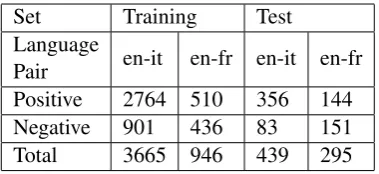
The setting we presuppose is that of a data provider that has a huge amount of translation memories and data crawled from the web and wants to train a unique model per language pair to clean both translation memories and data col-lected from the web. As we showed in (Barbu, 2015) a cross validation setting tends to overesti-mate the performance of the model. Therefore the training and test data for the English-Italian lan-guage pair is a random sample of multiple trans-lation memories inside the MyMemory database. The test data is enriched with translation units from an aligned parallel English-Italian web site. The training and test data for English-French is a random sample from approximately 17 million translation units resulted from crawling and align-ing at the sentence level a large number of paral-lel English-French sites. The crawling and align-ment of the web sites have been performed with the ILSP crawler (Papavassiliou et al.,2013). The training and test sets have been annotated with positive and negative labels by an annotator and checked by a supervisor. The size of the training and test data and the distribution of positive and negative examples is given in table 1. The per-centage of negative data in training and test set for English-French language pair is around50%. This percentage is much higher than the percent-age of negative data in English-Italian data sets. These figures are not a surprise because the data in translation memories has less noise than the data crawled and aligned from the web.
The features are computing using TM Cleaner, a publicly available software written by the author
3. The individual classifiers and almost all
ensem-bles of classifiers used in the experiments are
Set Training Test Language
Pair en-it en-fr en-it en-fr Positive 2764 510 356 144 Negative 901 436 83 151 Total 3665 946 439 295
Table 1: The distribution of positive and negative translation units in training and test sets
Classifier F1Positive F1Negative BalancedAccuracy
RBF 0.93 0.72 0.82
KN 0.93 0.65 0.77
DT 0.93 0.69 0.78
SK 0.93 0.69 0.8
BG 0.93 0.69 0.81
AB 0.93 0.73 0.84
MV 0.94 0.72 0.82
LR 0.94 0.73 0.82
LN 0.95 0.76 0.84
Table 2: Classification Results for English-Italian
plemented in the machine learning library scikit-learn (Pedregosa et al.,2011).
The word alignment features are computed us-ing the fast align (Dyer et al.,2013) version modi-fied in Modern Machine Translation project4. This
version allows training a word alignment model on a parallel corpus and the use of the aligned model for obtaining the word alignments on a test set. The fast align in Modern Machine Translation is trained on English-Italian and English-French par-allel corpora containing approximately 100 mil-lions parallel words each.
The language codes assigned to English, Italian and French segments are computed with the lan-guage detector Cybozu5.
The Majority Voting and the Stacking ensem-bles combine the results of all individual classi-fiers presented in section 3. The Stacking meta-classifier is logistic regression. Ada Boost uses 500 decision trees weak learners. The Bagging
ensemble technique combines the results of 500 decision trees classifiers.
The results for Italian and English-French are presented in tables2and3.
For each individual and ensemble of classifiers 4http://www.modernmt.eu
5https://github.com/shuyo/ language-detection
Classifier F1Positive F1Negative BalancedAccuracy
KN 0.81 0.77 0.8
DT 0.84 0.83 0.83
MV 0.86 0.86 0.86
LR 0.86 0.85 0.85
LN 0.86 0.86 0.86
RBF 0.86 0.86 0.86
AB 0.86 0.86 0.86
SK 0.87 0.86 0.86
BG 0.88 0.88 0.88
Table 3: Classification Results for English-French
we compute the F1 score for positive and negative class and the balanced accuracy (BA). The first column lists a short name form for the classifiers. RBF stays forSupport Vector Machinewith RBF kernel, KN for K-Nearst Neighbors, DT for De-cision Tree, SK forStacking, BG forBagging, AB forAda Boost, MV forMajority Voting, LR for Lo-gistic Regressionand LN forSupport Vector Ma-chineswith linear kernel. In both tables the clas-sifiers are ordered by the F1 score for the positive class. The ensembles of classifiers are emphasized with bold font.
In figures1and2the F1 positive scores and F1 negative scores are plotted for English-Italian and English-French language pairs. With continuous line we connect the F1-scores for the positive class and with dashed line we connect the F1-scores for the negative class. As in the above tables the clas-sifiers are ordered in ascending order according to F1 positive score.
For English-Italian language pair the best F1-scores for positive and negative classes are ob-tained bySupport Vector Machineswith linear ker-nel. For English-French language pair the clear winner is the Bagging ensemble. The difference between the performances of the classifiers for positive and negative classes is substantial for the English-Italian test set. The difference between the best performing classifiers for the positive class (Support Vector Machines with linear ker-nel) and negative class (Support Vector Machines
with linear kernel) respectively is19percents. The difference between the worst performing classi-fier for the positive class,Support Vector Machines
0 2 4 6 8 10
0.6
0.7
0.8
0.9
1.0
English−Italian
Classifier
F1−score
RBF KN DT SK BG AB MV LR LN
RBF
KN
DT SK BG AB
MV LR LN
Figure 1: The F1-Scores for positive and negative class for English-Italian
difference between the best performing classifiers for the positive and negative classes is 4percent. There is no difference between the worst perform-ing classifiers for the positive and negative classes. These results lead to the conclusion that it is much harder to distinguish between a positive and a negative translation unit in a translation mem-ory than in parallel corpora crawled from the web. The translation units in parallel web corpora con-tain errors due to misalignment. They are easier to spot because it is less probable that the aligned segments have overlapping vocabulary.
According to balanced accuracy measure, the
Ada Boost ensemble is as good as Support Vec-tor Machinewith the linear kernel for the mixed English-Italian test set. TheBaggingEnsemble is the best classifier for English-French test set with the other ensembles and the Support Vector Ma-chinewith Linear kernel coming next.
5 Conclusions
In this paper we have tested well-known ensem-bles of classifiers (Majority Voting,Stacking, Ad-aBoost andBagging) in the task of finding trans-lation units that are not true transtrans-lations in transla-tion memories and parallel web corpora. Transla-tion memories curators and researchers that build parallel corpora for machine translations can ben-efits from the results of this study.
To evaluate the performance of ensemble
clas-0 2 4 6 8 10
0.75
0.80
0.85
0.90
English−French
Classifier
F1−score
KN DT
MV LR LN RBF AB SK
BG
KN DT
LR
SK
Figure 2: The F1-Scores for positive and negative class for English-French
sifiers we have compared them against individ-ual classifiers like Support Vector Machines and
K-Nearst Neighbors. English-Italian translation units have better quality than the English-French translation units. For English-Italian language pair the ensemble classifiers are no better than the in-dividual classifiers. If we order them according to the balanced accuracy measure,Ada Boost ensem-ble is as good asSupport Vector Machinewith the linear kernel. If we evaluate the classifiers accord-ing to F1-scores for positive and negative class then the Support Vector Machine with the linear kernel is the winner. For English-French language pair theBaggingEnsemble wins for both Balanced Accuracy and F1-scores.
destination of the translation units matters as well. If they are used to improve a translation memory, then the quality matters and even a2-percent im-provement in the classifier performance is a suc-cess. If the translation units are used to train a SMT system, then a slightly cleaner resource does not have an impact over the BLEU score or the translation quality.
6 Reproducibility
To reproduce the results in this paper please go to the link bellow. The folder the link is pointing to is inside TM Cleaner package. Inside the folder you will find a README file. Follow the instructions to run the individual classifiers, the ensembles of classifiers the evaluation scripts and the R scripts for reproducing the graphs in this paper:
https://github.com/SoimulPatriei/ TMCleaner/tree/master/
TMCleaner-MMT-API/Reproducibility
References
Eduard Barbu. 2015. Spotting false translation
seg-ments in translation memories. In Proceedings of the Workshop Natural Language Processing for Translation Memories. Association for Computa-tional Linguistics, Hissar, Bulgaria, pages 9–16.
http://www.aclweb.org/anthology/W15-5202. Eduard Barbu, Carla Parra Escart´ın, Luisa
Ben-tivogli, Matteo Negri, Marco Turchi, Constantin
Orasan, and Marcello Federico. 2016. The
first automatic translation memory cleaning shared task. Machine Translation 30(3):145–166.
https://doi.org/10.1007/s10590-016-9183-x.
Leo Breiman. 1996. Bagging
predic-tors. Mach. Learn. 24(2):123–140.
https://doi.org/10.1023/A:1018054314350.
Thomas G. Dietterich. 2000. Ensemble
meth-ods in machine learning. In Proceedings of the First International Workshop on Mul-tiple Classifier Systems. Springer-Verlag, London, UK, UK, MCS ’00, pages 1–15.
http://dl.acm.org/citation.cfm?id=648054.743935. Chris Dyer, Victor Chahuneau, and Noah A. Smith.
2013. A simple, fast, and effective
reparameteriza-tion of IBM model 2. InHLT-NAACL. The
Associa-tion for ComputaAssocia-tional Linguistics, pages 644–648. Yoav Freund and Robert E Schapire. 1997.
A decisitheoretic generalization of on-line learning and an application to boost-ing. J. Comput. Syst. Sci. 55(1):119–139.
https://doi.org/10.1006/jcss.1997.1504.
William A. Gale and Kenneth W. Church. 1993. A program for aligning sentences in bilingual corpora.
COMPUTATIONAL LINGUISTICS.
Pierre Geurts, Damien Ernst, and Louis Wehenkel.
2006. Extremely randomized trees. Mach. Learn.
63(1):3–42.
https://doi.org/10.1007/s10994-006-6226-1.
Masoud Jalili Sabet, Matteo Negri, Marco Turchi, and
Eduard Barbu. 2016. An unsupervised method
for automatic translation memory cleaning. In
Proceedings of the 54th Annual Meeting of the Association for Computational Linguistics (Vol-ume 2: Short Papers). Association for Computa-tional Linguistics, Berlin, Germany, pages 287–292.
http://anthology.aclweb.org/P16-2047.
Dragos Stefan Munteanu and Daniel Marcu.
2005. Improving machine translation
per-formance by exploiting non-parallel cor-pora. Comput. Linguist. 31(4):477–504.
https://doi.org/10.1162/089120105775299168. Vassilis Papavassiliou, Prokopis Prokopidis, and
Gre-gor Thurmair. 2013. A modular open-source
fo-cused crawler for mining monolingual and bilin-gual corpora from the web. In Proceedings of the Sixth Workshop on Building and Using Comparable Corpora. Association for Computa-tional Linguistics, Sofia, Bulgaria, pages 43–51.
http://www.aclweb.org/anthology/W13-2506.pdf. F. Pedregosa, G. Varoquaux, A. Gramfort, V. Michel,
B. Thirion, O. Grisel, M. Blondel, P. Pretten-hofer, R. Weiss, V. Dubourg, J. Vanderplas, A. Pas-sos, D. Cournapeau, M. Brucher, M. Perrot, and E. Duchesnay. 2011. Scikit-learn: Machine learning
in Python. Journal of Machine Learning Research
12:2825–2830.
J¨org Tiedemann. 2011. Bitext Alignment.
Number 14 in Synthesis Lectures on
Human Language Technologies.
Mor-gan & Claypool, San Rafael, CA, USA.
https://doi.org/10.2200/s00367ed1v01y201106hlt014.
Marco Trombetti. 2009. Creating the world’s
largest translation memory. http://www.mt-archive.info/MTS-2009-Trombetti-ppt.pdf.
Friedel Wolff. 2016. Combining off-the-shelf
components to clean a translation mem-ory. Machine Translation 30(3):167–181.