2. Wavelet transform
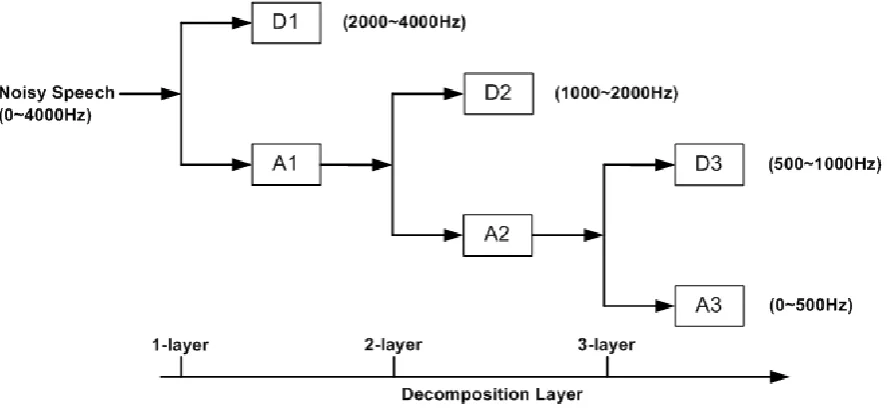
The wavelet transform (WT) is based on a time-frequency signal analysis. The wavelet analysis represents a windowing technique with variable-sized regions. It allows the use of long time intervals where we want more precise low-frequency information, and shorter regions where we want high-frequency information. It is well known that speech signals contain many transient components and non-stationary property. Making use of the multi-resolution analysis (MRA) property of the WT, better time-resolution is needed a high frequency range to detect the rapid changing transient component of the signal, while better frequency resolution is needed at low frequency range to track the slowly time-varying formants more precisely [10]. Figure 1 displays the structure of three-layer wavelet decomposition utilized in this paper. We decompose an entire signal into four non-uniform subbands including three detailed scales such as D1, D2 and D3 and one appropriated scale such A3.
Figure 1. Structure of three-layer wavelet decomposition
3. Mean-delta method for subband auto-correlation function
The well-known definition of the term "Auto-Correlation Function (ACF)" is usually used for measuring the self-periodic intensity of signal sequences shown as below:
0
( ) ( ) ( ), 0,1,... p k
n
R k s n s n k k p
−
=
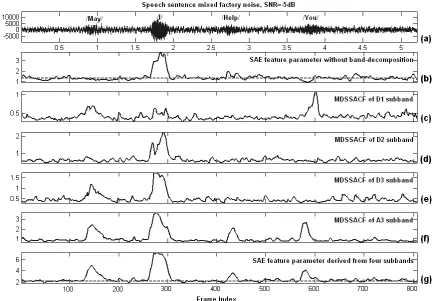
Figure 3 displays that the MRA property is important to the development of SAE feature parameter. The proposed SAE feature parameter is respectively developed with/without band-decomposition. In Figure 3(b), the SAE without band-decomposition only provides obscure periodicity and confuses the word boundaries. Figure 3(c)~Figure 3(f) respectively show each value of MDSACF from D1 subband to A3 subband. It implies that the value of MDSACF can provide the corresponding periodic intensity for each subband. Summing up the four values of MDSACFs, we can form a robust SAE parameter. In Figure 3(g), the SAE with band-decomposition can point out the word boundaries accurately from its envelope.
Figure 3. SAE with/without band-decomposition
4. Teager energy operator
The Teager energy operator (TEO) is a powerful nonlinear operator, and can track the modulation energy and identify the instantaneous amplitude and frequency [7-10].
In discrete-time, the TEO can be approximate by
2
[ ( )] ( ) ( 1) ( 1)
d s n s n s n s n
Ψ = − + − , (4)
where [ ( )]Ψd s n is called the TEO coefficient of discrete-time signal ( )s n .
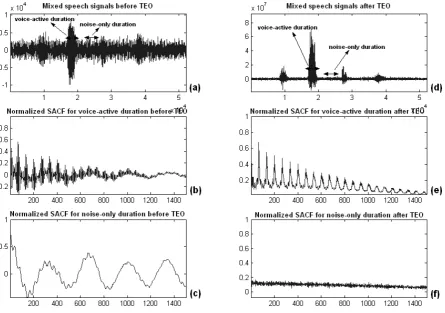
Figure 4. Illustration of TEO processing for the discrimination between speech and noise by using periodicity detection
5. Proposed voice activity detection algorithm
In this section, the proposed VAD algorithm based on DWT and TEO is presented. Fig. 8 displays the block diagram of the proposed wavelet-based VAD algorithm in detail. For a given layer j, the wavelet transform decomposed the noisy speech signal into j+1
subbands corresponding to wavelet coefficients sets wk nj, . In this case, three-layer wavelet decomposition is used to decompose noisy speech signal into four non-uniform subbands including three detailed scales and one appropriated scale. Let layer j=3,
3
, { ( ), 3}, 1.... , 1....4
k m
w =DWT s n n= N k = , (5)
where wk m3, defines the
th
m coefficient of the kth subband. N denotes as window length.
The decomposed length of each subband is N 2k in turn.
computing time of Chen's VAD is closely relative to the entire length of recording.
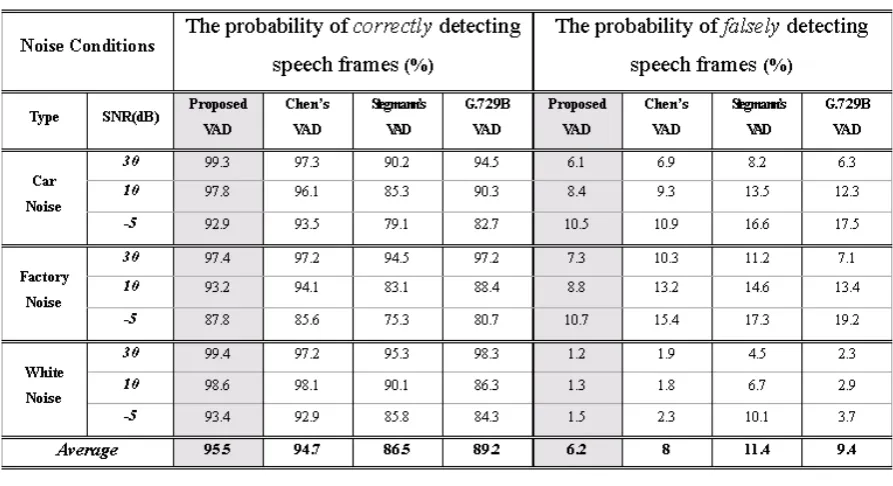
Table 1. Comparison performance.
Table 2. Illustrations of subjective listening evaluation and the computing time
VAD types Computing time (sec)
Proposed VAD 0.089
Chen’s VAD [5] 0.436
Stegmann’s VAD [12] 0.077
G.729B VAD [4] 0.091
6.3. Evaluation in non-stationary noise
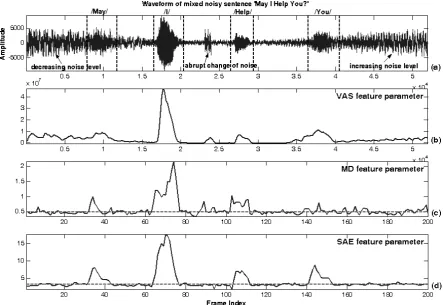
6(d), respectively. It is found that the performance of Chen's VAD algorithm seems not good in this case. The envelope of VAS parameter closely depends on the variable level of noise. Similarly, the envelope of MD parameter fails in variable level of noise. Conversely, the envelope of proposed SAE parameter is insensitive to variable-level of noise. So, the proposed wavelet-based VAD algorithm is performed well in non-stationary noise.
Figure 6. Comparisons among VAS, MD and proposed SAE feature parameters
7. Conclusions
Technologies, Vol. 4, No 2, 3-14, 2004.
[10] Stegmann, J., Schroder, G., and Fischer, K. A., "Robust classification of speech based on the dyadic wavelet transform with application to CELP coding", Proc. ICASSP, Vol. 1, 546 - 549, 1996.
[11] Varga, A. and Steeneken, H. J. M., "Assessment for automatic speech recognition: II. NOISEX-92: A database and an experiment to study the effect of additive noise on speech recognition systems", Speech Commun., Vol. 12, 247-251, 1993.