Automatic Detection and Semi-Automatic Revision of
Non-Machine-Translatable Parts of a Sentence
Kiyotaka Uchimoto
∗, Naoko Hayashida
†, Toru Ishida
†, and Hitoshi Isahara
∗∗National Institute of Information and Communications Technology
3-5 Hikari-dai, Seika-cho, Soraku-gun, Kyoto, 619-0289, Japan
{uchimoto, isahara}@nict.go.jp
†Kyoto University
Yoshida-Honmachi, Sakyo-ku, Kyoto 606-8501, Japan [email protected], [email protected]
Abstract
We developed a method for automatically distinguishing the machine-translatable and non-machine-translatable parts of a given sentence for a particular machine translation (MT) system. They can be distinguished by calculating the similarity between a source-language sentence and its back translation for each part of the sentence. The parts with low similarities are highly likely to be non-machine-translatable parts. We showed that the parts of a sentence that are automatically distinguished as non-machine-non-machine-translatable provide useful information for paraphrasing or revising the sentence in the source language to improve the quality of the translation by the MT system. We also developed a method of providing knowledge useful to effectively paraphrasing or revising the detected non-machine-translatable parts. Two types of knowledge were extracted from the EDR dictionary: one for transforming a lexical entry into an expression used in the definition and the other for conducting the reverse paraphrasing, which transforms an expression found in a definition into the lexical entry. We found that the information provided by the methods helped improve the machine translatability of the originally input sentences.
1.
Introduction
Machine translation (MT) systems are becoming more widely used by ordinary people as well as by expert transla-tors, with numerous web sites offering free translation ser-vices. In view of this situation, an international research project called the Intercultural Collaboration Experiment project was launched to investigate the use of MT systems (Nomura et al., 2002)1. This research project is being
un-dertaken by universities and research institutes and soci-eties in Asia. The goal is to support intercultural and mul-tilingual collaboration by using MT systems to aid com-munication across international borders. As the first step toward achieving the goal, multinational Asian teams ex-perimented on open-source software development. In the experiment, each team member wrote a message in his/her first language and translated it into the other members’ first languages using an MT system. Each member who re-ceived a message read it in his/her first language. During the experiment, however, they often found that translation errors resulted in incomprehensible messages or possible misunderstandings. They therefore had to exchange mes-sages several times to fix the errors and understand what the writers meant. The problem here is that the receiver may have difficulty in detecting the incomprehensible or mis-leading parts of a message and in letting the sender know which parts need paraphrasing because in many cases one error affects other parts of the translation, and the whole phrase or sentence becomes incomprehensible. Therefore, the sender has to identify the part that needs paraphrasing through trial and error. Even if the part is identified, he/she may have difficulty in paraphrasing it effectively.
We developed methods for automatically detecting the non-machine-translatable parts of a given sentence for a
particu-1
http://ice.kuis.kyoto-u.ac.jp/ice/
lar MT system and for providing knowledge useful to effec-tively paraphrasing or revising the detected non-machine-translatable parts.
2.
Machine Translatability
We used the definition of machine translatability of Uchi-moto et al. (UchiUchi-moto et al., 2005). Machine translatabil-ity is a measure that indicates how well a given sentence can be translated by a particular MT system, and we call the measure the “confidence measure”, or C-measure. The C-measure is defined as the similarity between a source-language sentence and its back translation. A back transla-tion is defined as the source-language sentence that is ob-tained by translating a sentence into the target language and then retranslating that sentence into the original language. We calculated similarities using a method based on BLEU (Papineni et al., 2002). We assumed that the higher the C-measure, the more stable and reliable the translation. The C-measure is calculated using the following equation:
CM = 2×CMbleu(B|S)×CMbleu(S|B) CMbleu(B|S) + CMbleu(S|B) , (1)
whereS andB in CMbleu(B|S)indicate the original sen-tence and its back translation. The term CMbleu(B|S) is derived from the equation for calculating the BLEU score by substituting the original sentence and its back translation for the reference translation and translation. The equation is as follows:
log(CMbleu(B|S)) = min1−sb,0
+N n=1
1
wheres,b, andNindicate the number of words in the orig-inal sentence, the number of words in its back translation, and the maximum number of words in the considered word n-gram. The termpn(B|S)is calculated as follows:
pn(B|S) =
wn∈B
Countclip(wn)
wn∈B
Count(wn) , (3)
whereCount(wn)indicates the frequency of the word n-gramwn inB. The termCountclip(wn)is calculated as follows:
Countclip(wn) = min(Count(wn), Count(wn|S)), (4)
whereCount(wn|S)represents the frequency of the word n-gramwninS. Our concept of similarity differs from that of BLEU, with our system having the following additional features:
• Tree-based word n-grams
In our measure, word n-grams are extracted from de-pendency trees. All word dependencies within a
bun-setsu are assumed to be between adjacent words. The bunsetsus are minimal linguistic units obtained by
seg-menting a sentence naturally in terms of semantics and phonetics, and each of them consists of one or more words. The direction of all word dependencies be-tween bunsetsus is assumed to be from the rightmost word in a modifier bunsetsu to the leftmost word in the modified bunsetsu. Here, word 3-grams were used as word n-grams, based on the results of our preliminary experiments.
• Harmonic mean
Our measure uses not only the original BLEU score, but also the BLEU score calculated when the auto-matic translation and a reference translation are sub-stituted for each other. The latter BLEU score is based on the word n-gram recall of an automatic translation. Therefore, the F-measure, namely, the harmonic mean of the precision and recall of both types of BLEU scores, as shown in equation (1), is used as our sim-ilarity measure.
• Generalization
The words are replaced with their word classes. When a word belongs to two or more classes, quasi-optimal sets of word classes are found greedily in the sense that the rate of agreement on word classes between the source-language sentence and its back translation is as high as possible. Word classes are defined based on a thesaurus, Bunrui goihyou, developed by the Na-tional Institute for Japanese Language (for Japanese Language (NIJL), 2004). The Bunrui goihyou has a tree structure and consists of seven layers. We used the upper fifth layer as word classes. The leaves of the
tree contain words, and each word has a figure indicat-ing its category number. The Bunrui goihyou contains 101,070 words. Words that belong in the conjunctive particle or numeral part-of-speech (POS) categories are generalized according to their POS categories. A series of numeral words is replaced with one numeral word, and all punctuation marks are ignored.
We used a commercial MT system that translates Japanese into English and English into Japanese to obtain the back translations in our experiments.
3.
Automatic Detection of
Non-Machine-Translatable Parts of a
Sentence
3.1. A Method for Detecting
Non-Machine-Translatable Parts
Uchimoto et al. reported that the machine translatability of a given sentence can be ranked using a C-measure (Uchi-moto et al., 2005). Therefore, the machine-translatable parts of a sentence may be detectable by calculating the C-measure for each part of the sentence. As sample parts, we used the back translation of each subtree for a given sen-tence. That is, we calculated the C-measures for all subtrees in the given sentence. Here, let us assume that the sentences themselves belong to the subtree setSST. The dependency trees of a Japanese sentence can be derived using JUMAN (Kurohashi and Nagao, 1999) and KNP (Kurohashi, 1998). Subtrees were extracted from the dependency trees thus ob-tained.
For a subtreesti(∈SST), the confidence score,Scr(sti), can be defined as follows:
Scr(sti) = (C−meaure ofsti)
×# ofbunsetsus# ofbunsetsusin a given sentenceinsti . (5)
Thus, the non-machine-translatable part is detected by find-ing the best subset ofSST,STbest, as follows:
STbest = argmax
ST stiΣ∈STScr
(sti), (6)
#ORIGINAL:
#---# Original sentence Back translation Confidence score
#---#---Subtrees-->
0.75 0.5 0.40 0.23 0.19 0.19 0 0 0 0
#<--Subtrees---
#---# Original sentence Back translation C-measure
#---#---Partial translation-->
1 0 0.75 #<--Partial
translation---#---Check!-->
0
#<--Check!---EOD
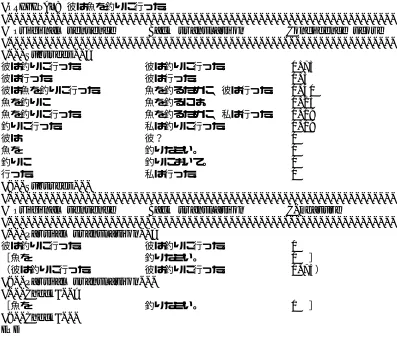
Figure 1: Example of detection of non-machine-translatable part of sentence.
1. When all the C-measures of the subtrees in the best subset are lower than a predetermined threshold, the subtree with the lowest C-measure is extracted from the best subset and presented to users as a possible non-machine-translatable part. In this case, the right-most part of the given sentence is often non-machine-translatable, or some information required for MT such as the subject word of the sentence is often miss-ing. When several subtrees have the same C-measure, the longest one is preferred to the others.
2. When a subtree with a C-measure over the threshold is found in the best subset, the subtree is often machine-translatable, and the remaining subtrees with low C-measures are often non-machine-translatable. Then, all the subtrees with C-measures below the threshold are extracted from the best subset and presented to users as possible non-machine-translatable parts.
We sometimes find a subtree from which possible non-machine-translatable parts have been extracted, but its super-subtree has a C-measure that is over the thresh-old. In this case, the difference between the sub-tree and its super-subsub-tree indicates the non-machine-translatable part. Therefore, the super-subtree with the highest C-measure is presented to users as reference information. Here, the super-subtree of a subtreest means the subtree that includesst.
Example output is shown in Figure 1. “Partial translation” indicates the best subset of subtrees. “Check!” indicates non-machine-translatable parts. The threshold was set at 0.5 in the experiment. In the example shown in Figure 1, the set of the subtree consisting of the bunsetsu “ ” with a C-measure of 0 and the subtree consisting of the
bun-setsus “ ” with a C-measure of 1 was
selected as the best subset. The first subtree, the bunsetsu “ ”, would then be presented to users as a possible non-machine-translatable part.
3.2. Experimental Results and Discussion
We experimented to examine whether detecting the non-machine-translatable parts of a sentence and the best sub-set of subtrees could help improve the machine translata-bility of originally input sentences. As a test set, we used an MT test set provided by NTT 2 (Ikehara et al., 1994).
This set consists of 3,718 Japanese sentences with English translations. Japanese sentences were used as input. The first 100 sentences of the test set were selected, and the best subsets of the subtrees and non-machine-translatable parts of the 100 sentences were presented to a human subject. For the C-measure, we used BLEU with generalization and harmonic-mean features, which achieved the best average correlation coefficients for both subjective human evalua-tion and the automatic MT evaluaevalua-tion metrics (Uchimoto et
2
Original sentence Reference translation Revised sentence (non-machine-translatable parts are
under-lined)
I ate a monaka.
(MT: I ate time.) (MT: I ate bean-jam-filled wafers.) Most persons wore hats.
(MT: The most person put on a hat.) (MT: Most people put on a hat.) He shot down a bird in
(MT: He shot down the bird to be flying in.) flight. (MT: He shot down the bird of the flying.) A ship runs aground.
(MT: The ship reaches a deadlock.) (MT: The ship strands.) He went fishing.
(MT: He went fishing in the fish.) (MT: He went fishing.) He placed his hands
(MT: He adjusted a hand.) together. (MT: He joined one’s palms together.) The two sumo wrestlers
(MT: Both sumo wrestlers adjusted a chest.) came to grips. (MT: Both sumo wrestlers grappled.) He put his heart into his
(MT: He attended to the work.) work. (MT: He concentrated on the work.)
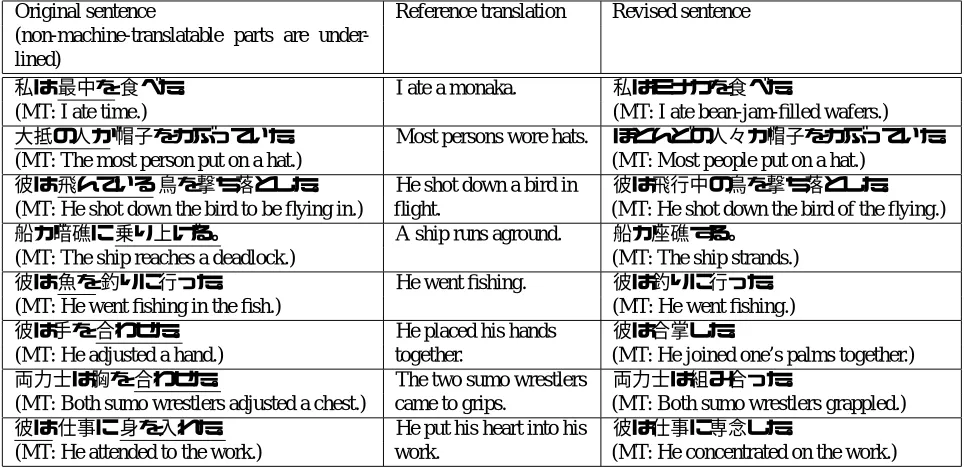
Table 1: Examples of original and revised sentences and detected non-machine-translatable parts.
Human subject Original (%) Without information (%) With information (%)
1 37 49 64
2 37 53 46
3 37 41 44
4 37 46 47
Table 2: The percentage of acceptable translations.
al., 2005). The subject revised the original Japanese sen-tences by referring to the information presented, as shown in Figure 1 (no information was presented on the target lan-guage). For example, when the human subject referred to the detected non-machine-translatable part “ ”, which is indicated by “Check!” in Figure 1 and revised the
orig-inal sentence “ ” to “
”, then we achieved an acceptable MT result, i.e., “He went fishing”, while the initial MT result was “He went fishing in the fish.” After the subject had revised the sentences, we found that the quality of the MT results im-proved. Examples of original and revised sentences and non-machine-translatable parts are shown in Table 1. The quality of the MT results was evaluated by a human subject using five grades: 1 (very poor) to 5 (very good). The trans-lation was considered acceptable when the grade was 3 or better. We found that the number of acceptable translations improved from 54 (54%) to 75 (75%) after revision.
Next, we experimented to compare the MT results obtained by referring to the non-machine-translatable parts of a sen-tence and the best subsets of subtrees with those obtained without referring to the additional information. The 100 sentences from number 201 to 300 of the MT test set were used in the experiment. The original sentences were re-vised by four human subjects. The results are shown in Table 2. We found that the number of acceptable transla-tions improved from the initial 37 when the original sen-tences were revised with the additional information. We also found that the number of acceptable translations
us-ing the additional information was higher than that without using additional information, except in the case of one sub-ject. This shows that the information provided by our sys-tem generally helped improve the machine translatability of the original input sentences.
4.
Semi-Automatic Revision of
Non-Machine-Translatable Parts of a
Sentence
4.1. A Method for Semi-Automatic Revision of Non-Machine-Translatable Parts
In the experiments described in the previous section, the human subjects had to revise the original sentences with-out any knowledge of paraphrase candidates except the back translation. The subjects thus had no idea in many cases how to effectively revise the original sentences. If paraphrase candidates and the automatically detected non-machine-translatable parts could be provided, they would help the human subjects revise the sentences. This section describes a method for extracting knowledge to help us ef-fectively paraphrase the non-machine-translatable parts. Investigating the paraphrase strategy of the human subjects in the experiments described in Section 3.2., we found that the strategy consisted of the following three actions:
1. Paraphrase a word in a bunsetsu as different one.
2. Paraphrase one or more bunsetsus as one bunsetsu.
Definition Lexical Entry Similarity (to fish) (to fish) 0.62 (to fish) (to fish) 0.62 (to fish) (fishing) 0.62 (fisher) (fisher) 0.62 (fisher) (fisher) 0.62 (fisher) (fisher) 0.62 (to fish) 0.62 (to catch fish by fishing)
. . . . . . . . .
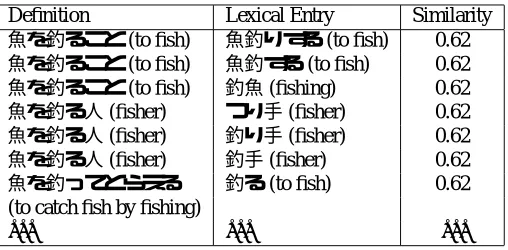
Table 3: Examples of candidates extracted from the EDR dictionary for “ ” (to fish).
We focused on supporting the first and second actions be-cause they were major actions in our experiments. The third action will be supported in future work. We also found that less ambiguous expressions could be correctly translated more reliably than plain but ambiguous expressions. This is because the accuracy of text analysis improves when a given sentence consists of unambiguous words or has sim-ple syntactic structure, and the improvement in text analysis contributes to improving the quality of MT results. We used a dictionary to extract knowledge for paraphras-ing. In conventional methods, also, dictionaries have been used for paraphrasing. For example, a method for para-phrasing verbs to plain expressions was proposed (Kaji et al., 2002). In this method, a verb found as a lexical entry of a dictionary is transformed into an expression found in the definition of the verb. The knowledge for transforming a lexical entry into an expression used in the definition is useful for paraphrasing; we call this lex-to-def knowledge. However, this kind of knowledge often generates plain but ambiguous expressions. To reduce the ambiguity, therefore, we also extract knowledge for conducting the reverse para-phrasing, which transforms an expression found in a defini-tion into the lexical entry; we call this def-to-lex knowledge. We also extract notational variants and synonyms because they are often less ambiguous than the original word for a particular MT system. They are extracted by finding lex-ical entries that have the same definitions as the original word. We used the EDR dictionary (NIC, 2003), which has approximately 410,000 lexical entries.
Knowledge extraction and semi-automatic revision were conducted using the following steps:
1. Extraction of notational variants and synonyms and generation of paraphrase candidates
Content words are extracted from the automatically detected non-machine-translatable parts, and defini-tions whose lexical entries are the same as the content words are extracted from the EDR dictionary. Then, the lexical entries whose definitions are the same as the extracted definitions are extracted as candidates of notational variants and synonyms. For example, the definition of the lexical entry “ ” (fishing) is “ ” (to fish)”, and two other lexical en-tries “ ” (to fish) and “ ” (to fish) have the same definition in the EDR dictionary. Para-phrase candidates are generated by transforming the original content words into the notational variants and
synonyms.
2. Extraction of lex-to-def and def-to-lex knowledge and generation of paraphrase candidates
Content words are extracted from the automatically detected non-machine-translatable parts, and defini-tions and lexical entries including each content word are extracted from the EDR dictionary. Next, a
bun-setsu in the non-machine-translatable parts and
depen-dencies consisting of a bunsetsu in the non-machine-translatable parts and its modifiee or modifier are ex-tracted from the original sentence. For each pair of the extracted strings, one extracted from the EDR dic-tionary and the other from the original sentence, the similarity is calculated. Then, all pairs are sorted ac-cording to the similarity, and the top 100 pairs are used as knowledge for paraphrasing. If several pairs have the same similarity, the pairs that include more con-tent words from the original sentence are preferred. The similarity of each pair is calculated using the C-measure. Paraphrase candidates are generated using the pairs with high similarity in two ways: one, trans-forming the original strings into the definition whose lexical entry is paired with the original strings, and the other, transforming the original strings into the lexi-cal entry whose definition is paired with the original strings.
For example, the detected non-machine-translatable part of the fifth example in Table 1 is “ ” (fish) and “ ” (case-marker), and its modifiee is “ ” (to fish). For the dependent expression, “ ” (to fish), the candidates shown in Table 3 can be extracted. In this table, “similarity” indicates the similarity between the expression “ ” and each definition in the EDR dictionary.
3. Ranking paraphrase candidates
For each paraphrase candidate generated using the above steps, a C-measure is calculated using the back translation. Then, the paraphrase candidates are ranked according to the C-measures.
Original sentence Reference translation Revised sentence (non-machine-translatable parts are
un-derlined)
The house is short handed.
(MT: There are no hands in a house.) (MT: A house is shortage of labor.) I am so busy that any help
would be appreciated.
(MT: I’d like to be also aided by a cat.) (MT: I’m very busy and want everyone to support.)
He completely changed
(MT: He has returned a palm.) his attitude. (MT: He changed the attitude entirely.) If you are free, we need
your help. (MT: If you’re free, you want you to
help me.)
(MT: If you’re free, could you help me?)
He is hearing impaired.
(MT: He doesn’t hear an ear.) (MT: He’s a person with hearing im-pairments.)
He poked a honeycomb.
(MT: He picked a bee hive.) (MT: He poked a bee hive.)
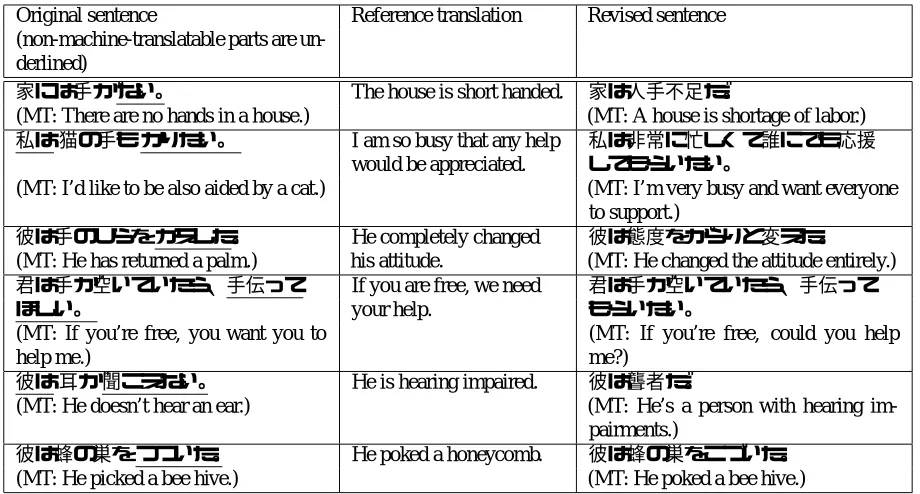
Table 4: Examples of original and revised sentences and detected non-machine-translatable parts.
4.2. Experimental Results and Discussion
We experimented to show that the extracted knowledge is useful for revising the detected non-machine-translatable parts. The 100 sentences from number 301 to 400 of the MT test set as described in Section 3.2. were used in the experiment. Examples of original and revised sentences and non-machine-translatable parts are shown in Table 4. We found that the numbers of acceptable translations im-proved from 68 (68%) to 76 (76%) using the paraphrase candidates, although the numbers of acceptable translations improved to 72 (72%) using only the information described in Section 3.. This shows that the information provided by semi-automatic paraphrasing helped improve the machine translatability of the originally input sentences.
5.
Conclusion
We developed a method for automatically detecting the non-machine-translatable parts of a given text and a method for providing useful knowledge to effectively paraphrase or revise the detected non-machine-translatable parts. We found that the information provided by the methods helped improve the machine translatability of the originally input sentences.
Although we used a single MT system in one translation direction, we are planning to use multiple MT systems and translation memories to find the best measure for rating ma-chine translatability and make the best translation. In recent years, research on paraphrasing technology has been inten-sive, and free software is now available for paraphrasing sentences. Therefore, we are planning to use this technol-ogy and our method to automatically generate paraphrase candidates and select the optimal paraphrase in the source language for translation by a particular MT system.
6.
References
The National Institute for Japanese Language (NIJL), edi-tor. 2004. Word List by Semantic Principles. Dainippon-tosho. (in Japanese).
Satoru Ikehara, Satoshi Shirai, and Kentaro Ogura. 1994. Criteria for Evaluating the Linguistic Quality of Japanese to English Machine Translations. Transactions of the
JSAI, 9(4):569–579. (in Japanese).
Nobuhiro Kaji, Daisuke Kawahara, Sadao Kurohashi, and Satoshi Sato. 2002. Verb Paraphrase based on Case Frame Alignment. In Proceedings of the 40th ACL, pages 215–222.
Sadao Kurohashi and Makoto Nagao, 1999. Japanese
Mor-phological Analysis System JUMAN Version 3.61.
De-partment of Informatics, Kyoto University.
Sadao Kurohashi, 1998. Japanese Dependency/Case Structure Analyzer KNP Version 2.0b6. Department of
Informatics, Kyoto University.
NICT (National Institute of Information and Communi-cations Technology), 2003. EDR Electronic Dictionary
Technical Guide.
Saeko Nomura, Toru Ishida, Kaname Funakoshi, Mika Ya-suoka, and Naomi Yamashita. 2002. Intercultural Col-laboration Experiment 2002 in Asia: Software Develop-ment Using Machine Translation. Transactions of
Infor-mation Processing Society of Japan, 44(5):503–511. (in
Japanese).
Kishore Papineni, Salim Roukos, Todd Ward, and Wei jing Zhu. 2002. BLEU: a Method for Automatic Evaluation of Machine Translation. In Proceedings of the 40th ACL, pages 311–318.