Centroids: Gold standards with distributional variations
Ian Lewin
∗, S¸enay Kafkas
†, Dietrich Rebholz-Schuhmann
†Linguamatics∗ St. John’s Innovation Centre
Cowley Road Cambridge
UK
European BioInformatics Institute† Wellcome Trust Genome Campus
Hinxton Cambridge
UK
[email protected],{kafkas,rebholz}@ebi.ac.uk
Abstract
Motivation: Gold Standards for named entities are, ironically, not standard themselves. Some specify the “one perfect annotation”. Others specify “perfectly good alternatives”. The concept of Silver standard is relatively new. The objective is consensus rather than perfection. How should the two concepts be best represented and related? Approach: We examine several Biomedical Gold Standards and motivate a new representational format, centroids, which simply and effectively represents name distributions. We define an algorithm for finding centroids, given a set of alternative input annotations and we test the outputs quantitatively and qualitatively. We also define a metric of relatively acceptability on top of the centroid standard. Results: Precision, recall and F-scores of over 0.99 are achieved for the simple sanity check of giving the algorithm Gold Standard inputs. Qualitative analysis of the differences very often reveals errors and incompleteness in the original Gold Standard. Given automatically generated annotations, the centroids effectively represent the range of those contributions and the quality of the centroid annotations is highly competitive with the best of the contributors. Conclusion: Centroids cleanly represent alternative name variations for Silver and Gold Standards. A centroid Silver Standard is derived just like a Gold Standard, only from imperfect inputs.
Keywords:Centroid, Gold Standard, Silver Standard, Evaluation
1.
Introduction
We examine several Gold Standard assessment datasets available in biomedicine and motivate a new representation for Gold Standard markup: centroids. Centroids provide a simple and effective representation for namedistributions
and a more fine-grained method for measuring how good a user annotation is. In this way, centroids represent an ex-tensionof classical gold standard markup.
In addition, we define an algorithm for finding centroids, given a set of alternatively annotated inputs, and test it quantitatively and qualitatively against both Gold Standard inputs and automatically annotated inputs.
Given a set of alternative inputs, each of which is Gold Standard, we verify that the algorithmically discovered cen-troids are also overwhelmingly gold standard, as tradition-ally conceived. Even when (infrequently) they are not, they very often represent errors in the original gold standard. We apply the algorithm also to sets of alternative automatic annotations as submitted to the CALBC challenge competi-tion. We thereby derive aSilverStandard, a representation of a consensus driven standard. We show that silver stan-dard centroids are very highly competitive with the best of the contributing annotations. Further experiments also show that Silver Standard scores correlate to Gold Stan-dard, suggesting that silver might indeed stand proxy for
gold as well as representing a consensus annotation (with distributions).
We conclude that it is indeed highly desirable to represent distributions directly within the Gold Standards and not just implicitly, for example through fuzzy or partial matching schemes.
2.
Background
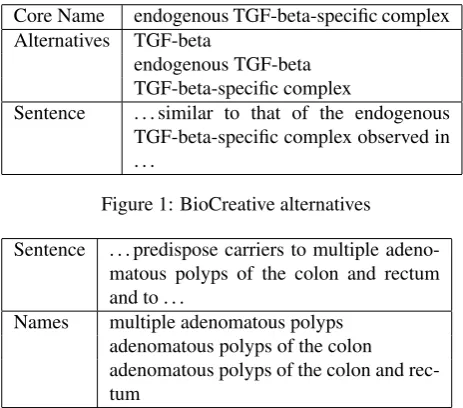
The Gold Standard data-sets available for biomedical named entity recognition are only few in number. Yet, they differ in more than just subject matter. Here we show how they vary in the representation and suggested evaluation of name variations.
The SCAI corpus (Kolarik et al., 2008) for chemical enti-ties, for instance, assigns gold standard I-O-B labels to pre-defined tokenswithin sentences. Good scores require re-producing the same tokenization as well as the one correct label for each token. Some variation is possible through the use of special class labels. For example, the token
compounds within uridine compoundsis assigned the la-belB-Modifier. This perhaps indicates thatcompounds
is not here functionning as an essential part of the name of the chemical. Other labels, such as B-Trivialand
auto-... o-f-t-h-e-e-n-d-o-g-e-n-o-u-s-T-G-F-b-e-t-a-s-p-e-c-i-f-i-c-c-o auto-... ... 0 0 0 0 0 2 2 2 2 2 2 2 2 2 2 4 4 4 4 4 4 2 2 2 2 2 2 2 2 2 2 ...
Figure 3: Counts of adjacent name-internal characters
1) . . . of the endogenousheb=’l:0:2,l:10:2,r:0:2,r:16:2’iTGF-betah/ei-specific complex observed . . . 2) . . . Rel-related humanheb=’l:16:2,l:5:3,l:0:2,r:0:2,r:13:1,r:20:3’ip75h/einucleoprotein complex . . .
Figure 4: Two centroids + boundary distributions
internal characters. Figure 3 shows the character-pair counts for our running example. Two markups consider that the transitione → nat the beginning ofendogenousfalls within the name; whereas all four consider thatT →Gdo. The focus on name-internal pairs, rather than single charac-ters, ensures that boundaries are valued when two different names happen to be directly adjacent themselves.
Over the course of a text, the number of votes will mostly be zero, punctuated by occasional bursts of wave-like vari-ation. We define the centroids to be the substring(s) over character pairs that are peaks (or local maxima) in a burst of votes. In our running example, there is only one peak and the centroid isTGF-beta.
In addition, thresholds may be added to further refine the notion of a peak. For example, “only local maxima” might be relaxed to “local maxima plus surrounding material within a certain threshold of votes”. In this way, small de-viations from peaks might be ignored. Equally, a minimum threshold of votes may be applied so that very low peaks be-come ignored. Thresholding bebe-comes important when the algorithm is applied to generate a Silver Standard from sets of imperfect inputs, such as those that result from automatic annotation.
The character-pair votes also define the boundary distribu-tion around the centroid. We currently define a possible boundary whenever the number of votes changes. Its value is the difference in votes. So, the centroidTGF-betahas a possible left boundary beforeTand its value is 2 (the differ-ence between 4 and 2). The boundary before endogenous
also scores 2 (the difference between 0 and 2). There isno
boundary immediately afterspecific.
Fig. 4 illustrates typical outputs of the algorithm using an xml representation. The centroid itself is represented in-side aneelement. Each possible boundary is represented asd:p:v(direction,position,value) in a comma-delimited list. For example,l:10:2means that there is a boundary 10 characters to the left of TGF-beta. This boundary in-cludesemdogenous. The ‘value’ of the boundary, 2, is used in measuring relative acceptability (see further below). The string encompassed by the leftmost and rightmost bound-aries is themaximal extentof the centroid.
5.
Algorithm Evaluation
Here we evaluate the centroid algorithm first when fed per-fect inputs, namely sets of humanly annotated alternatives from Gold Standard corpora, and secondly when fed auto-matic annotations.
5.1. Gold Standard Inputs
We generated multiple copies of the BioCreative training corpus (15k sentences) such that every Gold Standard name (core and alternative) was marked up once in some copy of the corpus. Then, we applied the centroid algorithm. No thresholding was used. As the inputs are all Gold Standard, no threshold ought to be necessary because one vote is sim-ply enough votes.
We evaluated the resulting centroids using, as a de facto pre-existing standard, the BioCreative evaluation script. (For the use of Boundary Scores, see below.)
The results (Fig 5) show that only a tiny proportion of cen-troids werenotalso Gold Standard names. That is, the vast majority of sets of alternatives in BioCreative do not resem-ble the (deliberately chosen) AZDC example of Section 3.. Nevertheless, we investigated the reasons why some names were not so well-behaved (see below). We also observe that the recall of Gold Standard names is extremely high. We conclude that any tagger that performs well in finding cen-troids will perform equally well against the original Gold Standard, as measured by BioCreative’s own evaluation. One unexpected result was that the algorithm uncovered more centroids (18339) than there were core names in BioCreative (18265). How could this be? It turned out that there were entries in the BioCreative Alternative Gene List that overlapped no core name, e.gPHA from offsets 175 to 177 in P01842498A0000; gp0.7 from 30 to 34 in P01310178A0876. Such cases are probably just errors in the BioCreative data2. If nothing else, this demonstrates
that a Gold Standard in the BioCreative format requires a certain degree of internal consistency checking. By con-trast, such an error simply cannot appear in a centroid rep-resentation. Every alternative must extend a centroid. Fig 5 also demonstrates that there are fewer true and false positives according to the evaluation procedure than there are “core” names. This is surprising too. One might ex-pect every candidate name either to be true (match the Gold Standard in some way) or false. This is not so however be-cause BioCreative evaluation actually depends on the dis-tribution of overlapping names between the Gene List and Alternative Gene List. If two candidates match smaller al-ternatives of the same longer core name, then they count for onlyone, nottwo.
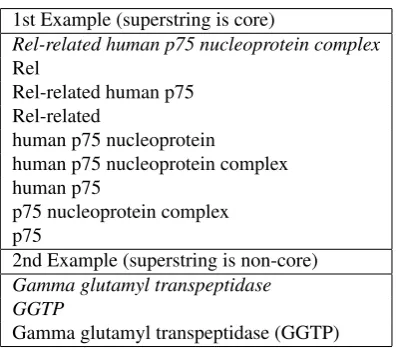
Our qualitative analysis of discrepancies also highlighted this possibility. Fig. 6 shows two such cases. In each case,
2Errors because a non-overlapping alternative will not be used
db #cents TP FP FN P R F #core names BC 18339 18141 134 124 0.993 0.993 0.993 18265 AZDC 3206 3186 15 32 0.995 0.990 0.993 3218
Figure 5: Centroid evaluation
the core name from the Gene List is shown italicized.
1st Example (superstring is core)
Rel-related human p75 nucleoprotein complex
Rel
Rel-related human p75 Rel-related
human p75 nucleoprotein
human p75 nucleoprotein complex human p75
p75 nucleoprotein complex p75
2nd Example (superstring is non-core)
Gamma glutamyl transpeptidase GGTP
Gamma glutamyl transpeptidase (GGTP)
Figure 6: Disjoint substring alternatives
In the first example, if a candidate annotation includesRel
but notp75, BioCreative will give no recall penalty. This is becauseRel andp75 are just equally good alternatives to annotating the one core entity: Rel-related human p75 nucleoprotein complex. If one name in the Alternative Gene List which overlaps it has been found, then the core name has been found. So there is no recall error. By contrast, the centroid algorithm finds that the two smaller names are
bothcentroids and evaluation will therefore require both of them to be found by an automatic annotator. This seems to us intuitively correct. Given the alternatives in Fig 6, both
Relandp75ought to be annotated either individually or as parts of one long name. Otherwise, a use of a gene name has been missed.
Fig 4 shows in xml format thep75 centroid that is found by the algorithm. It is important to note that the distribu-tion of boundaries does not tie particular left boundaries to particular right boundaries. Therefore, p75 nucleopro-teinispermissiblegiven the centroid representation. In this way, the centroid representation further deviates from what is represented in the BioCreative Gold Standard.p75 nucle-oproteinis not in fact included in the long list of alternative names that are deemed Gold Standard by BioCreative. If an annotation included this candidate, it would simply be false positive. According to the centroid measure, however, it is true positive with a right boundary score (see section 6.) of 0.33.
Who is right? Although no external validation (such as a Mesh identifier) forp75 nucleoprotein could be found in a web-search, we note that BioCreative itself deems hu-man p75 nucleoproteinto be Gold Standard and it certainly seems thathumanis an optional element. (We could find no identifier forhuman p75 nucleoproteineither.) Therefore, we believe thatp75 nucleoprotein ought to be acceptable too. It is of course not clear how the lists of alternative
names in the BioCreative gold standard were arrived at; but our investigations suggest that they may not be complete. We carried out the same procedure and analysis for the Arizona Disease Corpus. In this case it was necessary to partition the undifferentiated set of names into ‘core’ and ‘alternative’ and this was done without human interven-tion. Whenever an overlap was detected, the core name was simply the first member of the set. However, the re-sulting partition only contained 194 alternatives for 3218 core names which is significantly different from BioCre-ative where 14499 alternBioCre-atives are associated with 18265 core names. As a result, although the precision, recall and f-scores for AZDC in Figure 5 resemble those for BioCre-ative, the underlying situation is very different. The cen-troid algorithm only has work to do when there are alterna-tives and this is infrequently the case in AZDC.
Qualititative analysis of the AZDC disagreements revealed that they mostly resembled the example of Figure 2. For ex-ample,ovarian cancerandcancer cell growth, are overlap-ping alternatives in AZDC. This leads to a centroid of can-cerwhich is not itself deemed gold standard. In fact, in this particular case, the superstringovarian cancer cell growth
was also not AZDC gold standard! One might defend the omission of ‘cancer’ on its own from the Gold Standard on the grounds that it is too imprecise or vague, even though a disease tagger that spotscancerhas at least done some-thing better than one that spots nosome-thing at all. It is harder to understand why the superstringovarian cancer cell growth
should not be Gold Standard given that bothovarian cancer
andcancer cell growthare Gold Standard.
The conclusion is that, in most cases, where the cen-troid representation suggests names that differ from those present in the input list of alternatives, the centroid sug-gested names are correct.
5.1.1. Appositional cases
There is one common case, however, where the centroid algorithm appears, intuitively, to produce incorrect results. These cases involve the linguistic phenomenon of apposi-tion, where two adjacent terms have one referent, such as “C/EBP homologous protein CHOP-10.” Here, the follow-ing names are Gold Standard alternatives: CHOP-10, pro-tein CHOP-10 andC/EBP homologous protein. In these circumstances, the centroid algorithm detectsproteinas a centroid, in addition toCHOP-10andC/EBP homologous. Since these cases always arise through apposition and in-volve a highly general term (such as gene or protein) as head noun, one effective solution is simply to remove cen-troids that only consist of such a term.
The calbc silver standard corpus for biomedical named entities - a study in harmonizing the contributions from four independent named entity taggers. InLREC-10. D. Rebholz-Schuhmann, A. Jimeno-Yepes, C. Li,
S. Kafkas, I. Lewin, N. Kang, P. Corbett, D. Mil-ward, E. Buyko, E. Beisswanger, K. Hornbostel, A. Kouznetsov, R. Witte, LaurilaJ.B., B.J.O Baker, C.J Kuo, S. Clematide, G. Rinaldi, R. Farkas, G. Mora, K. Hara, L. Furlong, M. Rautschka, Lara Neves M., A. Pascual-Montano, Q. Wei, N. Collier, F. Mah-bub Chowdhury, A. Lavelli, R. Berlanga, R. Morante, V. Van Asch, W. Daelemans, J.L. Marina, E. van Mulligen, J. Kors, and U. Hahn. 2011. Assessment of ner solutions against the first and second calbc silver standard corpus. Journal of Biomedical Semantics, 2(Suppl 5:S11).
Erik F. Tjong Kim Sang and Fien De Meulder. 2003. Introduction to the conll-2003 shared task: Language-independent named entity recognition. InProceedings of CoNLL-2003, pages 142–147.
Satoshi Sekine and Hitoshi Isahara. 2000. Irex: Ir and ie evaluation project in japanese. InLREC-2.
Larry Smith, Lorraine Tanabe, Rie Ando, Cheng J. Kuo, Fang I. Chung, Chun N. Hsu, Yu S. Lin, Roman Klinger, Christoph Friedrich, Kuzman Ganchev, Man-abu Torii, Hongfang Liu, Barry Haddow, Craig Stru-ble, Richard Povinelli, Andreas Vlachos, William Baum-gartner, Lawrence Hunter, Bob Carpenter, Richard Tsai, Hong J. Dai, Feng Liu, Yifei Chen, Chengjie Sun, Sophia Katrenko, Pieter Adriaans, Christian Blaschke, Rafael Torres, Mariana Neves, Preslav Nakov, Anna Divoli, Manuel M. Lopez, Jacinto Mata, and John W. Wilbur. 2008. Overview of BioCreative II gene mention recog-nition.Genome Biology, 9(Suppl 2).