The TARSQI Toolkit
Marc Verhagen and James Pustejovsky
Computer Science Department, Brandeis University, Waltham, USA {marc,jamesp}@cs.brandeis.edu
Abstract
We present and demonstrate the updated version of the TARSQI Toolkit, a suite of temporal processing modules that extract temporal information from natural language texts. It parses the document and identifies temporal expressions, recognizes events, anchor events to temporal expressions and orders events relative to each other. The toolkit was previously demonstrated at COLING 2008, but has since seen substantial changes including: (1) incorporation of a new time expression tagger, (2) embracement of stand-off annotation, (3) application to the medical domain and (4) introduction of narrative containers.
Keywords:TimeML annotation; tools; temporal processing.
1.
Introduction
The TARSQI Toolkit (TTK) is a suite of temporal pro-cessing modules. It identifies temporal expressions and events in natural language texts, and parses the document to both order events and anchor them to temporal expres-sions. TTK was developed primarily from 2004-2008 in the context of the IARPA AQUAINT project, which aimed at building question answering systems an din which tem-poral information was considered a needed basic capabil-ity that would increase performance of question answering systems. Recently, development has picked up again and four major changes have been made or are being made:
1. replacement of an old and hard-to-maintain time ex-pression tagger
2. adoption of Linguistic Annotation Framework stan-dards
3. application to the medical domain 4. introduction of narrative containers
In this demo paper, we first give a short overview of TimeML, the representation language embodied in the toolkit. We then describe the current state of the toolkit, focusing especially on recent and current changes.
Further details on the toolkit and individual components are available in (Verhagen et al., 2005; Verhagen and Puste-jovsky, 2008; Saur´ı et al., 2005; Saur´ı et al., 2006b; Verha-gen, 2005; Saur´ı et al., 2006a; Mani et al., 2006; Mani et al., 2007) and on the TimeML website.1
2.
TimeML
TimeML (Pustejovsky et al., 2003a; Pustejovsky et al., 2005; Pustejovsky et al., 2010) is a specification language for events and temporal expressions. Recently, TimeML has been consolidated as an international cross-language ISO standard (ISO WD 24617-1:2007) within the seman-tic annotation framework.
Events in articles are naturally anchored in time within the narrative of a text. For this reason, temporally grounded events are the very foundation from which we reason about
1http://timeml.org/
.
how the world changes. Without a robust ability to iden-tify and extract events and their temporal anchoring from a text, the real aboutness of the article can be missed. More-over, since entities and their properties change over time, a database of assertions about entities will be incomplete or incorrect if it does not capture how these properties are updated throughout the timeline.
There are four major data structures that are specified in TimeML:EVENT,TIMEX3,SIGNAL, andLINK. TimeML considers eventa cover term for situations that happen or occur. Events can be punctual or last for a period of time. TimeML also considers as events those predicates describ-ing states or circumstances in which somethdescrib-ing obtains or holds true. Some examples of events are given in example (1) below. Note that the situations that happen or occur may do so in a hypothetical future.
(1) a. A fresh flow of lava, gas and debriseruptedthere Saturday.
b. Israel will ask the United States to delay a military strikeagainst Iraq until the Jewish state is fully prepared for a possible Iraqiattack.
c. A Philippine volcano,dormantfor six centuries, began exploding with searing gases, thick ash and deadly debris.
Temporal expressions in TimeML are marked up with the
TIMEX3 tag and can, amongst others, refer to dates, times and durations. There are three major types ofTIMEX3 ex-pressions: (i) fully specified temporal expressions, which provide all the information necessary in order to identify the point or period of time they are referring to; e.g.,June 11, 1989; (ii) underspecified temporal expressions, which require the use of some contextual information in order to interpret the point in time they are referring to; e.g.,early in the morningandMonday, and (iii) durations, such asthree months.
The SIGNAL tag is used to annotate sections of text, typ-ically function words, that indicate how temporal objects (events and temporal expressions) are to be related to each other.
Finally, TimeML introduced theLINKtags. There are three types ofLINKtags in TimeML, which encode the various
relations that exist between the temporal elements of a doc-ument, namely, events and temporal expressions:
1. TLINK: a Temporal Link representing the temporal re-lationship holding between two events, or between an event and a time. The actual relation is encoded with arelTypeattribute whose values include BEFORE,
AFTER,INCLUDES,IS INCLUDED, and SIMULTANE
-OUS.
2. SLINK: a Subordination Link used for contexts intro-ducing relations between two events. One example is the relation between the reporting verb and the embed-ded event inJohn said he drank some wine.
3. ALINK: an Aspectual Link representing the relation-ship between an aspectual event and its argument event. An example is the relation betweenfinishedand
assemblinginJohn finished assembling the table.
The original version of the TARSQI Toolkit generates all tags mentioned above except for the SIGNALtag. It also added a MAKEINSTANCE tag for events in order to deal with cases like He taught on Monday and Wednesday, where there are two instances of the teach event. This dis-tinction is now made at the level of the EVENT tag itself and MAKEINSTANCE was eliminated from both TimeML
and TTK.
3.
Overview of the Toolkit
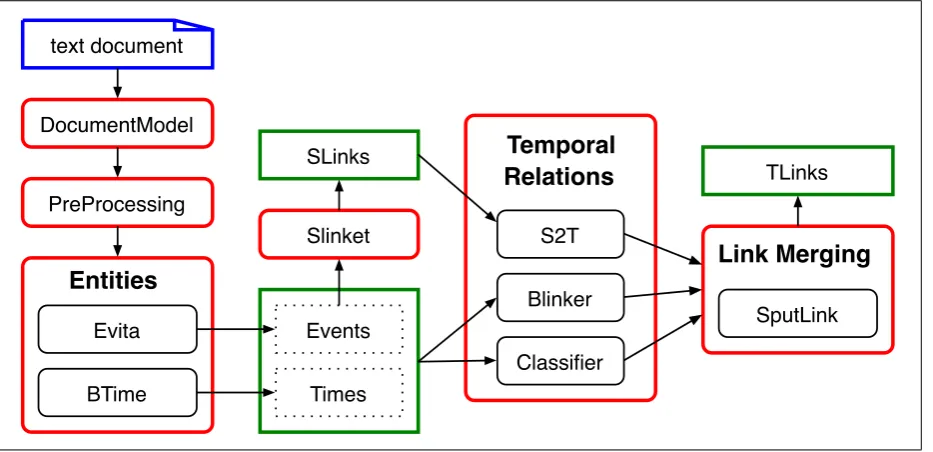
A diagram of the architecture of TTK is given in Figure 1 on the next page. Input text is first processed by the
DocumentModel, which takes care of document-level prop-erties like encoding and meta tags. The DocumentModel hands clean text to the other components which are allowed to be more generic.
The PreProcessor uses standard approaches to tokeniza-tion, part-of-speech tagging and chunking. The tokenizer and chunker are homegrown, but for tagging TTK provides an interface to the TreeTagger (Schmid, 1994).
BTimeis a temporal expression tagger that recognizes the extents of time expressions and generates their normalized values, it will be discussed further in section 3.2.. Evitais a domain-independent event recognition tool that performs two main tasks: robust event identification and analysis of grammatical features such as tense and aspect.
SlinketintroducesSLINKs and classifies them into the cat-egories factive, counterfactive, evidential, negative eviden-tial, and modal, based on the modal force of the subordinat-ing event (Saur´ı et al., 2006b). Slinket uses a pattern library for a well-delimited group of verbal and nominal predicates such asregret,say,promiseandattemptwhere the patterns identify the subordination context.
The temporal processing stage includes three modules that generateTLINKs.
1. Blinkeris a rule-based component that applies to cer-tain configurations of events and timexes, using pre-dominantly syntactic cues.
2. S2Ttakes the output of Slinket and uses about a dozen syntactic rules to map SLINKs onto TLINKs. For
ex-ample, one S2T rule encodes that in SLINKs with re-porting verbs where both events are in past tense, the reporting event occurred after the event reported on.
3. TheTLink Classifieris a MaxEnt classifier that identi-fies temporal relations between previously recognized events and times in a text. It is trained on the Time-Bank corpus (Pustejovsky et al., 2003b).
TLINKs generated by the three modules above are not guar-anteed to be consistent with each other. The Link Merging stage uses a greedy algorithm to mergeTLINKs into a con-sistent whole. First, all links are ordered on their confidence score and put into a queue. Currently these scores are ei-ther global or local. Global confidence scores are derived from the observed precision of the component that gener-ated the links. For example, links genergener-ated by S2T are considered high precision and are always deemed more re-liable than links generated by the classifier. Links generated by the classifier come with a confidence score assigned by the classifier and these scores are used to order all classifier links.
Merging proceeds by first creating a graph that contains all events and time expressions as nodes, but there are no constraints expressed on the edges. Those constraints are added by the temporal links that are popped off the queue and are added one by one to the graph. Each time a link is added a constraint propagation component namedSputlink, based on Allen’s interval algebra (Allen, 1983), is applied. If a link cannot be added because it is inconsistent with the constraint already on the edge, then the link is skipped. The result is a consistent annotation where high precision links are preferred over lower precision links.
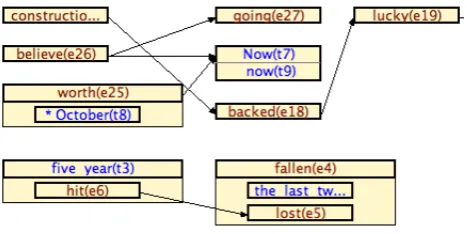
To present temporal relations visually, TTK uses a visual-ization scheme named TBox (Verhagen, 2007), which was added to the Tango TimeML annotation tool (Verhagen et al., 2006). It uses left-to-right arrows, box inclusion and stacking to encode temporal precedence, inclusion, and si-multaneity respectively (see Figure 2).
Figure 2: The TBox Representation
Blinker
Classifier S2T SLinks
SputLink DocumentModel
PreProcessing text document
Slinket
TLinks
Events
Times
Temporal
Relations
Link Merging
Entities
Evita
BTime
Figure 1: TARSQI Toolkit Architecture
3.1. Adopting Stand-off Annotation
Originally, the TARSQI Toolkit added annotations as inline XML tags to the source document. Recently however it has become increasingly clear that there is value in separating tags from the primary data that they annotate. The Lin-guistic Annotation Format (LAF), a standard for linLin-guistic annotation developed by the International Standard Orga-nization (Ide and Romary, 2006; Ide and Suderman, 2007), provides guidance on the basic principles for representing linguistic annotation schemes. Some of the main principles of are: (i) annotations are separated from the data they notate (that is, LAF requires stand-off annotation), (ii) an-notation structure and content are separated, and (iii) map-pings between annotation occur via a pivot format.
Figure 3: LAF Annotation Layers
The LAF data model for annotations comprises a directed graph referencing regions of primary data as well as other annotations, in which nodes are labeled with feature struc-tures providing the annotation content. The graph is initi-ated by creating virtual nodes between all characters in the primary data. Then leaf nodes can be created by referring to spans defined by virtual nodes. For example, for the string
”The clock struck ten.”, we can create leaf nodes as follows (this example is taken from (Ide and Romary, 2006)):
<edge id="e1" from="0" to="3"/> <edge id="e2" from="4" to="9"/> <edge id="e3" from="10" to="16"/> <edge id="e4" from="17" to="20"/> <edge id="e5" from="20" to="21"/>
Typically, this first layer of annotation is referred to as the base segmentation. Other annotations can be added on top of this annotation. Below is a node from a layer defining lemmatization and parts of speech:
<edge id="t2" ref="e2"> <fs type="token">
<f name="lemma" sVal="clock"/> <f name="pos" sVal="NN"/> </fs>
</edge>
The toolkit has been adapted to use stand-off annotation throughout. Inline XML is still an output option, but by de-fault TTK creates layered files that point to other tag iden-tifiers in other layers or to character offsets in the primary data.
3.2. BTime – Time Expression Tagger
The 2008 version of TTK used a component that was ba-sically a wrapper around the Tempex Perl module (Mani and Wilson, 2000), which used complex regular expres-sions to recognize the extent of time expresexpres-sions as well as a set of rules to determine the normalized value of the
TIMEX3. While performing at a reasonable level (which was then state-of-the-art), it was hard to make updates to the script.
date ->
day month year {
CalendarDate(_[2], _[1], _[0]) } | month day year {
CalendarDate(_[2], _[0], _[1]) } | day month "," year {
CalendarDate(_[3], _[1], _[0]) }
The normalized value of the time expressions is built dur-ing rule application by calldur-ing pre-defined constructors in the action part of the rule. In many cases, values thus con-structed remain underspecified. The other BTime compo-nent uses temporal functions that take the underspecified
TIMEX3 and create the normalized value given an anchor time, which is determined using a set of simple heuristics.
3.3. Application to the Medical Domain
Until recently, development on TimeML and the TARSQI Toolkit was heavily skewed towards the newswire domain. Under an exploratory NIH grant, several experiments have been undertaken to start adapting TTK to the medical do-main. One experiment focused on a set of discharge sum-maries and the task of selecting those documents where the patient was taking statins at the time of the patient’s admis-sion to the hospital (Stubbs and Harshfield, 2010). In order to successfully extend TTK, two major changes needed to be implemented:
1. The TimeML notion of event was expanded to in-clude medications, especially the implied period when a medication was taken.
2. Temporal information encoded in several headers in the discharge summary was taken into account.
External Perl scripts were created that (1) labeled statins as events using a dictionary of aliases, and (2) located section headers and associated temporal information with them. The TTK Blinker module was then modified to make sure that it uses temporal information in headers when determin-ing anchordetermin-ing of events in the section. With these additions, TTK performed with 84% accuracy on the document selec-tion task.
While very preliminary, this experiment unveiled the ma-jor obstacles and presented ways to adapt the toolkit for another domain. More specifically, the system needed to allow for domain-dependent notions of event and the Evita module needs to be sensitive to this. In addition, the docu-ment structure needed to provide more guidance to the re-lation discovery of TTK.
3.4. Narrative Containers
Related to the issue of document structure above is the rhetorical structure of the document and how it informs the anchoring of events. Recent work on TimeML and Time-Bank has explored how the notions of Narrative Time and Narrative Container can be used to increase the informa-tional content of an annotation (Pustejovsky and Stubbs, 2011).
A Narrative Time is the current temporal focus of the docu-ment, it is updated while the reader progresses through the document. The Narrative Container is an interval that ex-tends into the past from the creation time of a document and
that can be used to anchor recent events to. As an example, take the fragment below.
April 25, 2010 7:04 p.m. EDT-t0
S1: President Obama paid-e1 tribute Sunday-t1 to 29 workers killed-e2 in an explosion-e3 at a West Virginia coal mine earlier this month-t2, saying-e4 they died-e5 ”in pursuit of the American dream.”
S2: The blast-e6 at the Upper Big Branch Mine was the worst U.S. mine disaster in nearly 40 years.
The Document Creation Time (t0 in the fragment) forms the right boundary of the Narrative Container, which has, in this genre, a length of approximately a day. The two other time expressions, Sundayandearlier this monthboth are Narrative Times for parts of the fragment. With this infor-mation now available, it becomes easier to determine what anchor times to relate events to. For example, forpaid, the event with the identifier e1, we would resolve how it relates toSunday, possibly usingincluded inas a default. We can then envision to build a temporal graph as in Figure 4. It should be pointed out that the notion of narrative con-tainer mentioned here shares some of the features of the notion of ”framing” structures, as developed in (Charolles, 2005), as well as the ”discourse frame” as used in SDRT.
Note that some of the functionality needed for this is very similar to (i) the heuristics used by BTime to determine what the anchor time is and (ii) the external script that de-termines what section headers are and how to assign a tem-poral value to them.
4.
Conclusion
We have described the current status of the TARSQI Toolkit, focussing on recent changes and current work. We have not attempted to compare the toolkit with any of the many recent systems that extract temporal expres-sions, events and temporal relations for English (Chambers and Jurafsky, 2009; Pus¸cas¸u, 2007; Hepple et al., 2007; Bethard and Martin, 2007; Derczynski and Gaizauskas, 2010; Str¨otgen and Gertz, 2010; Saquete Boro, 2010; Llorens et al., 2010; UzZaman and Allen, 2010; Kolya et al., 2011).
The elements of TTK as described above are in various stages of completion and updates continue to be made. The move to standoff annotation has been wrapped up and BTime is implemented and was inserted into the process-ing chain. The main remainprocess-ing issues for the latter are on grammar coverage and speed. Since BTime uses the Early algorithm, it is also sensitive to the pitfalls of Early’s
O(n3)time complexity. This can be managed by (i)
rec-ognizing and avoiding costly rules that add too many edges t the graph, and (ii) implementing an expected maximum length of a time expression, which will move BTime’s time complexity to a linear scale.
Figure 4: Events grouped into their appropriate Narrative Times.
these scripts modify the BLinker module and these modifi-cations need to be more tightly integrated. Finally, design and implementation of the narrative container idea has only recently started.
The TARSQI source code is available on the TimeML web-site athttp://timeml.org/. An updated version, in-cluding at least the new version of BTime and the exten-sions for the medical domain, will be made available in the spring of 2012. This version will also use stand-off an-notation throughout and include many other updates like unicode support and greater easy of integration with other annotations.
5.
Acknowledgements
This work was supported by the National Institutes of Health, under grant number 5R01NS057484-04. We also like to thank Amber Stubbs, Alex Plotnick and Russell En-trikin, who have all made recent contributions to the code base.
6.
References
James Allen. 1983. Maintaining Knowledge about Tempo-ral Intervals. Communications of the ACM, 26(11):832– 843.
Steven Bethard and James H. Martin. 2007. CU-TMP: Temporal Relation Classification Using Syntactic and Semantic Features. InProceedings of the Fourth Inter-national Workshop on Semantic Evaluations (SemEval-2007), pages 129–132, Prague, Czech Republic, June. Association for Computational Linguistics.
Nathanael Chambers and Dan Jurafsky. 2009. Unsuper-vised Learning of Narrative Schemas and their Partici-pants. InProceedings of the Joint Conference of the 47th Annual Meeting of the ACL and the 4th International Joint Conference on Natural Language Processing of the AFNLP, pages 602–610, Suntec, Singapore, August. As-sociation for Computational Linguistics.
M. Charolles. 2005. Framing Adverbials and their Role in Discourse Cohesion from Connection to Forward La-belling. InPapers of the Symposium on the Exploration and Modelling of Meaning (Sem 05), Biarritz.
Leon Derczynski and Robert Gaizauskas. 2010. USFD2: Annotating Temporal Expresions and TLINKs for TempEval-2. In Proceedings of the 5th International Workshop on Semantic Evaluation, pages 337–340, Up-psala, Sweden, July. Association for Computational Lin-guistics.
Jay Earley. 1970. An efficient context-free parsing algo-rithm. Communications of the ACM, 13(2):94–102.
Mark Hepple, Andrea Setzer, and Robert Gaizauskas. 2007. USFD: Preliminary Exploration of Features and Classifiers for the TempEval-2007 Task. InProceedings of the Fourth International Workshop on Semantic Eval-uations (SemEval-2007), pages 438–441, Prague, Czech Republic, June. Association for Computational Linguis-tics.
Nancy Ide and Laurent Romary. 2006. Representing Lin-guistic Corpora and Their Annotations. InProceedings of the Fifth Language Resources and Evaluation Confer-ence (LREC), Genoa, Italy.
Nancy Ide and Keith Suderman. 2007. GrAF: A Graph-based Format for Linguistic Annotations. In Proceed-ings of the Linguistic Annotation Workshop, pages 1–8, Prague, Czech Republic, June. Association for Compu-tational Linguistics.
Anup Kumar Kolya, Asif Ekbal, and Sivaji Bandyopad-hyay. 2011. A Hybrid Approach for Event Extraction and Event Actor Identification. In Proceedings of the International Conference Recent Advances in Natural Language Processing 2011, pages 592–597, Hissar, Bul-garia, September. RANLP 2011 Organising Committee. Hector Llorens, Estela Saquete, and Borja Navarro. 2010.
TIPSem (English and Spanish): Evaluating CRFs and Semantic Roles in TempEval-2. In Proceedings of the 5th International Workshop on Semantic Evaluation, pages 284–291, Uppsala, Sweden, July. Association for Computational Linguistics.
Inderjeet Mani and George Wilson. 2000. Robust Tempo-ral Processing of News. InProceedings of the 38th An-nual Meeting of the Association for Computational Lin-guistics, pages 69–76, Hong Kong, October. Association for Computational Linguistics.
Inderjeet Mani, Ben Wellner, Marc Verhagen, Chong Min Lee, and James Pustejovsky. 2006. Machine Learning of Temporal Relations. InProceedings of the 44th Annual Meeting of the Association for Computational Linguis-tics, Sydney. ACL.
Inderjeet Mani, Ben Wellner, Marc Verhagen, and James Pustejovsky. 2007. Three Approaches to Learning TLINKs in TimeML. Technical Report CS-07-268, Brandeis University, Waltham, United States.
Georgiana Pus¸cas¸u. 2007. WVALI: Temporal Relation Identification by Syntactico-Semantic Analysis. In Pro-ceedings of the Fourth International Workshop on Se-mantic Evaluations (SemEval-2007), pages 484–487, Prague, Czech Republic, June. Association for Compu-tational Linguistics.
Proceed-ings of the Linguistic Annotation Workshop V, Portland, Oregon. Association of Computational Linguistics. James Pustejovsky, Jos´e Casta˜no, Robert Ingria, Roser
Saur´ı, Robert Gaizauskas, Andrea Setzer, and Graham Katz. 2003a. TimeML: Robust Specification of Event and Temporal Expressions in Text. InIWCS-5 Fifth In-ternational Workshop on Computational Semantics. James Pustejovsky, Patrick Hanks, Roser Saur´ı,
An-drew See, Robert Gaizauskas, Andrea Setzer, Dragomir Radev, Beth Sundheim, David Day, Lisa Ferro, and Mar-cia Lazo. 2003b. The TimeBank Corpus. Corpus Lin-guistics, pages 647–656, March.
James Pustejovsky, Robert Knippen, Jessica Littman, and Roser Saur´ı. 2005. Temporal and Event Information in Natural Language Text. Language Resources and Eval-uation, 39:123–164, May.
James Pustejovsky, Kiyong Lee, Harry Bunt, and Laurent Romary. 2010. ISO-TimeML: An International Stan-dard for Semantic Annotation. InLREC, Malta, May. Estela Saquete Boro. 2010. ID 392:TERSEO + T2T3
Transducer. A systems for Recognizing and Normaliz-ing TIMEX3. In Proceedings of the 5th International Workshop on Semantic Evaluation, pages 317–320, Up-psala, Sweden, July. Association for Computational Lin-guistics.
Roser Saur´ı, Robert Knippen, Marc Verhagen, and James Pustejovsky. 2005. Evita: A Robust Event Recognizer For QA Systems. In Proceedings of the HLT/EMNLP 2005, pages 700–707.
Roser Saur´ı, Marc Verhagen, and James Pustejovsky. 2006a. Annotating and Recognizing Event Modality in Text. InProceedings of of the 19th International FLAIRS Conference, FLAIRS 2006, Melbourne Beach, Florida, USA.
Roser Saur´ı, Marc Verhagen, and James Pustejovsky. 2006b. SlinkET: A Partial Modal Parser for Events. In
Proceedings of LREC 2006, Genoa, Italy.
Helmut Schmid. 1994. Probabilistic Part-of-Speech Tag-ging Using Decision Trees. In Proceedings of Interna-tional Conference on New Methods in Language Pro-cessing, Manchester, UK.
Jannik Str¨otgen and Michael Gertz. 2010. HeidelTime: High Quality Rule-Based Extraction and Normalization of Temporal Expressions. In Proceedings of the 5th International Workshop on Semantic Evaluation, pages 321–324, Uppsala, Sweden, July. Association for Com-putational Linguistics.
Amber Stubbs and Benjamin Harshfield. 2010. Applying the TARSQI toolkit to augment text mining of EHRs. In
Proceedings of the 2010 Workshop on Biomedical Natu-ral Language (BioNLP 2010), July.
Naushad UzZaman and James Allen. 2010. TRIPS and TRIOS System for TempEval-2: Extracting Temporal Information from Text. InProceedings of the 5th Inter-national Workshop on Semantic Evaluation, pages 276– 283, Uppsala, Sweden, July. Association for Computa-tional Linguistics.
Marc Verhagen and James Pustejovsky. 2008. Temporal Processing with the TARSQI Toolkit. In Coling 2008:
Companion volume: Demonstrations, pages 189–192, Manchester, UK, August. Coling 2008 Organizing Com-mittee.
Marc Verhagen, Inderjeet Mani, Roser Sauri, Jessica Littman, Robert Knippen, Seok Bae Jang, Anna Rumshisky, John Phillips, and James Pustejovsky. 2005. Automating Temporal Annotation with TARSQI. In
Proceedings of the 43th Annual Meeting of the Associ-ation for ComputAssoci-ational Linguistics, Ann Arbor, USA. Demo session.
Marc Verhagen, Robert Knippen, Inderjeet Mani, and James Pustejovsky. 2006. Annotation of Temporal Rela-tions with Tango. InProceedings of LREC 2006, Genoa, Italy.
Marc Verhagen. 2005. Temporal closure in an annota-tion environment. Language Resources and Evaluation, 39:211–241, May.