Expanding Parallel Resources for Medium-Density Languages for Free
Georgi Iliev, Angel Genov
Department of Computational Linguistics, Institute for Bulgarian, Bulgarian Academy of Sciences 52 Shipchenski prohod, bl. 17, Sofia 1113, Bulgaria
[email protected], [email protected]
Abstract
We discuss a previously proposed method for augmenting parallel corpora of limited size for the purposes of machine translation through monolingual paraphrasing of the source language. We develop a three-stage shallow paraphrasing procedure to be applied to the Swedish-Bulgarian language pair for which limited parallel resources exist. The source language exhibits specifics not typical of high-density languages already studied in a similar setting. Paraphrases of a highly productive type of compound nouns in Swedish are generated by a corpus-based technique. Certain Swedish noun-phrase types are paraphrased using basic heuristics. Further we introduce noun-phrase morphological variations for better wordform coverage. We evaluate the performance of a phrase-based statistical machine translation system trained on a baseline parallel corpus and on three stages of artificial enlargement of the source-language training data. Paraphrasing is shown to have no effect on performance for the Swedish-English translation task. We show a small, yet consistent, increase in the BLEU score of Swedish-Bulgarian translations of larger token spans on the first enlargement stage. A small improvement in the overall BLEU score of Swedish-Bulgarian translation is achieved on the second enlargement stage. We find that both improvements justify further research into the method for the Swedish-Bulgarian translation task.
Keywords:parallel corpora, automatic paraphrasing, compound splitting
1.
Background
Monolingual paraphrasing has been shown to improve the performance of statistical machine translation (SMT) sys-tems trained on parallel corpora of limited size which would otherwise suffer from sparse data (Callison-Burch et al., 2006). It is a way to augment existing parallel re-sources “for free”, i.e. without the need to collect more parallel data, but by way of introducing variations in the source language which are considered identical to the orig-inal meaning. A number of experiments along these lines are described in the literature involving high-density lan-guages, such as English and Spanish (Callison-Burch et al., 2006), (Nakov, 2008). We on the other hand choose to study its practical application in the case of a language pair for which no large parallel texts are available. Such re-source scarcity precludes the use of some of the techniques described earlier, such as extracting paraphrases through a pivot language (Callison-Burch et al., 2006). Instead we resort to corpus-based techniques for compound analysis and linguistically motivated techniques for shallow parsing, morphological analysis and generation, using freely avail-able monolingual tools and resources.
2.
Goals
Swedish and Bulgarian are official languages of the EU and are both represented in the Europarl (Koehn, 2005) cor-pus. Bulgarian, a South-Slavic language using the Cyril-lic alphabet, was added only recently, and the size of the English-Bulgarian version of the Europarl is rather mod-est – 226,768 sentence pairs compared to 1,678,333 sen-tence pairs in the Swedish-English Europarl. There are other Swedish-Bulgarian parallel texts available, such as the ones contained in the OPUS (Tiedemann et al., 2004), yet they are either literary texts of limited size, film subti-tles of varying quality, or highly specialized texts. Apart
from the Europarl and the JRC-ACQUIS, there are no other known available parallel language resources on general top-ics for the Swedish-Bulgarian language pair of any signifi-cant size.
Through intersection of the Swedish-English and the Bulgarian-English Europarl we arrive at a Swedish-Bulgarian parallel corpus of a total of 160,000 sentences to work with. Our primary goal is to enlarge the Swedish-Bulgarian text by combining several paraphrasing methods for the source language and to investigate the feasibility of the methods in the case of the languages at hand. In doing so we follow a shallow strategy, aimed at achieving as much coverage as possible by investing as little linguistic knowl-edge as possible. Our secondary goal is to study the effect from such enlargement on the quality of the output of an SMT system trained on the enlarged corpora compared to the results from training on the original corpus using stan-dard metrics.
3.
Language specifics
3.1. CompoundingCompounding is highly productive in Swedish (Sjöbergh and Kann, 2004) and accounts for a great number of unknowns in an unseen text, even if the separate parts of the compound are common. A prevailing number of compounds in a given Swedish text are endocentric noun-noun compounds. In terms of meaning most of them are determinative in that the first member of the compound modifies in some way the second member (Liljestrand, 1993). Typically, they would be translated into Bulgarian by a paraphrase where the first member is an adjective modifying the second member, as in the case ofjärnrör→
A considerable linguistic and computational effort is re-quired to tackle the issue of Swedish compound generation. Formulating (3) above from an observed analytic sequence in the original corpus requires knowledge of the specific in-terfix that needs to be used when compounding the Swedish “landslag” (itself a compound) and “spelare”. In the ab-sence of a ready solution for corpus-based compound gen-eration we apply an oversimplified model of combining candidate compound members by either the -s- interfix, which is by far the most frequent (Liljestrand, 1993), or without an interfix whatsoever in the cases where the first member ends in a vowel.
A morphological analysis is also required in order to be able to formulate a compound structure. Compare
(5) spelare i landslagetdefiniteand
(6) landslagindefinite-s-spelare
The base forms needed to fill the first position in the compound frame in (6) are extracted from the Swedish SALDO wordform lexicon.
4.2.3. Possessive structures
The SPARK shallow parser for Swedish does not split pos-sessive expressions into two noun phrases allowing us to re-verse the method already applied to creating analytic para-phrases of compound structures, so that compounds can be generated out of possessive expressions. We proceed on the assumption that any observed shallow structure in the form [NP* N1definite:possessive N2 *NP] can be paraphrased as a
compound of the typeabdefinitewhereais N1andbis N2.
For example in
(7) [NP* landsbygdens/NCUSG@DS utveck-ling/NCUSN@IS *NP]
the (shallow) NP “landsbydgens utveckling” (the rural ar-eas’ development) is analyzed without breaking up, where the first member (“landsbygdens”,the rural areas’) is in the definite, possessive form, and the second member (“utveck-ling”,development)is in the indefinite. An automatic para-phrase using a compound made up of the two members is “landsbygdsutvecklingen” which results in 37,100 Bing re-sults.
4.2.4. Limitations
It is obvious that the methods described so far are oversim-plified in certain respects and could result in nonsensical output, in particular in terms of compound generation and possessive paraphrasing. This, however, does not run con-trary to the goals of our experiment. The intuition behind this is that such nonsensical structures will not appear in the test set in the source language created by native speakers of Swedish, hence they will be filtered out from the phrase table used in actual translation.
4.3. Increasing wordform coverage
For the purpose of increasing the coverage of the corpus to include unobserved wordforms of lemmas which occur in a given form in the source language of the parallel cor-pus we resort to the language resources of the Grammatical
Framework (Ranta, 2011) for Swedish. Consider, for ex-ample, the following chunk from the source language in the development set:
(8) [PP* Enligt/SPS [NP* en/DI@US@S uppskatt-ning/NCUSN@IS *NP] *PP]
In this particular case we are able to generate all possi-ble morphological variants of the Swedish noun phrase “en uppskattning” (an evaluation) using readily available resources from the Grammatical Framework for Swedish without violating the grammaticality of the original sen-tence. The corresponding noun phrase in the target lan-guage does not necessarily have to be in the same morpho-logical form (singular, indefinite) as can be shown from the following example from the development set:
(9) Source: Alla säger samma sak: lösningen är att fortsätta att minska vårt beroende av (en enda en-ergikälla)singular:indefinite
(10) Bulgarian target: Âñè÷êè êàçâàò åäíî è ñúùî:
÷å ðåøåíèåòî å äà ïðîäúëæèì äà íàìàëÿâàìå íàøàòà çàâèñèìîñò îò (åäèíè÷íè åíåðãèéíè èçòî÷íèöè)plural:indefinite
(11) English target:Everyone is saying the same thing: that the solution is to continue to reduce our dependency on single sources of energy
The underlying intuition is that since the target-language noun phrase is not restricted to the morphological form of the source-language noun phrase, different morphological forms of noun phrases on the source-language side can be treated as paraphrases corresponding to one and the same target noun phrase.
In the case referred to in (8) we generate 3 additional sen-tence pairs where the original noun phrase “en uppskat-tning” is replaced by the following:
(12) uppskattningen (the evaluation)
(13) uppskattningar (evaluations)
(14) uppskattningarna (the evaluations)
We cannot, however, apply this approach indiscriminately to any noun phrase and preserve grammaticality because of the need for subject-verb agreement in many cases. In order to ensure that agreement rules are not violated we limit our transformations to noun phrases that are complements to a prepositional head in a prepositional phrase. The annota-tion needed to isolate those cases was already provided by the tools used for annotating the Swedish. This limitation cannot filter out all possible agreement errors but it is in line with the shallow strategy adopted in this work notwith-standing.
5.
Results
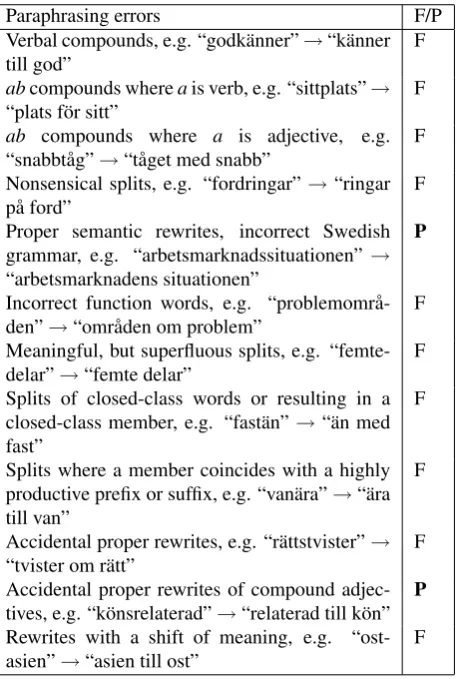
5.1. Parallel dataParaphrasing errors
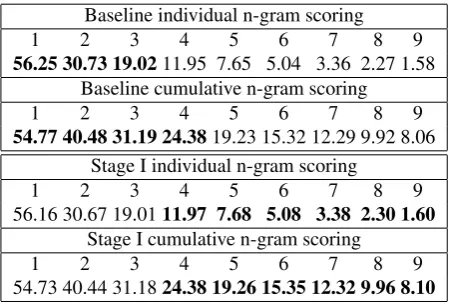
56.25 30.73 19.0211.95 7.65 5.04 3.36 2.27 1.58 Baseline cumulative n-gram scoring
1 2 3 4 5 6 7 8 9
54.77 40.48 31.19 24.3819.23 15.32 12.29 9.92 8.06 Stage I individual n-gram scoring
1 2 3 4 5 6 7 8 9
56.16 30.67 19.0111.97 7.68 5.08 3.38 2.30 1.60 Stage I cumulative n-gram scoring
1 2 3 4 5 6 7 8 9
54.73 40.44 31.1824.38 19.26 15.35 12.32 9.96 8.10
Jonas Sjöbergh and Viggo Kann. 2004. Finding the cor-rect interpretation of swedish compounds, a statistical approach. InProceedings of the 4th International Con-ference on Language Resources and Evaluation (LREC), pages 899–902.