The IULA Treebank
Montserrat Marimon
Universitat de BarcelonaGran Via de les Corts Catalanes, 585, Barcelona, Spain E-mail: [email protected]
Beatriz Fisas, Núria Bel, Blanca Arias, Silvia Vázquez,
Jorge Vivaldi, Sergi Torner, Marta Villegas Mercè Lorente
Universitat Pompeu Fabra Roc Boronat, 138, Barcelona, Spain
E-mail: {beatriz.fisas, nuria.bel, blanca.arias, silvia.vazquez, jorge.vivaldi, sergi.torner, marta.villegas merce.lorente}@upf.edu
Abstract
This paper describes on-going work for the construction of a new treebank for Spanish, The IULA Treebank. This new resource will contain about 60,000 richly annotated sentences as an extension of the already existing IULA Technical Corpus which is only PoS tagged. In this paper we have focused on describing the work done for defining the annotation process and the treebank design principles. We report on how the used framework, the DELPH-IN processing framework, has been crucial in the design principles and in the bootstrapping strategy followed, especially in what refers to the use of stochastic modules for reducing parsing overgeneration. We also report on the different evaluation experiments carried out to guarantee the quality of the already available results.
Keywords: treebank, Spanish, LKB
1.
Introduction
We present an on-going project whose aim is to produce a rich annotated corpus for Spanish within the framework of the European project METANET4U (Enhancing the European Linguistic Infrastructure, GA 270893)1: the IULA treebank. The initial plan is to annotate 60,000 sentences, distributed among different domains and sentence length, in a period of two years. Planned delivery is end of 2012.
To annotate the corpus, we have pursued the strategy initiated with the LinGO Redwoods treebank for English (Oepen et al., 2004), which was the first project to use the DELPH-IN processing framework2 for creating a rich annotated language resource in the form of a treebank. This strategy has also been followed in the development of the Hinoki treebank for Japanese (Hashimoto et al., 2007), the CINTIL treebank for Portuguese (Branco et al., 2010), and Tibidabo, a smaller treebank for Spanish based on a corpus from the press (Marimon, 2010b).
The DELPH-IN processing framework offers a range of facilities: (i) the treebanking environment is based on the selection of the correct analysis among all the analyses that are produced by a symbolic grammar instead of using human annotation only; (ii) the use of a stochastic learner that: learns the decisions taken by the annotators and applies the same in unseen parses, and reduces the outputs
1
http://www.meta-net.eu/projects/METANET4U/.
2http://www.delph-in.net.
generated by the grammar with a reduction of the manual annotation effort, especially of long sentences; (iii) finally, the disambiguation decisions can be reused to update the treebank semi-automatically with a revised version of the grammar.
The structure of the paper is as follows. In the following section, we present our target corpus. Section 3 briefly describes the annotation schema; i.e. the DELPH-IN processing framework. Section 4 presents how we have designed the annotation process for achieving our goal. Section 5 reports on the use of the stochastic module for reducing parsing overgeneration, and the experiments carried out to explore the design of the bootstrapping strategy. Section 6 reports on evaluation of the results with the inter-annotator agreement validation exercise carried out. Finally, Section 7 presents the conclusions and future developments.
2.
The target corpus
to 30 words represent the 65,1%. We decided to choose the committed volume for our project (60,000 sentences), at random from the above mentioned range, with the same proportion as the Corpus Tècnic de l'IULA in terms of number of sentences per length and domain.
Figure 1: The Corpus Tècnic de l'IULA. Ratio of number of sentences per sentence length for each domain
The aim of the IULA Treebank is to contribute to the availability of parsed data in Spanish. Currently the only broadly available treebanks for Spanish are Ancora (Taulé et al., 2008) which contains 500,000 words (about 17,000 sentences) from the press, and UAM Spanish Treebank (Moreno and López, 1999), which contains 1,500 sentences only.
3.
The annotation schema
The basic approach for corpus annotation of the DELPH-IN framework is a two-step based annotation. First, the corpus is parsed using a symbolic declarative grammar. In our treebanking work we use the Spanish HPSG grammar SRG (Marimon, 2010a), which consist of 230 syntactic rules, 68 lexical rules, and about 52,000 lexical entries which are defined by 500 lexical types that represent the type of words in the lexicon. As a declarative grammar produces all possible parses, the second step must be the disambiguation of the ambiguous outputs, by manually selecting the correct analysis among those produced by the system. Selection is done by rejecting (or, alternatively, selecting) the lexical items and grammar rules that originate the multiple parses to incrementally disambiguate the sentence until a single analysis is left.
Thus, the bulk of the annotation process is to select only one parse for each sentence. Because the average number of analyses produced for each sentence is typically proportional to its length, only a reduced number of top parses (500 as maximum) are shown to the annotator such that the disambiguation should not require more than 9 decisions (Kordoni and Zhang, 2009).
DELPH-IN is equipped with a stochastic parse ranking learner that learns from the decisions taken by the human
annotators (Toutanova et al., 2003). Later, the system ranks unseen sentence parses according to the learned model in order to determine the selection of the 500-best parses for an input sentence.
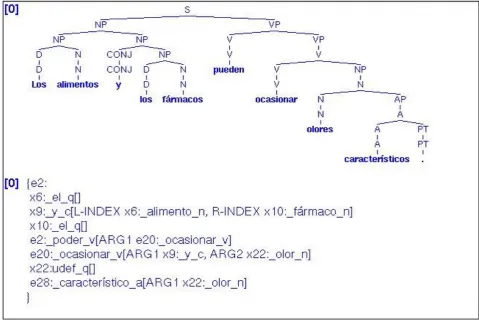
The basic annotation of each parsed sentence with the DELPH-IN processing framework simultaneously displays both a syntactic phrase structure tree and a Minimal Recursion Semantic (MRS) representation (Copestake et al., 2005).3 A MRS representation is a syntactically flat semantic representation that offers, by means of the labelling of arguments and their co-indexation, a list of semantic relations and a set of syntactic limitations on possible scope relations among them. Figure 2 shows both the syntactic and semantic representations, for the sentence Los alimentos y los fármacos pueden ocasionar olores característicos (Food and drugs may produce characteristic odours).
4.
Treebank development design principles
By means of the DELPH-IN processing framework, the treebanking task is typically organised into iterations of: parsing with HPSG grammars, manual disambiguation, manual inspection and error analysis, and grammar/treebanking update cycles. While error analysis and treebank update guarantee the quality of the treebank and the accuracy of the parse selection ranking model, they require extra manual annotation effort.Due to the time limitations of our project, we needed to increase the speed of the treebank development, and we decided to study strategies for gradually reducing the manual annotation workload. To achieve this we designed a bootstrapping approach. The strategy has been to subdivide the whole target corpus into six smaller sub-corpora, with the same proportion as our target corpus in terms of number of sentences per length and domain. Each sub-corpus, therefore, is a representative sample of all the elements involved: complex and simple syntactic phenomena (e.g. se-constructions, adverbs' ubiquity), short and long sentences (where coordination structures are frequent), single-verb and multiple verb sentences (subordinate clauses), contextual, and spurious ambiguity. Each sub-corpus, in turn, is distributed among several files according to the number of words in the sentences, thus progressively increasing the complexity of the sentences to be annotated
3
Figure 2: Phrase structure tree
and MRS representation for a sample Spanish sentence
While we have already annotated 18,000 in an initial annotation cycle, this strategy has allowed us to get a fine-grained diagnosis of the grammar performance in parsing domain specific corpus and to update the grammar accordingly. In addition, it has allowed us to identify the areas in which difficulties may arise and the needs of annotators with regards to the theoretical framework, the DELPH-IN grammar and processing framework, as well as the complexity of the linguistic phenomena shown in the target corpus. In this way, errors (produced both by the grammar and by the annotators), and therefore annotation updates, are gradually reduced.
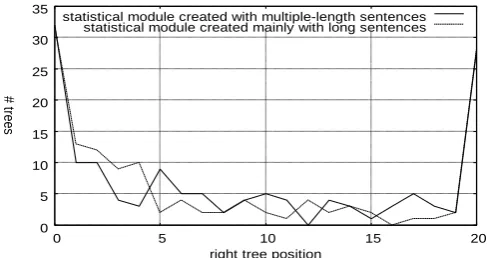
This strategy should have allowed us to use these manually annotated sub-corpora to incrementally update the stochastic parse ranking learner in order to get as benefit a smaller and ranked number of possible parses for human annotators to decide upon, ideally the right one only. The stochastic system delivers the requested n-best parses for a given sentence ranked as a prediction of the likelihood of being the right parse. Thus, the right analysis for each sentence should be in the position zero of the
ranking. Figure 3 shows, for a given set of sentences, the number of right parses found from position 0 to 19; in position 20 it accumulates all the results for positions greater or equal to 20. Figure 3 show that most sentences have their right analysis in position zero, even though a number of them has a position that is greater than zero.
We initially planned to periodically generate new stochastic modules using the increasing number of human annotated results, on the assumption that, as the evidence increases, more right analyses are to be found in lower positions and thus a less number of parses would have to be shown to the human annotators.
Grammar. In Proceedings of the ACL-IJCNLP 2009 Workshop LAW III (The Third Linguistic Annotation Workshop), Suntec, Singapore.
Kovacci, O. (1999) «El adverbio». In I. Bosque & V. Demonte (eds.) Gramática descriptiva de la lengua española. Madrid, Espasa Calpe. 705-786.
Marimon, M. (2010a). The Spanish Rosurce Grammar. In Proceedings of the 7th international conference on Language Resources and Evaluation, La Valleta, Malta.
Marimon, M. (2010b). The Tibidabo Treebank. Procesamiento del Lenguaje Natural, ISSN 1135-5948.
Mendikoetxea, A. (1999a). Construcciones inacusativas y pasivas. In I. Bosque & V. Demonte (dirs.) Gramática descriptiva de la lengua española. Madrid, Espasa-Calpe. 1575-1630.
Mendikoetxea, A. (1999b). Construcciones con se: medias, pasivas e impersonales. In I. Bosque & V. Demonte (dirs.) Gramática descriptiva de la lengua española. 1. Madrid, Espasa-Calpe. 1631-1722.
Moreno, A. and S. López (1999). Developing a Spanish Tree Bank. In Proc. Journées ATALA, Corpus annotés pour la syntaxe. Paris, 18-19 June 1999.
Oepen, S. and D. Flickinger, and K. Toutanova, and C.D. Manning (2004) LinGo Redwoods. In Research on Language and Computation, 2(4), Hinrichs, E.W. and K. Simov (ed).
Pollard, C.J. and I.A. Sag (1994). Head-driven Phrase Structure Grammar. The University of Chicago Press and CSLI Publications, Chicago.
Real Academia Española y Asociación de Academias de la Lengua (2009). Nueva gramática de la lengua española. Madrid, Espasa-Calpe.
Rodríguez (2003). La gramática de los adverbios en mente o cómo expresar maneras, opiniones y actitudes a través de la lengua. Madrid, Ediciones de la Universidad Autónoma de Madrid.
Sánchez, C. (ed.) (2002). Las construcciones con se. Madrid, Visor.
Taulé, M.; M.A. Martí and M. Recasens (2008). Ancora: Multilevel Annotated Corpora for Catalan and Spanish. Proceedings of 6th International Conference on
Language Resources and Evaluation. Marrakesh.
Torner, S. (2007) De los adjetivos calificativos a los adverbios en -mente: semántica y gramática. Madrid, Visor Libros.
Toutanova, K., Manning, C. D., and Oepen, S. (2003), Stochastic HPSG Parse Selection using the Redwoods Corpus, in Journal of Logic and Computation, 2005.