Weakly Supervised Definition Extraction
∗Luis Espinosa-Anke, Francesco Ronzano and Horacio Saggion TALN - DTIC
Universitat Pompeu Fabra Carrer T`anger, 122-134
08018 Barcelona
{luis.espinosa,francesco.ronzano,horacio.saggion}@upf.edu
Abstract
Definition Extraction (DE) is the task to ex-tract textual definitions from naturally occur-ring text. It is gaining popularity as a prior step for constructing taxonomies, ontologies, auto-matic glossaries or dictionary entries. These fields of application motivate greater interest in well-formed encyclopedic text from which to extract definitions, and therefore DE for academic or lay discourse has received less at-tention. In this paper we propose a weakly supervised bootstrapping approach for identi-fying textual definitions with higher linguis-tic variability than the classic encyclopedic genus-et-differentia definition, and take the domain of Natural Language Processing as a use case. We also introduce a novel set of fea-tures for DE and explore their relevance. Eval-uation is carried out on two datasets that re-flect opposed ways of expressing definitional knowledge.
1 Introduction
Definition Extraction (DE) is the task to automat-ically extract textual definitions from text (Navigli and Velardi, 2010). It has received notorious at-tention for its potential application to glossary gen-eration (Muresan and Klavans, 2002; Park et al., 2002), terminological databases (Nakamura and Na-gao, 1988), question answering systems (Saggion
∗This work is partially funded by the SKATER project, TIN2012-38584-C06-03, Ministerio de Econom´ıa y Compe-titividad, Secretar´ıa de Estado de Investigaci´on, Desarrollo e Innovaci´on, Espa˜na; and Dr. Inventor (FP7-ICT-2013.8.1 611383).
and Gaizauskas, 2004; Cui et al., 2005), for support-ing terminological applications (Meyer, 2001; Sierra et al., 2006), e-learning (Westerhout and Monach-esi, 2007), and more recently for multilingual para-phrase extraction (Yan et al., 2013), ontology learn-ing (Velardi et al., 2013) or hypernym discovery (Flati et al., 2014).
The corpora that have been used for evaluating DE systems are varied, although in general efforts have been greatly focused on academic and ency-clopedic genres. Some prominent examples include German technical texts (Storrer and Wellinghoff, 2006), the IULA Technical Corpus (in Spanish) (Alarc´on et al., 2009), the ACL Anthology (Jin et al., 2013; Reiplinger et al., 2012), the BNC corpus (Rodr´ıguez, 2004), Wikipedia (Navigli and Velardi, 2010), ensembles of domain glossaries and Web documents (Velardi et al., 2008), or technical texts in various languages (Westerhout and Monachesi, 2007; Przepi´orkowski et al., 2007; Borg et al., 2009; Deg´orski et al., 2008; Del Gaudio et al., 2013).
We propose a DE approach which, from a start-ing set of encyclopedic definition seeds, self-trains iteratively and gradually fits its classification capa-bility to a target domain-specific test set. Evalua-tion is carried out on two corpora: First, a set of 50 abstracts of papers in the field of NLP1. Here, the
target term is defined in the first sentence, and addi-tional information may appear in the form of “syn-tactically plausible false definitions”, i.e. sentences where the target term is also present, relevant infor-mation is provided, but do not constitute a definition 1Henceforth, we refer to this corpus as the MSR-NLP
(Navigli and Velardi, 2010). Second, theW00 cor-pus (Jin et al., 2013), a subset of the ACL Anthology manually annotated with definitions, and which in-cludes highly variable definitions both in terms of content and syntax. We achieve competitive results in both corpora.
The main contributions of our paper are: (1) A set of experiments demonstrating the soundness of our approach for DE in two different linguistic registers; (2) A novel set of features and an exploration of their influence in the learning process; and (3) A small, focused benchmarking dataset for DE evaluation in the NLP domain.
The remainder of this paper is structured as fol-lows: Section 2 reviews prominent work in DE; Sec-tion 3 provides a detailed descripSec-tion of the datasets used; Section 4 presents the features used in our classification procedure and describes the bootstrap-ping algorithm; Section 5 shows the performance of our approach; Section 6 lists the best features at im-portant iterations and discusses these findings; and finally Section 7 summarizes the main ideas con-tained in this paper and outlines potential directions for future work.
2 Background
Definitions are a well-studied topic, which traces back to the Aristotelian genus et differentia model of a definition, where the defined term (definiendum) is described by mentioning its immediate superordi-nate, usually a hypernym (genus), and the cluster of words that differentiate such definiendum from oth-ers of its class (definiens). Furthermore, additional research has elaborated on different criteria to take into consideration when deciding what is a defini-tion: either by looking at their degree of formality (Trimble, 1985), the extent to which they are spe-cific to an instance of an object or to the object it-self (Sepp¨al¨a, 2009), the semantic relations holding between definiendum and concepts included in the definiens (Alarc´on et al., 2009; Schumann, 2011), the fitness of a definition for target users (Bergen-holtz and Tarp, 2003; Fuertes-Olivera, 2010) or their stylistic and domain features (Velardi et al., 2008). In this work we elaborate on some ideas from the latter, especially on their domain and stylistic fil-ters, which motivated the design of
statistically-motivated features to describe a word’s salience in terms of definitional knowledge (cf. Section 4).
Regarding DE, the earliest attempts focused on lexico-syntactic pattern-matching, either by looking at cue verbs (Rebeyrolle and Tanguy, 2000; Saggion and Gaizauskas, 2004; Sarmento et al., 2006; Stor-rer and Wellinghoff, 2006), or other features like punctuation or layout (Muresan and Klavans, 2002; Malais´e et al., 2004; S´anchez and M´arquez, 2005; Przepi´orkowski et al., 2007; Monachesi and Wester-hout, 2008). As for supervised settings, let us refer to (Navigli and Velardi, 2010), who propose a gener-alization of word lattices for identifying definitional components and ultimately identifying definitional text fragments. Finally, more complex morphosyn-tactic patterns were used by (Boella et al., 2014), who model single tokens as relations over the sen-tence syntactic dependencies.
We refer now to unsupervised approaches to DE. (Reiplinger et al., 2012) benefit from hand crafted definitional patterns. Starting from a set of seed terms and patterns, term/definition pairs are itera-tively acquired, together with bootstrapped new pat-terns. These are obtained via a generalization ap-proach over part-of-speech and term wildcards. Ad-ditionally, two interconnected works are (De Bene-dictis et al., 2013) and (Faralli and Navigli, 2013), in that both bootstrap the web for acquiring large mul-tilingual domain glossaries starting with a few seeds for term and gloss. While both systems behave simi-larly in extracting glosses and learning new patterns by exploiting html tags, they are substantially dif-ferent in how acquired glosses are ranked. Specif-ically, the former exploits the bag-of-words repre-sentation of each extracted gloss and its intersection with the domain terminology, while the latter lever-ages Probabilistic Topic Models (PTM) by estimat-ing the probability of words and term/gloss pairs to be pertinent to the domain.
3 Corpora
Our weakly supervised DE approach requires: (1) A general-domain (encyclopedic) set of seeds of tex-tual definitions (T S) and (2) A domain-specific de-velopment set, e.g. a collection of papers (DS).
manually annotated with definitions and hypernyms. This dataset is constructed under the intuition that the first sentence of a Wikipedia article constitutes its textual definition. It is important to highlight that, while this dataset includes semantic informa-tion manually annotated such as definiendum or hy-pernym, we do not exploit any of it, which makes the seed-construction step highly flexible as it only requires the sentence definition/non-definition class. We use as DS a subset of the ACL ARC corpus (Bird et al., 2008), processed with ParsCit (Coun-cill et al., 2008). In this dataset, a well-formedness confidence score is given to each sentence (as these come from pdf parsing and noise is introduced in the process). We exploit this information and keep 500k sentences with a score of over .95.
For evaluation, we use two datasets: The MSR-NLP 2 and the W00 corpus. The MSR-NLP is
a manually constructed small list of 50 abstracts in the NLP field, amounting to 304 sentences: 49 definitions and 255 non-definitions. They are ex-tracted from the Microsoft Academic Research web-site3, where abstracts including a definition provide
a “Definition Context” section. This small dataset complies with the stylistic requirements of academic abstract writing, i.e. the use of well-developed, unified, coherent and concise language, and under-standability to a wide audience4. A different
reg-ister can be found in the W00 dataset, which in-cludes many definitional sentences that are highly domain-specific, sometimes including the definition of a very specific concept, and showing higher lin-guistic variability (e.g. the definiendum might not appear at the beginning of the sentence, and unlike most abstracts, citations might be present). We illus-trate this difference with two sentences containing a definition from the MSR-NLP (1) and the W00 (2) corpora:
(1) The Hidden Markov Model (HMM) is a prob-abilistic model used widely in the fields of Bioinformatics and Speech Recognition . (2) This corpus is collected and annotated for the
GNOME project (Poesio, 2000), which aims 2Available at
http://www.taln.upf.edu/MSR-NLP RANLP2015
3http://academic.research.microsoft.com/
4http://www.cameron.edu/˜carolynk/Abstracts.html
at developing general algorithms for generating nominal expressions
Note that in the case of (2), only the sequence “GNOME project aims at developing general algo-rithms for generating nominal expressions” is la-belled as definition in the original dataset. In this work a definitional sentence is generalized asbeing
orcontaininga definition, which enables casting the task as a sentence-classification problem, which is common practice in DE (Navigli and Velardi, 2010; Boella et al., 2014; Espinosa-Anke and Saggion, 2014).
Intuitively, we would expect a general-purpose DE system to be more likely to label sentence (1), as it includes the required elements for a canonical genus-et-differentia definition. This motivates our experiments, where we attempt to fit a model itera-tively to be able to perform better in sentences like (2).
4 Modelling the Data
As mentioned in Section 3, we approach the DE task as a sentence classification problem, where a sen-tence can be either a definition (def) or not (nodef). However, instead of modelling sentence-level fea-tures like sentence length or depth of the parse tree, we rather encode word-level features in order to ex-ploit individual items’ characteristics in terms of po-sition within the sentence, frequency or relevance in a definition corpus. These word-level features are used for classifying each word in a sentence (def|nodef).
We exploit the potential of the Conditional Ran-dom Fields5 algorithm (Lafferty et al., 2001) to
en-code prior and posterior contextual information of a given element in a sequence (in our case, a word in a sentence). Specifically, we consider a context win-dow of [-2,2]. For each word, we generate a feature vector consisting on the following features:
1. sur: Surface form of the current token without stemming.
2. lem: Lemma of the current token. 3. pos: Part-of-speech of the current token. 4. bio-np: Whether the current word is at the
be-ginning (B), inside (I) or outside (O) a noun phrase. Noun phrases are obtained with the fol-lowing regular expression over part-of-speech tags: [JN]*N.
5. dep: Dependency relation between the current token and its head.
6. head-id: The index of the head-word (or gov-ernor) in the syntactic dependency tree. 7. bio-def: An extension of the bio-np feature
that also takes into account the definition-wise position. We perform this na¨ıvely by finding the first verb of the sentence, and tagging all words before it as definiendum and the rest as definiens. We illustrate this feature below, where each word’s NP-chunking comes from the bio-np feature,Drefers to definiendum and
drefers to definiens.
Theho-Di Abwehrhb-Di washo-di
aho-di Germanhb-di intelligencehi-di
organizationhi-di fromho-di 1921ho-di
toho-di1944ho-di.
8. termhood: This metric determines the impor-tance of a candidate token to be a terminolog-ical unit by looking at its frequency in gen-eral and domain-specific corpora (Kit and Liu, 2008). It is obtained as follows:
Termhood(w)= r|DV(w)
D| −
rB(w) |VB|
5We use the CRF++ toolkit:
http://crfpp.googlecode.com/svn/trunk/doc/index.html
Where rD is the frequency-wise ranking of
wordwin a domain corpus (in our case,T S), and rB is the frequency-wise ranking of such
word in a general corpus, namely the Brown corpus (Francis and Kucera, 1979). Denomina-tors refer to the token-level size of each corpus. If wordw only appears in the general corpus, we set the value of Termhood(w) to−∞, and to∞in the opposite case.
9. tf-gen: Frequency of the current word in the general-domain corpus rB(Brown Corpus).
10. tf-dom: Frequency of the current word in the domain-specific corpus rD(T S).
11. tfidf: Tf-idf of the current word over the train-ing set, where each sentence is considered a separate document.
12. def prom: We introduce the notion of Defi-nitional Prominence aiming at establishing the probability of a word w to appear in a def-initional sentence (s = def). For this, we consider its frequency in definitions and non-definitions in theT Sas follows:
DefProm(w)= |DefsDF|− |NodefsNF |
where DF = Pii==0n(si = def ∧w ∈ si) and NF =Pii==0n(si =nodef ∧w ∈si). Similarly as with the termhood feature, in cases where a word w is only found in definitional sen-tences, we set the DefProm(w) value to∞, and to−∞ if it was only seen in non-definitional sentences.
13. D prom: We also introduce Definiendum Prominence in order to model our intuition that a word appearing more often in position of po-tential definiendum might reveal its role as a definitional keyword. This feature is computed as follows:
DP(w)=
Pi=n
i=0wi ∈termD
|DT|
po-sition and |DT|refers to the size of the candi-date term corpus in candicandi-date definienda posi-tion.
14. d prom: Similarly computed as D prom, but considering position of potential definiens.
4.1 Bootstrapping
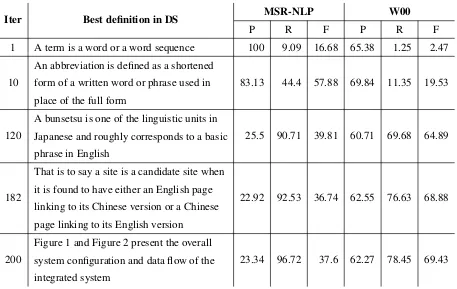
As noted in Section 3, the initialT Sconsists of the WCL dataset, which makes our model suitable for DE in well-formed encyclopedic texts. However, our hypothesis that it would perform poorly in a lin-guistically more complex setting (e.g. in a corpus like the W00 dataset) is confirmed by the results at iteration 1 (see Table 1). Our bootstrapping ap-proach is aimed at gradually obtaining a better fit model for W00, starting from our generic baseline trained exclusively on the WCL corpus. The fol-lowing description of our approach is summarized in Algorithm 1.
As mentioned above, T S is a manually labelled dataset where each sentence s ∈ S is given a la-bel d ∈ D = {def, nodef}. Likewise, DS is an unlabelled subset of the ACL-ARC corpus, which amounts to 500k sentences. The first step is to ini-tialize (1) The training set vocabularyV, which sim-ply contains all the words in T S; and (2) The fea-ture set F associated to each word w ∈ V. Then, for each iteration until we reach 200, the algorithm extracts the best-scoring sentences as predicted by our CRF-based classififer (recall that only sentences where all words are assigned the same label are con-sidered) for both labelsdef andnodef (s0ands00
re-spectively), and uses them to increase the initial fea-ture set and vocabulary. Next, it removess0 ands00
fromDS, trains and evaluates a model on both the MSR-NLP and the W00 datasets, and repeats until it reaches our manually set end point: iteration 200th.
One important aspect to consider is that increas-ing the size of the trainincreas-ing data does not have an effect of the features associated to a word. Incorpo-rating definitions having concepts related to the tar-get domain (NLP in our case) is a step forward, but their definitional salience (expressed by def prom, D prom and d prom) remains the same, as they were calculated before firing the bootstrapping algorithm. For this reason, we include a feature update step at iteration 100, our sole motivation being that, for
evaluation purposes, we will have the same number of iterations before and after such step. It consists in resettingF to∅and recalculating it. We hypothe-size that the new feature values can reflect better the linguistic idiosyncrasies of a domain-specific defini-tional corpus. After 200 iterations, our bootstrapped datasetT Sbootincludes the original training data and 400 new sentences: 200 definitions and 200 non-definitions.
As the bootstrapping process advances,s0 ands00
show greater linguistic variability because the train-ing data includes more non-canonical definitions (Table 1).
Algorithm 1Bootstrapping for DE
Require:
T S={(S, d∈D)}Initial labelled train seeds. DS ={S}Subset of the ACL-ARC corpus. MSR-NLP: Test set 1.
W00: Test set 2.
V :={w:∃(s, d)∈T S∧w∈s}
F :={fT S(w) :w∈V}
1: fori= 0, i <200, i+ +do
s0 =argmaxs∈DS P(s=def) s00 =argmaxs∈DS P(s=nodef) 2: forw∈s0∪s00do
3: ifw /∈V then
F =F ∪ {fT S(w)} V =V ∪ {w}
4: end if
5: end for
T S=T S∪ {(s0, def),(s00, nodef)} DS=DS\ {(s0, def),(s00, nodef)}
6: ifi= 100then
F =∅
7: forw∈V do
F =F ∪ {fT S(w)}
8: end for
9: end if
modeli =trainModel(T Si, Fi)
evaluateModel(modeli,{MSR-NLP,W00})
10: end for
4.2 Post Classification Heuristics
Iter Best definition in DS MSR-NLP W00
P R F P R F
1 A term is a word or a word sequence 100 9.09 16.68 65.38 1.25 2.47
10
An abbreviation is defined as a shortened form of a written word or phrase used in place of the full form
83.13 44.4 57.88 69.84 11.35 19.53
120
A bunsetsu is one of the linguistic units in Japanese and roughly corresponds to a basic phrase in English
25.5 90.71 39.81 60.71 69.68 64.89
182
That is to say a site is a candidate site when it is found to have either an English page linking to its Chinese version or a Chinese page linking to its English version
22.92 92.53 36.74 62.55 76.63 68.88
200
Figure 1 and Figure 2 present the overall system configuration and data flow of the integrated system
23.34 96.72 37.6 62.27 78.45 69.43
Table 1: Definitions extracted throughout the bootstrapping process from the ACL ARC corpus and P/R/F results at that iteration on the two evaluation corpora (without post-classification heuristics). Note the grad-ual increase in syntactic and terminological variability in the extracted definitions.
2009). It consists in a set of rules for label-switching aimed at increasing the recall and ideally without hurting precision significantly. Let wi be a word classified as not being part of a definition (nodef) at iterationi, we can rectify its class (wnew
i ) to being part of a definition (def) as follows:
wnew i =
(
def ifP(wi) =def > θ
def ifP(wi) =nodef < λ, wsyni =P
Wherewisyn refers to the dependency relation of the word examined at iteration i, andPis the pred-icativesyntactic function of the word.
Our goal is to increase the number ofdef words in a sentence in cases where they were discarded by a small margin. We hypothesize that this could be particularly useful in “borderline” cases (some words classified in a sentence asdef, some asnodef), where this heuristics helps our algorithm to make a decision always favouring definition labelling over non-definition. As for the constants, θ and λ are
empirically set to .35 and .8 respectively after ex-perimenting with several thresholds and inspecting manually the resulting classification.
5 Evaluation
We evaluate the performance of our approach at each iteration on both datasets (MSR-NLP and W00) using the classic Precision, Recall and F-Measure scores. All the scores reported in this article are at word-level.
iteration 100, where the feature update step occurs, Precision decreases, while Recall remains the same. On the other hand, the numbers in the W00 dataset are fairly stable until iteration 100, where a signif-icant improvement in both Precision and Recall is achieved.
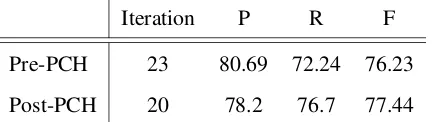
Let us look first at the results without applying recall-boosting post-classification heuristics: The performance of our models decreases in the MSR-NLP corpus after a few iterations (our best model is reached at iteration 23, where F=76.23), and this situation is unsurprisingly aggravated by the feature update step. However, our results improve signif-icantly in the W00 dataset6 after feature updating.
Our best-performing model reaches F=70.72 at iter-ation 198.
Moreover, we observed a minor improvement af-ter incorporating the label-switching heuristics in both corpora. Specifically, for the MSR-NLP cor-pus the improvement was from the aforementioned F=76.34 to F=77.46, while in the W00 dataset, it improved from F=70.72 to F=71.85. Tables 2 and 3 show Precision, Recall and F-Score for our best models in both datasets.
These numbers confirm that we are able to gener-ate a domain and genre-sensitive model provided we have a development set available of similar charac-teristics. The discrepancy in terms of performance as the bootstrapping algorithm advances is an indi-cator that the models we obtain become more tai-lored towards the specific corpus, and therefore less apt for performing well in the encyclopedic genre. Our approach seems suitable for partially alleviating the lack of manually labelled domain-specific data in the DE field.
Let us also refer to the importance of having a de-velopment set as close as possible to the target cor-pus in terms of register and domain, and with a rea-sonable level of quality. In relation to this, we also performed experiments with a development set auto-matically constructed from the Web, but due to lack of preprocessing for noise filtering, results were un-satisfactory and therefore unreported in this paper.
As for comparative evaluation, we cannot contrast our results directly with the ones reported in (Jin et 6Note that since the W00 corpus is also a subset of the ACL
ARC dataset, we first confirmed that it did not overlap with our dev-set.
Iteration P R F
Pre-PCH 198 62.69 81.11 70.72 Post-PCH 198 62.47 82.01 71.85
Table 2: Best results for the W00 dataset before (Pre-PCH) and after (Post-PCH) applying the post-classification heuristics.
Iteration P R F
Pre-PCH 23 80.69 72.24 76.23 Post-PCH 20 78.2 76.7 77.44
Table 3: Best results for both the MSR-NLP dataset before (Pre-PCH) and after (Post-PCH) applying the post-classification heuristics.
al., 2013), since while in both cases word-level eval-uation is carried out, in our case we generalized all the words inside a sentence containing a definition to the label def. In addition, as it is pointed out in (Jin et al., 2013), only in (Reiplinger et al., 2012) there is an attempt to extract definitions from the ACL ARC corpus, but their evaluation relies on hu-man judgement, and their reported coverage refers to a pre-defined list of terms.
In general, the results reported in this article are consistent with the ones obtained in previous work for similar tasks. For instance, prior experiments on the WCL dataset showed results ranging from F=54.42 to F=75.16 (Navigli and Velardi, 2010; Boella et al., 2014). In the case of the W00 dataset, (Jin et al., 2013) reported numbers between F=40 and F=56 for different configurations. Since the availability of manually labelled gold standard is scarce, other authors evaluated Glossary/Definition Extraction systems in terms of manually assessed precision (Reiplinger et al., 2012; De Benedictis et al., 2013).
6 Feature Analysis
ab-Figure 1: F-Score against iteration on the MSR-NLP (top row) and W00 datasets (bottom row), with boot-strapping + post-classification heuristics (left col-umn) and only bootstrapping (right colcol-umn).
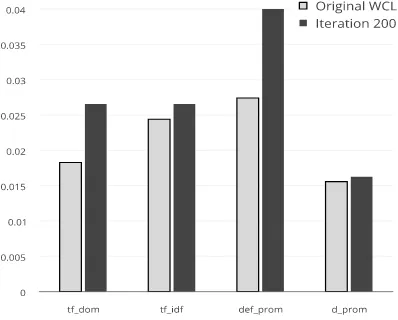
sent (Forman, 2003), using the Weka toolkit (Witten and Frank, 2005). We did this for the original train-ing setT Sand the training set resulting at iteration 200T Sboot. Then, we captured the top 30 features in T Sboot, and averaged their Information Gain score over all the available contexts. Finally, we compare these features in both datasets T S andT Sboot (see Figure 2).
We observe an improvement of definitionally-motivated features after iteration 100, which com-bined with the gradual improvement in performance in the W00 dataset, suggests that def prom and d prom contribute decisively to domain-specific DE, while D prom proved less relevant. Note that in our setting, we do not focus in term/definition pairs, but rather a full-sentence definition. Therefore, we do not know a priori which term is the definiendum, and thus we do not perform a generalization step to con-vert it to a wildcard, which is common practice in the DE literature (Navigli and Velardi, 2010; Reiplinger et al., 2012; Jin et al., 2013; Boella et al., 2014). This provokes high sparsity in D prom and we hy-pothesize that this may be the reason for this feature to not gain predictive power after many iterations or the feature update step.
Figure 2: Information Gain for the best features at the end of the bootstrapping process. Note the substantial improvement in def prom (definitional prominence).
7 Conclusions and Future Work
We have presented a weakly supervised DE ap-proach that gradually increments the size of the training set with high quality definitions and clear examples of non-definitions. Two main conclusions can be drawn: (1) The definition-aware features we introduce show, in general, high informativeness for the task of DE; and (2) Our approach is valid for generating genre and domain specific training data capable of fitting corpora, even though this differs greatly in terms of content and register from the en-cyclopedic genre.
In addition, a small and focused benchmarking dataset of real-world definitions in the NLP domain has been released, which can be used both for lin-guistic and stylistic purposes and for evaluating DE systems.