CSEIT1724178 | Received : 10 August 2017 | Accepted : 21 August 2017 | July-August-2017 [(2)4: 688-694]
International Journal of Scientific Research in Computer Science, Engineering and Information Technology © 2017 IJSRCSEIT | Volume 2 | Issue 4 | ISSN : 2456-3307
688
LETISA: Latency optimal Edge computing Technique for IoT
based Smart Applications
Mahmood Hussain Mir*1, Dr. D. Ravindran2
*1Research Scholar Department of Computer Sciences, St. Joseph’s College, Tiruchirappalli, Tamil Nadu, India 2Associate Professor Department of Computer Sciences, St. Joseph’s College, Tiruchirappalli, Tamil Nadu, India.
ABSTRACT
Internet of Things is a technological change which is not only “connected” but it is “smart”, connected is not equal to smart. The switch from connected to smart is the ability of performing analytics at device level, which implies moving beyond, means not just only sensing the data but also processing the data. IoT in “smart” sense also called as Internet of Everything (IoE) or Internet of Anything (IoA). Edge Computing is used as an intermediary layer between the cloud and end users to reduce the latency time and extra communication cost that is usually found high in cloud based systems. The transmission time of cloud based computing is intolerable almost for every smart application. In this paper the existing system is studied and also the drawbacks of system are highlighted and problems associated with it are discussed. Keeping existing system in view a novel and efficient system is proposed, which tries to eliminate the drawbacks of the existing system. The LETISA is based on edge computing, which is a new and emerging technology that brings the services close to the proximity of data sources, as IoT devices are not only used as data gathering devices but are also acting as data consumers. The LETISA improves the efficiency of IoT based applications by deploying some of the computational capabilities at the edge devices. Finally the performance of the system is compared with the existing system, which shows the LETISA can significantly overcome the end-to-end latency.
Keywords: Cloud Computing, Edge Computing, IoT, LEC, LETISA.
I. INTRODUCTION
The World Wide Web (www) is the most important invention of the 1990’s and cellular communication of 2000’s. Now the third biggest achievement in the field of information and communication technology is disruptive technology that has revolutionized the world, i.e. “Internet of Things”. The phrase “Disruptive Technology” was first introduced in [1], means a technological change often renovating the previous technology. The IoT describes a new way of linking the real world objects to virtual world, where each and everything or even virtual data environments can interact with each other in same space and time [2]. Developments and flexibility
consumers so it is better to perform computations Number of applications is growing exponentially, some are private which implies private data, some are producing huge amount of data that can cause network load, and some requires very short responses etc. depending upon nature and type of the application [3].
Cloud Computing is the efficient way to process the sensed data as there is more computing power in cloud and can give all types of services on demand [4]. But where response time and low latency is of interest, cloud computing surrenders here which implies this is inefficient enough to another technology: Edge Computing. Edge Computing is novel technology that allow computation near to the data sources that is at edge of network. Edge Computing functions for both the types of services which implies on downstream on request of cloud and for upstream on request of IoT services. Edge Computing is a platform of accelerating and improving the performance of cloud computing for mobile users [5]. Edge Computing promises the quicker responses, reduced network load in terms of bandwidth, reduces energy consumption and latency etc., security and privacy are additional benefits of edge computing because processing occurs close to data source [6]. The goal and objective of edge computing is to minimize communication latency and energy consumption of resource and energy constrained devices to attain high throughput. There are lot of applications which requires real
time processing such as autonomous vehicle that has lot of sensors embedded on it produces at least 1 Gigabyte data per second to take correct decisions [7].
The rest of this paper is divided into following sections: Section II describes the detailed summary of cloud model, explains the working of it and give tabular view of hot applications and technologies. Section III presents novel architecture for IoT based Smart Application which is based on edge computing. The aim of proposed architecture is to reduce the network delay and maximize throughput or in other terms low delay and quick responses. In Section IV the results of both the existing model and proposed model is compared, it shows proposed model is better than Existing model. Section V concludes by summarizing the paper.
II. Existing Technologies
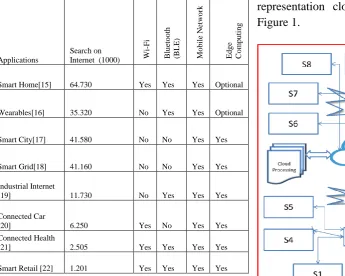
Cloud Computing plays vital role in the concept of modern internet technology and is building block of future internet. Cloud computing has enormously changed the way of living, work and study since the interception around 2005. Cloud computing provides the three basic services Application as a Service (AaaS) [8], Platform as a Service (PaaS) [9] and Infrastructure as a Service (IaaS) [10]. These services of cloud computing have greatly reduced the cost of ownership management of virtual resources, new services. The evolution of cloud computing and internet of things have enabled a lot of unprecedented opportunities in the IoT services arena. Most IoT applications are based on cloud processing [11], that are sensing the data then sending that data to cloud [12]. In this existing model that is based on cloud uses the services that are at remote location through the traditional network or internet connection [13]. Table 1 shows various IoT applications with the searching score and various technologies [14].
Applications Gateway model, IoT devices basically connected to gateway to access a cloud service [24]. Gateway acts like an intermediary between the cloud services and IoT devices. The gateway runs application software which is responsible for data or protocol translations to provide the solution for interoperability gap between devices that communicate on different standards. For example smart devices, Z-Wave and ZigBee transceivers can communicate with both families of devices. Another model is device to cloud, in this model communication involves an IoT device connecting directly to an Internet cloud service like an application service provider to exchange data and control message traffic. There is no gateway, so no conversion is done in this model, it uses already available internet connections (wired Ethernet or Wi-Fi connections) and can also use cellular technology. By this type of connectivity the user and an application obtain remote access to a device. A use case for cellular-based Device-to-Cloud would be a smart tag that keeps track of any device or thing which is at remote location [25]. Hybrid Model is combination of both device to cloud and device to gateway model. Diagrammatic
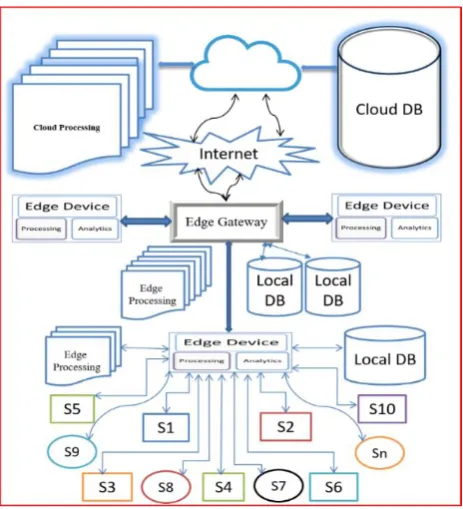
Figure 2. Latency optimal Edge Computing Model (LEC)
Mobile Edge Computing is novel concept in which some of the computation capabilities or shifting of the some computation power from cloud such as analysis, pre-processing and decision-making capabilities to the edge of the network. Mobile edge computing offers greater responses and reduces latency by deploying the computation and storage capacity at the edge of the network. Mobile Edge Computing gives real time Radio Access Network (RAN) information that is within the range of RAN such as network load, location. This real time data can be used to give the context aware services to the mobile users thereby to improve or enrich the user’s satisfaction.
The real world is divided into physical locations or areas. The area is geographical unit where one or more IoT devices are deployed. In an edge computing environment devices can be of three types depending on their role. The architecture of mobile edge computing is divided into three basic components or layers in the edge computing architecture: 1) Devices which includes all types of devices such as mobile phones, sensors, actuators and RFID tags etc. These are special purpose devices that do not have general purpose processors or operating systems. These devices are connected to edge devices or edge gateways directly or via low power radio technologies. 2) Edge device or Edge Gateways are general purpose devices which have the capability of running the full-fledged operating system and are often battery powered. Edge devices can perform computation on data, received
from sensors and send commands to Actuators. Edge Gateway acts as mediator for connecting edge devices to the cloud or edge devices can be connected directly to cloud. Edge Gateways are different from edge devices in a way that edge gateways have unconstrained power supply, more CPU power, Memory and storage. Edge Gateways offer location management services in addition of acting as intermediator. 3) Edge Gateways as well as Edge Devices can forward selected of raw or pre-processed IoT data to the services running in cloud like storage or analytical services. They both can receive commands from the cloud, like configurations, data queries or machine learning models against which to locally score IoT data.
IV.Performance Analysis
The proposed technique is compared with traditional cloud based processing. The parameters taken for calculation are as under, the range of Edge device is 500 meters, the physical layer protocol is BLE for device to edge communication, the transmission power is same for all devices that are 24 dBm and the bandwidth is 10MHz for device to edge communication. The adoption and deployment of cloud computing is critical to evaluate the performance of cloud environments. Modeling and simulation technologies are suitable for evaluating performance and security issues. Cloud simulators are required for cloud system testing to decrease the complexity and separate quality concerns. There are several cloud simulators that have been specifically developed for performance analysis of cloud computing environments and CloudSim is a one of them Cloud simulation application. CloudSim enables seamless modeling, simulation, and experimentation of cloud computing and application services. Now a days there are various versions of CloudSim such as CloudAnalyst, GreenCloud, Network CloudSim, EMUSIM and MDCSim. Most of them are open source and are based on java language and some are based on C++ also, the simulation type is either event based or packet level.
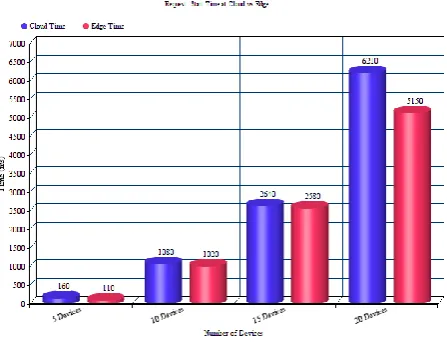
the data-rate link. In other words transmission delay is the time take by a unit of data to reach from one device to another. Response time is an amount of time that a system takes to respond to a request for service or in other words the response time is the total elapsed time from when a request is made to the time it is completed. The figure 3 below shows the results with respect the number of devices in cloud and as well as in edge. In figure x-axis shows the number of devices and y-axis shows time in milliseconds.
Figure 3. Transmission Delay [Edge vs cloud] Delay is most important characteristic of any system which is not to be for granted.
Delay and latency are sometimes used
interchangeably, it is the amount of time taken by a unit of data transmitted from one device to other device. In terms of networking, it is a time that a data packet takes to reach or get from one designated point to another. The Figure 4 below shows the delay in milliseconds for processing a unit of data in edge and in cloud. For analysis different number of users are taken 5 users, 10 users, 15 users, and 20 users respectively. The column represents the total delay and line represents the process start time. End to end delay is total delay that is processing time and transmission time of a process. The graph shows that edge processing is better than cloud processing, as the delay is low and response time is also lower than of cloud. In this the x-axis shows the number of devices and y-axis shows the time in milliseconds.
Figure 4. End to End Delay and Response Time with respect to Number of Devices
V. Conclusion
system and results have shown that proposed system is better than existing system. The analysis shows the proposed framework performs better when number of devices does not exceeds the capacity of edge device. This issue can be addressed by proposing scalable edge computing in future. Scheduling and scalability are the two main issues which can be taken as future work.
VI.References
[1] Flavin, Michael. "Free, Simple and Easy to Use: Disruptive Technologies, Disruptive Innovation and Technology Enhanced Learning", Disruptive Technology Enhanced Learning, 2017, pp. 19-52. [2] Weber, Rolf H., and Romana Weber, “Internet of
things. Vol. 12, Springer, 2010.
[3] Shi, Weisong, et al. "Edge computing: Vision and challenges." IEEE Internet of Things Journal, Vol. 3, No. 5, 2016, pp. 637-646.
[4] Mell, Peter, and Tim Grance. "The NIST definition of cloud computing." 2011, pp. 1-7.
[5] Cloud Computing Tutorial for Beginners,
https://www.guru99.com/cloud-computing-for-beginners.html.
[6] Varghese, B., Wang, N., Barbhuiya, S., Kilpatrick, P., & Nikolopoulos, D. S., “Challenges and opportunities in edge computing”, IEEE International Conference, 2016, pp. 20-26.
[7] Bonomi, F., Milito, R., Zhu, J., & Addepalli, S., “Fog computing and its role in the internet of things” In Proceedings of MCC workshop on Mobile cloud computing, 2012, pp. 13-16.
[8] Buyya, Rajkumar, Rajiv Ranjan, and Rodrigo N. Calheiros. "Intercloud: Utility-oriented federation of cloud computing environments for scaling of application services." International Conference on Algorithms and Architectures for Parallel Processing. Springer, 2010, pp. 13-31.
[9] Gong, C., Liu, J., Zhang, Q., Chen, H., & Gong, Z., “The characteristics of cloud computing”, IEEE Conference, 2010, pp. 275-279.
[10] Moreno-Vozmediano, Rafael, Rubén S. Montero, and Ignacio M. Llorente. "Iaas cloud architecture: From virtualized datacenters to federated cloud infrastructures." Computer, Vol. 45, No.12, 2012 pp. 65-72.
[11] Hassanalieragh, Moeen, Alex Page, Tolga Soyata, Gaurav Sharma, Mehmet Aktas, Gonzalo Mateos,
Burak Kantarci, and Silvana Andreescu, "Health monitoring and management using Internet-of-Things (IoT) sensing with cloud-based processing: Opportunities and challenges." IEEE International Conference, 2015, pp. 285-292.
[12] Shinde, Tejaswinee A., and Jayashree R. Prasad. "IoT based Animal Health Monitoring with Naive Bayes Classification." IJETT, Vol. 4, No. 2, 2017, pp. 1-4.
[13] Tao, Fei, Ying Cheng, Li Da Xu, Lin Zhang, and Bo Hu Li. "CCIoT-CMfg: cloud computing and internet of things-based cloud manufacturing service system." IEEE Transactions on Industrial Informatics, Vol. 10, No. 2, 2014, pp. 1435-1442. [14] IoT Analytics https://iot-analytics
.com/10-internet-of-things-applications/, Accessed on 24-07-2017.
[15] Hou, Enxing, Long Dai, and Zhenwei Wen. "Method, apparatus and electronic device for controlling smart home device." U.S. Patent No. 9,691,272. 27 Jun. 2017.
[16] Chan, M., Estève, D., Fourniols, J. Y., Escriba, C., & Campo, E., “Smart wearable systems: Current status and future challenges”, Artificial intelligence in medicine, Vol.56, No. 3, 2012, pp. 137-156.
[17] Sheng, Zhengguo, Shusen Yang, Yifan Yu, Athanasios Vasilakos, Julie Mccann, and Kin Leung., "A survey on the ietf protocol suite for the internet of things: Standards, challenges, and
opportunities." IEEE Wireless
Communications, Vol. 20, No. 6, 2013, pp. 91-98. [18] Kurt, S., Yildiz, H. U., Yigit, M., Tavli, B., &
Gungor, V. C., “Packet size optimization in wireless sensor networks for smart grid applications”, IEEE Transactions on Industrial Electronics, Vol. 64, No. 3, 2017, pp. 2392-2401. [19] Da Xu, Li, Wu He, and Shancang Li. "Internet of
things in industries: A survey." IEEE Transactions on industrial informatics, Vol. 10, No. 4, 2014, pp. 2233-2243.
[20] BJ Hubert Shanthan, A. Dalvin Vinoth Kumar, and L. Arockiam. "Filling Fuel Quantity Measurement Systems Using Internet Of Things.", International Journal of Innovative Research and Advanced Studies, Vol. 3, No. 13, 2016, pp. 152-154.
N-path techniques for IoT applications," Ultra-Low-Power and Ultra-Low-Cost Short-Range Wireless
Receivers in Nanoscale CMOS. Springer
International Publishing, 2016, pp. 81-103.
[22] Dacko, Scott G. "Enabling smart retail settings via
mobile augmented reality shopping
apps." Technological Forecasting and Social Change, 2016.
[23] Armbrust, Michael, Fox, A., Griffith, R., Joseph, A. D., Katz, R., Konwinski, A., & Zaharia, M., "A view of cloud computing." Communications of the ACM, Vol.53, No. 4, 2010, pp. 50-58.
[24] Using an IoT gateway to connect the "Things" to
the cloud, John Treadway,
http://internetofthingsagenda.techtarget.com/featur e/Using-an-IoT-gateway-to-connect-the-Things-to-the-cloud. Accessed on 1st July 2017.
[25] Chen, Min, et al. "Cloud-based wireless network: Virtualized, reconfigurable, smart wireless network to enable 5G technologies." Mobile Networks and Applications, Vol. 20, No.6, 2015, pp. 704-712.
Mahmood Hussain Mir, has received
BCA degree from Kashmir University, Srinagar, Jammu and Kashmir India, and
MCA from Baba Ghulam Shah Badshah University Rajouri, Jammu and Kashmir, India. He is currently Research Scholar of Department of Computer Sciences, St. Joseph’s College Trichy, Tiruchirappalli, Tamil Nadu, India, under Bharathidasan University, Tamil Nadu, India. His research interests are Internet of Things, Edge Computing and Data Analytics in IoT.
Dr. D. Ravindran, is currently Associate Professor in Department of Computer Sciences, St. Joseph’s College, Tiruchirappalli, Tamil Nadu, India. He has received BSc. degree from St. Joseph's College (Autonomous) Tiruchirappalli, Madras University, M.Sc. degree from St. Joseph's College (Autonomous) Tiruchirappalli Bharathidasan University,
PGDCSA from St. Joseph's College