Optimal Sizing of a Stand-Alone Wind/PV
Hybrid Generating System Using Homer
Software
Kousalya D
1, M. Gopikrishnan
*2Assistant Professor, Dept. of EEE, Jerusalem College of Engineering, Chennai, Tamil Nadu, India1
Assistant Professor, Dept. of EEE, Bharath University, Chennai, Tamil Nadu, India2
* Corresponding Author
ABSTRACT: A methodology for optimal sizing of stand-alone PV/WG system is presented. The proposed methodology purpose is to recommend, among a list of commercially available system devices, the optimal number and type of units ensuring that the total system cost is minimized subjected to the constraint that the load energy requirements are completely covered, resulting in zero load rejection. The total system cost is equal to the sum of the respective components capital and maintenance costs. The cost function minimization is implemented using Homer software. In the optimization process, HOMER simulates every system configuration in the search space and displays the feasible ones in a table, sorted by total net present cost (NPC).
I. INTRODUCTION
Global environmental concerns and the ever increasing need for energy, coupled with a steady progress in renewable energy technologies are opening up new opportunities to utilize a combination of renewable energy resources. In particular, advances in wind and PV generation technologies have brought the integration of these two energy resources into reality.
Wind and solar energy resources are highly variable and site specific. The problems caused by the variable nature of these resources can be partially overcome by using the strengths of one source to overcome the weaknesses of the other. This is apparent by realizing the fact that in many areas more insolation and less wind are available during the summer months; and similarly, more wind and less insolation are available during the winter.
Design of a hybrid energy system is site specific and it depends upon the resources available and the load demand. This paper describes design, simulation and feasibility study of a wind/PV hybrid system for small loads. National Renewable Energy Laboratory‟s HOMER software was used to select an optimum cost of energy hybrid system. HOMER stands for the Hybrid Optimization Model for Electric Renewables. HOMER was developed as a hybrid system design tool „accurate enough to reliably predict system performance, but simple and efficient enough to conveniently evaluate a large number of design options‟ and then rank the results to find the optimum configuration. HOMER identifies the least cost system for supplying electricity to remote loads by performing hourly simulations of thousands of potential power systems and rank ordering them by life-cycle costs. It also performs sensitivity analysis to evaluate the impact of a change in any of the input parameters and provides both annual and hourly outputs in tabular and graphic form. Hybrid system design is made difficult by the intermittency of renewable resources, the need to match electrical supply and demand, and the large number of potential component size combinations. A detailed design, description and expected performance of the system are presented in this paper.
average global solar radiation on the horizontal surface (kW/m2), monthly average global solar radiation on the horizontal surface (kWh/m2 day), or monthly average clearness index. The clearness index is the ratio of the solar radiation striking Earth‟s surface to the solar radiation striking the top of the atmosphere [3].
0.0 0.2 0.4 0.6 0.8 1.0
Jan Feb Mar Apr May Jun Jul Aug Sep Oct Nov Dec 0 1 2 3 4 5 6 7 D a il y R a d ia ti o n ( k W h /m ²/ d )
Global Horizontal Radiation
C le a rn e s s I n d e x
Daily Radiation Clearness Index
Fig. 2.1. Annual Solar radiation in Trichy
To model a system comprising one or more wind turbines, the HOMER user must provide wind resource data indicating the wind speeds the turbines would experience in a typical year [2][4]. The user can provide measured hourly wind speed data if available. Fig. 4.3. shows the annual wind speed for Trichy zone.
Jan Feb Mar Apr May Jun Jul Aug Sep Oct Nov Dec 0 2 4 6 8 W in d S p e e d ( m /s ) Wind Resource
Fig. 2.2. Annual Wind speed for Trichy
HOMER models a wind turbine as a device that converts the kinetic energy of the wind into ac or dc electricity according to a particular power curve, which is a graph of power output versus wind speed at hub height [5].
0 5 10 15 20 25
0 50 100 150 200 250 300 P o w e r (k W )
Pow er Curve
Wind Speed (m/s)
Fig. 2.3. Power curve for Wind turbine
3. Load Pattern: In HOMER, the term load refers to a demand for electric or thermal energy. HOMER models three types of loads. Primary load is electric demand that must be served according to a particular schedule. Deferrable load is electric demand that can be served at any time within a certain time span. Thermal load is demand for heat [7].
0 6 12 18 24 0
100 200 300 400 500
L
o
a
d
(
k
W
)
Daily Profile
Hour
Fig. 3.1. Load profile of AUT-T
4. Economic Modelling: Economics play an integral role both in HOMER‟s simulation process, wherein it operates
the system so as to minimize total net present cost, and in its optimization process, wherein it searches for the system configuration with the lowest total net present cost [6]. The NPC includes the costs of initial construction, component replacements, maintenance, fuel, plus the cost of buying power from the grid and miscellaneous costs such as penalties resulting from pollutant emissions.
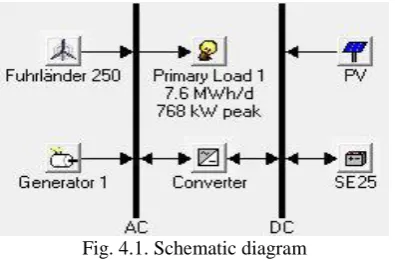
Fig. 4.1. shows the schematic diagram of this project, which consists of wind turbines, solar panels, generator, converter and the load.
Fig. 4.1. Schematic diagram
HOMER will simulate list of various feasible solutions. To produce these solutions, we have assigned multiple values of sizes for each component of the system.
The selection of components of hybrid energy system is done using National Renewable Energy Laboratory, Hybrid Optimization Model for Electric Renewables (HOMER) [8]. HOMER is general purpose hybrid system design software. HOMER performs comparative economic analysis on a generation power systems. Inputs to HOMER will perform an hourly simulation of every combination of components entered and rank the system according to user-specified criteria, such as capital cost or cost of energy (COE).
HOMER uses the following equation to
calculate the levelized cost of energy: Cann,tot
COE =
Eprim + Edef + Egrid,sales
Where Cann,tot is the total annualized cost, Eprim and Edef are the total amounts of primary and deferrable load, Egrid,sales is the amount of energy sold to the grid per year.
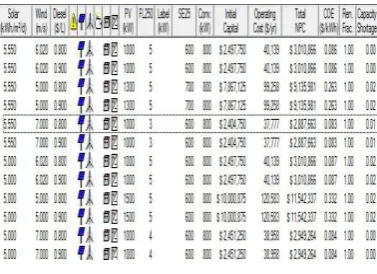
Table 4.1. Optimization results from HOMER
Sensitivity analysis of the HOMER is shown the overall winner which shows that the most least cost and optimize hybrid system is combination of the 1000kW PV array and five 250kW wind turbine [9]. This can be shown in Table 4.2 which shows a complete list of HOMER solutions from the best worst.
Table 4.2. Sensitivity results
However the main contribution of the wind/PV hybrid system is totally environment friendly therefore the system is very promising for a long term policy.
V. CONCLUSION
The application of hybrid wind/PV generation for utilizaiton as a stand-alone generating system was investigated. This optimization study indicates that energy requirements to provide electricity for a particular area (i.e) Anna University of Technology, Tiruchirappalli can be accomplished by a combination of the 1000 kW PV array and five 250 kW wind turbine.
REFERENCES
1. Juhari Ab. Razak, Kamaruzzaman Sopian, Yusoff Ali, Mohammad Ahmed Alghoul, Azami Zaharim, Ibrahim Ahmed, Optimization of PV-Wind-Hydro-Diesel Hybrid System by Minimizing Excess Capacity, European Journal of Scientific Research ISSN 1450-216X Vol. 25 No.4(2009).
2. Babu T.A., Sharmila V., "Cefotaxime-induced near-fatal anaphylaxis in a neonate: A case report and review of literature", Indian Journal of Pharmacology, ISSN : 0253-7613, 43(5) (2011) pp.611-612.
3. W. Kellogg, M.H. Nehrir, G. Venkataraman, V. Gerez, Optimal unit sizing for a hybrid wind/photovoltaic generating system, Elsevier (electric power systems research 39 (1996) 35-38.
4. Valiathan G.M., Thenumgal S.J., Jayaraman B., Palaniyandi A., Ramkumar H., Jayakumar K., Bhaskaran S., Ramanathan A., "Common docking domain mutation e322k of the erk2 gene is infrequent in oral squamous cell carcinomas", Asian Pacific Journal of Cancer Prevention, ISSN : 1513-7368, 13(12) (2012) pp.6155-6157.
5. S.Dehghan, B.Kiani, A.Kazemi, A.Parizad, “Optimal sizing of a hybrid Wind/PV plant considering reliability indices”, World academy of science, Engineering and Technology, 2009.
7. Pragya Nema, R.K Nema, Saroj Rangnekar, “PV - solar/wind hybrid energy system for GSM/CDMA type mobile telephony base station”, International Journal of Energy And Environment, Volume 1, Issue 2, 2010.
8. Thirunavukkarasu A.B., Chandrasekaran V., 'Efficacy of anti-scorpion venom serum over prazosin in severe scorpion envenomation: Is the current evidence enough", Journal of Postgraduate Medicine, ISSN : 0022-3859, 57(1) (2011) pp.83-84.
9. Subbaraj G.K., Kulanthaivel L., Rajendran R., Veerabathiran R., "Ethanolic extract of Carum carvi (EECC) prevents N-nitrosodiethylamine induced phenobarbital promoted hepatocarcinogenesis by modulating antioxidant enzymes", International Journal of Pharmacy and Pharmaceutical Sciences, ISSN : 0975 - 1491, 5(S1) (2013) pp.195-199.
10. B Karthik, S Rajeswari, Design and Analysis of a Transceiver on a Chip for Novel IR-UWB Pulses, Middle-East Journal of Scientific Research 19 (6), PP 817-820, 2014.
11. Shriram, Revati; Sundhararajan, M; Daimiwal, Nivedita; , Application of High & Low Brightness LEDs to Human Tissue to Capture Photoplethysmogram at a Finger TipRed, V-620,PP 700.
12. Muralibabu, K; Sundhararajan, M; , PAPR performance improvement in OFDM system using DCT based on adjacent symbol groupingTrans Tech Publ, Applied Mechanics and Materials, V-550,PP 204-209, 2014.
13. sivaperumal, s; sundhararajan, m; , advance feature extraction of mri brain image and detection using local segmentation method with watershed.
14. MURALIBABU,K;SUNDHARARAJAN, M; , PAPR reduction using DCT based sub carrier grouping with Companding Technique in OFDM system.