ISSN (Print) : 2320 – 3765 ISSN (Online): 2278 – 8875
I
nternational
J
ournal of
A
dvanced
R
esearch in
E
lectrical,
E
lectronics and
I
nstrumentation
E
ngineering
(An ISO 3297: 2007 Certified Organization)
Vol. 5, Issue 3, March 2016
Android Based Closed Loop Speed Control of
Dc Motor Using Voice Recognition via
Bluetooth
B.Gokul1, K.Karthi2, A.Thiyagaseelan3, V.Santhosh Kumar4
UG Students, Department of EEE, KPR Institute of Engineering and Technology, Coimbatore, India1, 2, 3 Assistant Professor, Department of EEE, KPR Institute of Engineering and Technology, Coimbatore, India4
ABSTRACT: The DC motors are widely used for variable speed drive system in industrial applications such as industrial automation, electric traction, aircraft, military equipment, hard disk drives because of their high efficiency, silent operation, compact, reliability and low maintenance. Due to the advancement of wireless technology, there are several connections are introduced such as GSM, Wi-Fi, ZIGBEE and Bluetooth. Each of the connection has their own unique specifications and applications. Among these wireless connections, Bluetooth technology often implemented. The speed control was implemented using Bluetooth technology to provide communication access from smart phone.Communication plays a major role in day today’s life and can be used as a better tool in control system. It deals with wireless communication and voice recognition and is used to control the motor speed. On the other hand we have ARDUINO UNO platform that we can use to quickly prototype electronic systems. It enables a person to work around independently using a touch screen and voice recognition applications which is interfaced with motors using ARDUINO UNO microcontroller. This can also be controlled through simple voice commands. In addition to this IR sensor is used to sense the motor speed and in turn speed of the motor can be received via Bluetooth to the android mobile.
KEYWORDS: ARDUINO, Android mobile, DC Motor, IR Speed sensor
I. INTRODUCTION
ISSN (Print) : 2320 – 3765 ISSN (Online): 2278 – 8875
I
nternational
J
ournal of
A
dvanced
R
esearch in
E
lectrical,
E
lectronics and
I
nstrumentation
E
ngineering
(An ISO 3297: 2007 Certified Organization)
Vol. 5, Issue 3, March 2016
II. BLOCK DIAGRAM
III. WORKING
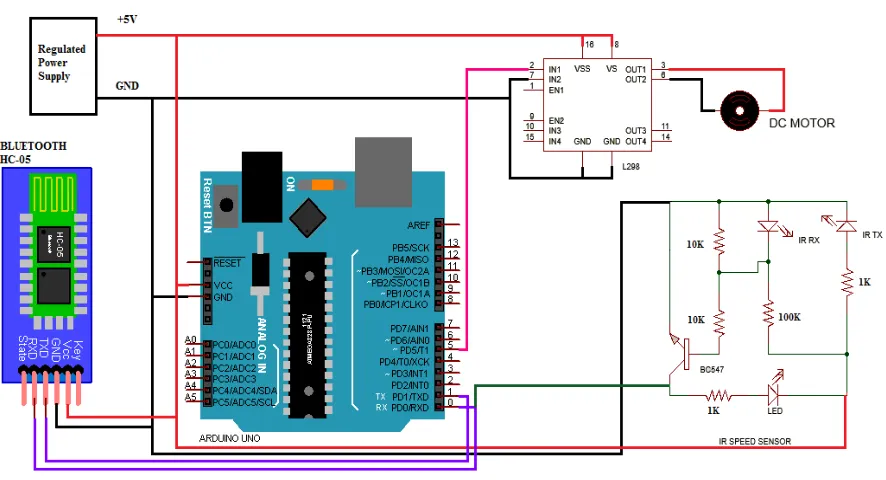
Voice is given to the android mobile. The mobile is used with an installed voice recognition application. This application has the feature of sending voice commands and also has the ability of receiving speed from the speed sensor. Voice command is given to android mobile application. This application sends the voice to the Bluetooth module interfaced with ARDUINO UNO. HC-05 is the Bluetooth module used here. Voice command is converted into industrial, scientific and medical (ISM) radio bands of about 2.4 GHz frequencies and transmitted to the microcontroller. It converts the given input signal to pulsating signal with the help of programming performed using ARDUINO software. The pulsating signal is converted into the driving signal using driver circuit. The driver circuit has IC L298. It operates two DC motors simultaneously upto 46V and 4A. The motor rotates as we given command through the android mobile. Speed is sensed by the IR sensor. It is a wireless sensor and it is directly connected to the ARDUINO UNO board. The speed of the motor can be displayed by android mobile via Bluetooth.
IV. HARDWARE COMPONENTS
A. BLUETOOTH MODULE
HC-05 embedded Bluetooth serial communication module (can be short for
ISSN (Print) : 2320 – 3765 ISSN (Online): 2278 – 8875
I
nternational
J
ournal of
A
dvanced
R
esearch in
E
lectrical,
E
lectronics and
I
nstrumentation
E
ngineering
(An ISO 3297: 2007 Certified Organization)
Vol. 5, Issue 3, March 2016
this project Bluetooth module (HC-05) acts as a bidirectional device. It can send and receive signals from the ARDUINO UNO.
B. ARDUINO UNO
The ARDUINO UNO is a microcontroller board based on the ATmega328. It has 14 digital Input/output pins (of which 6 can be used as PWM outputs), 6 analog inputs, a 16 MHz crystal oscillator, a USB connection, a power jack, an ICSP header, and a reset button. It contains everything needed to support the microcontroller; simply connect it to a computer with a USB cable or power it with a AC-to-DC adapter or battery to get started. The Uno differs from all preceding boards in that it does not use the FTDI USB-to-serial driver chip. Instead, it features the Atmega8U2 programmed as a USB-to-serial converter."Uno" means one in Italian.
C. MOTOR DRIVER
The L298 is an integrated monolithic circuit in a 15-lead Multiwatt and PowerSO20 packages. It is a high voltage, high current dual full-bridge driver designed to accept standard TTL logic levels and drive inductive loads such as relays, solenoids, DC and stepping motors. Two enable inputs are provided to enable or disable the device independently of the input signals. The emitters of the lower transistors of each bridge are connected together and the corresponding external terminal can be used for the connection of an external sensing resistor. An additional supply input is provided so that the logic works at a lower voltage.
D. DC MOTOR
Almost every mechanical movement that we see around us is accomplished by an electric motor. Electrical machines are used for the converting energy. Motors take electrical energy and produce mechanical energy. Electric motor is used to power hundreds of devices we use in everyday life. An example of small motor applications includes motors used in automobiles, robot, hand power tools and food blenders. Micro-machines are electric machines with parts the size of red blood cells and find many applications in medicine.
E. SPEED SENSOR
IR speed sensor is designed to monitor the speed of the motor. The holes type pulley is attached in the motor shaft. The pulley is rotated across the USLOT. The USLOT consists of IR transmitter and receiver.
Infrared transmitter is one type of LED which emits infrared rays generally called as IR Transmitter. Similarly IR Receiver is used to receive the IR rays transmitted by the IR transmitter. One important point is both IR transmitter and receiver should be placed straight line to each other.
F. POWER SUPPLY
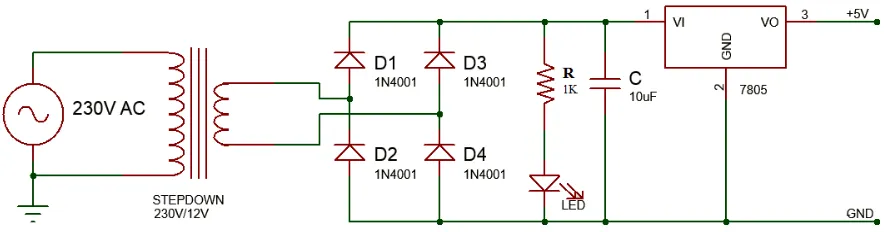
Fig 2: Power supply circuit diagram
ISSN (Print) : 2320 – 3765 ISSN (Online): 2278 – 8875
I
nternational
J
ournal of
A
dvanced
R
esearch in
E
lectrical,
E
lectronics and
I
nstrumentation
E
ngineering
(An ISO 3297: 2007 Certified Organization)
Vol. 5, Issue 3, March 2016
to obtain a desired fixed dc voltage. The regulation is usually obtained from an IC voltage regulator unit, which takes a dc voltage and provides a somewhat lower dc voltage, which remains the same even if the input dc voltage varies, or the output load connected to the dc voltage changes.
V. SOFTWARE
A. PROTEUS 8.0
Proteus is software for microprocessor simulation, schematic capture, and printed circuit board (PCB) design. It is developed by Labcenter Electronics. Proteus (Processor for text Easy to use) is a fully functional, procedural programming language created in 1998 by Simone Zanella. Proteus incorporates many functions derived from several other languages: C, BASIC, Assembly, etc. It is especially versatile in dealing with strings, having hundreds of dedicated functions; this makes it one of the richest languages for text manipulation. Proteus was initially created as a multiplatform (DOS, Windows, UNIX) system utility, to manipulate text and binary files and to create CGI scripts. The language was later focused on Windows, by adding hundreds of specialized functions for: network and serial communication, database interrogation, system service creation, console applications, keyboard emulation, ISAPI scripting.
B. MODELLING
Fig 3: Circuit diagram for speed control of DC motor using android speech recognition via Bluetooth
ISSN (Print) : 2320 – 3765 ISSN (Online): 2278 – 8875
I
nternational
J
ournal of
A
dvanced
R
esearch in
E
lectrical,
E
lectronics and
I
nstrumentation
E
ngineering
(An ISO 3297: 2007 Certified Organization)
Vol. 5, Issue 3, March 2016
C. SIMULATION SETUP
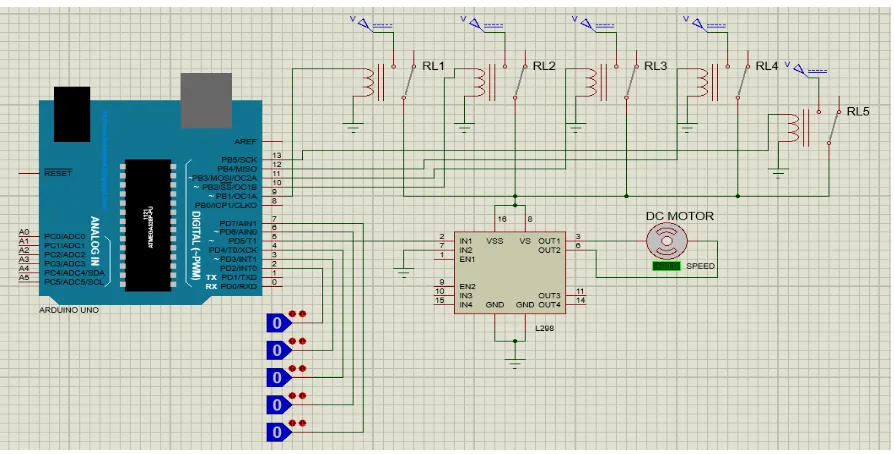
Fig 4: Simulation setup for speed control of DC motor using android speech recognition via Bluetooth
Simulation is done using Proteus software. The simulation setup consists of ARDUINO UNO board, IC L298 and DC motor. Logic state is connected to input of the ARDUINO UNO. It is considered as an input of DC motor. Any logic state is triggered speed of the motor can be varied as per the ARDUINO program upload in ARDUINO UNO.
ISSN (Print) : 2320 – 3765 ISSN (Online): 2278 – 8875
I
nternational
J
ournal of
A
dvanced
R
esearch in
E
lectrical,
E
lectronics and
I
nstrumentation
E
ngineering
(An ISO 3297: 2007 Certified Organization)
Vol. 5, Issue 3, March 2016
Fig 5: Simulation outputs for speed control of DC motor using android speech recognition via Bluetooth
This is the simulation output of this project. Input-1, Input-2, Input-3, Input-4 and Input-5 is fed to the Logic state through the ARDUINO UNO microcontroller and Relay-1, Relay-2, Relay-3, Relay-4 and Relay-5 is turned on respectively. Input-1 indicates 200rpm, Input-2 indicates 400 rpm, Input-3 indicates 600rpm, Input-4 indicates 800rpm and Input-5 indicates 1000rpm. The motor specification in this project is 12V, 1000rpm. The motor speed increases for each input of the relays which are fed to the Motor.
VI. ANDROID APPLICATION
A. ECLIPSE SOFTWARE
ISSN (Print) : 2320 – 3765 ISSN (Online): 2278 – 8875
I
nternational
J
ournal of
A
dvanced
R
esearch in
E
lectrical,
E
lectronics and
I
nstrumentation
E
ngineering
(An ISO 3297: 2007 Certified Organization)
Vol. 5, Issue 3, March 2016
B. APPLICATION INSTRUCTION
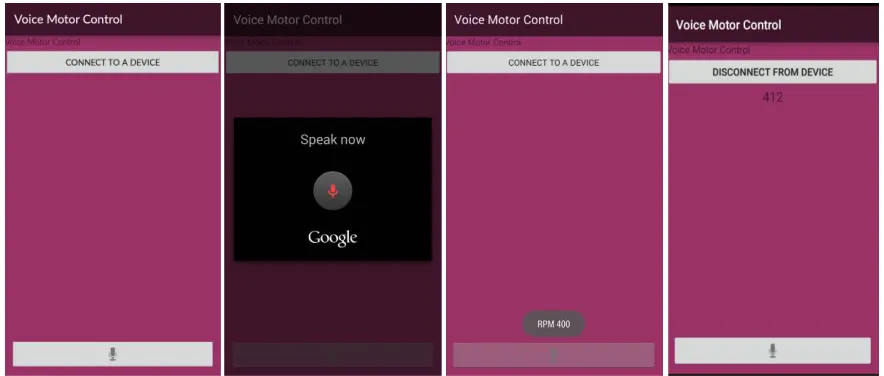
Fig 6: Android app screenshot for speed control of DC motor using android speech recognition via Bluetooth
a. First the HC-05 Bluetooth module is paired with the mobile. The default password for pairing is “1234” or “0000”. Check the manual of Bluetooth module.
b. Click on “SELECT DEVICE” icon to select paired Bluetooth module.
c. By giving the command “400rpm” it sends the data “B” to Bluetooth module connected with the circuit.
e. When microcontroller detects “B” the motor rotates “400rpm” and senses the speed of the motor and gives back to the Application via Bluetooth.
VII. CONCLUSION
In general projects, Android mobile can be used as a remote. For application regarding home automation field, it is used as an ON/OFF process and in addition to that the speed can also be varied. In this project Android mobile acts as a microphone. The command is given to the mobile and speed of the motor can be varied and in turn the speed of the motor is displayed in Android application.
REFERENCES
[1] S. Anita, S. Jothi, “Implementation of Android Voice Recognition for Smart Home Application Using Bluetooth”, International Journal of Innovative Science and Modern Engineering (IJISME), Volume-3 Issue-5, April 2015.
[2] M.Prathyusha, K. S. Roy, Mahaboob Ali Shaik, “Voice and Touch Screen Based Direction and Speed Control of Wheel Chair for Physically Challenged Using Arduino”, International Journal of Engineering Trends and Technology (IJETT) - Volume4 Issue4- April 2013.
[3] Sabedin A. Meha, Besnik Haziri, Loreta N. Gashi, “Controlling DC motor speed using PWM from C# Windows application”, 15th International Research and Expert Conference, "Trends in the Development of Machinery and Associated Technology” TMT 2011, Prague, Czech Republic, September 2011.
[4] Musaab Hassan, Hammam Mahjoub, Mohammed Obed, “Voice-Based Control of a DC Servo Motor”, American J. of Engineering and Applied Sciences 5, 2012.
[5] Radhakrishna Karne, Chakradhar.A, “An Enhanced Dc Motor Control Using the Speech Recognition System”, International Journal of Soft Computing and Engineering (IJSCE), Volume-3, Issue-4, September 2013.