
Intelligent Artificial Bee Colony Techniques to
Solve Environment Emission and Economic
Load Dispatch
Sujata Gupta
1, Rameshwar Singh
2PG Student [Control System], Dept. of EE, N.I.T.M Engineering College, Gwalior, M.P., India1 Assistant Professor, Dept. of EE, N.I.T.M Engineering College, Gwalior, M.P., India2
ABSTRACT: Economic load dispatch is an important optimization problem in power system. Due to the harmful effects of the emission released by fossil fueled electric power plants, Emission Dispatch plays an important role in power industry. This paper presents performances of an artificial bee colony algorithm; the proposed artificial bee colony is effective and reliable technique for obtaining the optimal solution of the combined economic and emission dispatch problem. The results have been demonstrated for combined economic and emission dispatch problem of standard 6-generator with and without consideration of the transmission losses.
KEYWORDS: Artificial bee colony, Economic Dispatch, Emission dispatch, Pareto optimal solution.
I. INTRODUCTION
In the present scenario electric power industry has to meet with subtle changes occurring worldwide. This has forced the utility engineers to plan the electric power generation system for efficient economic operation such that environmental pollution is reduced along with the minimization of generating cost. With the amendments in the clean air act in 1990 many efforts have been made to reduce the NOx, SOx and CO2 emissions into the atmosphere [1].In fossil-fired power plants, main sources of energy are coal, gas, oil and diesel. All of the above mentioned resources realize harmful gases in atmosphere. Coal Produces ash content, SOx, NOx, and CO2 in the atmosphere. The cooling water used in thermal power plant also rises the water temperature and affecting the marine life also. Nuclear power plants emit harmful radiation in the environment. Because of all above factors, emission control has become an important operational objective [2]. Emission control has received increasing attention owing to increased concern over environmental pollution caused by fossil based generating units and the enforcement of environmental regulations in recent years. Due to strict governmental regulations on environment protection, the conventional operation at absolute minimum fuel cost cannot be the only basis for dispatching electric power. There is a need from society for adequate and secure electricity at the cheapest possible price with minimum levels of pollution. It is compulsory for electric utilities to reduce pollution level by reducing CO2, SOx and NOx. Various methods available for reducing emissions are switching to low sulphur content coal, installing post-combustion cleaning system, allocation of generation to each generator unit with the objective to minimum emission dispatch [3]. The pollutants become an inescapable problem to control and govern emissions of power plants because, day by day energy conservation and pollution emissions reduction attains increasingly social attentions [4].
intelligent search algorithms. This paper uses artificial bee colony algorithm to solve combined economic and emission dispatch problem with equality and inequality constraints.
II. OVERVIEW OF THE ABC ALGORITHM
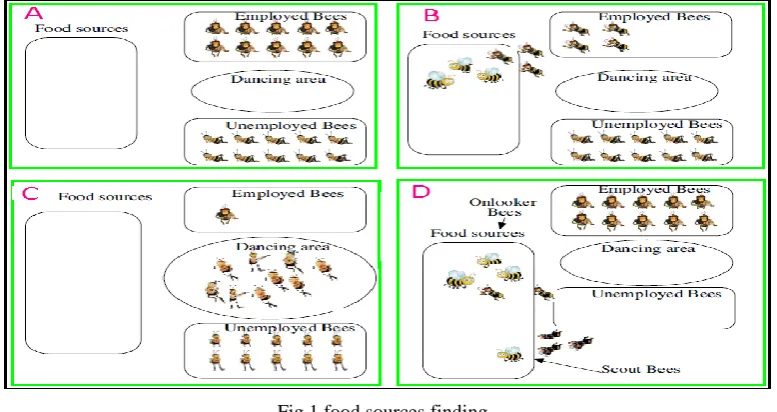
Artificial bee colony is one of the most recently defined algorithms by Karaboga in 2005, motivated by the intelligent behaviour of honey bees [14-15]. In the ABC system, artificial bees fly around in the search space, and some (employed and onlooker bees) choose food sources depending on the experience of themselves and their nest mates, and adjust their positions. Some (scouts) fly and choose the food sources randomly without using experience. If the nectar amount of a new source is higher than that of the previous one in their memory, they memorize the new position and forget the previous one .Thus; the ABC system combines local search methods, carried out by employed and onlooker bees, with global search methods, managed by onlookers and scouts, attempting to balance exploration and exploitation process In the ABC algorithm, the colony of artificial bees consists of three groups of bees: employed bees, onlooker bees, and scout bees. It is population-based search procedure and the foraging behavior of real bees in finding food sources is shown in Figure 1. The model consists of 3 essential components: employed bees, unemployed bees, and food sources. Figure 1A clearly shows the essential parts of the model: employed bees, unemployed bees, food sources, and a dancing area. Employed bees y around in a multidimensional search space and choose their food sources depending on their own experience, which is shown in Figure 1B. Once the employed bees complete their search
Fig 1 food sources finding
Process, they share their food source information with unemployed bees or onlooker bees waiting in the hive by dancing in the dancing area, which is shown in Figure 1C. Onlooker bees probabilistically choose their food sources depending on this information gained from the Employed bees, which is shown in Figure 1D. If there is no improvement in the food source (Fitness), then the scout bees y and choose the food sources randomly without using experience, which is also shown in Figure 1D [16].
III.ARTIFICIAL BEE COLONY (ABC) ALGORITHM
scout bee phase, the employed bees whose food resource becomes abandoned turns into scout bee. The main job of scout bees is to search for new food resources.
IV. THE STEP BY STEP PROCEDURE FOR PROPOSED ARTIFICIAL BEE COLONY (ABC) ALGORITHM
Step I: Specify generator cost coefficients, emission coefficients, generation power limits for each unit and B-loss coefficients. Initialize the four control parameters of ABC algorithm and maximum cycle for termination process.
Step II: Initialization of the ABC algorithm parameters. In this step, the parameters of the ABC algorithm, such asthe colony dimension, maximum cycle number (MCN), number of variables, and limit parameter, are initialized.
Step II: Initialization of the population with a random solution. In this step, a set of food sources (initial population of S solutions xi (i = 1, 2,...S)) is generated randomly by thebees and their nectar amounts are determined, where S corresponds to size of the employed bees. Each solution xi is represented by a D-dimensional vector, where D correspondsto the number of parameters to be optimized.
Step IV: Evaluation of the fitness.
In this step, evaluation of the fitness function of each food source position corresponding to the employed bee in the colony.
Step V: Modification of the food source position and local selection by the employed bee. In this step, an employed bee modifies the food source position, finds a new position (solution) using her visual information belonging to that source in her memory, and tests the nectar amount of the new source. In the ABC algorithm, the new food source found by the employed bee is described as follows:
)
(
ij kjij ij
ij
x
x
x
v
……….……… (1)Where, k (1, 2, 3…..S) and j (1, 2…..D) are randomly chosen indices and 𝜙 is a random number in the interval of [-1, 1]. In fact 𝜙ij gives a comparison between 2 sources found, the new and the old. After vij is produced and its fitness is evaluated, the comparison is done by the employed bees. According to the comparison, if the fitness value of the new food source is better than that of the old one, the new food source is kept in the memory and the old one is discarded; otherwise, the new one is discarded from the memory and the old one is kept. This selection is called local searching or greedy selection process in the ABC algorithm. In this process, if the new food source is selected instead of the old one, a limit count is set.
Step VI: Employ the onlookers for the selected sources and evaluate the fitness. After completion of the local search process in Step 5 by theemployed bees, they come back into the hive and share thenectar amount information of the sources with the onlooker bees waiting at the dancing area. In fact, these onlooker bees were called employed bees before going to the food sourcethat they visited. In this step, onlooker bees make a new foodsource choice according to the information they took fromthe employed bees and the nectar amount is calculated. This process of choosing a food source depends on the probability value Pi associated with the fitness of that food source and is formulated as follows:
𝑷𝒊= 𝒇𝒊𝒕𝒊
𝑵𝒏=𝟏𝒇𝒊𝒕𝒏………..……….. (2)
Where, 𝒇𝒊𝒕𝒊is the fitness value of the i th solution and N is the total number of food sources which is equal to the
number of employed bees.
Step VIII: Abandon the exploited food sources.
This step is done according to the `limit' parameter, which is a predetermined number of cycles for releasing the food source. In the ABC algorithm, a solution is abandoned when that solution can not improve further for the determined limit value. In this step, when the nectar amount is abandoned in this way, one of the employer bees is determined randomly as a scout bee to find a new food source. This process is described as follows:
𝒙𝒊𝒋= 𝒙𝒋𝒎𝒊𝒏+ 𝜹 𝟎, 𝟏 ∗ (𝒙𝒋𝒎𝒂𝒙− 𝒙𝒋𝒎𝒊𝒏)………..… (3)
j (1,2………D)
Where, 𝛿 is a random value in the interval of [0,1], and 𝑥𝑗𝑚𝑎𝑥 and 𝑥𝑗𝑚𝑖𝑛 are the minimum and maximum limits of the
parameter to be optimized and Keep the position achieved so far and increase the counter of the cycle.
Step IX: Stopping of the global searching process. In the ABC algorithm, steps V through IX are repeated untilthe criterion is met. Next, this global searching process stops.
V.COMBINED ECONOMIC AND EMISSION DISPATCH PROBLEM FORMULATION
The Combined economic and emission dispatch problems is formulated as an optimization problem in which fuel cost and emission are minimized simultaneously for the prescribed schedule of load. In electric power system, there are mainly four objectives to be minimized which include the economy and environmental impacts because of NOx, SO2 and CO2 gaseous pollution.
A. Economic Dispatch
The objective of solving the economic dispatch problem in electric power system is to determine the generation levels for all units which minimize the total fuel cost and minimizing the emission level of the system, while satisfying a set of constraints. It can be formulated as follows:
𝐹(𝑃) = 𝐹𝑖 𝑃𝑖 𝑛
𝑖=1
… . . … … … (4)
𝐹𝑖 𝑃𝑖 = 𝑎𝑖+ 𝑏𝑖𝑃𝑖+ 𝐶𝑖𝑃𝑖2 𝑛
𝑖=1
𝑅𝑠/𝑟 … … … (5)
The economic dispatch problem can be modeled by Where, 𝐹𝑖 𝑃𝑖 -Total fuel cost (𝑅𝑠 /𝑟)
Pi - generating unit 𝑖 𝑡 𝑎𝑖, 𝑏𝑖, 𝑐𝑖 Fuel cost coefficients of 𝑖 𝑡 unit
n- Number of generating units
B. Emission Equation
The fuel cost objective function is replaced by an emissions objective function. The constraints are the same but the optimal solution will produce the lowest total emissions as opposed to the lowest total cost.
The total (kg/hr) emission can be expressed as
𝐸(𝑃) = 𝐸𝑖 𝑃𝑖 𝑛
𝑖=1
… . . (6)
𝐸𝑖 𝑃𝑖 = 𝑑𝑖+ 𝑒𝑖𝑃𝑖+ 𝑓𝑖𝑃𝑖2 𝑛
𝑖=1
𝑅𝑠/𝑟 … (7)
Where, 𝐸𝑖 𝑃𝑖 -Total fuel cost (𝐾𝑔 /𝑟) ,Pi - generating unit 𝑖 𝑡
𝑑𝑖, 𝑒𝑖, 𝑓𝑖 Emission coefficients of 𝑖 𝑡 unit, n- Number of generating units
C. Power balance constraint The total power generated must supply total load demand and transmission losses.
𝑃𝑖 = 𝑃𝑑+ 𝑃𝑙 𝑛
𝑖=1
… . . MW … . (8)
D. Unit capacity constraint
The power generated, Pi by each generator is constrained between its minimum and maximum limits, i.e.
𝑃𝑖𝑚𝑖𝑛 ≤ 𝑃𝑖 ≤ 𝑃𝑖𝑚𝑎𝑥 … . . (9)
Where, 𝑃𝑖𝑚𝑖𝑛- minimum generation limit, 𝑃𝑖𝑚𝑎𝑥- Maximum generation limit.
VI. RESULT AND DISCUSSION
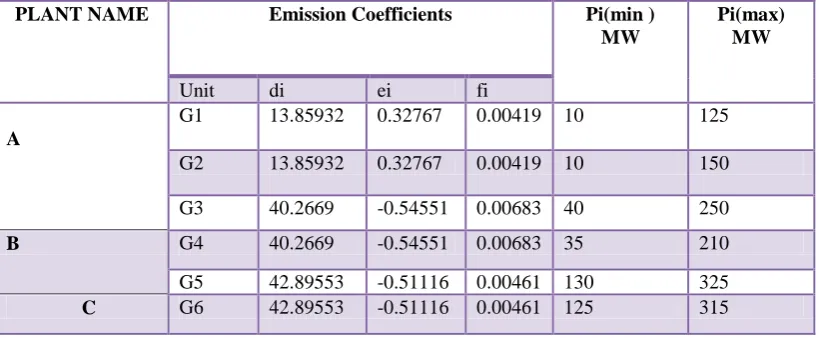
The applicability and validity of the ABC algorithm for practical applications has been two test Case study emissions and cost for 900 MW and 1170 MW. The Programs are developed using MATLAB 2012 and the system configuration is core i3with 2.40 GHz speed and 2 GB RAM. The system has the 6- units [20].The plant 1 consists of three generating units, plant 2 consists of two generators and plant 3 consists of one unit ,The Fuel cost coefficients show in table 1, Emission Coefficients show in table 2 and loss Coefficients show in table 3.
Data are show in the table 1, as follows.
Table 1: Fuel cost Coefficients of 6 units [20]
PLANT NAME
Fuel cost coefficients Pi(min ) MW
Pi(max) MW
Unit ai bi ci
A
G1 756.79886 38.53973 0.15247 10 125
G2 451.32513 46.15916 0.10587 10 150
G3 1049.32513 40.39655 0.02803 40 250
B G4 1243.5311 38.30553 0.03546 35 210
G5 1658.5696 36.32782 0.02111 130 325
C G6 1356.65920 38.27041 0.01799 125 315
Table 2: Emission Cost Coefficients of 6 units [20]
PLANT NAME Emission Coefficients Pi(min )
MW
Pi(max) MW
Unit di ei fi
A
G1 13.85932 0.32767 0.00419 10 125
G2 13.85932 0.32767 0.00419 10 150
G3 40.2669 -0.54551 0.00683 40 250
B G4 40.2669 -0.54551 0.00683 35 210
G5 42.89553 -0.51116 0.00461 130 325
Table 3 loss Coefficients of 6 units [20]
Bij 1 2 3 4 5 6
1 0.000091 0.000031 0.000029 0.000028 0.000031 0.000029
2 0.000031 0.000091 0.000028 0.000031 0.000029 0.000029
3 0.000029 0.000028 0.000091 0.000028 0.000031 0.000029
4 0.000028 0.000031 0.000028 0.000062 0.000029 0.000031
5 0.000031 0.000029 0.000031 0.000029 0.000062 0.000028
6 0.000029 0.000029 0.000029 0.000031 0.000028 0.000072
Case Study I – Without Loss (Cost and Emission)
In this case cost and emission without loss constraint are considered, here, the ABC algorithm implements as a single-objective optimization problem. The power load used 900 MW and 1170 MW and Parameter of ABC algorithm considered here are: N=30; Food-Number=N/2; and limit=100 and max Cycle 500. The result using the proposed ABC algorithm is in comparison with the recently reported methods is given in Table 4 and fig 2.
PLANT NAME
Economic/Emission Dispatch Without loss
Pareto optimal solution [20]
ABC solution
Pareto optimal solution [20]
ABC solution
POWER LOAD 900 MW 900 MW 1170 MW 1170 MW
A
G1 32.4969 67.2006 49.3809 77.0295
G2 10.8160 69.4331 35.1316 86.8251
B
G3 143.6467 240.1016 235.4875 199.4061
G4 143.0317 205.7478 210.0000 204.2118
C
G5 287.1036 317.6183 325.0000 296.4383
G6 282.9051 170.690052 315.0000 306.0892
Total fuel cost (Rs/hr) 45464 45456 59096 59010.0
Total emission (Kg/h) 795.0169 649.7982 1291.3 11811.0
Case study II – With loss (cost and Emission)
In this case cost and emission with loss constraint are considered, here, the ABC algorithm implements as a single-objective optimization problem. The power load used 900 MW and 1170 MW and Parameter of ABC algorithm considered here are: N=30; Food-Number=N/2; and limit=100 and max Cycle 500. The result using the proposed ABC algorithm is in comparison with the recently reported methods is given in Table 4 and fig 2.
PLANT NAME
Economic/Emission Dispatch With loss
Pareto optimal solution [20]
ABC solution
Pareto optimal solution [20]
ABC solution
POWER LOAD 900 MW 900 MW 1170 MW 1170 MW
A
G1 33.8724 19.3734 71.2939 70.2718
G2 12.7969 19.2234 66.6899 69.6181
B
G3 151.1287 104.4038 250.0000 239.1193
G4 148.9459 159.9865 210.0000 198.7708
C
G5 297.0382 302.1505 325.0000 281.1708
G6 294.5627 294.8624 315.0000 310.9881
Total fuel cost (Rs/hr) 47330 47175 62924 62319
VI. CONCLUSION
The Emission and Economic Load dispatch problem being attempted using ABC algorithm for 6 generator test system evaluates the performance of the proposed approach of artificial bee colony; ABC is the best algorithm to reach the near Global optimal solution. However good choice of the number of iterations, population size, Employed and unemployed bees results in fast computation. The comparison shows that ABC solution performs better than Pareto optimal solution. The ABC solution algorithm has superior features, including stable convergence characteristic, quality of solution and better computational efficiency.
REFERENCES
[1] Hari Mohan Dubey1*, Manjaree Pandit2, “A fuzzified improved hybrid PSO-GSA for environmental/economic power dispatch”, International Journal of Engineering, Science and Technology,Vol. 6, No. 4, 2014.
[2] Dimple Singla1, Sanjay K. Jain2, “A Review on Combined Economic and Emission Dispatch using Evolutionary Methods”, International Journal of Advanced Research in Electrical, Electronics and Instrumentation Engineering,Vol. 2, Issue 6, June 2013 .
[3] K. Senthil M.E., “Combined Economic Emission Dispatch using Evolutionary Programming Technique”,Evolutionary Computation for Optimization Techniques, ECOT, 2010.
[4] Jagadeesh Gunda, P.Acharjee, “Multi Objective Economic Dispatch Using Pareto Frontier Differential Evolution” International Journal Of Engineering Science And Technology (Ijest), Vol. 3 No. 10 October 2011.
[5] Mohd Javed Khan1, Hemant Mahala2, “Particle Swarm Optimization by Natural Exponent Inertia Weight for Economic load Dispatch” International Journal of Advanced Research in Electrical, Electronics and Instrumentation Engineering ,Vol. 3, Issue 12, December 2014.
[6] K Sathish Kumar* V Tamilselvan N Murali R Rajaram, “Economic Load Dispatch with Emission Constraints using Various PSO Algorithms” Wseas Transactions On Power Systems, Issue 9, Volume 3, September 2008.
[7] M.A. Abido, “Multiobjective particle swarm optimization for environmental/economic dispatch problem” ,Electric Power Systems Research 79 (2009) 1105–1113.
[8] Rakesh.V, 2 Mrs.S.B.Aruna, 3 Dr.T. Deva Raju, “Combined Economic Load And Emission Dispatch Evalution Using Bat Algorithm” International Journal of Engineering Research and Applications (IJERA), Vol. 3, Issue 3, May-Jun 2013.
[9] M. SaiCharan Reddy. 2Dr. P. S. Subramanyam., “A Meta-Heuristic Approach of Bat Algorithm to Evaluate the Combined EED Problem” International Journal of Engineering Research & Technology (IJERT), Vol. 3 Issue 10, October- 2014..
[10] Sunil Kumar Soni, Vijay Bhuria, “Multi-objective Emission constrained Economic Power Dispatch Using Differential Evolution Algorithm” International Journal of Engineering and Innovative Technology (IJEIT) Volume 2, Issue 1, July 2012.
[11] C.N. Ravi1, Dr. C. Christober Asir Rajan2, “Differential Evolution technique to solve Combined Economic Emission Dispatch”, 3rd International Conference on Electronics, Biomedical Engineering and its Applications (ICEBEA'2013) January 26-27, 2013 Hong Kong (China). [12] Naveen Kumar, K. P. Singh Parmar, “Optimal Solution of Combined Economic Emission Load Dispatch using Genetic Algorithm”, International Journal of Computer Applications (0975 – 8887) Volume 48– No.15, June 2012.
[13] Kamlesh Kumar Vishwakarma1, Hari Mohan Dubey2*, Manjaree Pandit3 and B.K. Panigrahi4, “Simulated annealing approach for solving economic load dispatch problems with valve point loading effects”, International Journal of Engineering, Science and Technology Vol. 4, No. 4, 2012.
[14] Hardiansyah1, Rusman2, “Combined Economic Emission Dispatch Solution using Modified Artificial Bee Colony Algorithm”, International Journal of Advanced Research in Electrical, Electronics and Instrumentation Engineering Vol. 4, Issue 11, November 2015.
[15] H. Shayeghi A. Ghasemi, “Moabc Algorithm For Economic/Environmental Load Dispatch Solution” International Journal On “Technical And Physical Problems Of Engineering” Issue 13 Volume 4, December 2012.
[16] Chandrasekaran Koodalsamy,1,Sishaj Pulikottil Simon2, “Fuzzi_ed arti_cial bee colony algorithm for nonsmooth and nonconvex multiobjective economic dispatch problem, Turkish Journal of Electrical Engineering & Computer Sciences,2013.
[17] Venkatesha G1, R D Satyanarayana Rao2, “Emission Minimization with Artificial Bee Colony Algorithm Incorporating Distributed Generation Sources” International Journal of Science and Research (IJSR), Volume 3 Issue 6, June 2014.
[18] Hardiansyah*, “Artificial Bee Colony Algorithm for Economic Load Dispatch Problem” IAES International Journal of Artificial Intelligence (IJ-AI),Vol. 2, No. 2, June 2013.
[19] Ganga Reddy Tankasala, “Artificial Bee Colony Optimisation for Economc Load Dispatch of a Modern Power system” International Journal of Scientific & Engineering Research, Volume 3, Issue 1, January-2012.
![Table 3 loss Coefficients of 6 units [20]](https://thumb-us.123doks.com/thumbv2/123dok_us/7781682.1285622/6.595.58.539.609.777/table-loss-coefficients-units.webp)
