Western University Western University
Scholarship@Western
Scholarship@Western
Electronic Thesis and Dissertation Repository
8-15-2014 12:00 AM
Identification of Informativeness in Text using Natural Language
Identification of Informativeness in Text using Natural Language
Stylometry
Stylometry
Rushdi Shams
The University of Western Ontario
Supervisor
Dr. Robert E. Mercer
The University of Western Ontario Graduate Program in Computer Science
A thesis submitted in partial fulfillment of the requirements for the degree in Doctor of Philosophy
© Rushdi Shams 2014
Follow this and additional works at: https://ir.lib.uwo.ca/etd
Part of the Artificial Intelligence and Robotics Commons, Computational Linguistics Commons, and the Statistical Models Commons
Recommended Citation Recommended Citation
Shams, Rushdi, "Identification of Informativeness in Text using Natural Language Stylometry" (2014). Electronic Thesis and Dissertation Repository. 2365.
https://ir.lib.uwo.ca/etd/2365
This Dissertation/Thesis is brought to you for free and open access by Scholarship@Western. It has been accepted for inclusion in Electronic Thesis and Dissertation Repository by an authorized administrator of
(Thesis format: Integrated Article)
by
Rushdi Shams
Graduate Program in Computer Science
A thesis submitted in partial fulfillment
of the requirements for the degree of
Doctor of Philosophy
The School of Graduate and Postdoctoral Studies
The University of Western Ontario
London, Ontario, Canada
c
Abstract
In this age of information overload, one experiences a rapidly growing over-abundance of written text. To assist with handling this bounty, this plethora of texts is now widely used to develop and optimize statistical natural language processing (NLP) systems. Surprisingly, the use of more fragments of text to train these statistical NLP systems may not necessarily lead to improved performance. We hypothesize that those fragments that help the most with training are those that contain the desired information. Therefore, determining informativeness in text has become a central issue in our view of NLP. Recent developments in this field have spawned a number of solutions to identify informativeness in text. Nevertheless, a shortfall of most of these solutions is their dependency on the genre and domain of the text. In addition, most of them are not efficient regardless of the natural language processing problem areas. Therefore, we attempt to provide a more general solution to this NLP problem.
This thesis takes a different approach to this problem by considering the underlying theme of a linguistic theory known as the Code Quantity Principle. This theory suggests that humans codify information in text so that readers can retrieve this information more efficiently. Dur-ing the codification process, humans usually change elements of their writDur-ing rangDur-ing from characters to sentences. Examples of such elements are the use of simple words, complex words, function words, content words, syllables, and so on. This theory suggests that these elements have reasonable discriminating strength and can play a key role in distinguishing in-formativeness in natural language text. In another vein, Stylometry is a modern method to analyze literary style and deals largely with the aforementioned elements of writing. With this as background, we model text using a set of stylometric attributes to characterize variations in writing style present in it. We explore their effectiveness to determine informativeness in text. To the best of our knowledge, this is the first use of stylometric attributes to determine informativeness in statistical NLP. In doing so, we use texts of different genres, viz., scien-tific papers, technical reports, emails and newspaper articles, that are selected from assorted domains like agriculture, physics, and biomedical science. The variety of NLP systems that have benefitted from incorporating these stylometric attributes somewhere in their computa-tional realm dealing with this set of multifarious texts suggests that these attributes can be regarded as an effective solution to identify informativeness in text. In addition to the vari-ety of text genres and domains, the potential of stylometric attributes is also explored in some NLP application areas—including biomedical relation mining, automatic keyphrase indexing, spam classification, and text summarization—where performance improvement is both impor-tant and challenging. The success of the attributes in all these areas further highlights their usefulness.
Keywords: Stylometry, The Code Quantity Principle, Text Analytics, Natural Language Processing, Machine Learning, Computational Linguistics, Biomedical Relation Mining, Keyphrase Indexing, Spam Classification, Text Summarization.
This thesis is written in an integrated article format. All the papers related to this thesis— published, submitted, or to be submitted—have two authors. The author of this dissertation is the primary author and Robert E. Mercer is a co-author of all the publications. Rushdi Shams, the author of this dissertation, carried out the literature survey, developed the approach described in the paper, conceived the design of the study, performed the statistical analysis, and drafted the manuscripts for the publications. In the capacity of a supervisor of this research, Robert E. Mercer has participated in the design of the study, interpretation of its results and preparation of the manuscripts for publication.
Dedication
To my mother. And to my mother.
Above all, I thank Almighty Allah for His blessings and mercy upon me. Surely I belong to Him and to Him shall I return. He gave me the strength, knowledge, enthusiasm, perseverance, and patience to finish this work in time and with this much capacity.
I would like to express my sincere appreciation and thanks to my supervisor Dr. Robert E. Mercer. He is among the best mentors I have found so far. He was always enthusiastic about my ideas, appreciating for our achievements, and encouraging during all the research blocks. Most importantly, he was always smiling! His methods have guided me towards the completeness as an independent researcher in text analytics.
My appreciation goes to my lovely wife Zereen for her patience for four years and for her faith in me. Her encouragements, inspirations and constructive criticisms of my work were among many of the driving forces for my thesis. I thank her for our discussions on code optimization ideas, program bugs, developing re-usable software tools, and so on.
Special thanks to my sister Nishat and my brother Mehedi and their families. During my hard time of my PhD, they were truly beside me as they always have been. My brother was always my inspiration to study Computer Science and do programming. I am also in debt to my in laws Maa and Baba who were always considerate, highly encouraging, and passionate about my PhD.
My sincere thanks to my lab colleagues and friends Brian, Fadi, Hospice, Dr. Maryam, Mengshuo, Shifta, and Syeed. Their invaluable suggestions on my work during the lab meet-ings were very helpful. Especially, Syeed helped me a lot by modifying some of his software tools that made it possible for me to annotate a few datasets. Besides, I thank all of my friends in London ON for whom I never felt alone. Special thanks to Janice for providing me all the documents and help whenever I needed them. Thanks to all the “third-floor” ladies in the main office. You were simply superb!
I am very grateful to many people who helped me in many regards during my research. I am extremely grateful to my friend Dr. Sadia Afroz for giving me countless information about her studies on Stylometry. I thank Dr. Charles Ling for his “how to” speeches on conducting a PhD research, giving a killer presentation, and his remarks on “cost-sensitive learning”. My thanks go to Dr. Alyona Medelyan for her time-to-time correspondence during the keyphrase indexing experiments. I am grateful to Dr. Ian Witten for his correspondence in evaluating some of the keyphrase indexers. Thanks to Dr. Robert Holte for his remarks on “cost-sensitive evaluation” and letting me use his “Cost-curve Tool”. His comments on some of the Cost Curves were invaluable. I am indebted to Dr. Arzucan ¨Ozg¨ur for his correspondence on some of the datasets. I appreciate Lance DaSilva and Lizhen Guo for their help in one my projects. In the very end of the thesis, the help of Dr. Constantin Or˘asan came as a life saver.
I also acknowledge the insightful thoughts and valuable feedbacks from my thesis examin-ers: Dr. Sylvia Osborn, Dr. Charles Ling, Dr. Victoria Rubin, and Dr. Fred Popowich.
Finally, I thank my parents. My mother lost my father during his PhD and I “almost” lost my mother to dementia during my PhD. May they have mercy even as they cherished me in childhood.
This thesis is dedicated to my mother.
Contents
Abstract i
Co-Authorship Statement ii
Dedication iii
Acknowledgments iv
List of Figures x
List of Tables xii
List of Appendices xiv
1 Introduction 1
1.1 Thesis Statement . . . 1
1.2 Problem Statement . . . 1
1.3 Motivation . . . 2
1.4 Objectives . . . 3
1.5 Contributions . . . 4
1.6 Thesis Organization . . . 4
Bibliography . . . 5
2 Extracting Connected Concepts from Biomedical Texts using Fog Index 9 2.1 Introduction . . . 9
2.2 Related Work . . . 10
2.3 Methodology . . . 11
2.4 Results and Discussions . . . 15
2.5 Conclusions . . . 16
Bibliography . . . 17
3 Evaluating Core Measures of Text Denoising for Biomedical Relation Mining 20 3.1 Introduction . . . 20
3.2 Background . . . 22
3.2.1 Text Denoising . . . 22
3.2.2 Overview of Readability Formulas . . . 22
Flesch Reading Ease Score (FRES) . . . 22
Flesch-Kincaid Readability Index (FKRI) . . . 23
3.3 Methodology . . . 24
3.3.1 The Dataset . . . 24
3.3.2 Procedure . . . 25
3.3.3 Evaluation Measures . . . 26
3.4 Results and Discussion . . . 27
3.5 Conclusions . . . 29
Bibliography . . . 30
4 Investigating Keyphrase Indexing with Text Denoising 33 4.1 Introduction . . . 33
4.2 Methodology . . . 34
4.2.1 Datasets . . . 35
4.2.2 Training and Testing . . . 35
4.2.3 Performance Measures . . . 36
4.2.4 Text Denoising Threshold . . . 36
4.3 Results and Discussions . . . 37
4.4 Conclusions . . . 38
Bibliography . . . 38
5 Improving Supervised Keyphrase Indexer Classification of Keyphrases with Text Denoising 40 5.1 Introduction . . . 40
5.2 Background . . . 41
5.2.1 Text Denoising . . . 41
5.2.2 The Keyphrase Indexers . . . 42
5.3 Methodology . . . 42
5.3.1 Datasets . . . 43
5.3.2 Training and Testing . . . 43
5.3.3 Performance Measures . . . 44
5.3.4 Text Denoising Threshold from Learning Curves . . . 44
5.4 Results and Discussions . . . 46
5.5 Conclusions . . . 47
Bibliography . . . 48
6 Extracting the Information-rich Part of Text using Text Denoising 50 6.1 Introduction . . . 50
6.2 Proposed Method . . . 51
6.3 Text Denoising on Relation Extraction . . . 51
6.4 Text Denoising on Keyphrase Extraction . . . 53
6.5 Text Denoising on Extracting Protein Relations bearing Sentences . . . 54
6.6 Conclusion and Future Work . . . 54
Bibliography . . . 55
7 Classifying Spam Emails using Text and Readability Features 57
7.1 Introduction . . . 57
7.2 Feature Selection . . . 59
7.2.1 Traditional Features . . . 59
Dictionary-based Features . . . 59
htmlFeatures . . . 59
7.2.2 Text Features . . . 59
Word-level Features . . . 60
Error Features . . . 60
7.2.3 Readability Features . . . 61
Score-based Features . . . 61
Frequency-based Features . . . 62
7.3 Learning Algorithms . . . 63
7.4 Evaluation Measures . . . 64
7.5 Datasets . . . 65
7.5.1 Description . . . 65
7.5.2 Pre-processing . . . 66
7.6 Experimental Results . . . 66
7.6.1 Feature Importance . . . 66
7.6.2 Classification Performance Evaluation . . . 68
7.7 Discussion and Related Work . . . 72
7.8 Conclusions . . . 73
Bibliography . . . 73
8 Personalized Spam Filtering with Natural Language Attributes 76 8.1 Introduction . . . 76
8.2 Related Work . . . 77
8.3 Materials and Methods . . . 79
8.3.1 Email Datasets . . . 79
8.3.2 Attribute Selection . . . 79
Word-level Attributes . . . 79
Error Attributes . . . 80
Readability Attributes . . . 80
8.3.3 Learning Algorithms . . . 81
8.3.4 Evaluation Measures . . . 82
8.3.5 Experimental Procedure . . . 82
8.4 Results and Discussions . . . 83
8.5 Conclusions . . . 85
Bibliography . . . 85
9 Supervised Classification of Spam E-mails with Natural Language Stylometry 88 9.1 Introduction . . . 88
9.2 Related Work . . . 90
9.2.1 Non-personalized Filters . . . 90
9.2.2 Personalized Filters . . . 91
Word-level Attributes . . . 92
Error Attributes . . . 93
Readability Attributes . . . 93
htmlAttributes . . . 94
9.3.2 Learning Algorithms . . . 94
9.3.3 Experimental Procedure . . . 95
9.3.4 Evaluation Measures . . . 95
9.3.5 Datasets . . . 96
9.4 Results and Discussions . . . 98
9.4.1 Performance on Non-personalized Emails . . . 98
9.4.2 Performance on Personalized Emails . . . 101
9.5 Conclusions . . . 107
Bibliography . . . 108
10 Protein interaction sentence classification with natural language stylometry 111 10.1 Background . . . 112
10.2 Results and Discussion . . . 113
10.2.1 Cost-insensitive Analysis . . . 114
10.2.2 Cost-sensitive Analysis . . . 115
10.3 Conclusions . . . 116
10.4 Methods . . . 117
10.4.1 Datasets . . . 117
Description . . . 117
Annotation . . . 118
10.4.2 Attribute Selection . . . 122
Text Complexity Attributes . . . 122
Word-level Attributes . . . 123
Character-level Attributes . . . 124
10.4.3 Classifier Design . . . 124
10.4.4 Experimental Procedure . . . 126
10.4.5 Evaluation Measures . . . 126
Cost-insensitive Measures . . . 127
Cost-sensitive Measures . . . 127
Bibliography . . . 127
11 Summary Sentence Classification using Stylometry 132 11.1 Introduction . . . 132
11.2 Related Work . . . 133
11.3 Materials and Methods . . . 134
11.3.1 Summarization Data . . . 134
11.3.2 Attributes for Summary Sentence Classification . . . 135
Text Complexity Attributes . . . 137
Word-level Attributes . . . 137
Character-level Attributes . . . 137
Attribute Importance . . . 138
11.3.3 Classifier Design . . . 139
11.3.4 Evaluation Measures . . . 141
11.4 Results and Discussions . . . 142
11.4.1 Performance of the Proposed Method . . . 142
11.4.2 Effect of Data Size . . . 145
11.5 Conclusions and Future Work . . . 145
Bibliography . . . 146
12 Conclusions 149 12.1 Empirical Findings . . . 149
12.2 Theoretical Implications . . . 151
12.3 Recommendations for Future Research . . . 151
12.4 Limitations of the Study . . . 152
12.5 Conclusions . . . 153
A Extended Work on Keyphrase Indexing 154 Bibliography . . . 157
B Parameter Settings 158 B.1 Parameter Settings for the Algorithms in Chapter 8 . . . 158
B.2 Parameter Settings for the Algorithms in Chapter 11 . . . 159
C Copyright Forms of the Papers 160
D Supporting Materials 175
Curriculum Vitae 177
2.1 Number of new connections for six papers on Ischemia and Glutamate . . . 13
2.2 Number of dropped connections for six papers on Ischemia and Glutamate . . . 14
3.1 Text denoising and related concept extraction method . . . 21
3.2 Experimental Procedure . . . 24
4.1 Error rates for different denoising thresholds with FAO-780 . . . 34
4.2 Error rates for different denoising thresholds with CERN-290 . . . 35
4.3 Error rates for different denoising thresholds with NLM-500 . . . 35
5.1 Overview of Keyphrase Extraction using Text Denoising . . . 43
5.2 Text denoising thresholds of KEA for different datasets . . . 45
5.3 Text denoising thresholds of KEA++for different datasets . . . 45
7.1 Feature importance on three datasets . . . 67
8.1 Comparison of results . . . 83
8.2 Ham and Spam misclassification rates of the classifiers . . . 85
9.1 Comparison of classification performances on the CSDMC2010 dataset . . . . 99
9.2 Comparison of accuracy of the classifiers on the SpamAssassin dataset. . . 100
9.3 Comparison of the classification performances on the LingSpam dataset . . . . 101
9.4 Cost curves for the CSDMC2010 dataset. . . 102
9.5 Cost curves for SpamAssassin dataset . . . 103
9.6 Cost curves for the LingSpam dataset . . . 103
9.7 Ham and Spam misclassification rates on the Enron-Spam collection . . . 104
9.8 Comparison of the performances on the Enron-Spam collection . . . 104
9.9 Cost curves of theadaboostm1 classifiers for the Enron-Spam collection . . . . 105
9.10 Cost curves of thebagged rfclassifiers on the Enron-Spam collection . . . 105
9.11 The incremental ham and spam misclassification rates for the Enron-Spam col-lection . . . 106
9.12 The reverse incremental ham and spam misclassification rates for the Enron-Spam collection . . . 107
10.1 Cost curves of the classifiers for five datasets. . . 113
10.2 ROC curves of the classifiers for five datasets. . . 116
10.3 Probability Histogram for 1000 samples . . . 120
10.4 Learning curves for thek-Nearest Neighbour classifier . . . 125
11.1 Attribute importance for the datasets . . . 138 11.2 The learning curve of thek-Nearest Neighbour classifier . . . 140 11.3 Precision-Recall Curves for the four datasets. . . 144
2.1 Normalized FI for three sets of sentences from 24 papers . . . 12
2.2 Most frequent connected concepts for a paper on Ischemia and Glutamate . . . 13
2.3 Connected concepts for a paper on Ischemia and Glutamate . . . 16
2.4 Connected concepts for a paper on Ataxia and Dehydrogenase . . . 16
2.5 Connected concepts for a paper on Hypogonadism and Gonadotropin . . . 17
2.6 Connected concepts for a paper on Epilepsy and GABA . . . 17
3.1 Relations extracted from the papers on Ischemia and Glutamate . . . 26
3.2 Relations extracted from the papers on Ataxia and Dehydrogenase . . . 27
3.3 Relations extracted from the papers on Hypogonadism and Gonadotropin . . . 28
3.4 Relations extracted from the papers on Epilepsy and GABA . . . 29
3.5 Performance of the four readability formulas . . . 30
3.6 Average precision, recall and F-Score of the formulas . . . 30
4.1 Precision, recall and F-score of Maui with text denoising . . . 36
4.2 Inter-indexing agreements of Maui with text denoising . . . 37
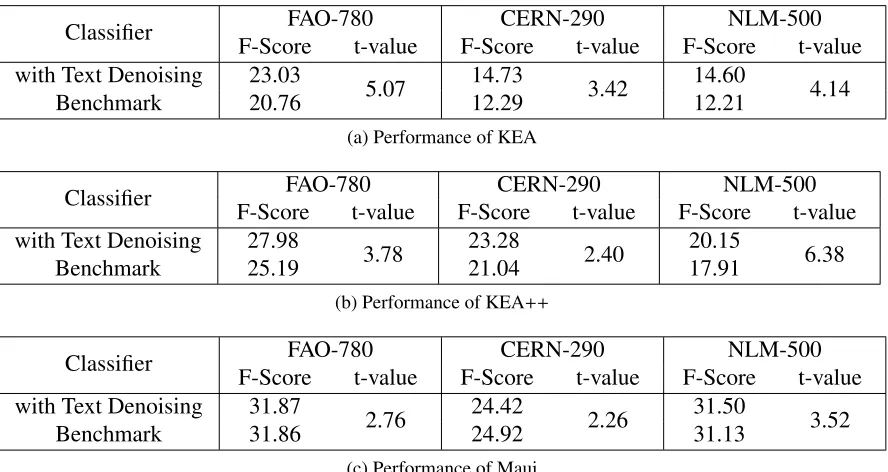
5.1 Performance of KEA with text denoising . . . 46
5.2 Performance of KEA++with text denoising . . . 46
6.1 Extracted related concepts for a paper on Ischemia and Glutamate . . . 52
6.2 Precision, recall and F-Score of the indexes on biomedical relation extraction . 52 6.3 F-Scores of the keyphrase indexers with text denoising . . . 53
6.4 Performance of text denoising on extracting protein relations bearing sentences 54 7.1 The list of features used to classify spams . . . 58
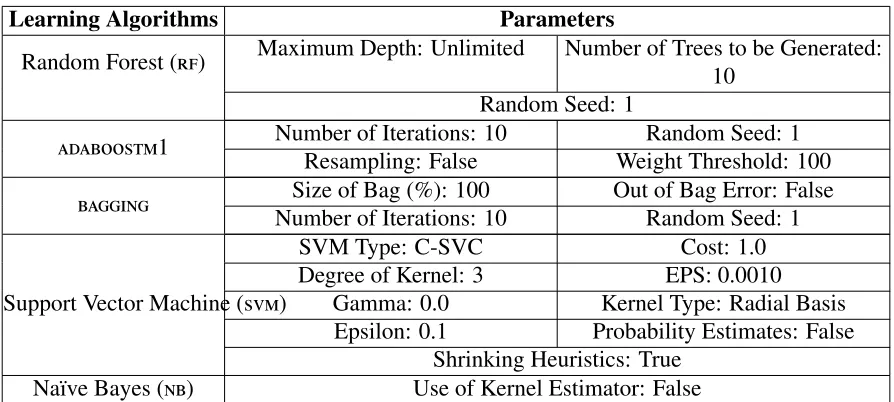
7.2 Parameters of the learning algorithms . . . 63
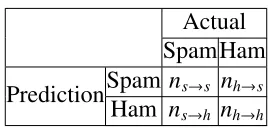
7.3 Confusion matrix for spam classification problem. . . 64
7.4 Brief description of the email datasets. . . 65
7.5 The effect of incrementing groups of features on spam classification . . . 69
7.6 Performances of the classifiers for spam classification . . . 70
8.1 The details of the Enron-Spam collection dataset . . . 78
8.2 Summary of the attributes used for spam classification . . . 81
8.3 Confusion matrix for spam classification problem. . . 82
8.4 Performances of the spam classifiers . . . 84
9.1 The brief summary of the attributes used in our study . . . 92
9.2 Parameter setup for the learning algorithms . . . 94
9.3 Confusion matrix for the spam classification problem. . . 96
9.4 Brief description of the non-personalized email datasets . . . 97
9.5 Brief descriptions of the Enron-Spam collection . . . 97
9.6 Ham and Spam misclassification rates . . . 98
10.1 Precision, recall, and F-score of our approach for the five datasets . . . 114
10.2 Brief summary of the datasets used in this experiment. . . 115
10.3 Annotation format for the datasets . . . 119
10.4 Confusion matrix for the dataset annotation by RelEx and WRelEx. . . 119
10.5 Statistics to validate the representativeness of the samples for the datasets. . . . 121
10.6 Intra-annotator correlation measures . . . 121
10.7 Inter-annotator correlation measures . . . 122
10.8 Post-annotation feedback from the annotators. . . 123
10.9 Set of stylometric attributes used in the experiment. . . 124
10.10Parameter setup for the learning algorithms . . . 126
10.11Confusion matrix for the protein interaction sentence classification problem. . . 126
11.1 Brief summary of the datasets used in this experiment. . . 135
11.2 The list of attributes used to classify summary sentences . . . 136
11.3 Confusion matrix for summary sentence classification problem. . . 141
11.4 Summary of the performance of the proposed method . . . 143
11.5 FPRandFNRof thek-Nearest Neighbour and Na¨ıve Bayes learners. . . 145
12.1 Overall performance summary of the stylometric attributes . . . 150
A.1 Summary of the attributes . . . 155
A.2 The performance of Maui . . . 156
A.3 The performance of Maui on the individual ACM categories . . . 156
A.4 Effect of Text Denoising on the SemEval-2010 training data . . . 157
B.1 Parameters of the learning algorithms used in Chapter 8 . . . 158
B.2 Parameters of the learning algorithms used in Chapter 11 . . . 159
Appendix A Extended Work on Keyphrase Indexing . . . 154
Appendix B Parameter Settings . . . 158
Appendix C Copyright Forms of the Papers . . . 160
Appendix D Supporting Materials . . . 175
Chapter 1
Introduction
1.1
Thesis Statement
Determining informativeness or importance in text is a big challenge in natural language pro-cessing. In this thesis, we explore some possibilities to find informativeness in text using a set of natural language attributes or features related to Stylometry—the linguistic analysis of writing style. The hypothesis underlying our exploration is based on a linguistic principle that authors apply linguistic techniques, deliberately or not, to codify important information in texts. The principle is widely known as theCode Quantity Principle[1]. Interestingly, the elements of this codification are also the key elements present in the writing styles of humans. In this study, these shared elements are represented as attributes—called the stylometric
at-tributes—based on Stylometry. Using these attributes, we provide a more general solution to a
problem that so far has been approached mostly with domain-dependent solutions.
1.2
Problem Statement
On a good note, most texts now-a-days are in digital form and publicly available. Because of this plethora of text, for the last few years, we have experienced a big increase in statistical nat-ural language processing. The effectiveness of the methods from this domain depends mostly on the quantity and the quality of data. Although both aspects are equally important, the quan-tityof data almost always receives most of the attention. More data beats the algorithm and
the modelwas almost the tone set by some of the state-of-the-art research in natural language
processing (see for instance, [2] and [3]). However, in his talk at the Strata 2012 conference, Netflix’s Xavier Amatriain said something very different—“Data is important but data without a sound approach becomes noise” [4] . He argued that language models usually have high
varianceand therefore adding more data helped the studies mentioned in [2] [3]. Surprisingly
for data withhigh bias, adding more data simply does not help. Therefore, the quantity of data is not the sole end means to succeed in natural language processing.
A trivial way to insure data quality isdata preprocessingsuch as removing function words, non-ASCII symbols, html tags, interpreting mathematical formulae, etc. [5]. And surpris-ingly, on many occasions, data preprocessing indeed boosts performance of natural language processing methods [6]. A better way to generate quality text data is to classifyimportantor
informative text units like words, sentences, and paragraphs among a set of text units. The usual definition of importance or informativeness of data is the amount of detail contained in a text unit [7] or its potential information-carrying capacity [8]. In addition to the performance boost, selecting an important subset of texts should also substantially reduce extraneous data and remove unwanted work from various text processing routines. This is absolutely impor-tant because of today’sinformation overloadwhen everyone is trying to get rid of unnecessary data [9].
Unfortunately, until now, there are very few attributes to gauge informativeness of text data that do not depend on the genre (i.e., scientific documents, newswire articles, and emails) or domain (i.e., agriculture, economics, politics physics, sports, disaster and even biomedical science) of the data. For instance, sentence position is a good attribute for summarization methods but not for spam classification; it is good for newspaper article summarization but not for summarizing medical questionnaires. Over the last decades, a number of surface-level text attributes have been proposed by many studies (see, for example, [10–15]). However, much is discussed about their limitations including their excessive domain dependency. Some semantic graph-based [16] and n-gram text attributes [17], however, are promising in terms of performance on different texts. Still, only a few attributes can be named that perform well despite difference in genres and domains of the data.
1.3
Motivation
Text importance and human psychology are tied together by some interesting research. Duffy and Kabance [18], for instance, explored the reasons behind the easy-readings of kindergarten prose. Their scientific study was centered around human psychology of signaling information and its effect on writing. What they have found is interesting: the sentences of kindergarten prose are less informative and by being so, they contain fewer complex words and syllables making them simpleto read. Interestingly, a linguistics theory known as the Code Quantity
Principle[1] also proposed much the same thing. The theory states that humans codify
impor-tant information in texts in such a way that it can signal the reader, and the codification process is based on conscious or unconscious changes made in the use of some linguistic elements such as syllables, long and short words, etc. This theory has been recently supported with substantial evidence that suggests that authors have a tendency to make sentences that have more coded information longer than others (see, for instance, [19]).
Stylometry, on the other hand, is a branch of linguistics that studies writing styles in texts.
It assumes that combining words into syntactic structures through writing is both habitual and variable, and during this procedure authors create individualized and unconscious patterns that can distinguish one from another [20]. The patterns often can be represented with features that are quantifiable, distinctive, salient, frequent, and relatively immune from the conscious control of authors [21]. Besides, these features, known asstylometric features, help to count stylistic traits of a particular author and to distinguish genuine style from mere chance variation in usage [22]. Following are some features related to stylometry:word length, number of syllables in a sentence, sentence length, distribution of parts-of-speech, number of function words in a
sentence, vocabulary richness, vocabulary distributions, word frequency, etc. (more detail of
Chapter1. 3
those that humans consciously or unconsciously modify during their codification of important information in texts as described in the code quantity principle [23]. The two views captured by stylometry and the code quantity principle are therefore closely related. However, to the best of our knowledge, the link has not been established yet because the former hypothesizes that patterns in writing are mostly individualized, while the latter finds that in certain situations the patterns can be generalized.
1.4
Objectives
The thesis has three major objectives. As the thesis progresses, the reader will understand that we try to explore new ideas and possibilities but always keep the following three objectives in mind.
To define a novel set of natural language attributes that can identify informativeness. We are interested in defining a more general, non-domain-specific but still effective set of natural language attributes. In doing so, combining both the Code Quantity Principle and Stylometry we define a set of stylometric attributes to model unit of text present in documents or articles. We consider the informativeness determination problem as a binary classification problem: one class of text units will be informative while the rest will be in the non-informative class. Note that throughout the research we use thesentenceas the text unit. The only exception is our work on spam classification where the body of email is considered as the text unit (see Chapters to ).
To evaluate the attributes for different genres of text. This evaluation should test the scope of applicability of the attributes for different genres of texts. We limit this scope in this thesis to the texts collected from domains like biomedical science, agriculture, nuclear physics, email texts, and newspaper articles.
To apply the attributes for different natural language processing tasks. There are some natural language processing application areas for which we can apply the attributes and observe their possibilities. Some of the areas are classic like text classification and summarization while some are becoming crucial and important such as biomedical relation mining and automatic keyphrase indexing.
We have carefully selected the genres of texts and application areas so that we can compare our work with previous state-of-the-art techniques. These comparisons are required to allow us to remark on the accomplishments of our research. In addition, to achieve the goals of the thesis, we explore various machine-learning techniques like supervised and semi-supervised learning.
1.5
Contributions
In many aspects, the thesis has some major contributions. First, we define a novel set of natural language attributes related to stylometry to identify informativeness in texts. Much empirical evidence confirms that the attributes have potential strength to distinguish informativeness in texts. We explore the merits of the attributes for a wide array of domains like agriculture, physics, biomedial science, email, and newspaper articles. This finding is significant since we have only a few genre-independent natural language attributes. The other key contribution of the research is the strong evidence of the attributes’ applicability in some state-of-the-art natural language processing areas that include biomedical relation mining, keyphrase indexing, spam classification, and single and multi-document text summarization. Last but not least, during this research, we have enhanced the usefulness of some benchmark datasets, that is we have provided an extra set of labellings for sentences, viz. the BioNLP [24], BioDRB [25], FetchProt [26], and the SemEval-2010 task 5 dataset [27].
1.6
Thesis Organization
The chapters in this thesis are designed in a way that should help the reader to understand the transitions that we had in our thinking and our approach. At the beginning of the research, our focus was only to find informativeness in biomedical texts. To do so, we used a single attribute known as the Fog Index [28]. The Fog Index is a yardstick measure to assess text readabil-ity. At this stage we did not consider the Fog Index to be a Stylometric attribute although the parameters of the index are all related to Stylometry. Also, as a sanity check to see whether this index had some possibilities, we did not develop any machine-learning techniques at this stage. Rather, we were relying on simple heuristic rules to classify the sentences of texts as informative and non-informative. We named this simple, single-attribute and rule-based idea
Text Denoisingsince its main objective is to remove non-informative, redundant text called the
noisetext. The work in the first few chapters, namely from Chapter 2 to 5, are built upon this
idea. However, at some point, we understood the method’s limitations which motivated us to make two important methodological changes that are summarized in Chapter 6. First, we devel-oped a machine-learning approach and second we explored more attributes. However, although the bulk of the attributes are stylometric, the success of the approach depended somewhat on some domain-specific attributes. Therefore, the reader might note that we did not use the term
stylometryor stylometric attributesbefore Chapter 8. The objective of our research changed
ever so slightly from that point on—we began to emphasize the evaluation of the attributes for texts of different genres and domains rather than simply denoising text by removing redundant text fragments from biomedical research articles. We started to see the problem of determin-ing informativeness as a binary classification problem and applied machine-learndetermin-ing models generated from the stylometric attributes for text classification (Chapters 7 to 9), biomedical relation mining (Chapter 10), and text summarization (Chapter 11). Note that our approaches before and after the transitions are very closely related—the minor difference being how the output is presented.
Chapter1. 5
Chapter 1provides the introduction to the thesis. The chapter outlines the problem, moti-vation for doing this research, thesis objectives, and contributions to the scientific community.
Chapter 2 outlines a method for text reduction called Text Denoising that can be used as a first step for the effective mining of biomedical concepts containing disease and chemical relations from research articles. The method uses a single attribute related to readability known as the Fog Index [28] and heuristics to classify sentences into informative and non-informative categories.
Chapter 3extends the work in Chapter 2 by using four more attributes related to readabil-ity.
InChapter 4, we move our focus from biomedical relation mining task to aiding automatic keyphrase indexing. The chapter describes the use ofText Denoisingas an intermediate step to enhance the performance of a supervised keyphrase indexing tool called Maui. The chapter is brief because its content is published as a short paper. For more details, a useful source can be found elsewhere1.
Chapter 5 is built upon the work described in Chapter 4. It describes the application of
Text Denoising for enhancing the performance of two supervised keyphrase indexers named
KEA [29] and KEA++[30]. Based on the idea presented in the following chapter, the work of Chapters 4 and 5 is extended and can be found in Appendix A.
Chapter 6 can be seen as the transition chapter between our rule-based and machine-learning based approaches. Additionally, this chapter briefly summarizes the work presented in the previous chapters.
Chapter 7 describes an anti-spam filter developed using the stylometric attributes and machine-learning models to classify both personalized and non-personalized spam emails.
Chapter 8 extends and improves the work described in Chapter 7 for personalized spam emails.
Chapter 9 combines and extends the work presented in Chapter Chapter 7 and 8. The contents of this chapter include more in-depth analysis of the performance of the anti-spam filter.
Chapter 10outlines the performance of the stylometric attributes for protein relation bear-ing sentence classification in biomedical research articles. This work can be seen as an exten-sion of the work presented in Chapter 6 but with more sophisticated machine-learning methods and with more attributes.
Chapter 11illustrates how the stylometric attributes perform for single and multi-document summarization.
Finally,Chapter 12briefly summarizes the thesis and explores its limitations and possible avenues for extension.
Bibliography
[1] T. Giv´on, Syntax: A functional typological introduction. Amsterdam: John Benjamins, 1990.
[2] A. Halevy, P. Norvig, and F. Pereira, “The unreasonable effectiveness of data,” IEEE
Intelligent Systems, vol. 24, pp. 8–12, Mar. 2009.
[3] E. Brill, “Processing natural language without natural language processing,” in Proceed-ings of the 4th International Conference on Computational Linguistics and Intelligent
Text Processing, CICLing’03, (Berlin, Heidelberg), pp. 360–369, Springer-Verlag, 2003.
[4] X. Amatriain, “Netflix recommendations: beyond the 5 stars.” O’Reilly Strata Conference 2012, 2012.
[5] D. Pyle,Data preparation for data mining. San Francisco, CA, USA: Morgan Kaufmann Publishers Inc., 1999.
[6] S. M. Weiss, N. Indurkhya, and T. Zhang,Text Mining. Predictive Methods for Analyzing
Unstructured Information. Springer, Berlin, 1 ed., 2004.
[7] R. L. Daft and R. H. Lengel, “Information Richness: A New Approach to Managerial Behaviour and Organizational Design,” Research in Organizational Behaviour, vol. 6, pp. 191–233, 1984.
[8] S. B. Sitkin, K. M. Sutcliffe, and J. R. Barrios-Choplin, “A dual-capacity model of com-munication media choice in organizations,” Human Communication Research, vol. 18, no. 4, pp. 563–598, 1992.
[9] M. Eppler and J. Mengis, “The Concept of Information Overload: A Review of Litera-ture from Organization Science, Accounting, Marketing, MIS, and Related Disciplines,”
Kommunikationsmanagement im Wandel, pp. 271–305, 2008.
[10] L. Plaza, M. Stevenson, and A. Daz, “Resolving ambiguity in biomedical text to improve summarization.,”Inf. Process. Manage., vol. 48, no. 4, pp. 755–766, 2012.
[11] L. P. Morales, A. D. Esteban, and P. Gerv´as, “Concept-graph based biomedical auto-matic summarization using ontologies,” inProceedings of the 3rd Textgraphs Workshop
on Graph-Based Algorithms for Natural Language Processing, TextGraphs-3,
(Strouds-burg, PA, USA), pp. 53–56, Association for Computational Linguistics, 2008.
[12] Y. Ko, J. Park, and J. Seo, “Improving text categorization using the importance of sen-tences,”Inf. Process. Manage., vol. 40, pp. 65–79, Jan. 2004.
[13] C. Nobata, S. Sekine, and H. Isahara, “Evaluation of features for sentence extraction on different types of corpora,” in Proceedings of the ACL 2003 workshop on Multilingual
summarization and question answering - Volume 12, MultiSumQA ’03, (Stroudsburg,
PA, USA), pp. 29–36, Association for Computational Linguistics, 2003.
Chapter1. 7
[15] W. T. Chuang and J. Yang, “Extracting sentence segments for text summarization: a machine learning approach,” inProceedings of the 23rd annual international ACM SIGIR
conference on Research and development in information retrieval, SIGIR ’00, (New York,
NY, USA), pp. 152–159, ACM, 2000.
[16] J. Leskovec, N. Milic-frayling, and M. Grobelnik, “Impact of linguistic analysis on the semantic graph coverage and learning of document extracts,” inProceedings of the
Twen-tieth National Conference on Artificial Intelligence(AAAI2005), pp. 1069–1074, 2005.
[17] M. Berker and T. Gngr, “Using genetic algorithms with lexical chains for automatic text summarization.,” inProceedings of the 4th International Conference on Agents and
Arti-ficial Intelligence (ICAART2012), pp. 595–600, SciTePress, 2012.
[18] T. M. Duffy and P. Kabance, “Testing a readable writing approach to text revision,”
Jour-nal of EducatioJour-nal Psychology, vol. 74, pp. 733–48, 1982.
[19] S. Ji, “A textual perspective on givn’s quantity principle,”Journal of Pragmatics, vol. 39, no. 2, pp. 292 – 304, 2007. Focus-on Issue: Discourse, Information, and Pragmatics.
[20] C. Chaski, “Variables and method for authorship attribution,” Oct. 11 2007. US Patent App. 11/398,728.
[21] D. I. Holmes, “The Evolution of Stylometry in Humanities Scholarship,” Literary and
Linguistic Computing, vol. 13, pp. 111–117, Sept. 1998.
[22] D. I. Holmes, “The Analysis of Literary Style–A Review,” 1985.
[23] E. Lloret and M. Palomar, “Challenging issues of automatic summarization: Relevance detection and quality-based evaluation.,”Informatica, vol. 34, no. 1, pp. 29–35, 2010.
[24] J.-D. Kim, S. Pyysalo, T. Ohta, R. Bossy, N. Nguyen, and J. Tsujii, “Overview of bionlp shared task 2011,” inProceedings of the BioNLP Shared Task 2011 Workshop, (Portland, Oregon, USA), pp. 1–6, Association for Computational Linguistics, June 2011.
[25] R. Prasad, S. McRoy, N. Frid, A. Joshi, and H. Yu, “The biomedical discourse relation bank,”BMC Bioinformatics, vol. 12, no. 1, pp. 188+, 2011.
[26] K. Franz¨en and D. Oppenheimer, “The fetchprot corpus: Documentation and annotation guidelines,” tech. rep., Swidish Institute Of Computer Science Report, Sweden, 2007.
[27] S. N. Kim, O. Medelyan, M.-Y. Kan, and T. Baldwin, “Semeval-2010 Task 5: Auto-matic keyphrase extraction from scientific articles,” in Proceedings of the 5th
Interna-tional Workshop on Semantic Evaluation (SemEval 2010), (Uppsala, Sweden), 2010.
[28] R. Gunning, “Fog index after twenty years,”Journal of Business Communication, vol. 6, no. 3, pp. 3–13, 1969.
[29] I. Witten, G. Paynter, E. Frank, C. Gutwin, and C. Nevill-Manning, “KEA: Practical automatic keyphrase extraction,” in Proceedings of the 4th ACM Conference on Digital
[30] O. Medelyan and I. Witten, “Domain-independent automatic keyphrase indexing with small training sets,”Journal of the American Society for Information Science and
Chapter 2
Extracting Connected Concepts from
Biomedical Texts using Fog Index
This chapter is based on the paper titled “Extracting Connected Concepts from Biomedical Texts using Fog Index” co-authored with Robert E. Mercer that appeared in the 12th Confer-ence of the Pacific Association for Computational Linguistics (PACLING 2011).
In this paper, we establish Fog Index (FI) as a text filter to locate the sentences in texts that contain connected biomedical concepts of interest. To do so, we have used 24 random papers each containing any of the four pairs of connected concepts. For each pair, we categorize sentences based on whether they contain both, any or none of the concepts. We then use FI to measure the difficulty of the sentences of each category and find that sentences containing both of the concepts have low readability. We rank sentences of a text according to their FI and select 30 percent of the most difficult sentences. We use an association matrix to track the most frequent pairs of concepts in them. This matrix reports that the first filter produces some pairs that hold almost no connections. To remove these unwanted pairs, we use the Equally Weighted Harmonic Mean of their Positive Predictive Value (PPV) and Sensitivity as a second filter. Experimental results demonstrate the effectiveness of our method.
2.1
Introduction
In recent years, extraction of connected biomedical concepts (i.e., disease, treatment, genes) from texts has drawn the attention of scientists interested in finding functional similarity (i.e., identification of genes involved in human diseases) [1]. Although benchmark research has reported successful methods to extract biomedical concepts [2, 3], they have rarely followed simple procedures. For example, Perez-Iratxeta et al.[4] could not relate diseases with gene functions from biomedical texts forthwith- they needed to apply a twofold intermediary pro-cess of connecting disease with chemical components and chemical components with gene functions. The key reason for not applying simple methods to extract connected concepts from biomedical texts is manifold. While some researchers concentrated on the number of co-occurrence of concepts in the abstract of a paper [4, 5], others preferred to comb through either the full text [6] or pre-specified segments (i.e., Introduction, Methods, Results, and Discus-sion) [7]. Moreover, the connections can be either very general (i.e., biochemical connections)
or very specific (i.e., regulatory connections). Therefore, the demand of developing simple methods to identify and extract biomedical concepts from a scientific literature that maintain connections, general or specific, with one another is not met till to date. This situation suggests to use simple yet improved computational method to identify and extract important, explicit, and implicit connections from biomedical texts.
As text is highly structured by syntax and semantics of natural language, it is believed that any relation extraction method should involve these two features. However, several reports as-serted their complexity [8, 9]. Apart from this, Sherman [10] proposed that scientific literature is subject to statistical analysis and zeroed in on the importance of average sentence length. Gunning [11] practically demonstrated this important measure along with the number of com-plex words (i.e., words with three or more syllables) to assess the readability of text known as the Fog Index (hereinafter, FI). It is now considered a yardstick for readability assessment of books, scientific literature and newspapers, and even to detect online chatting bots [12]. Be-sides, an interesting ascertainment that texts become relatively difficult to read when contain ideas and relations [18] can be motivational for using FI to find hidden relations in papers.
In this paper, we report a simple novel statistical method to extract connected biomedical concepts from biomedical texts using FI. We statistically established FI as a text filter, ex-perimenting on 24 random papers that describe four pairs of concepts: Ischemia-Glutamate,
Ataxia-Dehydrogenase, Hypogonadism-Gonadotropin, and Epilepsy-GABA. Besides FI, our
method also uses the equally weighted harmonic mean of the connections’ Positive Predictive Value (hereinafter, PPV) and sensitivity as a second filter. While the prior concentrates on the important part of the text where the connections are stated, the latter assesses their represen-tativeness. We selected the sentences of a paper that are difficult to read and ranked the most frequent connected concepts present in them. With careful observations, we noticed that the first filter produces somenoisypairs of concepts that hold almost no connection. To exclude them, we re-ranked every pair of concepts based on the equally weighted harmonic mean of their PPV and sensitivity, and filtered them.
In the remainder of this paper, we describe related work, illustrate the methodology, report and discuss experimental results, and draw conclusions.
2.2
Related Work
Chapter2. 11
texts depends on the proper identification of connections. Rosario and Hearst [15] concentrated on discovering connections between “treatment” and “disease”. They reported 79.6 percent accuracy in blindly identifying concepts that fall into either of the categories and are somehow connected with one another. They used a MEDLINE-based neural network that addresses it to be intriguing yet complicated. A similar machine learning technique was applied by Frunza and Inkpen [8] to extract disease-treatment connections from texts. Their reported accuracy surpassed the results of Rosario and Hearst although their interest was limited to MEDLINE 2001 titles and abstracts. Their paper, like many other prominent work [16,17], has a significant use of PPV and sensitivity to evaluate the mining technique. Contrary, we used these measures to evaluate the representativeness of the connected concepts.
Perez-Iratxeta et al. [4] proposed a massive framework to prioritize disease associated genes. Instead of looking into literature, they combined several isolated pieces of biomedical repositories like Medical Subject Heading (MeSH), Gene Ontology (GO), RefSeq database, and MEDLINE. They used both databases and ontology that have lack in communication with one another and thus experienced tedious and complex scoring methods and formidable num-ber of intermediate stages. In our work, we decided to stick with texts only to remain simple yet capable of producing improved results.
Robert Gunning [11] first introduced Fog Index (FI) to measure semantic difficulties using average sentence length and polysyllabic words in his 1952 bookThe Technique of Clear Writ-ing. We were motivated to apply FI as our text filter when we came across the results of an experiment carried out by Duffy and Kabance [18]. They converted a passage with no more than two phrases into primer prose and applied FI to test its readability. They found the score well below the readability index (i.e., it was excessively easy to read). Their investigation on this phenomenon suggested that easy articles (in this case the primer prose) obscure the rela-tionships and ideas as they emphasize each of them equally. In other words, difficult articles possess relationships and ideas and emphasize them in particular that yields low readability. We believe that if biomedical texts display a similar attribute, then FI can be an appropriate measure to filter texts that bear associations of scientific interest.
2.3
Methodology
The work of Perez-Iratxeta et al. [4] lists pairs of connected concepts like disease-chemical components, chemical component-genes, and disease-genes. Among them, we considered four disease-chemical component pairs, namely Ischemia-Glutamate, Ataxia-Dehydrogenase,
Hypogonadism-Gonadotropin., andEpilepsy-GABA. We collected 24 scientific papers (six for
each pair of concepts) at random from several biomedical literature repositories. To work with the text only, we removed the title, affiliations, keywords, footnotes, figures, tables, acknowl-edgements, and references from the paper.
We considered each pair of concepts and a paper related to them. We classified its sen-tences into three sets: sensen-tences containing both of the concepts, none of the concepts and any of the concepts. For example, the sentence “Glutamate, which is potentially excito-toxic to
brain neurons, is released excessively during ischemia”, will be put into the set of sentences
set. According to this formula, the lower the score of a sentence, the easier it is to read.
Fog Index=0.4×
Words Sentence
!
+100× Complex Words
Words
!!
(2.1)
It can be noted that according to Gunning, words that are polysyllabic (i.e., contain three or more syllables) are calledComplex Words. Also, as we applied FI on every sentence, the value of Sentences is always 1. We normalized this score by the paper’s average number of syllables per word because readability score of long and short sentences varies due to the total number of syllables [11]. Eq. 2.2 provides the normalized FI (FI0) of the sentences in every set.
Normalized Fog Index, FI0 = Fog Index, FI
Average No. of Syllables per Word (2.2)
TheFI0 calculated for the three sets of sentences for the 24 papers in groups related to the four pairs of connected concepts are shown in Table 2.1.
Table 2.1 shows that, for every pair of connected concepts, while the set of sentences con-taining any or both of the concepts displays eitherLoworMediumreadability, the set of sen-tences containing none of them consistently hasHighreadability (i.e., Low FI0). This obser-vation leads us to decide that those sentences that are easier to read contain fewer connected concepts and therefore, we should look into low-readable sentences for hidden connections.
Now that we have FI as a functioning text filter, we need to define a means to determine the number of low-readable sentences to be considered for concept extraction. To do this, we ranked every sentence in a paper based on their FI score and sorted them in descending order (i.e., the most difficult sentences are at the top of the list). From this sorted list, in five chunks, we selected the top 50 percent, 40 percent, 30 percent, 20 percent, and 10 percent of the sen-tences. For every chunk, we tagged these sentences with Genia Biomedical POS tagger [19], identified the nouns in them and used an association matrix to record the frequency of their co-occurrences (i.e., number of occurrences of one noun with the other). For instance, the con-nected concepts in the sentence“Glutamate, which is potentially excito-toxic to brain neurons,
is released excessively during ischemia”arebrain, neurons,
glutamate-ischemia, brain-neurons, brain-glutamate-ischemia,andneurons-ischemia. From the output of the
asso-ciation matrix, we kept the 20 most frequent connected concepts for our experiment. As we observed, some chunkicontains new connections that are absent in chunki−1 and vice versa. To find a threshold, we tracked the number of connections revealed and missed by every chunk
iwith respect to its previous chunki−1. From Figure 2.1, we see that for the first chunk (50 percent of the sentences), all of the 20 most frequent connections are new. The number of new connections remains steady up to the third chunk (30 percent of the sentences) but then reaches the extremes in the fourth and fifth. The results in Figure 2.1 are shown for six papers related to
IschemiaandGlutamate. Similar experiments with the other connected concepts showed that
Category Ischemia-Glutamate
Readability Ataxia-Dehydrogenase
Readability Epilepsy-GABA
Readability Dehydrogenase-Gonadotropin
Readability FI0
none 5.99 High 5.77 High 6.50 High 5.58 High
FI0
both 8.26 Low 7.23 Medium 7.24 Medium 10.29 Low
FI0
any 6.83 Medium 7.33 Low 7.58 Low 7.62 Medium
Chapter2. 13
Rank Connected Concepts Frequency Semantic Connection Rank Connected Concepts Frequency Semantic Connection 1
Levels-Glutamate
48 Yes 8 10min-Ischemia 17 Yes
2 Ischemia-Glutamate
37 Yes 9 Glutamate-Neurons
16 Yes
3 Levels-Ischemia 33 No 9 Levels-5min 16 No 4 Levels-10min 22 No 9
Glutamate-Experiment
16 Yes
4 10min-Glutamate 22 No 10 Levels-Neurons 15 No 5 Levels-Half 21 No 10 Glutamate-CA4 15 Yes 5 Levels-Increase 21 Yes 10 Levels-CA4 15 No 6
Increase-Glutamate
20 Yes 11 Ischemia-5min 14 Yes
6 Glutamate-5min 20 No 11 Levels-Pretreatment
14 No
7 Half-Glutamate 19 No 11 Levels-Experiment
14 No
Table 2.2: Most frequent connected concepts for a paper on Ischemia and Glutamate
if we take less than 30 percent of the ranked sentences, the number of new concepts reaches the extremes.
We recorded a similar behavior for the number of connections dropped by every chunk. Figure 2.2 shows that as we start with it, the first chunk (10 percent of the sentences) does not miss any connection but the number of dropped connections suddenly starts to reach the extremes in the fourth and fifth. Again, the results in Figure 2.2 are produced by six papers on
Ischemia and Glutamate. Similar experiments carried out with the other connected concepts
showed that if we take less than 30 percent of the ranked sentences, the number of dropped connections reach the extremes.
These two observations indicate that the degree of concepts connected with each other is conserved if we take 30 percent of the low-readable sentences. Similar results are obtained for the three other pairs of concepts.
Provided this threshold, Table 2.2 shows the 20 most frequent connected concepts found in a paper onIschemia-Glutamatewhere the connections are ranked according to their frequency. For each pair shown in Table 2.2, we extracted those sentences from the paper that contain both of the concepts. These sentences are fed to the Unified Medical Language System (UMLS) semantic relation network [20] to find out if the concepts have any semantic connection. Sur-prisingly, we found that among the 20 connected concepts, only nine have textual
seman-10 15 20 25 b er o f n ew c o n n ec ti o n s
Number of new connections in chunks
Paper 1 Paper 2 Paper 3 Paper 4 0 5
50% 40% 30% 20% 10%
N u m b er Chunks Paper 4 Paper 5 Paper 6
4 6 8 10 12 14 16 18 o f d ro p p ed c o n n ec ti o n s
Number of dropped connections in chunks
Paper 1 Paper 2 Paper 3 Paper 4 0 2 4
50% 40% 30% 20% 10%
N u m b er o f Chunks Paper 4 Paper 5 Paper 6
Figure 2.2: Number of dropped connections in five chunks for six papers on Ischemia and Glutamate
tic connections (Levels-Glutamate, Ischemia-Glutamate, Levels-Increase, Increase-Glutamate, 10min-Ischemia, Glutamate-Experiment, Glutamate-Neurons, Glutamate-CA4, and Ischemia-5min).
So, FI, as a text filter, brings in some text that contains most frequent connected concepts, some of which lack representativeness (i.e., they do not hold any connection). It urged us to provide a means to filter out these noisy pairs of concepts. As we collected texts at random, we observed that it is possible for the pairs to never co-occur in a sentence which indicates that our data set is imbalanced. So, we used the equally weighted harmonic mean of the PPV and sensitivity of the pairs of concepts provided by FI to evaluate their representativeness as it is a great evaluation metric for imbalanced dataset [8].
PPV1 is the percentage of correctly predicted connections and sensitivity represents the percentage of connections identified as relevant by our method. To measure the PPV and sensitivity of every pair of concepts, we first considered the set of sentences filtered by FI and counted the number. This is the total number of results returned by our system (R) that comprises the number of True Positives (TP) and False Positives (FP). Then, we take a pair depicted in Table 2.2, searched the paper, and developed a second set of sentences that contain both of its concepts. The number of sentences in this set is the number of results that should have been returned by our system (S) and comprises the number of True Positives (TP) and False Negatives (FN). Finally, we counted the number of sentences that are present in both sets– which is the number ofTPs by our system. Afterwards,FPis obtained by subtractingTP
fromRandFNis obtained by subtractingTPfromS. So, the PPV of every pair of connected concepts is TPTP+FP and the sensitivity of every pair of connected concepts is TPTP+FN. We then applied the formula in Eq. 2.3 to determine the equally weighted harmonic mean for the given pair of concepts. In this way, we measured this mean for every pair of concepts in Table 2.2.
Harmonic Mean of PPV and Sensitivity= 2×PPV×Sensitivity
PPV+Sensitivity . (2.3)
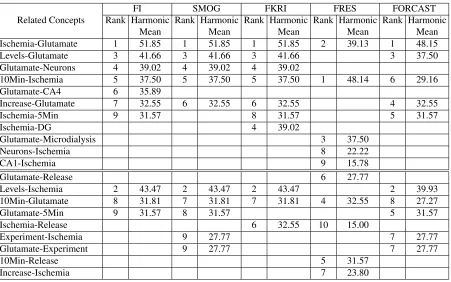
We re-ranked the pairs of concepts in Table 2.2 according to their individual Harmonic Mean of PPV and Sensitivity, and considered the first 10 pairs of concepts. These 10 pairs of connected concepts are said to be the representative connected concepts of the paper. Similar
Chapter2. 15
procedure is followed to evaluate the representativeness of the pairs of concepts for the rest of the connected concepts: Ataxia-Dehydrogenase, Hypogonadism-Gonadotropin, and
Epilepsy-GABA.
We also measured the accuracy of every connected pair by using Eq. 2.4–
Accuracy= TP+TN
TP+FN+FP+TN. (2.4) whereTNis the number of True Negatives and can be found by subtractingTP+FP+FNfrom the total number of sentences in a text, and ranked them accordingly. However, we found that in the case of accuracy, the ranked connections are not well distinguished.
2.4
Results and Discussions
In this section, the re-ranked connected concepts according to their individual Harmonic Mean of PPV and Sensitivity are reported. The results show that most of the biomedical connected concepts extracted by the proposed method are reported to be semantically connected by UMLS. This indicates that the use of the Harmonic Mean substantially decreased the num-ber ofnoisyrelations extracted by the FI.
Table 2.3 lists the 10 connected concepts for a paper on Ischemia and Glutamate among which seven pairs of concepts are reported as semantically connected by UMLS. It can be seen that the pairs of concepts in Table 2.2 that hold merely no relation between them are decreased significantly. However, the three pairs of concepts, not having any semantic connection, could not be filtered because of their high frequency of co-occurrence in the text.
Table 2.4 shows the 10 connected concepts for a paper on Ataxia and Dehydrogenase, seven of which are semantically connected in the UMLS semantic relation network. Our ob-servation of this domain reveals that PDHC (Pyruvate Dehydrogenase Complex) is manifested in Ataxia patients, especially those suffering from Friedreich’s Ataxia. So, the relations among Friedreich, Ataxia and PDHC are vividly represented in the list. Pyruvate-Ataxiais extracted as connected concepts because in the text, the elaboration of PDHC co-occurred with Ataxia many times.
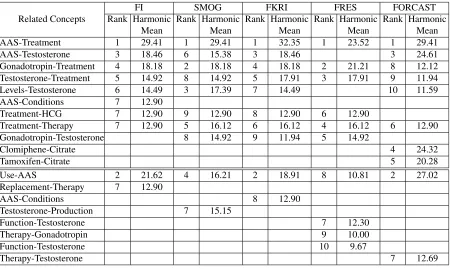
Table 2.5 lists the 10 connected concepts for a paper on Hypogonadism and Gonadotropin. According to the UMLS semantic relation network, eight of these pairs are semantically con-nected. Steroids have significant effects on diseases like Hypogonadism, where release of testosterone plays an important role. Therefore, the connection between AAS (a shorthand for Anabolic Androgenic Steroid) that induces Hypogonadism and Testosterone is present in the list. The pairs of concepts not semantically connected are still reported by our method for their extremely high co-occurrences in the text.
Rank Connected Concepts Harmonic Mean
Semantic Connection
1 Ischemia-Glutamate 51.85 Yes
2 Levels-Ischemia 43.47 No
3 Levels-Glutamate 41.66 Yes
4 Glutamate-Neurons 39.02 Yes
5 10min-Ischemia 37.50 Yes
6 Glutamate-CA4 35.89 Yes
7 Increase-Glutamate 32.55 Yes
8 10min-Glutamate 31.81 No
9 Ischemia-5min 31.57 Yes
9 Glutamate-5min 31.57 No
Table 2.3: Connected concepts for a paper on Ischemia and Glutamate
Rank Connected Concepts Harmonic Mean
Semantic Connection
1 Friedreich-Ataxia 59.25 Yes
2 PDHC-Ataxia 56.00 Yes
3 Activity-Friedreich 43.47 Yes
3 Patients-Ataxia 43.47 Yes
3 Activity-Ataxia 43.47 Yes
3 PDHC-Friedreich 43.47 Yes
4 Preparations-Ataxia 40.00 No
4 Preparations-Friedreich 40.00 No
5 Pyruvate-Ataxia 38.09 No
6 Patients-Friedreich 36.36 Yes
Table 2.4: Connected concepts for a paper on Ataxia and Dehydrogenase
2.5
Conclusions
Chapter2. 17
Rank Connected Concepts Harmonic
Mean
Semantic Connection
1 AAS-Treatment 29.41 Yes
2 Use-AAS 21.62 No
3 AAS-Testosterone 18.46 Yes
4 Gonadotropin-Treatment 18.18 Yes
5 Testosterone-Treatment 14.92 Yes
6 Levels-Testosterone 14.49 Yes
7 AAS-Conditions 12.90 Yes
7 Treatment-HCG 12.90 Yes
7 Replacement-Therapy 12.90 No
7 Treatment-Therapy 12.90 Yes
Table 2.5: Connected concepts for a paper on Hypogonadism and Gonadotropin
Rank Connected Concepts Harmonic
Mean
Semantic Connection
1 Inhibition-GABA 26.08 Yes
2 GABA-Synapse 20.25 Yes
3 Neurons-Synapse 14.70 Yes
4 Inhibition-Hippocampus 12.30 Yes
5 Synapse-Change 9.37 No
6 Neurons-GABA 8.00 Yes
7 Properties-GABA 6.45 Yes
7 GABA-Change 6.45 No
8 GABA-Number 6.34 No
9 Cl-Gradient 3.33 Yes
Table 2.6: Connected concepts for a paper on Epilepsy and GABA
Bibliography
[1] F. Yuan, R. Wang, M. Guan, and G. He, “A Novel Computational Method for Predicting Disease Genes Based on Functional Similarity”,Lecture Notes in Computer Science, Vol. 6216/2010, 2010, pp. 42-51.
[2] S. Zhao, “Named Entity Recognition in Biomedical Texts using an HMM Model”, Inter-national Joint Workshop on Natural Language Processing in Biomedicine and Its
Applica-tions, Geneva, Switzerland, 2004, pp. 84-87.
[3] J. Kazama, T. Makino, Y. Ohta, and J. Tsujii, “Tuning Support Vector Machines for Biomedical Named Entity Recognition”, ACL-02 Workshop on Natural Language
Pro-cessing in the Biomedical Domain, Vol. 3, Philadelphia, USA, 2002, pp. 1-8.
[4] C. Perez-Iratxeta, P. Bork, and M. Andrade, “Literature and Genome Data Mining for Prioritizing Disease-Associated Genes”,Discovering Bimolecular Mechanisms with
[5] H. Dai, Y. Chang, R. T. Tsai, and W. Hsu, “New Challenges for Biological Text-Mining in the Next Decade”,Journal of Computer Science and Technology, Vol. 25, No. 1, 2010, pp. 169-179.
[6] R. Lindsay and M. Gordon, “ Literature-Based Discovery by Lexical Statistics”, Journal
of the American Society for Information Science, Vol. 50, No. 7, 1999, pp. 574-587.
[7] S. Agarwal and H. Yu, “Automatically Classifying Sentences in Full-text Biomedical Arti-cles into Introduction, Methods, Results and Discussion”,Bioinformatics, Vol. 25, No. 23, 2009, pp. 3174-3180.
[8] O. Frunza and D. Inkpen, “Extraction of Disease-Treatment Semantic Relations from Biomedical Sentences”, 2010 Workshop on Biomedical Natural Language Processing,
ACL 2010, Uppsala, Sweden, 2010, pp. 91-98.
[9] G. Leroy, H. Chen, and J. D. Martinez, “A Shallow Parser based on Closed-class Words to Capture Relations in Biomedical Text”,Journal of Biomedical Informatics, Vol. 36, 2003, pp. 145-158.
[10] A. L. Sherman, “Analytics of literature: A Manual for the Objective Study of English Prose and Poetry”, Boston: Ginn & Co, 1893.
[11] R. Gunning, “Fog Index after Twenty Years”,Journal of Business Communication, Vol. 6, No. 3, 1969, pp. 3-13.
[12] O. S. Goh, C. C. Fung, A. Depickere, and K.W. Wong, “Using Gunning-Fog Index to Assess Instant Message Readability from ECAs”,3rd International Conference on Natural
Computation (ICNC 2007), Hainan, China, 2007, pp. 480-486.
[13] D. R. Swanson, “Fish Oil, Raynaud’s Syndrome, and Undiscovered Public Knowledge”,
Perspectives in Biology and Medicine, Vol. 30, 1986, pp. 7-18.
[14] D. R. Swanson, “A Second Example of Mutually Isolated Medical Literatures related by Implicit, Unnoticed Connections”, Journal of the American Society for Information Sci-ence, Vol. 40, 1989, pp. 432-435.
[15] B. Rosario and M. A. Hearst, “Classifying Semantic Relations in Bioscience Texts”,42nd
Annual Meeting of Association for Computational Linguistics, Barcelona, Spain, 2004.
[16] L. Smithet al., “Overview of BioCreative II Gene Mention Recognition”,Genome Biology, Vol. 9 (Suppl.2): S2, 2008.
[17] M. Krallingeret al., “Overview of the Protein-Protein Interaction Annotation Extraction Task of BioCreative II”,Genome Biology, Vol. 9 (Suppl.2): S4, 2008.
[18] T. M. Duffy and P. Kabance, “Testing a Readable Writing Approach to Text Revision”,
Journal of Educational Psychology, Vol. 74, 1982, pp. 733-48.
[19] Y. Tsuruoka et al., “Developing a Robust Part-of-Speech Tagger for Biomedical Text”,
Chapter2. 19
Evaluating Core Measures of Text
Denoising for Biomedical Relation Mining
This chapter is based on the paper titled “Evaluating Core Measures of Text Denoising for Biomedical Relation Mining” co-authored with Robert E. Mercer that appeared in the 3rd International Workshop on Global Collaboration of Information Schools (WIS 2012).
Text Denoisingis a tool that reduces texts to their content-rich parts. It has been reported as
an effective tool which improves biomedical relation mining as well as supervised keyphrase indexers for digital libraries. The idea behind text denoising is that the complexity of a sentence plays an important role for it being the content-rich part of the text. Therefore, the core measure of text denoising is a well-known readability formula called Fog Index (FI). However, the effect of using other readability formulas is yet to be explored. In this paper we plug in four other readability formulas—FRES, SMOG, FORCAST, and FKRI—with text denoising and report their performance on mining relations from a corpus of 24 biomedical texts. Experimental results show that FI outperforms all other formulas in terms of meaningful relation extraction. The results also show that besides FI, formulas like SMOG index and FKRI can be used as core measures of text denoising for biomedical relation mining.
3.1
Introduction
Readability formulas measure text difficulty in quantitative terms and thus are served as eff ec-tive warning systems against complex writing style since the 1930’s. Nowadays, their use is widespread—from the assessment of readability of newspaper articles and scientific literature to the identification of chatting bots [1]. Recently, Shams and Mercer [2] proposed textual noise reduction, similar to that in image processing, using FI—a technique to keep content-rich sentences of a scientific paper based on their reading difficulty. The idea was based on a hypothesis that texts yield complexity when they contain concepts and relations [3]. The tool with its core measure FI, as applied on a corpus of 24 biomedical texts, extracted meaningful biomedical relations. Later, it was applied on three keyphrase indexers KEA [4], KEA++[5] and Maui [6] to reduce their training data [7] [8]. Experimental findings showed that even with reduced training data, the indexers induced better classifiers and achieved better F-score than their benchmarks. The authors concluded that low-readable sentences of a text are content-rich