ISSN (Print) : 2320 – 3765 ISSN (Online): 2278 – 8875
I
nternational
J
ournal of
A
dvanced
R
esearch in
E
lectrical,
E
lectronics and
I
nstrumentation
E
ngineering
(A High Impact Factor, Monthly, Peer Reviewed Journal)
Website: www.ijareeie.com
Vol. 7, Issue 2, February 2018
Programmable Logic Controller Based Metal
Segregation in Steel Industry
P.Thirumurugan1, R.Aravind2, M.Arun Kumar2, S.Dharshan Manjunath2, R.Kalaiselvan2. Assistant Professor Department of Instrumentation and Control Engineering, Saranathan College of Engineering,
Tiruchirappalli, India1
B.E Students, Department of Instrumentation and Control Engineering, Saranathan College of Engineering,
Tiruchirappalli, India2
ABSTRACT: Mostly the waste management is one of the most important things in day to day life. This waste disposal mostly disturbs the earth environment because of lack of segregation of the particular waste. The waste disposal mainly consists of plastic items, metal waste, and waste from industries like E-waste, etc. Here the metal waste can be recycled in a proper manner if the metal disposal is segregated separately. This metal segregation can be done by detecting the metals in the waste that is coming in through any source. Here we have done a simple conveyor based system which separates the metal from non-metals. This will be useful in the waste segregation process. This system will separate the metal using the Programmable Logic Controllers (PLC) and a simple conveyor system will helps to segregate the metals.
KEYWORDS: Metal detection, Conveyor system, Programmable Logic Controller (PLC), Metal separation.
I. INTRODUCTION
ISSN (Print) : 2320 – 3765 ISSN (Online): 2278 – 8875
I
nternational
J
ournal of
A
dvanced
R
esearch in
E
lectrical,
E
lectronics and
I
nstrumentation
E
ngineering
(A High Impact Factor, Monthly, Peer Reviewed Journal)
Website: www.ijareeie.com
Vol. 7, Issue 2, February 2018
[8]. The metal segregation using the hydraulic cylinder flaps, which is then further goes to the sensing section and this process is automated using the Programmable Logic Controller (PLC) [9].
A. PLC (Programmable Logic Controller) system.
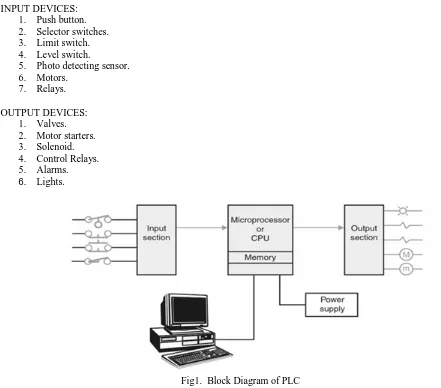
The main motive of the automation is to reduce the man power and also to do the work which the man cannot perform. The automation has been widely increased in the industries for the past decades.The main stream in which the automation has been used is as follows Electrical, Wirings, Communication, Mechanical, Instrumentation, and Robotics (Servo Mechanism). The basic automation has been used in PLC was Relay mechanism. The Relay mechanism is the basic version of the PLC. Relay mechanism plays an important role in the part of automation. PLC is known as Programmable Logic Controllers.Initially it was the advanced version of the Relay switching.PLC was found in 1969.The PLC is a solid state device that controls output devices based on input signals and a user developed program.The PLC device can be connected to both Input and Output devices.
INPUT DEVICES: 1. Push button. 2. Selector switches. 3. Limit switch. 4. Level switch.
5. Photo detecting sensor. 6. Motors.
7. Relays.
OUTPUT DEVICES:
1. Valves. 2. Motor starters. 3. Solenoid. 4. Control Relays. 5. Alarms.
6. Lights.
Fig1. Block Diagram of PLC
ISSN (Print) : 2320 – 3765 ISSN (Online): 2278 – 8875
I
nternational
J
ournal of
A
dvanced
R
esearch in
E
lectrical,
E
lectronics and
I
nstrumentation
E
ngineering
(A High Impact Factor, Monthly, Peer Reviewed Journal)
Website: www.ijareeie.com
Vol. 7, Issue 2, February 2018
became available, being general-purpose programmable devices, they were soon applied to control sequential and combinatorial logic in industrial processes.
B. The PLC Processor
It stores the control program and data in its memory. It reads the status of connected input devices and executes the control program. Commands connected outputs to change state based on program execution For example: Turn a light on, start a fan, adjust a speed, or temperature and Comes in various physical forms.
C. I/O Modules
They physically connect to field devices. Input modules convert electrical signals coming in from input field devices such as pushbuttons, to electrical signals that the PLC can understand. Output modules take information coming from the PLC and convert it to electrical signals the output field devices can understand, such as a motor starter, or a hydraulic solenoid valve. I/O comes in various forms.
D. Power Supply
The function of the power supply is to provide the DC power required to operate the PLC system. It is supplied by single-phase 120 or 240V AC line power that powers the PLC system.
II. BLOCK DIAGRAM OF METAL SEPARATION PROCESS.
Fig2. Block diagram of separation Process
ISSN (Print) : 2320 – 3765 ISSN (Online): 2278 – 8875
I
nternational
J
ournal of
A
dvanced
R
esearch in
E
lectrical,
E
lectronics and
I
nstrumentation
E
ngineering
(A High Impact Factor, Monthly, Peer Reviewed Journal)
Website: www.ijareeie.com
Vol. 7, Issue 2, February 2018
III. DESIGN AND WORKING
The conveyor system hasbeen imparted in our system to separate the metals and non-metals for the segregation process. We have chosen the conveyor system because it will be one of the simplest processes in order we can easily separate the incoming process through the conveyor belt. We can also use hopper like system in order for segregation process. But when compared to that the conveyor system will be easiest and also it can be easily interfaced through the Programmable Logic Controller (PLC) system. Here we have shown you the simple conveyor system with two motors.
Fig3. Conveyor system
ISSN (Print) : 2320 – 3765 ISSN (Online): 2278 – 8875
I
nternational
J
ournal of
A
dvanced
R
esearch in
E
lectrical,
E
lectronics and
I
nstrumentation
E
ngineering
(A High Impact Factor, Monthly, Peer Reviewed Journal)
Website: www.ijareeie.com
Vol. 7, Issue 2, February 2018
based on the sensed product. If the product sensed is metal means then the secondary conveyor will move in the right direction. If it is a non-metal then the conveyor will move in the left side direction.
Fig4. PLC connections
Fig4 represents the initial stage connections of the Programmable Logic Controller (PLC) and also the connections of the Relay system. In this the 8 pin double change over relay has been used as the relay system. The terminals blocks are introduced because the output from the SMPS will be of two terminals one positive and one negative. This one positive and one negative terminal cannot be connected to the other systems like motors of conveyor, etc. So the terminal blocks are used in order to enhance the positive and negative terminal of the SMPS so that more number of connections can be given through it. This terminal blocks has to be interconnected to each other in a loop manner.
IV. RESULTS AND DISCUSSIONS
ISSN (Print) : 2320 – 3765 ISSN (Online): 2278 – 8875
I
nternational
J
ournal of
A
dvanced
R
esearch in
E
lectrical,
E
lectronics and
I
nstrumentation
E
ngineering
(A High Impact Factor, Monthly, Peer Reviewed Journal)
Website: www.ijareeie.com
Vol. 7, Issue 2, February 2018
waste management process. We can also do this for the non-metallic product like plastics, rubber, or any other products based on the requirements. We can also further make a improvements by making a combined detection process in which the metals as well as non-metals can be segregated at a time.
V. CONCLUSIONS
From our work, we have concluded that the metal segregation is one of the easiest ways to reduce the waste disposal in the nearby areas. This metal segregation work is done in a simple conveyor process in which the metal products alone gets sensed and has been segregated. This metal segregation is mostly used in the garbage disposal process and also in industries in which the metallic products need to be separated. The above work done the metal separation is made one of the easiest ways to remove the metal products. Mainly the waste management industry can use the metal segregation process which will be much helpful for their disposal purpose.
REFERENCES
1. AishwaryaBhojkar, ShrutiDhage, AbhishekPotdar, Y.M.Ajgar, “Waste Management Using PLC”, International Journal of Electrical, Electronics and Computer Systems (IJEECS), ISSN 2347-2820, Volume -5, Issue-2, 2017.
2. Divyanshu Singh, Aman Jain, Sheila Mahapatra, “Metal Sensing Automation”, International journal on Hybrid Information Technology, vol 9, No.1(2016).
3. BhagyeshChuri, AshishMhatre, Ashok More, “Waste Management” , IJIRST –International Journal for Innovative Research in Science & Technology Volume 1 Issue 11 April 2015ISSN online 2349-6010.
4. Rashmi M. Kittali and Ashok Sutagundar, “Automation of Waste Segregation System using PLC”, International Journal on Emerging Technologies (Special Issue on ICRIET-2016) 7(2): 265-268(2016)ISSN No. Print 0975-8364ISSN No Online 2249-3255.
5. S.M .Dudhal, B. S. Jonwal, Prof. H. P. Chaudhari, “WASTE SEGREGATION USING PROGRAMMABLE LOGIC CONTROLLER”, International Journal For Technological Research In EngineeringVolume 1, Issue 8, April-2014 ISSN (Online): 2347 – 4718.
6. ArtzaiPicon,OvidiuGhita, Pedro M Iriondo , AranzazuBereciartua ,Paul F. Whelan, “Automation of waste recycling using hyperspectral image analysis”, Tecnalia Research and Innovation, Infotech Unit, ParqueTecnológico Ed 202 Robotiker-Tecnalia,Zamudio, Spain.
7. Ashwini D. Awale, Akshada A. Margaje, Akshay B. Jagdale, “Automated Waste Segregator”, JOURNAL OF INFORMATION, KNOWLEDGE AND RESEARCH INELECTRONICS AND COMMUNICATION ENGINEERINGISSN: 0975 – 6779 NOV 16 TO OCT 17 VOLUME – 04, ISSUE – 02.
8. Aman Jain, Alisha Babbar, Divyanshu Singh, Sheila Mahapatra, “METAL SENSING USING SCADA”, International Journal of Engineering Research and General Science Volume 3, Issue 1, January-February, 2015 ISSN 2091-2730.
9. SubhasiniDwivedi, Michael Fernandes, RohitD’souza, “A Review on PLC based Automatic Waste Segregator”, International Journal of Advanced Research in Computer Engineering & Technology (IJARCET) Volume 5 Issue 2, February 2016.
10. Cristina Gabriela Sărăcin, Marin Sărăcin, CălinCiobanu, SilviuDrăguş, “Programmable Logic Controllers Used in Collecting of Metal