Removal of Gaussian Noise in Digital Images
by Immerkaer’s Fast Method using Fast and
Efficient Algorithm
K.Subbulakshmi
1, A.Geetha
2Assistant Professor, Dept. of ECE, Bharath Institute of Science & Technology, Chennai, Tamil Nadu, India1,2
ABSTRACT: Image preprocessing is the technique of enhancing data images prior to computational processing. Over the past two decades, studies of photographic images represented with multi-scale multi-orientation image decompositions (loosely referred to as “wavelets”) have revealed striking non- Gaussian regularities and inter and intra-subband dependencies. In this paper we propose a new fast and efficient method to remove noise. The propose method is Immerkaer’s method which denoise the image and filtering process (removing noise from images ) is done to remove noise using bilateral filter and Alpha trimmed median Filter. Bilateral filtering smooth's images while preserving edges, by means of a nonlinear combination of nearby image values. It is non-iterative, local, and simple. This method is fast and efficient method to denoise and has good quality output with high PSNR value. Here, the method first takes an input image which is a colour image and preprocessing of image is done to denoise. Preprocessing is one of the important processes in de-noising, it involves the following process removing low-frequency background noise, normalizing the intensity of the individual particles images, removing reflections, and masking portions of images.
KEYWORDS: Image processing, denoising, Immerkaer’s method, bilateral filter.
I. INTRODUCTION
An image is an array or a matrix of square pixels (picture elements) arranged in columns and rows. In Image processing, the input is an image, such as a photo or video frame the output of image processing may be either an image or a set of features or parameters related to the image. The techniques for image-processing involve treating the image as a two-dimensional signal and then applying standard signal-processing techniques to it. Image processing generally refers to digital image processing, but visual and analog image processing are also possible. The acquisition of images (producing the input image) is referred to as imaging. Digital Image composes of finite number of elements (as picture elements or image elements or pels or pixels) each having a particular location and value. Pixel is the most widely used term for denoting the elements of the digital image. Image processing involves varying the nature of an image in order to either to improve its pictorial information for human interpretation or render it more suitable for autonomous machine perception. The image will have ranging from 1 to 256 each and the brightness values also ranging from 0 (black) to 255 (white). A digital image is a collection of a large array of separate dots, each of which has a brightness related with it.
1.1 Modeling photographic images:
Figure.1 Decomposition of a subband from image (left) into normalized subband u
The subband is decomposed into the product of the u field (middle panel) and the z field (right panel, in the logarithm domain), along with model parameters Qu, μ and Qz (not shown). Visually, the changing spatial variances are represented in the estimated log z field, and the estimated u is much more homogeneous than the original subband and has a marginal distribution close to Gaussian.1 However, the log z field still has a non-Gaussian marginal distribution and is spatially inhomogeneous, suggesting limitations of FoGSM for modeling photographic image wavelet coefficients.
The statistical dependencies captured by the FoGSM model can be further revealed by examining marginal and joint statistics of samples synthesized with the estimated model parameters.
1.2 Image Noise:
Image noise is random (not present in the object imaged) variation of brightness or color information in images, and is usually an aspect of electronic noise. It can be produced by the sensor and circuitry of a scanner digital camera. Image noise can also originate in film grain and in the unavoidable shot noise of an ideal photon detector. Image noise is an undesirable by-product of image capture that adds spurious and extraneous information.
The original meaning of "noise" was and remains "unwanted signal"; unwanted electrical fluctuations in signals received by AM radios caused audible acoustic noise ("static"). By analogy unwanted electrical fluctuations themselves came to be known as "noise". Image noise is, of course, inaudible.
The magnitude of image noise can range from almost imperceptible specks on a digital photograph taken in good light, to optical and radio astronomical images that are almost entirely noise, from which a small amount of information can be derived by sophisticated processing
1.3 Image Denoising:
Image denoising is an important image processing task, both as a process itself, and as a component in other processes. Very many ways to denoise an image or a set of data exists. The main properties of a good image denoising model are that it will remove noise while preserving edges. Traditionally, linear models have been used. One common approach is to use a Gaussian filter, or equivalently solving the heat-equation with the noisy image as input-data, i.e. a linear, 2nd order PDE-model. For some purposes this kind of denoising is adequate. One big advantage of linear noise removal models is the speed. But a backdraw of the linear models is that they are not able to preserve edges in a good manner: edges, which are recognized as discontinuities in the image, are smeared out.
B. Karthik et.al proposes a concept Gaussian noise is added to the original image. Perform multiscale decomposition on the image corrupted by Gaussian noise using wavelet transform. For each level, the sub band is computed. For each subband compute threshold Apply soft thresholding to the noisy coefficients. Invert the multiscale decomposition to reconstruct the denoised image.
Remzi Öten proposes a concept of Alpha-trimmed mean filters are widely used for the restoration of signals and images corrupted by additive non-Gaussian noise. They are especially preferred if the underlying noise deviates from Gaussian with the impulsive noise components. The key design issue of these filters is to select its only parameter, optimally for a given noise type. In image restoration, adaptive filters utilize the flexibility of selecting according to some local noise statistics. In the present paper, we first review the existing adaptive alpha-trimmed mean filter schemes. We then analyze the performance of these filters when the underlying noise distribution deviates from the Gaussian and does not satisfy the assumptions such as symmetry. Specifically, the clipping effect and the mixed noise cases are analyzed.
David J. Field reveals the relative efficiency of any particular image-coding scheme should be defined only in relation to the class of images that the code is likely to encounter. To understand the representation of images by the mammalian visual system, it might therefore be useful to consider the statistics of images from the natural environment (i.e., images with trees, rocks, bushes, etc). In this study, various coding schemes are compared in relation to how they represent the information in such natural images. The coefficients of such codes are represented by arrays of mechanisms that respond to local regions of space, spatial frequency, and orientation (Gabor-like transforms). For many classes of image, such codes will not be an efficient means of representing information. However, the results obtained with six natural images suggest that the orientation and the spatial-frequency tuning of mammalian simple cells are well suited for coding the information in such images if the goal of the code is to convert higher-order redundancy (e.g., correlation between the intensities of neighboring pixels) into first-order redundancy (i.e., the response distribution of the coefficients). Such coding produces a relatively high signal-to-noise ratio and permits information to be transmitted with only a subset of the total number of cells.
Wavelet-domain Hidden Markov Models (HMMs) have been recently proposed and applied to image processing, e.g., image denoising. In this letter, we develop a new HMM, called Local Contextual HMM (LCHMM), by introducing the Gaussian mixtureeld where wavelet coefficients are assumed to locally follow the Gaussian mixture distributions determined by their neighborhoods. The LCHMM can exploit both the local statistics and the intrascale dependencies of wavelet coefficients at a low computational complexity.
III. PROPOSED SYSTEM ARCHITECTURE
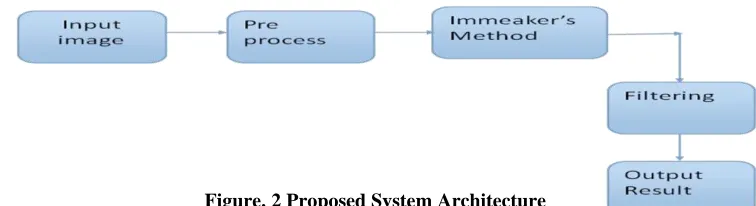
The following figure shows the architectural diagram of our proposed system.The natural scene image for text detection we give as input image. In imaging science, image processing is any form of signal processing for which the input is an image, such as a photograph or video frame; the output of image processing may be either an image or a set of characteristics or parameters related to the image.
Figure. 2 Proposed System Architecture
technique of enhancing data images prior to computational processing. Immerkaer’s method is one of the noise erosion methods using to reduce or eliminate the noise of an image or signal. It is a fast and furious to remove noise for an image.
Figure. 3 Immerkaer’s Process
The bilateral filter is a nonlinear digital filtering technique, often used to remove noise. Such noise reduction is a typical pre-processing step to improve the results of later processing (for example, edge detection on an image). Bilateral filtering is very widely used in digital image processing because, under certain conditions, it preserves edges while removing noise. Bilateral filtering smooth's images while preserving edges, by means of a nonlinear combination of nearby image values. It is non-iterative, local, and simple.
IV. EXPERIMENTAL RESULTS
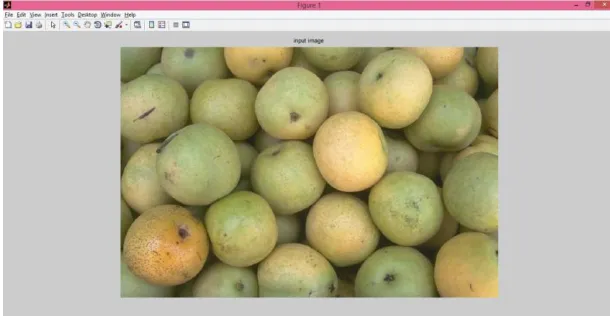
The following screenshots shows the experimental result of our proposed system. It is implemented using Matlab.
The following screenshot 1 shows the original image.
Screenshot 1: Original color Image
Screenshot 2: Preprocessed Gray Scale Image
After noise removing, the reformed image is given in the following screenshot.
Screenshot 3: Reformed Image
Finally filtered output image is given the following screenshot.
In this paper, we evaluated the mixture Gaussian model of the image and processed in bilateral filter through Immerkaer’s method, to denoise the model. Parameters of the method filter out the blurred and connected components of pixels structure elements through this bilateral filter. This is achieved by Immerkaer’s algorithm which is efficient and fast denoising process.
REFERENCES
1. Srivastava, A., A.B. Lee, E.P. Simoncelli and S.C. Zhu, (2003). On Advances in Statistical Modeling of Natural Images, Journal of Mathematical Imaging and Vision, 18: 17-33.
2. Nagarajan C., Madheswaran M., "Stability analysis of series parallel resonant converter with fuzzy logic controller using state space techniques", Electric Power Components and Systems, ISSN : 1532-5008, 39(8) (2011) pp.780-793.
3. Field, D.J., (1987). Relations between the statistics of natural images and the response properties of cortical cells, J. Opt. Soc. Am. A, 4(12): 2379-2394.
4. Bhat V., "A close-up on obturators using magnets: Part I - Magnets in dentistry", Journal of Indian Prosthodontist Society, ISSN : 0972-4052 , 5(3) (2005) pp.114-118.
5. Mallat, S., (1989). Multifrequency channel decomposition of images and wavelet models, IEEE Trans. Acoust., Speech, Signal Proc., 37(12): 2091-2110.
6. Khanaa V., Thooyamani K.P., Saravanan T., "Simulation of an all optical full adder using optical switch", Indian Journal of Science and Technology, ISSN : 0974-6846, 6(S6)(2013) pp.4733-4736.
7. Donoho, D.L., (1995). De-Noising by Soft- Thresholding, IEEE Trans. Inform. Theory, 41(3): 613-627.
8. Madhubala V., Subhashree A.R., Shanthi B., "Serum carbohydrate deficient transferrin as a sensitive marker in diagnosing alcohol abuse: A case - Control study", Journal of Clinical and Diagnostic Research, ISSN : 0973 - 709X, 7(2) (2013) pp.197-200.
9. Abramovich, F., T. Sapatinas and B.W. Silverman, (1998). Wavelet thresholding via a Bayesian approach, J. the Royal Statist. Society B, 60: 725-749.
10. Shanthi B., Revathy C., Devi A.J.M., Parameshwari P.J., Stephen T., "Serum 25(OH)D and type 2 diabetes mellitus", Journal of Clinical and Diagnostic Research, ISSN : 0973 - 709X, 6(5) (2012) pp.774-776.
11. Mihçak, M.K., (1999). Low-complexity Image Denoising based on Statistical Modeling of Wavelet Coefficients, IEEE Signal Processing Letters, 6(12): 300-303.
12. Chang, S., B. Yu and M. Vetterli, (2000). Spatially Adaptive Wavelet Thresholding with Context Modeling for Image Denoising, IEEE Trans. Image Processing, 9(9): 1522-1531.
13. Fadili, J.M. and L. Boubchir, (2005). Analytical form for a Bayesian wavelet estimator of images using the Bessel K Form Densities, IEEE Trans. on Image Process., 14(2): 231-240.
14. Piurica, A. and W. Philips, (2006). Estimating the probability of the presence of a signal of interest in multiresolution single- and multiband image denoising., IEEE Trans. Image Processing, 15(3): 654- 665.
15. Shapiro, J.M., (1993). Embedded image coding using zerotrees of wavelet coefficients, IEEE Trans. Signal Proc., 41(12): 3445-3462. 16. Crouse, M., R. Nowak and R. Baraniuk, (1998). Wavelet-based statistical signal processing using Hidden Markov Models, IEEE. Trans.
Signal Processing, 46(4): 886-902.
17. Fan, G. and X. Xia, (2001). Image denoising using local contextual hidden Markov model in the wavelet domain, IEEE Signal Processing Letters, 8(5): 125-128.
18. Wainwright, M.J., E.P. Simoncelli and A.S. Willsky, (2001). Random Cascades on Wavelet Trees and their use in modeling and analyzing natural images, Applied Computational and Harmonic Analysis, 11(1): 89-123.
19. B Karthik, TVU Kirankumar, MS Raj, E BharathKumaran,Simulation and Implementation of Speech Compression Algorithm in VLSI, Middle-East Journal of Scientific Research 20 (9), PP 1091-1092, 2013.
20. A.Geetha, Face Recognition Using OPENCL, International Journal of Advanced Research in Electrical, Electronics and Instrumentation Engineering , ISSN (Print) : 2320 – 3765, pp- 7148-7151, Vol. 3, Issue 2, Febuary 2014.
21. A.Geetha, Universal Asynchronous Receiver / Transmitter (UART) Design for Hand Held Mobile Devices, International Journal of Advanced Research in Electrical, Electronics and Instrumentation Engineering, ISSN: 2231-5381, pp 25-26, Volume 3 Issue 1 No1 – January 2012.
22. D.Sridhar raja, Comparison of UWB Band pass filter and EBG embedded UWB Band pass filter, International Journal of Advanced Research in Electrical, Electronics and Instrumentation Engineering, ISSN 2278 – 8875,pp 253-257 ,Vol. 1, Issue 4, October 2012
23. D.Sridhar raja, Performances of Asymmetric Electromagnetic Band Gap Structure in UWB Band pass notch filter, International Journal of Advanced Research in Electrical, Electronics and Instrumentation Engineering, ISSN (Online): 2278 – 8875,pp 5492-5496, Vol. 2, Issue 11, November 2013